AltIndex Review 2026: Is Alternative Data Worth It?
Quick Answer: AltIndex aggregates alternative data — social media sentiment, app downloads, job postings, web traffic — and translates it into stock alerts and AI-scored picks. For retail traders willing to pay $29–$99/month, it offers an edge traditional screeners don't: early signals before earnings surprises or momentum shifts. But it's not a crystal ball, and the data works best as confirmation alongside price action and fundamentals, not as a standalone system. If you're already profitable and looking for an additional layer of insight, it's worth testing. If you're still figuring out entry and exit rules, fix that first.
Key Takeaways
AltIndex tracks alternative data sources — social sentiment, app usage, hiring trends, website traffic — that traditional screeners ignore, giving retail traders access to signals institutional investors have used for years.
Pricing ranges from free (limited alerts) to $99/month (full AI stock picks and real-time alerts), positioning it between basic screeners and premium platforms like Danelfin or Stock Rover.
The platform's AI score combines multiple alternative data streams into a single 0-100 rating, but the score is only as useful as your ability to layer it with price action and risk management.
AltIndex works best for swing traders and position traders hunting early momentum or confirmation signals — not for day traders who need sub-second execution data.
Alternative data is legal for retail use, but it's not a shortcut: the edge comes from knowing when the data matters and when it's just noise.
Common mistakes include chasing every alert, ignoring traditional technicals, and expecting the AI score to replace a trading plan.
Free trial available; test it for 30 days alongside your current process before committing to a paid tier.
What Is AltIndex and How Does It Work?
AltIndex is a stock research platform that uses alternative data — information outside traditional financial statements — to generate trade ideas and alerts for retail investors. Instead of relying solely on earnings reports or analyst upgrades, it tracks social media mentions, mobile app download trends, employee reviews on Glassdoor, job postings, and website traffic patterns. The platform's AI engine aggregates these signals, scores each stock from 0 to 100, and pushes alerts when the data suggests a potential move before it shows up in price.
Here's the setup: you connect your watchlist or browse AltIndex's AI-generated picks. The platform monitors alternative data sources in real time and flags stocks when sentiment spikes, app usage surges, or hiring accelerates — all potential leading indicators of revenue growth or user engagement that haven't hit the headlines yet. You get the alert, check the chart and fundamentals, and decide whether the setup aligns with your system.
The edge? Traditional retail tools show you what already happened. AltIndex attempts to show you what might happen next, based on behavioral and operational data that precedes earnings surprises. Institutional investors have used alternative data for over a decade; AltIndex packages it for retail traders at a fraction of the cost.
Does it replace a screener or a trading plan? No. It's an additional layer — signal over noise — that works when you already know how to read the tape and manage risk.
What Kind of Alternative Data Does AltIndex Provide?
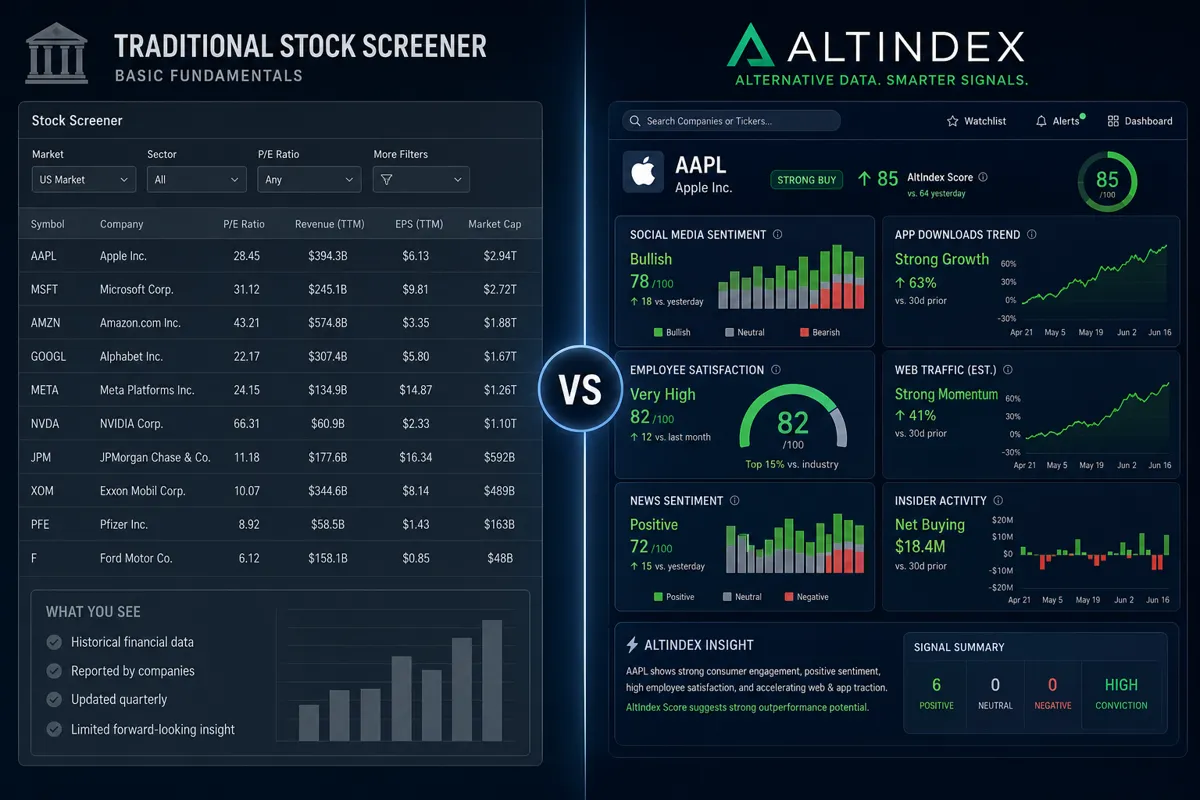
AltIndex pulls from four primary alternative data categories, each designed to catch momentum or deterioration before it shows up in quarterly filings:
Social Media Sentiment
Tracks mentions, sentiment tone, and engagement velocity across Twitter, Reddit, StockTwits, and other platforms. A sudden spike in positive mentions can precede a breakout; a sentiment collapse often leads price by days or weeks. This isn't about counting rocket emojis — the AI filters for volume, tone shift, and anomaly detection.
App Download and Usage Trends
Monitors mobile app install rates, daily active users, and engagement metrics for consumer-facing companies. If a fintech app's downloads surge 40% month-over-month, that's a leading indicator for user growth before the company reports it. Conversely, declining app usage often signals trouble before revenue guidance gets cut.
Job Postings and Hiring Activity
Scrapes corporate job boards and LinkedIn for new postings, role types, and hiring velocity. Aggressive hiring in engineering or sales suggests expansion; a hiring freeze or mass deletions signals contraction. This data has historically led earnings surprises by one to two quarters.
Website Traffic and Engagement
Measures site visits, page views, time on site, and traffic sources. E-commerce companies, SaaS platforms, and media stocks are especially sensitive to web traffic trends. A sustained traffic decline is a red flag; an unexpected surge can indicate a product launch or viral moment gaining traction.
Each data stream gets weighted and combined into AltIndex's proprietary AI score. The platform doesn't just dump raw data on you — it interprets the signal and tells you whether it's bullish, bearish, or neutral. The quality of that interpretation is where the platform earns (or loses) its subscription fee.
For a deeper look at how AI tools are reshaping stock research, see our breakdown of AI stock analysis tools that catch red flags before they cost you.
AltIndex Pricing Plans and Subscription Cost
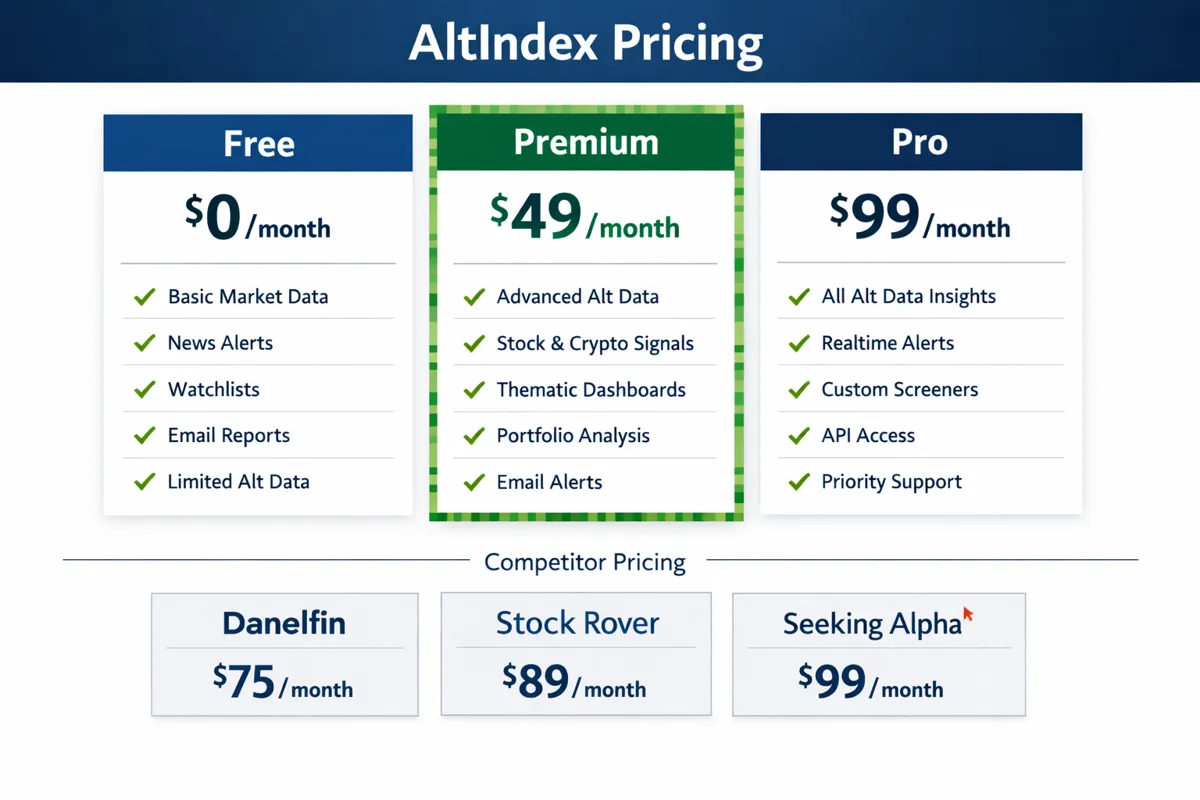
AltIndex offers three tiers, each with a clear use case depending on how seriously you trade and how much alternative data you want in your process:
Free Plan
Limited to a handful of stock alerts per month and basic AI scores. Good for testing the platform's signal quality without committing cash, but not enough volume to build a repeatable process. Think of it as a demo, not a trading tool.
Premium Plan — $29/month
Unlocks unlimited AI stock scores, real-time alternative data alerts, and access to the full alternative data dashboard. This is the entry point for active traders who want alternative data as a confirmation layer alongside their existing screeners and charts. You get the signals; you still need to do the work.
Pro Plan — $99/month
Adds AI-generated stock picks, deeper historical data, and priority alerts. Designed for traders who want AltIndex to surface opportunities they wouldn't find on their own. The AI picks are curated based on the platform's highest-conviction signals across all alternative data streams. If you're managing a five- or six-figure account and alternative data is part of your edge, this tier pays for itself if it catches one or two setups per quarter that you would have missed.
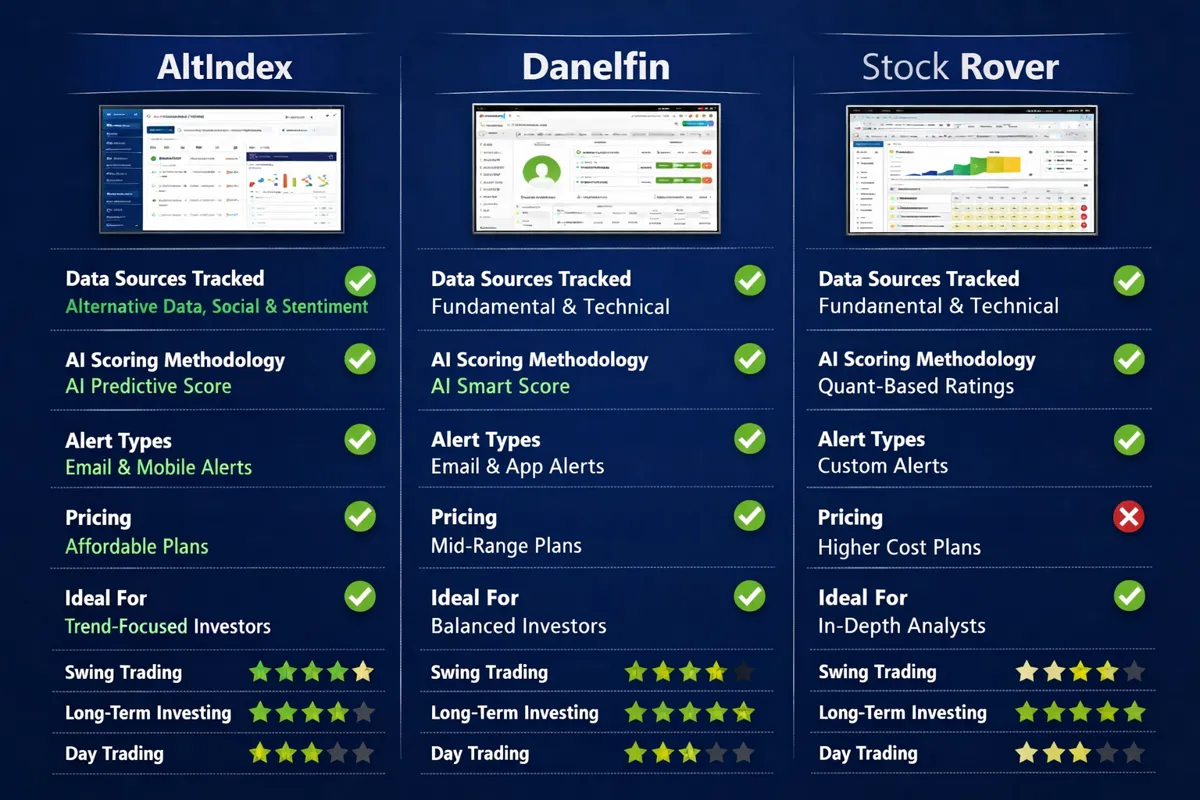
How does this compare? Danelfin charges $39–$59/month for AI-scored stock rankings but focuses more on quantitative factors than alternative data. Stock Rover runs $8–$28/month but leans heavily on fundamentals and technical screeners without alternative data integration. Seeking Alpha Premium is $29/month but emphasizes analyst opinions and earnings transcripts, not behavioral signals. AltIndex sits in the middle: more expensive than basic screeners, cheaper than institutional-grade alternative data platforms, and more focused on early signals than traditional research tools.
If you're evaluating multiple platforms, compare features side-by-side using our AI stock tools comparison directory.
Is AltIndex Worth It for Beginner Investors?
Short answer: probably not yet.
AltIndex is a confirmation and discovery tool, not a training system. It assumes you already know how to read a chart, size a position, set a stop loss, and manage risk. If you're still learning the difference between support and resistance or figuring out when to cut a loser, alternative data will just add noise to an already noisy process.
Here's why beginners struggle with tools like AltIndex:
No context for the signal.
An alert that says "social sentiment spiking on XYZ stock" doesn't tell you whether the stock is overextended, basing, or in a clean setup. If you don't know how to layer that signal onto price action, you'll chase bad entries and blame the tool.
Too many alerts without a filter.
Alternative data generates a lot of signals. Without a trading plan that defines which setups you take and when, you'll either overtrade or freeze up with analysis paralysis. The platform doesn't teach you how to filter; it just gives you more information.
Expensive relative to beginner account size.
If you're trading a $2,000 account, a $99/month subscription is 5% of your capital annually. That's a steep cost for a tool you're not yet equipped to use effectively. Better to spend that money on education, a solid screener, and paper trading until you have a repeatable process.
When does it make sense for beginners?
If you've been consistently profitable for six months, understand position sizing and risk-reward, and want to add an edge to your watchlist-building process, then AltIndex becomes useful. Start with the free plan or the $29 tier, test it for 30 days, and see if the signals improve your win rate or help you avoid bad setups. If not, cancel and revisit it in six months.
For traders still building their foundation, start with our guide on how to find stocks for swing trading before everyone else does.
AltIndex vs Stock Rover vs Seeking Alpha: Which Platform Fits Your Style?
Each platform solves a different problem. Here's the breakdown:
Choose AltIndex if: you're an active swing trader who wants early signals on sentiment shifts, user growth, or operational changes before they hit the news. You already know how to read charts and manage risk; you just want an additional edge.
Choose Stock Rover if: you're a long-term investor who screens for fundamentals, tracks portfolio performance, and wants a clean interface for comparing stocks across sectors. You don't need real-time alerts; you need a better way to organize and analyze your holdings.
Choose Seeking Alpha if: you're a fundamental investor who reads earnings transcripts, follows analyst opinions, and wants a centralized hub for research. You're less concerned with early signals and more focused on understanding the business.
Can you use more than one? Absolutely. Many traders layer AltIndex's alternative data alerts with Stock Rover's fundamental screens and Seeking Alpha's earnings analysis. The tools aren't mutually exclusive — they're complementary if you know what each one does best.
For a full comparison of AI-powered stock tools, check out our AI stock trading software review.
How Accurate Are AltIndex Stock Alerts and Predictions?
AltIndex claims its AI stock picks have outperformed the S&P 500 by double digits over the past few years, but let's cut through the marketing and talk about what accuracy actually means in this context.
What the platform tracks:
AltIndex publishes performance data for its AI-generated stock picks, showing win rates, average returns, and comparison to benchmark indexes. As of early 2026, the platform reports a win rate in the 60-70% range for its highest-conviction picks, with an average holding period of several weeks to months. That's solid — but not magic.
What accuracy doesn't mean:
A 65% win rate doesn't mean you make money on 65% of trades. It means the stock moved in the predicted direction 65% of the time, assuming you entered at the alert price and held for the platform's suggested timeframe. In practice, your entry, exit, position sizing, and risk management determine your actual P&L. If you chase the alert after the stock already ran 10%, or you hold through a reversal because you ignored your stop loss, the platform's accuracy is irrelevant.
Where alternative data works:
Alternative data shines when it catches inflection points — moments when sentiment, user behavior, or operational activity shifts before the market prices it in. A social sentiment spike ahead of an earnings beat, a hiring surge before a product launch, or app download acceleration before a revenue surprise — these are the setups where AltIndex adds value. The data works best as a leading indicator, not a standalone prediction.
Where it doesn't:
Alternative data lags in low-volatility, range-bound markets where sentiment and behavior don't drive price. It also struggles with macro-driven moves (Fed announcements, geopolitical shocks) where fundamentals and technicals matter more than app downloads or Twitter mentions. If the entire market is selling off, a bullish AltIndex alert on a single stock won't save you.
How to test accuracy yourself:
Paper trade the alerts for 30 days. Track every signal, note your hypothetical entry and exit, and measure the results against your own system. If AltIndex's signals improve your win rate or help you avoid bad setups, it's working. If the alerts are just noise that distracts you from your process, cancel the subscription.
For more on how AI tools perform in real trading conditions, see our analysis of whether AI trading bots actually make money.
Can You Actually Make Money Using AltIndex Data?
Yes — but only if you already know how to make money without it.
Alternative data is an edge, not a system. It gives you information other retail traders don't have, but it doesn't tell you when to enter, how much to risk, or when to cut a loser. If your trading process is broken — if you're overtrading, revenge trading, or ignoring stop losses — AltIndex won't fix that. It'll just give you more reasons to make the same mistakes.
When alternative data adds value:
Confirmation plays. You've identified a clean setup — tight consolidation, volume drying up, sitting on support. An AltIndex alert shows social sentiment spiking and app downloads accelerating. That's confirmation. The setup was already there; the alternative data increases your conviction.
Early discovery. AltIndex flags a stock you weren't watching because hiring activity just doubled and web traffic is surging. You check the chart, see a basing pattern forming, and add it to your watchlist before the breakout. The alternative data put the stock on your radar before the crowd noticed.
Avoiding traps. A stock breaks out on volume, but AltIndex shows social sentiment collapsing and app usage declining. That's a red flag. The price action looks bullish, but the alternative data suggests the move won't hold. You skip the trade or tighten your stop.
When it doesn't:
Chasing alerts without a plan. You get an alert, buy immediately without checking the chart, and the stock reverses the next day. That's not the platform's fault — that's you ignoring the setup.
Overtrading because the signals are there. AltIndex generates a lot of alerts. If you take every one, you'll overtrade, rack up commissions, and dilute your edge. The platform gives you signals; you still need a filter.
Expecting the AI score to replace risk management. A 95 AI score doesn't mean the stock can't drop 20%. Position sizing, stop losses, and risk-reward still matter. The score is a signal, not a guarantee.
Bottom line: AltIndex can help you make money if you're already profitable and disciplined. It won't turn a losing trader into a winning one. If you're not consistently profitable yet, fix your process first. Then add alternative data as a layer, not a crutch.
For more on building a repeatable trading system, see our guide on AI tools swing traders are using to catch moves before everyone else.
What Are the Biggest Mistakes People Make with Alternative Data Investing?
Alternative data is powerful, but it's easy to misuse. Here are the mistakes that cost traders money:
Treating the AI score as a buy signal.
A high AI score means the alternative data looks bullish. It doesn't mean the stock is in a clean setup, sitting at support, or offering good risk-reward. If the chart is overextended or the stock just ran 30% in three days, the AI score is irrelevant. Always layer alternative data onto price action and fundamentals — never trade the score in isolation.
Chasing every alert.
AltIndex pushes a lot of signals. If you take every one, you'll overtrade, ignore your watchlist discipline, and dilute your edge. The platform's job is to surface opportunities; your job is to filter them through your system. Pick the setups that match your strategy and ignore the rest.
Ignoring traditional technicals.
Alternative data catches early momentum, but it doesn't tell you where support and resistance sit, whether the stock is basing or overextended, or what the risk-reward looks like. If you skip the chart work and trade purely on alternative data, you'll get stopped out on bad entries even when the signal was right.
Expecting instant results.
Alternative data is a leading indicator, but it's not a crystal ball. A social sentiment spike might precede a breakout by days or weeks — or it might fizzle out. If you buy the alert and expect the stock to run the next day, you'll get frustrated and blame the tool. Alternative data works on a swing-trading timeframe, not a day-trading one.
Using alternative data as a crutch.
If you're not profitable without AltIndex, you won't be profitable with it. The platform amplifies your edge; it doesn't create one. If you don't have a trading plan, position sizing rules, and risk management discipline, alternative data will just give you more ways to lose money.
Not testing the signals.
Paper trade the alerts for 30 days before risking real capital. Track every signal, measure the win rate, and see if the alternative data improves your results. If it doesn't, cancel the subscription and move on. Don't pay for a tool you're not using effectively.
For more on avoiding common trading mistakes, see our breakdown of the position sizing mistake that wipes out 90% of new traders.
Does AltIndex Work for Day Trading or Just Long-Term Investing?
AltIndex is built for swing traders and position traders, not day traders.
Here's why:
Alternative data moves too slowly for intraday execution.
Social sentiment, app downloads, hiring trends, and web traffic don't change minute-to-minute. These signals unfold over days, weeks, or months — not hours. If you're scalping or trading intraday momentum, AltIndex won't give you the sub-second data you need. Day traders need Level 2 quotes, time and sales, and real-time order flow — not a sentiment score that updates once a day.
The edge is in early detection, not fast execution.
AltIndex's value is catching inflection points before they show up in price. A hiring surge today might precede an earnings beat in 60 days. An app download spike this week might signal user growth that gets reported next quarter. That's a swing-trading or position-trading edge, not a day-trading one.
Alerts aren't fast enough for intraday setups.
By the time you get an AltIndex alert, check the chart, and decide whether to trade it, the intraday opportunity is gone. Day traders need scanners that flag breakouts, volume spikes, and price action in real time — tools like Trade Ideas, Scanz, or TrendSpider. AltIndex is too slow for that game.
Where it works:
Swing traders holding positions for days to weeks, and position traders holding for weeks to months. If you're building a watchlist on Sunday, looking for stocks with early momentum or sentiment shifts, and planning your entries for the week ahead, AltIndex fits. If you're scalping the open or trading power hour, it doesn't.
Can you use both?
Yes. Some traders use AltIndex to build their swing-trading watchlist and then use a real-time scanner for intraday execution. The alternative data identifies the stocks with edge; the intraday tools time the entry. But if you're purely a day trader with no swing positions, AltIndex won't add value.
For day traders looking for real-time tools, check out our review of AI tools for day traders that spot setups before the opening bell.
AltIndex Free Trial or Free Version Available?
Yes — AltIndex offers a free plan with limited access, and you can test the platform without a credit card.
What the free plan includes:
A handful of stock alerts per month, basic AI scores, and access to the alternative data dashboard. You won't get unlimited alerts or AI-generated stock picks, but you'll see enough to evaluate whether the platform's signals align with your trading style.
How to use the free trial effectively:
Add a few stocks from your watchlist to AltIndex and monitor the alternative data for 30 days. Track when the platform sends alerts, compare the signals to price action, and see if the alternative data would have improved your entries or helped you avoid bad setups. If the signals add value, upgrade to the $29 or $99 tier. If they're just noise, move on.
No credit card required.
You can sign up for the free plan without entering payment info, which means you won't get auto-billed if you forget to cancel. That's a cleaner trial experience than platforms that require a card upfront and hope you forget to cancel before the trial ends.
When to upgrade:
If you find yourself checking AltIndex daily, wishing you had more alerts, or frustrated by the free plan's limitations, that's a signal the platform is adding value. Upgrade to Premium ($29/month) if you want unlimited alerts and real-time data. Upgrade to Pro ($99/month) if you want the AI-generated stock picks and deeper historical data.
When to skip it:
If you check the free plan once a week, ignore most of the alerts, or find the signals don't change your trading decisions, don't upgrade. The platform isn't a good fit for your process, and that's fine. Not every tool works for every trader.
For more on testing AI stock tools before committing, see our guide on AI investing apps worth your money.
Why Is My AltIndex Alert Not Showing Up?
If you're not getting alerts, here are the most common reasons and how to fix them:
Notification settings are off.
Check your account settings and make sure email or push notifications are enabled. AltIndex sends alerts via email by default; if you want mobile notifications, you'll need to enable them in the app settings.
Your watchlist is empty or too narrow.
AltIndex only sends alerts for stocks you're tracking or stocks that meet the platform's AI criteria. If your watchlist is empty or limited to a few low-volume stocks, you won't get many signals. Add more stocks or browse the platform's AI-generated picks to expand your coverage.
The free plan has alert limits.
If you're on the free tier, you only get a few alerts per month. Once you hit the limit, you won't receive more until the next billing cycle. Upgrade to Premium or Pro if you need unlimited alerts.
The stock didn't trigger an alert.
Not every stock generates alternative data signals. If the stock you're watching has low social media activity, no app presence, minimal hiring, and flat web traffic, AltIndex won't have much to report. The platform works best on consumer-facing companies with active social engagement and measurable digital footprints.
Email filters or spam folders.
Check your spam or promotions folder. Some email providers flag stock alerts as promotional content. Add AltIndex to your contacts or whitelist the sender to ensure alerts land in your inbox.
Platform lag or technical issues.
Occasionally, alerts get delayed due to API issues or data provider lag. If you suspect a technical problem, contact AltIndex support or check their status page.
How to test if alerts are working:
Add a high-profile stock with active social media presence (like a major tech or consumer brand) to your watchlist and wait a few days. If you don't get any alerts, troubleshoot your notification settings or reach out to support.
Is Alternative Data Legal for Retail Traders to Use?
Yes — alternative data is completely legal for retail traders, and it's the same type of information institutional investors have been using for over a decade.
What alternative data is:
Publicly available information that isn't part of traditional financial statements. Social media posts, app download rankings, job postings, website traffic, satellite imagery, credit card transaction data (aggregated and anonymized), and other behavioral or operational signals. None of this is insider information; it's all publicly accessible or purchased from third-party data providers who aggregate and anonymize it.
Why it's legal:
Alternative data doesn't come from confidential corporate sources or non-public material information. It's derived from public behavior, public postings, and publicly available datasets. Using this data to inform trading decisions is no different from reading earnings reports, analyst opinions, or news articles — it's just a different type of information.
What's not legal:
Insider trading — trading on material, non-public information obtained from a corporate insider. If you work at a company and trade on confidential information about earnings, mergers, or product launches before it's public, that's illegal. But using publicly available alternative data to infer trends or sentiment is not insider trading.
Regulatory perspective:
The SEC has acknowledged alternative data as a legitimate research tool. Institutional investors, hedge funds, and asset managers have been using it for years without regulatory issues. Retail traders have the same right to access and use this data.
The ethical question:
Some traders worry that alternative data gives an unfair advantage. But information asymmetry has always existed in markets. Institutional investors have access to expensive research, proprietary models, and direct management access that retail traders don't. Alternative data platforms like AltIndex level the playing field by making some of that information accessible to retail traders at a fraction of the cost.
Bottom line:
Alternative data is legal, ethical, and increasingly mainstream. If you're using a platform like AltIndex, you're not doing anything shady — you're just using better information to make better decisions.
For more on how AI tools are changing retail trading, see our breakdown of AI stock trading tools worth the subscription.
Who Should Not Use AltIndex?
AltIndex isn't for everyone. Here's who should skip it:
Day traders.
If you're scalping or trading intraday momentum, AltIndex is too slow. The alternative data updates daily or weekly, not in real time. You need Level 2 quotes, time and sales, and sub-second scanners — not sentiment scores that lag price by hours or days.
Traders without a system.
If you don't have a trading plan, position sizing rules, or risk management discipline, AltIndex will just give you more ways to lose money. The platform amplifies your edge; it doesn't create one. Fix your process first, then add alternative data as a layer.
Investors who only trade index funds or ETFs.
AltIndex is built for individual stock picking. If you're a passive investor who buys and holds broad market ETFs, you don't need alternative data. The platform won't add value to a buy-and-hold index strategy.
Traders on a tight budget.
If you're trading a small account (under $5,000) and every dollar counts, a $99/month subscription is a steep cost. Better to spend that money on education, a solid screener, and building your process. Revisit AltIndex when your account size and profitability justify the expense.
Traders who ignore charts.
If you trade purely on fundamentals or news and never look at price action, AltIndex won't help. Alternative data works best when layered onto technical setups — support and resistance, consolidation patterns, volume trends. If you skip the chart work, you'll chase bad entries even when the alternative data is right.
Traders who want a set-it-and-forget-it solution.
AltIndex requires active engagement. You need to review alerts, filter signals through your system, and make trading decisions. If you're looking for a passive robo-advisor or a fully automated trading bot, this isn't it.
When it makes sense:
Active swing traders and position traders who already have a profitable process, understand risk management, and want an additional edge. If that's you, AltIndex is worth testing. If not, skip it and focus on building your foundation first.
For more on building a solid trading foundation, see our guide on swing trade scanners that find setups before they break out.
What Data Sources Does AltIndex Track for Stock Signals?
AltIndex aggregates data from multiple public and third-party sources to generate its alternative data signals. Here's what the platform monitors:
Social Media Platforms
Twitter, Reddit, StockTwits, and other social networks. The platform tracks mention volume, sentiment tone, engagement velocity, and anomaly detection. A sudden spike in positive mentions or a sentiment shift from neutral to bullish can precede price moves.
Mobile App Stores
Apple App Store and Google Play Store. AltIndex monitors app download rankings, install rates, daily active users, and user reviews. For consumer-facing companies, app usage is a leading indicator of user growth and engagement.
Job Boards and Corporate Career Pages
LinkedIn, Indeed, Glassdoor, and company career sites. The platform tracks new job postings, hiring velocity, role types (engineering, sales, operations), and employee reviews. Aggressive hiring suggests expansion; a hiring freeze or mass deletions signals contraction.
Website Traffic and Analytics
Third-party web analytics providers that measure site visits, page views, time on site, and traffic sources. E-commerce companies, SaaS platforms, and media stocks are especially sensitive to web traffic trends.
Employee Sentiment and Reviews
Glassdoor and other employer review sites. The platform tracks employee satisfaction scores, review sentiment, and changes in company culture indicators. A collapse in employee sentiment often precedes operational problems or executive turnover.
News and Media Mentions
Aggregated news sentiment from financial media, blogs, and press releases. The platform filters for volume, tone, and anomaly detection to identify when a stock is gaining or losing media attention.
How the data gets scored:
AltIndex's AI engine weights each data stream based on historical correlation with price moves, combines the signals into a single 0-100 score, and flags stocks when the data suggests a potential inflection point. The score is proprietary, but the underlying data sources are transparent.
What's missing:
AltIndex doesn't track insider trading filings, institutional ownership changes, or options flow — all of which are valuable alternative data sources. If you want those signals, you'll need to layer in tools like Quiver Quantitative, Ortex, or Unusual Whales.
For a full comparison of alternative data platforms, check out our AI stock tools directory.
Frequently Asked Questions
How much does AltIndex cost?
AltIndex offers a free plan with limited alerts, a Premium plan at $29/month with unlimited AI scores and real-time alerts, and a Pro plan at $99/month with AI-generated stock picks and deeper historical data.
Can I use AltIndex for day trading?
No. AltIndex is built for swing traders and position traders. The alternative data updates daily or weekly, not in real time, so it's too slow for intraday execution. Day traders need sub-second scanners and Level 2 data.
Is AltIndex better than Danelfin or Stock Rover?
It depends on your trading style. AltIndex focuses on alternative data signals (social sentiment, app usage, hiring trends). Danelfin emphasizes quantitative AI scoring across fundamentals and technicals. Stock Rover is a fundamental screener and portfolio tracker. Choose based on what type of edge you're looking for.
Does AltIndex guarantee returns?
No. No platform guarantees returns. AltIndex provides signals based on alternative data, but your entry, exit, position sizing, and risk management determine your actual P&L. The platform amplifies your edge; it doesn't create one.
Is alternative data insider trading?
No. Alternative data is publicly available or aggregated from public sources. It's not material, non-public information obtained from corporate insiders. Using alternative data is legal and ethical.
Can I cancel my AltIndex subscription anytime?
Yes. AltIndex subscriptions are month-to-month with no long-term commitment. You can cancel anytime from your account settings.
Does AltIndex work for penny stocks or low-float stocks?
Not well. Alternative data works best on liquid, consumer-facing companies with active social media presence, measurable app usage, and public hiring activity. Penny stocks and low-float stocks often lack the digital footprint needed to generate reliable alternative data signals.
How accurate are AltIndex's AI stock picks?
As of early 2026, AltIndex reports a win rate in the 60-70% range for its highest-conviction picks. But accuracy depends on your execution, risk management, and whether you follow the platform's suggested holding periods. Paper trade the signals for 30 days to test accuracy yourself.
Can I use AltIndex alongside my current screener?
Yes. Many traders layer AltIndex's alternative data alerts with traditional screeners like Finviz, TradingView, or Stock Rover. The tools are complementary — AltIndex surfaces early signals, and your screener confirms the technical setup.
What happens if I don't get any alerts?
Check your notification settings, make sure your watchlist isn't empty, and verify you're not on the free plan's alert limit. If you're still not getting alerts, the stocks you're tracking may not be generating alternative data signals.
Is there a mobile app?
Yes. AltIndex offers a mobile app for iOS and Android with push notifications for real-time alerts. The app mirrors the web platform's functionality.
Can I get a refund if I don't like it?
Check AltIndex's refund policy on their website. Most subscription platforms offer a 30-day money-back guarantee, but policies vary. Test the free plan first to minimize risk.
Conclusion
AltIndex Review: Is Alternative Data Actually Worth It for Retail Traders? Yes — if you're already profitable, disciplined, and looking for an edge that traditional screeners don't provide. Alternative data catches early momentum, sentiment shifts, and operational changes before they show up in price. For swing traders and position traders who know how to layer signals onto price action and manage risk, AltIndex is a legitimate tool that levels the playing field with institutional investors.
But it's not a shortcut. If you're still figuring out entry and exit rules, struggling with position sizing, or chasing every alert without a plan, AltIndex won't fix that. The platform amplifies your edge; it doesn't create one. Fix your process first, then add alternative data as a confirmation layer — not a crutch.
Here's the verdict:
Start with the free plan. Add a few stocks to your watchlist, track the alerts for 30 days, and see if the alternative data improves your win rate or helps you avoid bad setups. If it does, upgrade to Premium ($29/month) or Pro ($99/month) depending on how much you trade and how much alternative data you want in your process. If the signals are just noise, cancel and move on. Not every tool works for every trader, and that's fine.
Alternative data is legal, ethical, and increasingly mainstream. Institutional investors have used it for over a decade; now retail traders have access at a fraction of the cost. The edge is real — but only if you know how to use it.
Want the tools and systems behind this, without the hype? Start at aistockpickerapps.com.