The Position-Sizing Mistake That Wipes Out 90% of New Traders
Last updated: June 16, 2026
Quick Answer: The position-sizing mistake that wipes out 90% of new traders is simple: they risk too much per trade, based on gut feel instead of a formula. When a few trades go wrong in a row — and they will — the account math turns brutal fast. The fix is a rules-based position sizing system that caps risk at 0.5–1% of account equity per trade, calculated before every entry.
Key Takeaways
- Position sizing is how many shares or contracts you buy — and it determines how much you lose when you're wrong, not just how much you make when you're right.
- The most common mistake is sizing by dollar target or "feel" instead of calculating risk based on stop distance and account size.
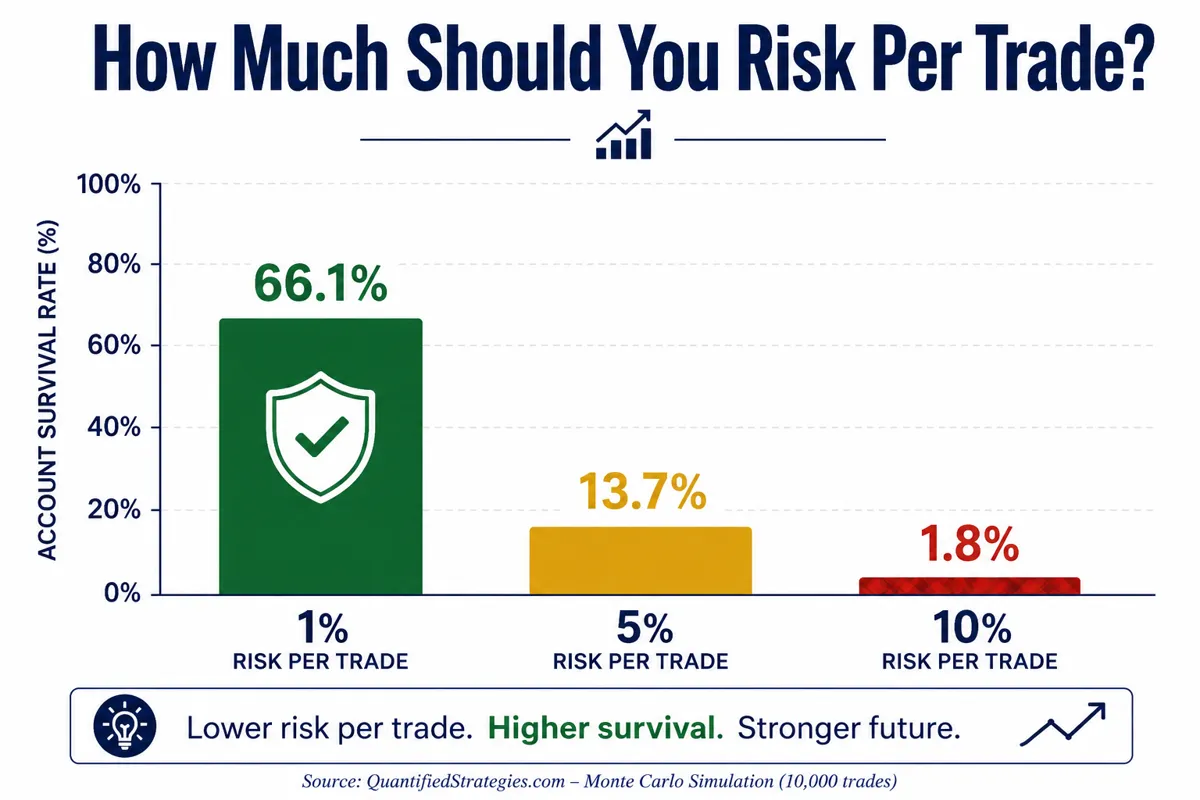
- Risking 10% per trade means five losing trades in a row wipes out nearly half your account. At 1% risk, five losers barely dent you.
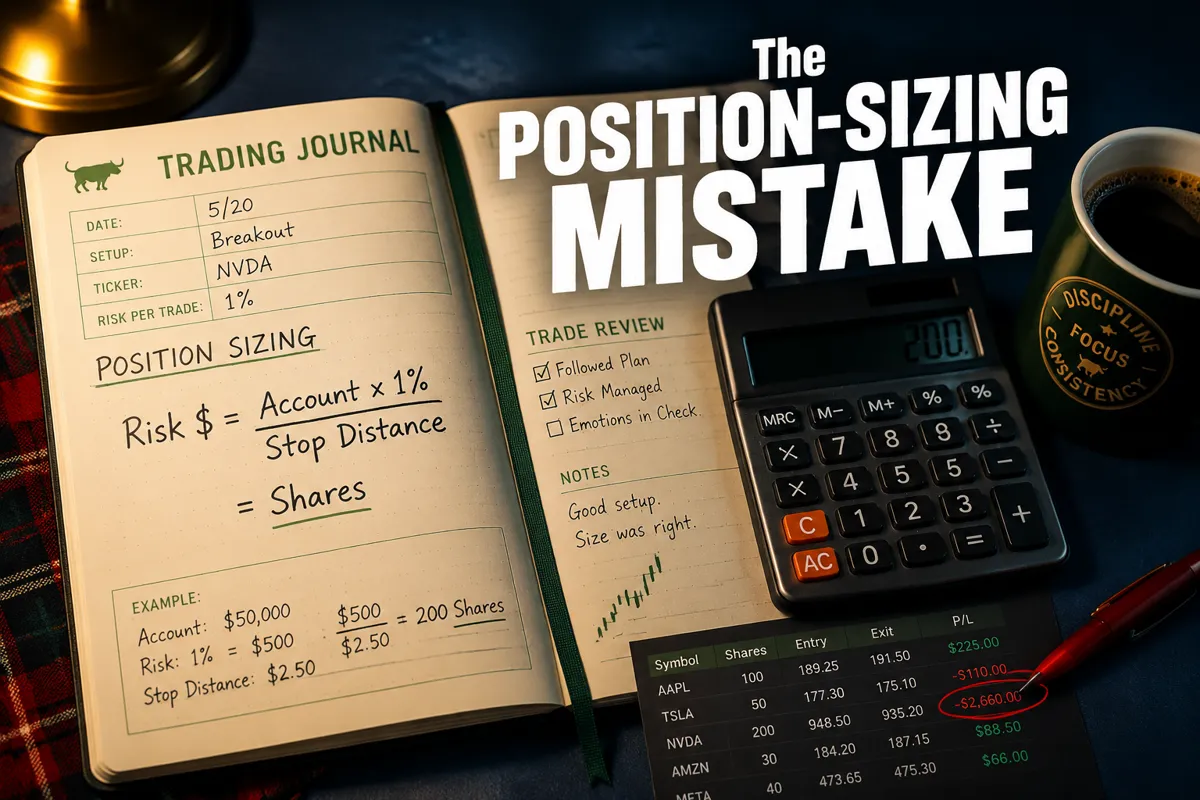
- The standard formula: Shares = (Account x Risk %) / Stop Distance in dollars. Run this before every trade.
- Professional traders typically cap single-trade risk at 0.5–1% of total account equity, rarely exceeding 1.5%.
- A string of losses isn't just a math problem — it triggers revenge trading, overtrading, and the kind of emotional spiral that turns a bad week into a blown account.
- Tools like a swing trade planner and scanners like Trade Ideas can automate the calculation and keep you honest.
- Paper trading first is not optional for beginners — it's how you stress-test your sizing rules without real consequences.
- Recovery from a large drawdown is mathematically harder than most traders realize: a 50% loss requires a 100% gain just to break even.
What Exactly Is Position Sizing in Trading?
Position sizing is the process of deciding how many shares, contracts, or units to buy for a given trade. It's not about which stock to pick — it's about how much of your capital you put at risk on that pick.
Most beginners think the hard part of trading is finding the right stock. It isn't. The hard part is surviving long enough to let a good process play out. Position sizing is the mechanism that keeps you in the game.
Here's the simplest way to think about it: your stop loss (the price where you exit if the trade goes against you) defines how much you lose per share. Your position size determines how many shares you hold. Multiply those two numbers together and you get your total dollar risk on the trade. If that number is too large relative to your account, one bad trade can permanently damage your capital base.
Three things position sizing controls:
- How much you lose on any single trade
- How many consecutive losses you can survive
- Whether you stay emotionally stable enough to keep executing your process
The Position-Sizing Mistake That Wipes Out 90% of New Traders
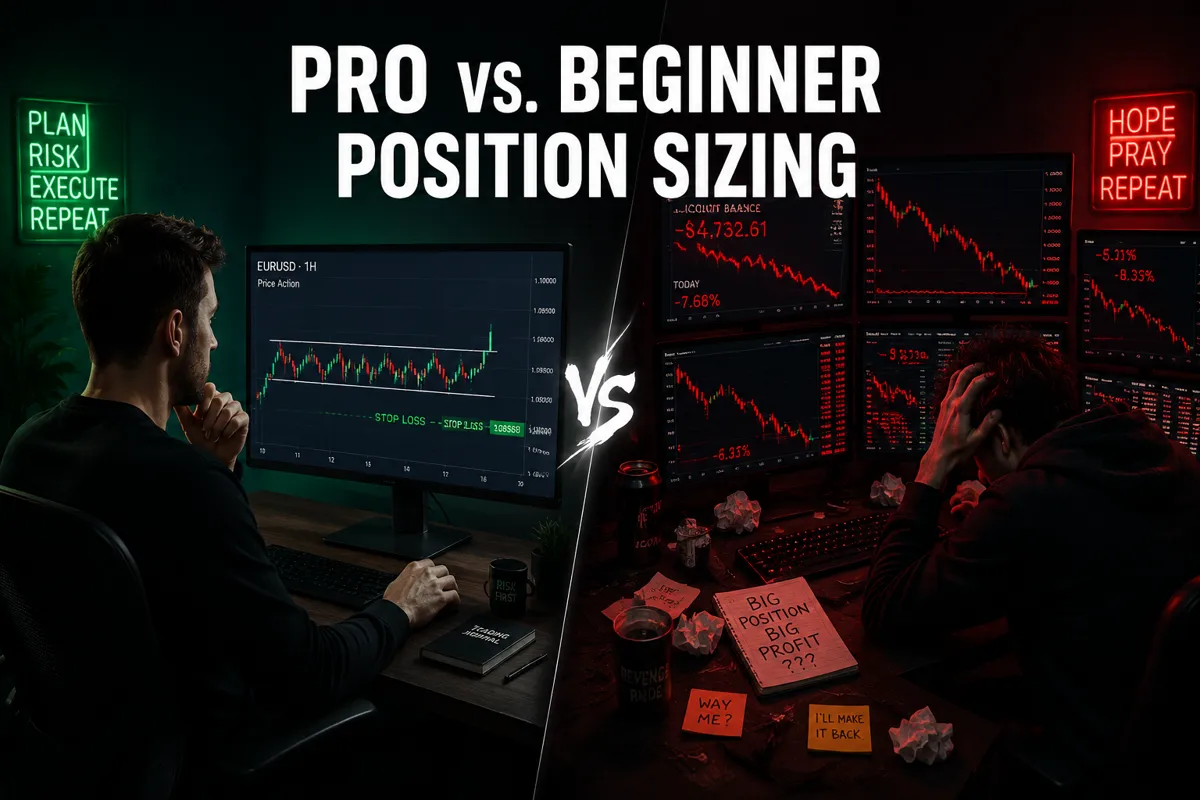
This is the mistake: new traders size their positions based on how much money they want to make, not how much they can afford to lose.
They see a stock setting up for a breakout, decide they want to make $500 on the trade, back-calculate how many shares they need to hit that number, and buy. The stop loss — if they even set one — is an afterthought. The actual dollar risk on the trade? They haven't calculated it.
That's not a trading strategy. That's wishful math.
The position-sizing mistake that wipes out 90% of new traders shows up in a few specific forms:
- Flat dollar sizing: "I always buy $5,000 worth of stock." This ignores stop distance entirely. A tight stop on a volatile low-float stock means you're risking far more than you realize.
- Full-account concentration: Putting 20–50% of the account into one trade because the setup "looks perfect." Play stupid games, win stupid prizes.
- Emotion-based scaling: Adding to a losing position because you're convinced you're right. This is how small losses become account-ending ones.
- Ignoring correlation: Running five trades in the same sector at the same time. When that sector sells off, all five positions move against you simultaneously.
The result is always the same: a few bad trades in a row — which is statistically normal in any trading system — cause a drawdown so severe that the trader either blows up the account or panic-exits every position and locks in losses that a properly sized portfolio would have absorbed easily.
How Much of Your Account Should You Risk Per Trade?
The expert consensus in 2026 is 0.5–1% of total account equity per trade, with a hard ceiling around 1.5% for experienced traders with a proven edge.
That sounds conservative. It's supposed to be.
Here's the math that makes it click. Say your account is $10,000.
| Risk Per Trade | Dollar Risk | Losses to Lose 20% |
|---|---|---|
| 1% | $100 | 20 consecutive losers |
| 2% | $200 | 10 consecutive losers |
| 5% | $500 | 4 consecutive losers |
| 10% | $1,000 | 2 consecutive losers |
A four-trade losing streak is not unusual. It happens to every trader, including professionals. At 5% risk per trade, four losers in a row drops your account by nearly 19%. At 1%, the same streak costs you less than 4%.
The rule of thumb: If a single trade going wrong would cause you to feel sick, change your behavior, or second-guess your system — you're sized too large.
What Percentage Loss Will Destroy a Trading Account?
A 25% drawdown is survivable but painful. A 50% drawdown is nearly fatal — and the math explains why.
To recover from a 25% loss, you need to make 33% on the remaining capital. To recover from a 50% loss, you need to double your money. To recover from a 75% loss, you need to 4x what's left. The deeper the hole, the steeper the climb — and the more likely a trader is to take on even more risk trying to "make it back," which is exactly how accounts go to zero.
This is why the 1% rule isn't just a guideline — it's a survival mechanism. It keeps the drawdowns shallow enough that the math stays manageable and the psychology stays intact.
The recovery math:
| Loss Taken | Gain Needed to Break Even |
|---|---|
| 10% | 11% |
| 25% | 33% |
| 50% | 100% |
| 75% | 300% |
Catching a falling knife, revenge trading after a loss, or doubling down on a bad position — these aren't just bad habits. They're the direct path to the unrecoverable end of that table.
How Do Professional Traders Calculate Position Size?
Professional traders use a formula. Every time. No exceptions.
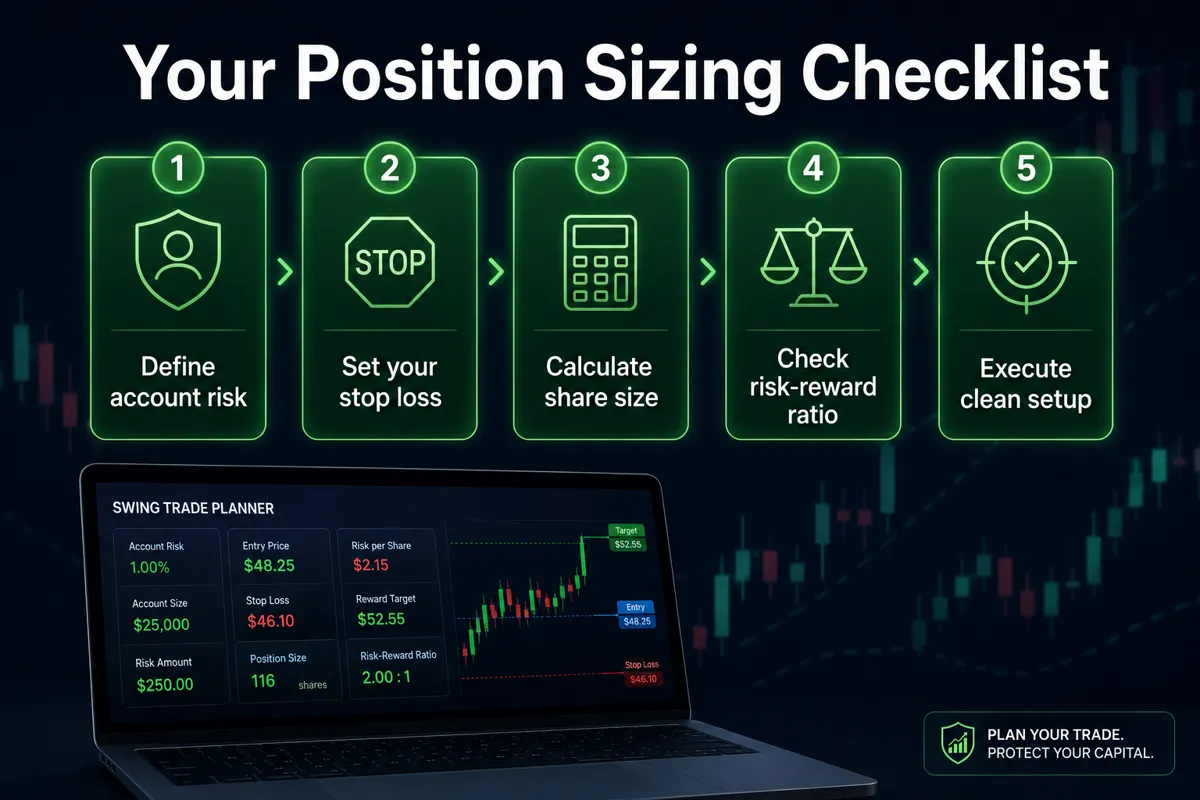
The standard position sizing formula is:
Position Size (shares) = (Account Equity x Risk %) / (Entry Price - Stop Loss Price)
Breaking it down with a real example:
- Account equity: $20,000
- Risk per trade: 1% = $200
- Entry price: $50.00
- Stop loss: $48.00 (stop distance = $2.00)
- Position size: $200 / $2.00 = 100 shares
That's it. The formula removes emotion from the decision entirely. You don't ask "how much do I want to make?" You ask "how much am I willing to lose, and where does the chart tell me I'm wrong?"
Professional traders also apply portfolio-level caps. Even if each individual trade risks 1%, running ten correlated positions simultaneously means a sector-wide move could hit all of them at once. A portfolio-level cap of 5–6% total open risk at any time keeps the account stable even during choppy tape.
Tools like TrendSpider let you set stops and targets visually on the chart, so the stop distance is defined before you size the trade — not after. The free Swing Trade Planner on aistockpickerapps.com runs this calculation automatically so there's no excuse for skipping it.
What Are the Biggest Position Sizing Mistakes Beginners Make?
Most beginners make the same five mistakes, and they're all variations of the same root problem: sizing by emotion instead of by formula.
1. No defined stop loss before entry.
If you don't know where you're getting out when you're wrong, you can't calculate your position size. The stop loss isn't just risk management — it's the input that makes the formula work. No stop, no sizing. No sizing, no process.
2. Averaging down without a plan.
Adding shares to a losing position feels logical ("it's cheaper now"). It's actually doubling your risk on a trade that's already telling you it's wrong. This is catching a falling knife with two hands.
3. Oversizing because the setup "looks perfect."
A clean setup with tight consolidation and strong price action is a reason to take the trade — not a reason to bet the farm on it. Even the best setups fail. The market doesn't care how good your chart looks.
4. Ignoring volatility in the stop distance.
A $1 stop on a $10 stock is 10% risk per share. A $1 stop on a $100 stock is 1% risk per share. Same dollar stop, completely different risk profile. Sizing by share count instead of dollar risk misses this entirely.
5. No portfolio-level risk cap.
Running five trades at 2% each in the same sector isn't five separate 2% risks — it's a single 10% risk wearing five costumes.
For traders building a system, TraderSync is worth looking at as a trade journal that tracks risk per trade over time, so patterns in oversizing become visible before they become catastrophic.
What Percentage of Traders Actually Survive Their First Year?
The numbers are not encouraging. Studies of retail brokerage data and prop firm evaluations consistently show that roughly 70–80% of retail day traders lose money over any given year, and a significant portion of those who blow up do so within the first 90 days.
Prop firm challenge data is even more direct: the most common reason traders fail evaluations isn't picking the wrong stocks — it's violating daily loss limits and maximum drawdown rules, both of which are position sizing failures.
The "90% fail" figure that gets thrown around is a rough aggregate, but the directional truth holds: most new traders don't lose because their market analysis is wrong. They lose because their risk management is nonexistent.
What separates survivors from blow-ups:
- Survivors treat each trade as one data point in a long series, not a make-or-break event.
- Survivors have a written rule for maximum risk per trade and stick to it even when they're confident.
- Survivors reduce position size after a losing streak, not increase it.
- Survivors paper trade new strategies before risking real capital.
Discipline beats prediction. Every time.
How Risky Is Day Trading for Someone With Limited Funds?
Day trading with a small account is not impossible, but it's genuinely harder — and position sizing is the main reason why.
With a $5,000 account and a 1% risk rule, your maximum loss per trade is $50. That's a tight leash. It forces you to find trades with very small stop distances, which often means low-float stocks with high volatility — exactly the kind of choppy tape that gets beginners stopped out repeatedly.
The SEC's Pattern Day Trader (PDT) rule in the U.S. requires a minimum $25,000 account balance to make more than three day trades per week in a margin account. Traders under that threshold are effectively limited to swing trading, which actually pairs well with strict position sizing because the longer time horizon allows wider stops with smaller share counts.
For small accounts, the practical advice is:
- Start with swing trading, not day trading
- Use the 1% rule religiously — $50 at risk on a $5,000 account feels tiny, but it keeps you alive
- Use the free Swing Trade Planner to calculate every trade before you enter it
- Paper trade the system for 30 days before putting real money on it
For a broader look at swing trading tools that work for smaller accounts, the swing trading resources section at aistockpickerapps.com covers the tools worth using.
Can You Recover From a Massive Trading Loss?
Yes — but it requires changing the behavior that caused the loss, not just adding more capital.
The biggest trap after a large drawdown is FOFO: Fear Of Finding Out what went wrong. Traders who blow up often jump back in immediately, sizing up to "make it back faster." That's revenge trading, and it almost always makes the hole deeper.
The actual recovery process looks like this:
- Stop trading immediately. Take a week away from the screen.
- Review the trades that caused the loss. Was it one oversized position? Multiple trades in the same direction? No stop losses?
- Rebuild with a written risk plan before placing another trade. Define maximum risk per trade, maximum open positions, and maximum daily loss.
- Start smaller than feels comfortable. If you blew up a $20,000 account, restart with $5,000 and prove the new rules work before scaling.
- Track every trade. A journal tool like TraderSync makes the data visible so you can see whether the new rules are actually holding.
Recovery is a process, not an event. The math of drawdown recovery demands patience — and patience demands a system that doesn't blow up again.
What Tools Help Calculate Safe Position Sizes?
The best tool is the one you'll actually use before every trade. Here are the options worth knowing about.
Free Swing Trade Planner (aistockpickerapps.com): Built specifically for retail traders. Enter your account size, risk percentage, entry price, and stop level — it outputs the share count and dollar risk instantly. This is the fastest way to remove the "sizing by feel" habit. Try it here.
TrendSpider: Lets you draw stop levels and targets directly on the chart before you enter a trade. The visual stop placement makes the risk-reward ratio obvious and keeps the stop loss from being an afterthought. See the TrendSpider review.
Trade Ideas: An AI-powered scanner that surfaces setups matching specific risk parameters. When the scanner is filtering for clean setups with defined entry and exit levels, position sizing becomes easier because the stop distance is already built into the setup. Explore Trade Ideas.
TraderSync: A trade journal that tracks risk per trade over time. If you're consistently oversizing without realizing it, the journal data will show the pattern before it becomes a blow-up.
For a broader comparison of AI trading tools that support risk management workflows, the AI trading platforms directory at aistockpickerapps.com covers 100+ options with honest breakdowns.
Conclusion: The Fix Is a Formula, Not Willpower
The position-sizing mistake that wipes out 90% of new traders isn't a mystery. It's not bad luck, bad picks, or a rigged market. It's a failure to define risk before entering a trade — and a refusal to let math override emotion.
The good news: this is one of the most fixable problems in trading. It doesn't require a new strategy, a better scanner, or a paid Discord group. It requires one formula, applied consistently, before every single trade.
Here's what to do this week:
- Write down your account balance and calculate 1% of it. That's your maximum risk per trade starting now.
- Before your next trade, define your stop loss level on the chart first. Then use the formula: Shares = (Account x 1%) / Stop Distance.
- Use the free Swing Trade Planner to run the calculation — it takes 30 seconds.
- Set a portfolio-level cap: no more than 5% of account equity at risk across all open positions simultaneously.
- If you're not tracking your trades, start. TraderSync makes the data visible so the patterns can't hide.
Cut the noise, keep the alpha. Systems over hacks. The traders who survive aren't the ones with the best stock picks — they're the ones who never let a single trade end their career.
Frequently Asked Questions
What is the 1% rule in trading?
The 1% rule means you never risk more than 1% of your total account equity on a single trade. On a $10,000 account, that's $100 maximum loss per trade. It's the most widely recommended position sizing rule for retail traders because it keeps drawdowns survivable even through extended losing streaks.
What is the position sizing formula?
The standard formula is: Position Size (shares) = (Account Equity x Risk %) / (Entry Price - Stop Loss Price). For example, with a $10,000 account risking 1%, an entry at $50, and a stop at $48, the position size is $100 / $2 = 50 shares.
How many shares should I buy per trade?
That depends on your account size, your risk percentage, and your stop loss distance — not on how much you want to make. Use the position sizing formula to calculate it for every trade. Never size by feel or by a flat dollar amount.
Why do most new traders blow up their accounts?
The primary cause is oversizing — risking too much per trade relative to account size. When a losing streak hits (which is statistically inevitable), the losses compound faster than the account can absorb. Revenge trading and averaging down on losing positions accelerate the damage.
Is 2% risk per trade too much?
For most beginners, yes. At 2% risk, five consecutive losing trades cost 10% of the account. That's not fatal, but it's enough to trigger emotional decision-making. Starting at 0.5–1% builds the habit and keeps the psychology stable while you develop a proven edge.
What is a stop loss and why does it matter for position sizing?
A stop loss is a pre-defined exit price — the level where you get out of a trade when it moves against you. It matters for position sizing because the distance between your entry and your stop (in dollars per share) is the denominator in the sizing formula. Without a stop loss, you can't calculate a safe position size.
Can I use position sizing for swing trading?
Absolutely — position sizing is just as critical for swing trading as for day trading, and arguably more so because swing trades are held overnight and can gap against you. The swing trade planner at aistockpickerapps.com is built specifically for this use case.
What happens if I ignore position sizing rules?
You're essentially gambling with variable bet sizes and no bankroll management. Even a strong win rate can produce a blown account if the losing trades are sized too large. A trader who wins 60% of trades but risks 10% on losers and 2% on winners will still lose money over time.
How do I recover from blowing up a trading account?
Stop trading, review what caused the blow-up (almost always position sizing or no stop losses), rebuild with a written risk plan, restart with a smaller account, and track every trade. Do not increase position size to "make it back faster" — that's the path to a second blow-up.
What tools calculate position size automatically?
The free Swing Trade Planner on aistockpickerapps.com does this in seconds. TrendSpider allows visual stop placement on charts. TraderSync tracks risk per trade over time so patterns become visible.
Is there a maximum number of open positions I should hold?
There's no universal rule, but a common guideline is to cap total open risk at 5–6% of account equity across all positions simultaneously. If you're running five trades at 1% each, that's 5% total exposure — manageable. If all five are in the same sector, treat them as one correlated position.
Should beginners paper trade before sizing real trades?
Yes, without exception. Paper trading lets you stress-test your position sizing rules, practice the formula, and observe how your risk management holds up during volatile price action — all without real capital at stake. Thirty days of paper trading with strict sizing rules is the minimum before going live.
References
Poor Position Sizing - https://protraderdashboard.com/blog/poor-position-sizing/
Position Sizing Mistakes - https://www.tradezella.com/blog/position-sizing-mistakes
Trading Mistakes - https://www.tradezella.com/blog/trading-mistakes
Why Traders Lose Money - https://traderssecondbrain.com/guides/why-traders-lose-money
Top Mistakes New Traders Make During Challenges - https://www.fortraders.com/blog/top-mistakes-new-traders-make-during-challenges
The Trader Position Sizing Part I - https://knowledge.sharescope.co.uk/2025/09/05/the-trader-position-sizing-part-i/
Position Sizing Neglect - https://journalplus.co/mistakes/position-sizing-neglect/
Position Sizing Guide - https://www.tradingsim.com/blog/position-sizing-guide
FullStack Alpha cuts the noise so you can keep the alpha. See the AI tools, scanners, and systems we actually rate at aistockpickerapps.com.