Do AI Trading Bots Actually Make Money? We Ran the Real Numbers
Last updated: June 16, 2026
Quick Answer: Most AI trading bots do not consistently make money for retail investors. A small minority of well-designed, properly deployed bots can generate modest outperformance, but the gap between backtested promises and live trading reality is brutal — research suggests a 40-60% performance degradation when bots move from simulation to real markets. The honest answer is: it depends entirely on the bot, the market, the operator's skill, and how "making money" is defined.
Key Takeaways
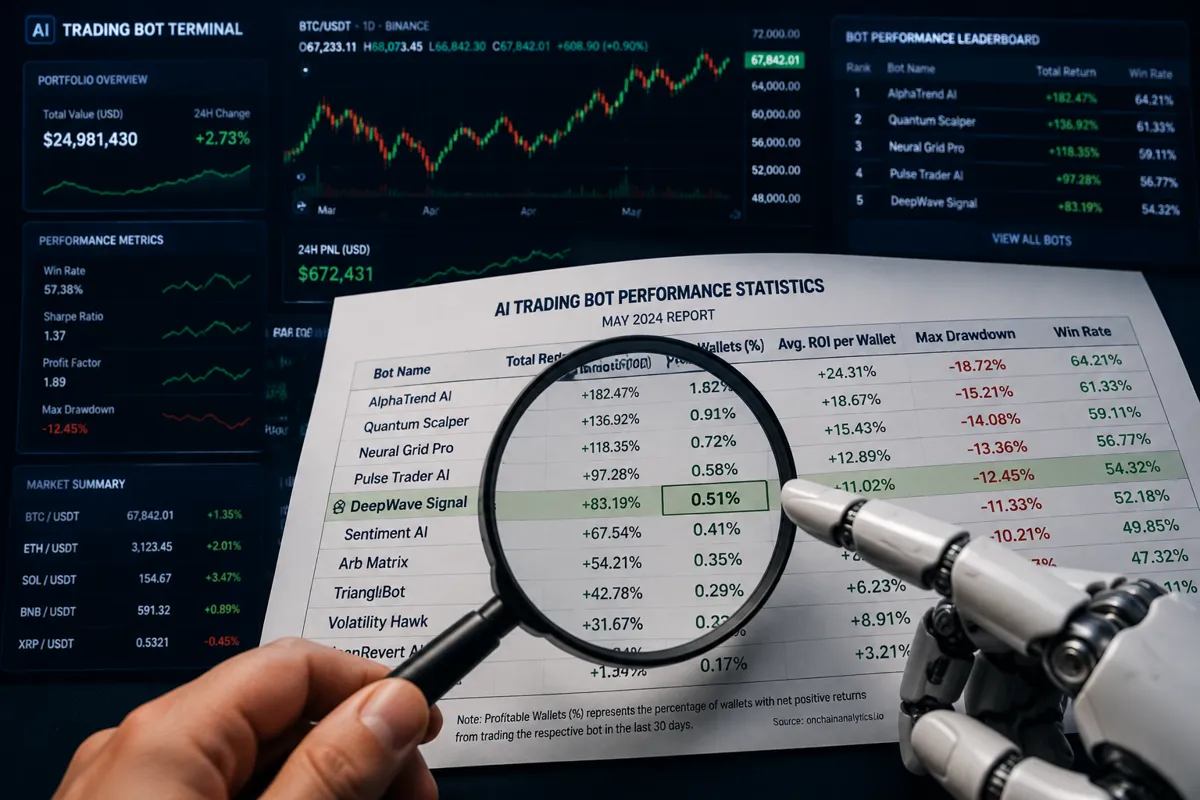
- Only 0.51% of wallets in a study of 95 million Polymarket transactions achieved profits over $1,000 — profitable bot trading is genuinely rare
- AI trading bots can achieve annual outperformance of 3-8% in academic models, but live results consistently underperform backtests by 40-60%
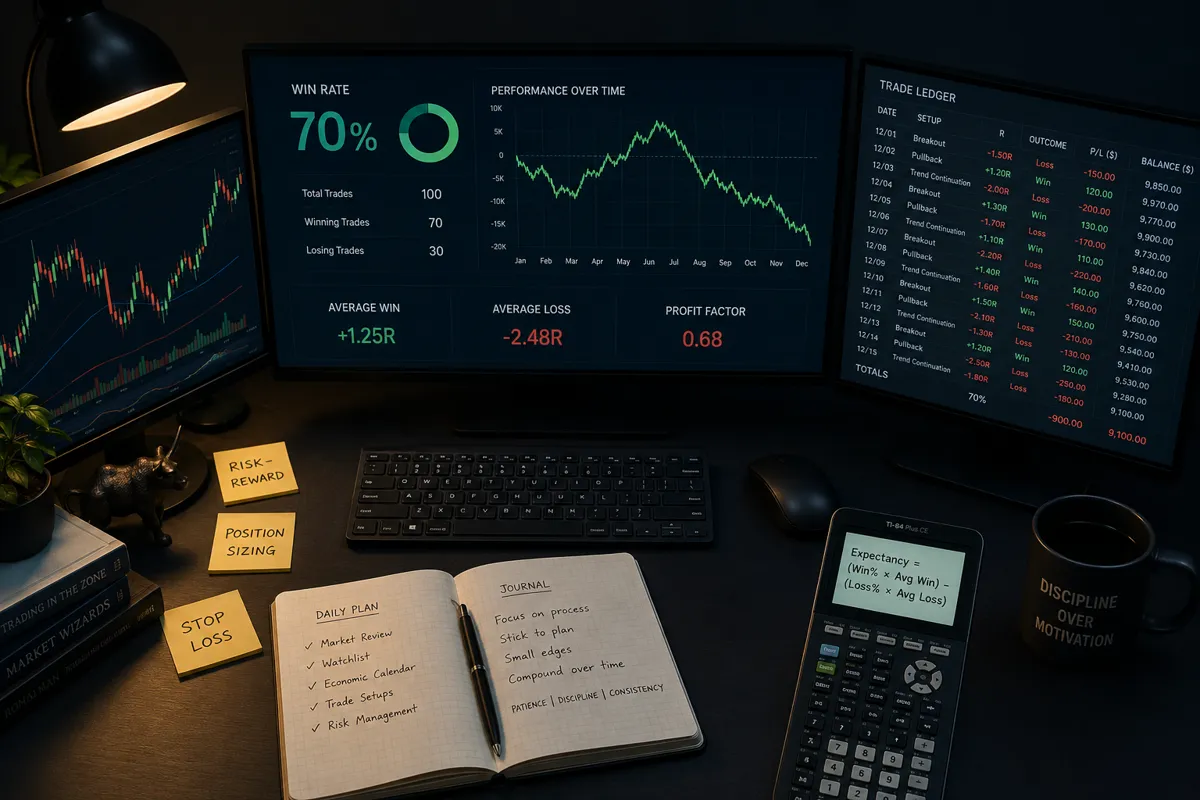
- Win rate alone does not determine profitability — a bot winning 70% of trades can still lose money if the losses are bigger than the wins
- 73% of automated crypto trading accounts fail within six months
- The top 1% of wallets captured 81.4% of all gains in DeFi AI agent studies — the profits are concentrated, not distributed
- AI bots are genuinely useful for removing emotional bias and processing data fast, but they are not a replacement for human judgment
- Free bots exist but rarely outperform the market consistently after accounting for fees and slippage
- The biggest mistake retail traders make is trusting backtested performance numbers without understanding how they were generated
Do AI Trading Bots Actually Make Money? We Ran the Real Numbers
Here's the short version: some do, most don't, and the ones that do rarely perform the way the sales page claims.
A May 2026 experiment called Alpha Arena put eight leading AI systems — including Claude, ChatGPT, Gemini, and Grok — each trading US tech stocks with $10,000 over two weeks. The result? Most were losing money. Overtrading, poor timing, and inconsistent decision-making were the culprits. These aren't obscure bots from a Discord server. These are the most advanced AI systems on the planet, and they struggled with a two-week live trading test.
The numbers from the crypto side are even more sobering. An on-chain study of 95 million Polymarket transactions from April 2024 to December 2025 found that only 0.51% of wallets achieved profits exceeding $1,000. That's not a typo. Less than one in two hundred wallets crossed that threshold.
The market truth: AI trading bots work in controlled conditions with clean data and favorable market regimes. They break down in choppy tape, during unexpected macro events, and whenever the conditions they were trained on stop matching reality.
Practical takeaway: Before trusting any bot's performance claim, ask one question — is this backtested or live? Those are two completely different numbers.
How Much Money Can AI Trading Bots Really Earn?
Realistic expectations matter more here than any headline figure. Academic consensus suggests that well-designed machine learning models can achieve annual outperformance of 3-8% above a benchmark. That's meaningful compounded over years. It's not a retirement shortcut.
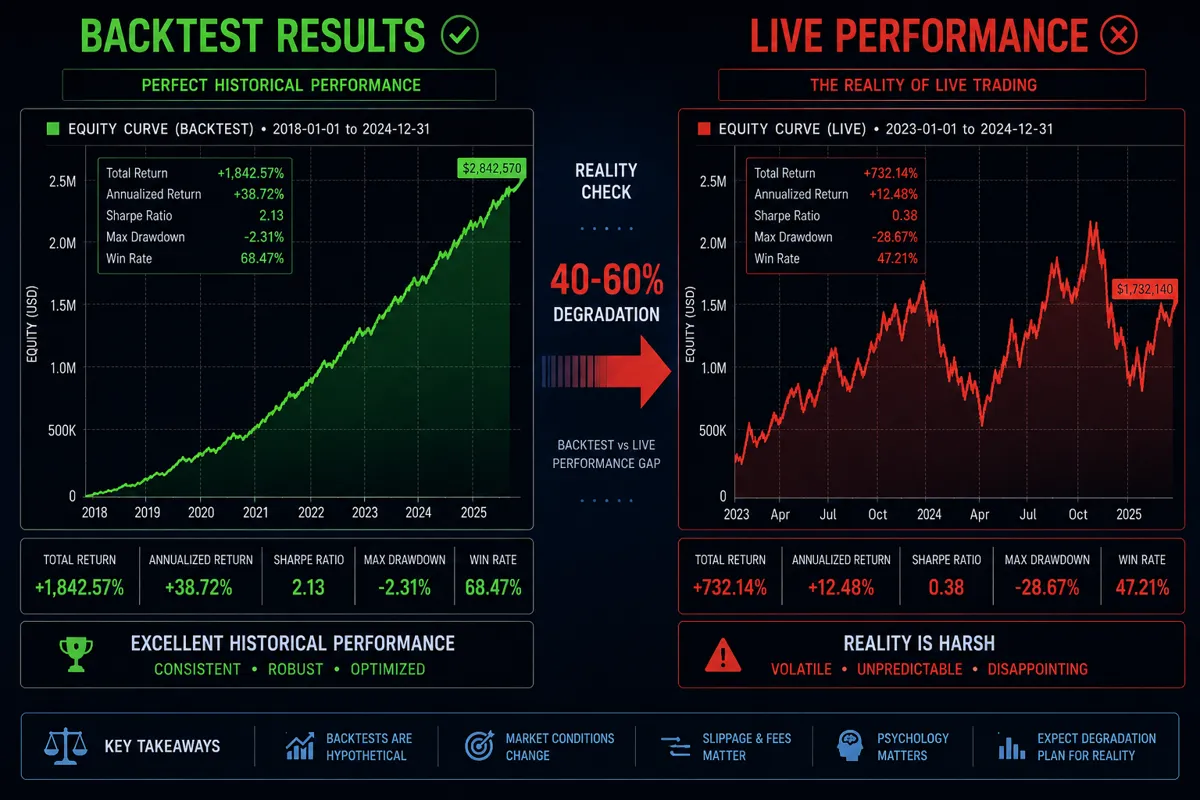
The problem is the gap between the model and the market. Research consistently shows a 40-60% degradation when strategies move from backtesting to live trading. A bot that showed 12% annual alpha in simulation might deliver 5-7% in reality — if it holds up at all.
On the crypto side, the top-performing bots show real revenue. As of April 2026, Maestro is the most profitable crypto bot with 13,206 ETH accumulated since launch. Unibot follows with 8,954 ETH, and Banana Gun sits third at 1,938 ETH. Those three bots alone account for 82.7% of revenue among the top ten. The concentration tells you everything: a handful of winners, a long tail of losers.
Decision rule: If a bot is promising double-digit monthly returns, that's not alpha — that's a red flag. Realistic annual outperformance of 3-8% from a well-run system is something worth taking seriously. Anything beyond that demands extraordinary evidence.
Win Rate vs. Profit: Why the Number Everyone Watches Is the Wrong One
This is where most retail traders get burned. A 70% win rate sounds great. It can still lose money.
Here's the math. If a bot wins 70% of its trades but the average winner is $50 and the average loser is $200, the expectancy is negative. Every trade, on average, costs money. Win rate without risk-reward context is noise.
Trading expectancy is the actual number that matters. The formula is simple:
Expectancy = (Win Rate x Average Win) - (Loss Rate x Average Loss)
A bot with a 45% win rate but a 3:1 risk-reward ratio has a positive expectancy. A bot with a 70% win rate and a 1:3 risk-reward ratio is a money-losing machine dressed up in impressive statistics.
This is exactly the kind of analysis the free Trading Expectancy Calculator at aistockpickerapps.com is built for. Plug in the win rate, average win, and average loss from any bot's track record. The output tells you whether the system has a mathematical edge — or whether you're paying for a coin flip with extra steps.
The mistake: Trusting win rate alone. Play stupid games, win stupid prizes. A high win rate with poor risk-reward is how traders slowly bleed out while thinking they're doing fine.
AI Trading Bot Backtest vs. Live: The Gap Nobody Talks About
Backtesting is where bots look brilliant. Live trading is where they meet reality.
The 40-60% performance degradation between backtest and live results isn't a bug — it's a feature of how backtesting works. Backtests assume perfect order fills at the exact price shown on the chart. They don't account for slippage (the difference between the price you see and the price you actually get), bid-ask spreads, or the market impact of your own orders. They also don't account for the fact that once a strategy becomes widely known, it stops working.
A December 2025 study evaluated six mainstream large language models across multiple markets and trading frequencies. The finding was blunt: general intelligence does not automatically translate to effective trading capability. Most agents showed poor returns and weak risk management in live conditions.
The practical takeaway: When evaluating any AI trading bot, demand live audited performance — not backtested curves. If the provider can't show at least six months of verified live results, the backtest is a marketing document, not a track record.
Tools like TrendSpider and Option Alpha are worth noting here because they show transparent backtesting methodology alongside live automation. Option Alpha in particular publishes its automation logic openly, which is the standard every serious bot provider should be held to.
What Are the Real Risks of Using AI Trading Algorithms?
The risks are real, specific, and often ignored until after the damage is done.
Market regime risk: Most bots are trained on historical data from a specific market environment. A bot optimized for a trending bull market will get destroyed in a choppy, mean-reverting tape. It doesn't know the regime has changed.
Overfitting: This is the backtest problem in technical terms. A bot that was tuned to fit historical data perfectly has essentially memorized the past. It has no predictive power for the future.
Execution risk: Slippage, latency, and broker API failures can turn a theoretically profitable strategy into a losing one. Low float stocks are particularly vulnerable — a bot trying to fill a large order in a thin market will move the price against itself.
Leverage amplification: Many crypto bots use leverage by default. A 2x leveraged bot that's down 50% needs a 100% gain just to break even. Getting stopped out repeatedly with leverage is how accounts go to zero fast.
Concentration risk: As the DeFi AI agent study showed, the top 1% of wallets captured 81.4% of all gains while token holders collectively lost $191.7 million. The profits in algorithmic trading are not evenly distributed. Most participants fund the winners.
Which AI Trading Bot Has the Best Performance Track Record?
No single bot dominates across all markets and time periods — that's the honest answer. Performance is highly dependent on market conditions, asset class, and time frame.
In crypto, Maestro, Unibot, and Banana Gun have the most documented revenue track records as of 2026. But revenue for the bot provider is not the same as profit for the user. These bots charge fees on every transaction — their revenue comes from volume, not from your portfolio growing.
For stock trading, platforms like Tickeron publish AI confidence levels alongside their signals, which at least gives users a framework for evaluating signal quality. Kavout uses machine learning to rank stocks by predicted performance and has published methodology that can be independently evaluated.
The more important question isn't "which bot is best" — it's "which bot has audited, live performance data I can verify." That list is much shorter than the marketing would suggest.
Choose X if: You want AI-assisted research and signal generation rather than fully automated execution. Tools that inform your decisions tend to outperform tools that replace them entirely.
Are AI Trading Bots Legal for Retail Investors?
Yes, AI trading bots are legal for retail investors in the United States and most major markets. There are no regulations prohibiting individual traders from using automated systems to execute trades in their own accounts.
The relevant regulatory boundaries are around market manipulation (coordinating bots to artificially move prices), insider trading (feeding material non-public information into an algorithm), and operating as an unregistered investment advisor (selling bot signals to others for profit without proper licensing). Using a bot in your own account for your own trading falls well outside those lines.
The SEC and FINRA do monitor for unusual trading patterns, but automated retail trading is standard practice. Brokers including Alpaca, Interactive Brokers, and Tastytrade explicitly support API-based automated trading for retail accounts.
Edge case: If you're trading in a tax-advantaged account like an IRA, high-frequency bot trading can create wash sale complications and generate unexpected tax events. Check with a tax professional before running an active bot in a retirement account.
How Much Does a Good AI Trading Bot Cost?
The range is wide, and price does not reliably predict performance.
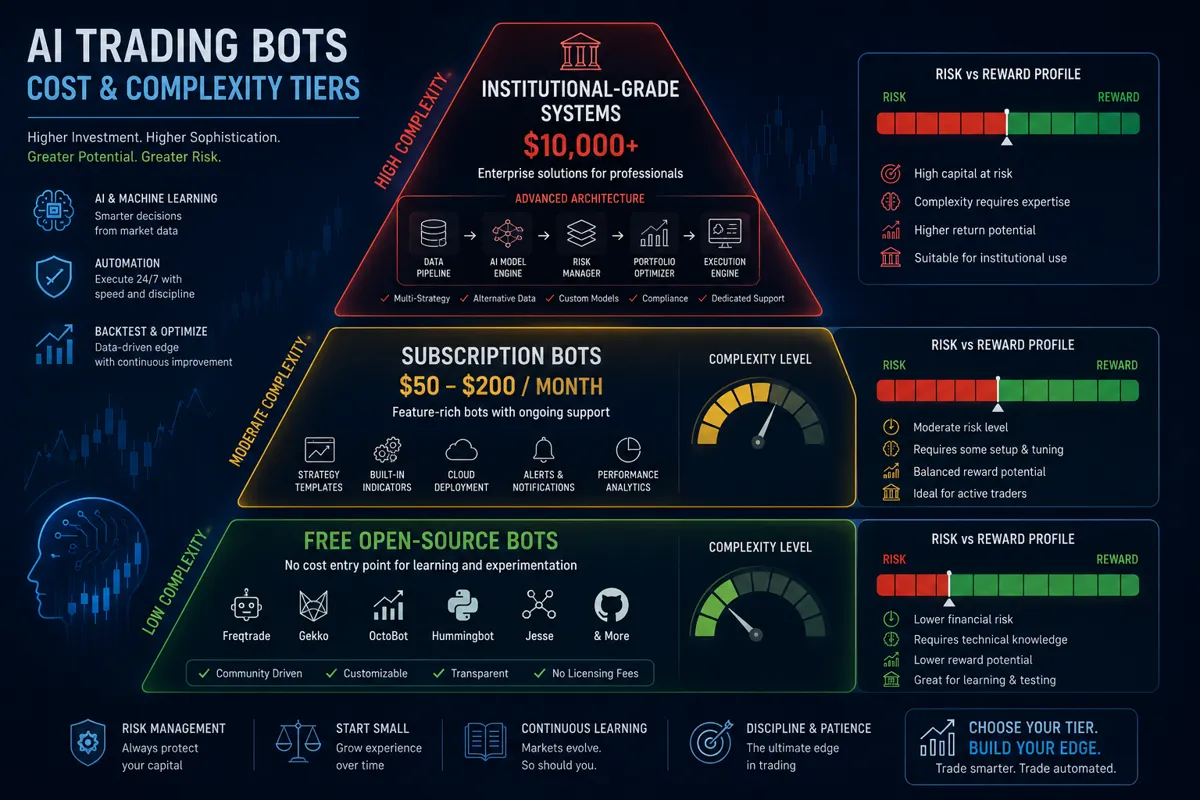
| Tier | Cost Range | What You Get | Who It's For |
|---|---|---|---|
| Free / Open Source | $0 | Basic automation, community support | Developers, experimenters |
| Entry-level subscription | $20-$75/month | Pre-built strategies, limited customization | Beginners |
| Mid-tier subscription | $75-$250/month | Strategy builder, backtesting, live alerts | Intermediate traders |
| Professional platforms | $250-$1,000+/month | Institutional-grade data, full API access | Active professionals |
| Custom-built systems | $10,000+ upfront | Proprietary algorithms, dedicated infrastructure | Quant funds, serious operators |
The hidden cost most retail traders ignore is slippage and fees. A bot executing 50 trades per month at $0.65 per trade plus average slippage of 0.1% per trade can eat several hundred dollars monthly in friction costs alone. That has to be recovered before the bot shows any net profit.
For retail investors starting out, the free tools available at aistockpickerapps.com offer a lower-risk way to test AI-assisted analysis before committing to a paid subscription.
Can Beginners Use AI Trading Bots, or Is It for Experts Only?
Beginners can use AI trading bots, but they should understand what they're signing up for first. Handing a beginner an automated trading system without foundational market knowledge is like giving someone car keys before they understand traffic laws.
The specific risk for beginners: they can't tell when a bot is malfunctioning or when market conditions have changed enough to make the strategy invalid. An experienced trader watching a bot execute sees warning signs — overextended entries, ignoring support and resistance levels, revenge trading patterns built into the logic. A beginner just sees the account balance changing.
The right starting point for beginners:
- Paper trade it first. Run the bot in simulation mode for at least 30 days before risking real capital.
- Understand the strategy the bot is executing. If you can't explain the logic in plain English, you can't evaluate when it's breaking down.
- Start with AI-assisted research tools rather than fully automated execution. Platforms like Danelfin or Zen Ratings give AI-powered stock analysis while keeping the human in the decision seat.
- Use the Trading Expectancy Calculator to evaluate any strategy before deploying it with real money.
What Are the Most Common Mistakes People Make With AI Trading Bots?
1. Trusting backtests as gospel. The backtest looked great. The live account didn't. This is the most common and most expensive mistake.
2. Ignoring position sizing. A bot with a positive expectancy can still blow up an account if position sizing is too aggressive. Risk management is not optional — it's the whole game.
3. Overtrading. The Alpha Arena experiment showed overtrading as a primary reason AI bots lost money in live tests. More trades means more friction costs and more exposure to bad fills.
4. No stop loss discipline. Some bots are configured without hard stop losses, relying instead on the strategy to "work out eventually." Catching a falling knife with no stop is how small losses become catastrophic ones.
5. FOFO — Fear of Finding Out. Traders who don't check their bot's actual performance metrics regularly because they're afraid of what they'll see. Analysis paralysis on the setup, then willful blindness on the results.
6. Chasing the best-performing bot from last quarter. Past performance in algorithmic trading decays faster than in traditional investing. The conditions that made a strategy profitable often disappear by the time retail traders find it.
How Do AI Trading Bots Compare to Human Stock Traders?
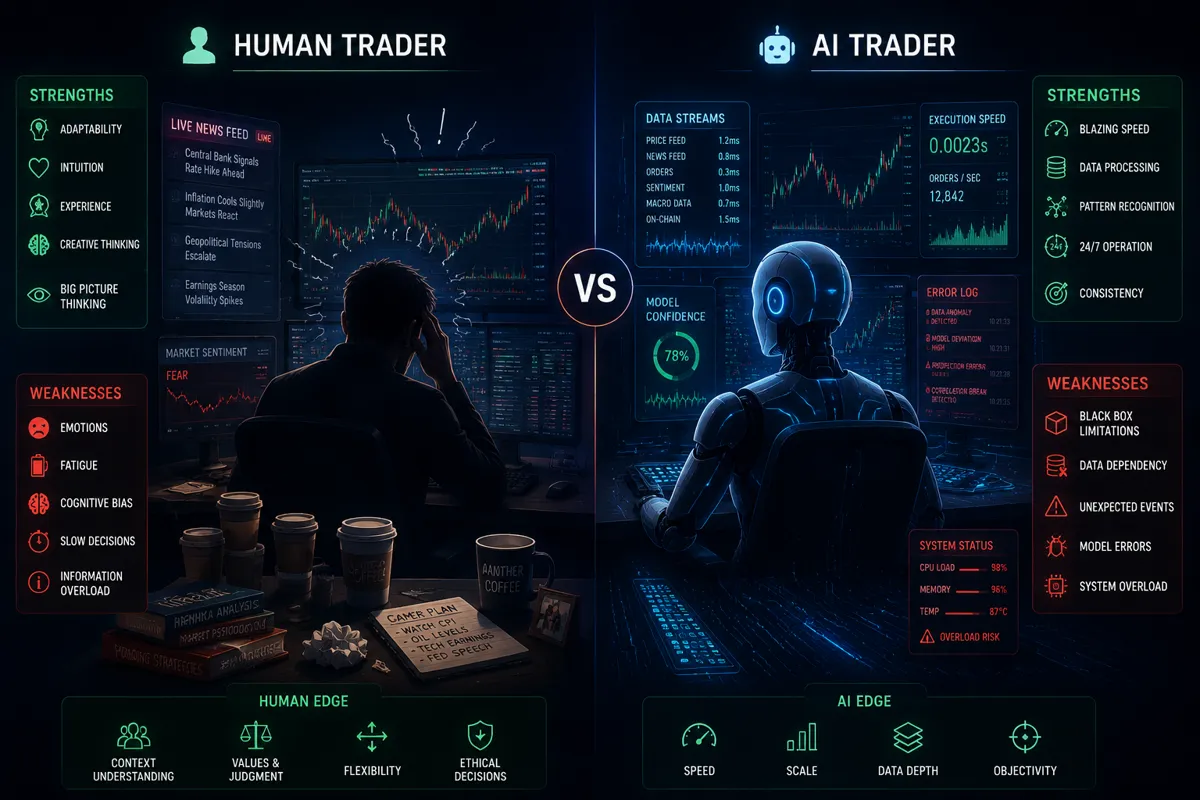
AI bots have real advantages in specific areas and real weaknesses in others. Neither is categorically better.
Where bots win:
- Speed: executing orders in milliseconds, no hesitation
- Consistency: no revenge trading, no emotional decision-making after a loss
- Data processing: scanning thousands of securities simultaneously
- Discipline: following the rules of the strategy without deviation
Where humans win:
- Regime recognition: identifying when market conditions have fundamentally changed
- Qualitative judgment: reading earnings call tone, assessing management credibility, evaluating geopolitical context
- Adaptive thinking: adjusting strategy in real time based on new information
- Risk intuition: knowing when something "feels wrong" even before the data confirms it
The May 2026 BabyPips analysis put it plainly: AI is genuinely useful for research and keeping emotions out of trades, but it's not ready to replace human thinking in trading decisions. The best setup for most retail traders is AI as a co-pilot, not an autopilot.
For swing trading specifically, combining AI signal tools with human judgment on entry and exit timing tends to outperform either approach alone. The swing trading tools comparison at aistockpickerapps.com is a useful starting point for finding that kind of hybrid approach.
Which Markets Work Best for AI Trading Algorithms?
AI trading algorithms tend to perform best in liquid, data-rich markets with consistent historical patterns. The worst environments are thin, event-driven markets where a single headline can invalidate months of pattern data.
Best markets for AI bots:
- Large-cap equities (S&P 500 constituents): high liquidity, abundant data, tight spreads
- Forex major pairs (EUR/USD, GBP/USD): 24-hour trading, deep liquidity, mean-reverting tendencies
- Futures (ES, NQ, CL): standardized contracts, excellent liquidity, clear price action
- Crypto top-tier assets (BTC, ETH): 24/7 trading, high volatility that bots can exploit with proper risk management
Harder markets for AI bots:
- Low float small-caps: thin liquidity means bot orders move the market against themselves
- Options: complex pricing dynamics, time decay, and volatility surface changes are difficult to model
- Penny stocks: easily manipulated, data quality is poor, spreads are wide
For day trading applications, the day trading tools at aistockpickerapps.com cover platforms built specifically for the high-frequency, intraday use cases where AI has the most practical application.
Do AI Trading Bots Work for Cryptocurrency or Just Stocks?
AI trading bots are actually more widely used in crypto than in stocks, largely because crypto markets are open 24/7 and don't require a broker relationship to access programmatically. The barrier to deploying a crypto bot is lower than in traditional markets.
But lower barriers cut both ways. The 73% failure rate for automated crypto trading accounts within six months reflects a market full of undercapitalized, poorly designed bots running without adequate risk management. The crypto market's volatility also means that a bot's edge can disappear overnight during a regime shift — a bull run strategy deployed into a bear market is a fast way to lose capital.
The top crypto bots (Maestro, Unibot, Banana Gun) generate revenue primarily from transaction fees on volume, not from directional trading alpha. That's a fundamentally different business model than "the bot makes money by trading well."
For stocks: AI bots face more regulatory friction, higher data costs, and market hours constraints. But the underlying market structure is more stable and the data quality is generally higher. Tools like WunderTrading bridge both worlds, supporting automated strategies across crypto and traditional markets.
What Technical Skills Do You Need to Run an AI Trading Bot?
The technical requirements depend entirely on which type of bot you're using.
No-code platforms (3Commas, Capitalise.ai, Option Alpha): Require no programming. Users configure strategies through visual interfaces. The tradeoff is limited customization — you're working within the platform's constraints.
Low-code platforms (TradingView Pine Script, TrendSpider): Require basic scripting ability. Pine Script is readable even for non-programmers. This tier offers meaningful customization without requiring software engineering skills.
Full-code systems (Python-based bots using Alpaca, Interactive Brokers APIs): Require real programming knowledge — Python fluency, understanding of REST APIs, basic data science for backtesting. This is where institutional-grade strategies live.
The honest minimum for any tier: Understanding of basic trading concepts (support and resistance, position sizing, stop loss placement, risk-reward ratios) is non-negotiable regardless of technical skill level. A bot is only as good as the strategy it's executing. If the trader doesn't understand the strategy, they can't evaluate when it's failing.
Are There Any Free AI Trading Bots That Actually Work?
Free bots exist, and some are legitimate starting points — but "actually work" requires careful definition.
Superalgos is an open-source platform with a genuine community and transparent methodology. It requires technical setup but costs nothing to run. The quality of the strategy depends entirely on the user.
TradingView's strategy tester is free at the basic tier and lets users backtest automated strategies using Pine Script. It's not a live execution bot, but it's a legitimate tool for testing logic before deploying capital.
The honest reality: Free bots tend to use generic strategies that are widely known and therefore arbitraged away. The edge, if there ever was one, is usually gone by the time it's packaged into a free tool.
The better use of free resources is AI-assisted research and screening tools rather than fully automated execution. The free tools at aistockpickerapps.com — including the Trading Expectancy Calculator — give retail traders analytical leverage without the execution risk of a fully automated system.
What Happens If an AI Trading Bot Makes a Big Mistake?
It depends on the type of mistake and whether safeguards were in place.
The common failure modes:
- A bot misreads a data feed and executes a massive position in the wrong direction
- A flash crash triggers stop losses across the entire portfolio simultaneously
- A bug in the code causes the bot to keep buying or selling in a loop
- An API connection drops mid-trade, leaving an open position with no management
Real-world consequences: In 2010, algorithmic trading contributed to the Flash Crash, briefly wiping nearly $1 trillion in market value before prices recovered. Individual retail bots can't move markets at that scale, but a poorly configured bot can absolutely wipe a personal trading account.
The safeguards that matter:
- Hard position size limits (maximum percentage of account per trade)
- Daily loss limits that shut the bot down automatically
- Kill switch access that can halt all trading instantly
- Regular monitoring — "set it and forget it" is not a risk management strategy
The bottom line: Discipline beats prediction. A bot without risk controls is not a trading system — it's a liability.
FAQ
Q: Do AI trading bots actually work for retail investors?
Most do not produce consistent profits for retail investors. A small minority of well-designed bots in liquid markets can generate modest outperformance, but the failure rate is high and live performance consistently underperforms backtested results.
Q: What is a realistic return expectation from an AI trading bot?
Academic research suggests well-designed machine learning models can achieve 3-8% annual outperformance above a benchmark. Anything claiming double-digit monthly returns is almost certainly not sustainable.
Q: What is trading expectancy and why does it matter more than win rate?
Trading expectancy measures the average profit or loss per trade, accounting for both win rate and the size of wins versus losses. A bot with a 45% win rate and 3:1 risk-reward has better expectancy than a bot with a 70% win rate and 1:3 risk-reward. Use the free Trading Expectancy Calculator to run the numbers on any strategy.
Q: Are AI trading bots legal in the US?
Yes. Retail investors can legally use automated trading systems in their own accounts. Market manipulation and operating as an unregistered investment advisor are the relevant legal boundaries, not automated trading itself.
Q: How do I spot an AI trading bot scam?
Key red flags: guaranteed returns, no verifiable live track record, backtests with suspiciously smooth equity curves, no disclosed drawdown data, and pressure to invest immediately. Legitimate systems show audited live performance and disclose risk clearly.
Q: What percentage of automated trading accounts are profitable?
Data suggests 73% of automated crypto trading accounts fail within six months. For prediction market bots, only 0.51% of wallets achieved profits over $1,000 in a large-scale study.
Q: Can I run an AI trading bot without programming skills?
Yes. No-code platforms like Option Alpha and 3Commas allow strategy configuration through visual interfaces. However, understanding basic trading concepts — position sizing, stop loss, risk-reward — is still required to evaluate whether a strategy makes sense.
Q: Do AI bots work better in crypto or stocks?
Crypto has lower barriers to entry and 24/7 markets, making bots more common there. But the failure rate is also higher. Stock markets offer better data quality and more stable structure, but require more infrastructure to access programmatically.
Q: What is the biggest mistake traders make with AI bots?
Trusting backtested performance as a reliable predictor of live results. The 40-60% performance degradation from backtest to live trading means most bots will underperform their historical simulations significantly.
Q: Should beginners use AI trading bots?
Beginners should start with AI-assisted research tools rather than fully automated execution. Paper trade any strategy for at least 30 days before deploying real capital, and use tools that keep the human in the decision seat.
Q: How much does a reliable AI trading bot cost?
Entry-level subscriptions run $20-$75/month. Mid-tier platforms with strategy builders cost $75-$250/month. Professional-grade systems exceed $1,000/month. Free open-source options exist but require technical setup.
Q: What markets are best for AI trading algorithms?
Large-cap equities, major forex pairs, and liquid futures contracts (ES, NQ) are the most favorable environments. Low float stocks and penny stocks are the worst, due to thin liquidity and high manipulation risk.
Conclusion
The honest answer to whether AI trading bots actually make money is: rarely, inconsistently, and almost never the way the marketing claims. The data is clear — a 0.51% profitable wallet rate in large-scale studies, a 73% account failure rate within six months for automated crypto trading, and a 40-60% degradation from backtest to live performance. These aren't cherry-picked pessimistic numbers. They're what the research actually shows.
That doesn't mean AI has no role in trading. It means the role is different from what most retail traders are sold. AI is a research accelerator, a bias reducer, and a data processor. It is not a passive income machine that runs while you sleep.
Here's what to do with this information:
- Run any bot's claimed performance through the free Trading Expectancy Calculator before trusting it with real capital. Win rate alone is not the answer.
- Demand live audited results, not backtests. Six months minimum.
- Start with AI-assisted tools that inform your decisions rather than replace them. The AI trading platforms comparison at aistockpickerapps.com is a good place to evaluate what's actually available.
- Paper trade it first. Every time.
- Build the system before you trust the bot. Know your position sizing rules, your stop loss levels, and your maximum daily loss before any automation touches your account.
Systems over hacks. Process over prediction. Signal over noise. That's the framework — whether the signal comes from a human or a machine.
FullStack Alpha cuts the noise so you can keep the alpha. Browse the AI tools, scanners, and systems we actually rate at aistockpickerapps.com.
References
Are Polymarket Trading Bots Actually Profitable The Math Behind 2026 S Predictio - https://smartcr.org/ai-in-business/are-polymarket-trading-bots-actually-profitable-the-math-behind-2026-s-predictio/?utm_source=openai
Most Profitable Crypto Bots - https://www.coingecko.com/research/publications/most-profitable-crypto-bots?utm_source=openai
Explainer Ai Trading Bots What They Can And Cant Do 2026 05 09 - https://www.babypips.com/news/explainer-ai-trading-bots-what-they-can-and-cant-do-2026-05-09?utm_source=openai
Are Retail Crypto Trading Bots Profitable - https://lenz.io/q/are-retail-crypto-trading-bots-profitable?utm_source=openai
Can Ai Trade Stocks - https://www.tradealgo.com/trading-guides/ai-trading/can-ai-trade-stocks?utm_source=openai