The AI Tools for Day Traders That Spot Setups Before the Opening Bell...
Last updated: June 17, 2026
Quick Answer: The best AI tools for day traders that spot setups before the opening bell use real-time scanners, machine learning pattern recognition, and pre-market gap analysis to surface high-probability trade candidates before 9:30 AM. Platforms like Trade Ideas (Holly AI), TrendSpider, and Tickeron lead the category in 2026 — but the right tool depends on your trading style, budget, and how much noise you're willing to cut through first.
Key Takeaways
- Pre-market AI scanners filter thousands of stocks in seconds, surfacing gap-ups, volume spikes, and technical setups before the market opens.
- Trade Ideas' Holly AI, TrendSpider's intraday multi-timeframe analysis, and Tickeron's AI pattern signals are the three most-cited tools among active day traders in 2026.
- AI tools for day traders work best as a process layer — they narrow the watchlist, they don't replace judgment on entry and exit.
- Free AI tools for day traders exist and can find decent setups, but they come with data delays, fewer filters, and no real-time alerts.
- AI trading bots and scanners are legal and allowed by most brokers, but automated execution requires broker-specific API access.
- The biggest mistake new traders make with AI signals is skipping risk management — a clean setup without a stop loss is just a losing trade waiting to happen.
- Machine learning techniques used in top platforms include natural language processing for news sentiment, LSTM neural networks for price prediction, and random forest models for pattern classification.
- AI accuracy on directional signals runs roughly 55-65% in favorable market conditions — better than a coin flip, not a guarantee. Discipline beats prediction every time.
The AI Tools for Day Traders That Spot Setups Before the Opening Bell...
The AI tools for day traders that spot setups before the opening bell do one thing really well: they compress hours of manual scanning into a two-minute watchlist. Before 9:30 AM, a solid pre-market AI scanner has already processed overnight news, earnings releases, gap-up and gap-down candidates, volume relative to average, and key support and resistance levels — all before most traders have finished their coffee.
The core workflow looks like this:
- Pre-market gap scan — identifies stocks moving more than 2-5% on above-average pre-market volume.
- News and catalyst filter — flags whether the move has a real catalyst (earnings beat, FDA approval, sector news) or is just noise.
- Technical pattern overlay — checks if the price action is basing cleanly near a key level or is already overextended.
- Alert delivery — pushes the shortlist to your screen or phone before the opening bell.
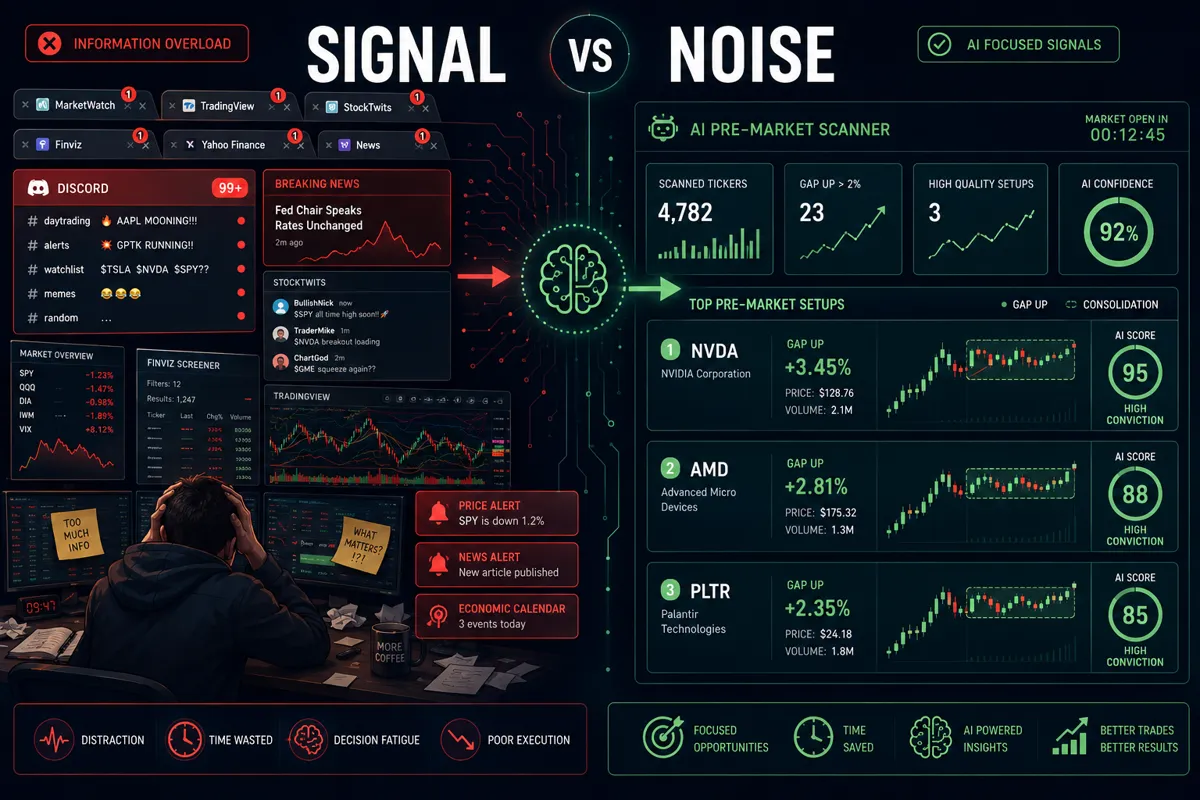
The difference between a trader who shows up with a clean watchlist of three high-conviction setups and one who shows up with 40 tickers and no plan? The first one has a process. The second one has analysis paralysis.
What AI Tools Actually Predict Stock Movements Before the Market Opens
No AI tool predicts stock movements with certainty — and any platform claiming otherwise is selling you something you should walk away from fast. What the best pre-market AI scanners actually do is calculate probability-weighted setups based on historical pattern data, current price action, and real-time news sentiment.
How they do it:
- Natural Language Processing (NLP): Scans earnings calls, SEC filings, and news headlines for sentiment shifts before the market opens. Tools like Benzinga Pro and MarketReader specialize here.
- LSTM Neural Networks: A type of machine learning that's good at finding patterns in time-series data — like price and volume sequences that historically precede breakouts.
- Pattern Recognition Models: Classify chart formations (flags, wedges, tight consolidation near highs) and score them by historical win rate.
- Gap Analysis Algorithms: An AI gap scanner for day trading cross-references overnight price gaps with average daily range and float size to estimate whether a gap is likely to fill or hold.
The honest truth: these tools are signal amplifiers, not crystal balls. They surface setups worth watching. Whether you execute well is still on you.
How Much Do Professional AI Day Trading Platforms Cost
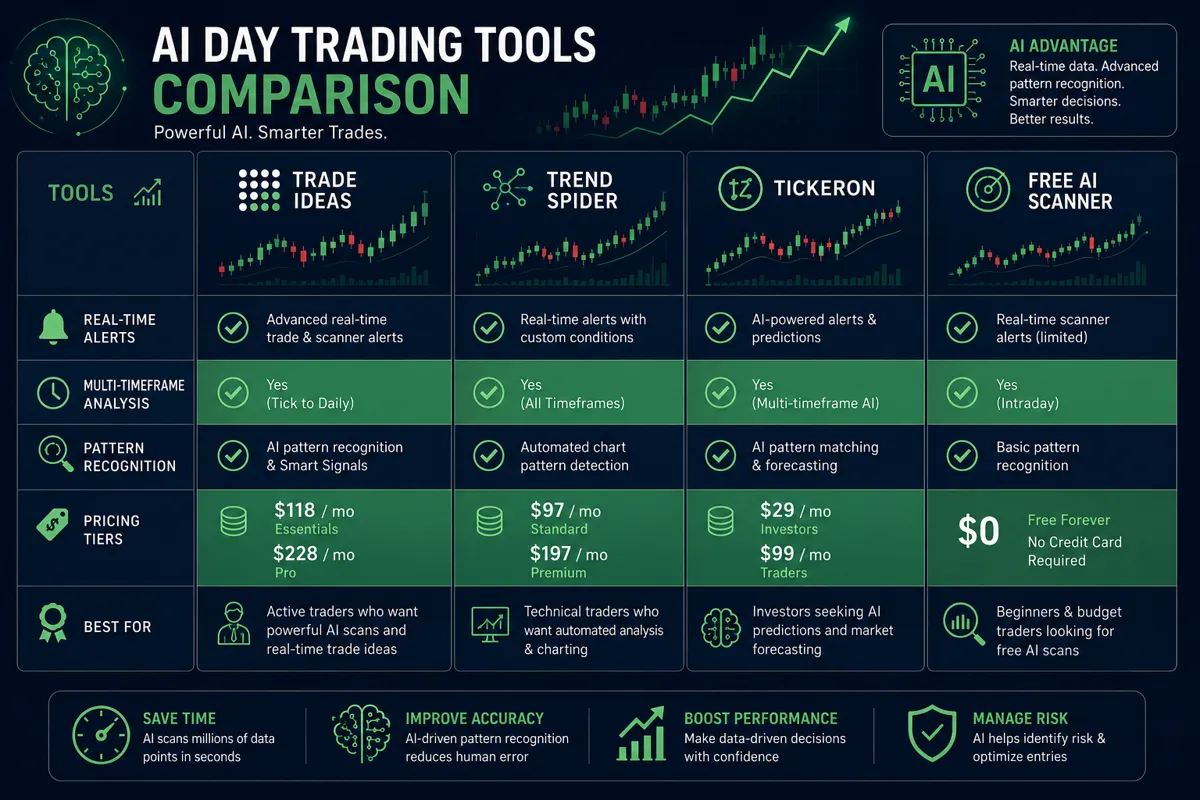
Pricing ranges from free to institutional, and the gap between tiers is real. Here's a practical breakdown for 2026:
| Platform | Tier | Monthly Cost (est.) | Best For |
|---|---|---|---|
| Trade Ideas | Standard / Premium | $118 / $228 | Active day traders, Holly AI alerts |
| TrendSpider | Basic / Elite | $33 / $79 | Intraday multi-timeframe, automation |
| Tickeron | Basic / Premium | $25 / $90 | AI pattern signals, beginners |
| Webull | Free / Premium | $0 / $3 | Free AI tools for day traders |
| Scanz | Pro | $149 | High-speed momentum scanning |
A few honest notes on pricing:
- Free tiers are real but limited. Expect 15-20 minute data delays, fewer scan filters, and no real-time AI stock alerts. For paper trading and learning, that's fine. For live intraday trading, the delay can cost more than the subscription.
- Annual billing typically saves 20-40%. If you're committed to a platform, pay annually.
- Don't pay for two tools that do the same thing. Most traders need one strong scanner, one charting platform, and one news feed. That's it. Systems over hacks.
You can compare 100+ AI stock tools side by side to see which platforms match your budget and style before committing.
Which AI Trading Software Works Best for Beginners
For beginners, the best AI day trading scanner is the one that explains what it's showing you — not just what to buy. Tickeron is the most beginner-accessible platform in 2026 because its AI pattern signals come with plain-English explanations of why a setup is flagged, what the historical win rate is, and what the risk-reward looks like.
Beginner-friendly picks:
- Tickeron — AI pattern recognition with educational context. Good for learning to read setups without drowning in data.
- Webull — Free AI tools for day traders with a clean interface. The AI screener is basic but functional for learning the ropes.
- TrendSpider — Steeper learning curve, but the automated trendline detection removes one of the most error-prone parts of manual charting.
What beginners get wrong: They treat the AI signal as the trade. It's not. The signal is the starting point. You still need to check the risk-reward, set a stop loss, and size the position correctly. Paper trade it first — seriously. Run the AI signals in a simulated account for 30 days before risking real money. If the setup doesn't work in paper trading, it won't magically work live.
Can Free AI Stock Scanners Really Find Good Trade Setups
Yes, free AI stock scanners can find legitimate setups — with important caveats. The data delay is the main problem. A 15-minute lag on a momentum day trading setup is the difference between catching a clean breakout and chasing an overextended move into a bull trap.
Where free tools hold up:
- Swing trade ideas where intraday timing matters less.
- Learning to read price action and pattern recognition without financial risk.
- Building a watchlist the night before for the next session.
Where free tools fall short:
- Real-time AI stock alerts for intraday momentum plays.
- Low float scanners that need tick-level data to be useful.
- Power hour setups where conditions change in seconds.
The free tools section at AI Stock Picker Apps has a curated list of no-cost options worth testing. Start there, then upgrade once you know which features you actually use.
Why Professional Traders Trust AI Pattern Recognition
Professional traders trust AI pattern recognition because it removes the emotional noise that wrecks most human analysis. When a trader has been watching a stock for three hours and is already up on a position, confirmation bias kicks in hard. The AI doesn't care. It reads the tape the same way every time.
The three featured tools that earn that trust:
Trade Ideas — Holly AI real-time alerts
Holly AI runs backtested strategies overnight and delivers a pre-market shortlist of setups ranked by historical edge. It's the closest thing to having a quant desk running scans for you. The real-time alerts during market hours are among the fastest in the retail space. For AI tools for momentum day trading, Trade Ideas is the benchmark.
TrendSpider — Intraday multi-timeframe analysis
TrendSpider's strength is automated technical analysis across multiple timeframes simultaneously. It catches when a setup is clean on the 5-minute chart but running into resistance on the daily — the kind of conflict that causes traders to get stopped out unnecessarily. TrendSpider intraday analysis is particularly useful for traders who want to confirm that the short-term setup aligns with the bigger picture before entering.
Tickeron — AI pattern signals
Tickeron's pattern recognition engine classifies chart formations and attaches a confidence score based on historical outcomes. It's not perfect — no pattern recognition tool is — but it gives traders a structured way to evaluate setups instead of relying on gut feel.
The common thread: all three tools are process builders. They give you a repeatable framework for evaluating setups before the opening bell. That's the whole game — consistency over hype.
What Mistakes Do New Traders Make with AI Stock Analysis
The most expensive mistake is treating an AI signal as a trade recommendation rather than a research starting point. An AI gap scanner for day trading can surface a stock gapping up 8% on earnings — but it can't tell you whether the market's mood that morning will support a continuation or a brutal gap fill.
The top mistakes, ranked by how often they happen:
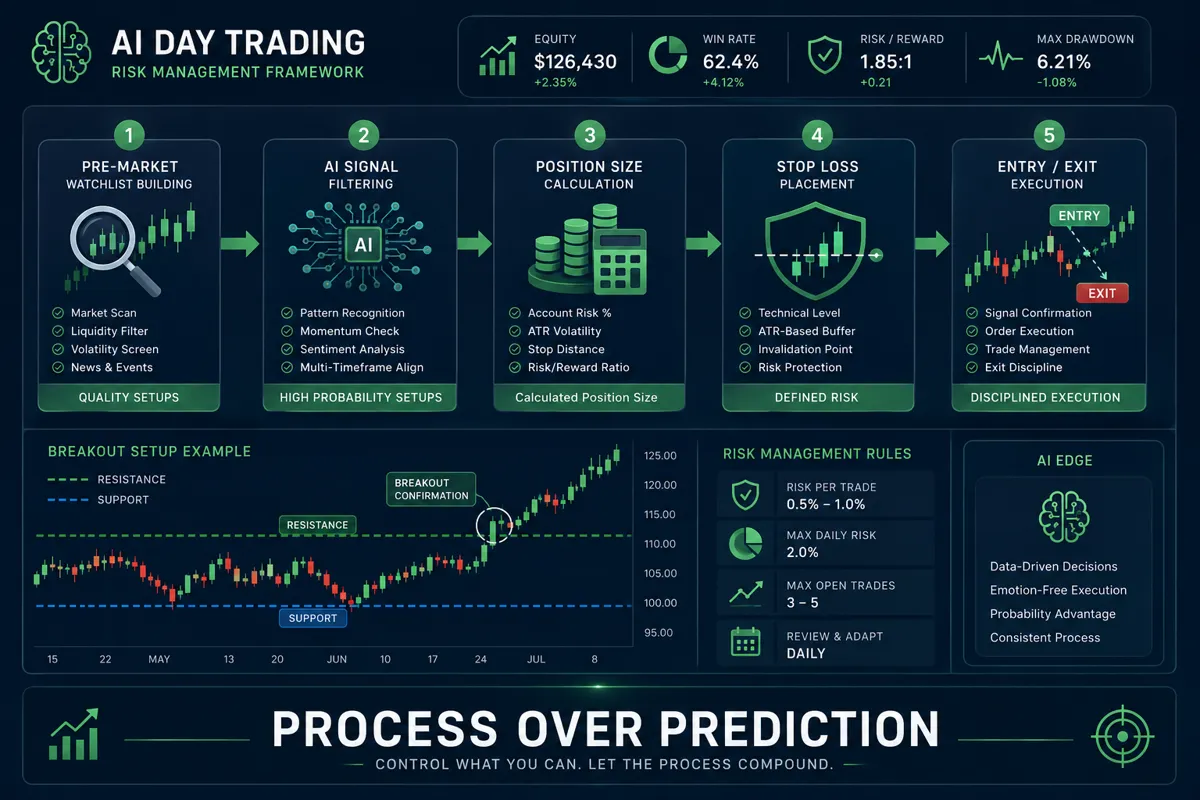
- Skipping the stop loss. A clean setup without a defined stop loss is just a position with unlimited downside. Set it before you enter, not after.
- Overtrading the alerts. Getting 40 real-time AI stock alerts and acting on 20 of them is overtrading with extra steps. Filter to your top three. That's it.
- Ignoring position sizing. The AI found a great setup. You put 80% of your account into it. Now you're not trading — you're gambling. Risk management is the job.
- Revenge trading after a bad signal. The AI was wrong. The setup failed. You doubled down to recover. Play stupid games, win stupid prizes.
- Analysis paralysis from too many tools. Four scanners, two Discord servers, and a Twitter feed running simultaneously is not an edge. It's a distraction. Cut the noise, keep the alpha.
How Accurate Are AI Trading Signals Compared to Human Analysis
AI trading signals in 2026 run roughly 55-65% directional accuracy in trending market conditions, based on backtested results published by platforms including Trade Ideas and Tickeron. In choppy tape — sideways, low-conviction markets — that accuracy drops closer to 50%, which is essentially a coin flip.
Human analysts with deep sector expertise can outperform AI signals in specific situations: reading management tone on earnings calls, interpreting geopolitical events, or recognizing when a technical setup is occurring in a structurally broken sector. But humans are also subject to FOFO (fear of finding out), confirmation bias, and revenge trading — none of which affect an algorithm.
The honest take: AI tools for intraday trading are better at processing volume and speed. Humans are better at context and judgment. The best traders in 2026 use both — AI to narrow the field, human judgment to make the final call on entry and exit.
Which AI Tools Work Best for Momentum vs. Swing Trading Styles
The right tool depends on your holding period and what kind of setups you're hunting.
For momentum day trading (holding minutes to hours):
- Trade Ideas is the standard. Holly AI's pre-market scans and real-time alerts are built for fast-moving intraday setups.
- Scanz is worth considering for high-speed momentum scanning with customizable filters.
- Key indicators to look for: relative volume, float size, price action near intraday highs, catalyst strength.
For swing trading (holding days to weeks):
- TrendSpider and Intellectia AI handle multi-day pattern recognition well.
- The swing trade planner at AI Stock Picker Apps is a solid free starting point for building a structured approach.
- Key indicators: weekly chart basing patterns, earnings season setups, support and resistance on the daily chart.
For options traders:
- AI options tools that track unusual options activity and flow are a separate category worth exploring if derivatives are your primary vehicle.
The trend is your friend — but only if you're using a tool calibrated to your timeframe. A momentum scanner is not a swing trading tool. Know what you're running before you trust the output.
What Risk Management Features Should AI Trading Software Have
Risk management features are non-negotiable in any AI trading platform worth paying for. A scanner that finds great setups but gives you no framework for managing risk is just an expensive way to lose money faster.
Must-have risk management features:
- Position size calculator — inputs your account size, risk percentage per trade, and stop loss distance to output the correct share count. This removes the math error that blows up accounts.
- Stop loss automation — the ability to set conditional orders directly from the scanner alert, not as a separate manual step.
- Risk-reward display — shows the ratio of potential gain to potential loss before you enter. Anything below 2:1 deserves a hard look.
- Backtested win rate — tells you how the strategy has performed historically, not just in the current bull run.
- Drawdown alerts — flags when a strategy is underperforming its historical baseline, which is a signal to reduce size or step back.
The expectancy calculator at AI Stock Picker Apps is a free tool that helps traders understand whether their current win rate and risk-reward ratio actually produce positive expected value over time. Run your numbers there before trusting any signal.
Are AI Trading Bots Legal and Allowed by Brokers
AI trading bots are legal in the United States and most international markets for retail traders. The SEC and FINRA regulate the outcomes of trading activity, not the tools used to generate signals. Using an AI scanner or automated strategy is not a regulatory violation.
Broker-specific rules matter more than the law:
- Most retail brokers allow AI-generated signals and manual execution based on those signals with no restrictions.
- Automated execution (bots placing orders without human confirmation) requires API access, which varies by broker. Platforms like Alpaca are built specifically for algorithmic trading and support full automation.
- Pattern Day Trader (PDT) rules still apply regardless of whether a human or AI initiates the trade. Four or more day trades in five business days in a margin account under $25,000 triggers PDT status.
- Some brokers restrict certain order types or execution speeds that automated systems rely on. Check the broker's API documentation before building an automated workflow.
Short version: the tool is legal. The execution rules are broker-specific. Know both before you automate anything.
Do AI Trading Platforms Work for Stocks, Options, and Crypto
Most AI tools for day traders were built primarily for equities, but the category has expanded. In 2026, the coverage breakdown looks like this:
Stocks: Full coverage across all major platforms. Pre-market AI scanners, gap analysis, and pattern recognition are most mature here.
Options: Specialized tools track unusual options flow, implied volatility changes, and options chain anomalies. This is a distinct data set from equity scanners — look for platforms that specifically advertise options flow analysis rather than assuming your stock scanner covers it.
Crypto: Coverage exists but quality varies significantly. Crypto markets trade 24/7, which changes how pre-market scanning works. Some platforms have added crypto modules, but the signal quality is generally less refined than equity tools due to lower historical data depth and higher volatility noise.
Futures: Futures-specific AI tools are available but niche. If futures are your primary market, look for platforms with dedicated futures scanning rather than retrofitted equity tools.
The honest answer: if you trade stocks and options, the AI tools for day traders in 2026 are genuinely useful. If you trade crypto or futures primarily, the category is improving but not yet at the same standard.
Conclusion: Build the Process, Then Use the Tools
The AI tools for day traders that spot setups before the opening bell are genuinely useful in 2026 — but only if you treat them as the front end of a process, not a replacement for one. Trade Ideas finds the gap. TrendSpider confirms the technical picture. Tickeron scores the pattern. You decide the risk-reward, set the stop loss, and size the position correctly. That's the full workflow.
The traders who get burned by AI tools are the ones who outsource their judgment entirely. The signal fires, they enter, they skip the stop loss, the trade goes against them, and they revenge trade back into a bigger loss. That's not an AI problem. That's a process problem.
Here's what to do this week:
- Pick one AI scanner — Trade Ideas, TrendSpider, or a free option if you're starting out.
- Run it in paper trading mode for 30 sessions. Track every signal it generates and what actually happened.
- Build your pre-market routine: gap scan, catalyst check, technical confirmation, watchlist of three names maximum.
- Set your stop loss before you enter every trade. Non-negotiable.
- Review your expectancy — win rate times average win minus loss rate times average loss — at the end of every week.
Data over noise. Discipline beats prediction. The setup is only as good as the process around it.
FullStack Alpha tests the AI stock tools so you don't waste months on the wrong ones. Browse the full day trading tool breakdowns and find the scanner that actually fits your style at aistockpickerapps.com.
Frequently Asked Questions
What is the best AI tool for day trading in 2026?
Trade Ideas with Holly AI is the most widely used professional-grade AI day trading scanner in 2026. For beginners, Tickeron offers the most accessible entry point with pattern signals explained in plain language.
Can AI tools predict which stocks will go up before the market opens?
No AI tool predicts stock movements with certainty. Pre-market AI scanners calculate probability-weighted setups based on historical patterns, gap analysis, and news sentiment. Directional accuracy in favorable conditions runs roughly 55-65%.
Are there free AI tools for day traders?
Yes. Webull's built-in scanner, Finviz's free screener, and several platforms offer free tiers with limited features. The main limitation is data delay — typically 15-20 minutes — which makes them unsuitable for fast intraday momentum trading.
How does Holly AI from Trade Ideas work?
Holly AI runs backtested trading strategies overnight and delivers a ranked shortlist of pre-market setups each morning. During market hours, it sends real-time alerts when stocks meet the criteria of its highest-performing historical strategies.
Is TrendSpider good for intraday trading?
Yes. TrendSpider's automated multi-timeframe analysis is particularly useful for intraday traders who want to confirm that a short-term setup aligns with the broader daily or weekly technical picture before entering.
What technical indicators do AI tools look for before the market opens?
The most common pre-market indicators include: relative volume versus 30-day average, gap percentage and direction, float size, catalyst type (earnings, news, sector move), and proximity to key support and resistance levels.
Do AI trading signals work for options trading?
Standard AI day trading scanners are built for equities. Options-specific AI tools that track unusual flow, implied volatility changes, and options chain anomalies are a separate category and generally more useful for options traders.
What is the Pattern Day Trader rule and does it apply to AI trading?
The PDT rule requires a minimum $25,000 account balance for traders who make four or more day trades in a five-business-day period in a margin account. It applies regardless of whether trades are initiated manually or via AI signals.
How much does Trade Ideas cost?
Trade Ideas runs approximately $118/month for the Standard plan and $228/month for Premium (which includes Holly AI) as of 2026. Annual billing reduces the cost significantly.
What is the biggest mistake traders make with AI stock scanners?
Treating the AI signal as a complete trade recommendation rather than a starting point. The signal narrows the field. The trader still needs to evaluate risk-reward, set a stop loss, and size the position correctly before entering.