AI Investing App: Which Ones Are Worth Your Money
Last updated: June 30, 2026
Quick Answer: Most AI investing apps in 2026 fall into two categories — robo-advisors that automate your portfolio and AI signal tools that help you find and time trades. The ones worth paying for give you explainable signals, transparent methodology, and a clear edge over doing nothing. The ones that aren't worth it sell confidence dressed up as intelligence. This guide cuts through both.
Key Takeaways
- An AI investing app uses machine learning to analyze market data, score stocks, or manage a portfolio automatically — but "AI-powered" is a marketing label, not a quality guarantee.
- The best AI investing apps for beginners in 2026 include Danelfin (free tier, explainable scores), Magnifi (portfolio and ETF focus), and SoFi Invest (guided, low barrier to entry).
- Robo-advisors like Betterment automate long-term allocation; AI signal tools like Tickeron or Prospero.ai target active traders looking for daily setups.
- Free AI investing apps exist — Danelfin has a functional free tier; Finviz offers free screening — but the meaningful edge usually lives behind a paid plan.
- AI does not eliminate risk. It shifts the source of error from "I panicked" to "the model was wrong." Both cost money.
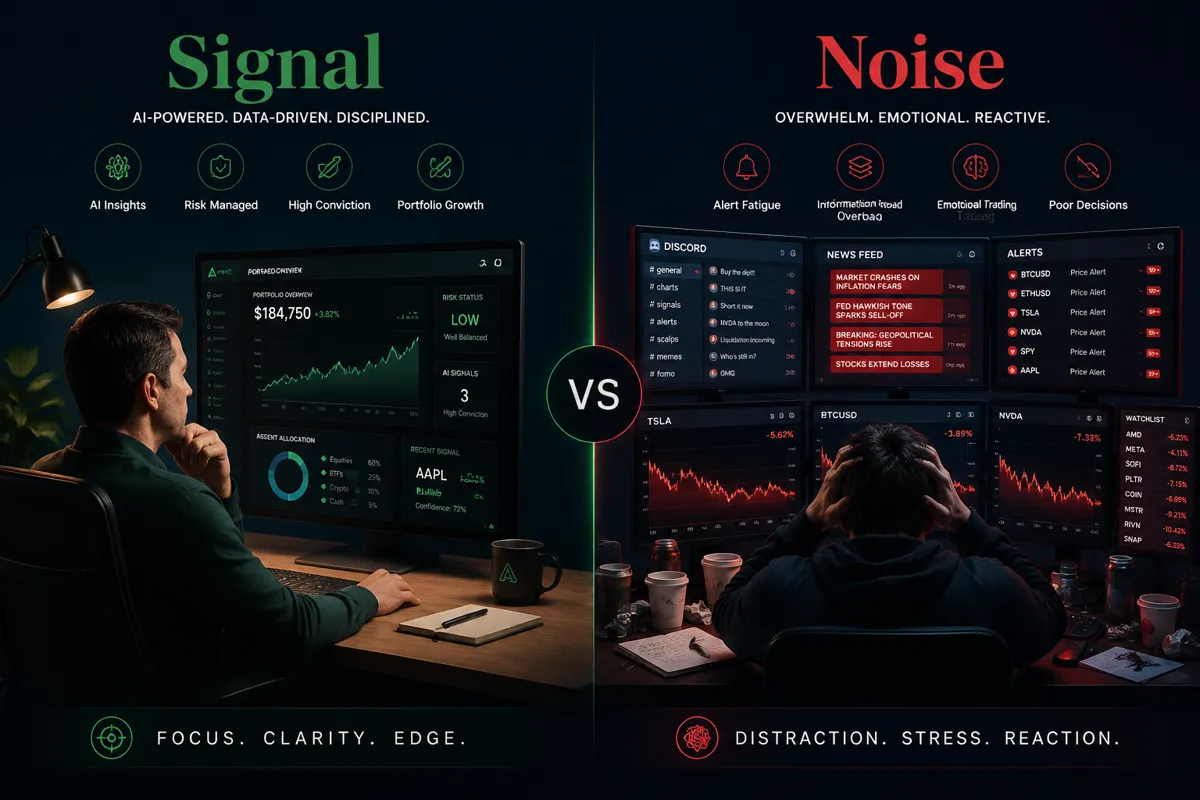
- The most common mistake: treating AI signals as instructions instead of inputs. Signal over noise means you still need a process.
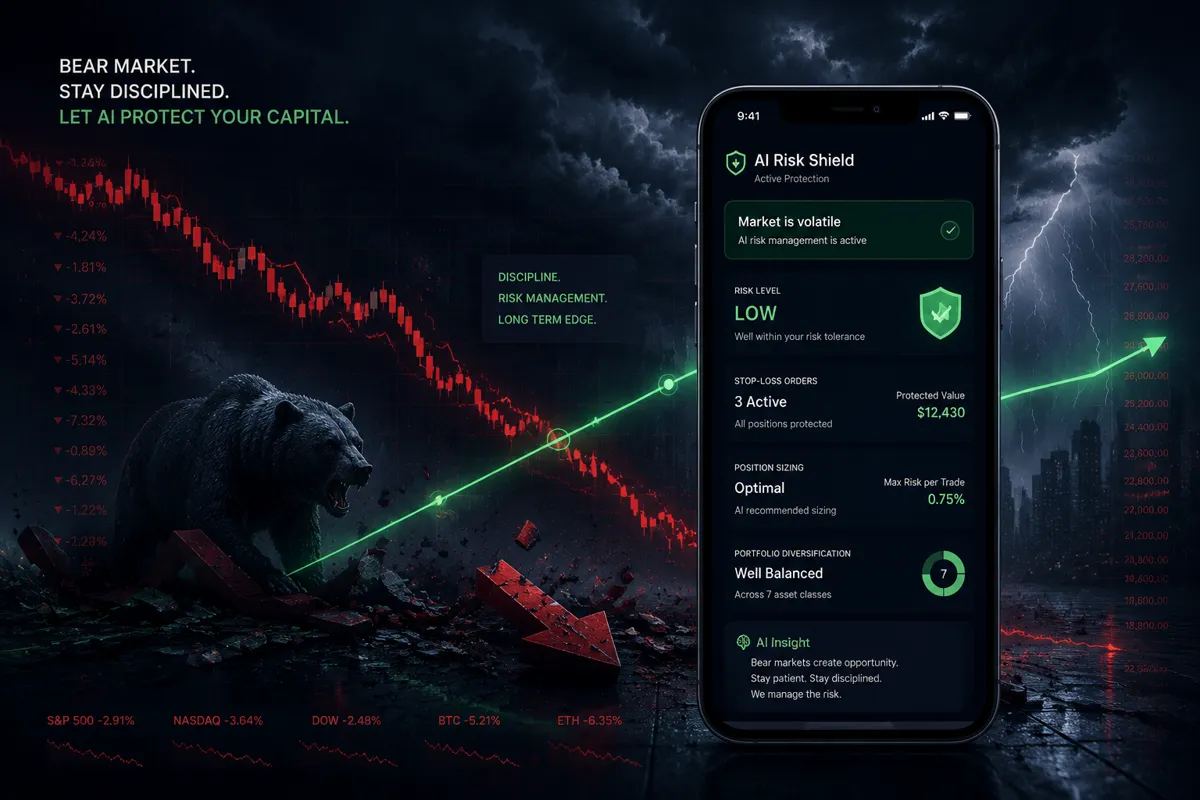
- In a bear market, AI tools that include risk management and stop-loss logic outperform those that only optimize for returns.
- Always verify an app's regulatory standing through FINRA.org or SEC.gov before connecting your brokerage account.
What Is an AI Investing App and How Does It Work?
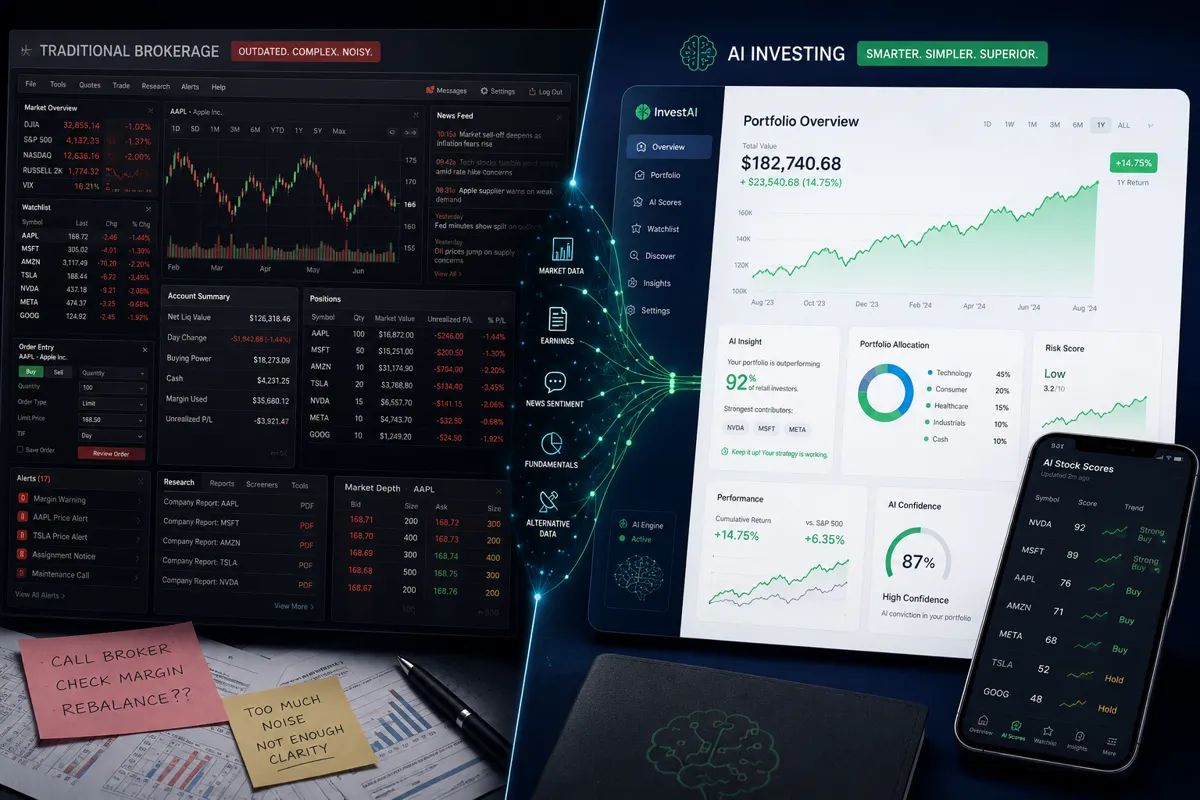
An AI investing app uses algorithms — typically machine learning models — to analyze financial data, identify patterns, and either recommend trades or execute them automatically. The core job is to process more data faster than a human can, then surface what matters.
Here's the basic mechanics:
- Data ingestion: The app pulls in price history, earnings data, news sentiment, options flow, or alternative data (think satellite imagery of parking lots, credit card transaction trends).
- Model scoring: Algorithms score stocks, ETFs, or portfolios based on defined criteria — momentum, value, growth, risk-adjusted return potential.
- Output: Either a ranked watchlist, a buy/sell signal, an automated trade, or a portfolio allocation recommendation.
The key distinction is between apps that inform your decisions and apps that make decisions for you. Tools like Danelfin or Tickeron show you AI-generated scores you act on yourself. Robo-advisors like Betterment or M1 Finance actually move the money. Neither approach is universally better — it depends on how involved you want to be.
One thing that wasn't in our bingo card a few years ago: the best AI investing apps now explain their reasoning. Explainability — knowing why a stock scored high — separates the signal from the noise. If an app can't tell you why it's recommending something, that's not intelligence. That's a black box with a slick UI.
AI Investing App: Which Ones Are Worth Your Money in 2026
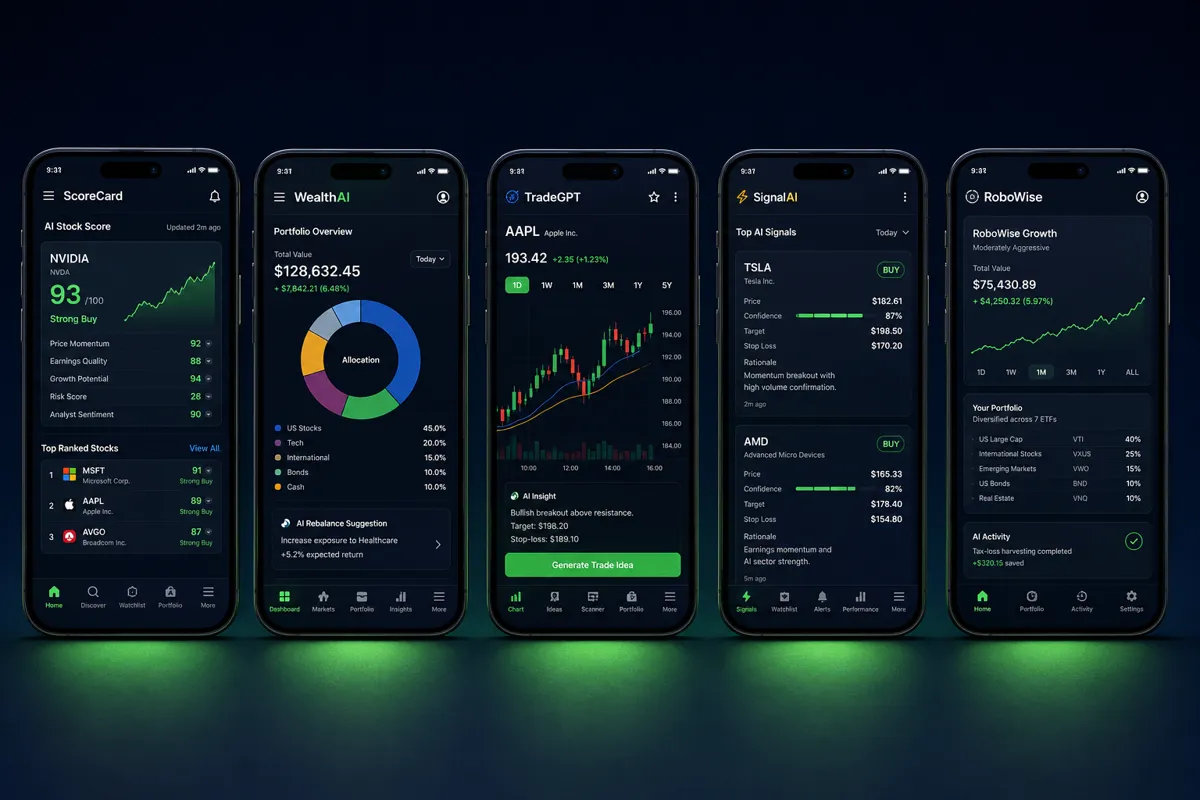
The honest answer: fewer than the app stores suggest. Here's a practical breakdown by use case.
| App | Best For | Free Tier | Paid Plans Start At | Key Feature |
|---|---|---|---|---|
| Danelfin | Beginners, explainable AI | Yes | ~$20/mo | AI score 0–10 with factor breakdown |
| Prospero.ai | Daily stock picks, active traders | Limited | ~$30/mo | Daily AI-ranked watchlist |
| Magnifi | ETF and portfolio focus | Yes | ~$14/mo | Natural language portfolio search |
| AltIndex | Alternative data signals | Limited | ~$29/mo | Non-traditional data inputs |
| Tickeron | Signal marketplace, active traders | Limited | ~$17/mo | AI robots with backtested strategies |
| Betterment | Hands-off long-term investors | No | 0.25% AUM/yr | Automated tax-loss harvesting |
| SoFi Invest | Beginners, no minimums | Yes | Free | Guided investing, no account minimum |
For active traders who want to build a process around AI signals, tools like Tickeron and Tradytics offer more granular data. For hands-off investors, the robo-advisor comparison at AI Stock Picker Apps covers the full landscape.
The apps worth your money share three traits: transparent methodology, a clear use case, and a track record you can verify — not just testimonials on a landing page.
AI Investing Apps vs. Robo-Advisors: What's the Difference?
These two categories get lumped together constantly, and that confusion costs people money. They solve different problems.
Robo-advisors (Betterment, M1 Finance, SoFi Invest) are portfolio management tools. They allocate your money across diversified assets based on your risk tolerance, rebalance automatically, and often handle tax optimization. They're built for the investor who wants to set it and mostly forget it. The AI component is in the allocation and rebalancing logic — not in picking individual stocks.
AI signal and research apps (Danelfin, Prospero.ai, Tickeron, AltIndex) are decision-support tools. They don't manage your money. They surface opportunities, score stocks, or flag unusual activity. You still make the trade.
Choose a robo-advisor if your goal is long-term wealth building with minimal time investment. Choose an AI signal app if you're actively managing your own trades and want data-backed inputs for your watchlist and entry decisions.
Mixing them up is like using a GPS to cook dinner. The technology is impressive — it just isn't built for what you're asking it to do. For a deeper look at the robo-advisor side, the investing tools overview covers what separates the serious platforms from the noise.
How Much Does It Cost to Use an AI Investing App?
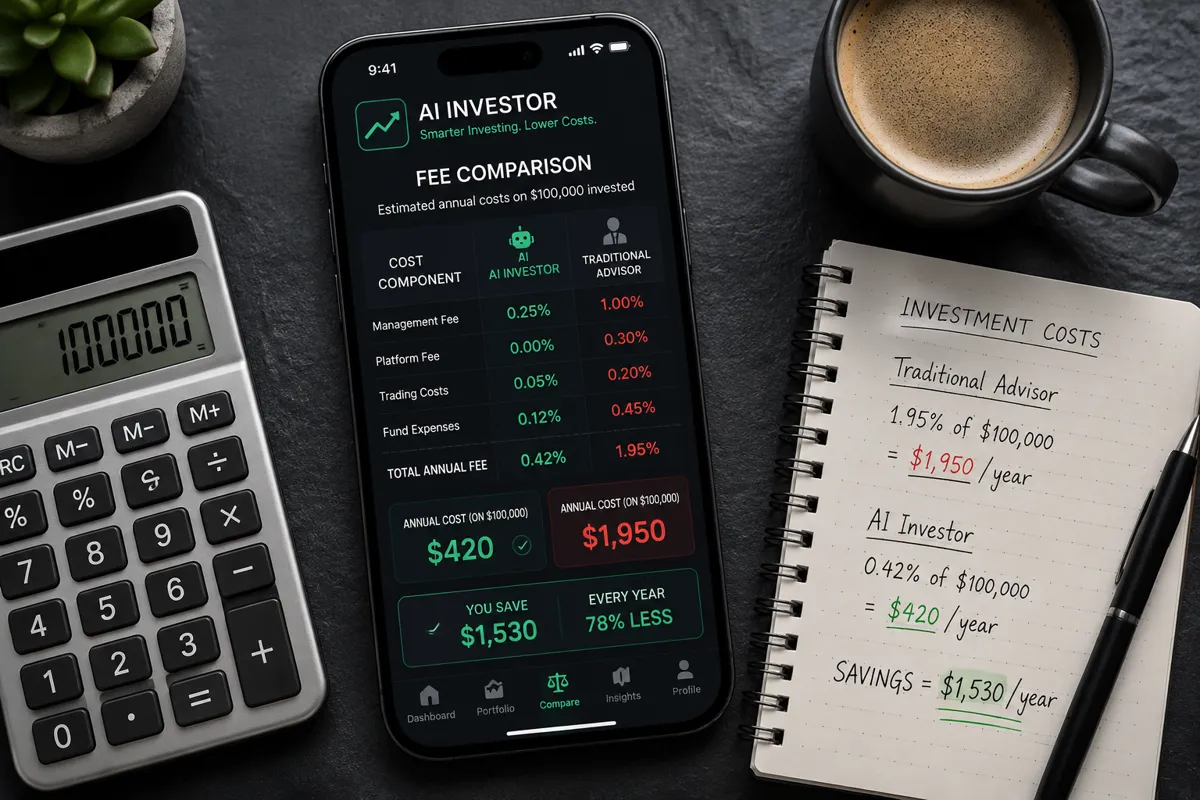
Costs range from zero to several hundred dollars per month depending on the depth of data and features. Here's the realistic breakdown:
Free AI investing apps do exist and some are genuinely useful:
- Danelfin's free tier gives you AI scores on individual stocks with basic factor explanations.
- Finviz offers free screening with technical filters.
- SoFi Invest charges no management fees on automated portfolios.
Mid-tier paid plans ($15–$50/month) are where most active retail investors land. Prospero.ai, Magnifi, and Tickeron all sit in this range. You get daily signals, more data depth, and in some cases backtested strategy performance.
Professional-grade tools ($100–$500+/month) like Benzinga Pro, Trade Ideas, or institutional-facing platforms are built for traders who treat this as a business. The cost is real, but so is the data quality.
The rule of thumb: if a paid AI investing app doesn't demonstrably improve your risk-reward on trades, it's an expense — not an investment. Paper trade it first for 30 days before committing real money to a subscription.
One cost people miss: the robo-advisor fee structure. A 0.25% annual AUM fee sounds small. On a $100,000 portfolio, that's $250 per year. On a $500,000 portfolio, it's $1,250. Not a dealbreaker, but worth knowing before you sign up.
Can You Actually Make Money With an AI Investing App?
Yes — but not because the app is magic. You make money because the app helps you make fewer dumb decisions, build a cleaner process, and stay consistent when the market gets choppy.
Here's what the data actually supports: AI models that incorporate multiple factors (momentum, quality, sentiment) have shown meaningful outperformance in backtests versus simple buy-and-hold in certain market conditions. But backtests are not live trading. Slippage, taxes, and the psychological difficulty of holding through drawdowns all eat into theoretical returns.
What AI investing apps genuinely help with:
- Reducing analysis paralysis by narrowing your watchlist to high-probability setups
- Flagging unusual options flow or sentiment shifts before price moves
- Automating rebalancing so you don't let winners run too long or hold losers out of ego
What they don't do:
- Predict the future with certainty
- Protect you from your own revenge trading after a bad week
- Replace risk management and position sizing discipline
Play stupid games, win stupid prizes. Treating an AI score as a guaranteed entry is the same mistake as following a Discord tip. The score is an input. Your process is the edge. AI prediction tools can sharpen your setup identification — but discipline beats prediction every single time.
Is It Safe to Let AI Manage Your Investments?
For robo-advisors managing diversified long-term portfolios, the answer is generally yes — with conditions. Platforms like Betterment and M1 Finance are registered investment advisors, regulated by the SEC, and use SIPC-insured brokerage accounts. The AI isn't gambling with your money; it's executing a rules-based allocation strategy.
For AI signal apps, "safe" is the wrong question. These tools don't manage your money — you do. The risk is in how you use the signals, not the signals themselves.
Key safety checks before using any AI investing app:
- Verify SEC or FINRA registration at FINRA BrokerCheck
- Confirm brokerage accounts are SIPC-insured
- Read the data privacy policy — some apps request broad account access
- Check if the platform has a verifiable track record, not just marketing claims
The FOFO (Fear of Finding Out) is real here. A lot of investors skip the due diligence because they don't want to find a red flag that kills a tool they've already emotionally committed to. Do the check anyway.
Common Mistakes People Make With AI Investing Apps
The app isn't usually the problem. The behavior around the app is.
Mistake 1: Treating signals as instructions. An AI score of 9/10 is not a buy order. It's a reason to look closer. Check the price action, the support and resistance levels, and whether the broader market tape supports the trade.
Mistake 2: Overtrading because the tool makes it easy. More signals does not mean more alpha. Overtrading is one of the fastest ways to destroy a good system.
Mistake 3: Ignoring the stop loss. AI apps don't manage your exits. If you don't define your stop loss before entering, you're not trading — you're hoping.
Mistake 4: Chasing the best-performing app instead of building a process. An AI investing app comparison exercise is useful once. Switching tools every month because last month's picks underperformed is just a more expensive version of analysis paralysis.
Mistake 5: Skipping the free trial or paper trading phase. Most platforms offer a trial. Use it. Paper trade it first. Validate the signals against your own strategy before real money is involved.
Do AI Investing Apps Work in a Bear Market?
This is where most AI tools get exposed. Models trained predominantly on bull market data can give dangerously optimistic signals when the macro environment flips. That wasn't in our bingo card for a lot of 2022 users who got caught holding AI-recommended positions through a 30%+ drawdown.
The AI investing apps that hold up in a bear market share these characteristics:
- They incorporate macro regime detection — the model knows whether it's in a risk-on or risk-off environment
- They include downside risk metrics, not just upside potential
- They surface defensive positioning signals — cash, bonds, inverse ETFs — not just long equity ideas
AltIndex's alternative data approach can be useful here because non-traditional signals sometimes lead price action before traditional technicals catch up. Tools that track options flow (like Unusual Whales or Cheddar Flow) can also flag institutional hedging activity before a move materializes.
The bottom line: no AI investing app is bear-proof. But the ones built with risk management baked in — not bolted on — give you a better chance of cutting losers fast before a dead cat bounce turns into a real collapse.
How to Know If an AI Investing App Is a Scam
The red flags are consistent, and they're not subtle once you know what to look for.
Red flags:
- Guaranteed returns or specific profit percentages in marketing copy
- No verifiable track record — only testimonials and screenshots
- Pressure to upgrade immediately or "limited spots available" urgency
- No SEC, FINRA, or regulatory registration for apps that manage money
- Vague explanations of how the AI actually works ("proprietary algorithm" with zero detail)
- Affiliate-heavy review sites that rate every tool 9.5/10
Green flags:
- Transparent methodology with explainable outputs
- Audited or independently verified performance data
- Clear regulatory status
- Free trial or money-back guarantee without aggressive upsell
- Active, verifiable user community with honest mixed reviews
For a broader comparison of tools that have been vetted, the AI stock picker app comparison is a good starting point. Cross-reference any tool you're considering with independent user reviews — not just the platform's own marketing.
Best AI Investing App for Beginners and Hands-Off Investors
For beginners, the best AI investing app is one that explains itself clearly, doesn't require a minimum deposit, and doesn't punish you for not knowing what a Sharpe ratio is.
Top picks for beginners in 2026:
- Danelfin — The free tier gives you a 0–10 AI score on stocks with a breakdown of the factors driving it. It's a genuinely useful best ai investing app for beginners because it teaches you why a stock is rated the way it is, not just what to do.
- SoFi Invest — No account minimum, no management fee on automated portfolios, and a clean mobile ai investing app experience. Good for someone who wants to start investing without a steep learning curve.
- Magnifi — Uses natural language search ("find me low-cost international ETFs with low volatility") to help investors who don't know the jargon find what they're actually looking for.
For hands-off investors who want AI to do the heavy lifting, Betterment and M1 Finance remain the strongest robo-advisor options — automated rebalancing, tax-loss harvesting, and a set-it-and-monitor-it approach that doesn't require you to watch charts every morning.
The best ai app for stock market beginners isn't the one with the most features. It's the one you'll actually use consistently without second-guessing every signal.
Conclusion: Build the Process, Then Pick the Tool
The AI investing app market in 2026 is crowded, noisy, and full of tools that look impressive in a demo and disappoint in a real account. The ones worth your money share a common trait: they make your thinking clearer, not just faster.
Here's what to do next:
Define your use case first. Are you building long-term wealth hands-off? Use a robo-advisor. Are you actively trading and need better setups? Use an AI signal or research tool. Don't buy a tool before you know what problem it's solving.
Start with a free AI investing app. Danelfin's free tier, SoFi's no-fee automated account, and Finviz's free screener all give you real signal without a subscription commitment. Validate before you pay.
Paper trade any signal tool for 30 days. This is non-negotiable. Consistency over hype means you test the system before trusting it with real capital.
Build your risk management rules before you enter a single trade. Know your stop loss, your position sizing, and your exit criteria. The AI identifies the setup. You manage the risk.
Cut the noise. You don't need six apps. You need one or two that fit your process, your time availability, and your risk tolerance.
The edge isn't in the app. It's in how you use it. Cut the noise, keep the alpha, and stop letting tool overload become the excuse for not having a system.
Browse vetted AI investing tools, scanners, and robo-advisor comparisons at aistockpickerapps.com.
FAQ
What is the best AI investing app in 2026?
For active traders, Danelfin and Prospero.ai offer strong AI signal tools with explainable outputs. For hands-off investors, Betterment and SoFi Invest lead on automation and low fees. The best choice depends on whether you want to manage trades yourself or let the app handle allocation.
Is there a free AI investing app that actually works?
Yes. Danelfin has a functional free tier with AI stock scores and factor breakdowns. SoFi Invest charges no management fees on automated portfolios. Finviz offers free stock screening. Free tiers have limitations, but they're enough to validate whether the tool fits your process before paying.
What's the difference between an AI investing app and a robo-advisor?
A robo-advisor manages your portfolio automatically — it allocates, rebalances, and optimizes for you. An AI investing app (like Danelfin or Tickeron) surfaces signals and scores that inform your own trading decisions. One manages money; the other informs decisions.
Can AI investing apps predict the stock market?
No. They identify patterns and probabilities, not certainties. Any app claiming to predict the market with high accuracy is selling confidence, not intelligence. Use AI signals as one input in a broader process, not as a crystal ball.
Are AI investing apps safe to connect to my brokerage?
For SEC-registered robo-advisors using SIPC-insured accounts, yes — with standard due diligence. For signal apps that only read data (not execute trades), the risk is lower. Always verify regulatory status at FINRA.org before granting account access.
What's the cheapest AI investing app with real features?
Danelfin and Tickeron both have entry-level paid plans under $20/month. SoFi Invest is free for automated portfolios. The cheapest option that actually fits your use case is better than a premium tool you won't use consistently.
Do AI investing apps work for beginners with no experience?
Yes, with the right tool. Danelfin explains its scores in plain language. Magnifi uses natural language search. SoFi Invest guides new investors through setup. The key is choosing an app that teaches you something, not just one that tells you what to do.
How do I know if an AI investing app is a scam?
Look for: guaranteed return claims, no regulatory registration, vague methodology, and testimonial-only proof. Legitimate platforms are transparent about how their models work, have verifiable track records, and are registered with the SEC or FINRA where required.
Do AI investing apps work in a bear market?
Some do, some don't. Apps that incorporate macro regime detection and downside risk metrics perform better in declining markets. Models trained only on bull market data can give dangerously optimistic signals when conditions reverse. Always check whether a tool has been stress-tested across different market environments.
How many AI investing apps do I actually need?
One or two that match your specific use case. More tools create more noise, not more alpha. Pick one research or signal tool and one execution or portfolio platform, then use them consistently for at least 90 days before evaluating.