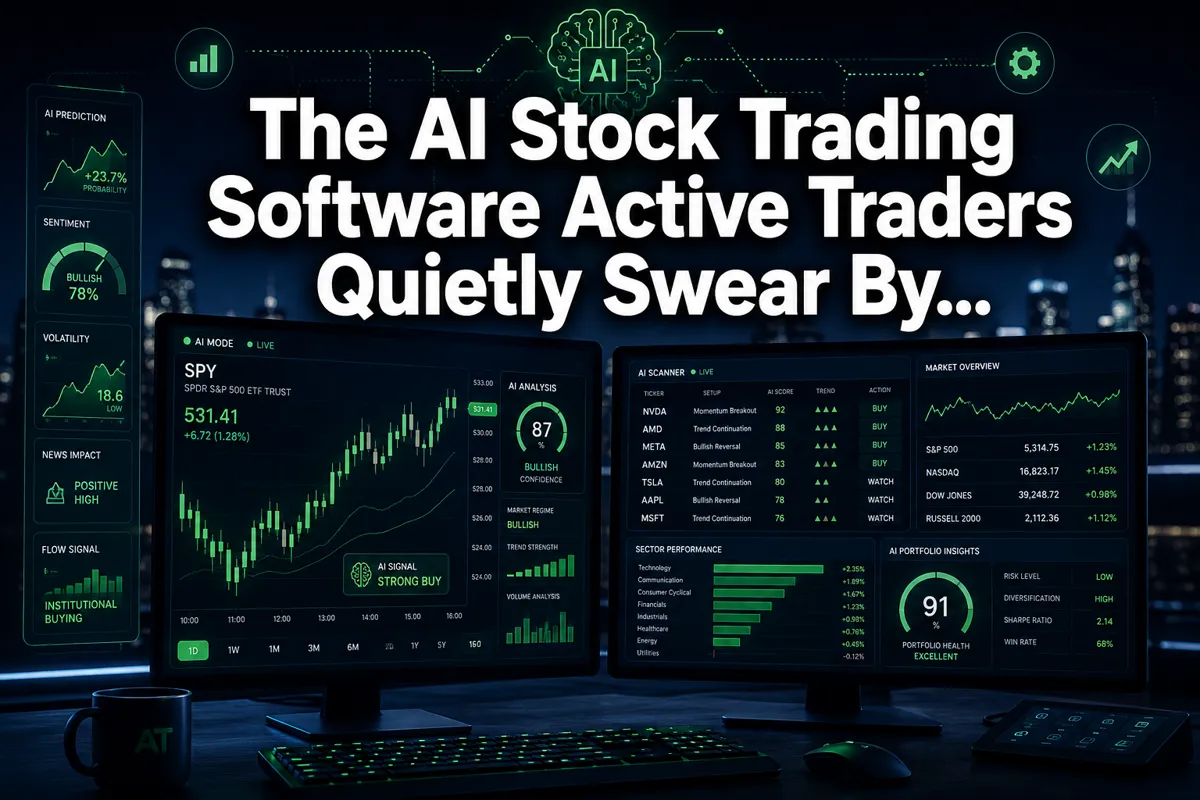
The AI Stock Trading Software Active Traders Quietly Swear By...
Last updated: June 17, 2026
Quick Answer: The AI stock trading software active traders quietly swear by are platforms that cut signal from noise — tools like TrendSpider, Trade Ideas, and Tickeron that automate chart analysis, surface clean setups, and enforce process discipline without replacing human judgment. They work best when traders use them as a system layer, not a magic button. The right tool depends on your style: day trader, swing trader, or long-term investor.
Key Takeaways
- AI stock trading software processes price action, volume, news sentiment, and pattern data faster than any human can manually scan.
- The best tools in 2026 — TrendSpider, Trade Ideas, Tickeron, and Capitalise.ai — each serve different trader profiles and time horizons.
- AI trading software is legal in the U.S. and internationally for retail investors; it does not guarantee returns and is not regulated differently than standard brokerage tools.
- Beginners can use AI trading tools successfully, but only after learning the basics of risk management, position sizing, and stop loss placement first.
- The biggest mistakes new traders make: over-automating too fast, ignoring risk-reward, and treating AI signals as certainties rather than probabilities.
- Free AI stock trading tools exist and are worth testing before committing to a paid platform.
- AI trading software does not replace discipline. Revenge trading and overtrading still destroy accounts even with the best software running.
- The honest answer on accuracy: AI tools improve the quality of your watchlist and setup identification. They do not predict the future.
The AI Stock Trading Software Active Traders Quietly Swear By...
The traders who consistently build edge aren't the loudest ones in the Discord. They're the ones who quietly built a process, found two or three tools that fit that process, and stopped looking for the next shiny thing.
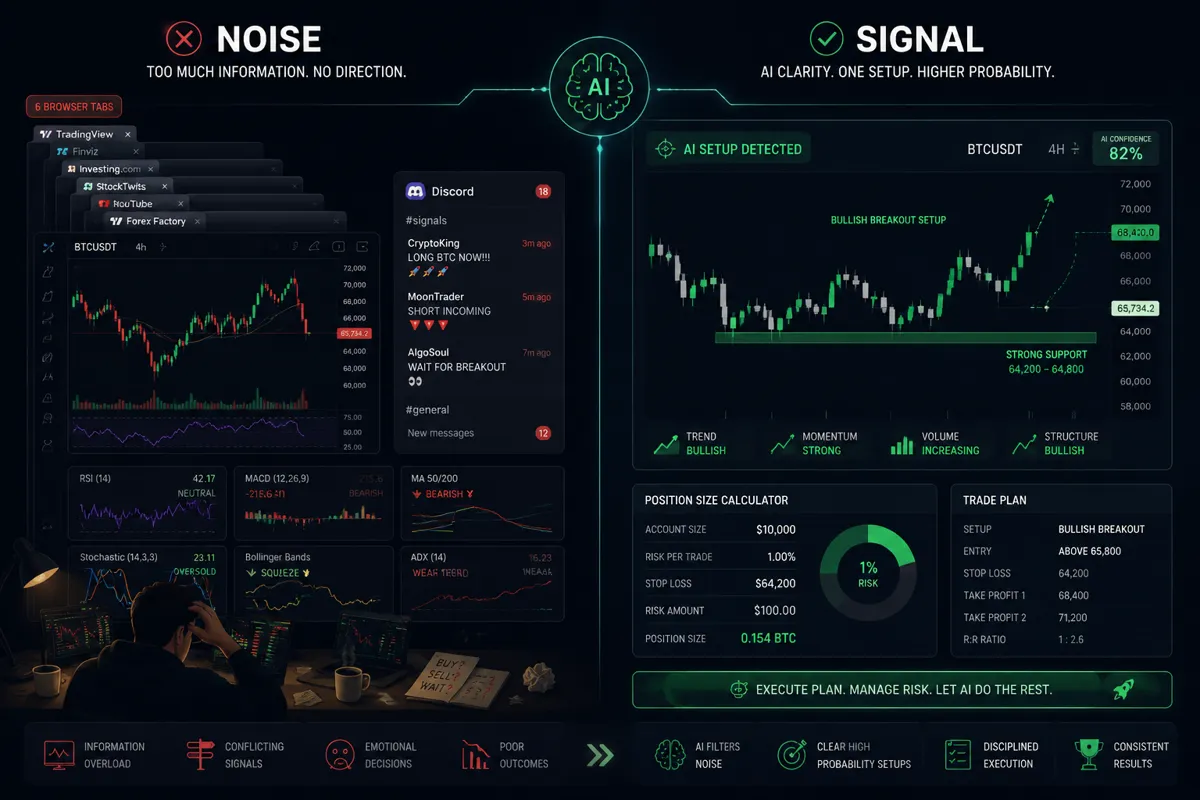
The AI stock trading software active traders quietly swear by shares a common trait: it reduces the number of decisions a trader has to make under pressure, not increase them. That's the whole job. Less noise, more signal.
Here's what that actually means in practice.
What AI stock trading software does:
- Scans thousands of tickers in real time and surfaces only the ones meeting your specific criteria (tight consolidation, volume surge, breakout from a base)
- Automates chart pattern recognition — flags bull flags, wedges, support and resistance levels — so you're not manually drawing lines on 50 charts at 9:30 AM
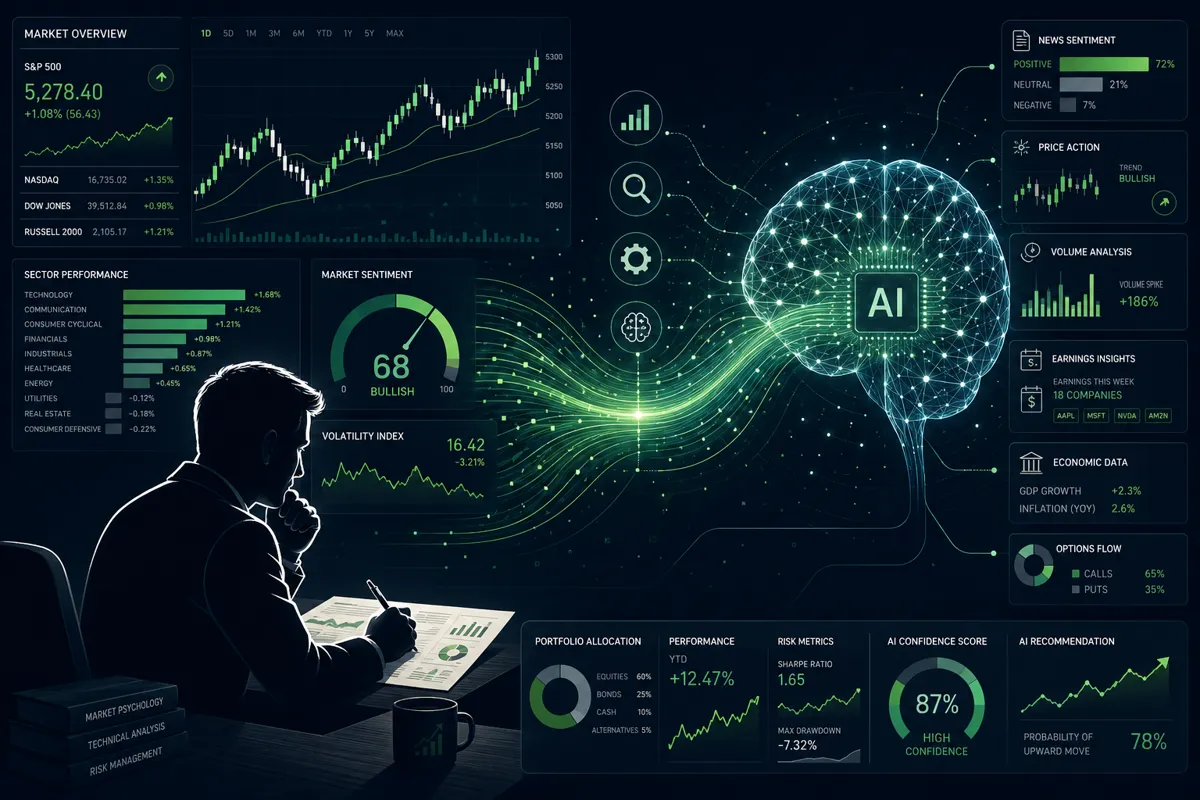
- Processes news sentiment and earnings data faster than any human reading headlines
- Backtests your strategy against historical price action so you know if your setup has a statistical edge before you risk real money
- Sends alerts when a setup triggers, so you're not staring at screens all day
The key distinction: the best AI stock analysis software surfaces the setup. You still make the trade decision. That separation matters enormously for risk management.
What Exactly Is AI Stock Trading Software and How Does It Work?
AI stock trading software uses machine learning algorithms and statistical models to analyze market data — price, volume, news, earnings, and sometimes alternative data like social sentiment — and generate actionable signals or automate trade execution.
At its core, it does three things:
- Pattern recognition — identifies chart formations (breakouts, basing patterns, dead cat bounces) faster and more consistently than manual analysis
- Screening and filtering — runs a customizable scanner across thousands of stocks simultaneously, returning only the setups that match your criteria
- Signal generation or automation — either alerts you to act or, in fully automated systems, executes the trade directly
The "AI" part ranges from simple rule-based logic (if price crosses above 20-day moving average AND volume is 150% of average, alert me) to genuine machine learning models trained on years of price action data. Most retail-facing tools sit somewhere in the middle: smarter than a basic screener, not as complex as a hedge fund quant system.
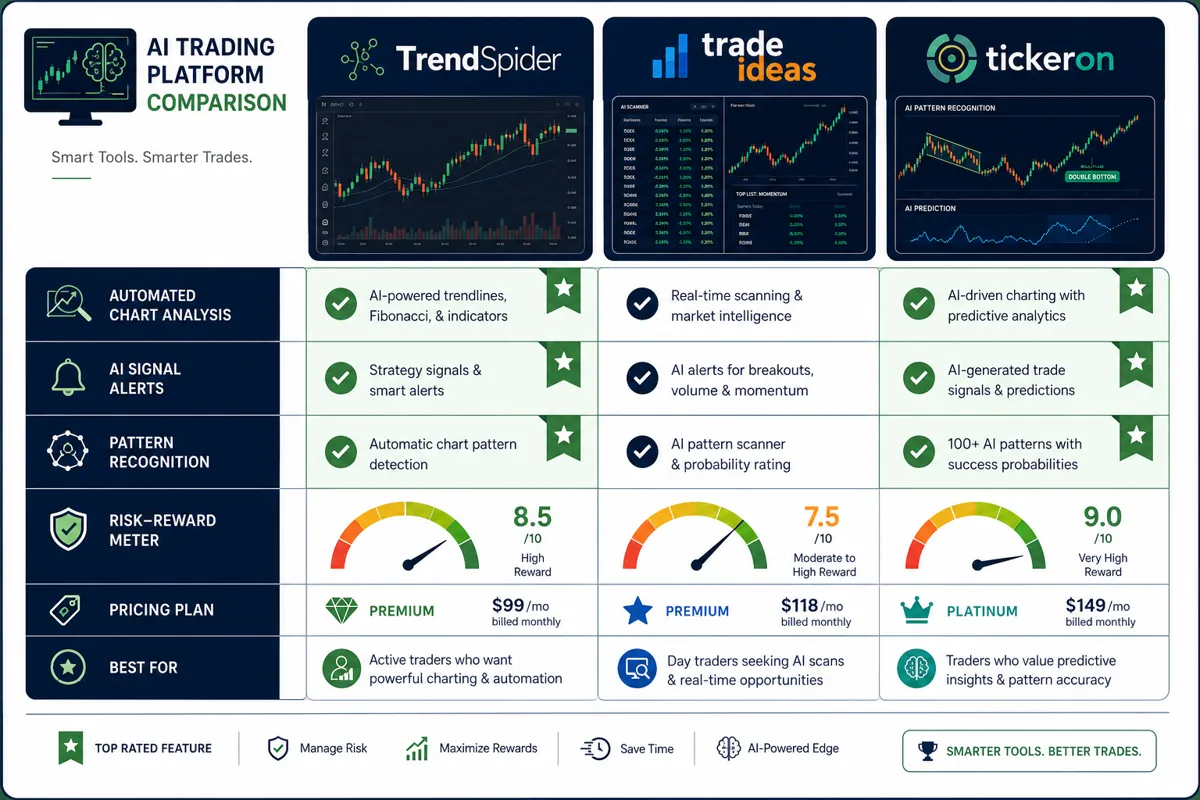
Tools like TrendSpider use automated technical analysis to draw trendlines, detect patterns, and run multi-timeframe analysis without manual input. Tickeron offers a full AI suite that includes pattern recognition, AI trend predictions, and portfolio analysis. Trade Ideas uses a proprietary AI engine called "Holly" that runs overnight simulations to generate a prioritized watchlist each morning.
None of them predict the future. They improve the quality of your process.
Which AI Trading Platforms Are Most Reliable for Day Traders and Swing Traders?
For active day traders and swing traders in 2026, the most consistently reliable platforms are TrendSpider, Trade Ideas, Tickeron, and Capitalise.ai. Each serves a different part of the workflow.
| Platform | Best For | Standout Feature | Price Range (2026) |
|---|---|---|---|
| TrendSpider | Swing + day traders | Automated chart analysis, multi-timeframe | $39–$79/mo |
| Trade Ideas | Active day traders | AI-generated morning watchlist ("Holly") | $118–$228/mo |
| Tickeron | All-in-one AI suite | Pattern recognition + AI trend predictions | $17–$188/mo |
| Capitalise.ai | Automation builders | No-code strategy automation | Free–$99/mo |
| Finviz Elite | Screener-first traders | Real-time scanning + heat maps | ~$40/mo |
A few things to know before picking one:
- Choose TrendSpider if you want to eliminate manual charting work and run automated technical analysis across multiple timeframes simultaneously.
- Choose Trade Ideas if you're a day trader who wants an AI-curated watchlist before the open rather than building one from scratch.
- Choose Tickeron if you want a full AI suite that covers scanning, pattern recognition, and portfolio-level analysis in one place.
- Choose Capitalise.ai if you want to automate a specific strategy using plain-English rules without writing code.
For a full side-by-side breakdown, the AI trading platforms comparison covers 100+ tools with structured scoring.
How Much Does Professional AI Trading Software Cost?
Most retail-grade AI stock trading software runs between $20 and $250 per month, depending on the feature depth and data quality. Professional or institutional-grade tools can run significantly higher.
The honest take: price doesn't equal performance. A $40/month tool used with discipline beats a $200/month tool used without a process. The question isn't what the software costs — it's whether it improves your risk-reward on enough trades to justify the subscription.
Cost tiers to know:
- Free / freemium — Finviz (basic), Stockanalysis.com, and some screener tools. Good for learning and filtering. Limited real-time data.
- Entry-level ($15–$50/mo) — Tickeron's base tiers, TrendSpider's starter plan, basic Capitalise.ai. Enough for most swing traders building a system.
- Mid-range ($50–$150/mo) — TrendSpider's full plan, Trade Ideas standard. Real-time data, advanced scanning, backtesting.
- Premium ($150–$300/mo) — Trade Ideas premium, institutional data feeds, advanced AI signal layers.
Paper trade it first. Most platforms offer a free trial. Use it to test whether the signals actually fit your style before paying for a year upfront.
Can Beginners Actually Use AI Stock Trading Tools Successfully?
Yes — but only if they understand what the tool is doing and why. Handing a beginner an automated trading bot without foundational knowledge of risk management is like giving someone a race car before they've learned to drive.
The tools that work well for beginners are the ones that explain their signals rather than just firing alerts. Platforms like Tickeron show the pattern it identified and the historical accuracy of that pattern. That's educational, not just directional.
What beginners should do before automating anything:
- Learn the basics: support and resistance, position sizing, stop loss placement, and risk-reward ratios. These aren't optional prerequisites — they're the difference between using AI as a tool and using it as a crutch.
- Use a free screener or the free swing trade planner to build a manual watchlist before relying on automated signals.
- Paper trade every strategy for at least 30 sessions before putting real money behind it.
- Start with swing trading tools rather than day trading automation. Slower time frames give more room to learn without getting stopped out on noise.
The FOFO (Fear of Finding Out) is real. Most beginners avoid backtesting because they don't want to know their setup doesn't work. That's exactly backward. Find out on paper, not with your account.
What Are the Biggest Risks of Using AI for Stock Trading?
The biggest risks aren't technical — they're behavioral. AI stock trading software doesn't eliminate bad habits; it can amplify them.
The real risks, ranked by how often they actually blow up accounts:
- Over-automation without understanding — running a bot on a strategy you haven't manually tested. When the market goes choppy, the bot keeps trading. You don't know why it's losing because you never understood why it was winning.
- Treating signals as certainties — AI tools generate probabilities, not predictions. A 70% historical win rate still means 30% of trades lose. If your position sizing doesn't account for that, one bad run wipes the gains.
- Revenge trading — the AI flags a losing trade, you override it, take a bigger position to "make it back," and compound the loss. Play stupid games, win stupid prizes. The software didn't cause this. The psychology did.
- Analysis paralysis — using five AI tools simultaneously and getting conflicting signals on every ticker. More tools is not more signal. It's more noise.
- Overfitting — backtesting a strategy until it looks perfect on historical data, then watching it fail in live markets because it was tuned to the past, not the present.
The fix for all of these is the same: systems over hacks. Build a defined process, test it, and follow it. The AI is a layer on top of that process, not a replacement for it.
Is AI Trading Software Legal and Approved by the SEC?
Yes. AI stock trading software is fully legal for retail investors in the United States and most international markets. The SEC regulates broker-dealers and investment advisers, not the analytical tools traders use to make decisions.
Using AI software to analyze stocks, generate signals, or automate trades through a registered broker is no different legally than using a spreadsheet or a charting platform. The tool itself isn't regulated — the broker executing the trades is.
A few important distinctions:
- If an AI platform provides personalized investment advice for compensation, it may need to register as an investment adviser under SEC rules. Most retail tools explicitly disclaim this.
- Fully automated trading bots that execute trades must do so through a registered broker-dealer. Platforms like Capitalise.ai and trading bot platforms connect to regulated brokers for execution.
- The SEC's investor education resources at Investor.gov cover what to watch for when evaluating any trading tool or service.
The legal risk isn't in using the software. It's in following unregistered "signal services" that promise guaranteed returns — which is a separate problem entirely.
How Do AI Trading Bots Compare to Human Stock Traders?
AI trading bots execute faster, scan more data, and never get emotional. Human traders have contextual judgment, adaptability, and the ability to recognize when market conditions have fundamentally changed.
Neither is categorically better. The traders who outperform tend to use both: AI handles the scanning, filtering, and rules-based execution; the human handles strategy design, risk management decisions, and recognizing when to step back from a choppy tape.
Where AI wins:
- Speed of execution and scanning
- Consistency in following a defined rule set
- Processing volume, news sentiment, and price action simultaneously
- Eliminating emotional entries and exits
Where human judgment wins:
- Recognizing structural market shifts (a bull trap forming, a sector rotation underway)
- Adapting a strategy when the setup stops working
- Managing position sizing in unusual volatility
- Knowing when not to trade
The trend is your friend — until it isn't. AI bots are excellent at riding defined trends. They're less reliable when the tape turns genuinely uncertain. That's when the human layer matters most.
What Mistakes Do New Traders Make When Using AI Trading Tools?
The most common mistake is expecting the software to do the thinking. The second most common is adding more tools when the first one doesn't immediately produce results.
The mistake list that actually costs money:
- Skipping the watchlist process — letting the AI generate signals without first understanding what kind of setups they represent
- No stop loss defined before entry — AI tools can identify the setup; they can't force you to define your exit before you're in the trade
- Overtrading during earnings season — AI scanners light up during earnings. More signals does not mean more edge. Most of those are noise.
- Ignoring position sizing — putting the same dollar amount on every trade regardless of the setup quality or volatility
- Chasing alerts — the AI fires an alert on a breakout, you enter late, the stock is already overextended, and you get stopped out on the pullback
The fix: use the stock health scorecard to evaluate setups before acting on any alert. Build the habit of checking risk-reward before entry, not after.
Can AI Trading Software Work for Retirement Investment Strategies?
Yes, with the right type of tool. For long-term retirement investing, the relevant AI tools are robo-advisors and AI-powered portfolio analysis platforms — not day trading scanners.
Platforms like Wealthfront, Betterment, and Empower use AI to automate portfolio rebalancing, tax-loss harvesting, and asset allocation based on your time horizon and risk tolerance. These are appropriate for retirement accounts.
Active day trading tools like Trade Ideas or TrendSpider are built for short-term price action and are not designed for retirement investing. Using a day trading scanner inside an IRA is a mismatch of tool and purpose.
For retirement-focused AI tools, the robo-advisors comparison covers the platforms built specifically for long-term, tax-efficient investing.
The rule: match the tool to the time horizon. Discipline beats prediction over a 30-year retirement horizon more than any signal ever will.
Are There Free AI Stock Trading Platforms Worth Testing?
Several free or freemium AI stock trading tools are genuinely useful for learning and initial screening. They're not as powerful as paid platforms, but they're a legitimate starting point.
Free tools worth testing in 2026:
- Finviz (free tier) — end-of-day screener with heat maps and basic filtering. Good for building a watchlist process.
- Stockanalysis.com — clean fundamental and technical data, free tier covers most basic needs.
- FullStack Alpha's free screener recipe builder — build custom screening criteria without a paid subscription.
- TradingView (free tier) — charting platform with community scripts and basic scanning. The free tier is more capable than most beginners need.
The honest limitation: free tools typically use delayed data (15–20 minutes), which makes them unsuitable for day trading but perfectly adequate for swing trading research and system building.
Use the free tools to build and test your process. Upgrade to paid data when the process is working and the cost is justified by your results.
How Accurate Are AI Stock Predictions Compared to Traditional Analysis?
This is the question everyone asks and the one that deserves the most honest answer: AI tools don't predict stocks with reliable accuracy, and neither does traditional analysis. What they both do is improve the probability of identifying high-quality setups.
The research on algorithmic and AI-based trading systems consistently shows that edge comes from process consistency and risk management, not from prediction accuracy. A strategy with a 55% win rate and a 2:1 risk-reward ratio is profitable over time. A strategy with a 70% win rate and a 0.5:1 risk-reward ratio is not.
What AI tools actually improve:
- Setup identification speed and consistency
- Reduction of emotional bias in entry decisions
- Backtested probability data for specific patterns
- News sentiment processing speed
What they don't improve:
- The fundamental unpredictability of short-term price movement
- Black swan events and macro shocks
- Earnings surprises that invalidate technical setups
For a deeper look at how AI prediction tools stack up, the AI prediction tools breakdown covers the platforms that publish verifiable track records — and the ones that don't.
Signal over noise. Data over noise. That's the standard every tool should be held to.
FAQ
What is the best AI stock trading software for beginners in 2026?
Tickeron and TrendSpider are the most beginner-accessible paid options because they explain their signals rather than just generating alerts. For free starting points, Finviz and Stockanalysis.com are solid. Start with a screener before moving to automation.
Does AI trading software actually work?
It works as a process layer, not a prediction engine. AI stock trading software improves setup identification, reduces emotional bias, and enforces consistency. It does not guarantee profitable trades. Traders who use it with a defined risk management process outperform those who treat it as a signal service.
Is AI stock trading software legal in the U.S.?
Yes. Retail investors can legally use AI trading tools to analyze stocks and automate trades through registered brokers. The software itself is not regulated by the SEC. Execution must go through a licensed broker-dealer.
What is TrendSpider used for?
TrendSpider is an automated technical analysis platform that draws trendlines, identifies chart patterns, and runs multi-timeframe analysis without manual input. It's particularly useful for swing traders who want to eliminate the time cost of manual charting.
What is Capitalise.ai?
Capitalise.ai is a no-code trading automation platform that lets traders write strategy rules in plain English and automate execution through connected brokers. It's designed for traders who want to automate a defined strategy without programming skills.
Can AI trading software work in a choppy tape?
Most AI trading tools underperform in choppy, range-bound markets because they're optimized for trending conditions. The best practice is to reduce position sizing and trade frequency when the tape is choppy — the same discipline a manual trader should apply.
How do I avoid overtrading with AI tools?
Set a maximum number of trades per day or week before you open the platform. Use the AI to build your watchlist, not to justify every alert it fires. More signals is not more edge.
What technical skills do I need to use AI trading software?
Most retail AI trading tools require no coding or technical background. You need to understand basic market concepts: support and resistance, position sizing, stop loss, and risk-reward. The software handles the computation; you handle the judgment.
Are there AI tools specifically for swing trading?
Yes. TrendSpider, Trade Ideas, and Tickeron all have features designed for swing trading time frames. The swing trading tools comparison covers the platforms best suited for multi-day holding periods.
What's the difference between a robo-advisor and an AI trading bot?
A robo-advisor manages a long-term portfolio automatically based on your risk profile and goals — designed for retirement and passive investing. An AI trading bot executes short-term trades based on technical signals. They serve completely different purposes and should not be confused.
Conclusion
The AI stock trading software active traders quietly swear by doesn't promise easy money. It promises a better process — and that's the only promise worth believing.
The tools that actually move the needle share three traits: they reduce noise, they surface clean setups faster than manual scanning, and they enforce the kind of consistency that discipline-first traders already practice. TrendSpider for automated charting. Trade Ideas for an AI-curated morning watchlist. Tickeron for a full AI suite. Capitalise.ai for no-code automation. Each one earns its place by doing one thing well, not by claiming to do everything.
The mistake most traders make isn't choosing the wrong tool. It's expecting the tool to replace the work. It won't. Risk management, position sizing, stop loss discipline, and the patience to let winners run — those are still on you.
What to do right now:
- Pick one tool from this article that matches your trading style and sign up for the free trial.
- Run it in paper trade mode for 30 sessions before using real capital.
- Compare the AI-generated watchlist to the one you'd build manually. Where does it add value? Where does it miss?
- Build the process first. Add automation after the process works.
Cut the noise. Keep the alpha.
We test the AI stock tools so you don't waste months on the wrong ones. Browse the full breakdowns at aistockpickerapp.com.