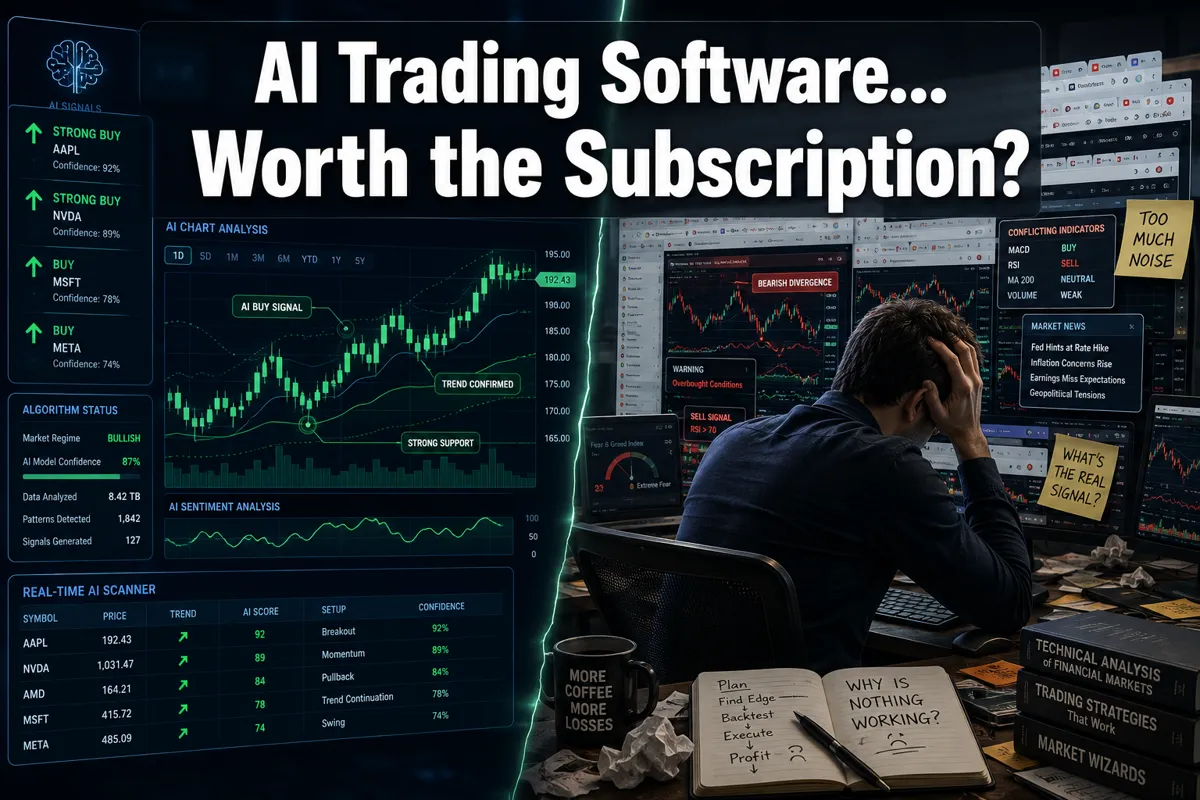
AI trading software...worth the subscription?
Last updated: June 30, 2026
Quick Answer: AI trading software can be worth the subscription — but only if you already have a defined trading process and understand what the tool actually does. For traders with no system, no risk management, and no experience reading price action, paying $50–$250/month for an AI tool won't save you. It'll just automate your mistakes faster.
Key Takeaways
- AI trading software ranges from free tiers to $254/month. The price doesn't determine the value — fit does.
- The best tools surface signals, scan setups, and automate analysis. They don't make decisions for you.
- TrendSpider ($52–$156/month), Trade Ideas ($127–$254/month), and Danelfin (free + $29/month) represent three very different use cases and price points.
- Backtesting results in AI tools are only as good as the assumptions baked in — past performance is not a guarantee of future results.
- Most traders who fail with AI software fail because of the same reason they failed without it: no process, no position sizing, no stop loss discipline.
- Free alternatives exist and are genuinely useful — but they have real ceilings.
- Paper trade any AI-generated signal for at least 30 days before putting real money behind it.
- The question isn't "can this tool make me money?" It's "does this tool make my process sharper?"
What Is AI Trading Software and How Does It Work?
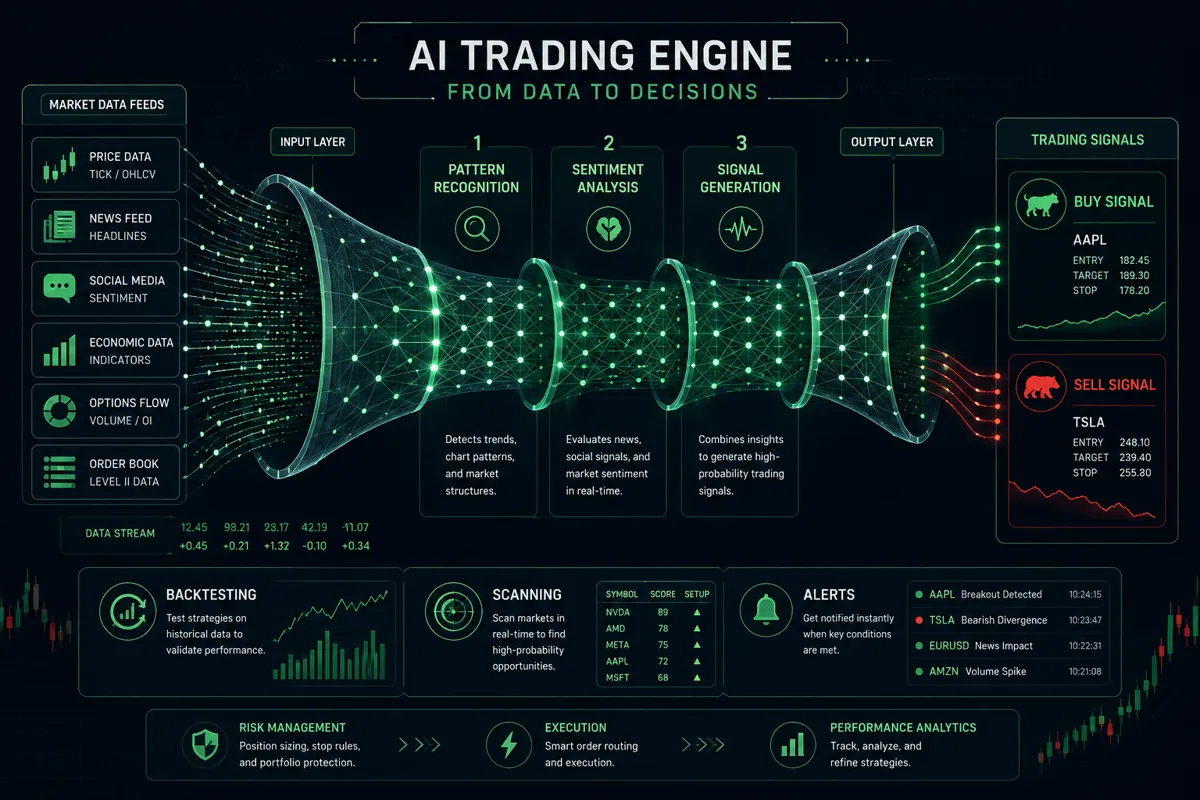
AI trading software uses machine learning, pattern recognition, and data processing to analyze market data and generate signals, alerts, or automated trades. Think of it as a very fast analyst that never sleeps, never gets emotional, and can scan thousands of tickers simultaneously — something no human trader can do manually.
Here's the basic mechanics:
- Data ingestion: The software pulls in price data, volume, news sentiment, earnings reports, options flow, and sometimes social media signals.
- Pattern recognition: Algorithms identify historical setups — things like tight consolidation before a breakout, support and resistance levels, or unusual options activity.
- Signal generation: Based on those patterns, the tool flags potential entries, exits, or risk levels.
- Execution (in some tools): Fully automated platforms can place trades directly through a connected brokerage account.
What it doesn't do: think. AI trading software doesn't understand context the way a seasoned trader does. It sees patterns. It doesn't know that the Fed just shifted tone, that a CEO just resigned, or that the broader tape is choppy and nothing is working cleanly. That gap between pattern recognition and market judgment is where most retail traders get burned.
AI Trading Software...Worth the Subscription? Here's the Honest Cost Breakdown
The price range for AI trading software in 2026 runs from genuinely free to eye-watering. Here's a realistic snapshot of what you're actually paying for:
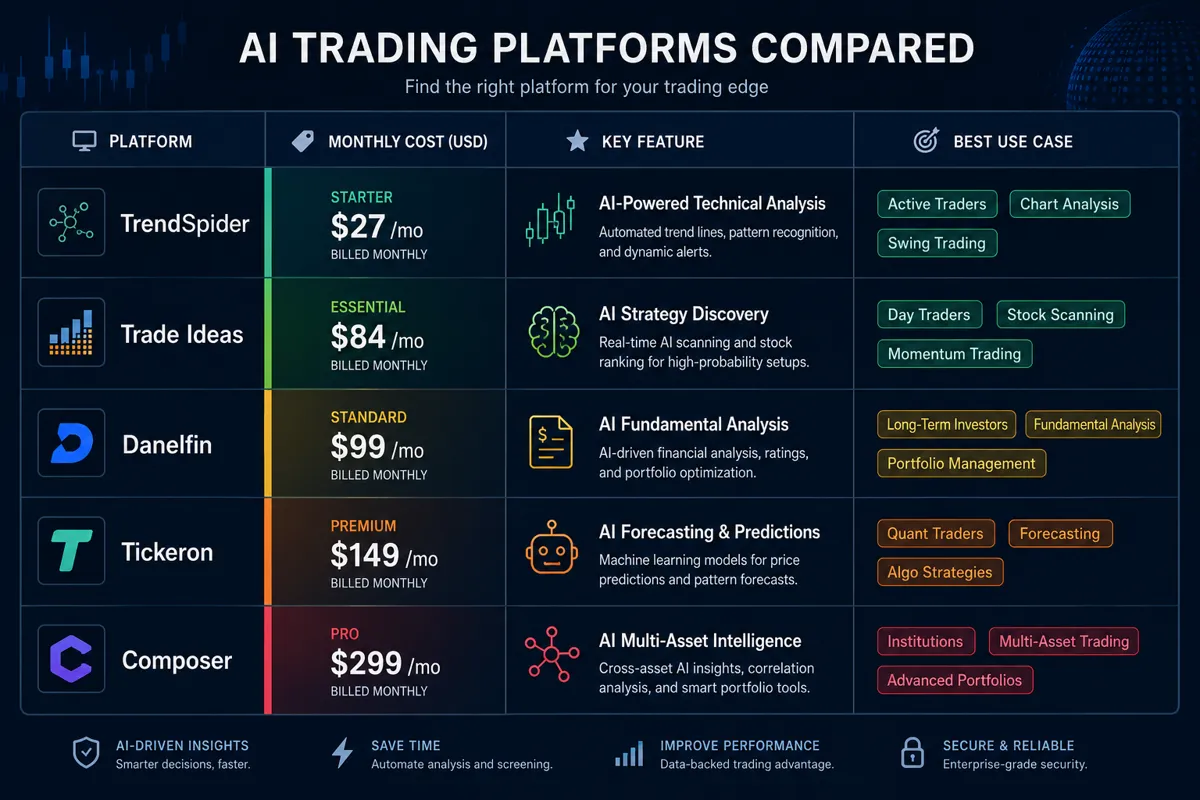
| Platform | Monthly Cost | Best For |
|---|---|---|
| Danelfin | Free tier + $29/month | Beginners, explainable AI scores |
| TrendSpider | $52–$156/month | Automated technical analysis, multi-timeframe |
| Tickeron | $5–$250/month | AI robots marketplace, pattern recognition |
| Composer | ~$19–$29/month | No-code strategy builder, passive automation |
| Trade Ideas | $127–$254/month | Active day traders, Holly AI pre-market scanning |
A TrendSpider pricing review comes down to one question: do you spend more than an hour a day drawing trendlines and checking multiple timeframes manually? If yes, $52/month to automate that is a steal. If you're checking one chart once a day, it's a waste.
A Trade Ideas subscription worth it analysis is similar. Holly AI — Trade Ideas' pre-market scanning engine — surfaces high-probability setups before the open. For a serious day trader running a defined system, $127–$254/month is a legitimate business expense. For someone who trades twice a week with no clear process, it's an expensive distraction.
A Danelfin pricing review is the easiest call: the free tier gives you AI-scored stock ratings with explainability built in (meaning it tells you why a stock scores high, not just that it does). At $29/month for the premium tier, it's one of the better value plays in the space for swing traders and investors.
The real AI trading software ROI question: If a tool helps you avoid one bad trade per month — say, a $300 loss you'd have taken without the signal — a $99/month subscription has already paid for itself. The math works. The discipline to actually use it correctly is the harder part.
Best AI Trading Software for Beginners in 2026
For beginners, the best AI trading software is the one that explains its reasoning, not just its output. A tool that says "buy this" without telling you why is just a black box — and black boxes are dangerous when you don't yet have the experience to sanity-check the signal.
Three solid starting points for beginners:
Danelfin — The explainable AI scoring system is genuinely beginner-friendly. You can see which technical, fundamental, and sentiment factors are driving a score. Free tier is real, not a bait-and-switch. Good for building conviction on swing trade ideas.
Composer — A no-code strategy builder that lets beginners construct rule-based trading strategies without writing a single line of code. It's a great way to learn how systematic trading actually works before spending serious money on more complex platforms.
TradingView — Not purely an AI tool, but its Pine Script community and built-in screeners with AI-assisted features make it the best starting canvas for beginners learning to read price action. The TradingView platform breakdown covers what's worth using on the free tier versus paid.
What beginners should avoid: fully automated execution tools with no manual override. If you don't understand what the bot is doing, you can't fix it when it goes wrong. And it will go wrong.
AI Trading Software vs. Manual Trading: Does the Data Actually Support It?
AI trading software doesn't automatically outperform manual trading — context matters enormously. In trending markets with clean setups, AI-assisted scanning and signal tools give traders a genuine edge by processing more data faster. In choppy tape with no clear direction, automated signals can generate false positives and get you stopped out repeatedly.
The honest comparison:
Where AI software wins:
- Pre-market scanning across hundreds of tickers (no human can do this manually)
- Removing emotional bias from entry and exit decisions
- Consistent application of rules — no revenge trading, no overtrading
- Backtesting a strategy across years of data in minutes
Where manual trading still wins:
- Reading the tape in real time during power hour
- Adjusting for macro context that isn't in the data
- Recognizing when the setup looks technically right but feels wrong (earnings season volatility, for example)
- Managing a position dynamically when news breaks mid-trade
The smart play isn't AI versus manual. It's AI-assisted manual trading — using the software to surface the watchlist and flag the setup, then applying human judgment to the entry and exit.
For a deeper look at automated execution tools, the trading bots comparison breaks down which platforms are genuinely autonomous versus which ones still require human confirmation.
Can AI Trading Software Actually Make Money?
Yes — but not in the way most people asking this question are hoping. AI trading software can improve decision quality, reduce emotional errors, and surface setups you'd miss manually. Whether that translates to profit depends almost entirely on the trader using it.
Here's the uncomfortable truth: the software doesn't have an edge. Your process has an edge. The software helps you execute that process more consistently.
A few things that actually determine whether AI trading software makes money for you:
- Your risk-reward discipline. If you're not cutting losers fast and letting winners run, no AI tool fixes that.
- Your position sizing. A great signal traded at 50% of your account is still a disaster waiting to happen.
- Market conditions. AI tools trained on bull market data can underperform badly in a bear market (more on that below).
- Your willingness to paper trade it first. Seriously. Paper trade any new AI-generated signal for 30 days before real money touches it.
Play stupid games, win stupid prizes. Buying a $200/month AI subscription and immediately trading full size on every signal it generates is a game with a predictable ending.
AI Trading Software Free Trials and Free vs. Paid Tiers
Most reputable AI trading platforms offer either a free tier or a trial period. Here's how to use them without wasting time:
Free tiers worth using:
- Danelfin's free tier gives real AI scores with genuine explanatory data
- Finviz's free screener is a legitimate starting point for building a watchlist
- TradingView's free tier covers basic charting and a limited number of indicators
What free tiers typically cut off:
- Real-time data (you get delayed quotes, usually 15–20 minutes)
- Advanced scanning filters
- Backtesting depth
- Automated alerts and execution
How to evaluate a free trial properly:
- Run the tool's signals against your existing watchlist for two weeks before trusting it
- Check whether the AI explanations match what you'd see reading the chart manually
- Test the scanner in both a trending day and a choppy day — tools that only work in one condition aren't worth paying for
- Calculate whether the time saved justifies the monthly cost at your current trading frequency
The AI trading platforms comparison covers free vs. paid breakdowns across the major tools in 2026.
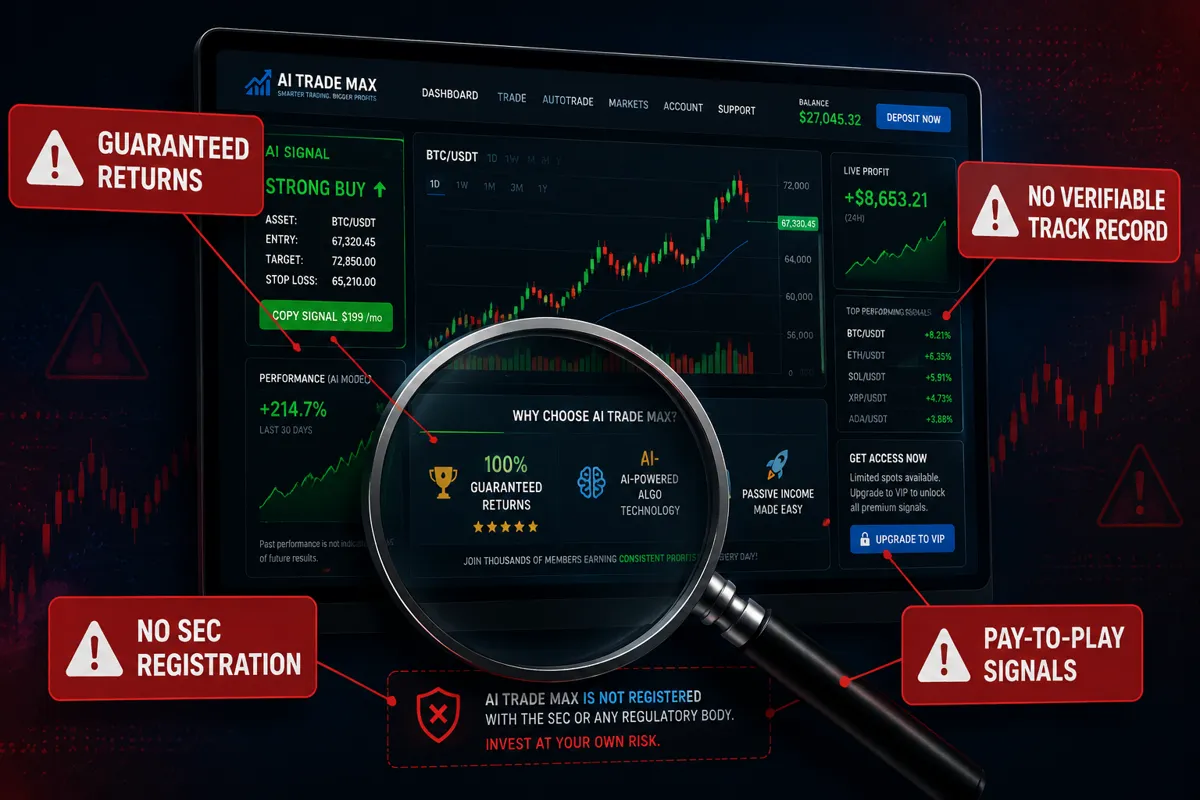
AI Trading Software Scams: Red Flags to Watch For
This is where FOFO — Fear Of Finding Out — costs traders real money. The AI trading space has a scam problem. Not every tool is fraudulent, but enough are that skepticism is the correct default setting.
Hard red flags:
- Guaranteed returns or specific win rates — No legitimate AI tool promises this. If a platform claims "87% accuracy" without a verifiable, audited track record, walk away.
- No SEC or FINRA registration for investment advice — If a tool is giving you personalized trade recommendations (not just signals or educational content), it may need to be registered. Check FINRA's BrokerCheck at finra.org.
- Pay-to-play signal groups — Platforms that charge you for "exclusive AI signals" delivered via Discord or Telegram are almost always selling noise dressed up as alpha.
- No verifiable backtesting methodology — If you can't see how the backtest was constructed, the win rate number is meaningless.
- Testimonials without verifiable track records — Screenshots of winning trades prove nothing. Anyone can screenshot a winner.
Yellow flags (proceed carefully):
- Very new platform with no independent reviews
- Overly complex fee structures
- Aggressive upsell pressure during free trial
That wasn't in our bingo card: some of the most sophisticated-looking AI trading platforms have the worst actual signal quality. Slick UI is not a proxy for edge.
Does AI Trading Software Work in a Bear Market?
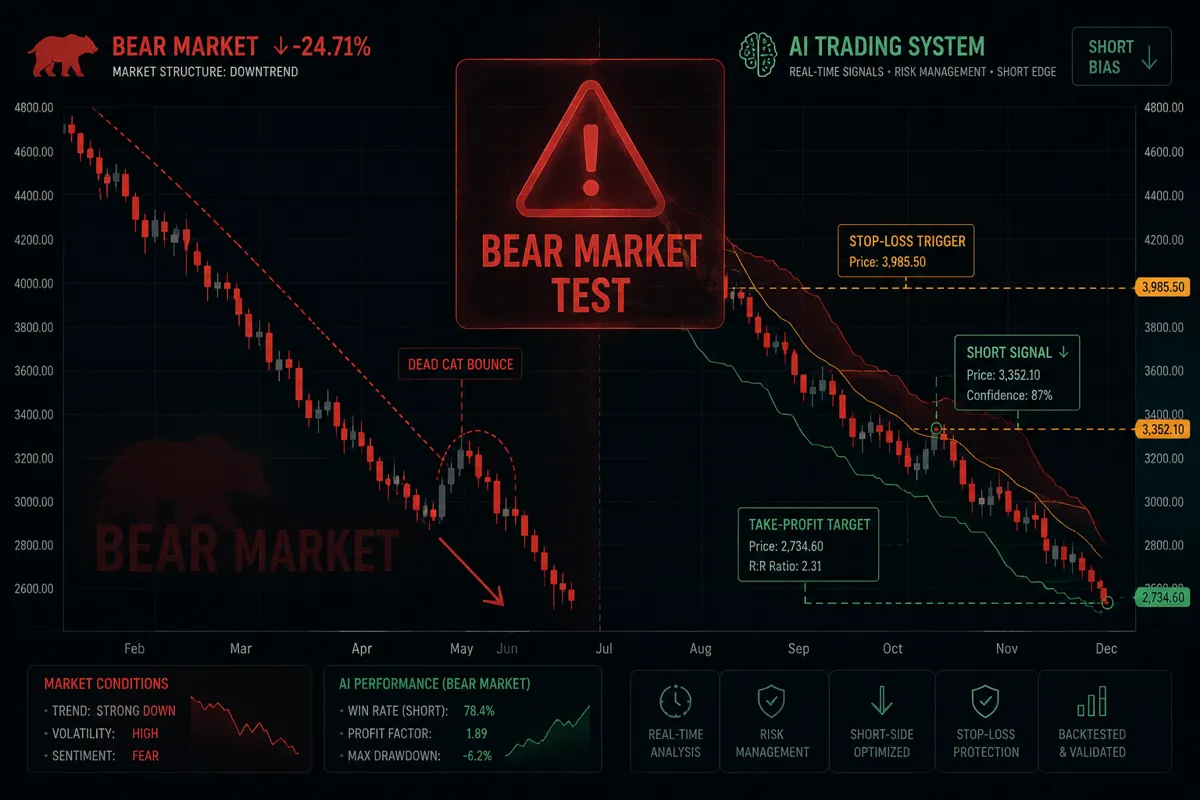
Most AI trading software performs worse in bear markets — and the ones that don't will tell you exactly why upfront. This is one of the most important questions to ask before subscribing.
The core problem: most retail-facing AI tools are trained predominantly on bull market data. When the market regime shifts — when the trend is no longer your friend and every bounce is a dead cat bounce or a bull trap — the pattern recognition that worked in an uptrend starts generating false signals.
What to look for in a bear-market-capable tool:
- Short-side signal generation (not just long setups)
- Regime detection features that flag when market conditions have shifted
- Volatility-adjusted position sizing recommendations
- Clear documentation of how the model was trained and what market periods it covers
Catching a falling knife is a real risk when AI tools keep flagging "oversold" conditions in a sustained downtrend. Oversold can get more oversold. A good AI tool should know that. A bad one will keep telling you to buy the dip.
AI Trading Software for Crypto vs. Stocks: Not the Same Animal
AI trading software built for stocks doesn't automatically translate to crypto — and vice versa. The data structures, market hours, liquidity profiles, and regulatory environments are fundamentally different.
For stocks:
- Market hours are defined (9:30 AM–4:00 PM ET), which makes backtesting cleaner
- Regulatory data (SEC filings, earnings reports) is structured and reliable
- Liquidity is generally higher in large-cap names, reducing slippage on signals
For crypto:
- 24/7 markets mean signals can trigger at 3 AM
- On-chain data adds a layer of analysis stocks don't have
- Volatility is higher, which means stop losses need to be wider — and position sizing tighter
- Regulatory uncertainty in 2026 still affects data availability for some platforms
If you're primarily a stock trader looking at AI tools, the day trading tools comparison and swing trading tools comparison are the right starting points. Don't buy a crypto-first AI tool and expect it to work on NYSE-listed equities.
Who Should Use AI Trading Software (and Who Definitely Shouldn't)
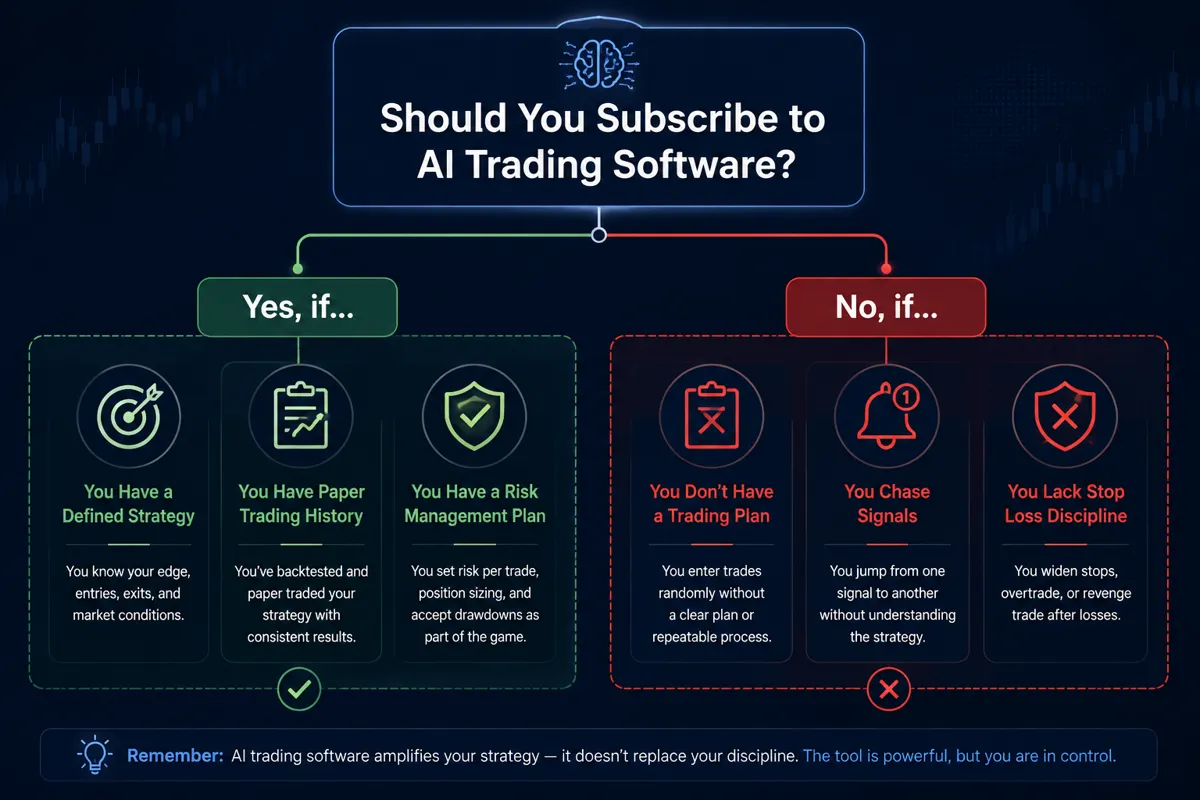
AI trading software is worth the subscription for a specific type of trader. It's a waste of money — or actively harmful — for another.
Use AI trading software if:
- You have a defined trading strategy and want to execute it more consistently
- You're spending more than 2 hours/day on manual scanning and analysis
- You understand risk management and position sizing already
- You're willing to paper trade signals before committing real capital
- You treat it as a tool that supports your process, not a replacement for one
Skip the subscription if:
- You don't have a written trading plan
- You're hoping the AI will tell you what to buy and you'll just follow it
- You're in analysis paralysis and think another tool will fix it (it won't)
- You're revenge trading after losses and looking for a "system" to get back to even
- You've never paper traded anything
The discipline beats prediction principle applies here hard. A trader with a simple, disciplined manual process will outperform a trader with a $250/month AI subscription and no process. Every time.
Common Mistakes Traders Make With AI Trading Software
The tool isn't usually the problem. Here's what actually goes wrong:
Mistake 1: Treating signals as certainties. AI signals are probabilities, not predictions. Every signal needs a stop loss and a defined exit. Getting stopped out on a signal isn't a failure of the AI — it's the cost of doing business.
Mistake 2: Overtrading the signals. More signals does not mean more profit. Overtrading is one of the fastest ways to blow up an account. Filter aggressively. Trade only the cleanest setups.
Mistake 3: Skipping backtesting validation. The AI trading software backtesting accuracy question matters enormously. Backtests can be curve-fitted — meaning the model was optimized on historical data in a way that won't hold up going forward. Always check the out-of-sample performance period, not just the headline win rate.
Mistake 4: Ignoring market context. A clean setup in a choppy tape is still a bad trade. The best AI tools flag market conditions. The best traders listen.
Mistake 5: Subscribing to too many tools. Tool overload is real. Three overlapping AI subscriptions giving conflicting signals is worse than one clear process. Systems over hacks.
The screeners and scanner tools comparison can help narrow down which single tool fits your workflow before you stack subscriptions.
What Features Actually Matter in AI Trading Software
Not all features are created equal. Here's what separates genuinely useful AI trading software from expensive noise:
Must-have features:
- Real-time or near-real-time scanning (delayed data kills day trading utility)
- Explainable signals (the tool tells you why, not just what)
- Customizable filters (you set the criteria, not just accept defaults)
- Backtesting with transparent methodology
- Risk management integration (stop loss suggestions, position sizing guidance)
Nice-to-have features:
- News sentiment analysis layered onto price action
- Options flow integration for confirmation
- Multi-timeframe analysis in one view
- Mobile alerts for watchlist triggers
Features that sound impressive but rarely deliver:
- "AI-powered predictions" without methodology disclosure
- Social sentiment scores from unverified sources
- Overly complex scoring systems that can't be explained in plain English
The signal over noise principle applies to feature sets too. A tool with five genuinely useful features beats a tool with fifty mediocre ones.
Alternatives to Paid AI Trading Software
Paid AI tools aren't the only path. Several free or low-cost alternatives deliver real value — with real limitations.
Finviz (free screener) — Solid for building a watchlist based on technical and fundamental filters. No AI signal generation, but the screening logic is clean and fast.
TradingView (free tier) — The best free charting platform available. Community scripts add AI-adjacent functionality. The ceiling on the free tier is real, but it's a legitimate starting point.
TD Ameritrade's thinkorswim — Free with a brokerage account. Powerful scanning and backtesting tools that rival paid platforms for traders willing to learn the interface.
Paper trading on any platform — Free, and the most underused tool in retail trading. If you're not paper trading new strategies, you're paying tuition in real money.
The honest caveat: free tools have real ceilings. If you're trading actively and your time has value, a $50–$100/month subscription that saves two hours of manual analysis per day is a rational business decision. The AI stock screeners comparison covers the free-versus-paid tradeoff in detail.
Is AI Trading Software Worth It? The Straight Read
Here's the straight answer on whether AI trading software is worth the subscription: it depends on whether you're buying a better process or buying a shortcut.
If you're using it to sharpen a process you already have — to scan faster, spot setups more consistently, and execute with less emotional interference — yes, it's worth it. The math on avoiding even one bad trade per month usually covers the subscription cost.
If you're buying it because you don't have a process and you're hoping the AI does the thinking for you — no, it's not worth it. You'll be out the subscription fee and the trading losses.
Cut the noise, keep the alpha. That's the whole game. The best AI trading software helps you do exactly that. The worst just adds to the noise you're already drowning in.
Frequently Asked Questions
Is AI trading software legal for retail traders in the U.S.?
Yes. Using AI trading software for your own account is completely legal. If a platform provides personalized investment advice for compensation, it may need to be registered as an investment adviser with the SEC or FINRA. Check finra.org to verify any platform's registration status before subscribing.
How long does it take to see results from AI trading software?
Realistically, plan for 30–90 days of paper trading before drawing conclusions. Markets cycle, and a tool that looks great in a trending week may underperform in a choppy one. Give it enough time across different conditions.
Can AI trading software replace a broker?
No. AI trading software analyzes and signals. A broker executes. Some platforms integrate directly with brokers for automated execution, but the brokerage relationship is separate.
What's the difference between AI trading software and a robo-advisor?
Robo-advisors manage long-term portfolios automatically based on your risk profile — think Betterment or Wealthfront. AI trading software is for active traders making frequent decisions. They're built for different time horizons and strategies. The robo-advisors comparison covers the passive investing side.
Does backtesting accuracy predict future performance?
No — and this is critical. Backtesting shows how a strategy would have performed on historical data. It doesn't guarantee future results, especially if the backtest was curve-fitted to that specific data set. Always look for out-of-sample testing periods.
What's the minimum account size to make AI trading software worth it?
There's no universal answer, but a rough rule: if your monthly subscription cost is more than 1% of your trading capital, the math gets difficult. A $200/month subscription on a $5,000 account means you need a 4% return just to break even on the tool cost.
Can I use multiple AI trading tools at once?
You can, but tool overload is a real trap. If two tools give conflicting signals, you'll end up in analysis paralysis. Pick one primary tool, master it, then add a second only if it fills a specific gap your primary tool doesn't cover.
Is there AI trading software specifically for options traders?
Yes. Several platforms specialize in options flow analysis and AI-assisted options strategy building. The AI options tools comparison covers the best options-focused platforms in 2026.
What happens if the AI signal is wrong?
You take the loss — which is why every AI signal needs a predefined stop loss before entry. The signal being wrong isn't the problem. Having no exit plan when it's wrong is the problem.
Is free AI trading software worth using or is it too limited?
Free tiers from reputable platforms (Danelfin, TradingView, Finviz) are genuinely useful for building process and testing signals. They're limited in real-time data and advanced scanning. For active day traders, those limitations matter. For swing traders and investors, free tiers can cover a lot of ground.
Conclusion: Build the Process First, Then Pick the Tool
The AI trading software question isn't really about the software. It's about whether you have something worth automating.
A trader with a clean, repeatable process — defined entry criteria, a stop loss on every trade, consistent position sizing, and a watchlist built on actual setups — will get genuine value from AI trading software. It'll make the process faster, sharper, and less emotional.
A trader without that foundation will spend $100–$250/month automating confusion.
Here's what to do right now:
- Write down your trading process in plain English. Entry criteria, exit criteria, stop loss rules, position sizing. If you can't do this in one page, you don't have a process yet.
- Pick one AI tool that fits your style (day trading, swing trading, or investing) and use the free tier or trial for 30 days.
- Paper trade every signal for those 30 days. Track the results.
- At the end of 30 days, calculate whether the tool improved your hit rate or your risk-reward. If it did, subscribe. If it didn't, move on.
Data over noise. Consistency over hype. Discipline beats prediction.
The AI trading software ROI question answers itself when you have a process to measure it against.
We test the AI stock tools so you don't waste months on the wrong ones. Browse the full breakdowns at aistockpickerapp.com.