Best Broker for Day Trading a $2,000 Account | 5 Compared for 2026

The $25,000 velvet rope that kept small accounts out of active trading for a quarter century came down on June 4, 2026, when FINRA's amended Rule 4210 wiped the pattern day trader flag off accounts nationwide. If you're a new trader with $2,000 and a plan, the question isn't whether you're allowed to day trade anymore. It's which broker actually earns your money. Finding the best broker for day trading a $2,000 account now matters more than finding the rule workaround, because the workaround is gone and the real decision, execution quality, cost, and tools, is what's left.
Quick Answer
For most traders funding a $2,000 account in 2026, the best broker for day trading comes down to five names: Webull, Robinhood, Interactive Brokers, Schwab's thinkorswim, and TradeZero. Webull and thinkorswim fit beginners who want free tools and strong charting. TradeZero and Interactive Brokers fit traders who want hotkeys and a desk-style platform. None of them turn $2,000 into a living on their own.
Quick pick: best broker for day trading a $2,000 account
- Webull: Best for a free platform with desktop hotkeys. Price: $0 commission.
- TradeZero: Best for attachable hotkeys. Price: $59/mo for ZeroPro, free on TZ1.
- Thinkorswim (Schwab): Best for charting depth and futures access. Price: $0 commission.
Skip it if: you want hands-off, passive investing instead of active day trading.
Key Takeaways
- The pattern day trader rule ended on June 4, 2026, and Interactive Brokers and Webull implemented the change on day one, while Schwab rolled out up to 4x intraday buying power starting July 13.
- Robinhood wiped its PDT flags on June 4 too, then announced 4x intraday buying power on September 29, rolling out the following month, with OCO (one cancels other) orders due in October.
- Webull's equity notional volume jumped 73% year over year to $279 billion after the repeal, a sign of how many small accounts walked through the open door at once.
- The standard margin account minimum across most U.S. brokers, including Schwab, sits at $2,000, the same Reg T floor that's existed for decades, now unlocked for actual day trading.
- TradeZero's ZeroPro platform costs $59 a month (free once you trade 100,000 shares a month) and comes with 16 attachable hotkeys, a detail that matters more than people think.
- Reddit users describe thinkorswim's interface bluntly: "The TOS UI is geriatric at best."
- No broker fixes a bad process. The best broker for day trading gives you speed and tools; the account still needs a system behind it.
What is the best broker for day trading with $2,000?
The best broker for day trading with $2,000 is the one that gives you clean, fast execution, a real margin account at the standard $2,000 minimum, and platform tools you'll actually use before your stop loss gets hit. For most new traders in 2026, that short list is Webull, thinkorswim, TradeZero, Interactive Brokers, and Robinhood, each with a different personality and a different catch.
Here's the context that changed everything: for 25 years, the pattern day trader (PDT) rule required $25,000 in equity before an account could place more than three day trades in five business days. A $2,000 account was locked out of real day trading, full stop. The repeal didn't lower the bar to zero. It moved the floor back to the ordinary margin account minimum, $2,000, that's governed brokerage accounts for decades.
Pattern day trader rule explained
The pattern day trader rule is a FINRA regulation that once required $25,000 in account equity to day trade stocks freely in a margin account. As of June 4, 2026, that specific $25,000 threshold no longer applies the way it used to, and the standard $2,000 margin minimum governs instead. Our full PDT rule breakdown covers the mechanics if you want the long version, and our Robinhood-specific explainer covers how one broker handled the transition.
Do I need a margin account for day trading?
Yes. Day trading, buying and selling the same stock within one trading session, almost always requires a margin account rather than a cash account, because cash accounts make you wait for trades to settle and will freeze you out with "good faith violations" if you try to trade the same dollars twice in a week. A margin account also gives you intraday buying power beyond your cash balance, which is the entire point of leverage in a small account.
Can you day trade with $2,000?
Yes, as of the June 2026 rule change, you can open a margin account with $2,000 at most major U.S. brokers and day trade without hitting the old pattern day trader restriction. What you can't do is trade size that requires $25,000 in account equity, use unlimited leverage, or expect the account to behave like a professional trading desk. The math on how much $2,000 can realistically produce is further down this page, and it's not flattering.
Best broker for day trading: what matters for a small account?
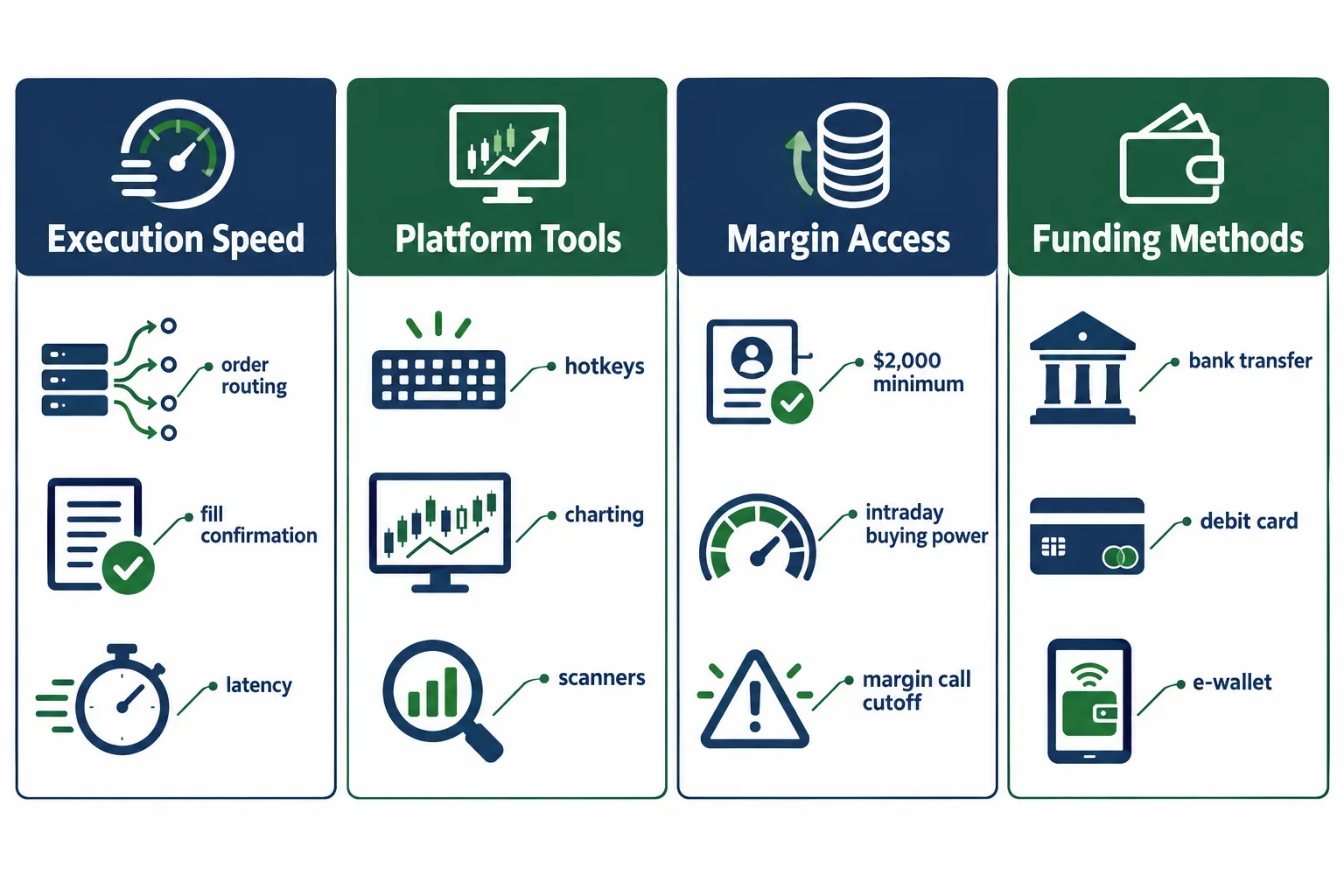
What matters for a small account isn't the broker with the flashiest app. It's execution speed, real cost per trade, margin access at the $2,000 floor, and platform tools that don't require a finance degree to operate under pressure. The best broker for small account day trading treats $2,000 like money that matters, because for the person trading it, it does.
Four things decide whether a broker is worth your $2,000:
- Execution speed. How fast does an order actually fill, and does the broker route it somewhere that gets you a fair price.
- Cost structure. Commissions, spreads on options contracts, and any hidden data or platform fees.
- Margin and buying power. What you get at the $2,000 minimum, and what triggers a margin call.
- Platform and hotkeys. Can you cut a losing position in one keystroke, or are you hunting through menus while the trade runs away from you.
Day trading broker fees and commissions comparison
Most of the five brokers compared here charge $0 commission on U.S. stock trades, which flattens one variable but not all of them. Options contracts, data subscriptions, and margin interest still vary. Webull, Robinhood, Schwab, and TradeZero's TZ1 platform all advertise commission-free equity trading, while TradeZero's ZeroPro desktop platform runs $59 a month unless you clear 100,000 shares traded that month, at which point it's free.
The real cost difference between brokers rarely shows up as commission dollars. It shows up as spreads on thin option chains, as slippage on market orders during volatile opens, and as the gap between the price you wanted and the price you got.
Which brokers have the lowest day trading minimums?
The lowest day trading minimum across the five brokers compared here is the same $2,000 margin account floor at Schwab, Webull, Interactive Brokers, and Robinhood, since that's the standard Reg T requirement, not a broker-specific discount. TradeZero's exact minimum for margin access should be confirmed on its own pricing page before you fund an account, since broker minimums can shift.
Day trading broker with best charting tools
Schwab's thinkorswim platform is widely regarded as having the deepest free charting and scanning toolkit of the group, built for traders who want to study price action, support and resistance, and multiple timeframes without paying extra. TradeZero's included ProScanner and Webull's built-in charting cover the basics well, but neither matches thinkorswim's depth for technical analysis. If you'd rather build your watchlist on TradingView instead, see our comparison of free charting platforms before picking a broker around that workflow.
Best day trading platforms for fast execution
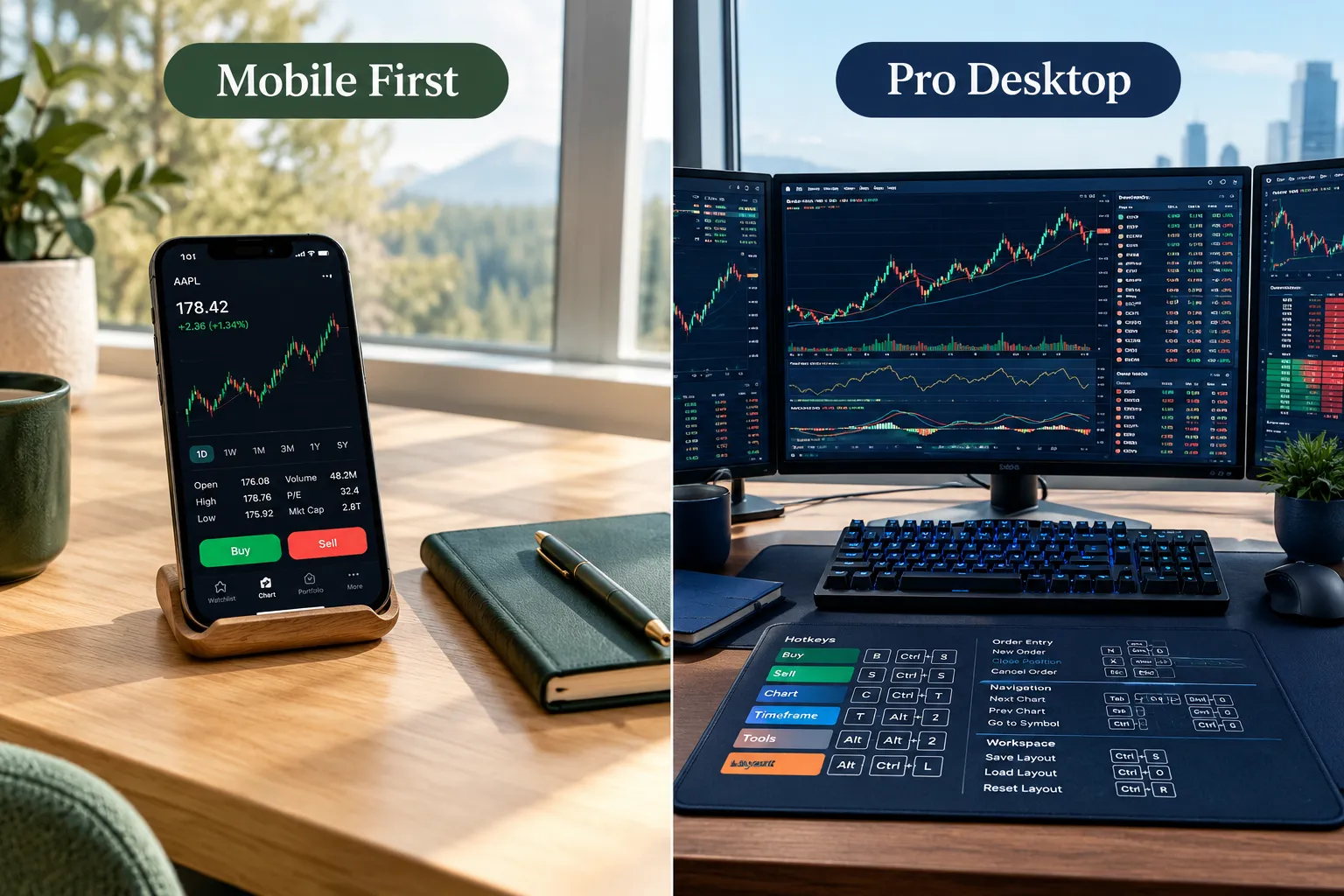
The best platform for day trading is the one whose exit key you can find under pressure. Execution speed decides whether your entry and exit happen at the price you saw on screen or three ticks worse. Interactive Brokers' TWS platform is free and built with hotkeys like Close Position and Cancel All Orders designed for speed, though Reddit threads note the API requires a weekly re-login and the platform had a reported outage on August 5, 2026. TradeZero's ZeroPro ships with 16 attachable hotkeys out of the box, which matters a lot more than it sounds like at 9:31 a.m. during a breakout.
How do the 5 brokers compare on margin, tools and cost?
Here's the side-by-side for anyone choosing the best broker for day trading on $2,000. Each of these five brokers implemented the PDT repeal differently, and the differences show up in buying power, platform quality, and where the catch is hiding.
| Broker | Minimum for margin | Intraday buying power | Platform and hotkeys | Notable drawback | Cost |
|---|---|---|---|---|---|
| Webull | $2,000 | Implemented June 4, 2026; exact multiplier varies by tier, check live margin page | Free desktop and app, built-in hotkeys | Margin multiplier not confirmed here, check its margin page | $0 commission |
| Robinhood | $2,000 | 4x announced September 29, 2026, rolling out; OCO orders due in October | Mobile-first app | 4x and OCO orders were announcements still rolling out | $0 commission |
| Interactive Brokers | $2,000 | Implemented June 4, 2026 | Free TWS with hotkeys (Close Position, Cancel All Orders, auto stop) | Weekly API re-login; reported August 5, 2026 outage | Free platform, tiered per-trade cost |
| Schwab (thinkorswim) | $2,000 | Up to 4x from July 13, 2026; positions must close by 8 p.m. ET to avoid margin calls | Free, customizable hotkeys | Interface widely called dated by users | $0 commission |
| TradeZero | Confirm on official pricing page | Confirm on official pricing page | ZeroPro: 16 attachable hotkeys, ProScanner included; TZ1 free | ZeroPro costs $59/mo unless 100,000 shares traded | $59/mo or free past volume threshold |
Webull is the broker most beginners land on first: free, fast enough for most small-account strategies, and the one whose volume data proves people are actually using it, equity notional volume rose 73% year over year to $279 billion after the PDT repeal, according to 24/7 Wall St's August 2026 reporting. Pros: free platform, desktop hotkeys, $0 commission. Cons: confirm its intraday margin terms on the official page, and a free, frictionless app makes overtrading easy.
Robinhood cleared PDT flags the same day as everyone else but lagged on the pro features that matter mid-trade. Pros: dead-simple interface, $0 commission, finally offering 4x intraday buying power. Cons: 4x buying power and OCO orders were announcements still rolling out, and it is a mobile-first app, not a hotkey desk.
Interactive Brokers is the broker most cited as the overall top pick for serious active traders, largely because TWS is genuinely free and genuinely fast, per NerdWallet's day trading broker rankings. Pros: free professional-grade platform, deep hotkey set, forex and futures access on top of equities. Cons: the learning curve is real, and the reported weekly API re-login requirement is a legitimate annoyance for anyone running automated trading scripts on top.
Schwab's thinkorswim gives you Wall Street-grade charting for $0, which is why it keeps showing up on Investopedia's best day trading broker list. Pros: strong charting, customizable hotkeys, up to 4x intraday buying power since July 13. Cons: the 8 p.m. ET close requirement to dodge a margin call is a real constraint, and the interface earns blunt reviews, as one Reddit user put it, "The TOS UI is geriatric at best."
TradeZero is built for people who already know what a hotkey is for. Pros: 16 attachable hotkeys in ZeroPro, ProScanner included, TZ1 free. Cons: ZeroPro's $59 monthly fee is a real cost on a $2,000 account unless you're trading enough volume to waive it, and its margin terms need confirming on the official page.
Which broker fits which kind of trader?
The best broker for day trading depends on what kind of trader you are, not what app looks the cleanest. A beginner who wants to learn without drowning in hotkeys needs a different setup than someone who already knows their entry and exit rules and just wants speed.

Best brokers for day trading beginners
If you want the best day trading platform for beginners, Webull and thinkorswim are the two strongest fits, because both are free, both have genuinely useful charting, and neither requires a hotkey setup before you can place your first trade. Our guide to the best stock apps for day trading breaks down the mobile-first options in more depth if that's your entry point.
Best broker for day trading stocks vs options
If you're trading stocks, Webull, Robinhood, and thinkorswim all handle the basics fine, and commissions are a non-issue since all three are $0 on equities. If you're trading options on a $2,000 account, thinkorswim's options chain analytics and Interactive Brokers' execution quality pull ahead, because options spreads eat small accounts alive faster than stock commissions ever will. Our options trading platform comparison goes deeper on that specific decision.
Brokers that don't restrict day trading
All five brokers covered here removed their internal pattern day trader restrictions in step with the June 4, 2026 FINRA change, meaning none of them will flag or freeze a $2,000 margin account for trading frequency the way they would have in 2025. That said, "doesn't restrict day trading" isn't the same as "has no rules." Margin calls, buying power limits, and options approval tiers still apply everywhere.
Is day trading worth it on a small account?
Day trading a $2,000 account is legally possible now, but the math on whether it's worth it depends entirely on your process, not your broker. Our honest breakdown of what day trading actually costs runs the numbers most new traders skip before funding an account. If you want the slower, workaround-based path that existed before the rule change, this piece on day trading without $25,000 is still worth reading for context.
How does day trading compare with other trading strategies at these brokers?
Day trading demands the fastest execution and the tightest spreads of any strategy these brokers support, because you're paying the cost of entry and exit multiple times a day instead of once. Swing trading and long-term investing care less about execution speed and more about research tools and fees over time. If a $2,000 account and tight stop losses sound exhausting before you've even started, our swing trading tools roundup and how to start day trading guide can help you figure out which pace actually fits your temperament.
What can a $2,000 account not do, at any broker?
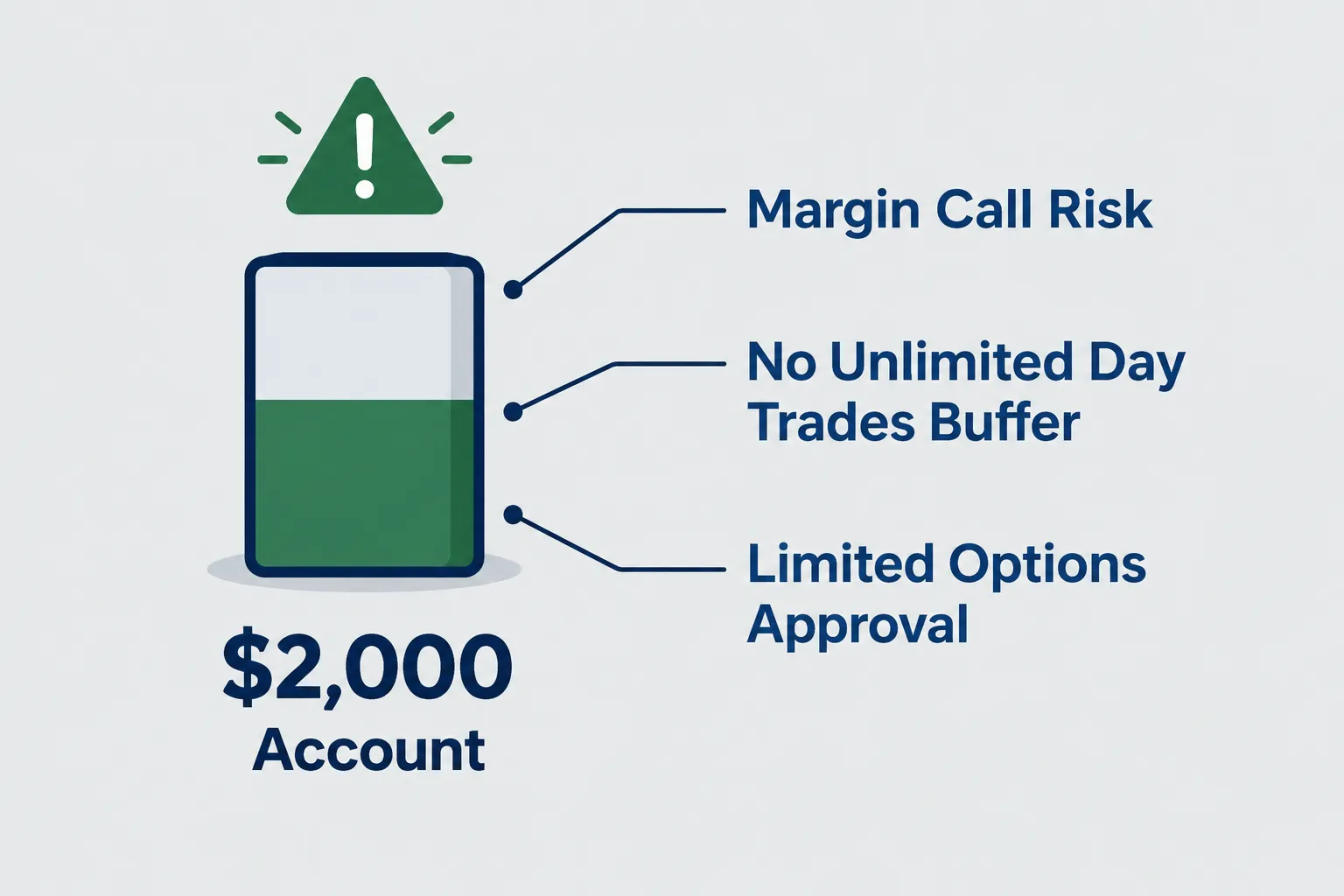
A $2,000 account cannot access the old $25,000 pattern day trader exemption's original purpose, which was giving large accounts room to absorb losing trades without a margin call. No broker, no matter how good its execution or hotkeys, changes that math. Position sizing and risk management matter more on a small account, not less.
How much can you make day trading with $2,000?
There's no honest number here, and anyone giving you one is selling something. A $2,000 account with disciplined position sizing, a 1% to 2% risk per trade, and a real edge might compound slowly over months. It might also hit a string of losses and get cut in half in a week. Day trading performance on a small account depends on process, not on which broker's logo is on the app, and nobody can promise you a daily dollar figure because the market doesn't take promises.
Common mistakes new day traders make with brokers
The most common mistake is treating a broker's margin and leverage as a budget instead of a tool, trading size that assumes a win instead of planning for the loss. The second most common mistake is chasing every hotkey feature before learning entry and exit discipline. The third is revenge trading after a loss, doubling size to "make it back" instead of walking away. Play stupid games with a $2,000 account and leverage, and you'll win stupid prizes.
A few more that show up constantly:
- Overtrading because the app makes it frictionless, not because there's a setup worth taking.
- Skipping a stop loss because "it'll come back," then watching it not come back.
- Confusing a broker's fast execution for a strategy. Speed helps you execute a plan. It doesn't create one.
- Ignoring margin call rules, like Schwab's 8 p.m. ET close requirement, and getting a forced liquidation instead of a clean exit.
Systems over hacks. A broker with great hotkeys still needs a trader with a stop loss and a plan behind the keyboard.
What do real users say?
Ask real users about the best broker for day trading and they are more blunt than any marketing page will be, especially about the brokers that have been around long enough to collect Reddit threads. The clearest example is thinkorswim's interface, where a Reddit user who built a free, open-source scanner on top of the platform summed up the UI in one line: "The TOS UI is geriatric at best."
On the Interactive Brokers side, Reddit threads in trading subs describe a recurring friction point rather than a single quote: the IBKR API requires a weekly re-login to stay connected, and users reported a platform outage on August 5, 2026. That's not a deal-breaker for most manual day traders, but if you're planning to bolt automated trading scripts onto IBKR's API, it's worth knowing before you build around it.
The pattern across both complaints is the same: the free, powerful platforms (thinkorswim, TWS) ask you to tolerate a rougher experience in exchange for depth. The newer, slicker apps (Webull, Robinhood) trade some of that depth for a smoother first week. Neither tradeoff is wrong. It depends on what kind of trader you are.
What are the alternatives?
If none of these five is your best broker for day trading, the alternative field is wider than it's ever been, because the PDT repeal pulled nearly every broker into the small-account conversation at once. TradeStation is frequently cited alongside this group as a leading day trading broker for 2026, with a platform built specifically around active trading rather than retrofitted for it, per Investopedia's broker rankings.
If you're hunting for the best futures broker for small accounts, the criteria shift again, margin requirements per contract matter more than per-share commissions, and our futures broker comparison covers that specific setup. For traders who'd rather have software make the calls, automated trading bots and fully automated trading tools are a different risk profile entirely, closer to running a system than sitting at the screen reading the tape yourself. Copy trading services, where you mirror another trader's moves instead of placing your own, sit somewhere in between, and they're worth understanding before you hand your $2,000 to someone else's strategy.
Final Verdict
There's no single best broker for day trading every $2,000 account, because the right pick depends on whether you value free charting, raw execution speed, or hotkey depth most. Webull and thinkorswim are the strongest starting points for beginners who want $0 commissions and solid tools without a learning curve attached. TradeZero and Interactive Brokers are the stronger picks once you know your entry and exit rules and want the platform to keep up with you instead of slowing you down.
Robinhood closed part of the gap in 2026, with 4x buying power and OCO orders announced. None of the five, including the strong ones, make a $2,000 account into something it isn't. The broker handles execution. You still have to handle discipline, position sizing, and the stop loss. Pick the broker that matches the trader you actually are, not the one you're hoping to become by Friday.
Stop guessing which platform fits a small day trading account. We sorted the day trading tools and brokers that matter by execution, cost, and what they actually offer: see the full day trading shortlist.
FAQ
Is $100 enough for day trading?
Not really. Most margin accounts require $2,000 to day trade at all, so $100 won't open the door at the brokers covered here. You could trade a cash account with $100, but settlement rules and tiny position sizes make it closer to a lesson in patience than an actual day trading strategy.
Can you day trade with $2,000?
Yes. Since the June 4, 2026 FINRA rule change, $2,000 is the standard margin account minimum needed to day trade at most U.S. brokers, including all five compared in this guide. You're not exempt from margin calls or buying power limits, but the old $25,000 pattern day trader barrier no longer applies.
Which broker is best for beginners who day trade?
For a beginner, the best broker for day trading is usually Webull or Schwab's thinkorswim, since both are free, both offer solid charting, and neither demands a hotkey setup before your first trade. Robinhood is simpler still, with OCO orders announced for October 2026.
Which broker works with TradingView?
TradingView connects to a list of partner brokers for order execution, and that list changes. If you want the best broker to use with TradingView for beginners, start from the supported broker list on TradingView's own site, then apply the same four tests above: execution, cost, margin and platform.
Do I still need $25,000 to day trade?
No. The $25,000 pattern day trader requirement ended on June 4, 2026, when FINRA amended Rule 4210. The standard margin account minimum of $2,000 now governs day trading eligibility at most brokers, a floor that existed long before the PDT rule and will likely outlast this news cycle.
Which broker has the best hotkeys?
TradeZero's ZeroPro platform ships with 16 attachable hotkeys, the most specific hotkey count published among the five compared here, followed by Interactive Brokers' TWS with hotkeys like Close Position and Cancel All Orders. Schwab's thinkorswim also offers customizable hotkeys for free, which matters if TradeZero's $59 monthly fee doesn't fit your account size.
Can you make $1000 a day with day trading?
No broker, strategy, or tool can promise that, and anyone claiming it is selling hype, not results. A $2,000 account risking 1% to 2% per trade is working with $20 to $40 of risk capital per position, which makes a consistent $1,000 daily target mathematically disconnected from the account size.
Can you make $500 a day with day trading?
It's not realistic as a consistent target on a $2,000 account. Risking a responsible 1% to 2% per trade means position sizes designed to protect the account, not generate four-figure swings. Day trading results vary trade to trade and there's no guaranteed daily number at any account size.
Can you make $200 per day in day trading?
Possible on a good day, impossible to promise on every day. A $2,000 account with disciplined risk management might see days like that and days where it loses money instead. Day trading performance depends on strategy, market conditions, and discipline, not on which broker you picked.
Prices, minimums, and buying power rules are the kind of thing brokers change without calling first, so verify current numbers on the official site before funding anything.
This is education, not financial advice.
Your market edge starts with the right tool. Stay alpha.
This article may contain affiliate links. We may earn a commission if you sign up through one, at no extra cost to you.