How to Start Day Trading: 7 Steps Before You Risk a Dollar

Quick answer: If you searched “how start day trading,” begin with simulated trading, learn your broker’s account rules, and write a loss limit before funding a live trade. A small account needs protection from trading mistakes and margin exposure, not another stock alert. FINRA’s 2026 intraday framework changes access, but brokers can transition on different schedules. 9
Key takeaways
- FINRA: Confirm the rules your broker currently applies before live trading. 1
- June 4, 2026: The updated intraday-margin framework became effective. 9
- October 20, 2027: The transition window means legacy restrictions may remain at some firms. 9
- Broker choice: Compare account services and execution controls, not promotional screenshots. 8
- FINRA’s exposure principle: More trading access does not mean less financial risk. 10
- FullStack Alpha: Use the preparation process below before selecting paid trading tools.
What should a beginner learn before starting day trading?
A useful beginner course catalog covers market mechanics, account rules, order entry, and risk management before trading strategies. Beginners should finish with a written process they can rehearse, not a collection of stock predictions. 2

Essential knowledge for beginner traders
Learn how stocks trade, how an order reaches the market, and why a displayed price may differ from an execution price. Broker comparisons help identify trading services, but a feature list cannot establish financial suitability. 3
Your 2026 learning sequence should include cash versus margin, settled funds, securities restrictions, and intraday exposure. Read updated FINRA guidance beside your broker’s rules. 9
Keep broker education separate from investment decisions. Learning through app materials does not make a stock suitable or an options strategy safe. Apply the same standard to every trading platform. 7
What skills do successful traders need, and how long does learning take?
Traders need arithmetic, order-entry accuracy, recordkeeping, and the ability to stop. No credible completion date turns a beginner into a consistently profitable trader. Platform learning and profitable trading are different tasks. 8
Start with observable skills: explain the setup, calculate position sizing, identify an invalidation point, and recognize when market conditions no longer match your plan. 2
A course promising a daily financial income before discussing losses has its priorities backward. Read how to find a trading edge before risking money.
Searching “how start day trading”? What do you need first?
Three things come before any broker sign-up.
You need a practice environment, money you can afford to lose, and written rules explaining when you will not trade. Beginners do not need margin borrowing, options, or paid trading signals to start learning. 2
What is day trading, and how does it work?
Day trading means opening and closing a securities position during the same trading day. Intraday trading seeks short-term market moves; an investment held beyond the day follows a different time horizon. 5
A beginner buys or sells through a brokerage account. The stock market supplies counterparties, not a salary. Trading gains depend on execution and subsequent market movement. 3
What should beginners check before using moomoo?
Treat moomoo as a candidate, not the default winner. Compare its trading services, account restrictions, and market-data permissions with your intended trading style. 7
Check which legal entity provides the services available in your region. An app brand and the firm you actually contract with are not always the same.
Read the legal disclosures for the products and services available through your broker in your region. Menu labels and marketing pages tell you nothing about financial protection.
For 2026 account decisions, prioritize updated margin rules over old search snippets. 9 Ask your broker’s support team which intraday framework applies to your account. 1
If the question is “how do I start day trading with no money?”, start in simulation. If the question is “how can I start day trading and make money?”, remove the income deadline first. 8
How to start day trading: what are the 7 steps before you risk a dollar?
Each step closes off one way beginners lose money before they ever place a live order.
Follow the steps in order: simulation, market knowledge, broker selection, account checks, a written risk plan, a testable strategy, and an execution rehearsal. Live trading comes only after the preparation, and passing a rehearsal does not prove future profitability.
The time and cost entries below are planning guidance, not industry averages or broker quotes.
| Step | What to do | Tools needed | Time required | Cost |
|---|---|---|---|---|
| Simulation | Practice order entry | Demo access | Until accurate | Check access terms |
| Mechanics | Learn orders and spreads | Broker education | Ongoing | Free resources possible |
| Broker | Compare controls | Disclosure documents | Before funding | Research only |
| Account | Confirm applicable rules | Broker support | Before live access | No trade required |
| Risk plan | Define loss boundaries | Written worksheet | Before each session | No paid tool needed |
| Strategy | Test explicit conditions | Charts and journal | Until reviewed | Data costs vary |
| Rehearsal | Practice the full workflow | Simulated order ticket | Repeat after errors | No market capital risk |
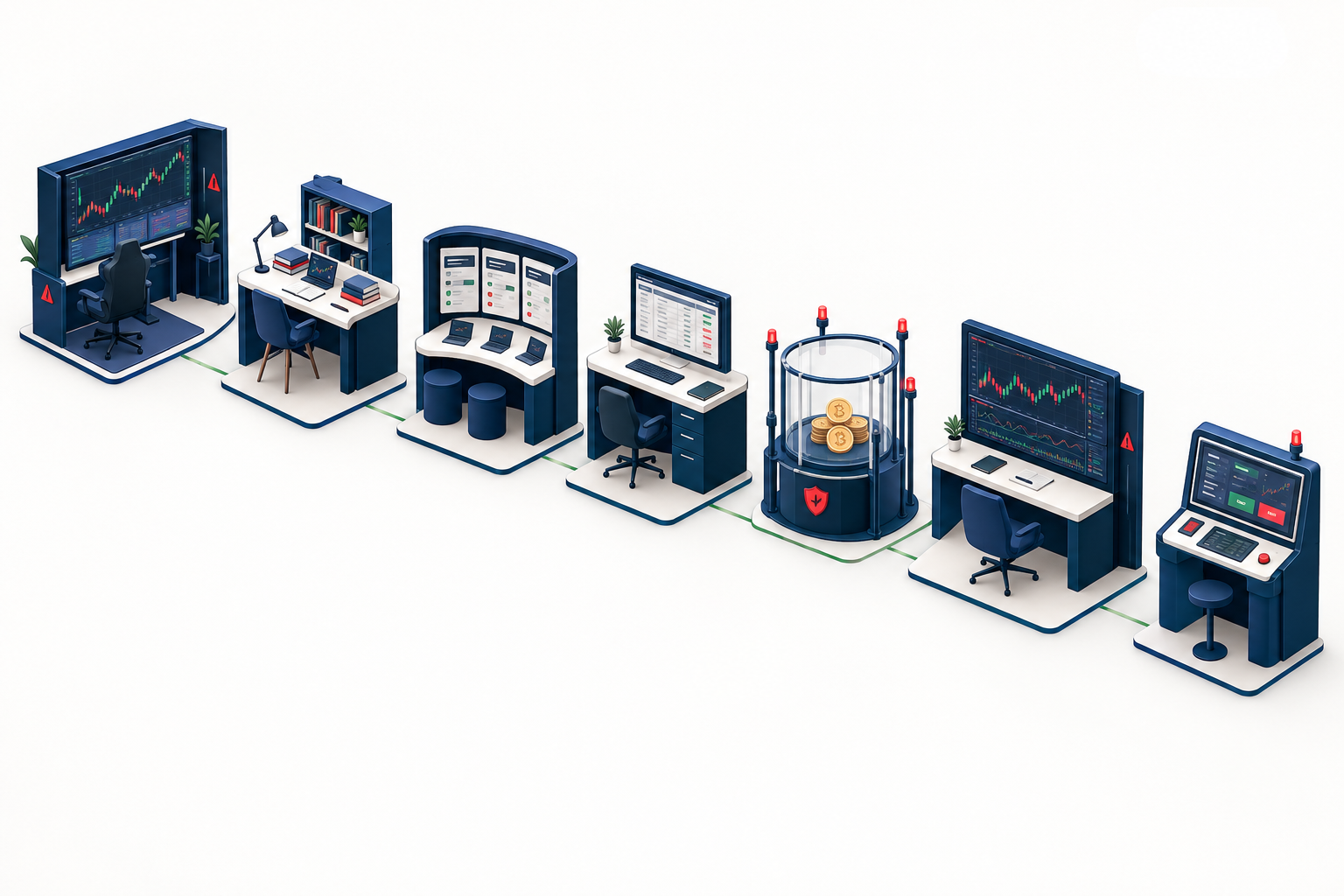
Step 1: Use paper trading before live trading
Paper trading lets beginners practice without placing real capital at market risk. It does not reproduce every financial or emotional pressure of live trading. 3
In a paper trading account, check the instruments, simulated fills, and data timing available in your region. Compare practice tools across brokers. 7
Keep the simulated balance close to your intended account capital. A fantasy balance teaches fantasy position sizing. Start with stocks rather than layering options and margin onto unfamiliar order controls. 2
Practice buying, selling, canceling, and checking order status. Confirm whether a paper trading account and a live account use the same order-ticket defaults. 8
Record the intended entry and exit, execution, spread, and rule compliance. Paper trade it first, then challenge the simulation’s assumptions. 3
A profitable practice day is evidence to inspect, not permission to borrow. Intraday margin risk remains separate from simulation performance. 1
Step 2: Learn volatility, liquidity, and order types
Volatility describes movement; liquidity describes how readily securities trade. A liquid stock can still move sharply, and a tight spread can disappear during market stress. 2
A market order prioritizes execution rather than a chosen price. A limit order controls the acceptable price but may remain unfilled. Review the trading platform’s supported order types. 3
With your broker, confirm which controls operate during your selected session. Do not assume every stock order or options order behaves alike. 7
Real-time data helps observation; it cannot guarantee your next fill. Check your broker’s real-time permissions, chart timestamps, and whether market depth covers the venues you expect. 8
Read price action as observed movement. Support and resistance are areas where buying or selling previously appeared, not financial force fields. 2
Low float means relatively few shares are available for public trading. Beginners should avoid using rapid movement as their only stock-selection rule. Choppy tape, or erratic movement, can punish an otherwise reasonable intraday idea. 3
Step 3: Choose a beginner broker and set up your trading station
The best day trading platforms for beginners make orders, costs, and account restrictions understandable. Compare moomoo with alternatives using the same checklist. 2 8
Check your broker’s commissions, regulatory charges, data charges, and margin interest before calling it inexpensive. Published pricing and eligibility can change. 7
Check your broker’s execution disclosures and cancellation behavior. Fast-looking charts do not establish fast or favorable execution. 3
Check your broker’s support access, account recovery, and the procedure for closing a position during an outage. Financial services should remain understandable when the screen stops cooperating. 2
Your station needs a reliable connection, readable charts, and a backup contact method. More monitors can create more opportunities for analysis paralysis. 8
As a beginner, keep the watchlist short and disable unnecessary alerts. Confirm real-time stock data before interpreting a delayed chart as current market activity. 7
Read AI trading app settings to check before trading. FullStack Alpha helps retail investors compare tools; it does not execute your trading or approve your financial risk.
Step 4: Confirm the updated 2026 account and margin rules
FINRA’s updated day trading framework replaces trade-count restrictions with intraday risk standards, subject to broker transition. Your broker’s implementation determines the rules your account currently follows. 9
The legacy PDT rule used 4 or more day trades within 5 business days, subject to the more-than-6% activity test and other classification provisions. Those are historical framework numbers, not universal 2026 instructions. 5
The updated rule became effective June 4, 2026, following SEC approval on April 14, 2026. Firms can transition until October 20, 2027. 9
Ask your broker whether your account uses legacy counting or updated intraday margin. Ask how the platform displays real-time intraday margin, account deficiencies, and margin risk limits. 1
What happens if you break the pattern day trader rule? Under a broker’s legacy framework, trading restrictions or an equity requirement may follow. Under updated rules, insufficient margin can trigger different controls. Get the applicable policy in writing. 5 9
Do not turn an updated access rule into an investment thesis. More permitted trading does not improve a weak strategy. 10
Step 5: Write the risk plan every beginner must follow
A written risk plan sets position size, planned loss, session limits, and conditions requiring a stop. Broker margin availability is a ceiling imposed by the broker, not your personal risk budget. 1
The 1% rule is an optional position-sizing convention, not a FINRA rule or a safety guarantee. A smaller limit may suit beginners better. Your personal limit must fit your financial circumstances. 9
Illustrative arithmetic, not a return forecast: A hypothetical $500 account risking 1% budgets $5. With $0.25 planned risk per share, that permits 20 shares before costs and execution differences. These are author-calculated assumptions; broker margin requirements remain separate. 1
Write down:
- The stock conditions that permit a trade.
- The stop loss and planned exit.
- The session loss boundary.
- The technical failure that ends trading.
A stop order does not guarantee the planned loss. Ask your broker how its stop orders operate, and check current order documentation. 3
For margin trading, add an account-equity buffer and a response to reduced buying power. Updated intraday risk monitoring does not replace personal risk management. 10
Step 6: Develop a simple trading strategy
Beginner trading strategies should state conditions that another person could recognize. “Buy strong stocks” leaves too much room for emotion and hindsight. 2
Possible practice strategies include a pullback within an existing trend or the breakout from tight consolidation, meaning a narrow trading range. Neither strategy guarantees a favorable result. 3
Define the setup before the session: eligible stocks, market conditions, entry trigger, invalidation, and exit. A clean setup means it matches your written conditions, not that the chart looks attractive. 8
Save charts and trading notes if your broker’s tools fit your workflow. Check whether its real-time data and alerts support your intended observation process. 7
Test strategies across losing periods. Earnings season can change intraday behavior; a bull trap is a breakout that reverses and catches buyers. 2
Review how to backtest a trading strategy without fooling yourself. Then use the trading expectancy calculator with your own records, including costs.
Do not promote simulated performance into a financial promise. Strategy testing and live execution answer different questions. 3
Step 7: Rehearse your first trade from entry through exit
Rehearse the entire trade in simulation before live trading. The goal is accurate execution of written rules, including choosing not to trade. 8
Identify the stock and entry point. Select a stock meeting your liquidity and setup conditions. Check market news before mistaking a sudden move for routine price action. 2
Set the stop and target. Place the invalidation point where the trade idea fails, then calculate size. Do not move the stop simply to fit more shares. 3
Execute and manage. Review the symbol, account, order direction, quantity, and session setting before submitting. Confirm the fill rather than assuming a submitted order executed. 7
Review the result. Record whether the trade followed the plan. Getting stopped out can be correct execution; a profitable rule violation is still a rule violation. 8
If margin changes during the session, follow your prewritten response. Intraday exposure can change faster than a beginner expects. 1
Day trading
Day Trading Readiness Check
Is your plan ready, and what position size does your stop allow?
Enter your account and risk rules. The check returns a readiness score and a position size from your stop.
Educational tool only, not financial advice. A readiness score measures your plan, not your odds of profit.
Is day trading right for you, or does swing trading fit better?
Be honest about your calendar before you judge your chart skills.
Intraday trading suits someone who can monitor positions and accept uncertain results without needing trading income for bills. Swing trading may fit someone who needs a slower decision schedule, but it introduces overnight exposure. 2 3

What is the difference between day trading and swing trading?
A day trader closes positions during the day. A swing trader holds beyond the session, seeking a broader move. A scalper targets shorter intraday moves and depends heavily on execution costs. 5 2
A long-term position investor focuses on an investment thesis rather than each intraday fluctuation. Beginners should choose a schedule before choosing alerts or chart layouts. 8
Read how to find stocks for swing trading if constant monitoring clashes with your job.
Is trading worth it, or just gambling?
Trading becomes speculation without discipline when you cannot explain the risk, costs, and evidence behind a decision. A journal and a plan improve accountability; neither guarantees an investment edge. 3
The drawbacks are real: active trading consumes time, and costs accumulate even when commissions look small. Margin adds financial exposure and possible forced action. 2 1
Regulation checkpoint: The legacy $25,000 PDT minimum is removed under the updated framework, but broker transition affects when your account follows it. 9
Timing checkpoint: Updated standards became effective June 4, 2026; the transition deadline is October 20, 2027. 9
Historical checkpoint: The old classification generally involved 4 trades, 5 business days, and more than 6% of account trades. Do not confuse historical numbers with your broker’s current instructions. 5
What common mistakes do beginners make?
Overtrading, revenge trading, and buying an overextended stock are process failures worth recording. A dead cat bounce is a brief rebound inside a decline; buying it without a plan can become catching a falling knife.
Check your broker’s trading records rather than relying on memory. Real-time alerts invite action, but an alert is not an investment recommendation. 7
How does day trading compare to the alternatives?
Day trading is one option among several, and it is the most demanding on your time.
The main alternatives are swing trading, simulation apps, index investing, and prop firm evaluations. Compare the financial commitment and time demand before comparing software. Broker rankings alone cannot decide which activity fits your life. 2
Swing trading: Suits traders who can review markets without remaining at a screen all day. Overnight news remains a risk. 3
Paper trading apps: Suit beginners learning orders and strategies. Simulated execution and absent financial pressure limit what results prove. Compare paper trading account access across brokers. 7
Index investing: Suits longer-horizon investment goals better than daily trading targets. Market losses remain possible; selecting a broad fund does not remove investment risk.
Prop firm evaluations: Require close reading of fees, drawdown rules, payout conditions, and whether trading is simulated. Paying for an evaluation does not establish trading skill.
For any broker comparison, compare costs, order controls, and data access against the same tasks. 8 Check the account’s financial services provider rather than treating the app brand as the whole contract. 2
This guide uses desk research, published broker comparisons, and public user sentiment. It is not a scored broker review. 3
How much money do you need to start day trading in 2026?
The deposit question is really a risk question in disguise.
There is no universal deposit that makes intraday trading financially sensible. Required capital depends on account type, broker implementation, securities, and your planned exposure. 9 1

Can you start with a small account under the old threshold?
Yes, depending on the account and applicable rules. The updated framework removes the old PDT equity threshold, but it does not eliminate margin requirements or broker controls. 9
The standard $2,000 margin-equity baseline is not an assurance of unlimited trading access. Securities requirements and house rules may demand more capital. 1
Before funding, ask your broker to confirm margin eligibility, cash-account restrictions, and intraday risk controls. 9
“How to start day trading with little money” should lead to smaller exposure and more practice, not more borrowing. The same applies to searches about starting with $20 or $100: those are proposed budgets, not evidence of adequate trading capital. 2
How much can you make?
No broker, trading tool, or strategy can supply a dependable daily income figure for a beginner. Financial targets should not dictate position size. 3
Illustrative math: earning $200 from $2,000 requires 10% before costs; earning $1,000 requires 50%. Those are arithmetic requirements, not expected returns. Compare that pressure with FINRA’s focus on controlling exposure. 1
Read Reddit for questions worth investigating, then verify financial claims against current broker documents. A screenshot cannot establish risk, withdrawals, or repeatability. 8
Top 5 things to set up before you start day trading
Get these five in place and the first live trade becomes a rehearsal you have already run.
- A simulator at your real balance. A fantasy balance teaches fantasy position sizing.
- Your broker’s current rules. Ask whether your account follows legacy PDT counting or the updated intraday margin standard; firms can transition until October 20, 2027.
- A written risk plan. Position size, planned loss per trade, and a session loss limit, all decided before the open.
- A strategy someone else could recognize. Eligible stocks, entry trigger, invalidation, and exit, written down in plain language.
- A trade journal. Record entry, exit, spread, and rule compliance so you judge the process, not a lucky day.
FAQs about how to start day trading
Beginners should separate permission to trade from readiness to risk capital. The answers below depend on current broker rules, financial circumstances, and the limits of simulated practice. 9
Is $100 enough to day trade?
It may support limited cash trading where broker minimums and order sizes permit, but it is not a practical income plan. Small costs and small losses consume a large share of that budget. Start with simulation, then verify your broker’s account restrictions before committing money. 8
Can you make $1000 a day with day trading?
It is possible to have a profitable day of that size, but a beginner should not treat it as a repeatable wage. Required exposure, losses, costs, and capital all matter. A daily income target can push traders into oversized positions and margin risk they cannot afford. 2 1
Is $500 enough to start day trading?
It may be enough for limited cash-account activity, depending on broker terms, but it provides little room for mistakes. It does not automatically qualify you for margin borrowing. For beginners, a simulated balance matching the intended live account is a better starting point than stretching the budget through borrowed exposure. 3
Is it possible to make $200 a day day trading?
Yes, but possibility does not establish probability or a sustainable financial plan. Losses can exceed a daily target, and trading costs reduce gross gains. Judge a strategy using complete records, including losing sessions, rather than asking it to pay a fixed amount every day. 2
What is the minimum capital required to start day trading for beginners in the U.S.?
There is no single minimum covering every account and security. Cash trading follows available-funds and broker requirements; margin trading adds equity and exposure requirements. The updated FINRA framework changes the legacy PDT threshold, but brokers may still be transitioning. Confirm the rule applied to your account before depositing money. 9
Can a beginner start day trading with a small account, specifically under the $25,000 threshold?
Yes, where the account type and current brokerage rules permit it. The updated framework removes that legacy minimum, but transition arrangements mean restrictions can differ between firms. Ask whether the broker has implemented the new standard and how it handles intraday margin deficiencies. Permission does not establish financial readiness. 9
Do you need a license to day trade your own money?
Ordinary retail trading of your own brokerage funds generally does not require a professional securities license. Account approval, identity checks, and product permissions still apply. Managing other people’s money, selling regulated advice, or trading in a professional capacity raises different legal questions. Check those activities separately rather than assuming retail rules cover them. 5
What is the most important first step for someone learning how to start day trading?
Practice order entry without risking market capital, then write the conditions under which trading must stop. “How do you start day trading?” should begin with behavior you can control, not profit you cannot. Learn account restrictions alongside the simulator so practice reflects the constraints of your intended live account. 8 9
How do I start day trading as a complete beginner?
Open a simulator, learn order types and your broker’s account rules, then write a risk plan with a per-trade loss and a session loss limit. Go live only after you can rehearse a full trade from entry to exit without errors.
Should I start day trading with margin?
No. Beginners do not need margin borrowing to start learning. Broker margin availability is a ceiling set by the broker, not your personal risk budget.
How do I pick a broker to start day trading?
Compare commissions, data permissions, order controls, and which intraday margin framework applies to your account. Treat any single broker as a candidate, not the default choice.
Why do 90% of day traders lose?
The exact 90% figure is not a verified universal statistic, but most beginners who day trade do lose money. The usual causes are overtrading, revenge trading, oversized positions, and costs that add up even when commissions look small. A written risk plan and time in simulation address those causes before real money is at stake.
Conclusion: start day trading with a process, not a deposit
Starting day trading the right way feels slow at first, and that is the point.
Start with simulation and a written loss plan before choosing a live stock trade. Confirm your broker’s updated account rules, then rehearse the full entry-and-exit process without risking capital. 9
If your search began with “how start day trading,” your first move is simple: open a practice journal today and write the conditions that end your session. Leave live trading disabled until those conditions are clear.
For readers searching “full stack alpha,” FullStack Alpha’s directory of 200+ trading tools helps compare categories and costs. Cut the noise, keep the alpha.
References
These sources support the regulatory discussion and broker-comparison criteria. FINRA’s regulatory documents take priority over comparison articles; live broker implementation was not independently checked.
Finras Intraday Margin Standard What Investors And Members Need To Know - https://www.finra.org/media-center/finra-unscripted/finras-intraday-margin-standard-what-investors-and-members-need-to-know
Best Online Brokers For Day Trading - https://www.forbes.com/advisor/investing/best-online-brokers-for-day-trading/
The Best Brokers For Day Trading 8762913 - https://www.investopedia.com/the-best-brokers-for-day-trading-8762913
Pattern Day Trader - https://www.investor.gov/introduction-investing/investing-basics/glossary/pattern-day-trader
Best Day Trading Platform - https://www.finder.com/stock-trading/best-day-trading-platform
Online Brokers Platforms For Day Trading - https://www.nerdwallet.com/investing/best/online-brokers-platforms-for-day-trading
26 10 - https://www.finra.org/rules-guidance/notices/26-10
Finras New Intraday Margin Standard Shifts Focus To Real Time Risk - https://www.tradersmagazine.com/xtra/finras-new-intraday-margin-standard-shifts-focus-to-real-time-risk/
Affiliate disclosure: FullStack Alpha may earn a commission if you purchase through affiliate links.