Day Trading Is It Worth It? The Math Most Skip
Last updated: August 31, 2026
Quick Answer
Day trading is it worth it comes down to four numbers most people never run: profitability odds, real transaction costs, tax drag, and the hourly rate your time actually earns. Academic research across hundreds of thousands of traders consistently shows fewer than 1% remain profitable over multi-year horizons. Before you fund a margin account, those four numbers deserve a spreadsheet, not a YouTube video.
Key Takeaways
- Fewer than 1% of retail day traders outperform consistently over multiple years, per Barber, Lee, Liu and Odean's study of roughly 360,000 Taiwanese traders.
- The pattern day trader (PDT) rule required a $25,000 minimum equity in a margin account for U.S. traders making four or more day trades in five business days; that rule was eliminated in June 2026, lowering the effective floor to the standard $2,000 margin minimum.
- Short-term capital gains on profitable trades are taxed as ordinary income, not at the lower long-term rate, meaning a trader in the 32% bracket pays 32 cents on every dollar of net gain.
- The bid-ask spread and slippage together can cost an active trader $0.05 to $0.20 per share per round trip on liquid names, and more on thin-float stocks.
- Swing trading and long-term index investing both carry lower transaction cost burdens and more favorable tax treatment than high-frequency day trading.
- The wash sale rule disallows a loss deduction if you repurchase a substantially identical security within 30 days before or after the sale; it catches more traders than almost any other tax rule.
- Skills built in day trading, including reading price action, managing risk-reward, and position sizing, transfer directly to swing trading and other financial disciplines even if full-time day trading does not work out.
What Does Day Trading Actually Require to Start?
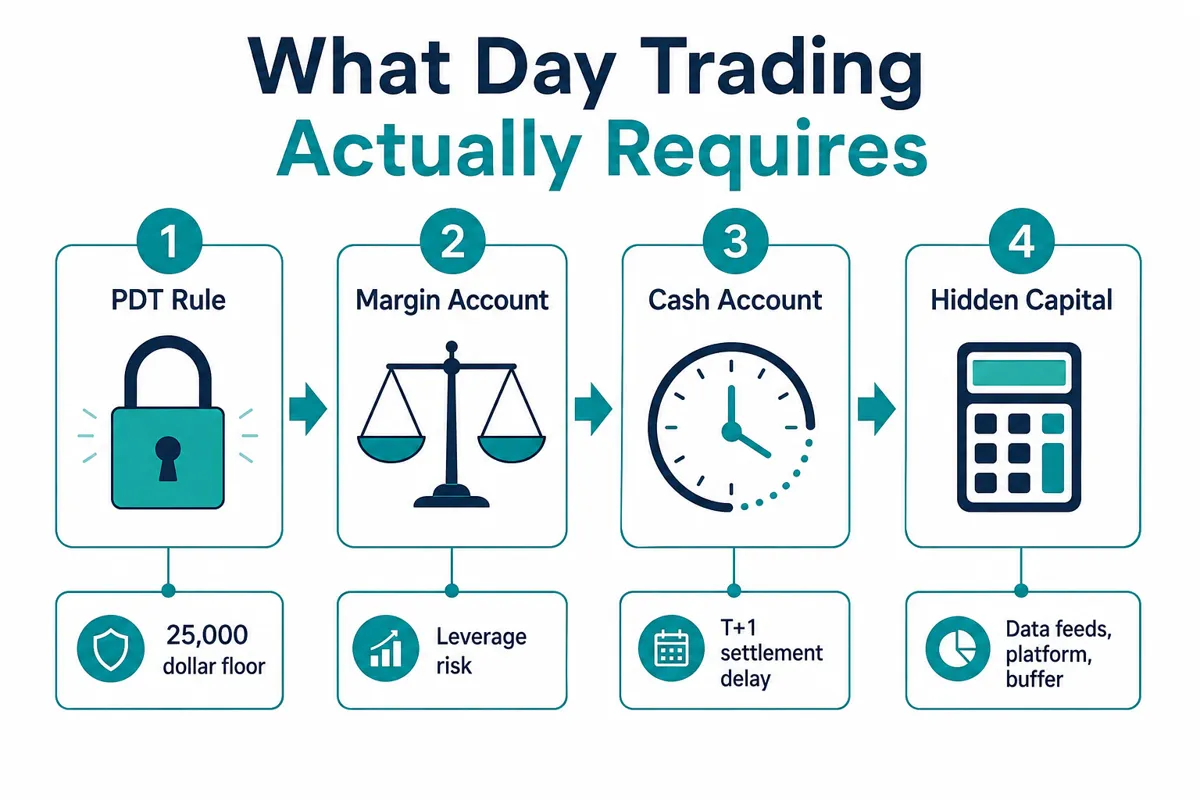
Day trading requires a funded brokerage account, a reliable data feed, a tested trading strategy, and enough capital to absorb a string of losses without blowing up. The capital requirement is the part most beginners dramatically underestimate, and the rule governing it just changed in a significant way.
The Pattern Day Trader Rule and the 25,000 Dollar Floor
The pattern day trader rule, enforced by FINRA and the SEC, defined a pattern day trader as anyone who executes four or more day trades within five business days in a margin account, provided those trades represent more than 6% of total trades in that period. The rule required those traders to maintain at least $25,000 in equity in their margin account at all times.
That rule was eliminated effective June 2026. Charles Schwab updated its intraday margin buying power rules on July 13, 2026, and other major brokers including Robinhood, Webull, Interactive Brokers, and thinkorswim followed with their own policy changes. The effective floor is now the standard $2,000 margin minimum that always existed for margin accounts. That is a structural shift worth understanding before you decide whether day trading is it worth it for your situation.
The $25,000 threshold did not disappear because day trading got safer. It disappeared because regulators decided the rule was paternalistic. The underlying math on profitability did not change.
Cash Account Versus Margin Account Tradeoffs
A cash account lets you trade without the PDT restriction because you are using settled funds, not borrowed money. The catch is T+1 settlement (trade date plus one business day under the SEC's current settlement cycle), which means proceeds from a sale are not available to trade again until the next trading day. That limits how many round trips you can run in a single trading day.
A margin account gives you access to leverage and lets you trade with unsettled funds, but it comes with margin interest, the risk of a margin call, and the psychological pressure of trading with borrowed capital. Leverage amplifies losses exactly as much as it amplifies gains. Most traders discover this the expensive way.
The Capital the Videos Leave Out
Even with the PDT rule gone, the real capital question is not the regulatory minimum. It is the amount you need to trade a position size that produces meaningful income while keeping risk-reward sane.
A trader risking 1% of account equity per trade on a $5,000 account risks $50 per trade. After commissions, data fees, and the bid-ask spread, that $50 risk budget leaves almost no room for a viable stop loss on most liquid stocks. The practical minimum for a serious day trading attempt, with a buffer for losses and a position size that moves the needle, is closer to $25,000 to $50,000 for most strategies. The regulatory floor and the practical floor are two different numbers.
Number 1: What the Research Says About Profitability
The academic literature on retail day trader performance is one of the most consistent bodies of evidence in behavioral finance. The finding does not change across markets, time periods, or research teams: the vast majority of retail day traders lose money, and very few are consistently profitable net of costs.
What Academic Studies Found About Retail Day Traders
Brad Barber, Yi-Tsung Lee, Yu-Jane Liu, and Terrance Odean studied roughly 360,000 Taiwanese individuals who day traded on the Taiwan Stock Exchange. Their research found that about 13 to 20% earn positive abnormal returns net of costs in a given year, but fewer than 1% are able to outperform consistently across multiple years. The study is among the most cited in the literature because the Taiwan Stock Exchange provided complete transaction-level data, eliminating the survivorship bias that plagues most retail trading research.
A separate 2003 study in the Financial Analysts Journal found that the most active day traders earned the lowest returns, and that trading costs were the primary driver of underperformance. The SSRN working paper database contains more recent work confirming the same pattern in U.S. and European markets.
More recent aggregated statistics reinforce the academic findings. ForTraders estimates that about 10 to 15% of retail day traders show a profit over a single year, but only 1 to 3% remain profitable across three or more years. WorldMetrics, citing multiple data sources updated in August 2026, reports that only 10 to 15% of day traders consistently profit over a 12-month period, with average annual ROI in the negative 5% to positive 10% range, and 35% going bankrupt within three years.
The Brazilian day trading study by Chague and De-Losso, examining traders on the Brazilian futures market, found that of those who persisted for more than 300 days, 97% lost money and the rare profitable traders earned returns that did not compensate for the time invested. That study is frequently cited in discussions of whether day trading is it worth it as a full-time pursuit.
Why Survivorship Bias Distorts What You See Online
The traders you see on Reddit, YouTube, and social media are not a representative sample. They are the ones still trading, still posting, and still monetizing an audience. The traders who lost their accounts and moved on are not making content about it. This is survivorship bias in its most visible form.
A useful way to think about it: if 100 traders start in January, and 70 quit by December, the 30 still posting in December look like a 100% success rate to anyone who discovers the community in December. The data on day trading consistently shows that the visible online community represents the surviving tail, not the average outcome. That is not a reason to dismiss the skill of successful traders. It is a reason to be honest about what the base rate actually is before you decide whether day trading is it worth it for you.

Number 2: What It Actually Costs to Trade
Transaction costs are the silent tax on every trade, and they compound against you in a way that is easy to underestimate when you are paper trading or backtesting without realistic cost assumptions. If you want to know whether day trading is it worth it, cost modeling is non-negotiable.
Commissions, Data Feeds, and Platform Fees
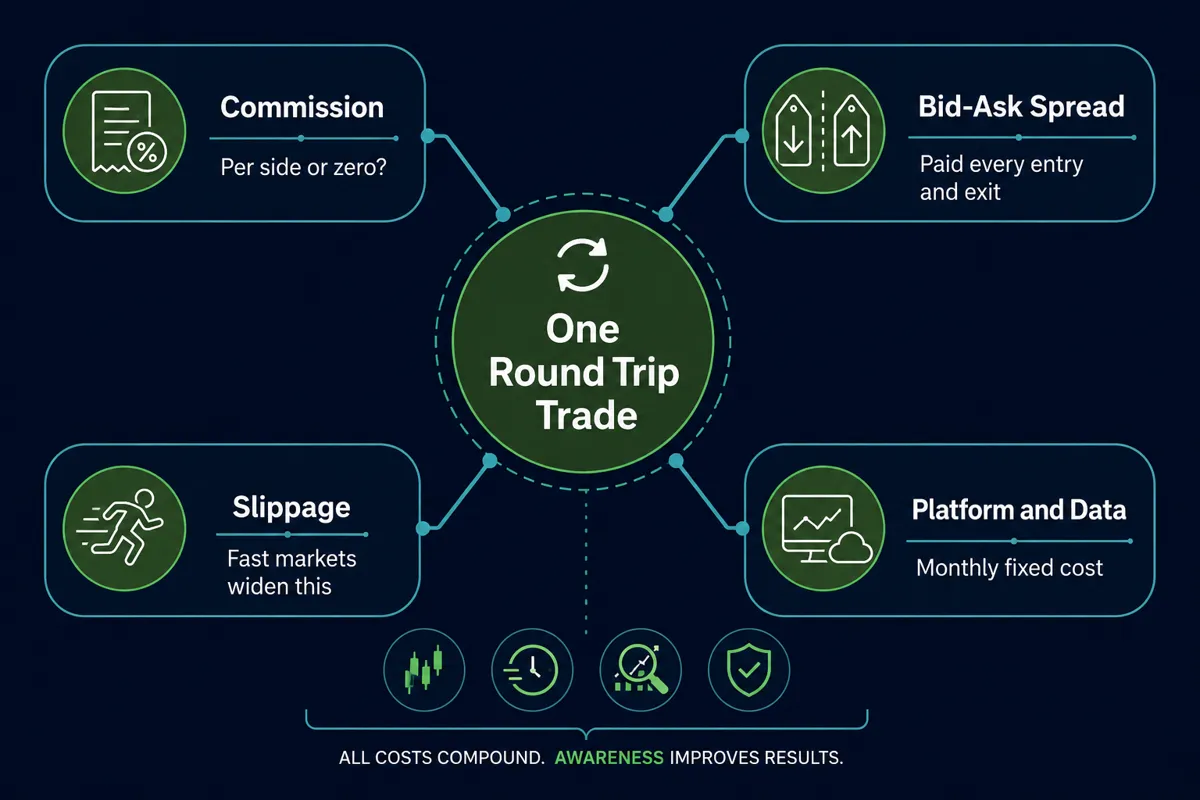
Most major brokers, including Robinhood, Webull, Charles Schwab, and Interactive Brokers' IBKR Lite tier, now offer zero-commission equity trading. That sounds like free, but it is not. Zero-commission brokers route orders through payment for order flow (PFOF), which means a market maker pays the broker for the right to fill your order. The market maker profits on the spread between the bid and ask price. You do not pay a commission line item, but you often get a slightly worse fill price than you would on a direct-access platform.
Active day traders who need direct-access routing, Level 2 quotes, and fast execution often use platforms like Interactive Brokers Pro or thinkorswim, where per-share commissions or per-trade fees apply. Add a professional market data subscription ($50 to $200 per month depending on the exchange feeds), a charting platform, and a news service, and the fixed monthly overhead for a serious day trading setup runs $150 to $600 per month before a single trade is placed.
Slippage and the Spread You Pay Every Round Trip
The bid-ask spread is the difference between the price a buyer will pay and the price a seller will accept. On a liquid large-cap stock like Apple or Microsoft, the spread might be one cent. On a low-float small-cap stock that day traders favor for volatility, the spread can be five to twenty cents or wider. Every time you enter a trade, you buy at the ask. Every time you exit, you sell at the bid. You pay the spread twice on every round trip.
Slippage is the difference between the price you expected to fill at and the price you actually filled at. In fast markets, particularly around earnings releases, Fed announcements, or breaking trading news, slippage can be significant. A stop loss order set at $50.00 might fill at $49.70 in a fast-moving market. That gap is a real cost that does not show up in most backtests.
The Annual Cost Before You Make a Dollar
Run the math on a realistic active day trading setup:
- Platform and data fees: $300 per month, or $3,600 per year
- Spread cost on 10 round trips per day at $0.05 average spread on 100 shares: $50 per day, or roughly $12,500 per year on 250 trading days
- Slippage estimate: another $5 to $20 per round trip, or $2,500 to $10,000 per year
That puts the annual cost floor at roughly $18,600 to $26,100 before taxes and before a single net-losing trade. On a $50,000 account, that is a 37% to 52% hurdle rate just to break even. This is why the research consistently finds that trading costs are the primary driver of retail trader underperformance.
For a deeper look at how AI tools can help manage a trading strategy without adding to this cost burden, see the best AI trading tools of 2026 put head to head.
Number 3: How Day Trading Taxes Work
Day trading taxes are where a profitable gross return can become a net loss. The IRS does not treat trading income the way most new traders expect, and the rules have several traps that catch people off guard.
Short Term Capital Gains Versus Long Term
Any security held for one year or less is subject to short-term capital gains tax, which is taxed at your ordinary income rate. For 2026, those rates range from 10% to 37% depending on your bracket. Day traders, by definition, hold positions for less than one trading day, so every profitable trade is taxed at the short-term rate.
Long-term capital gains, for securities held more than one year, are taxed at 0%, 15%, or 20% depending on income. A buy-and-hold index investor in the 22% ordinary income bracket pays 15% on long-term gains. A day trader in the same bracket pays 22% on every profitable trade. That 7-percentage-point gap compounds meaningfully over time, and it is one of the clearest arithmetic reasons why long-term index investing outperforms day trading for most people on an after-tax basis.
The Wash Sale Rule and Why It Surprises People
The wash sale rule (IRS Section 1091) disallows a loss deduction if you buy a substantially identical security within 30 days before or after the sale that generated the loss. For a day trader who trades the same securities repeatedly, this rule can eliminate the tax benefit of loss harvesting almost entirely.
The rule applies to stocks, options, and ETFs. It does not currently apply to cryptocurrencies, though proposed legislation has periodically sought to change that. The wash sale rule is the single most common tax surprise for new traders who assumed their losses would offset their gains dollar for dollar on Schedule D.
Trader Tax Status and the Section 475 Election
Traders who meet the IRS definition of a trader in securities (trading with frequency, regularity, and continuity as a business activity) may qualify for trader tax status (TTS). TTS allows deductions for trading-related business expenses, including home office, data subscriptions, and platform fees.
More significantly, traders with TTS can make a Section 475(f) mark-to-market election, which converts capital gains and losses to ordinary income and losses. The key benefit: the wash sale rule no longer applies, and losses are fully deductible as ordinary losses rather than being capped at the $3,000 annual capital loss limit. The election must be made by the tax deadline of the year preceding the year it takes effect, which means it requires planning well in advance.
The IRS sets the bar for TTS qualification high. Occasional or part-time traders rarely qualify. Consult a tax professional before assuming TTS applies to your situation.
Number 4: The Time Cost Against an Hourly Rate
Time is the cost that never shows up in a brokerage statement, but it is as real as any commission. Whether day trading is it worth it as a time investment is a question the math can actually answer.
Screen Hours, Prep Hours, and Review Hours
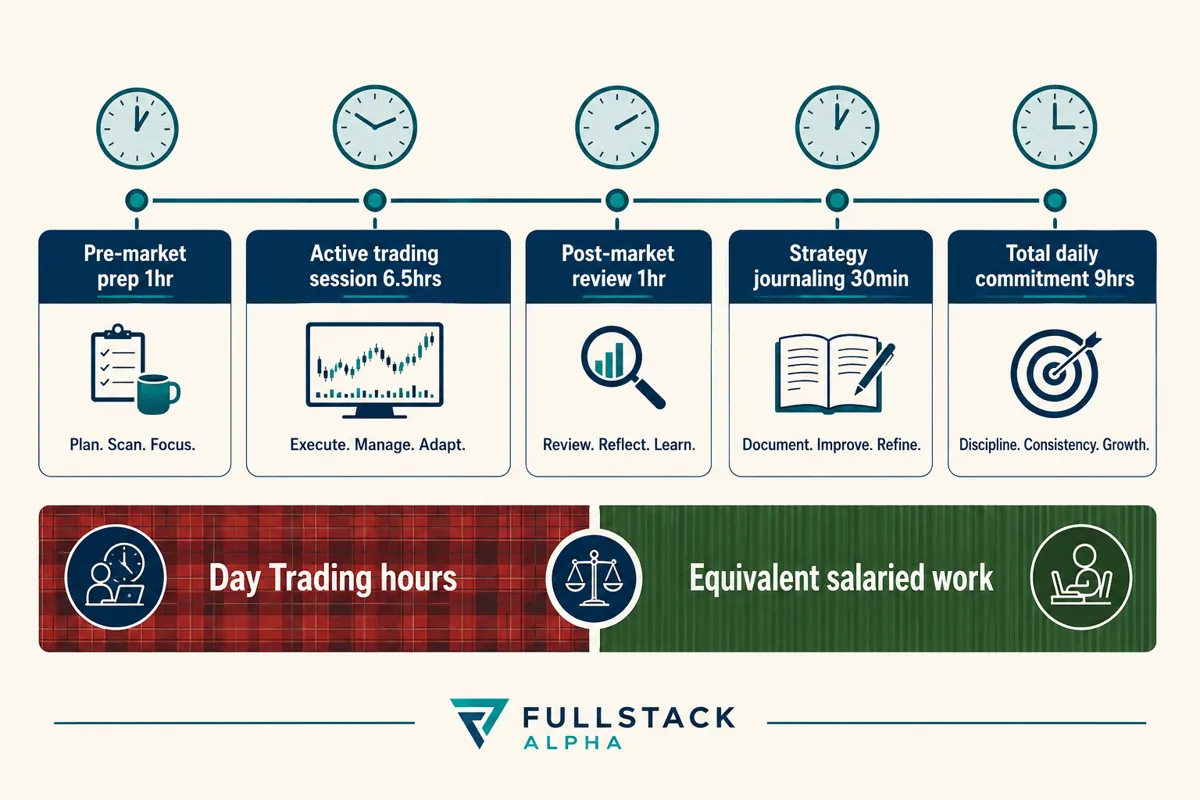
A realistic day trading schedule for someone taking it seriously looks like this:
- Pre-market preparation (reviewing the watchlist, scanning for setups, reading trading news): 60 to 90 minutes
- Active trading session (U.S. market hours, 9:30 a.m. to 4:00 p.m. Eastern, with power hour at open and close): 6.5 hours
- Post-market review (journaling trades, reviewing entries and exits, updating the trading strategy): 45 to 60 minutes
That is roughly 8.5 to 9 hours per trading day, five days a week, for approximately 250 trading days per year. Total annual time commitment: 2,100 to 2,250 hours.
What the Same Hours Earn Elsewhere
The U.S. Bureau of Labor Statistics median weekly earnings for full-time workers in 2026 translate to an effective hourly rate of roughly $30 to $35 for a median-income worker. A software engineer, accountant, or skilled tradesperson earns $50 to $100 per hour or more.
At 2,200 hours per year, the opportunity cost of full-time day trading is $66,000 to $220,000 in foregone income, depending on your alternative earning rate. A trader who nets $40,000 in a year from day trading while forgoing $80,000 in salary has not made $40,000. They have lost $40,000 on a net basis. That is not a lecture. It is arithmetic. Running this number before you commit is exactly the kind of process-over-prediction thinking that separates disciplined traders from expensive hobbyists.
If you are considering automating part of the process to reclaim time, AI trading bots: what to know before you automate trades is worth reading first.
Comparison Table: Day Trading Versus Swing Trading Versus Long-Term Investing
| Factor | Day Trading | Swing Trading | Long-Term Investing |
|---|---|---|---|
| Capital Required | $2,000 regulatory min; $25,000+ practical | $5,000 to $10,000 practical | Any amount; dollar-cost averaging works |
| Time Per Week | 40 to 50 hours (full-time commitment) | 5 to 15 hours | 1 to 3 hours |
| Tax Treatment | Short-term gains taxed as ordinary income (up to 37%) | Mix of short-term and long-term rates | Mostly long-term gains (0 to 20%) |
| Transaction Costs | High: spread, slippage, data fees daily | Moderate: fewer trades, lower data cost | Very low: minimal trades, no data fees |
| Documented Outcomes | Less than 1% consistently profitable long-term | Limited academic data; better odds than day trading | S&P 500 averages ~10% annually over decades |
Is It Worth It to Learn Day Trading at All?
Learning day trading builds skills that have real value beyond the trading screen, even for people who ultimately decide the full-time path is not for them. The question of whether day trading is it worth it to learn is different from whether it is worth it to do full-time.
Is It Worth It to Start Day Trading With a Small Account
Starting with a small account, say $1,000 to $5,000, is worth it as an educational exercise if you treat it as tuition, not income. Paper trading first is the right move. Platforms including thinkorswim and Webull offer paper trading modes where you can run a real trading strategy with simulated capital. Paper trade it first, build a track record, and only fund a live account when your simulated results are consistently positive over at least 60 trading days.
With a small account, the math on income is brutal. A 1% daily return on $5,000 is $50. After taxes at the short-term rate, that is $34. Before platform fees. The realistic use of a small account is learning the mechanics of entries and exits, reading price action, and building discipline around stop losses, not generating income.
Is It Worth It to Get Into Day Trading Part Time
Part-time day trading is harder than full-time day trading, not easier. The first 30 minutes after the open and the last 30 minutes before the close (power hour) account for a disproportionate share of daily volume and volatility. If you have a job, you are likely missing the best setups. Pre-market and after-hours trading exist, but spreads are wider, volume is thinner, and the risk-reward on most setups deteriorates significantly outside regular trading hours.
Swing trading is a more realistic fit for someone with a full-time job. Positions held for two to five trading days do not require constant screen time. The tax treatment is similar for short holds, but the time cost is dramatically lower. For tools that support a swing approach, swing trading tools is a good starting point.
What Transfers Even If You Stop
The skills built in day trading have real market value. Reading price action, understanding the bid-ask spread, managing position sizing, setting stop losses, and keeping a trade journal all transfer directly to swing trading, options trading, and long-term portfolio management. The discipline of cutting losers fast and letting winners run is the same whether you hold for five minutes or five weeks.
Traders who spend a year learning day trading and then shift to swing trading often describe the transition as a significant improvement in both results and quality of life. The knowledge compounds. The screen time does not have to.
Is Day Trading Effective for Building Wealth?
Day trading is not an effective primary wealth-building strategy for most people, based on the documented outcomes in the academic literature. That is a factual statement, not a moral one. The question of whether day trading is it worth it as a wealth-building tool has a clear answer when you compare it to the documented long-term performance of index funds.
Is Day Trading a Good Idea Compared to Index Investing
The S&P 500 has returned approximately 10% annually on average over the past century, including dividends. An investor who put $50,000 into a low-cost S&P 500 index fund and added $500 per month would have roughly $1.1 million after 25 years at a 10% average annual return, paying long-term capital gains rates and spending roughly two hours per month on portfolio management.
A day trader who earns a 10% annual return on the same $50,000 (which puts them in the top 10 to 15% of retail day traders in any given year) pays short-term capital gains rates, spends 2,200 hours per year, and nets significantly less after taxes and costs. The index investor wins on a risk-adjusted, after-tax, after-time-cost basis in almost every realistic scenario.
This is not an argument against trading. It is arithmetic. If you enjoy trading, find it intellectually engaging, and treat it as a skill to develop over years rather than a get-rich-quick mechanism, the calculus changes. But if the goal is purely wealth accumulation, the data does not support day trading over index investing for most people.
Where Day Trading Genuinely Fits
Day trading does fit for a specific type of person: someone with genuine market knowledge, a tested edge (the actual reason they make money, in one sentence), enough capital to absorb a learning curve, and the psychological temperament to follow a system without revenge trading or overtrading.
Algorithmic trading and systematic approaches have improved the odds for traders who can build and backtest rules-based systems. If you are interested in that path, how to backtest a trading strategy without fooling yourself is required reading before you risk capital on any system. Algorithmic trading removes some of the emotional decision-making that causes most retail traders to underperform their own systems.
For traders who want to understand where AI fits into a day trading or swing trading workflow without adding noise, AI trading software: what you pay for vs what you get breaks it down honestly.

FullStack Alpha tool
Day Trading vs Just Buying the Index
“20k to 55k in 5 years you would have done more by holding SPY or QQQ, why are yall bot obsessed”
YouTube · @freedomordeath89, 48 likes
The question is not whether you made money. It is whether you made more than doing nothing, and what your hours were worth. Enter your real numbers.
S&P 500 has averaged roughly 10% a year over the long run.
Before tax. Short-term trading gains are taxed as ordinary income in the US, which widens the gap against a long-held index fund.
Frequently Asked Questions
Day trading is it worth it for a beginner?
Day trading is it worth it for a beginner only if the beginner treats the first year as education, not income. Start with paper trading for at least 60 days, build a written trading strategy, and track every trade in a journal. Most beginners who fund a live account before proving a paper-trading edge lose a significant portion of their capital within the first six months. The skills are learnable, but the learning curve has a real financial cost if you skip the paper stage.
What percentage of day traders are profitable?
About 10 to 15% of retail day traders show a profit over any single year, but only 1 to 3% remain profitable across three or more years, according to ForTraders. The Barber, Lee, Liu and Odean study of roughly 360,000 Taiwanese traders found fewer than 1% could outperform consistently over multi-year periods. These figures are net of transaction costs, which are the primary driver of underperformance.
How much money do you need to start day trading?
The regulatory minimum for a U.S. margin account is now $2,000 following the elimination of the pattern day trader rule in June 2026. The practical minimum for a strategy that produces meaningful income while maintaining sensible risk management is closer to $25,000 to $50,000. Below that level, position sizing constraints make it nearly impossible to generate income that justifies the time and tax costs involved.
Is it worth it to learn day trading if you work full time?
Learning day trading while working full time is feasible, but actively day trading while working full time is not. The most active and profitable setups occur at market open and close, which conflict with standard work hours. Swing trading, which requires 5 to 15 hours per week rather than 40 to 50, is a more realistic fit for someone with a full-time job. The skills transfer directly if you later want to increase your trading activity.
How are day trading profits taxed?
Day trading profits are taxed as short-term capital gains at your ordinary income tax rate, which ranges from 10% to 37% in 2026 depending on your total income. There is no preferential long-term rate because day traders hold positions for less than one year. Losses are subject to the wash sale rule, which disallows a deduction if you repurchase the same security within 30 days. Traders who qualify for trader tax status and make a Section 475(f) election can deduct losses as ordinary losses and avoid the wash sale rule.
Is day trading a good idea with $1,000?
Day trading is not a good idea with $1,000 as a live trading account. The position sizes available at that capital level are too small to generate meaningful income, and a single bad trade can eliminate a significant percentage of the account. A $1,000 account is appropriate for paper trading practice or for learning platform mechanics, not for a serious trading strategy. The practical minimum for a viable live account is significantly higher.
How long does it take to become a profitable day trader?
Most traders who eventually become consistently profitable report a learning period of two to four years. The Brazilian day trading study found that of traders who persisted past 300 days, 97% still lost money. Consistent profitability requires a tested edge, strict risk management, and the psychological discipline to follow a system through losing streaks. There is no reliable shortcut, and most traders who claim to have found one are selling something.
Is day trading effective compared to long-term investing?
Day trading is less effective than long-term index investing for most people on an after-tax, after-cost, after-time-cost basis. The S&P 500 has averaged approximately 10% annually over the long run. Fewer than 1% of day traders match that return consistently after costs and taxes. Long-term investing also benefits from lower tax rates on gains and requires a fraction of the time commitment. Day trading can be effective for a small subset of traders with genuine edges and strong risk management, but it is not the base case.
Final Verdict: Run Your Own Four Numbers First
Day trading is it worth it? The math says: for most people, no. Not because trading is impossible, but because the four numbers, profitability odds under 1% for consistent multi-year outperformance, annual cost floors of $18,000 to $26,000 before a net-losing trade, short-term tax rates up to 37%, and a 2,200-hour annual time commitment with a real opportunity cost, stack against the average retail trader in a way that is hard to overcome without a genuine, tested edge.
That is not a lecture. It is a spreadsheet. Run it with your own numbers before you fund an account.
The traders for whom day trading does work share a few things: they have a specific, documented edge; they manage risk-reward on every trade without exception; they treat it as a business with real costs; and they have the capital to survive the learning curve. If that describes you, or describes who you are building toward, the path is real. It just requires systems over hacks and process over prediction, not a Discord alert and a margin account.
Paper trade it first. Build the journal. Know your edge before you risk a dollar.
Worth it depends on what you're replacing. The FullStack Alpha directory has 200+ AI stock tools filterable by price, so you can see what the same money buys elsewhere. Check the alternatives at aistockpickerapps.com.
Disclosure: FullStack Alpha may earn a commission from affiliate links in this article. This does not affect editorial independence or the accuracy of the information presented.
References
Day Trading Statistics - https://whatsthebigdata.com/day-trading-statistics/
Schwab Changes Rules Around Day Trading - https://www.schwab.com/learn/story/schwab-changes-rules-around-day-trading
Day Trading Skill (Barber, Lee, Liu & Odean) - https://faculty.haas.berkeley.edu/odean/papers/day%20traders/Day%20Trading%20Skill%20110523.pdf
The Profitability of Day Traders (Financial Analysts Journal) - https://ideas.repec.org/a/taf/ufajxx/v59y2003i6p85-94.html
SSRN Working Paper on Retail Trader Performance - https://papers.ssrn.com/sol3/papers.cfm?abstract_id=4977485
The Cross-Section of Speculator Skill (Barber, Lee, Liu & Odean) - https://faculty.haas.berkeley.edu/odean/papers/day%20traders/The%20Cross-Section%20of%20Speculator%20Skill.pdf
Day Trading and Learning (Barber, Lee, Liu & Odean) - https://faculty.haas.berkeley.edu/odean/papers/Day%20Traders/Day%20Trading%20and%20Learning%20110217.pdf
The Profitability of Day Traders (CFA Institute) - https://rpc.cfainstitute.org/research/financial-analysts-journal/2003/the-profitability-of-day-traders
The Data on Day Trading - https://www.currentmarketvaluation.com/posts/the-data-on-day-trading.php
Day Trading Profitable - https://fortraders.com/blog/day-trading-profitable