The Best AI Trading Tools of 2026, Put Head to Head...
Last updated: June 17, 2026
Quick Answer: The best AI trading tools of 2026 for most active traders are TrendSpider (charting and automation), Trade Ideas (real-time scanning), Koyfin (fundamental research), and Option Alpha (options automation). Each wins a different use case. Which one belongs in your setup depends entirely on how you trade — not on which has the flashiest marketing.
Key Takeaways
- TrendSpider leads for automated technical analysis and multi-timeframe chart scanning with AI-drawn trendlines
- Trade Ideas is the top real-time scanner for day traders who need live setups during power hour
- Koyfin punches well above its price for fundamental and macro research, especially for swing traders
- Option Alpha is the clear winner for options traders who want to automate strategies without writing code
- Most traders fail with AI tools because they add more tools instead of building a cleaner process
- Free AI trading tools exist — but free tiers rarely include the real-time data that makes them actionable
- No AI trading tool is regulated as a broker or investment advisor; they are research and analysis platforms
- The biggest risk isn't using the wrong tool — it's using the right tool with no position sizing or stop loss discipline
The Best AI Trading Tools of 2026, Put Head to Head
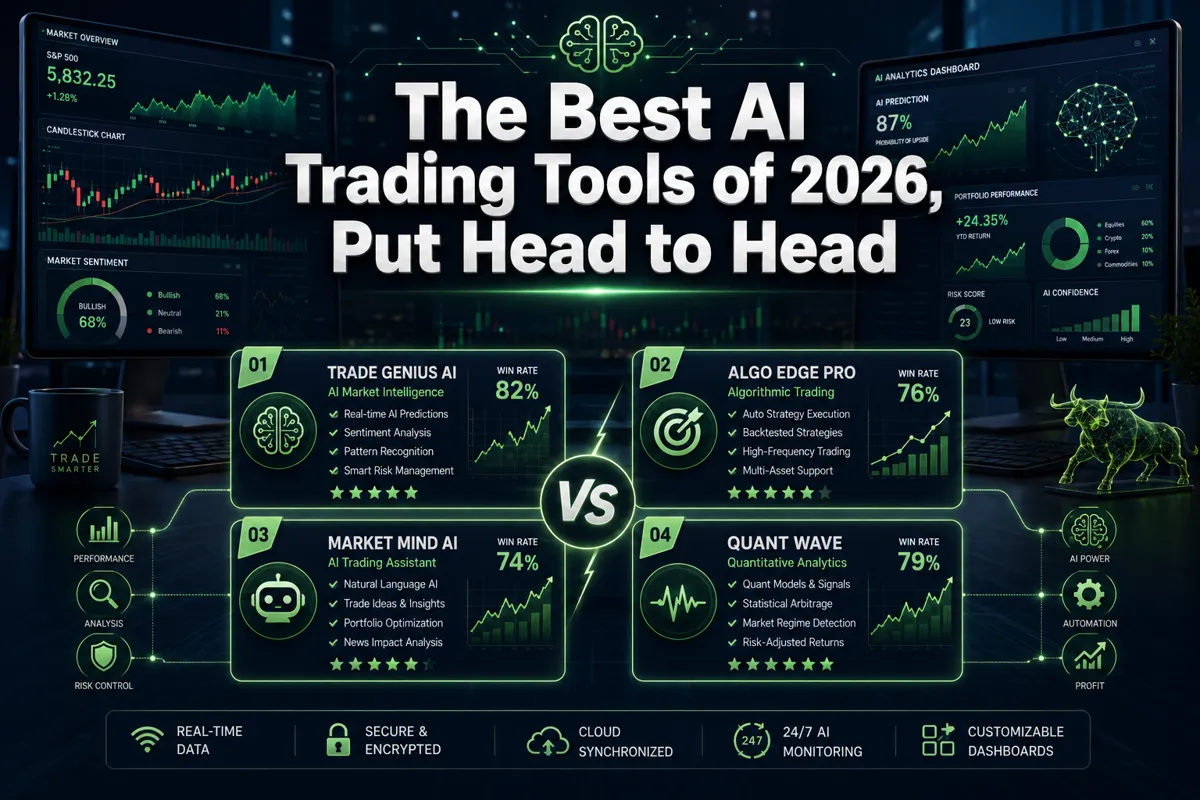
Four platforms dominate the conversation when traders compare the best AI trading tools of 2026: TrendSpider, Trade Ideas, Koyfin, and Option Alpha. Each one is genuinely good. Each one also has a real ceiling. The goal here isn't to crown one winner for everyone — it's to match the right tool to the right trader.
Here's the honest head-to-head breakdown:
| Tool | Best For | Starting Price (2026 est.) | AI Feature Highlight |
|---|---|---|---|
| TrendSpider | Technical analysis, swing/day traders | ~$39/mo | Automated trendlines, multi-timeframe analysis |
| Trade Ideas | Day trading, live scanning | ~$118/mo | AI-powered Holly scanner, real-time alerts |
| Koyfin | Fundamental + macro research | Free tier / ~$49/mo Pro | AI-assisted data dashboards, earnings models |
| Option Alpha | Options automation | Free tier / ~$149/mo | Automated options bots, no-code strategy builder |
TrendSpider vs Trade Ideas is the most common debate in active trading communities. TrendSpider wins on chart intelligence — it draws support and resistance automatically and flags clean setups without you staring at a screen for hours. Trade Ideas wins on speed and live scanning. If you're trading the open and need a watchlist built in real time, Trade Ideas' Holly AI is faster and more aggressive. If you're building swing setups the night before, TrendSpider is the better tool.
Koyfin is the sleeper pick. It's not a flashy AI scanner — it's a research platform that lets you build custom dashboards combining price action, fundamentals, and macro data. For swing traders who want to understand why a stock is moving before they take a position, Koyfin fills a gap that pure charting tools ignore. The Koyfin review on AI Stock Picker Apps puts it in context against similar research platforms.
Option Alpha is in a category by itself. It's built specifically for traders who want to run options strategies on autopilot — defined-risk spreads, iron condors, covered calls — triggered by rules they set. No code required. For anyone spending hours managing options positions manually, this is the tool that actually buys back time.
What Exactly Are AI Trading Tools and How Do They Work?
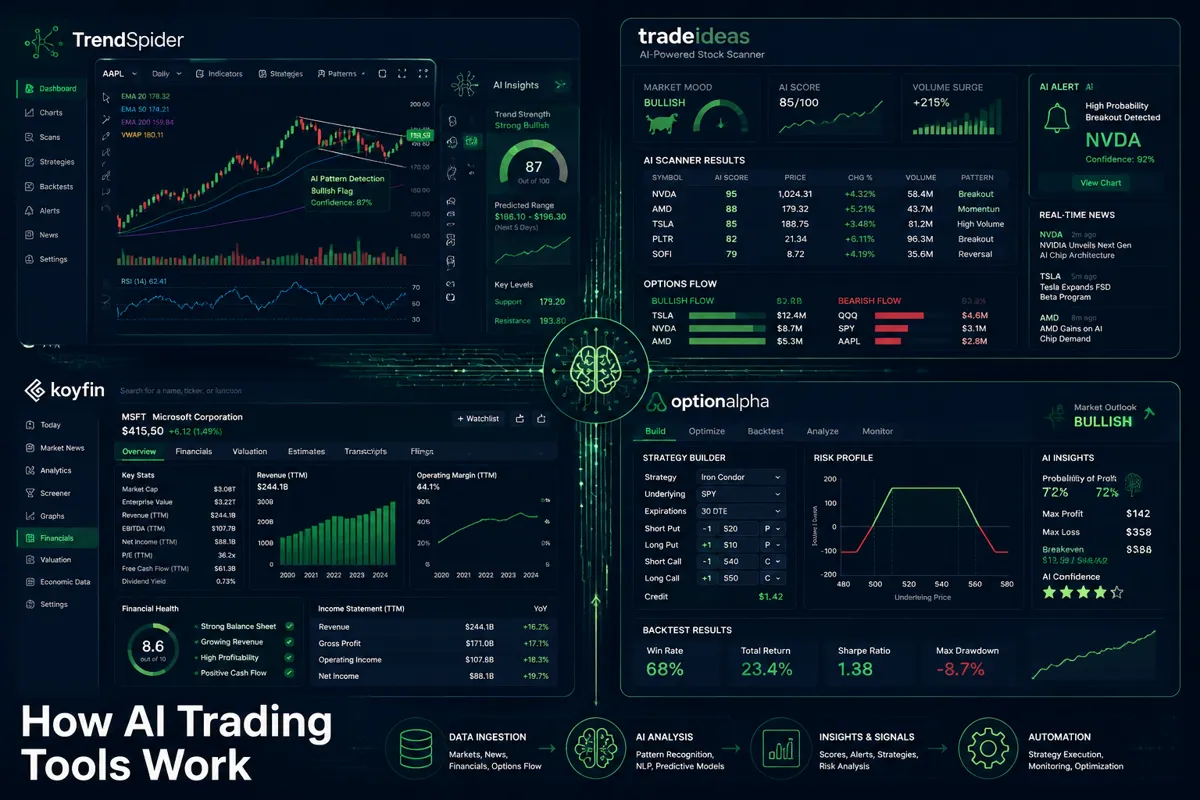
AI trading tools are software platforms that use machine learning, pattern recognition, and data processing to help traders find setups, analyze markets, and in some cases execute trades automatically. They don't predict the future — they process more data, faster, than any human can manually.
The core functions vary by tool type:
- Scanners (like Trade Ideas) run thousands of stocks through filters in real time, flagging setups that match your criteria — breakouts, gap fills, volume surges
- Chart analysis tools (like TrendSpider) use AI to identify trendlines, support and resistance levels, and multi-timeframe patterns automatically
- Research platforms (like Koyfin) aggregate fundamental data, earnings models, and macro indicators into dashboards that would take hours to build manually
- Automation platforms (like Option Alpha) let traders build rule-based strategies that trigger entries and exits without manual intervention
None of these tools trade for you unless you explicitly set up automation. Most are research and signal tools — the decision to pull the trigger is still yours. That's not a weakness. That's the correct setup. Discipline beats prediction, and no algorithm replaces a trader who understands their own risk tolerance.
For a broader look at what's available, the full AI trading platforms directory covers over 100 tools across every category.
Which AI Trading Platform Has the Best Performance Track Record?
No AI trading platform publishes independently audited, real-money performance data that holds up to scrutiny — and you should be skeptical of any that claims otherwise. What platforms do publish are backtested results, which show how a strategy would have performed on historical data. That's useful context, not a guarantee.
Trade Ideas' Holly AI has published backtested win-rate data showing above-average performance on momentum setups during trending markets. TrendSpider's automated strategy testing lets users backtest their own rules against historical price action. Neither is a promise of future results — and any platform that frames it that way is selling you something.
The honest performance metric: the best AI trading tool is the one that improves your process consistency, not the one with the highest theoretical backtest return. A tool that keeps you from revenge trading or overtrading a choppy tape is worth more than one promising 70% win rates on paper.
How Much Do Professional AI Trading Tools Cost in 2026?
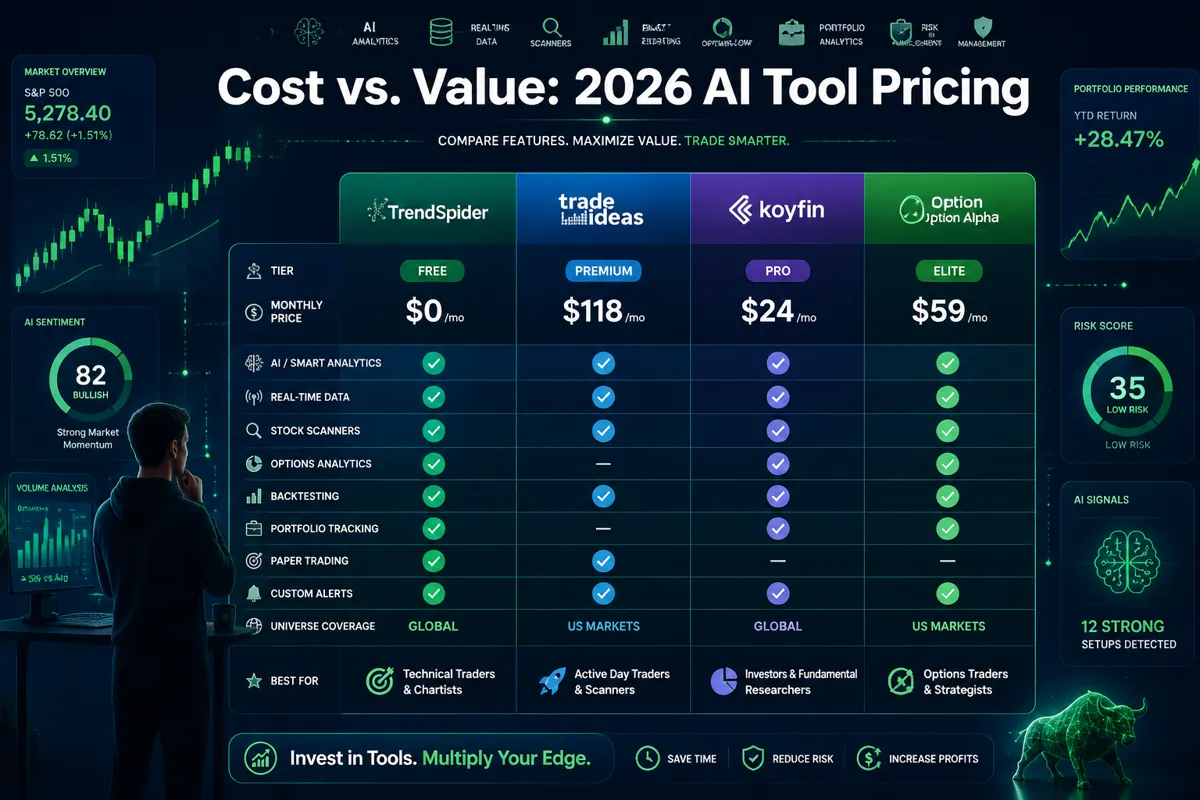
AI trading tool pricing in 2026 ranges from free tiers with limited data access to professional plans exceeding $300/month. Here's what you're actually paying for at each level:
Free tiers (Koyfin, Option Alpha, TradingView basic): Good for learning the interface and running basic scans. Real-time data, advanced filters, and AI features are almost always locked behind a paid plan.
Mid-tier plans ($39–$99/month): TrendSpider's entry plans, Koyfin Pro, and similar tools fall here. This is where most serious retail traders live. You get real-time data, AI chart features, and enough scanner functionality to build a legitimate watchlist.
Professional plans ($100–$300+/month): Trade Ideas Premium, Option Alpha's full automation suite, and institutional-grade tools like AlphaSense sit here. Worth it if trading is your primary income source or you're managing a meaningful account size.
The math that matters: if a $150/month tool helps you avoid one bad trade per month — say, a $500 loss from chasing an overextended setup — it's paying for itself. Position sizing and stop loss discipline still determine whether any tool is worth its cost.
Want to compare free options before committing? The free AI trading tools directory is a good starting point.
What Are Common Mistakes Traders Make When Using AI Trading Software?
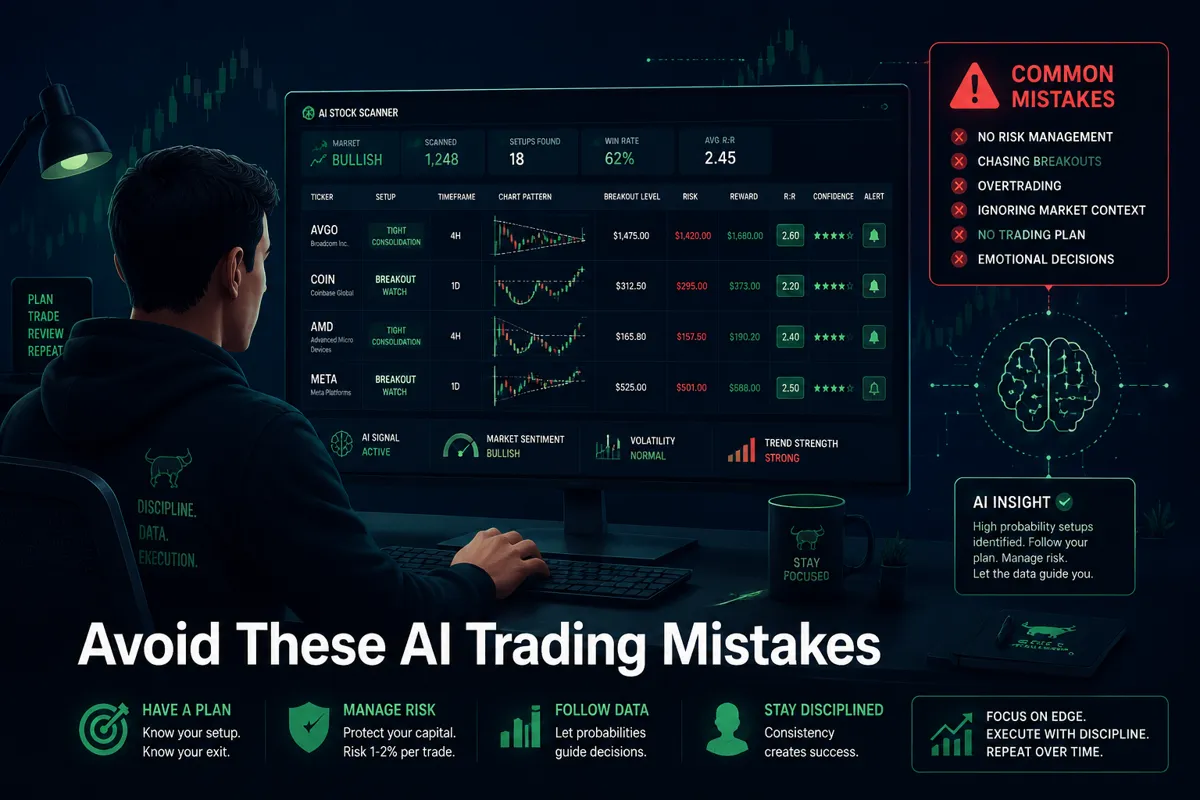
The most common mistake is treating an AI tool as a signal service rather than a process improvement tool. Traders see a scanner flag a setup, skip their own analysis, and enter without checking risk-reward or position sizing. That's not systems over hacks — that's just outsourcing your bad habits to an algorithm.
The other big ones:
- Analysis paralysis from too many tools. Running TrendSpider, Trade Ideas, and two other scanners simultaneously doesn't give you more signal — it gives you more noise. Pick one primary tool per function and commit to it for 30 days before adding another.
- Ignoring the stop loss. AI tools find entries. They don't manage your exits. Getting stopped out on a well-planned trade is fine. Holding through a 20% drawdown because the AI "said it was a good setup" is not.
- Skipping the paper trade phase. Every tool has quirks. Paper trade it first — run the scanner, take the setups on paper, and see how the signals actually perform in your trading style before risking real capital.
- Chasing alerts during a choppy tape. Scanners fire constantly. Not every alert is a clean setup. The best traders use AI tools to build a watchlist the night before, not to react to every real-time ping during market hours.
For swing traders specifically, the swing trade planner is a free tool worth using alongside any scanner to keep your process structured.
Can AI Trading Tools Really Beat Human Stock Pickers?
On average, over long time horizons, most active stock pickers — human or AI-assisted — underperform a simple index fund. That's not an opinion; it's consistent with decades of data from SPIVA reports and academic research on active management. So the question isn't whether AI beats humans — it's whether AI-assisted trading beats unassisted retail trading.
There, the answer is more favorable. AI tools reduce emotional decision-making, speed up setup identification, and enforce rules-based filters that most traders abandon under pressure. A trader using a structured scanner and a defined risk-reward framework will, on average, make better decisions than the same trader flying blind.
The real edge: AI tools don't make you smarter. They make your process more consistent. Consistency over hype — that's the actual value proposition.
Which AI Trading Platforms Are Best for Beginners vs. Experienced Investors?
Beginners need simplicity and guardrails. Experienced traders need depth and customization. The tools that serve both groups well are different.
Best for beginners:
- Koyfin (clean interface, strong free tier, good for learning fundamental analysis)
- Robinhood Cortex (integrated into a commission-free broker, low barrier to entry)
- Webull's AI features (built-in scanner and charting for new traders)
Best for experienced active traders:
- TrendSpider (deep technical analysis, strategy automation)
- Trade Ideas (professional-grade real-time scanning)
- Option Alpha (for experienced options traders ready to automate)
- Tradytics (options flow and dark pool data for traders who read the tape)
The mistake beginners make is starting with a professional tool before they understand what they're looking at. A scanner showing 200 alerts per hour is useless if you don't know what a clean setup looks like. Start simple. Build the process. Add complexity only when you've outgrown the current tool.
What Investment Minimum and Technical Skills Do I Need?
Most AI trading tools have no investment minimum — they're software subscriptions, not brokerage accounts. The broker you connect them to will have its own minimums, which vary by platform.
Technical skills required: lower than most people assume. TrendSpider, Trade Ideas, and Koyfin are all point-and-click interfaces. Option Alpha's bot builder uses a visual logic editor — no coding needed. The tools that require coding (like QuantConnect or custom algorithmic platforms) are the exception, not the rule.
What you do need before using any of these tools effectively:
- A basic understanding of price action and chart reading
- A defined risk-reward minimum (e.g., only take trades with at least 2:1 reward-to-risk)
- A position sizing rule (e.g., never risk more than 1-2% of account on a single trade)
- A stop loss strategy before you enter any position
If those four things aren't in place, no AI tool will save you. Fix the process first. For day traders building that foundation, the day trading tools and resources section covers the basics alongside the AI layer.
Are AI Trading Tools Legal and Regulated?
AI trading tools are legal in the United States, the EU, the UK, Canada, and most major markets. They are research and analysis platforms — not registered investment advisors, brokers, or fund managers. That distinction matters.
Because they're not giving personalized investment advice in the regulatory sense, they don't fall under SEC or FINRA broker-dealer registration requirements. However, platforms that offer automated trading connected to real brokerage accounts operate in a more complex regulatory space. Always check whether a tool's automation features are compatible with your broker's terms of service.
In the EU, MiFID II rules apply to algorithmic trading at the institutional level. For retail traders using AI-assisted tools, the regulatory burden sits primarily with the broker, not the tool provider. The SEC's investor education resources at Investor.gov are worth reviewing if you're uncertain about the regulatory status of any platform you're using.
Bottom line: using AI trading tools is legal. Treating them as licensed financial advisors is not how they're designed — and that's a distinction you need to own.
How Do Top AI Trading Platforms Protect Against Algorithmic Trading Risks?
The main risks in algorithmic and AI-assisted trading are over-optimization (building a strategy that only works on historical data), flash-crash exposure, and runaway automation. Reputable platforms address these in different ways.
- TrendSpider limits automation to alert triggers, not direct order execution, reducing runaway trade risk
- Option Alpha includes position-level controls, maximum loss limits per bot, and manual override at any point
- Trade Ideas' Holly AI is a signal generator, not an autonomous executor — the trader still clicks the button
The risk no tool can fully protect against: you. Overtrading, revenge trading after a loss, and ignoring your own stop loss rules are behavioral risks that no algorithm patches. The setup can be perfect. The risk management still has to come from you.
What Are the Top 3 Alternatives If AI Trading Tools Don't Work for You?
If AI trading tools feel like overkill or you've tried them and found the signal-to-noise ratio still too high, three alternatives consistently produce better outcomes for retail traders:
Index fund investing with a rules-based rebalancing schedule. No scanner, no AI, no active decisions. Decades of data support this as the highest-probability path for most retail investors. Platforms like Wealthfront automate the process entirely.
A single, well-understood screener with manual review. Tools like TradingView's screener or TC2000 let you build a simple filter — say, stocks above their 50-day moving average with above-average volume — and review results manually each evening. Slower, but cleaner.
A robo-advisor for the core portfolio, active trading only with money you can afford to lose. The robo-advisor comparison section covers the main options. This hybrid approach keeps the bulk of your capital in a disciplined, low-cost structure while giving you a smaller active account to sharpen your skills without catastrophic downside.
Play stupid games, win stupid prizes. Chasing every new AI tool without a foundational process is the game. These three alternatives are the fix.
FAQ
What is the best AI trading tool overall in 2026?
For most active traders, TrendSpider and Trade Ideas lead for technical analysis and scanning respectively. Koyfin is the best value for fundamental research. The "best" tool depends on your trading style — there's no single winner for every use case.
Is there a free AI trading tool worth using?
Koyfin's free tier is genuinely useful for research. TradingView's free plan covers basic charting. Option Alpha has a free tier for learning the platform. Real-time AI scanning features are almost always behind a paywall.
Does TrendSpider or Trade Ideas work better for swing trading?
TrendSpider is better suited for swing trading. Its multi-timeframe analysis and automated chart pattern detection are designed for traders who build setups over days or weeks, not minutes.
Can AI trading tools execute trades automatically?
Some can, with the right broker integration. Option Alpha's bots execute options trades automatically. Most other tools generate signals or alerts — the trader still executes manually.
How accurate are AI stock scanners?
Accuracy depends on how you define it. Scanners flag setups that match your criteria — they don't predict outcomes. A scanner showing a breakout pattern is identifying a setup, not guaranteeing a move. Win rate depends on your entry rules, risk management, and market conditions.
Do I need coding skills to use AI trading software?
No, for the tools covered here. TrendSpider, Trade Ideas, Koyfin, and Option Alpha are all no-code platforms. Algorithmic trading platforms like QuantConnect require Python or C#.
Are AI trading tools worth the monthly cost?
If they improve your process consistency and reduce emotional trading mistakes, yes. If you're subscribing and not using them systematically, no tool justifies the cost.
What's the difference between an AI scanner and a trading bot?
A scanner identifies potential setups based on your criteria. A trading bot executes trades automatically based on pre-set rules. Scanners inform decisions; bots make them. Most retail traders should start with scanners before considering bots.
Which AI trading tool is best for options traders?
Option Alpha is the clear leader for options automation. For options flow data and unusual activity scanning, Cheddar Flow and Tradytics are strong alternatives.
Can beginners use AI trading tools safely?
Yes, with the right tools and realistic expectations. Start with a free or low-cost platform, paper trade before using real capital, and build a process around risk management before worrying about which scanner has the best signals.
Conclusion: Cut the Noise, Pick Your Tool, Build the Process
The best AI trading tools of 2026 aren't magic. They're process accelerators. TrendSpider wins on chart automation. Trade Ideas wins on live scanning speed. Koyfin wins on research depth. Option Alpha wins on options automation. Those aren't marketing claims — they're use-case matches.
The traders who get the most out of these tools share one thing: they use one tool well before adding another. They define their setup criteria before opening a scanner. They set their stop loss before they enter a position. They let the AI handle the data processing and take responsibility for the decision themselves.
That's not a limitation of AI tools — it's the correct division of labor. Signal over noise. Process over prediction. Discipline beats prediction, every time.
Your next move: pick one tool from this list that matches how you actually trade, not how you wish you traded. Run it for 30 days with a defined watchlist and documented entries. See what the data tells you. Then decide if you need more.
We test the AI stock tools so you don't waste months on the wrong ones. Browse the full breakdowns at aistockpickerapp.com.