PDT Rule Gone | 4x Intraday Margin at Schwab, E*TRADE, Robinhood
Quick Answer
The PDT rule is gone. As of June 4, 2026, FINRA retired the pattern day trader designation, the $25,000 equity minimum and the old day-trading buying power formula, replacing all three with an intraday margin monitoring standard. The floor is now the $2,000 margin minimum that always existed under Reg T. Schwab, E*TRADE, Robinhood, Interactive Brokers and Webull have all switched over, and several now offer up to 4x intraday buying power. The gate opened. The risk did not shrink.
Quick pick: brokers after the PDT rule change
- Charles Schwab Best for cautious small accounts wanting 4x. $0 stock commissions, $2,000 margin minimum.
- E*TRADE Best for traders who want a call window. $0 stock commissions, $2,000 margin minimum.
- Robinhood Best for mobile-first, flag-free trading. $0 stock commissions.
Skip it if: you have no written risk rules yet. Leverage will find you.
Key Takeaways
- The PDT rule died June 4, 2026 under amended FINRA Rule 4210. Firms have until October 20, 2027 for full compliance, per FINRA's rule notice.
- The $25,000 minimum is replaced by the standard $2,000 margin account minimum.
- Reg T stays: 50% initial margin, 25% maintenance, as described in the SEC's investor bulletin on margin.
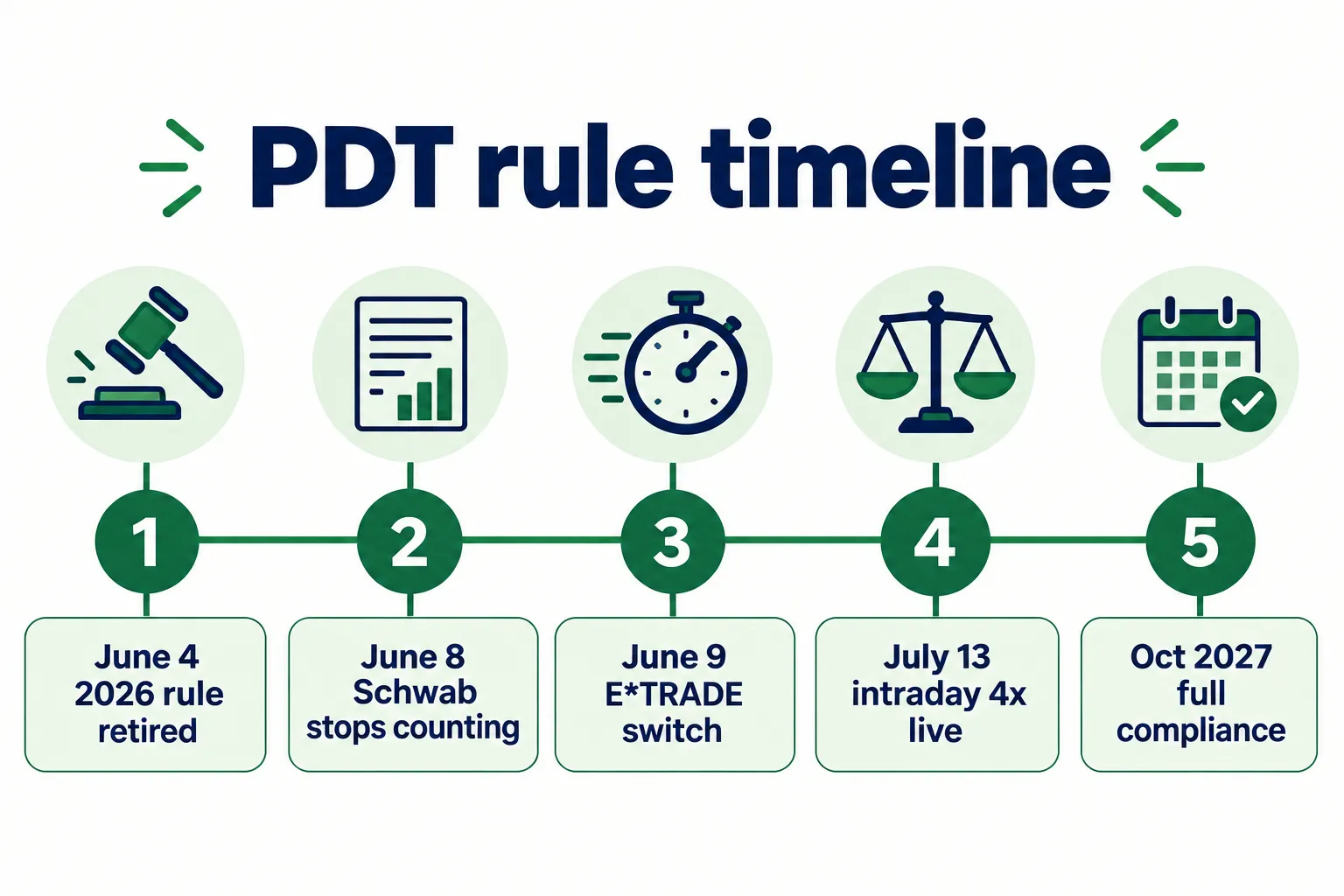
- Schwab stopped counting day trades June 8 and rolled out Intraday Margin Buying Power up to 4x from July 13, 2026, with positions required to close by 8 p.m. ET.
- E*TRADE switched June 9 and gives 5 business days to meet an Intraday Margin Deficit call, per its pattern day trading rule change page.
- Robinhood said it would be "wiping all past PDT flags clean," and announced 4x intraday buying power on September 29, 2026.
- Webull's equity notional volume rose 73% year over year to $279 billion after the repeal, reported by 24/7 Wall St in August 2026.
What happened to the PDT rule?
FINRA eliminated the pattern day trader rule effective June 4, 2026, and replaced it with an intraday margin standard that monitors risk in real time instead of counting trades. The designation, the day-trade counter and the $25,000 threshold are all retired. Brokers now watch whether your account has enough margin excess at the moment of the trade.
Twenty-five years of a hard gate, undone by a rule amendment. The old regime treated four day trades in five business days as evidence you were a professional and demanded $25,000 to prove it. The new regime treats you as an account with a number attached, and that number updates intraday.
The transition is not instant across the industry. FINRA's rule filing with the SEC sets a long runway, and compliance advisers covering the end of the pattern day trader rule flag that member firms have until October 20, 2027 to finish building the monitoring systems. Translation: early adopters moved in June, stragglers have another year.
What that means for you: your broker, not FINRA, now sets your practical ceiling.
PDT rule: what replaced the $25,000 minimum?
An intraday margin monitoring standard replaced it. Instead of a static equity floor, your broker checks margin excess in real time and issues a deficit call if an intraday position exceeds what your account supports. The hard minimum to trade on margin is $2,000, the Reg T floor that predates the PDT rule by decades.
FINRA's own explainer on intraday margin requirements for investors lays out the shape of it: firms must monitor intraday exposure, set house requirements and act on deficits. On the FINRA Unscripted episode covering the intraday margin standard, the point regulators keep returning to is flexibility paired with faster risk management. More rope for you, faster reaction from them.
Three things stayed exactly the same:
- Reg T initial margin: 50%. Overnight, you can hold roughly 2x your equity.
- Maintenance margin: 25%. Fall below and you get a call.
- House requirements. Brokers can always be stricter than the regulator, and most are.
So the PDT rule change to $2,000 is real, but it is not a free pass. It is a different control system.
What was the PDT rule and why did it exist?
The PDT rule, formally the pattern day trader rule, flagged any margin account that executed four or more day trades within five business days when those trades made up more than 6% of total trading activity. Once flagged, the account needed $25,000 in equity to keep day trading. It existed to make sure leveraged intraday traders had a cushion to absorb losses.
What is pattern day trading, in plain English?
A day trade is buying and selling the same security on the same day. Pattern day trading is doing that repeatedly. The old counter did not care whether you made money, only how often you round-tripped a position. If you want the mechanics of terms like margin excess and maintenance call, our trading glossary breaks them down without the textbook voice.
How much did you need to avoid the PDT rule?
Under the old rules: $25,000 in a margin account, or a cash account where you traded settled funds only. Those were the real day trading rules under 25k, and they pushed a generation of small accounts into cash-account workarounds, offshore brokers and prop firms. Our guide on how to day trade without $25K documents what people actually did.
Did the PDT rule apply to crypto and futures?
No. The pattern day trader rule applied to margin equity and options accounts at FINRA member firms. Futures trade under CFTC and exchange rules with their own day-trade margin schedules, which is why futures were the classic escape hatch for small accounts. Digital assets sat outside the rule entirely, and they sit outside this site's coverage too.
How does 4x intraday margin work at Schwab, E*TRADE and Robinhood?
Four times intraday margin means your broker lets you control up to four dollars of position for every dollar of equity, but only during the session. The leverage is intraday only, it unwinds before or at the close, and the exact mechanics differ by firm. Schwab, E*TRADE, Robinhood, Interactive Brokers and Webull all implemented the change, on different dates and with different guardrails.

PDT rule Schwab: Intraday Margin Buying Power
The PDT rule change Schwab shipped came in two stages. Schwab stopped counting day trades on June 8, 2026, then turned on Intraday Margin Buying Power of up to 4x from July 13, 2026. You need $2,000 in the account, and positions opened against intraday buying power must be closed by 8 p.m. ET or you risk a margin call.
That 8 p.m. ET deadline is the part people skim. Carry a 4x position past it and you have converted an intraday trade into an overnight position your account cannot support at Reg T.
PDT rule E*TRADE: real-time intraday margin excess
E*TRADE made the switch on June 9, 2026. The PDT designation is gone, the $2,000 margin minimum applies, and intraday buying power is calculated from real-time intraday margin excess. Overextend and you get an Intraday Margin Deficit call, with 5 business days to meet it.
Five business days is the most forgiving window in this comparison. It is also the easiest one to abuse by telling yourself the trade will come back.
Robinhood PDT rule change: flags wiped, 4x rolling out
Robinhood moved on day one, June 4, and said plainly: "We will be wiping all past PDT flags clean" and "No more $25K minimum, no more flags." On September 29, 2026, Robinhood announced 4x intraday buying power rolling out "next month." If you want the detail on what changed inside the app, see our breakdown of the Robinhood PDT rule change.
That answers the people still searching for when Robinhood will remove the PDT rule. It already did.
PDT rule Webull, IBKR and Fidelity
Interactive Brokers implemented on June 4, 2026 for eligible securities clients. The PDT rule Webull handled was also a day-one implementation. Fidelity, tastytrade, TradeZero and Lightspeed terms were not confirmed on an official page at the time of writing, so check their margin disclosure pages directly rather than trusting a forum post. If you are comparing accounts, our listings for tastytrade and TradeZero are a starting point, not a substitute for the official margin terms.
Broker comparison: who gives what
| Broker | Change date | Minimum | Intraday buying power | Close-out / call rule | Stock commission |
|---|---|---|---|---|---|
| Charles Schwab | Stopped counting day trades June 8, 2026 | $2,000 | Up to 4x from July 13, 2026 | Close by 8 p.m. ET or risk a margin call | $0 online stock trades |
| E*TRADE | June 9, 2026 | $2,000 | Based on real-time intraday margin excess | Intraday Margin Deficit call, 5 business days to meet | $0 online stock trades |
| Robinhood | June 4, 2026, flags wiped | No $25K minimum | 4x announced Sept 29, 2026, rolling out | Per app margin terms, confirm in-app | $0 stock trades |
| Interactive Brokers | June 4, 2026 | Per firm margin terms | Firm intraday margin monitoring | Per firm margin terms | $0 commission tier available |
| Webull | June 4, 2026, day one | Per firm margin terms | Firm intraday margin monitoring | Per firm margin terms | $0 stock trades |
Confirm every figure on the broker's own margin disclosure page before you fund. Terms are still moving through the October 2027 compliance window.
Can you still get flagged, and what happens if you violate the PDT rule now?
No. At firms that have implemented the change, there is no pattern day trader flag to receive and no day-trade counter to trip. What you can get instead is a margin deficit call, and those have teeth. Old flags were cleared by brokers like Robinhood when the rule retired.
So the question "how long does a PDT restriction last" has a new answer at most major firms: it does not, because the restriction no longer exists. There is nothing to get removed or waived. If your broker has not finished its build-out, the old 90-day restriction logic may still appear in your account until it switches over, and the only fix is calling the firm.
What replaces the flag:
- Intraday margin deficit. Your position exceeds intraday buying power. You meet the call or the broker closes positions.
- Maintenance call. Equity drops below the 25% maintenance level on a held position.
- Forced liquidation. Brokers can close positions without waiting for you. They do not need your permission.
Decision rule: if you cannot state your maximum intraday exposure in dollars before the open, you are not ready for 4x.
What is the new 4x margin trap for small accounts?
The trap is simple arithmetic. 4x on a $2,000 account is $8,000 of intraday buying power, and a 5% move against a full position is a $400 loss, which is 20% of the account. Same leverage that opens the door can empty the room in one bad candle.
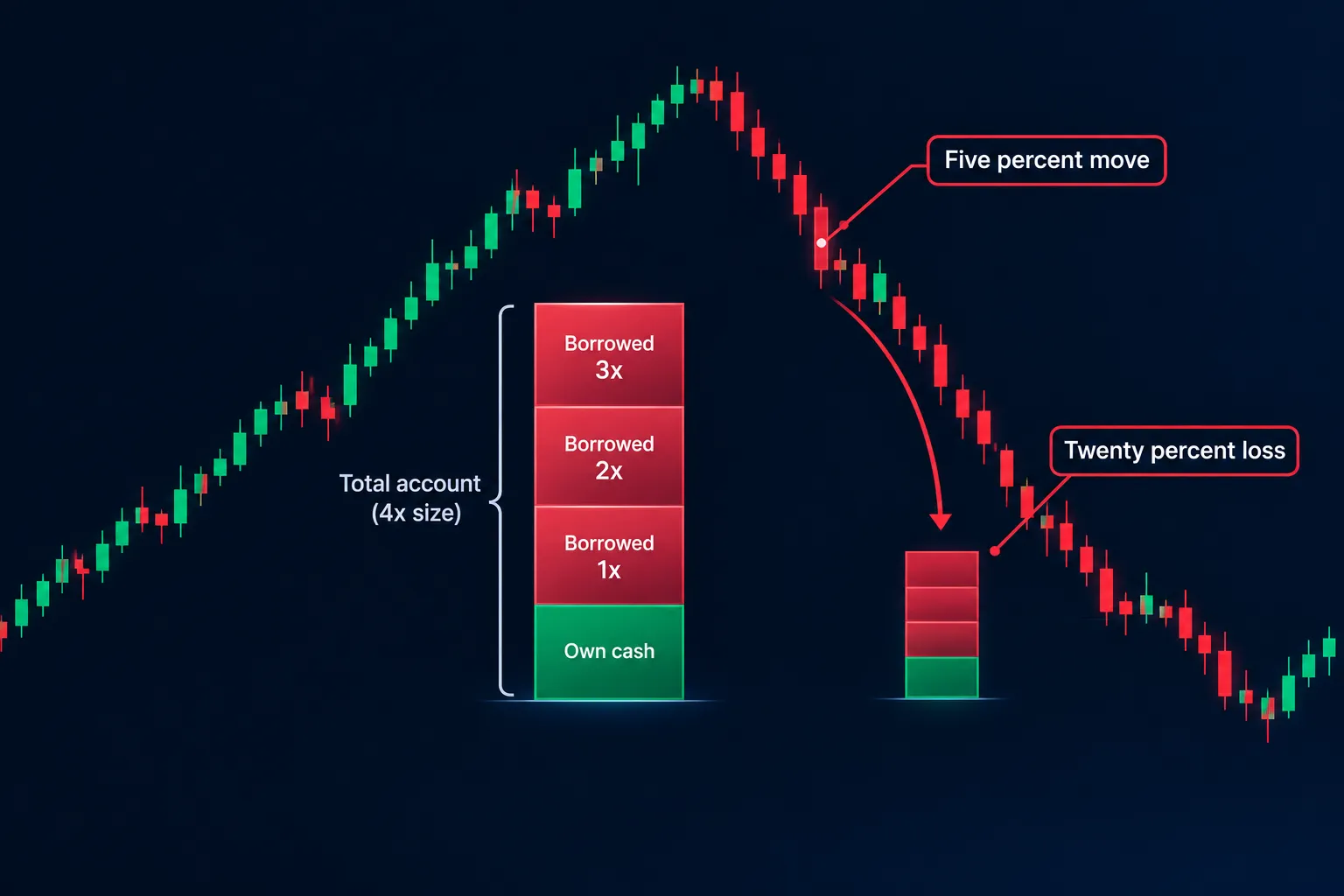
Run the chain of events out loud. You take the full $8,000. The stock gaps against you 5%, a move that happens multiple times a week in low float names. You are down $400. Two of those in a week and 40% of the account is gone. Not from being wrong about the company. From position sizing.
Three failure modes that show up fast with new leverage:
- Revenge trading. Losing $400 on a 4x position invites a bigger one to win it back. That is how a $2,000 account becomes a $600 account by Thursday.
- Overtrading. No day-trade counter means no built-in brake. The old PDT rule accidentally capped how badly a beginner could behave in a week.
- Holding past the deadline. Schwab's 8 p.m. ET close-out exists for a reason. A 4x position held overnight is a margin call waiting for the open.
Play stupid games, win stupid prizes. The rule that annoyed you for years was also the thing standing between a bad streak and a blown account.
How should a $2,000 account size positions now?
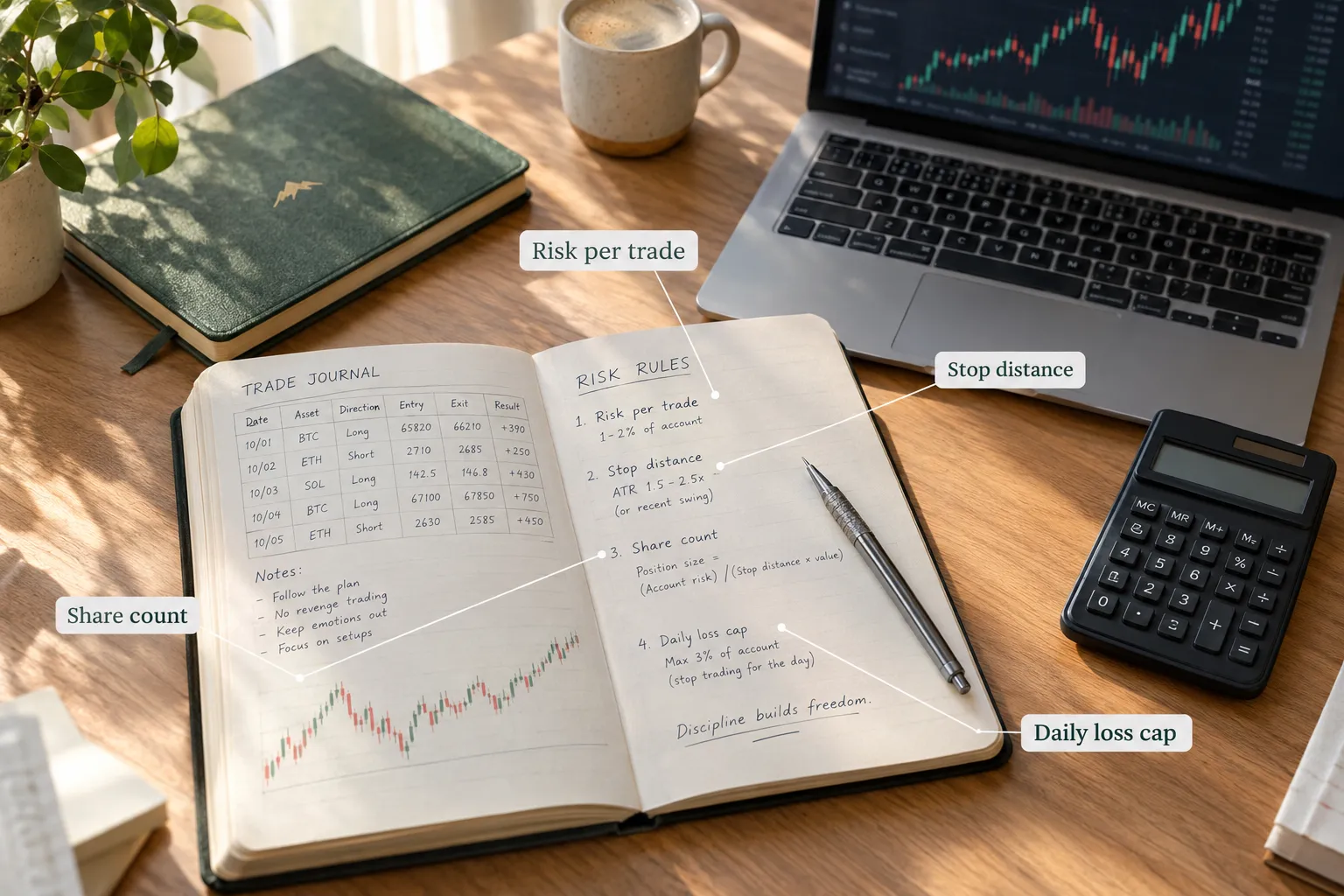
Size from your risk per trade, not from your buying power. A common framework: risk no more than 1% to 2% of account equity on a single trade, which on $2,000 is $20 to $40 of actual risk, then let your stop distance determine share count. Buying power is a ceiling, not a target.
The math, step by step:
- Set risk per trade. $2,000 account, 1.5% risk, so $30 maximum loss.
- Define the stop. Entry $20.00, stop below support at $19.40, so $0.60 of risk per share.
- Divide. $30 divided by $0.60 equals 50 shares. That is a $1,000 position, not $8,000.
- Set a daily loss cap. Two stop-outs and you are done for the day. Write it down.
- Log every trade. Entry, exit, reason, outcome. The journal is the system.
Notice what happened: the position sizing math ignored the 4x entirely. That is the point. The position sizing mistake that wipes out most new traders is sizing from available margin instead of from a stop loss. If you want to run the numbers before the open, use our free swing trade position size calculator and adapt the inputs to an intraday stop.
Discipline beats prediction. Your edge is not the leverage. Your edge is surviving the week where you are wrong four times in a row.
What do the numbers say about post-PDT rule trading?
Volume moved immediately. Webull's equity notional volume rose 73% year over year to $279 billion after the repeal, reported by 24/7 Wall St in August 2026. That is the clearest public read on how many small accounts walked through the open door in the first quarter after the change.
What is on the record comes from brokers and regulators. Robinhood's language was blunt: "No more $25K minimum, no more flags." Retail platforms echoed it, including SoFi's customer explainer on what is happening to pattern day trader rules on June 4th, 2026, which walks retail users through the switch in plain language.
Regulators framed it as a trade: more flexibility for traders, more real-time surveillance for firms. FINRA's compliance calendar archive and its Q3 2026 financial and operational report show the monitoring apparatus being built out behind the scenes. You got the freedom. They got the dashboard.
What are the alternatives and workarounds?
If your broker has not implemented the change yet, or you would rather not touch intraday leverage, the old workarounds still function: a cash account trading settled funds, futures, or longer holding periods. None of them require a $25,000 balance either.
Cash account trading
No margin, no leverage, no margin calls. You trade settled cash, which under T+1 settlement means funds free up the next business day. Slower, and you cannot double down on a bad idea. Drawback: you lose same-day reuse of capital, and you have no short selling.
Futures and micro futures
Futures never fell under the pattern day trader rule and carry their own intraday margin schedules, often far lower than equities. Drawbacks: contract specifications and tick values take real study, and leverage is higher than most beginners should handle. Futures reward people with a written process, not people escaping a rule.
Swing trading instead
Hold for days to weeks, avoid intraday margin entirely, and trade off daily charts. It fits people with jobs. Our rundown of swing trade scanners that find setups before they break out covers the tooling. Drawbacks: overnight gap risk and slower feedback on whether your process works.
Best brokers with the lowest day trading requirements
Post-change, the practical answer is any firm that has implemented the new standard and accepts the $2,000 margin minimum. Schwab and E*TRADE have published terms. Robinhood, IBKR and Webull implemented early. Fidelity's terms were not confirmed on an official page, so verify rather than assume.
Is active day trading worth it now that the PDT rule is gone?
For most people, no, and the removal of the PDT rule does not change that math. Studies of retail day traders keep finding that most lose money, and leverage widens the distribution in both directions. Access is not the same as edge.
The honest version: the rule was never the reason you were not profitable. A gate removed does not install a strategy, a stop loss discipline or a watchlist process. If you were not making money paper trading, 4x will make you lose real money faster.
Who it genuinely helps:
- Traders with a tested, written system who were capital-constrained, not skill-constrained.
- Scalpers who need multiple round trips per day and were throttled to three per week.
- People rebuilding after a drawdown who no longer have to sit out at $24,000.
Who should ignore the headlines entirely: anyone still shopping for a strategy. Paper trade it first, then fund the account. Our guide to AI trading app settings to change before your first trade is a better use of the next hour than enabling margin.
Final Verdict
The PDT rule is genuinely gone, the $2,000 floor is real, and 4x intraday buying power at Schwab, E*TRADE and Robinhood is a meaningful change for small accounts with an actual system. It is a terrible change for anyone without one.
What to do this week:
- Confirm your broker's terms on its own margin page. Dates, minimums and close-out deadlines differ.
- Write your risk rules before enabling intraday margin: risk per trade, daily loss cap, maximum position size in dollars.
- Trade one position size for 30 days and log every trade. Let the data argue back.
- Treat 4x as a ceiling you rarely touch, not a default.
FullStack Alpha's position has not moved: the tools and the access are not the edge. The process is.
Stop guessing which day trading tool fits a small account. We sorted 200+ AI stock tools by strategy, price and what they actually do, so you can skip three months of trial subscriptions.
See the day trading shortlist: https://aistockpickerapps.com/day-trading
Frequently asked questions about the PDT rule
Short, direct answers to the questions traders are asking most since the change took effect.
Will the PDT rule change in 2026?
It already did. The change took effect June 4, 2026, when amended FINRA Rule 4210 retired the pattern day trader designation, the $25,000 minimum and the old day-trading buying power formula. An intraday margin monitoring standard replaced them. Member firms have until October 20, 2027 to complete full compliance, so some brokers moved faster than others.
Is the 25k PDT rule gone?
Yes. The $25,000 equity minimum for pattern day traders no longer applies. The operative floor is the $2,000 margin account minimum that has existed under Reg T for decades. Robinhood stated it would be "wiping all past PDT flags clean," and Schwab stopped counting day trades on June 8, 2026. Verify your own broker's implementation date.
Do you have to have $25,000 to start day trading?
No. Since June 4, 2026, you need $2,000 in a margin account at a firm that has implemented the new intraday margin standard. Cash accounts trading settled funds have no day-trade limit either. Having enough capital to survive a losing streak is a separate question from the regulatory minimum, and it matters more.
Can you make $1000 a day with day trading?
Some traders do. Most do not, and most retail day traders lose money overall. Making $1,000 a day consistently on a $2,000 account would require a 50% daily return, which is not a realistic expectation. No system here promises returns. Size positions from your stop loss, not from an income target.
Are they taking away the PDT rule?
They took it away. FINRA eliminated the pattern day trader rule effective June 4, 2026, replacing trade counting with real-time intraday margin monitoring. Regulators describe the swap as more flexibility for investors paired with faster risk management at firms. Reg T's 50% initial and 25% maintenance margin requirements were not touched and still apply.
What is the current PDT rule?
There is no PDT rule anymore. The current standard is intraday margin monitoring: your broker calculates intraday buying power from real-time margin excess and issues a deficit call if you exceed it. E*TRADE, for example, gives 5 business days to meet an Intraday Margin Deficit call. Schwab requires intraday positions closed by 8 p.m. ET.
When did the pdt rule change take effect?
The PDT rule change effective date was June 4, 2026. Robinhood, Interactive Brokers and Webull implemented on day one. Schwab stopped counting day trades June 8 and launched 4x Intraday Margin Buying Power July 13. E*TRADE switched June 9. Full industry compliance is required by October 20, 2027.
Can you day trade with $2,000 now?
Yes, in a margin account at a broker that has implemented the new standard. $2,000 is the minimum, and 4x intraday buying power on it equals $8,000 of exposure. A 5% move against a full position is a $400 loss, or 20% of the account. Size from your stop, not your buying power.
Does the pdt rule apply to cash accounts?
It never did, and now it applies to nobody. Cash accounts have always been exempt from pattern day trader counting because they use no leverage. The constraint there is settlement: you trade settled funds only. Cash accounts remain a reasonable choice for traders who want no margin calls and no intraday leverage at all.
Conclusion
The PDT rule is retired, the $25,000 gate is open, and 4x intraday margin is live or arriving at the biggest retail brokers. That is a real shift in access for small accounts, and the single most important thing you can do with it is less than you are allowed to do.
Next steps, in order: confirm your broker's margin terms on its official page, write your risk rules on paper, pick one position size and run it for 30 days with a trade log. Then, and only then, think about leverage.
Prices and broker terms change faster than a 4x position, so check the official pages before you fund anything.
This is education, not financial advice.
Your market edge starts with the right tool. Stay alpha.
Some links on this page may be affiliate links, which may earn us a commission at no cost to you.