How to Day Trade Without 25K: Small-Account Options That Work
Day Trade Without 25K: Small-Account Options That Work

Last updated: July 19, 2026
Quick Answer
You can legally day trade without 25K by using a cash account instead of margin, trading forex or futures markets that aren't subject to the Pattern Day Trader rule, opening accounts with offshore brokers, or joining a proprietary trading firm that provides funded capital. Each path has trade-offs in settlement time, leverage, regulation, and risk, but all let you execute multiple intraday trades without hitting the PDT restriction that locks out most small U.S. margin accounts.
Key Takeaways
- The Pattern Day Trader rule only applies to U.S. margin accounts, cash accounts, forex, and futures are exempt
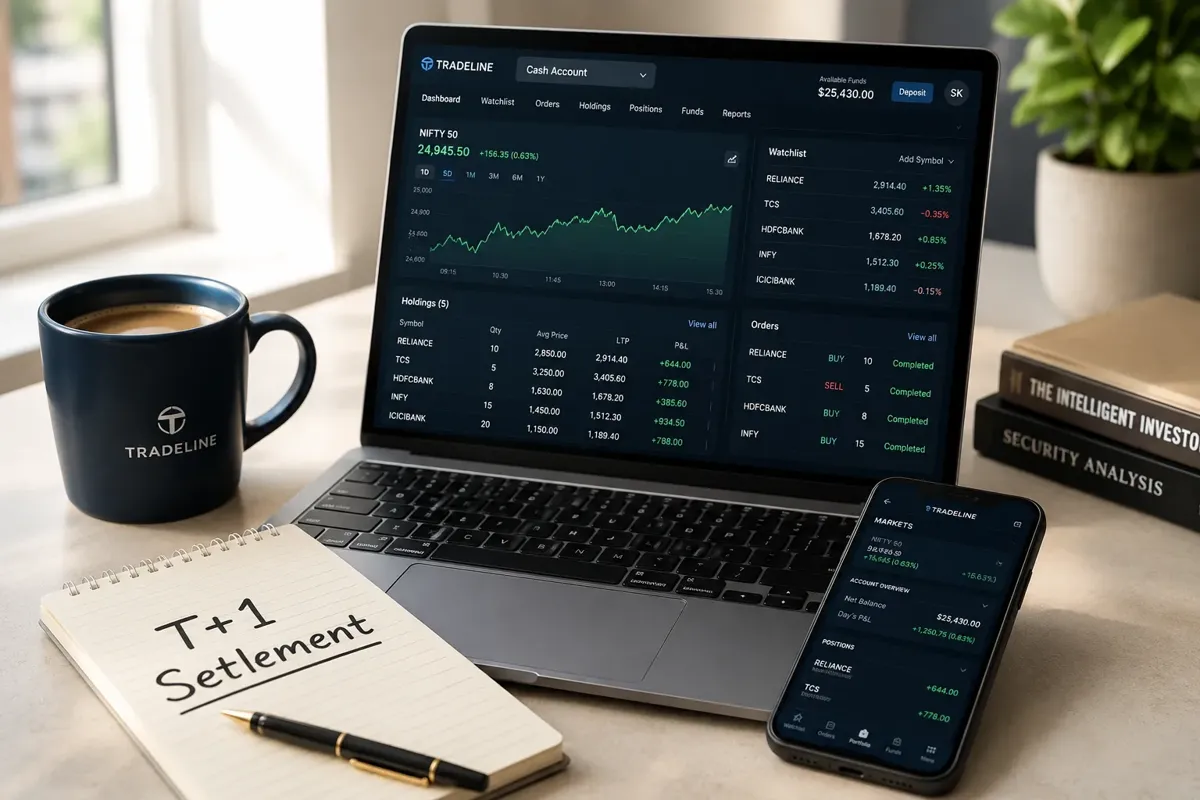
- Cash accounts let you day trade freely but require T+1 settlement, meaning you must wait one business day for funds to clear between trades
- Offshore brokers and prop firms bypass the 25K minimum but introduce counterparty risk and different regulatory protections
- Forex and futures markets operate under different rules and allow day trading with accounts under $5,000
- Position sizing and risk management matter more than account size, most traders fail because of process, not capital
- Swing trading (holding overnight) eliminates PDT restrictions entirely and often produces better risk-adjusted returns for small accounts
- The best path depends on your strategy, risk tolerance, and whether you're willing to trade outside U.S.-regulated brokers
What Is the Pattern Day Trader Rule and Why Does It Require 25K?
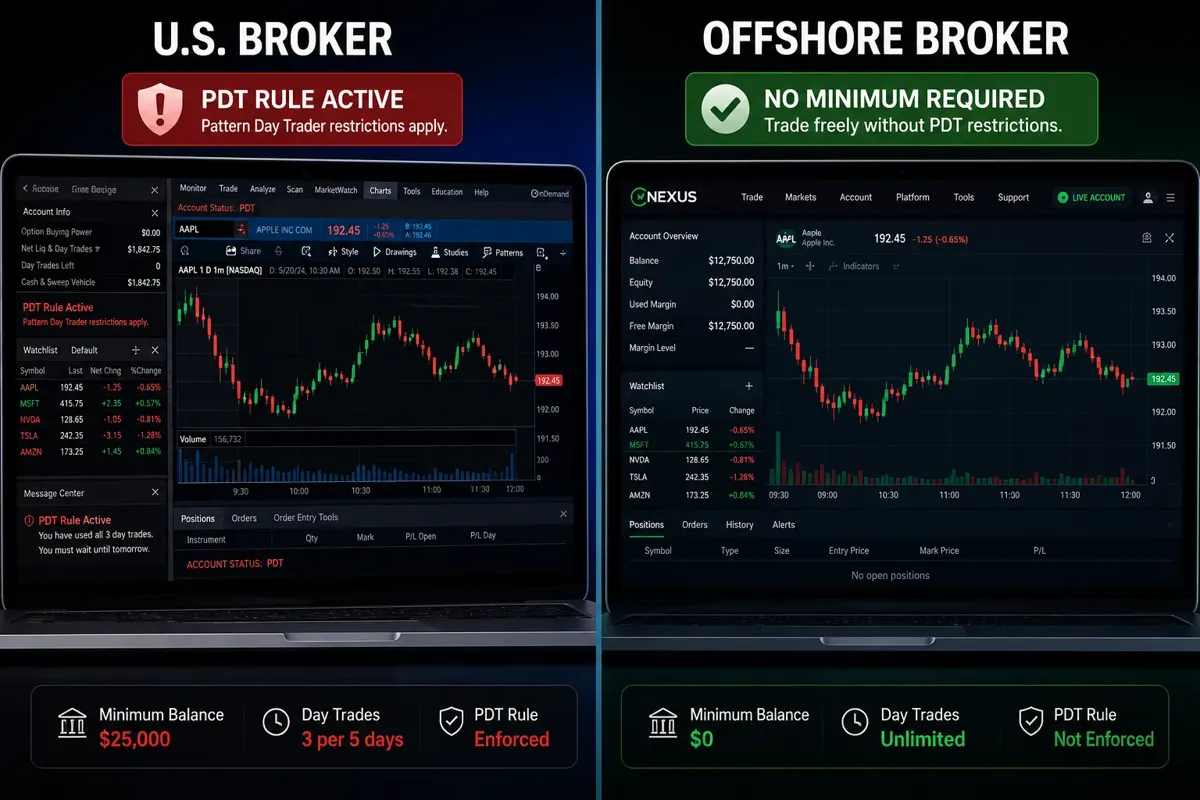
The Pattern Day Trader rule is a FINRA regulation that requires any U.S. margin account executing four or more day trades within five business days to maintain a minimum balance of $25,000. A day trade is defined as opening and closing the same security position within a single trading session. If you fall below the threshold, your broker will restrict your account to closing positions only until you deposit enough to meet the minimum.
The rule was introduced in 2001 after the dot-com crash, ostensibly to protect inexperienced traders from blowing up small accounts with leverage. The logic: if you're going to trade multiple times per day using borrowed money, you should have enough capital to absorb losses without immediately going negative.
Here's the reality, the rule doesn't protect anyone. It just locks out retail traders with small accounts while institutional desks and prop traders operate without the same restrictions. A trader with $24,999 can lose it all in one bad swing trade, but they're somehow "protected" from making four disciplined intraday exits in a week. The rule conflates activity with risk, which is lazy policy.
What actually matters is position sizing, stop losses, and risk per trade, not arbitrary account minimums. A trader risking 1% per trade with $5,000 is managing risk better than someone with $50,000 going all-in on meme stocks. But FINRA doesn't regulate discipline, so here we are.
The 25K rule only applies to margin accounts. If you're trading with settled cash or in markets outside U.S. equities, the restriction doesn't exist. That's the loophole, and it's completely legal.
Can You Day Trade With Less Than 25,000 Dollars Legally?
Yes. You can day trade with less than $25,000 legally by avoiding the conditions that trigger the Pattern Day Trader rule. The PDT rule applies exclusively to U.S. margin accounts trading equities and options, so if you trade in a cash account, switch to forex or futures, use an offshore broker, or join a prop firm, the restriction doesn't apply.
Here's the breakdown of legal paths:
Cash accounts: You can execute unlimited day trades in a cash account, but you're subject to T+1 settlement. That means after you sell a stock, the proceeds aren't available to trade again until the next business day. If you start with $5,000, you can day trade Monday, but you'll need to wait until Tuesday to use those funds again. This limits velocity but keeps you legal and fully regulated.
Forex and futures: These markets operate under different regulatory frameworks. Forex accounts can be opened with as little as $100 (though that's insane from a risk perspective), and futures accounts typically require $500 to $1,000 depending on the contract. Neither market enforces a PDT rule. You can trade /ES or EUR/USD as many times per day as you want.
Offshore brokers: Some brokers based outside the U.S. (commonly in the Bahamas or Caribbean) allow American clients to open accounts without PDT restrictions. You're still subject to U.S. tax reporting, but the broker isn't bound by FINRA rules. The trade-off: weaker regulatory protections and higher counterparty risk.
Prop firms: Proprietary trading firms provide funded accounts after you pass an evaluation. You trade the firm's capital, they take a cut of profits, and there's no PDT rule because it's not your personal brokerage account. The catch: you pay for the evaluation, and most traders fail it.
All of these are legal. None require you to lie, hide assets, or break securities law. The question isn't legality, it's which path fits your strategy and risk tolerance.
How to Day Trade Forex Without 25K Minimum
Forex day trading doesn't require $25,000 because currency markets aren't governed by FINRA or the Pattern Day Trader rule. Forex brokers regulated by the CFTC and NFA in the U.S. allow accounts to open with as little as $100 to $500, and you can execute unlimited intraday trades without restriction.
Here's how it works in practice:
Regulation and leverage: U.S. forex brokers are capped at 50:1 leverage on major pairs (like EUR/USD) and 20:1 on minor pairs. That means with $1,000, you can control a position worth $50,000. Offshore brokers often offer 100:1 or higher, but that's a trap, more leverage just means you blow up faster when you're wrong.
Minimum account size: Technically you can open a forex account with $100. Realistically, you need at least $1,000 to $2,000 to survive normal volatility without getting margin-called on your first losing trade. Forex moves in pips, and a single standard lot (100,000 units) can swing $10 per pip. If you're trading micro lots (1,000 units), you're risking $0.10 per pip, which is manageable with a small account.
Best brokers for small forex accounts: OANDA, Forex.com, and Interactive Brokers all allow small account minimums and are U.S.-regulated. Avoid offshore brokers promising 500:1 leverage and "no rules", they're unregulated, and if they go under, your capital disappears with no SIPC insurance.
The catch: Forex is a zero-sum game dominated by banks, hedge funds, and algorithmic traders with better data and faster execution than you. The bid-ask spread and overnight swap fees eat into profits. Most retail forex traders lose money not because of the PDT rule, but because they're trading noise with no edge.
If you're going to day trade forex with a small account, treat it like any other market: have a system, use stop losses, and risk no more than 1-2% per trade. The lack of a PDT rule doesn't make forex easier, it just removes one barrier to losing money quickly.

Offshore Brokers That Allow Day Trading Under 25K
Offshore brokers let U.S. traders day trade equities without the $25,000 minimum because they operate outside FINRA jurisdiction. These brokers are typically based in the Bahamas, Belize, or other Caribbean nations and accept American clients while sidestepping U.S. pattern day trader restrictions.
How offshore brokers work: You open an account with a non-U.S. entity, fund it via wire transfer or ACH, and trade U.S. stocks through their platform. Because the broker isn't a FINRA member, the PDT rule doesn't apply. You can execute unlimited day trades with an account under $25,000, often with margin.
Popular offshore brokers for small accounts:
- TradeZero: Bahamas-based, allows accounts as low as $500, offers 6:1 leverage on accounts over $2,500. Popular with penny stock and momentum traders. Charges $0.01 per share with a $1 minimum per trade.
- CMEG (Capital Markets Elite Group): Based in Trinidad and Tobago, minimum deposit around $1,500, offers up to 6:1 intraday leverage. Known for catering to active day traders.
- Centerpoint Securities: Offshore arm allows small accounts, higher fees but better execution than budget offshore platforms.
The trade-offs:
- Regulatory risk: Offshore brokers aren't covered by SIPC insurance, which protects up to $500,000 in a U.S. brokerage failure. If the offshore broker collapses or freezes your account, you have limited legal recourse.
- Higher fees: Offshore brokers typically charge per-share commissions (often $0.005 to $0.01 per share) instead of flat-rate trades. On high-volume strategies, this adds up.
- Execution quality: Routing and execution speed can lag behind U.S. brokers like Interactive Brokers or Fidelity. Slippage on volatile stocks can cost more than the PDT rule ever would.
- Tax reporting: You're still required to report all gains and losses to the IRS. Offshore brokers may not provide 1099 forms, so you'll need to track everything manually.
Who should consider offshore brokers: Traders with a proven strategy who are consistently profitable and need more than three day trades per week. If you're still learning or haven't proven an edge, the added risk and cost aren't worth it. Most traders would be better off using a U.S. cash account or switching to futures.
Who should avoid them: Anyone without a tested system, anyone uncomfortable with counterparty risk, or anyone who can't afford to lose their entire account balance if the broker goes under. The lack of PDT restrictions doesn't fix a broken process, it just lets you lose money faster.
For a deeper comparison of broker platforms and execution quality, see our breakdown of AI-powered trading tools and broker integrations.
Cash Account vs Margin Account for Day Trading Small Accounts
A cash account lets you day trade without the $25,000 minimum, but you're bound by T+1 settlement rules. A margin account gives you instant buying power and leverage, but triggers the Pattern Day Trader restriction if you execute four or more day trades in five business days with less than $25,000.
Cash account mechanics:
When you sell a stock in a cash account, the proceeds aren't available to trade again until the next business day (T+1 settlement, updated from T+2 in 2024). If you start Monday with $5,000 and day trade a stock for a $200 gain, you'll have $5,200, but you can't use that $5,200 again until Tuesday. This is called a "good faith violation" if you try to trade unsettled funds and then sell before settlement.
You can work around this by splitting your capital. If you have $5,000, trade $2,500 on Monday and $2,500 on Tuesday, rotating between the two pools. It's clunky, but it's legal and keeps you under FINRA's radar.
Margin account mechanics:
Margin accounts give you 2:1 leverage (you can borrow up to 50% of your position value) and instant settlement, you can sell and immediately rebuy without waiting. The trade-off: if you make four day trades in a rolling five-day window with less than $25,000, you're flagged as a pattern day trader and restricted to closing positions only until you deposit enough to hit the minimum.
Which one for small accounts?
If you have under $25,000 and want to day trade U.S. equities, a cash account is the only viable path unless you're willing to limit yourself to three day trades per week. The T+1 settlement is annoying, but it forces discipline, you can't revenge trade or overtrade because you physically can't access the capital.
If you're swing trading (holding overnight), use a margin account. You won't trigger PDT restrictions, and you'll have access to leverage for larger positions. Just don't day trade more than three times in five days.
Common mistakes with cash accounts:
- Good faith violations: Buying with unsettled funds, then selling before settlement. Three violations in 12 months gets your account restricted for 90 days.
- Overtrading velocity: Trying to trade every day with a small cash pool. You'll run out of settled funds by Tuesday and sit idle the rest of the week.
- Ignoring opportunity cost: Waiting for settlement while a better setup appears. Cash accounts work best for traders with patience and a low-frequency strategy.
For traders serious about building a repeatable system with a small account, cash accounts force better habits. You can't chase, you can't overtrade, and you can't blow up in a single session. The PDT rule is annoying, but settlement rules might actually save you from yourself.
If you're looking for tools that help you plan trades around settlement windows and position limits, check out our free swing trade planner.
What Is the Difference Between Day Trading and Swing Trading?
Day trading means opening and closing a position within the same trading session, you're flat by market close. Swing trading means holding a position overnight, typically for a few days to a few weeks, to capture a larger price move. The distinction matters because swing trading completely avoids the Pattern Day Trader rule, even in a margin account under $25,000.
Time horizon and strategy:
Day traders profit from intraday volatility, a stock gaps up at open, they buy the breakout, sell into strength an hour later, and repeat. They're reading the tape, watching volume, and reacting to price action in real time. The edge is speed and execution.
Swing traders profit from multi-day trends, a stock breaks out of consolidation on earnings, they enter the next morning, hold through the momentum move, and exit when the setup deteriorates. The edge is pattern recognition and patience.
Risk and capital efficiency:
Day trading requires constant attention and fast decision-making. You're in and out multiple times per day, so transaction costs (commissions, slippage, spread) add up. You also need enough capital to survive intraday noise without getting stopped out on normal volatility.
Swing trading requires less screen time but more overnight risk. You're exposed to after-hours news, earnings surprises, and gap risk. But you're not fighting the noise of every five-minute candle, and you're not paying the spread six times a day.
Which one works better for small accounts?
Swing trading. Here's why: a $5,000 account day trading will get chopped up by commissions, slippage, and the emotional toll of making 10+ decisions per day. A $5,000 account swing trading can take two or three high-conviction setups per week, risk 1-2% per trade, and compound gains without the friction.
Day trading rewards speed and volume. Swing trading rewards patience and selectivity. Most retail traders with small accounts don't have the execution speed or the capital base to compete with algorithmic day traders. They do have the ability to wait for clean setups and let winners run, which is the entire game in swing trading.
If you're stuck under $25,000 and frustrated by the PDT rule, the simplest fix isn't finding a workaround, it's holding overnight and trading less frequently. You'll avoid the rule entirely, reduce transaction costs, and probably make better decisions because you're not reacting to every tick.
For a deeper dive into finding swing trade setups that actually work, see our guide to swing trade scanners that find setups before they break out.
Best Brokers for Day Trading With Small Accounts Under 25K
The best broker for a small day trading account depends on whether you're using a cash account, trading forex or futures, or going offshore. No single broker is optimal for every path, but a few stand out for specific use cases.
For U.S. cash accounts (no PDT rule):
- Webull: Zero commissions, clean mobile interface, allows cash accounts with no minimum. Settlement is T+1, so you'll need to rotate capital. Good for beginners who want a simple platform without fees.
- Robinhood: Also zero commissions, instant deposits up to $1,000, but limited charting and no desktop platform. Fine for casual traders, not serious for active day trading.
- Fidelity or Schwab: No commissions, institutional-grade platforms (Active Trader Pro and StreetSmart Edge), and strong customer service. Better for traders who want research tools and reliability. Both allow cash accounts with no PDT restrictions.
For futures (no PDT rule, lower capital requirements):
- Tastytrade: Low commissions ($1.25 per contract), excellent platform for options and futures, allows small accounts. Popular with retail traders who want to trade /ES or /NQ with $1,000 to $2,000.
- Interactive Brokers: Industry-standard for serious traders. Low margin rates, access to global markets, and professional-grade tools. Futures commissions are $0.85 per contract. Minimum deposit is technically $0, but you'll need at least $500 to trade futures with any breathing room.
For forex (no PDT rule, high leverage):
- OANDA: U.S.-regulated, no minimum deposit, fractional lot sizes so you can trade with $500. Clean platform, transparent pricing.
- Forex.com: Also U.S.-regulated, $100 minimum, good for beginners. Offers educational resources and demo accounts.
For offshore (no PDT rule, higher risk):
- TradeZero: $500 minimum, 6:1 leverage, popular with momentum and penny stock traders. Not SIPC insured, so only deposit what you can afford to lose.
- CMEG: $1,500 minimum, similar leverage and risk profile. Better execution than TradeZero but higher fees.
What to prioritize:
- Commissions and fees: Per-share pricing (common offshore) adds up fast. Flat-rate or zero-commission brokers are better for high-frequency strategies.
- Execution speed: If you're day trading volatile stocks, routing and fill quality matter more than saving $1 per trade. Fidelity and Interactive Brokers have better execution than budget offshore platforms.
- Platform quality: You need real-time data, hotkeys, and a stable platform. Webull and Robinhood are fine for swing trading but inadequate for serious day trading.
- Regulation and safety: SIPC insurance protects up to $500,000 in a U.S. broker failure. Offshore brokers offer no such protection.
If you're starting with under $5,000 and want to day trade, the safest path is a U.S. cash account at Fidelity or Schwab, or a futures account at Tastytrade. If you're willing to take on more risk for fewer restrictions, TradeZero is the most popular offshore option, but understand you're trading without a safety net.
For a full comparison of broker platforms and how they integrate with AI-powered scanners, see our directory of AI stock tools traders are actually using.
Can You Day Trade Options With Less Than 25,000?
Yes, but the same Pattern Day Trader rule applies. If you're trading options in a U.S. margin account and you execute four or more day trades (opening and closing the same option contract within one trading session) in five business days, you'll be flagged as a PDT and restricted unless you have $25,000.
The workarounds are identical to equity day trading:
Cash account options trading: You can day trade options in a cash account without hitting the PDT rule, but you're subject to T+1 settlement. When you sell an option, the proceeds aren't available until the next business day. Most brokers (Fidelity, Schwab, Tastytrade) allow options trading in cash accounts, though some require higher approval levels.
Spread strategies to avoid day trade classification: If you open a multi-leg spread (like a vertical or iron condor) and close only one leg intraday, some brokers don't count it as a day trade. This is broker-specific and not a reliable loophole, check with your platform before assuming it works.
Futures options: Options on futures contracts (like options on /ES) aren't subject to the PDT rule. You can trade them with a small account at brokers like Tastytrade or Interactive Brokers. These are more complex and less liquid than equity options, but they're an option if you're comfortable with the learning curve.
Offshore brokers: TradeZero and CMEG allow options trading without PDT restrictions, but options liquidity and execution quality are worse than U.S. platforms.
The bigger issue with small-account options day trading:
Options are leveraged instruments, and day trading them with a small account is a fast way to blow up. A single bad trade can wipe out 20-30% of a $5,000 account if you're trading short-dated calls or puts with high implied volatility. The bid-ask spread on illiquid options can cost you 5-10% on entry and exit, which is a bigger drag than any PDT rule.
If you're going to day trade options with a small account, stick to high-volume underlyings (SPY, QQQ, AAPL) where the spread is tight, and never risk more than 1-2% of your account on a single trade. Most traders would be better off swing trading options or using spreads to define risk.
For a breakdown of options-focused tools and scanners, check our guide to AI options tools.
How Many Day Trades Can You Make With Under 25K?
In a U.S. margin account with less than $25,000, you can make three day trades within a rolling five-business-day period without being flagged as a Pattern Day Trader. The fourth day trade triggers the restriction, and your account will be limited to closing positions only until you either deposit enough to reach $25,000 or wait 90 days for the flag to reset.
How the count works:
A day trade is opening and closing the same security (stock or option) within the same trading session. If you buy 100 shares of AAPL at 10:00 AM and sell them at 2:00 PM, that's one day trade. If you buy 50 shares at 10:00 AM, add 50 more at 11:00 AM, and sell all 100 at 2:00 PM, that's still one day trade (because it's the same security, same day).
The count resets on a rolling five-day window. If you make three day trades on Monday, you can't make another until the following Tuesday (five business days later). If you make your fourth, you're flagged immediately.
What happens when you're flagged:
Your broker will restrict your account to closing positions only. You can sell what you own, but you can't open new positions until you either deposit enough to bring your balance to $25,000 or wait 90 days for the restriction to lift. Some brokers will give you a one-time courtesy reset if you call and ask nicely, but don't count on it.
Strategies to stay under the limit:
- Plan your trades: If you only have three bullets per week, use them on your highest-conviction setups. Don't waste a day trade on a low-quality scalp.
- Hold overnight: If you're not sure whether to exit, hold the position overnight and sell the next day. It's no longer a day trade, and you preserve your count.
- Use a cash account: Unlimited day trades, but you're subject to T+1 settlement. You'll need to rotate capital or trade less frequently.
- Switch to futures or forex: No day trade limits, but different risk profiles and learning curves.
The three-trade limit is frustrating, but it's also a forcing function. If you can't make money with three high-quality setups per week, adding more trades won't fix the problem, it'll just accelerate the losses.
Is It Worth Day Trading With a Small Account Under 5000?
Probably not, but it depends on your goal. If you're trying to replace income or grow $5,000 into $50,000 in six months, day trading is the wrong tool. If you're using $5,000 to learn the mechanics of execution, test a system, and build discipline, it can work, but only if you treat it as tuition, not capital.
The math problem:
A $5,000 account risking 1% per trade is risking $50. If your average winner is 2:1 risk-reward, you're making $100 per win. To grow the account 20% in a month, you'd need 10 winning trades with no losers. That's not realistic.
Even if you're a 60% win-rate trader (which is very good), you'll have losing streaks. A three-trade losing streak costs you $150, or 3% of your account. You'll spend more time recovering from drawdowns than compounding gains.
The friction problem:
Commissions, slippage, and the bid-ask spread eat a larger percentage of small accounts. If you're trading $500 positions and losing $5 to slippage on entry and exit, that's 1% gone before the trade even moves. Do that 10 times and you've lost 10% to friction, not bad decisions.
Day trading rewards volume and speed, which means more transaction costs. Swing trading rewards patience and selectivity, which means fewer costs and better risk-adjusted returns.
The psychological problem:
A $5,000 account doesn't have enough cushion to survive normal volatility without triggering emotional decisions. A $200 loss feels catastrophic when it's 4% of your account. You'll tighten stops, cut winners early, and revenge trade to "get it back." That's how small accounts die.
When it makes sense:
If you're using $5,000 to paper trade a system in a live environment (real money, real emotions, real execution), it's worth it. You'll learn faster with skin in the game than you will in a simulator. But you need to accept that the $5,000 might go to zero, and that's the cost of the education.
If you're trying to grow $5,000 into a meaningful income stream, you're better off saving until you have $10,000 to $25,000, then trading less frequently with better position sizing. Or skip day trading entirely and swing trade or invest in a diversified portfolio.
The alternative path:
Most traders with small accounts would make more money working an extra shift, saving the paycheck, and investing in an index fund than they will day trading. The math is brutal, but it's true. Day trading is a negative-sum game after costs, and small accounts have the least margin for error.
If you're committed to trading, use the $5,000 to learn, not to get rich. Build a system, track every trade, and prove you can be consistently profitable over 100+ trades. If you can do that, then add capital. If you can't, you just saved yourself from losing $25,000 instead of $5,000.
For a reality check on position sizing and risk management, see our breakdown of the position sizing mistake that wipes out 90% of new traders.

Common Mistakes When Day Trading With a Cash Account
Cash accounts let you bypass the PDT rule, but they introduce settlement restrictions that trip up most traders. Here are the mistakes that get accounts restricted or blow up capital:
Good faith violations:
You buy a stock with unsettled funds, then sell it before those funds settle. Example: You sell Stock A on Monday for $2,000. Tuesday, you use that $2,000 to buy Stock B. Wednesday, you sell Stock B before the original $2,000 from Stock A has settled (which happens Tuesday). That's a good faith violation. Three violations in 12 months gets your account restricted to settled funds only for 90 days.
Freeriding:
You buy a stock with unsettled funds and never deposit enough cash to cover the purchase. Example: You have $1,000 settled and $2,000 unsettled. You buy $3,000 worth of stock, then sell it before the $2,000 settles, using the sale proceeds to "pay" for the original purchase. That's freeriding, and it gets your account frozen immediately.
Overtrading velocity:
You start the week with $5,000, trade it all on Monday, and then sit idle Tuesday through Friday waiting for settlement. You're not restricted, you just ran out of buying power. The fix: split your capital into two or three pools and rotate them, or trade less frequently.
Ignoring the T+1 calendar:
Settlement is T+1 (trade date plus one business day), but that doesn't mean 24 hours. If you trade Friday, settlement is Monday. If Monday is a holiday, it's Tuesday. Most brokers show your "settled cash" balance in real time, but new traders assume "cash" means "available" and trigger violations.
Chasing with unsettled funds:
You make a winning trade Monday, see another setup Tuesday, and jump in with the unsettled proceeds. If you sell Tuesday before Monday's trade settles, you've violated. The temptation to chase is highest right after a win, which is exactly when you're most likely to screw up the settlement timing.
How to avoid these mistakes:
- Check your broker's "settled cash" balance before every trade, not your total cash balance.
- Use a spreadsheet or the broker's trade log to track which funds settle on which days.
- Trade smaller position sizes so you always have settled cash available for the next setup.
- If you're not sure whether funds are settled, wait a day. The opportunity cost of missing one trade is lower than the cost of a 90-day restriction.
Cash accounts force discipline, but only if you understand the rules. Most traders don't read the settlement disclosures, assume "cash" means "available," and get restricted within the first month. Don't be that trader.
Do Prop Firms Let You Day Trade Without Your Own 25K?
Yes. Proprietary trading firms provide funded accounts, you trade the firm's capital, not your own, so the Pattern Day Trader rule doesn't apply. You're not operating a personal brokerage account; you're trading as an independent contractor or employee of the firm, and the firm's capital isn't subject to FINRA's retail account restrictions.
How prop firms work:
You pay an upfront fee (typically $100 to $500) to take an evaluation or "challenge." The challenge requires you to hit a profit target (often 8-10% of the account) within a set timeframe (30 to 60 days) without exceeding a maximum drawdown (usually 5-10%). If you pass, the firm funds you with a live account ranging from $25,000 to $200,000, and you split profits (commonly 80/20 or 90/10 in your favor).
Popular prop firms for day traders:
- Topstep: Focused on futures trading. You pay $150/month for the evaluation, and if you pass, you get a funded futures account. Profit split is 80/20 initially, scaling to 90/10.
- Earn2Trade: Similar model, futures-focused, slightly cheaper evaluation fees.
- FTMO: Forex and futures, based in Europe but accepts U.S. traders. Higher profit targets but also higher payouts.
- MyFundedFutures: Newer, lower fees, faster evaluation timelines.
The catch:
Most traders fail the evaluation. The profit target is achievable, but the drawdown limit is tight. If you're down 5% at any point, you're out, even if you would have recovered. The firms make money from evaluation fees, not from your trading profits. It's a business model that works because most people overestimate their edge.
Who should consider prop firms:
Traders with a proven system who are consistently profitable in a demo or small live account, but don't have $25,000 to unlock full day trading access. If you can hit 8% profit with a 5% max drawdown over 30 days in a simulator, you can probably pass the evaluation.
Who should avoid them:
Anyone still learning, anyone without a tested strategy, or anyone who can't afford to lose the evaluation fee. Paying $150 to fail an evaluation is just expensive feedback that you're not ready. Most traders would be better off paper trading for free until they prove consistency, then paying for the evaluation.
Prop firms are a legitimate path to day trading without $25,000, but they're not a shortcut. You still need a system, discipline, and risk management. The firm's capital doesn't make you a better trader, it just removes the capital barrier if you're already good.
For more on building a repeatable system before you risk real capital, see our guide to AI tools that help traders spot setups before the opening bell.
What Happens If You Violate the Pattern Day Trader Rule?
If you execute four or more day trades within five business days in a margin account with less than $25,000, your broker will flag your account as a Pattern Day Trader and restrict it to closing positions only. You won't be able to open new trades until you either deposit enough to bring your balance to $25,000 or wait 90 days for the restriction to lift.
Immediate consequences:
The restriction happens instantly, often mid-session if you trigger it during market hours. You can sell existing positions, but you can't buy anything new. If you had open orders, they'll be canceled. If you were planning to add to a position or hedge a trade, you're locked out.
How to remove the restriction:
- Deposit funds: If you bring your account balance to $25,000 or above, the restriction lifts immediately and you can trade freely as a Pattern Day Trader (with the requirement to maintain the $25,000 minimum going forward).
- Wait 90 days: If you don't deposit, the PDT flag remains for 90 days. After that, your day trade count resets and you can make three more day trades in the next five-day window.
- Request a reset (one-time courtesy): Some brokers will remove the flag once as a courtesy if you call and ask. This is not guaranteed, and it only works once per account. Don't waste it.
What doesn't work:
- Opening a new account at the same broker. They'll see the PDT flag and restrict the new account too.
- Transferring to a different broker. The flag follows your Social Security number through FINRA's system.
- Lying about your account balance or trading activity. Brokers report to FINRA, and you'll just get flagged again.
Long-term consequences:
If you repeatedly violate the rule across multiple accounts or brokers, you can be banned from opening margin accounts entirely. This is rare, but it happens to traders who try to game the system by opening accounts at multiple brokers and cycling through them.
How to avoid the violation in the first place:
- Track your day trades manually. Don't rely on your broker's counter, it's often delayed or unclear.
- If you're at two day trades in a five-day window, stop. Wait until the oldest trade rolls off the window before making another.
- Use a cash account if you need more than three day trades per week. The settlement rules are annoying, but they're better than a 90-day lockout.
- Hold positions overnight when you're unsure. It's not a day trade if you sell the next day, and you preserve your count.
The PDT rule is frustrating, but it's not ambiguous. The violation happens because traders don't track their count or assume "just one more" won't matter. It always matters. If you're going to day trade with a margin account under $25,000, treat those three trades per week like they're the only bullets you have, because they are.
Frequently Asked Questions
Can I day trade with $500?
Technically yes, but it's not practical. A $500 account risking 1% per trade is risking $5, which means your position sizes are so small that commissions and slippage eat most of your edge. You'd be better off saving until you have $2,000 to $5,000, or using the $500 to paper trade and learn without the friction of real transaction costs.
What is the T+1 settlement rule?
T+1 means trade date plus one business day. When you sell a stock in a cash account, the proceeds aren't available to trade again until the next business day. This replaced the old T+2 rule in 2024. If you sell on Monday, the funds settle Tuesday. If you sell Friday, they settle Monday (assuming no holidays).
Do day trading rules apply to crypto?
No. Cryptocurrency trading isn't regulated by FINRA, so the Pattern Day Trader rule doesn't apply. You can day trade Bitcoin, Ethereum, or any other crypto as many times as you want with any account size. The catch: crypto is 24/7, highly volatile, and most retail traders lose money. The lack of a PDT rule doesn't make it easier.
Can I use multiple brokers to get around the PDT rule?
Technically yes, but it's not a good idea. If you open accounts at three different brokers, you get three day trades per week at each broker (nine total). But you're splitting your capital, paying multiple platform fees, and complicating your tax reporting. You're also more likely to overtrade because you have more "bullets." Most traders would be better off using one broker and trading less frequently.
What's the best market for small account day trading?
Futures. Contracts like /MES (micro E-mini S&P 500) require $500 to $1,000 in margin, have tight spreads, and aren't subject to the PDT rule. You can trade them as many times per day as you want. The learning curve is steeper than equities, but the capital efficiency is better for small accounts.
Is swing trading more profitable than day trading?
For most retail traders, yes. Swing trading has lower transaction costs, less screen time, and better risk-adjusted returns because you're not fighting intraday noise. Day trading can be more profitable if you have speed, discipline, and enough capital to survive volatility, but most small accounts don't have those advantages.
Can I day trade options in a cash account?
Yes, but you're subject to T+1 settlement just like stocks. When you sell an option, the proceeds aren't available until the next business day. Most brokers allow options trading in cash accounts, though you may need Level 2 or Level 3 approval depending on the strategies you're using.
What happens if my account drops below $25,000 after I'm flagged as a PDT?
If you're already flagged as a Pattern Day Trader and your account drops below $25,000, you'll be restricted to closing positions only until you bring the balance back above the minimum. You won't be able to open new trades, even if you're not making day trades. The $25,000 minimum must be maintained at all times once you're flagged.
Do I need $25,000 to trade futures?
No. Futures aren't subject to the Pattern Day Trader rule, and margin requirements are set by the exchange and broker, not FINRA. A standard /ES contract requires around $12,000 in margin, but micro contracts like /MES require $500 to $1,000. You can day trade futures with a small account as long as you meet the margin requirement.
Can I day trade in a retirement account?
Yes, but with restrictions. IRAs are cash accounts by default, so you can day trade without the PDT rule, but you're subject to T+1 settlement. Some brokers offer "limited margin" in IRAs, which gives you same-day settlement but not leverage. You can't borrow funds in an IRA, so true margin trading isn't allowed.
What's the fastest way to get to $25,000?
Save it. The math on compounding a $5,000 trading account to $25,000 is brutal, you'd need to 5x your account, which almost no one does consistently. You're better off working, saving, and depositing the difference than trying to trade your way there. If you can't save $25,000, you probably can't survive the drawdowns of day trading anyway.
Are there any brokers that ignore the PDT rule?
Offshore brokers like TradeZero and CMEG operate outside FINRA jurisdiction and don't enforce the PDT rule. But they also don't offer SIPC insurance, and execution quality is often worse than U.S. brokers. It's a trade-off between regulatory protection and flexibility.
Conclusion
The Pattern Day Trader rule is annoying, but it's not a wall. You can day trade without $25,000 by using a cash account, switching to forex or futures, opening an offshore account, or joining a prop firm. Each path has trade-offs in settlement time, regulation, and risk, but all of them are legal and accessible.
The bigger question isn't how to get around the rule. It's whether day trading with a small account is the right strategy in the first place. Most traders with under $25,000 would make more money swing trading, building a system, and compounding gains slowly than they will trying to scalp their way to a funded account.
If you're committed to day trading, treat the capital restriction as a forcing function. Three high-quality setups per week in a margin account, or rotating settled funds in a cash account, will teach you more about discipline and selectivity than unlimited trades ever will. The traders who survive aren't the ones with the most bullets, they're the ones who only pull the trigger when the setup is clean.
Cut the noise. Build a system. Trade less, think more. The PDT rule isn't the problem, overtrading and under-preparation are.
Want the tools and systems behind this, without the hype? Start at aistockpickerapps.com.