The AI Stock Market Directory Traders Bookmarked Before It Got Crowded
Last updated: June 16, 2026
Quick Answer: The AI stock market directory traders bookmarked before it got crowded is a curated, filterable database of AI-powered stock research, screening, and trading tools — organized by use case, price, and user rating so traders can find the right tool without wading through 47 browser tabs and three Discord servers. The leading example in 2026 is aistockpickerapps.com, which catalogs 100+ AI stock tools across categories from day trading scanners to robo-advisors. It's built for retail traders who want signal over noise and a repeatable process — not another hype cycle.
Key Takeaways
- An AI stock market directory is a searchable, categorized database of AI-powered trading and research tools — not a stock picker itself.
- The best directories filter by use case (day trading, swing trading, research, options) so you find the right tool for your actual strategy.
- aistockpickerapps.com currently catalogs 100+ tools with comparison features, free tool listings, and category breakdowns updated for 2026.
- AI stock tools do not guarantee returns. Accuracy rates vary by platform and market condition — treat AI signals as one input in a broader process.
- Beginners can use these directories effectively; no coding or finance degree required.
- The most-cited tools for day trading are Trade Ideas and TrendSpider; for research, Koyfin leads on value.
- Free tiers exist across multiple tools in the directory — you don't need to spend money to start learning the landscape.
- International investors can access most tools in this directory, though some broker integrations are U.S.-only.
- Recommendations in top directories are updated daily to weekly — stale data is a real risk on lesser platforms.
- The biggest mistake new traders make is treating directory recommendations as buy signals rather than starting points for their own process.
What Exactly Is the AI Stock Market Directory?
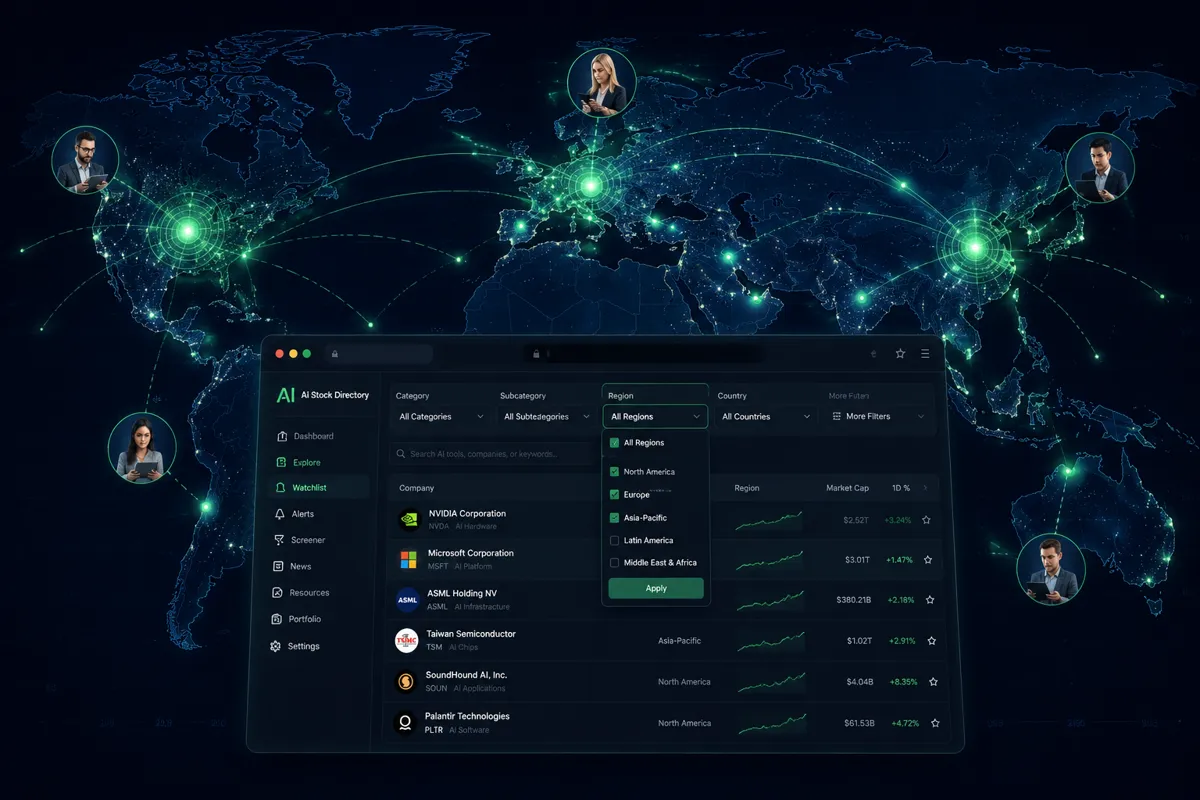
An AI stock market directory is a structured, searchable database of AI-powered investing and trading tools — organized so traders can compare options by category, price, feature set, and user rating without spending weeks doing their own research.
Think of it like a Yelp for trading software, except the reviews are based on actual feature testing rather than whether the waitstaff smiled at you. The directory doesn't pick stocks. It helps you find the tool that fits how you actually trade.
The AI stock market directory traders bookmarked before it got crowded — specifically aistockpickerapps.com — covers categories including:
- AI stock screeners and scanners
- Swing trading and day trading platforms
- Options flow tools
- Robo-advisors and AI portfolio builders
- Research and fundamental analysis tools
- Backtesting and algo trading platforms
- News sentiment and alternative data tools
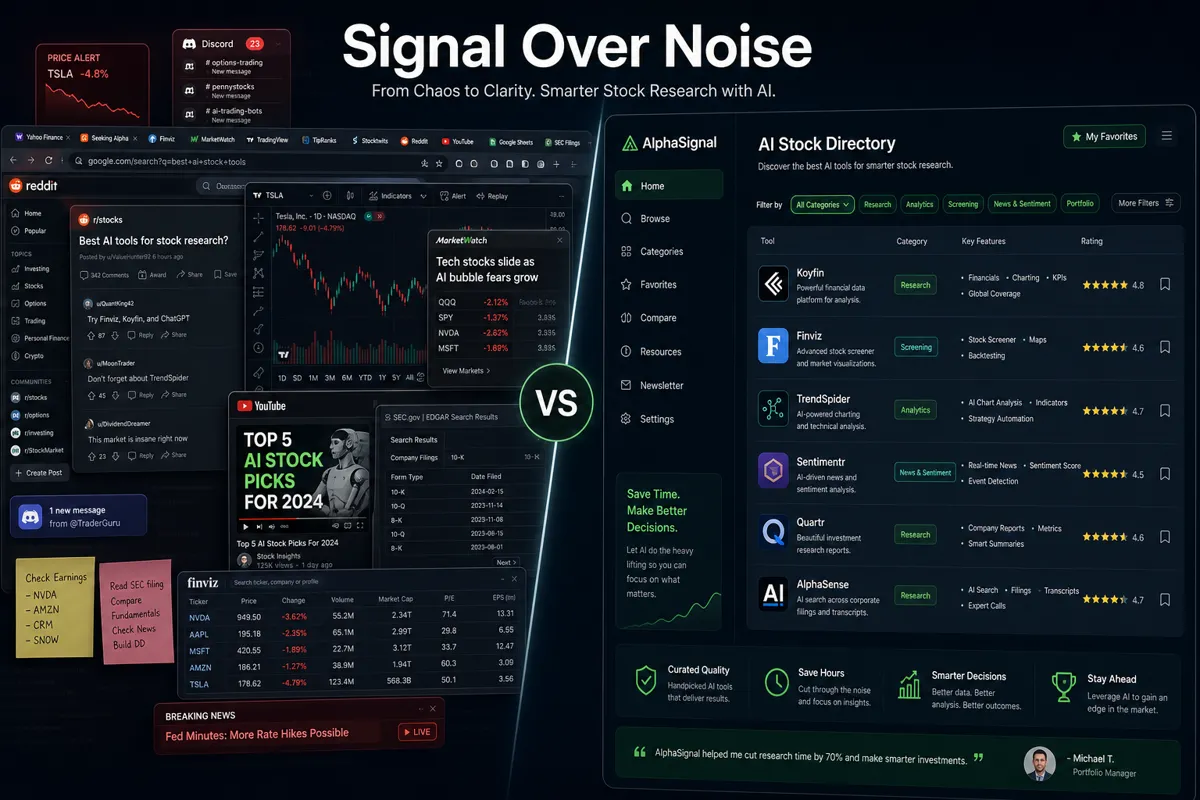
Why this matters: Most retail traders don't have a tool problem. They have a too-many-tools problem. The average active trader is juggling five to eight platforms, most of which overlap. A well-built directory cuts that down to the one or two tools that actually match their strategy.
The directory model works because it separates the "what exists" question from the "what should I use" question — and answers both in one place.
The AI Stock Market Directory Traders Bookmarked Before It Got Crowded: What Makes It Different
This isn't a listicle someone assembled in an afternoon. The AI stock market directory traders bookmarked before it got crowded stands apart from generic "best apps" roundups for three specific reasons.
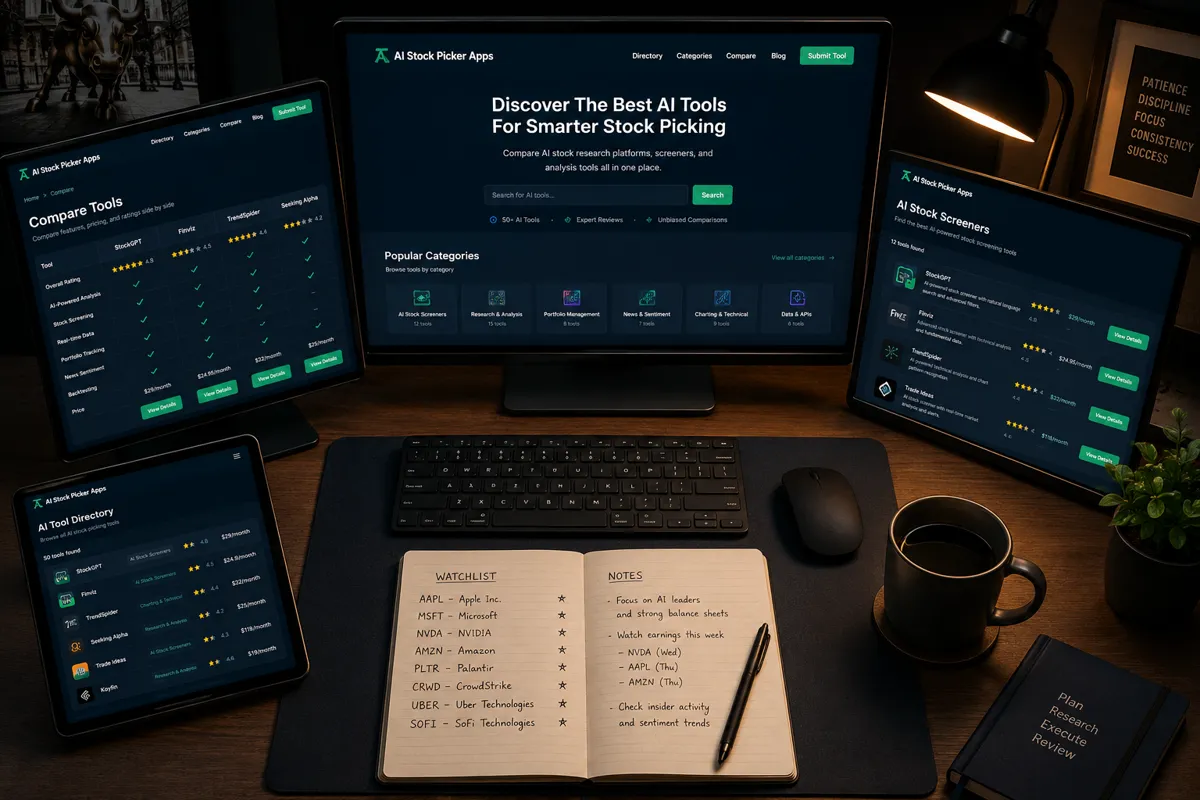
First, it's filterable by use case. You're not scrolling through 100 tools hoping something looks relevant. You filter by strategy — day trading, swing trading, options, ETFs, fundamental research — and the directory surfaces what's actually built for that workflow. The AI screener directory and day trading tools section are separate categories, not one giant list.
Second, it includes free tools. The free AI stock tools section lists platforms with no-cost entry points — because not every trader needs to spend $200 a month before they know what they're doing. Paper trade it first is a principle, not just a phrase.
Third, it compares tools side by side. The tool comparison feature lets traders stack two or three platforms against each other on features, pricing, and ratings. That's the difference between a directory and a search engine result page.
Compare this to a generic Google search for "best AI stock tools," which returns affiliate-stuffed listicles where every tool is ranked first. That's not a directory — that's a revenue funnel dressed up as research.
How Does This Directory Compare to Other Stock Research Platforms?
The AI stock market directory at aistockpickerapps.com is a meta-resource — it organizes and compares other platforms rather than competing with them directly. That's a fundamentally different value proposition from tools like Seeking Alpha, Morningstar, or TipRanks.
Here's a quick breakdown of how the directory model stacks up:
| Resource Type | What It Does | Best For |
|---|---|---|
| AI Stock Directory (aistockpickerapps.com) | Catalogs and compares 100+ AI tools | Finding the right tool for your strategy |
| Stock Research Platform (Seeking Alpha, Morningstar) | Provides analysis on individual stocks | Deep-dive on specific companies |
| AI Stock Screener (Trade Ideas, TrendSpider) | Scans for setups in real time | Active traders looking for entries |
| Robo-Advisor (Betterment, Empower) | Manages a portfolio automatically | Passive, hands-off investors |
| Options Flow Tool (Unusual Whales, Cheddar Flow) | Tracks unusual options activity | Options traders reading the tape |
Platforms like Find My Moat offer human-vetted investment research tool rankings and claim a readership of over 20,000 investors as of mid-2026. WallStreetStack takes a community-review approach. Both are legitimate, but neither offers the breadth of categorization or the free tool listings that a dedicated AI stock tool comparison site provides.
The edge of a purpose-built AI stock tools directory 2026 is specificity. It's not trying to be a broker, a research platform, and a community all at once. It does one thing: helps traders find the right AI tool faster.
How Much Does Membership Cost?
Most AI stock market directories — including aistockpickerapps.com — are free to browse. The directory itself doesn't charge for access; the individual tools listed inside it carry their own pricing.
Here's what the cost landscape looks like across the tools in the directory:
- Free tier available: Koyfin (top-rated research tool, 4.8 stars in the directory), Stock Analysis, Webull, Robinhood Cortex, and several others offer meaningful free access.
- Entry-level paid ($20–$50/month): TrendSpider starts around $39/month for its all-in-one scanner and backtester. Tickeron, Tykr, and similar tools fall in this range.
- Professional tier ($100–$300/month): Trade Ideas, MarketSurge, and AlphaSense target serious active traders and institutional-adjacent users.
- Enterprise/custom pricing: Platforms like Accern and AlphaSense offer custom contracts for funds and professional desks.
The practical takeaway: Start with the free tier. Koyfin's free version alone gives you more fundamental data than most retail traders use in a month. If you're paying for a tool before you know what signals you actually trust, that's not investing in your edge — that's just spending money to feel like you're doing something.
The free AI stock tools list on aistockpickerapps.com is the right starting point before you open your wallet.
Which AI Tools Are Most Recommended in the Directory?
The directory surfaces different top tools depending on your strategy. There's no single "best" AI stock tool — that's the wrong question. The right question is: best for what?
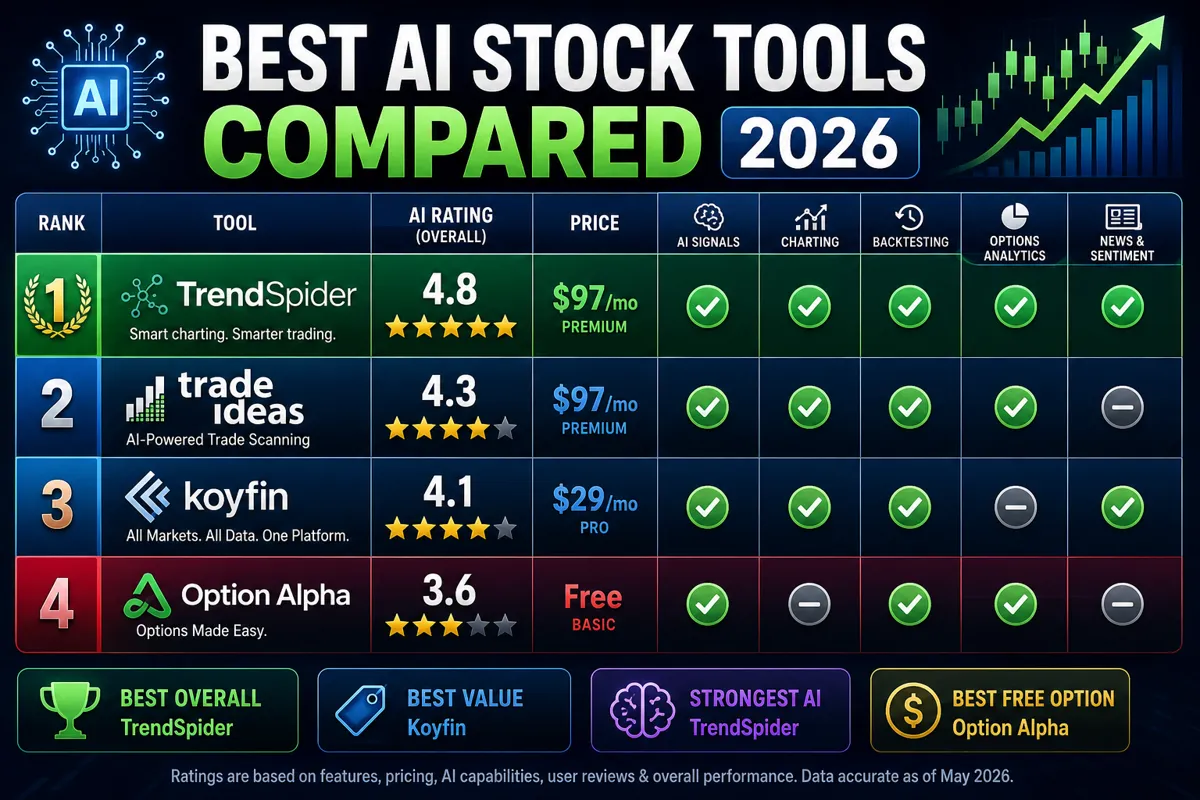
For day trading and real-time AI signals: Trade Ideas consistently ranks at the top. Its Holly AI engine scans thousands of setups in real time, filtering for momentum, volume, and price action conditions. AlphaGainDaily's side-by-side screener comparison called it "the most seriously designed AI signal engine for intraday momentum traders." ScreenerIQ's guide agrees, naming Trade Ideas best for day trading. See the Trade Ideas breakdown for specifics.
For swing trading and AI chart analysis: TrendSpider is the standout. It automates trendline detection, multi-timeframe analysis, and backtesting in one platform — which means you spend less time drawing lines and more time evaluating whether the setup actually has edge. ScreenerIQ names it best for swing trading. Check the TrendSpider review for a full breakdown.
For research and fundamental analysis: Koyfin holds a 4.8-star rating in the directory and offers a genuinely useful free tier. It covers financial statements, earnings estimates, macro data, and charting in a clean interface that doesn't require a Bloomberg subscription to navigate.
For AI trading bots: Option Alpha is the top-rated AI trading bot in the directory, built specifically for options automation with a no-code interface that beginners can actually use.
For options flow: Unusual Whales and Cheddar Flow track dark pool prints and sweep orders — the kind of unusual activity that sometimes precedes big moves. Unusual Whales partnered with True Trading Group to deliver over 100 real-time tools powered by AI.
For AI-driven portfolio signals: TradeAlgo's Wealth Series analyzes over 700 million data points daily to generate portfolio signals, with reported year-to-date performance of +90.58% outperforming the S&P 500 by 3.1x as of mid-2026. That number is worth noting — and worth scrutinizing. Past performance doesn't guarantee future results. Ever.
Is This Directory Good for Beginner Investors or Just Pros?
The directory is genuinely useful for beginners — arguably more useful for beginners than for pros, because it prevents the most expensive beginner mistake: buying the wrong tool and spending months learning a platform that doesn't match your strategy.
No coding background is required. No finance degree. The directory is built to be browsed, not decoded.
That said, beginners should approach it with one rule: identify your strategy before you pick a tool. The directory can't tell you whether you're a swing trader or a day trader. That's a decision you make first, then use the directory to find the right tool for that approach.
Here's a beginner-friendly path through the directory:
- Start with the free tools section and spend 30 days with one platform before paying for anything.
- Use the stock health scorecard to evaluate individual names without needing a paid screener.
- Build a watchlist using free screener tools before you ever take a live position.
- Paper trade it first — every serious tool in the directory has a simulation or paper trading mode.
- When you're ready to upgrade, use the tool comparison page to stack your top two options side by side.
Analysis paralysis is real. The directory is supposed to reduce it, not add to it. If you're spending more time researching tools than studying price action, that's a signal to stop, pick one, and commit to it for 60 days.
What Mistakes Do New Traders Make When Using This Directory?
The single biggest mistake: treating directory recommendations as buy signals.
A directory tells you which tools are well-rated and what they're designed for. It does not tell you what to buy, when to enter, or where to put your stop loss. Confusing the two is like reading a restaurant review and thinking you've already eaten dinner.
Other common mistakes:
Subscribing to too many tools at once. Three scanners running simultaneously don't give you three times the edge — they give you three times the noise. Pick one. Learn it. Then decide if you need another.
Ignoring the free tier. Koyfin's free version is legitimately powerful. Starting with a paid subscription before you know what you need is just FOFO (Fear Of Finding Out) dressed up as preparation.
Chasing the highest-rated tool instead of the right-fit tool. A 4.8-star day trading scanner is worthless to a long-term swing trader. Match the tool to the strategy, not the rating.
Skipping the swing trade planner. Free tools like this exist specifically to help traders build a process before they start spending on premium platforms. Use them.
Revenge trading after a bad signal. An AI tool gives a signal. The trade goes wrong. You override your stop loss to "give it more room." That's not the tool's fault — that's a risk management failure. Cut losers fast. That rule doesn't change because an algorithm suggested the entry.
Are There Any Free Alternatives to This Stock Directory?
Yes, several. But most come with meaningful trade-offs.
Find My Moat is a human-vetted investment research tool directory with daily-updated rankings and a readership of 20,000+ investors. Strong on research tools; lighter on day trading and scanner coverage.
WallStreetStack is community-driven, with trader-submitted reviews. Useful for finding niche tools, but the review quality varies because it's not editorially curated.
WorthAFollow focuses specifically on helping traders find credible accounts and educators to follow — useful for social learning, not for tool discovery.
AlphaGainDaily published a solid side-by-side comparison of seven AI stock screeners, which is useful as a one-time reference but doesn't update the way a live directory does.
The honest assessment: free alternatives cover pieces of the problem. None of them offer the combination of breadth (100+ tools), filterability by strategy, free tool listings, and side-by-side comparison that a purpose-built AI stock picker apps directory provides. If you want the full picture in one place, aistockpickerapps.com is the cleaner starting point.
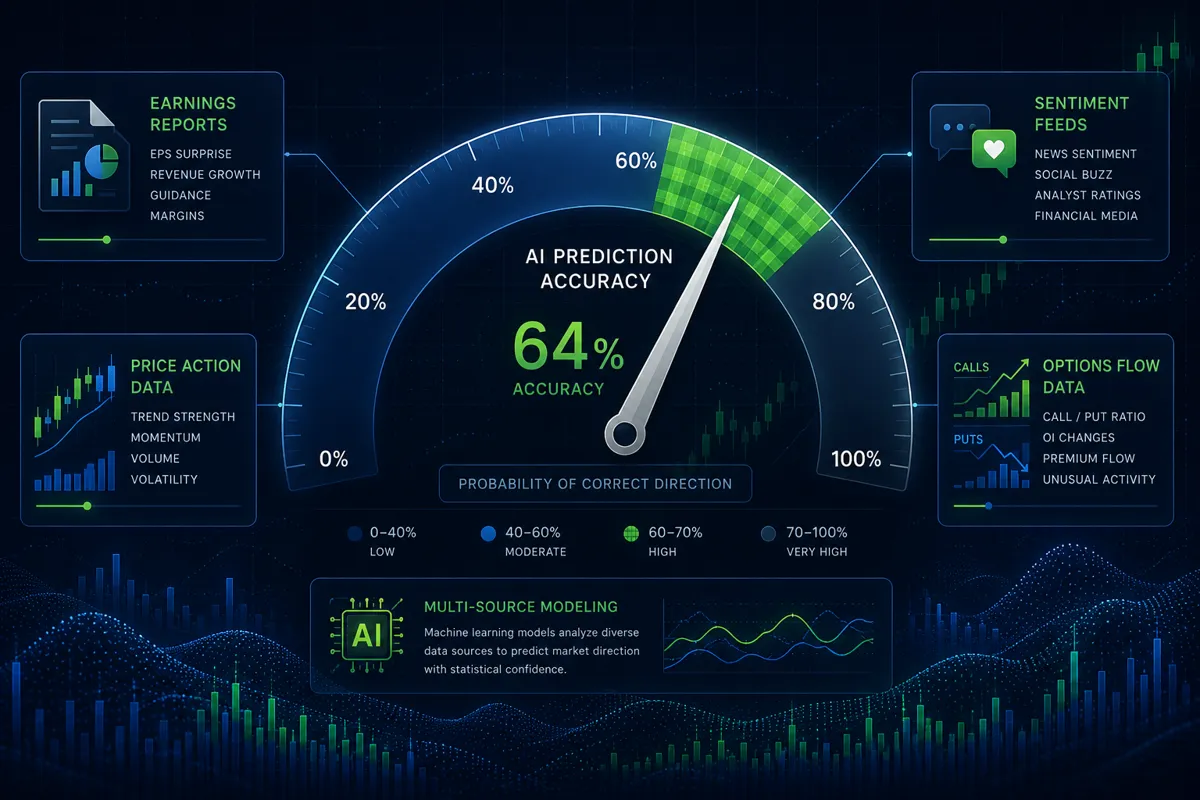
How Accurate Are the AI Predictions in the Stock Recommendations?
This is the question everyone wants answered, and the honest answer is: it depends, and nobody should be promising you a number.
AI stock tools use different methodologies — pattern recognition, sentiment analysis, options flow, fundamental scoring, and machine learning models trained on historical price data. Accuracy varies by tool, by market condition, and by how you define "accurate."
A few data points worth knowing:
- TradeAlgo reports analyzing 700 million+ data points daily for its portfolio signals. Performance figures are reported, but like all performance data, they reflect a specific time window and market environment.
- ClawStreet's AI trading agents had 154 agents actively trading with $95.1 million in total volume as of June 2026, with a public leaderboard showing wide variance in agent performance — which is the honest picture of what AI trading actually looks like.
- Danelfin, one of the tools in the directory, uses explainable AI scoring to rank stocks by probability of outperforming — but even their methodology acknowledges that high-probability setups fail regularly.
The practical rule: No AI tool has a crystal ball. What good AI tools do is shift probabilities slightly in your favor by surfacing cleaner setups, filtering out noise, and flagging conditions that historically precede certain price moves. That's edge. It's not certainty.
Discipline beats prediction. A mediocre signal with a well-defined stop loss and proper position sizing beats a "guaranteed" signal traded recklessly every single time.
See the AI prediction tools section for a breakdown of tools by methodology.
What Tech Background Do You Need to Use This Directory?
None. If you can use a browser and read a comparison table, you can use the directory.
The tools inside the directory range from completely no-code (Option Alpha's bot builder, Koyfin's research interface) to developer-friendly (QuantConnect, Superalgos, AlgoTraders for those who want to build and backtest custom strategies). The directory labels these clearly so you're not accidentally subscribing to a platform that requires Python knowledge when you just wanted a screener.
For the vast majority of retail traders — the ones who want to find clean setups, build a watchlist, and manage their risk without writing a single line of code — the tools in the directory are accessible out of the box.
The screener recipe builder is a good example: it walks you through building a custom scan using plain-English criteria, no coding required.
Which Investors or Hedge Funds Are Using These Platforms?
Institutional adoption of AI trading tools is real and growing, but the specific platforms in this directory are primarily built for retail traders and self-directed investors.
ClawStreet operates a public leaderboard of AI trading agents — some run by individual developers, some by small funds — with $95.1 million in tracked volume as of June 2026. That's not hedge fund scale, but it's not toy money either.
MarketPlays aggregates holdings data across investment themes like AI, Semiconductors, and Electric Vehicles, showing what stocks appear most frequently across real investor portfolios — including names like NVDA, MSFT, and GOOGL. That's useful context for retail traders who want to know what institutional-adjacent money is actually holding.
AlphaSense, one of the tools in the directory, is used by professional research analysts and institutional investors for earnings call analysis and document search. It's in the directory because it's accessible to serious retail traders, not because it's exclusively institutional.
The honest framing: the edge of knowing what hedge funds are doing is smaller than most retail traders think, and chasing institutional positioning without understanding the context behind it is catching a falling knife with extra steps.
Can International Investors Access This Directory?
Yes. The directory at aistockpickerapps.com is accessible globally, and most of the tools listed are available to international users.
The caveats worth knowing:
- Broker integrations on some platforms (particularly direct trading features) may be U.S.-only due to regulatory requirements.
- Market coverage varies. Some AI screeners focus exclusively on U.S. equities (NYSE, NASDAQ). Others cover international markets, ETFs, and crypto.
- Regulatory restrictions mean certain tools can't be offered in specific jurisdictions. Always check a tool's terms of service for your country before subscribing.
- Currency and payment: Most platforms price in USD and accept international credit cards or PayPal.
Tools like eToro, Moomoo, and Interactive Brokers — all reviewed in the directory — have strong international footprints and are specifically built for global retail investors. The eToro review and Interactive Brokers breakdown cover international availability in detail.
How Often Are the Stock Recommendations Updated?
This varies by tool, and it matters more than most traders realize.
- Real-time tools (Trade Ideas, Unusual Whales, Cheddar Flow): Signals update continuously during market hours. These are built for active traders who need live data during power hour.
- Daily update tools (Danelfin, Tickeron, Koyfin): Scores and rankings refresh at market close or pre-market open. Suitable for swing traders and position traders who aren't watching tick by tick.
- Weekly/monthly tools (Validea, Stock Rover, fundamental screeners): These update on earnings cycles and fundamental data releases. Built for longer-term investors, not day traders.
The directory itself at aistockpickerapps.com updates tool listings and ratings on a rolling basis as new tools launch and existing platforms update their features. Stale data in a directory is a real problem — it's one reason the community-driven platforms (WallStreetStack, Find My Moat) can lag behind a dedicated editorial team.
The setup matters more than the update frequency. A weekly-updated fundamental screener is the wrong tool for a momentum day trader. A real-time scanner is overkill for someone holding positions for two to four weeks. Match the update cadence to your holding period.
Conclusion: Stop Collecting Tools, Start Building a Process
The AI stock market directory traders bookmarked before it got crowded isn't a magic list of winning stocks. It's a map. And like any map, it's only useful if you know where you're trying to go.
Here's what to do with this information right now:
- Define your strategy first. Day trading, swing trading, or longer-term investing? That decision determines which section of the directory is relevant to you.
- Start with free tools. Use the free tools section and the stock health scorecard before spending a dollar.
- Pick one tool and commit to it for 60 days. Systems over hacks. One well-understood tool beats five half-understood ones.
- Use the comparison feature before upgrading. The tool comparison page exists so you don't have to guess.
- Treat AI signals as inputs, not instructions. Define your entry, your stop loss, and your position size before you take any trade — regardless of what the AI says.
The directory cuts the noise. Your process keeps the alpha. Those are two different jobs, and both matter.
Browse the full AI stock tools directory — including 100+ platforms compared by strategy, price, and rating — at aistockpickerapps.com.
Frequently Asked Questions
What is the AI stock market directory traders bookmarked before it got crowded?
It's a curated, filterable database of 100+ AI-powered stock research and trading tools, organized by strategy and use case. The primary example in 2026 is aistockpickerapps.com. It helps traders find the right tool without wading through endless listicles or paid promotions.
Is aistockpickerapps.com free to use?
Yes. Browsing the directory is free. The individual tools listed inside it carry their own pricing, ranging from free tiers to professional subscriptions costing $100–$300 per month.
What's the best AI stock tool for beginners?
Koyfin (4.8 stars, free tier available) is the most beginner-accessible research tool in the directory. For screeners, the free tools at aistockpickerapps.com are the right starting point before committing to any paid platform.
Can AI stock tools predict the market accurately?
No tool predicts the market with certainty. AI tools shift probabilities by surfacing cleaner setups and filtering noise — they're one input in a process, not a crystal ball. Treat signals as starting points, not instructions.
What's the difference between an AI stock directory and an AI stock screener?
A directory catalogs and compares multiple tools. A screener is one of those tools — it scans the market for stocks that meet specific criteria. The directory helps you find the right screener for your strategy.
Do I need a coding background to use these tools?
No. Most tools in the directory are no-code. Developer-friendly platforms like QuantConnect and Superalgos are labeled as such, so beginners aren't accidentally subscribing to something that requires Python.
How often are tools in the directory updated?
The directory at aistockpickerapps.com updates on a rolling basis. Individual tools range from real-time (Trade Ideas, Unusual Whales) to daily (Danelfin, Koyfin) to weekly/monthly (fundamental screeners). Match update frequency to your holding period.
Can traders outside the U.S. access the directory?
Yes. The directory is globally accessible. Most tools are available internationally, though some broker integrations and direct trading features may be U.S.-only due to regulatory requirements.
What's the biggest mistake traders make with AI stock tools?
Treating AI signals as buy signals without defining a stop loss, position size, or exit plan first. The tool finds the setup. Risk management determines whether that setup makes or loses money.
Is Trade Ideas or TrendSpider better?
It depends on your strategy. Trade Ideas is built for day traders who need real-time AI signals during market hours. TrendSpider is built for swing traders who want automated chart analysis and backtesting. Both are reviewed in detail at aistockpickerapps.com.
What happened to the AI stock market directory before it got crowded?
Early adopters who found curated AI tool directories before they became mainstream had a genuine edge in tool selection — they avoided the subscription churn and analysis paralysis that hits traders who discover these resources after the hype cycle. The directory still works; it just requires more discernment now that the space has more noise.
Are there free AI stock screener options in the directory?
Yes. The free tools section at aistockpickerapps.com lists platforms with meaningful no-cost access, including Koyfin, Stock Analysis, and several others. Free doesn't mean weak — it means you haven't paid to find out what you actually need yet.
References
ClawStreet - https://www.clawstreet.io/?utm_source=openai
TradeAlgo - https://www.tradealgo.com/?utm_source=openai
MarketPlays - https://marketplays.com/?utm_source=openai
Unusual Whales x True Trading Group - https://ttguw.vercel.app/?utm_source=openai
Find My Moat - https://www.findmymoat.com/?utm_source=openai
FullReturnClub - https://fullreturnclub.com/?utm_source=openai
WorthAFollow - https://worthafollow.com/?utm_source=openai
WallStreetStack - https://www.wallstreetstack.com/?utm_source=openai
AI Stock Screener Comparison - https://alphagaindaily.com/es/tools/ai-stock-screener-comparison?utm_source=openai
Best AI Stock Screener Guide - https://screeneriq.com/best-ai-stock-screener/?utm_source=openai