Best Futures Trading Broker 2026: 7 Compared on Fees
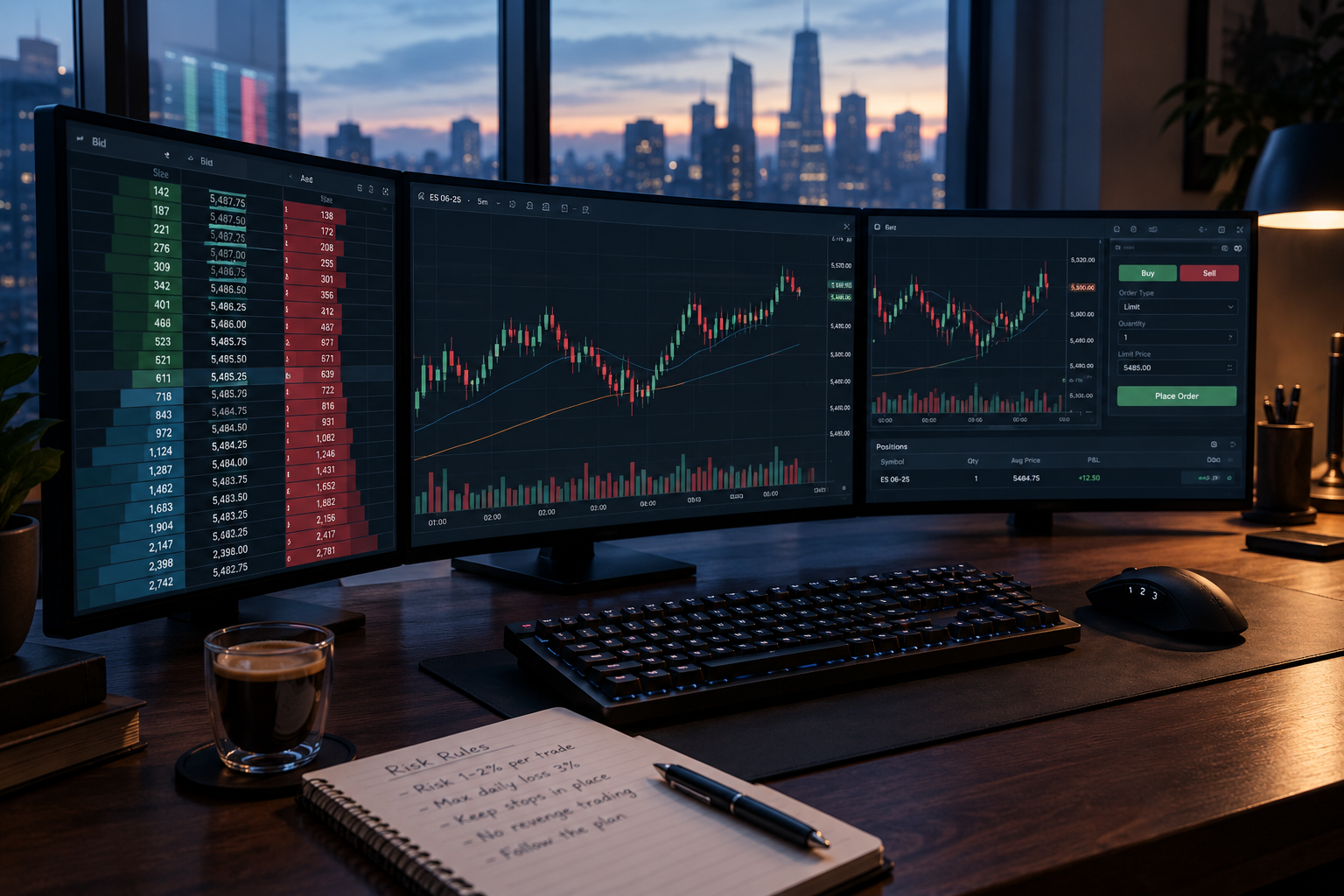
Short answer: NinjaTrader is the best futures broker for most active retail day traders, pairing deep-discount commissions with $50-level intraday micro margins.
Quick answer
NinjaTrader is the best futures trading broker for most active day traders in 2026, because it pairs deep-discount per-side commissions with $50-level intraday micro margins and a ladder built for fast scalping. If you trade size and want commissions closer to zero, Tradovate's membership model wins on math. If you need futures to sit next to stocks, options, and foreign currency in one account, Interactive Brokers is the adult in the room. And if you're trading a $2,000 account, the broker matters less than your position sizing.
One sentence of housekeeping before the numbers: every commission, margin, and data fee below is the publicly advertised figure we could find at the time of writing, it excludes exchange, clearing, and NFA fees, and futures brokers change these tables often. Verify on the broker's own pricing page before you wire money.
Searching "futures trading best broker"? Start with these key takeaways
Commissions, margins and data fees decide your real cost, so these seven points come before any brand name.
- Commission is the only cost you control. CME sets exchange and clearing fees, so those are roughly identical everywhere. The NFA assessment fee is about $0.02 per side. Your broker's commission is the variable.
- NinjaTrader's advertised micro rates run from roughly $0.35 per side on the free plan down to about $0.09 per side on the paid lifetime license, plus exchange fees. Break-even on the license depends entirely on your volume.
- Schwab charges about $2.25 per futures contract, per side, including micros. That's roughly 6x a deep-discount broker. Convenient, not cheap.
- Deep-discount brokers advertise intraday margin from $50 on micro index futures. Interactive Brokers and Schwab don't play that game, so expect requirements in the hundreds per micro instead.
- CME non-professional Level 1 data costs roughly $11 to $15 per month per exchange. Level 2 depth costs more. Some brokers bundle it for funded accounts.
- Minimum deposits are misleading. AMP advertises $100 and Interactive Brokers advertises $0, but a $100 futures account holding one micro contract is a margin call with a countdown timer.
- Futures have never had a pattern day trader rule. There's no $25,000 gate on intraday futures activity, which is exactly why undercapitalized traders overtrade them.
How did we pick the best futures trading broker for each trader?
We ranked on five things a day trader actually feels: all-in cost per round turn, intraday margin policy, platform speed and order entry, data fees, and regulatory standing. Marketing copy got zero weight.
The specific filters:
- Regulation first. Every broker here is a CFTC-registered Futures Commission Merchant or introducing broker with NFA membership. You can check any of them yourself on NFA BASIC, free, in about 90 seconds. A broker that fails this screen doesn't get reviewed, no matter how low the commission is.
- All-in cost per round turn, not headline commission. A round turn means one entry and one exit, so two sides. A broker advertising $0.09 per side and charging a $99 monthly platform fee is expensive at 40 round turns a month and cheap at 800.
- Intraday margin, stated in dollars per contract. "Up to 500:1 leverage" is a slogan. "$50 per MES contract during liquid hours, exchange maintenance overnight" is a spec.
- Order entry and routing. Ladder quality, bracket orders (a stop loss and profit target attached to your entry automatically), one-cancels-other logic, and whether the platform survives a Consumer Price Index release without freezing.
- Data and platform fee transparency. Exchange data fees are unavoidable. Hiding them until the second monthly statement is a choice.
The decision rule: pick the broker whose cost structure matches your actual monthly volume, not the volume you imagine you'll trade. Most traders overestimate by a factor of three, then pay for a license they never break even on.
Best futures trading broker picks at a glance
If you typed "futures trading best broker" into a search bar and got 40 affiliate pages with identical rankings, here's the version with decision columns instead of vibes. All figures are advertised rates, exclusive of exchange, clearing, and NFA fees, and subject to change.
| Broker | Best for | Advertised commission (per contract, per side) | Micro intraday margin | Platforms | Non-pro data fees | Minimum deposit | Entry price |
|---|---|---|---|---|---|---|---|
| NinjaTrader | Active retail day traders | ~$0.09 to $0.35 on micros by plan | From ~$50 on micro index | NinjaTrader desktop, web, mobile | ~$11 to $15/mo per exchange, Level 2 extra | ~$400 for micros | $0 free plan, paid license one-time |
| Tradovate | High-volume scalpers | Tiered by membership, top tier near zero on many products | From ~$50 on micro index | Tradovate web, desktop, mobile, API | Exchange fees passed through | No stated minimum | $0 free plan, monthly or annual membership |
| AMP Futures | Lowest day-trade margins and platform choice | From ~$0.29 on micros, volume-negotiable | Among the lowest advertised, from ~$50 | 20+ including CQG, Sierra Chart, MultiCharts, R Trader | Passed through per exchange | ~$100 advertised | $0, pay per platform chosen |
| Interactive Brokers | Multi-asset traders | ~$0.25 micros, ~$0.85 standard US futures | No deep discount, roughly half exchange maintenance intraday | Trader Workstation, IBKR Desktop, mobile, API | Metered, ~$11+/mo per exchange | $0 stated | $0 |
| Optimus Futures | Traders who want a human on the phone | ~$0.25 to $0.60 on micros by platform and volume | From ~$50 on micro index | 15+ including Optimus Flow, CQG, Jigsaw | Passed through per exchange | ~$500 typical | $0, platform fees vary |
| TradeStation | One platform for futures plus equities | ~$0.50 micros, ~$1.50 standard futures | Reduced intraday, higher than deep-discount tier | TradeStation Desktop, Web, mobile | Bundled or metered by plan | $0 stated for futures | $0 |
| Charles Schwab (thinkorswim) | Long-term investors who dabble in futures | ~$2.25 per contract including micros | House requirement near exchange levels | thinkorswim desktop, web, mobile | Often bundled for funded accounts | $0 stated, futures approval required | $0 |
1. NinjaTrader: best for active retail day traders
Start here if futures are your main market and you want the ladder most retail scalpers already use.
NinjaTrader is the default answer for a trader doing 20 to 200 micro round turns a month who wants a real ladder, low commissions, and $50 intraday margins in the same account. It's the closest thing retail futures has to a standard.
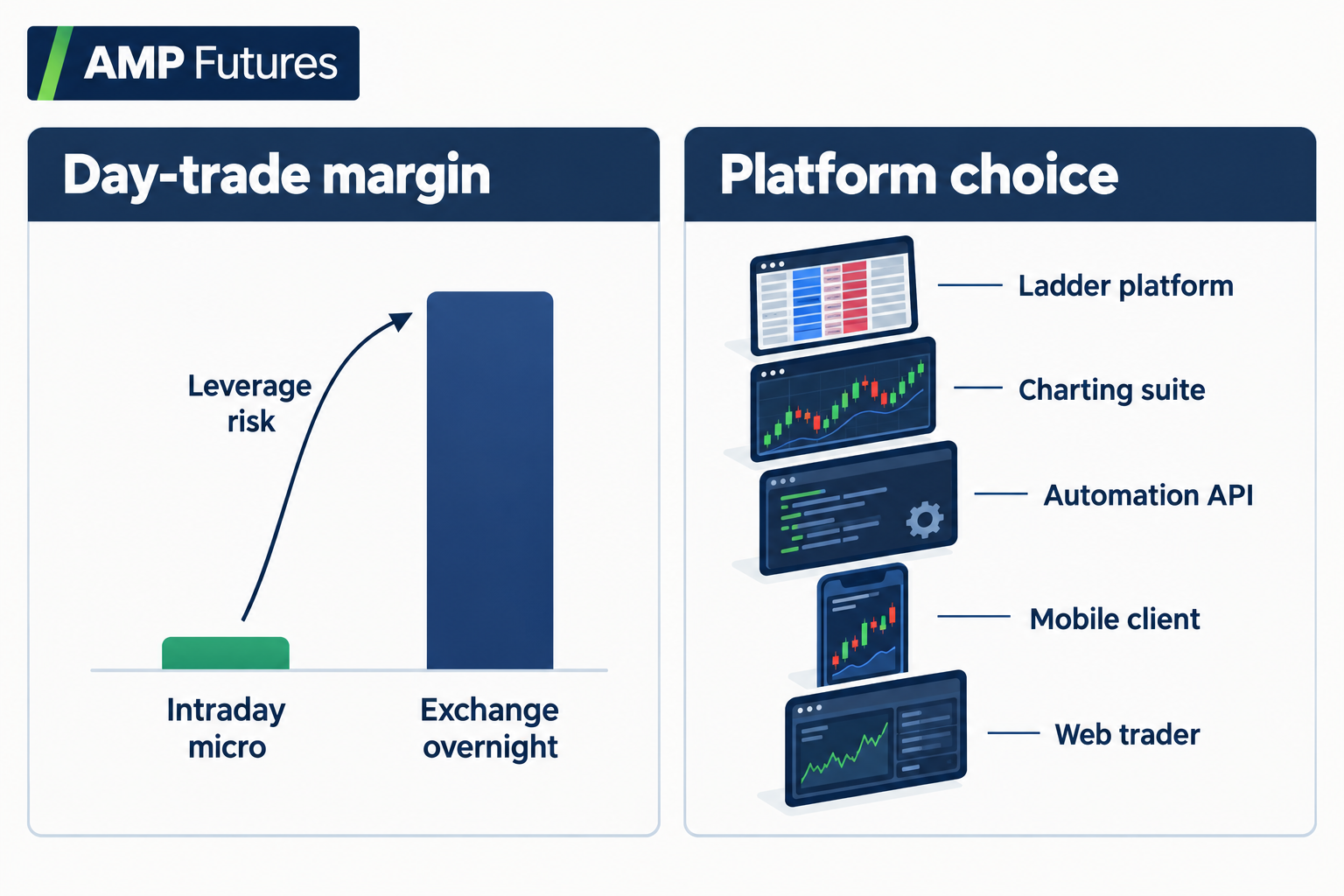
The SuperDOM, which is the depth-of-market order ladder you click to enter and exit, is the reason. You see resting bids and offers at each price, you click to buy, and your stop and target attach as brackets. That workflow is why scalpers stay. The charting is competent rather than beautiful, and the strategy builder lets you automate a rules-based setup without writing C# if your logic is simple.
The pricing model is where people get it wrong. The free plan carries the highest per-side rate. The paid license drops that rate substantially and adds order flow tools. Do the arithmetic before you buy the license, not after. If the license costs several hundred dollars and saves roughly a quarter per side, you need hundreds of sides per month for years to break even. At 20 round turns a month, the free plan is the correct answer and the license is a vanity purchase.
Pros
- ✅ Ladder order entry built for speed, with bracket and OCO orders native
- ✅ Advertised intraday micro margins from $50, one of the lowest in the field
- ✅ Free plan is genuinely usable, not a trial
- ✅ Large third-party add-on ecosystem and a lot of free tutorials
- ✅ Simulated trading is unlimited, so you can paper trade it first
Cons
- ❌ Commission tier is tied to a plan purchase, which pressures low-volume traders into overpaying
- ❌ Desktop platform runs on Windows natively, Mac users work around it
- ❌ Charting and backtesting lag purpose-built analysis tools
Best for: the trader who has picked futures as their primary market and wants one platform to live in.
2. Tradovate: best for high-volume scalpers
Tradovate rewards consistent volume and punishes quiet months, so know your round-turn count before you pay for a membership.
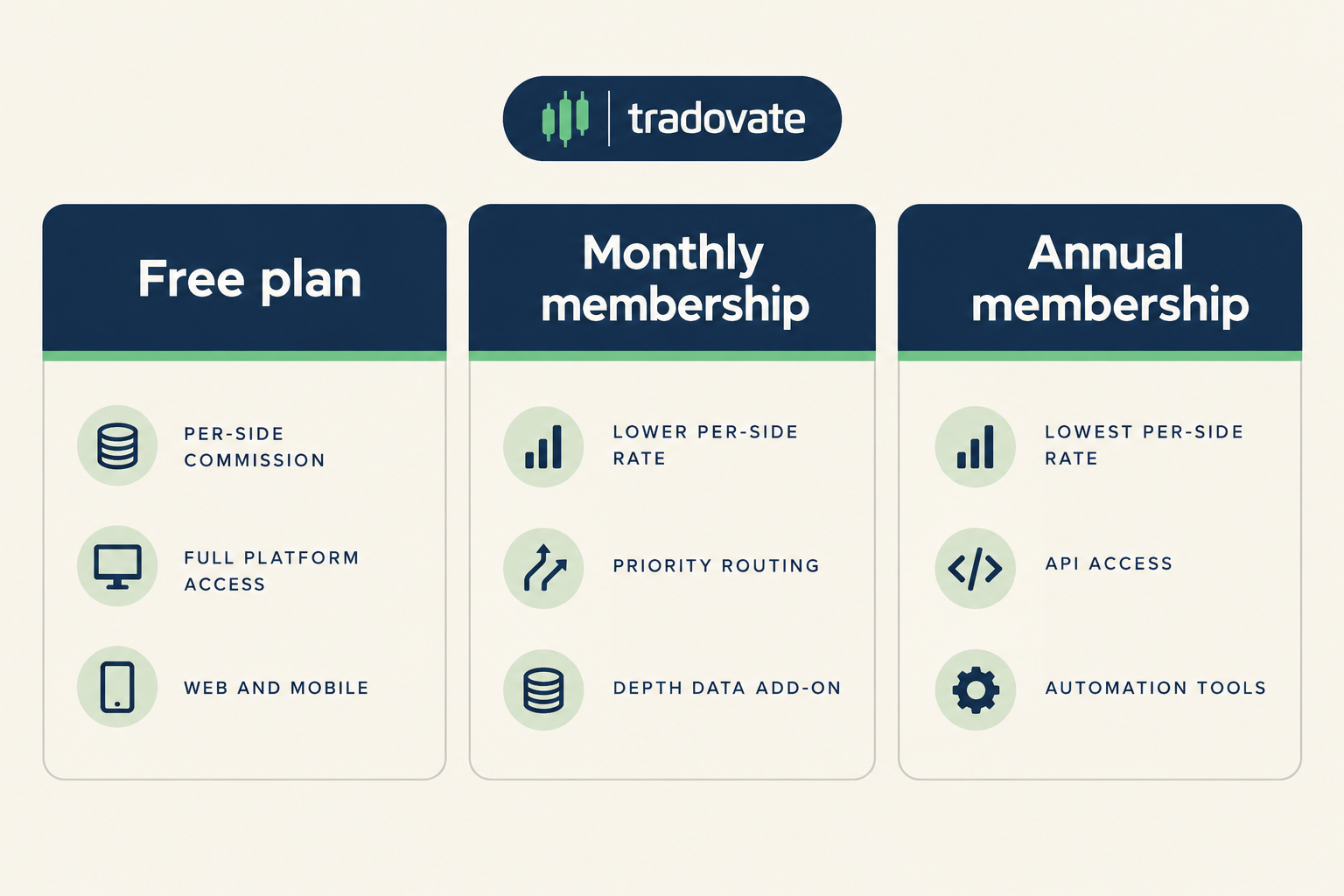
Tradovate flipped the model. Instead of charging you per side forever, it sells memberships that push commissions down toward zero on many products, leaving you with exchange fees and a subscription. For a scalper putting on 40 round turns a day, that math is brutal in the right direction.
The platform is cloud-based, which is the interesting part and the annoying part. Cloud-based means you log in from a browser on any machine, your workspace follows you, and there's no install to corrupt. It also means your fills depend on a connection you don't own. If your internet is inconsistent, that's a real risk, not a theoretical one. Have a phone app and a support number ready before you need them.
Order entry is clean, the ladder is responsive, and the API access on higher tiers makes automation straightforward. What you give up is depth of analysis. This is an execution venue, not a research suite. Pair it with a separate charting tool if you need heavy indicator work, and read our breakdown of AI trading platforms if you want the analysis layer to live somewhere else.
Pros
- ✅ Membership pricing can effectively eliminate commissions on many contracts at volume
- ✅ Cloud platform, no install, workspace syncs across devices
- ✅ Advertised intraday micro margins in the $50 range
- ✅ Free tier exists for lower-volume traders
- ✅ Solid API for rules-based automation
Cons
- ❌ Membership fees are dead weight in a slow month when you don't trade
- ❌ Browser dependency means your execution rides on your connection
- ❌ Thinner charting and backtesting than desktop rivals
Best for: high-frequency intraday traders whose volume is consistent enough to amortize a membership.
3. AMP Futures: best for low day-trade margins and platform choice
AMP is a clearing layer first and a product second, which suits traders who already know their platform.
AMP is the broker for traders who already know which platform they want and just need cheap clearing behind it. It supports more than 20 front ends, from CQG and Sierra Chart to MultiCharts, and it advertises some of the lowest intraday margins in US retail futures.
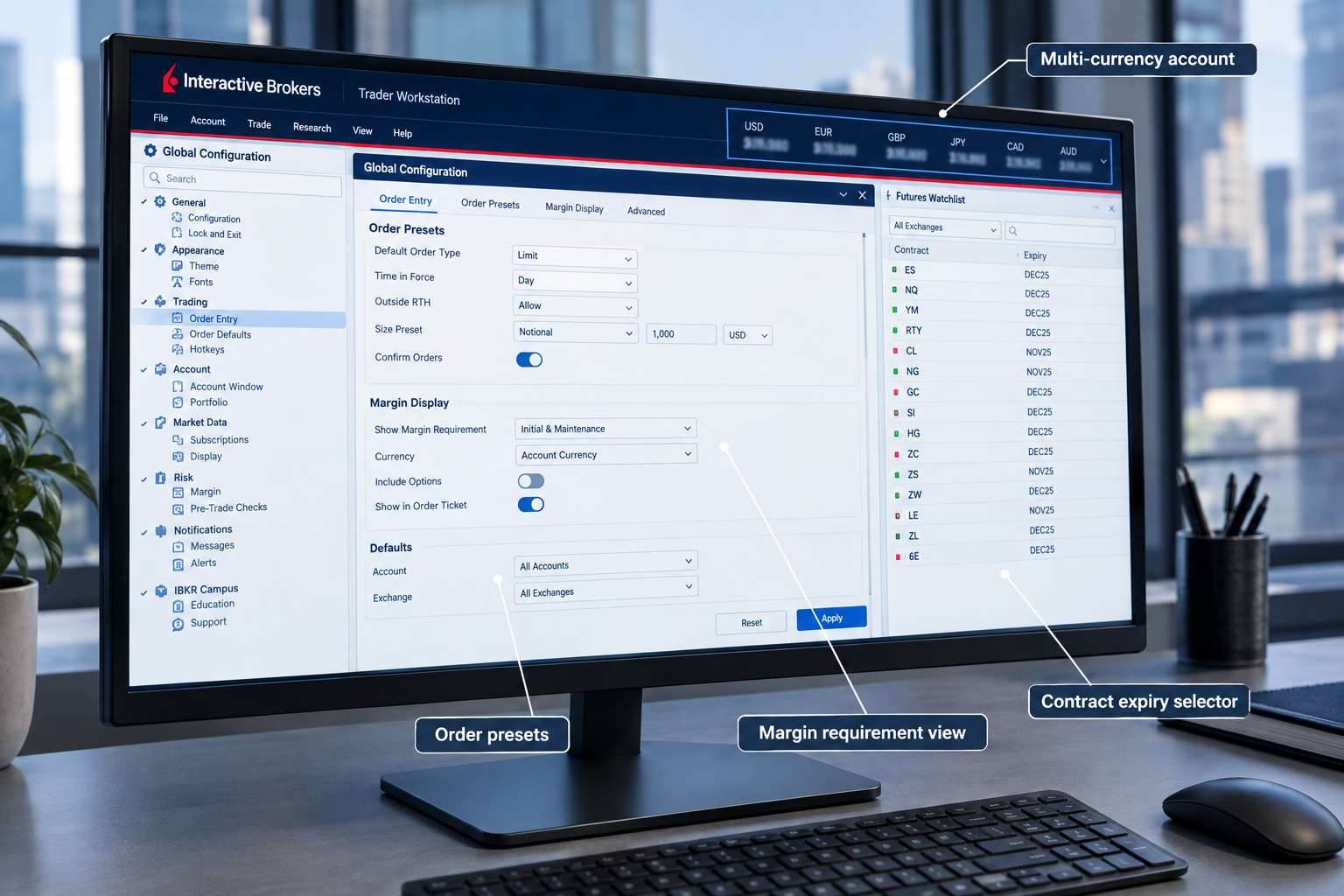
Commissions start low and are openly negotiable if you bring volume. That's normal in futures and unusual in equities. Call, state your monthly round turns, and ask. Traders who don't ask pay the rack rate.
The catch is the experience. AMP feels like a clearing shop, not a consumer fintech product. Onboarding is paperwork-heavy, the website is dense, and your platform support depends on which of those 20 platforms you chose. The low margin is also the trap. A $50 intraday requirement on a micro index contract means one contract controls roughly $25,000 of notional exposure. A 1% move against you on one contract is $250, which is five times your margin. Low margin isn't cheap leverage, it's a smaller buffer before a liquidation.
Pros
- ✅ Among the lowest advertised intraday day-trade margins in the field
- ✅ Huge platform selection, so you're not forced into a house app
- ✅ Advertised minimum deposit around $100
- ✅ Commissions negotiable at volume, transparently so
Cons
- ❌ Interface and onboarding feel dated
- ❌ Platform fees stack on top of commissions depending on your choice
- ❌ Support quality varies by platform, not one consistent desk
- ❌ Ultra-low margins invite position sizing mistakes
Best for: experienced futures traders who bring their own charting and want the thinnest cost layer underneath it.
4. Interactive Brokers: best for multi-asset traders
For a trader who wants the best futures broker for a mixed book of stocks, options and futures, one IBKR account covers all of it.
Interactive Brokers is the pick when futures are one line in a broader book. Advertised commissions of roughly $0.25 per micro contract and $0.85 on standard US futures are competitive without a license purchase, and you get equities, options, bonds, and 20-plus currencies in the same account with genuinely low financing rates.
What you don't get is the retail day-trading margin party. IBKR reduces intraday requirements relative to overnight, but you're looking at something in the neighborhood of half the exchange maintenance requirement, which on a micro index contract lands in the hundreds, not at $50. For a scalper trading five micros, that's a real capital difference. For a trader running one or two contracts against a funded portfolio, it barely registers.
Trader Workstation is powerful and hostile to beginners in equal measure. Expect a week before it stops fighting you. Data is metered per exchange, which is honest and slightly irritating, since you'll subscribe to exactly what you use and see it itemized. The API is the best in this group by a wide margin, which matters if you're building systematic execution. If that's your direction, our notes on AI trading bots cover what breaks first.
Pros
- ✅ Low commissions with no platform license required
- ✅ Futures, equities, options, and FX in one margin account
- ✅ Best API and institutional-grade order types in this comparison
- ✅ Publicly traded parent company with transparent financials
Cons
- ❌ No $50-style intraday micro margins
- ❌ Trader Workstation has a genuinely steep learning curve
- ❌ Data fees are itemized per exchange and add up
- ❌ Support is competent but rarely fast
Best for: traders running futures alongside stocks and options who value balance sheet strength over the cheapest intraday margin.
5. Optimus Futures: best for broker support and platform variety
Optimus sells service first, and a phone answered during a fast market is worth real money.
Optimus is an introducing broker, which means it sits between you and a clearing FCM and earns its keep on service. In a market where most discount brokers route you to a help ticket, Optimus answers the phone. That's the whole pitch, and for a certain trader it's worth more than two cents a side.
Commissions run competitive, usually in the $0.25 to $0.60 range per micro side depending on platform and volume, with the same negotiate-at-volume culture as AMP. Intraday margins on micro index products are advertised in the $50 range. The platform list runs past 15, including its own Optimus Flow, plus CQG and Jigsaw for order flow work.
Where it loses points: you're paying a small service premium versus the absolute cheapest clearing, and the introducing broker structure adds a layer. That layer is fine when it's transparent, and you should still confirm which FCM holds your money and check that entity on NFA BASIC. Do that for any introducing broker, not just this one.
Pros
- ✅ Actual human support with futures-specific knowledge
- ✅ 15-plus platform options including order flow tools
- ✅ Low intraday margins on micro contracts
- ✅ Helpful educational content that isn't a sales funnel
Cons
- ❌ Not the outright cheapest on commissions
- ❌ Introducing broker structure means your clearing firm is a separate entity to diligence
- ❌ Typical minimum around $500, higher than the advertised floors elsewhere
Best for: newer futures traders who will actually use support, and anyone testing several platforms before committing.
6. TradeStation: best for one platform across futures and equities
TradeStation sits between the deep-discount crowd and Schwab on price, and it earns that spot with strategy testing.
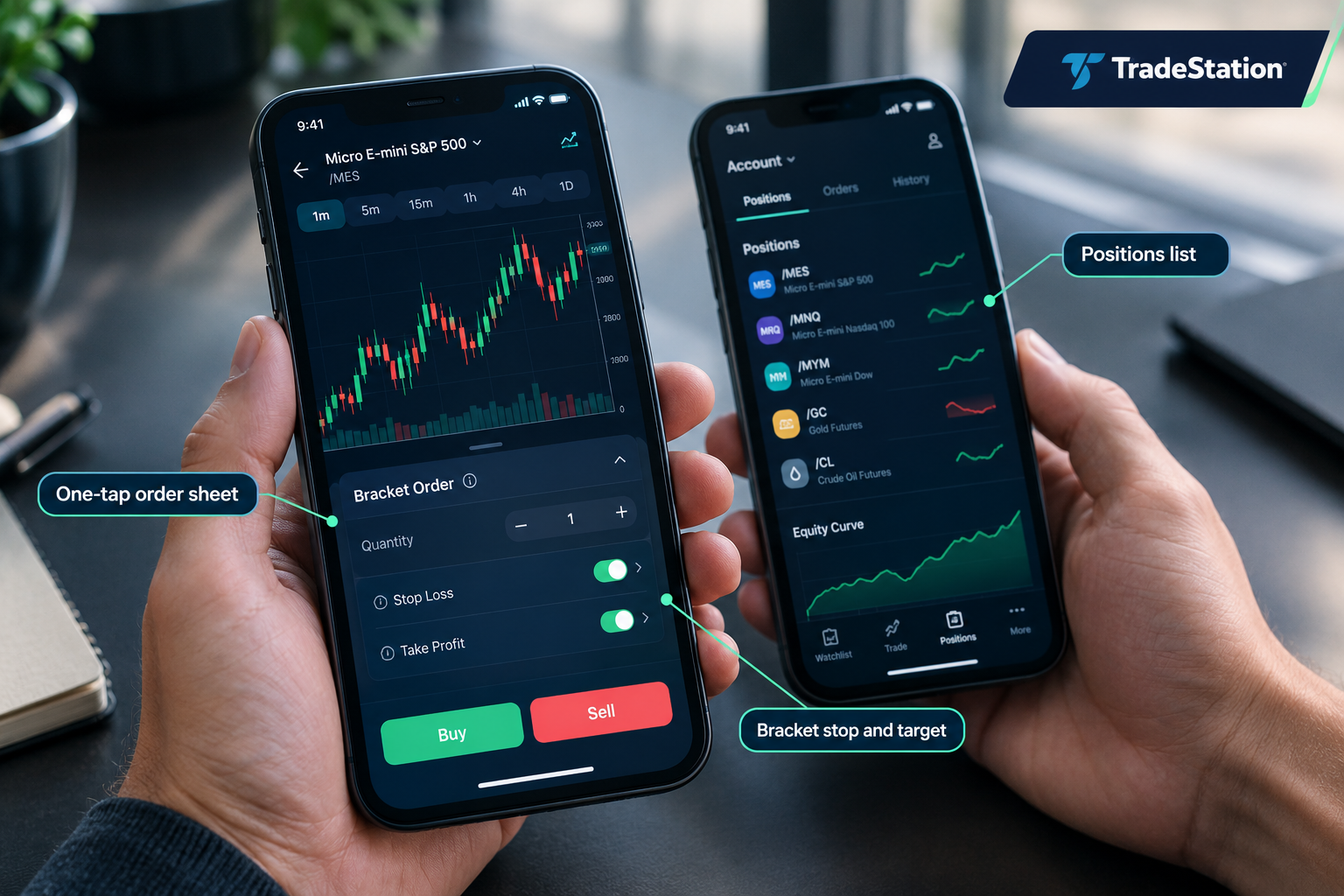
TradeStation is the middle path. Advertised futures commissions around $1.50 per standard contract and $0.50 per micro, per side, put it above the deep-discount crowd and well below Schwab. In exchange you get a charting and strategy testing environment that's been refined for three decades, plus equities and options in the same login.
EasyLanguage, its strategy scripting language, is the underrated asset. If you want to define a setup in code, backtest it against years of tick data, and then run it, TradeStation makes that unusually approachable compared to writing C# or Python. Its intraday day-trade margins are reduced from exchange requirements but aren't in the $50 tier, which is a fair trade for the research depth.
The cost structure has historically included plan-dependent platform and data fees, so check whether your account qualifies for the bundled tier. If you trade futures three times a week and swing trade stocks the rest of the time, TradeStation's total bill usually beats running two brokers. If you scalp 50 round turns a day, the per-side rate will eat you alive.
Pros
- ✅ Serious backtesting with EasyLanguage and long tick history
- ✅ Futures, equities, and options in one platform
- ✅ Mature desktop platform with a usable mobile app
- ✅ Reduced intraday margins, just not the deepest
Cons
- ❌ Per-side commissions roughly 2x to 5x the deep-discount brokers on micros
- ❌ Platform and data fees depend on plan and activity
- ❌ Desktop software shows its age in places
Best for: system builders who want to test a setup properly before risking capital, and who trade moderate volume.
7. Charles Schwab (thinkorswim): best for investors who trade futures occasionally
Convenience is the product here, and you pay for it on every contract.
Schwab's futures offering exists for one reason: your money is already there. At roughly $2.25 per contract per side including micros, it's the most expensive broker in this comparison by a wide margin. On 400 sides a month, that's roughly $900 in commissions where a deep-discount broker charges under $150 for the same activity.
What you get is thinkorswim, which is still one of the best-designed retail platforms in existence, plus futures data that's typically bundled for funded accounts, plus a custodian holding trillions. The analysis tools, options chains, and charting are excellent. The house margin requirements sit near exchange levels, so plan on hundreds per micro contract rather than $50.
The honest read: Schwab is a fine place to hedge a portfolio with two micro contracts and a terrible place to scalp. If you're trading futures more than a few times a week, the commission gap alone justifies opening a second account at a specialist. Convenience has a price, and here it's printed on your statement.
Pros
- ✅ thinkorswim is a top-tier platform for charting and analysis
- ✅ Futures data commonly bundled for funded accounts
- ✅ Everything in one account with a large, well-capitalized custodian
- ✅ Strong education and paperMoney simulated trading
Cons
- ❌ About $2.25 per contract per side, roughly 6x the cheapest options here
- ❌ No deep intraday margin discount
- ❌ Futures approval adds an application step
- ❌ Platform is built for options traders first, futures scalpers second
Best for: self-directed investors who want occasional futures exposure without moving money to a new firm.
Cost calculator
Futures Round-Turn Cost Calculator
What does your real trading volume cost per month and per year once every fee is counted?
What should you look for in a futures broker before you choose?
Start with your monthly round turns, then work backward. That single number decides which cost structure wins, and almost every bad broker choice comes from guessing it high.
Run the math on a realistic month. Ten micro round turns a day, 20 trading days, is 400 sides:
| Advertised rate per side | Commission on 400 sides | Plus a $99 monthly platform fee |
|---|---|---|
| $0.09 | $36 | $135 |
| $0.35 | $140 | $239 |
| $0.50 | $200 | $299 |
| $2.25 | $900 | $999 |
Exchange, clearing, and NFA fees sit on top of all four columns and are effectively the same wherever you trade, because CME sets them. You can view the official schedule on CME Group's fee page. Commission is the part you negotiate. Everything else is weather.
The rest of the checklist:
- Confirm registration. Look up the FCM and any introducing broker on NFA BASIC. Check for disciplinary history. This takes two minutes and rules out the worst outcomes.
- Read the intraday margin table in dollars. Ask what happens at 4:00 p.m. Eastern when intraday margin reverts to exchange maintenance, and what the auto-liquidation policy is. Getting flattened at the close because you were holding on day margin is a self-inflicted wound.
- Price data separately. Budget roughly $11 to $15 per month per exchange for non-professional Level 1, more for depth. If you trade CME index products plus energy, you're paying for two exchanges.
- Test the platform in simulation for two weeks. Not two days. You want to see how it handles a Federal Open Market Committee release and a jobs report.
- Check funding and withdrawal mechanics. ACH speed, wire fees, and whether withdrawals require a phone call. Boring until you need the cash.
- Ask about volume discounts explicitly. Futures commissions are negotiable at nearly every specialist broker. Equity traders find this shocking. Futures traders find it Tuesday.
The common mistake: choosing a broker for $50 intraday margin, then sizing to what that margin allows. One micro index contract represents roughly $25,000 of notional exposure. Four contracts is $100,000. Your $2,000 account is not equipped for a six-figure position, regardless of what the margin table permits. Set your size from your stop distance and your risk per trade, then check that margin allows it. Never the reverse.
How does a futures broker compare to prop firms and CFDs?
Direct futures brokerage is one of three ways retail traders get exposure to index and commodity moves, and the other two are structurally different products with different failure modes.
Prop firms (futures evaluation accounts). You pay a monthly fee, trade a simulated account against a target, and if you pass, you trade firm capital for a profit split. The appeal is obvious: a $150 monthly fee instead of $10,000 in capital. The problem is that in most programs you are not trading your own money, your position is often mirrored rather than executed at the exchange, and the drawdown rules are tight enough that a normal losing streak ends the account. Payout terms vary enormously and consistency rules can delay withdrawals. Prop evaluations suit disciplined traders with a proven setup and no capital. They're a bad fit for beginners, who tend to pay repeated reset fees and learn nothing. Verify how any firm handles funded-account execution before you pay.
CFD brokers. Contracts for difference let you speculate on an index or commodity price without the standardized contract. They're widely available outside the United States and generally not available to US retail clients. The cost shows up in the spread instead of a commission, which makes it harder to measure, and you're trading against your broker rather than a central exchange. No central clearing means counterparty risk lives with the firm. CFDs suit non-US traders who want small position sizes and simple platforms. They suit nobody who cares about transparent pricing.
Direct futures brokerage, which is this list. Standardized contracts, centrally cleared at CME, transparent fee schedules, and a consolidated tape. You need real capital and you own the risk completely. Leverage cuts both directions and there is no negative balance protection to save you in a gap.
One more comparison worth naming: micro futures versus index ETF options. Micros give you clean 23-hour access, favorable tax treatment under the 60/40 rule for many US traders (talk to an accountant, not a blog), and no assignment risk. Options give you defined risk and a smaller minimum bite. If you're weighing that trade-off, our AI options tools breakdown covers the analysis side.
Top 5 features to demand in a futures trading broker
- Clean NFA registration. Look up the FCM and any introducing broker on NFA BASIC and check the disciplinary history before you fund.
- Commissions that match your volume. Pick the cost structure that fits your real monthly round turns, not the volume you imagine.
- Intraday margin stated in dollars. Know the per-contract figure and what happens when day margin reverts to exchange maintenance at the close.
- A ladder with native brackets. Bracket and OCO orders attached at entry, on a platform that survives a CPI release without freezing.
- Transparent data fees. Budget roughly $11 to $15 per month per exchange for non-professional Level 1, and avoid brokers that hide it.
Frequently asked questions about the best futures trading broker
What's the cheapest futures broker for micro contracts in 2026?
On advertised per-side commissions, NinjaTrader's paid-license tier (around $0.09) and Tradovate's top membership (near zero on many products) are the lowest. Both require an upfront or recurring payment, so they only beat free-plan pricing above a few hundred sides per month.
How much money do I need to day trade futures?
Brokers advertise minimums from $0 to $500 and intraday margins from about $50 per micro contract. Practically, most experienced futures traders suggest $2,000 to $5,000 for one or two micro contracts so a normal losing streak doesn't liquidate you. Futures have no pattern day trader rule, so there's no $25,000 requirement.
Do futures brokers charge market data fees?
Yes, almost always, because exchanges charge them. CME non-professional Level 1 real-time data typically runs about $11 to $15 per month per exchange, with Level 2 depth costing more. Schwab commonly bundles futures data for funded accounts, and specialist brokers usually pass it through itemized.
What is day-trade margin versus overnight margin?
Day-trade margin is the reduced amount a broker requires to hold a position during liquid hours, sometimes as low as $50 per micro index contract. Overnight margin is the exchange maintenance requirement that applies when you hold past the daily close, often 10 to 30 times higher. If you hold past the cutoff without sufficient equity, most brokers liquidate the position.
Is NinjaTrader better than Tradovate for day trading?
NinjaTrader wins on order ladder quality, desktop stability, and its free plan. Tradovate wins on total cost once you're trading roughly 40-plus round turns a day, and on device flexibility because it's browser-based. Choose NinjaTrader for a desktop-first workflow, Tradovate for volume economics.
Are prop firm futures accounts a substitute for a real broker account?
No. A prop evaluation is a paid challenge with firm-defined drawdown rules, and in most programs you're not placing orders at the exchange with your own capital. They can work as a capital source for a trader who already has a tested setup, but they don't replace a CFTC-registered broker account for learning or for owning your own risk.
Which futures broker is best for automated trading?
Interactive Brokers has the deepest API and the widest asset coverage for systematic execution. Tradovate's API is simpler and cheaper to run at futures-only volume. TradeStation is the easiest place to build and backtest a strategy in code before you automate it.
How do I verify a futures broker is legitimate?
Search the firm on NFA BASIC at nfa.futures.org to confirm CFTC registration and review disciplinary history, and check whether it's a Futures Commission Merchant holding your funds or an introducing broker routing to one. The CFTC also publishes fraud advisories worth reading before you fund any new account.
Which is the best futures trading broker for beginners?
Optimus Futures if you will actually use phone support, or NinjaTrader if you want a free plan and unlimited simulated trading while you learn. Paper trade for two weeks before you fund either account.
What is the best futures trading broker for micro contracts?
NinjaTrader and Tradovate lead on cost, with advertised intraday micro margins around $50 and the lowest per-side commissions once your volume justifies a license or membership. AMP Futures is the pick if you bring your own platform.
Is Schwab a good futures broker?
For occasional use, yes. At about $2.25 per contract per side it is roughly 6x a deep-discount broker, so it only makes sense if you trade futures rarely and value thinkorswim and one account.
Is $5000 enough to trade futures?
Yes, for one or two micro contracts. Most experienced futures traders suggest $2,000 to $5,000 at that size so a normal losing streak doesn't liquidate you. It is not enough to size up to whatever a $50 intraday margin allows.
Is $1000 enough to trade futures?
Technically yes, since advertised minimums run from $0 to $500, but it is a thin cushion. One micro index contract controls roughly $25,000 of notional exposure, so a 1% move against you is $250, a quarter of the account. Most experienced traders suggest $2,000 to $5,000 for one or two micros.
Which broker offers the best futures accounts?
NinjaTrader for most active retail day traders, Tradovate once you trade 40-plus round turns a day, and Interactive Brokers if futures sit inside a stock and options book. Match the cost structure to your real monthly volume before you pick.
Final verdict: the best futures trading broker by trader type
The honest answer to "futures trading best broker" is a volume answer, not a brand answer.
NinjaTrader is the pick for the active retail day trader who wants a real ladder, $50-level intraday micro margins, and a free plan that works while you build volume. Tradovate takes it if you're doing 40-plus round turns a day and the membership math clears. AMP Futures is for the experienced trader bringing their own charting who wants the thinnest cost layer underneath. Interactive Brokers is right when futures sit inside a broader multi-asset book. Optimus Futures earns its small premium if you'll actually use support. TradeStation is for the system builder who tests before risking capital. Charles Schwab is for occasional exposure in an account you already own, at a price you should only accept if you trade rarely.
Your next step, and it takes 15 minutes: count your realistic round turns per month, multiply by two for sides, and run that number against the four commission tiers in the table above. Then open a simulated account at the winner and trade it for two weeks before you fund anything. Cut the noise, keep the alpha.
Related reading
- AI trading platforms compared
- What AI trading software actually gets you for the subscription
- Five settings to change before your first trade
- About FullStack Alpha and how we test
Sources
- NFA BASIC registration and disciplinary lookup, National Futures Association, 2026: https://www.nfa.futures.org/basicnet/
- CME Group clearing and exchange fee schedules, 2026: https://www.cmegroup.com/company/clearing-fees.html
- Commodity Futures Trading Commission, customer advisories and registration resources, 2026: https://www.cftc.gov/
Picking a broker is one decision. Picking what runs on top of it is the next one. The FullStack Alpha directory lists 200+ AI stock tools by category and price.
Browse the directory → aistockpickerapps.com
This article contains affiliate links; we may earn a commission if you open an account, at no cost to you, and rankings are never sold.