AI in the Stock Market: 5 Jobs It Does Better Than People
Last updated: August 31, 2026
Wall Street has run ai in stock market operations for two decades. It just doesn't do what most retail traders think it does.
The assumption is that hedge funds feed a ticker into a machine, the machine picks winners, and that's the edge. That's not it. The actual jobs AI handles at institutional scale are far less glamorous and far more defensible. And once you understand what those jobs are, you'll stop chasing tools that promise to replicate them and start using the ones that actually help.
Quick Answer
AI in the stock market does five jobs better than any human: reading documents at scale, executing large orders without moving the price, monitoring portfolio risk in real time, detecting patterns across thousands of instruments simultaneously, and following rules without deviation. It does not predict the future. No version of it does.
Key Takeaways
- BlackRock's Aladdin platform monitors risk across roughly $21.6 trillion in assets under management as of 2024, a scale no human team could replicate manually (BlackRock, 2024 Annual Report).
- VWAP and TWAP execution algorithms, used by firms like Citadel Securities and Virtu Financial, slice large orders into hundreds of smaller trades to minimize price impact, a job that takes milliseconds and requires no human input.
- Renaissance Technologies' Medallion Fund, the most cited quant success story, uses statistical pattern detection across historical data, not stock-picking intuition.
- Natural language processing (NLP) tools can scan thousands of SEC filings, earnings call transcripts, and news items in the time it takes a human analyst to read one 10-K.
- In July 2026, AI-focused hedge fund Situational Awareness LP saw its portfolio fall 67% after using up to 4x leverage in concentrated AI infrastructure positions, showing that AI-driven concentration risk is real and dangerous.
- Goldman Sachs reported its Hedge Fund VIP list suffered its worst one-month underperformance versus the S&P 500 in over 20 years of data during July 2026, as AI momentum trades unwound.
- The jobs AI still cannot do reliably: exercise judgment when market regimes shift without historical precedent, sign off on compliance decisions, and distinguish causation from correlation in live markets.
What Does AI in Stock Market Work Actually Look Like?
Where AI and the Stock Market Actually Meet
AI in stock market infrastructure is not one thing. It's a collection of specific tools doing specific jobs inside specific workflows. At the institutional level, that means execution algorithms at firms like Citadel Securities and Jane Street, risk platforms like BlackRock's Aladdin, NLP engines scanning SEC filings, factor models at quantitative funds like Two Sigma and Renaissance Technologies, and systematic rule-following in strategy execution.
None of those are "the AI picks a stock and the trader buys it." They're process tools. Faster, more consistent, broader in scope than any human. But they're still tools running inside a process that humans designed and humans can shut down.
The Job Retail Assumes It Does, and Does Not
Most retail traders hear "AI in stock market" and picture a machine that reads the news, runs the numbers, and tells you what to buy tomorrow. That's the product that gets sold in Discord servers and on landing pages with green arrows.
The reality is that no institutional quant fund claims their AI predicts prices. They claim it finds statistical patterns that have historically repeated, with enough frequency and edge to be worth betting on, with strict risk controls. That's a very different claim. And even that edge erodes as more capital chases the same signals.
For a plain-English breakdown of what these tools actually do at the retail level, the honest guide to AI stock trading is worth reading before you spend a dollar on any subscription.
Job 1: Reading Every Filing and Transcript at Once
AI research tools do this better than humans. Full stop. The mechanism is natural language processing, a branch of machine learning that converts unstructured text into structured, searchable data. A single NLP engine can process thousands of 10-K filings, earnings call transcripts, and analyst reports in the time a human analyst needs to read one.
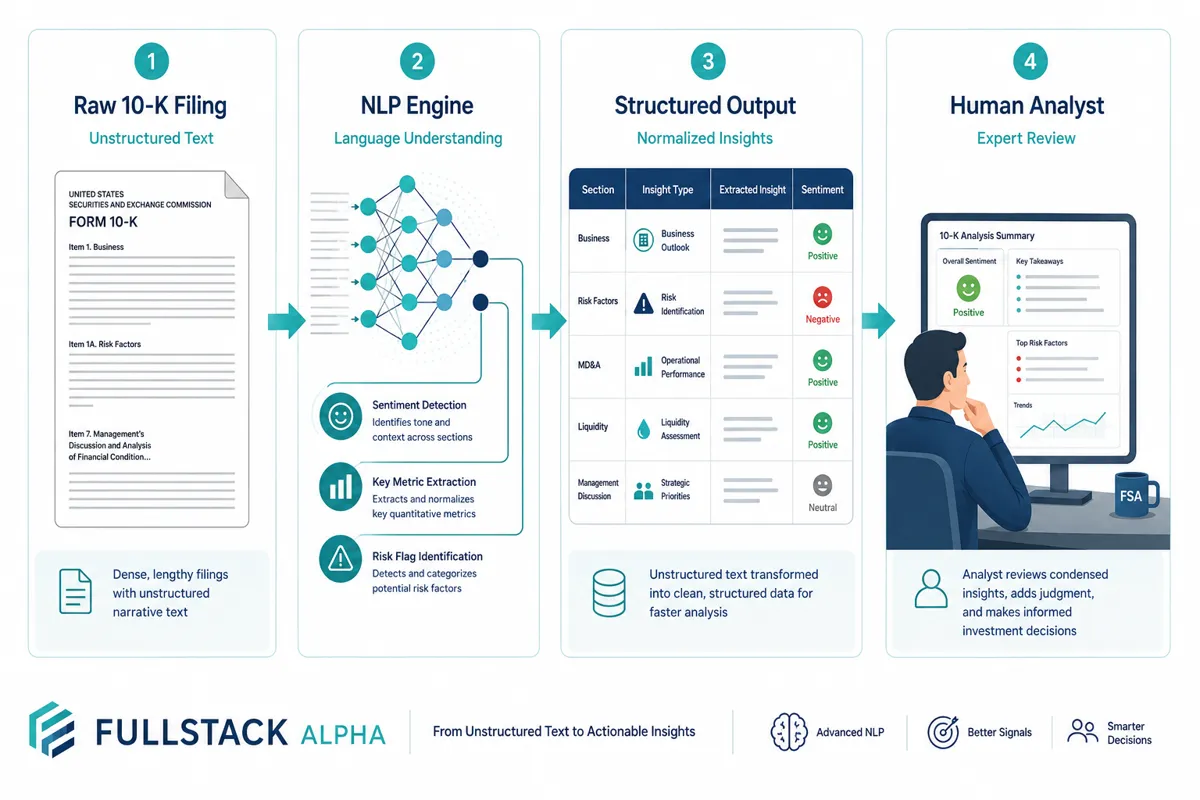
Natural Language Processing Across Thousands of Documents
When a company files a 10-K with the SEC, it's typically 80 to 200 pages of dense text. An NLP model can extract revenue figures, flag changes in risk language between this year and last year, score the sentiment of the management discussion section, and cross-reference it against 500 peer filings, in seconds.
That's not analysis. That's triage. It tells a human analyst where to look, not what to think. The distinction matters.
Firms like Two Sigma and Point72 use NLP to monitor news flow and filings continuously. The output isn't "buy this stock." It's "something changed in this filing that's worth a human looking at."
Why AI Research Tools Beat a Human Reading Week
A senior analyst at a mid-size fund might cover 30 to 40 names. An NLP system covers the entire NYSE and Nasdaq universe simultaneously. During earnings season, when hundreds of companies report in a two-week window, that breadth advantage is enormous.
The practical takeaway for retail: AI stock research tools that read 10-Ks automatically exist at retail price points now. They don't replace your judgment on whether to buy. They compress the time it takes to find what's worth judging.
Job 2: Executing a Large Order Without Moving the Price
This is the job almost nobody outside a trading desk knows about, and it might be the clearest example of AI doing something humans genuinely cannot.
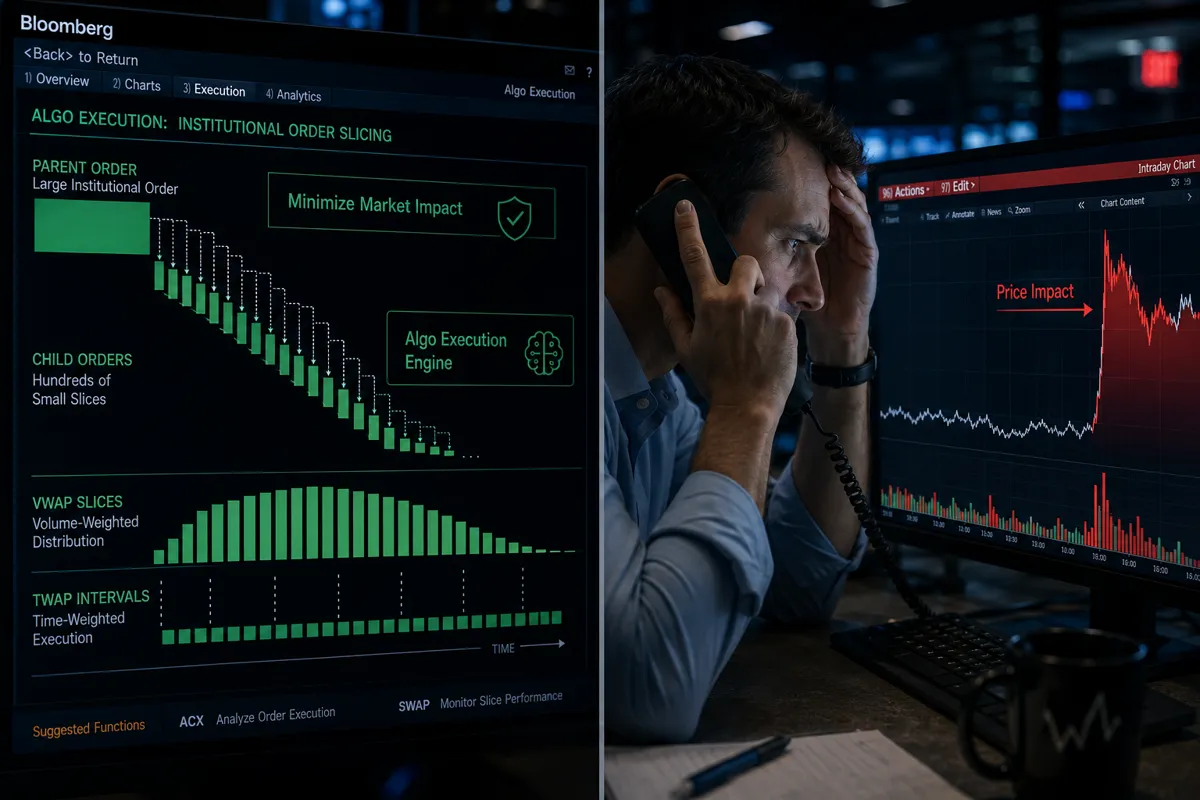
VWAP, TWAP, and Order Slicing
If a fund wants to buy 2 million shares of a mid-cap stock, it can't just submit a single market order. That order would move the price against itself before it's half filled. The solution is execution algorithms.
VWAP stands for Volume Weighted Average Price. A VWAP algorithm slices the order into hundreds of smaller child orders and releases them in proportion to the stock's historical volume pattern throughout the day, so the fund's average fill price tracks the market's average price. TWAP, or Time Weighted Average Price, does the same thing but distributes the order evenly over a set time window. Implementation shortfall algorithms optimize for minimizing the gap between the decision price and the final average fill.
These algorithms run in milliseconds. They adjust in real time to volume spikes, spread changes, and momentum shifts. A human trader managing the same order manually would move the price, tip off high-frequency traders, and get a worse fill. Every time.
The Job Almost No One Outside the Desk Knows About
Firms like Citadel Securities and Virtu Financial built their businesses partly on the efficiency of these execution systems. Jane Street reportedly took a $15 billion hit in July 2026 tied to the Situational Awareness unwind, showing how execution at scale cuts both ways when positions need to be liquidated fast.
The point isn't that execution algorithms are foolproof. It's that they solve a specific, mechanical problem, minimizing market impact on large orders, better than any human can. That's a genuine AI advantage with a clear mechanism behind it.
Job 3: Monitoring Risk Across a Whole Portfolio in Real Time
Real-time portfolio risk monitoring is where AI in stock market infrastructure earns its keep. The job is continuous, multidimensional, and never stops while markets are open.
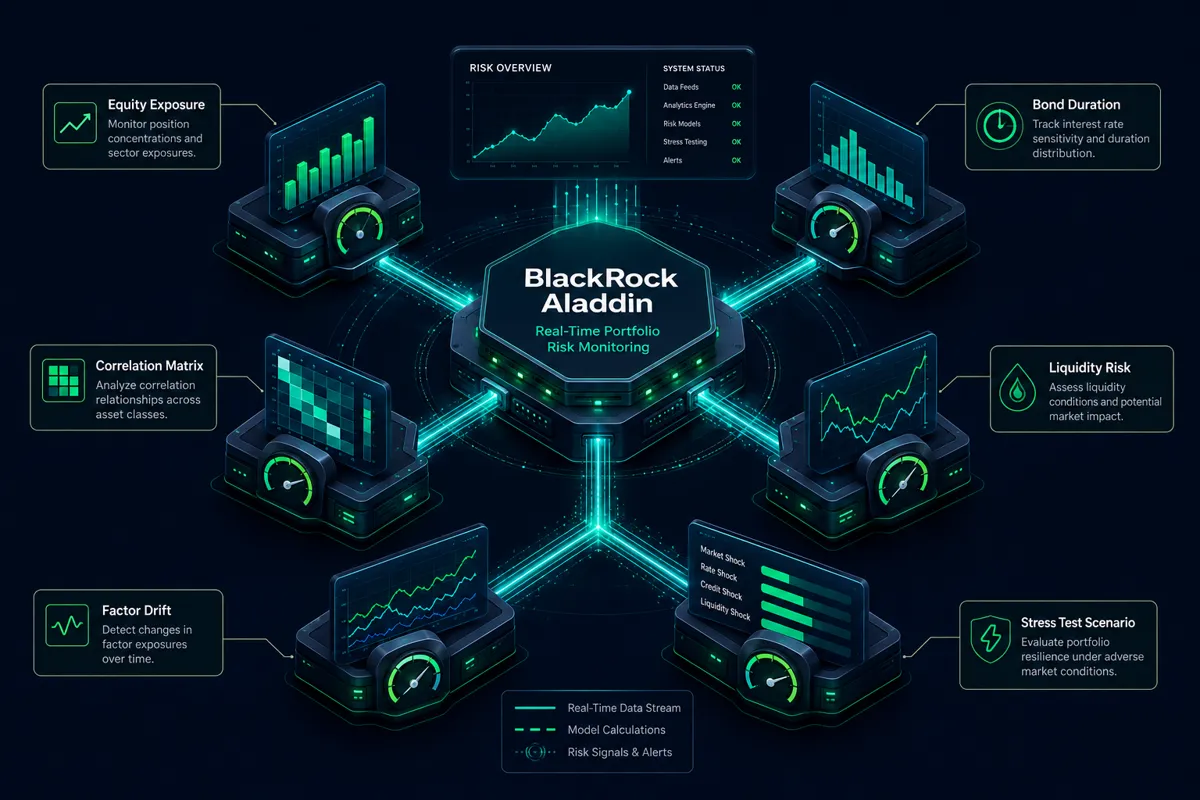
What BlackRock Aladdin Does All Day
BlackRock's Aladdin platform is the most cited example of institutional AI risk infrastructure. As of BlackRock's 2024 Annual Report, Aladdin monitors risk across approximately $21.6 trillion in assets. That's not a typo. The platform runs continuous stress tests, tracks factor exposures, monitors liquidity across thousands of positions, and flags concentration risks, all simultaneously.
Aladdin doesn't tell BlackRock's portfolio managers what to buy. It tells them what they already own might do under 47 different market scenarios, before something bad happens rather than after.
Correlation Shifts a Human Would Miss
The specific advantage here is breadth combined with speed. A human risk manager can monitor a portfolio of 50 names with reasonable attention. Aladdin monitors tens of thousands of positions across asset classes, geographies, and factor exposures simultaneously.
When correlations shift, which they do in every market stress event, a system like Aladdin catches it in real time. A human reviewing a morning risk report catches it hours later. In a fast-moving tape, that lag is expensive.
The July 2026 AI selloff illustrated this perfectly. Funds with heavy AI infrastructure exposure saw correlations between their semiconductor longs, data center plays, and energy positions converge to nearly 1.0 during the unwind. VARA, an AI-focused fund running $20 billion, dropped 44% in July alone, cutting its 2026 year-to-date return from roughly 200% through June down to 65%. Concentrated exposure plus correlated positions is a risk monitoring failure, not a prediction failure.
Job 4: Detecting Patterns Across Thousands of Instruments at Once
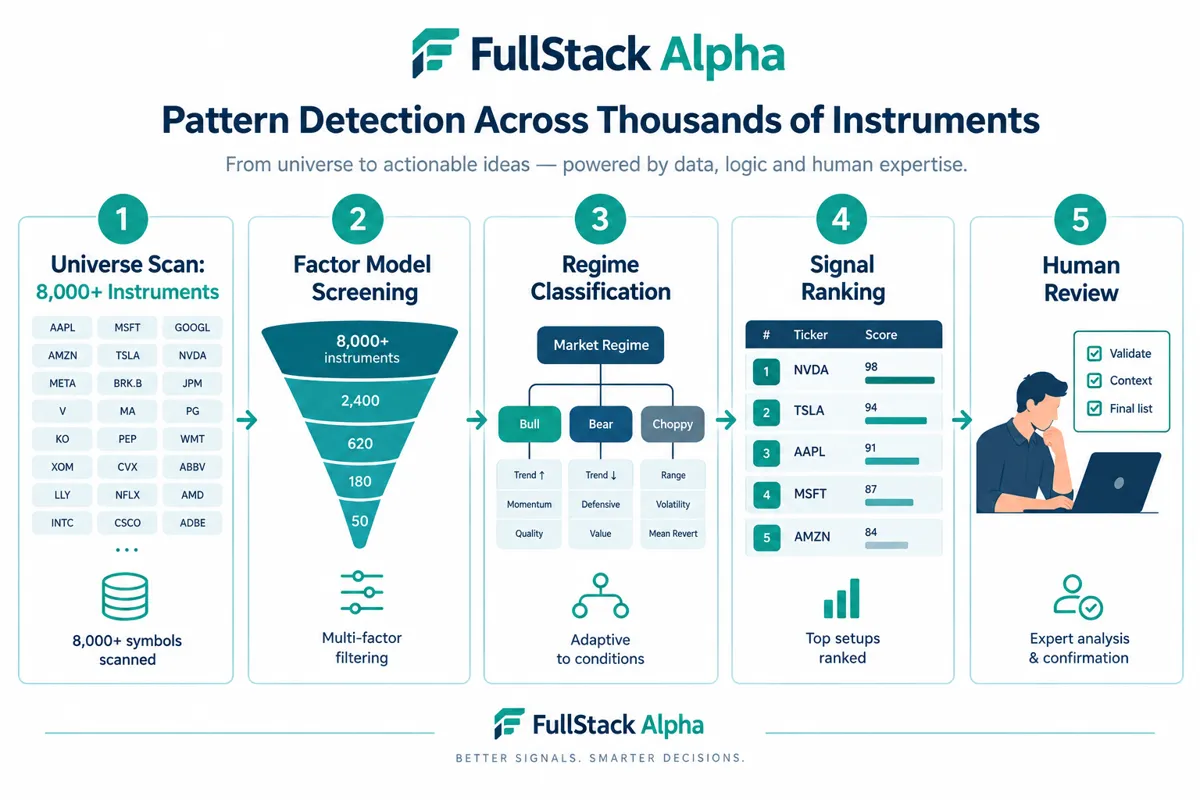
Pattern detection at scale is where firms like Renaissance Technologies built their reputation. The Medallion Fund's edge isn't that it found one great pattern. It's that it continuously scans for hundreds of statistical regularities across global markets, many of which are too small and too short-lived for a human to act on.
Breadth Over Depth
A skilled human trader might develop a deep read on 10 to 20 stocks. They know the price action, the float, the typical behavior around earnings. That depth has real value. But it doesn't scale.
An AI stock analysis system running factor models can scan 8,000 instruments simultaneously, looking for tight consolidation patterns, volume anomalies, relative strength shifts, and cross-asset correlations. It doesn't get tired at 3 PM. It doesn't get distracted by a position it's already in. It applies the same criteria to every name in the universe on every bar.
Where AI Stock Analysis Genuinely Outperforms
The honest answer is that this advantage is mostly useful for generating a watchlist, not for making the final call. A system that flags 40 names showing a clean setup from a universe of 8,000 is doing something a human physically cannot do in the same time window. But the human still needs to evaluate which of those 40 setups has the best risk-reward given current market conditions.
That's the correct division of labor. AI handles breadth. You handle judgment on the specific setup.
For retail traders building a process around this, how to find stocks for swing trading before everyone else does covers the practical workflow.
Job 5: Following the Same Rule Every Single Time
This is the least flashy job on the list and probably the most valuable for retail traders to understand.
Consistency as the Real Edge
An AI system executing a strategy doesn't revenge trade. It doesn't hold a loser because it "feels like it should come back." It doesn't skip a stop loss because the position is up on the week and it doesn't want to give back gains. It doesn't overtrade on a choppy tape because it's bored.
It follows the rule. Every time. Without exception.
That's not a small thing. The research on retail trader performance consistently points to behavioral errors, not bad stock selection, as the primary driver of losses. Getting stopped out on a valid setup and then immediately re-entering out of frustration. Sizing up after a win because confidence is high. Cutting winners fast and letting losers run, the exact opposite of what the process says.
Why Discipline Beats Insight in a Drawdown
A systematic strategy running on defined rules will underperform a great discretionary trader at their best. It will massively outperform that same trader at their worst, which is during a drawdown, when emotions are loudest and the temptation to deviate from the plan is highest.
Discipline beats prediction. Not because the system is smarter, but because it doesn't have bad days.
The practical application for retail: use AI tools to enforce your rules, not to replace them. Set your entry criteria, your stop loss, your position sizing formula, and let the system flag when a setup meets them. The swing trade position size calculator is a simple starting point for building that consistency into your process before you ever place a trade.
Comparison Table: What AI Does Better, What People Still Do Better
| Task | AI Advantage | Human Advantage |
|---|---|---|
| Reading volume | Scans thousands of filings and transcripts simultaneously via NLP | Interprets context, tone, and intent a model may misread |
| Execution speed | VWAP and TWAP algorithms slice orders in milliseconds without moving price | Recognizes unusual market conditions that warrant pausing execution |
| Risk monitoring | Monitors thousands of positions and factor exposures in real time | Decides whether a flagged risk warrants action or is noise |
| Pattern breadth | Scans 8,000+ instruments for setups simultaneously with no fatigue | Evaluates qualitative context behind a pattern that data alone misses |
| Rule consistency | Executes defined rules without emotion, fatigue, or deviation | Knows when a rule no longer fits the current environment |
| Judgment under new conditions | Applies historical pattern recognition at scale | Recognizes when historical patterns no longer apply to current regime |
| Accountability | Creates full audit trails of every decision and parameter | Bears legal and fiduciary responsibility; can sign off on compliance decisions |
Where Institutions Still Refuse to Automate
Here's the part that most AI-in-markets coverage skips. Knowing what AI does well is only half the picture. The other half is understanding where the largest, most sophisticated quant shops in the world still put a human in the loop, and why.
Judgment Under Regime Change
Every quantitative model is trained on historical data. That means every model has a hidden assumption baked in: that the future will resemble the past in the ways that matter.
Most of the time, that assumption holds well enough. Then it doesn't.
A regime change is when the rules of the market shift in a way that has no close historical analogue. The 2020 COVID crash happened in 11 trading days. The 2026 AI selloff saw Goldman Sachs report that its Hedge Fund VIP list suffered its worst one-month underperformance versus the S&P 500 in over 20 years of data, as a crowded trade unwound faster than any backtest had modeled. Situational Awareness LP's portfolio fell 67% in July 2026 after concentrated AI infrastructure positions with up to 4x leverage reversed violently.
No model trained on prior data predicted that specific sequence. The funds that survived it best were the ones where a human made the call to reduce gross exposure before the model said to.
Backtest overfitting is the technical term for what happens when a model is tuned too precisely to historical data and fails on new data. Every quant firm knows this problem. None of them have solved it with more AI. They solve it with human judgment at the portfolio construction level.
Accountability and the Compliance Problem
The SEC and FINRA don't accept "the algorithm decided" as a compliance defense. Every trade, every position, every risk limit has a human name attached to it somewhere in the regulatory chain.
That's not going to change. Regulators are moving toward more AI oversight, not less human accountability. The compliance sign-off on a trading strategy, the decision to launch a new fund structure, the call to halt a system that's behaving unexpectedly, all of those stay with humans because the legal and fiduciary liability stays with humans.
The Causation Gap No Model Closes
This is the deepest problem in quantitative finance, and it's worth stating plainly.
AI finds correlations. It does not find causes. A model might discover that a specific pattern in options flow precedes a 2% move in a stock 63% of the time over 10 years of data. That's a useful signal. But the model doesn't know why it works. And when the why changes, the signal dies, often before the model detects it.
Human analysts who understand the mechanism behind a signal, why it works, under what conditions it should work, and when it logically should stop working, are more robust to regime change than a model that only knows the correlation existed historically.
Systems over hacks means building a process that accounts for this. The signal is a starting point, not a conclusion.
What Is the Best AI for Stock Trading at Retail Level?
The best ai for stock trading at the retail level depends entirely on what job you're asking it to do. There is no single tool that replicates what BlackRock Aladdin, a Two Sigma factor model, and a Citadel execution algorithm do together. But there are tools that handle individual pieces of that stack at retail price points.
What Retail Tools Actually Automate
Most retail AI tools fall into three categories: screeners and scanners that handle pattern detection across large universes, research tools that use NLP to summarize filings and news, and alert systems that enforce rule-based entry and exit triggers.
What they don't do is execute at institutional scale, monitor correlated risk across a complex multi-asset portfolio, or make judgment calls. That's still your job.
For a current look at what's actually worth using, the AI stock market apps taking over traders' phones in 2026 covers the retail tool landscape without the hype.
Best AI for Investing Versus Best AI for Research
These are different jobs. The best ai for investing in a long-term, fundamental context is probably a research tool that reads 10-Ks, flags valuation changes, and monitors news flow on your holdings. Something like an AI stock analysis tool that catches red flags before they cost you fits that use case.
The best ai for stock trading in an active, technical context is a scanner that surfaces setups meeting your criteria from a large universe, paired with an alert system that notifies you when price action confirms the setup. Those are two separate tools doing two separate jobs.
Trying to find one tool that does both usually means finding one that does neither particularly well.
Matching the Tool to the Job It Is Good At
The framework is simple. Write down the five jobs AI does well from this article. Then ask which of those jobs is currently the weakest link in your own process. That's the job to automate first.
If you're missing setups because you can't scan enough names, the answer is a screener. If you're making emotional decisions at entry because you haven't defined your rules clearly, the answer is a rule-based alert system, not a fancier AI. If you're doing research manually on too many names, an NLP research tool compresses that time significantly.
Signal over noise means matching the tool to the actual gap, not buying the most impressive demo.
The AI for stock market research: what beginners get wrong piece is a useful read before you spend money on any of these tools.
Frequently Asked Questions
How is AI used in the stock market today?
AI in stock market operations covers five main jobs at institutional scale: reading documents at scale via NLP, executing large orders without moving price using algorithms like VWAP and TWAP, monitoring portfolio risk in real time, detecting patterns across thousands of instruments simultaneously, and following rules consistently without emotional deviation. Retail tools handle smaller versions of the first, fourth, and fifth jobs.
Can AI predict the stock market?
No. AI finds statistical patterns in historical data that have repeated with enough frequency to have a measurable edge. That is not prediction. It's pattern recognition with a probability attached. When market conditions change in ways that have no historical analogue, those patterns fail. Every major quant fund acknowledges this limitation. Any tool claiming to predict prices is selling something the underlying technology cannot deliver.
Do hedge funds use AI to pick stocks?
Hedge funds use AI to surface candidates, monitor risk, and execute orders. The final decision on position sizing, portfolio construction, and when to override a model sits with human portfolio managers. Renaissance Technologies, Two Sigma, and Citadel Securities all employ large teams of researchers and portfolio managers alongside their automated systems. The July 2026 AI selloff, which saw Situational Awareness LP fall 67% and VARA drop 44%, showed what happens when AI-driven concentration risk isn't managed by human judgment.
What is the best AI for stock trading for retail investors?
There's no single answer because the best tool depends on the job. For scanning setups across a large universe, a screener with AI-driven filtering handles the breadth problem. For research on individual names, an NLP tool that reads filings and summarizes news compresses your research time. For enforcing entry and exit rules, an alert system removes emotional deviation. The best AI stock tools for 2026 covers the current field with actual testing behind the reviews.
Is AI stock analysis reliable?
AI stock analysis is reliable for the jobs it's designed for: reading volume, pattern detection, and rule enforcement. It's unreliable as a substitute for judgment on whether a setup fits the current market environment, whether a correlation will hold going forward, or whether a regime change is underway. Treat AI stock analysis as a filter, not a final answer.
What are the best AI research tools for investors?
The most useful ai research tools for investors are those that apply NLP to SEC filings, earnings transcripts, and news flow to surface changes worth investigating. Tools in this category compress the reading problem without replacing the analytical judgment. For a side-by-side comparison of what's available, the AI stock market directory is a good starting point.
Does AI replace human traders?
Not at the decision-making level. AI replaces human traders at the mechanical level: scanning, executing, monitoring, and rule-following. The jobs that require judgment under novel conditions, accountability to regulators, and the ability to distinguish a broken model from a broken market remain with humans. The firms that have tried to remove humans entirely from the loop have generally learned expensive lessons about what happens when a model encounters conditions it wasn't trained on.
What is the best AI for investing long term?
For long-term investors, the most useful AI application is research compression. NLP tools that monitor your holdings for changes in risk language, earnings quality, or competitive positioning give you the coverage of a research team at a fraction of the cost. The trading expectancy calculator is also worth running on any systematic strategy before committing capital, to understand the math behind whether the process has a positive edge over time.
Final Verdict: Use It for the Five Jobs, Not the Sixth
AI in stock market infrastructure does five things better than any human: reads documents at scale, executes orders without moving price, monitors risk continuously, detects patterns across thousands of names, and follows rules without flinching. Those are real advantages with clear mechanisms behind them.
The sixth job, predicting what the market does next, is not on the list. It's not on the list because no version of AI does it reliably. The July 2026 AI selloff, which wiped out months of gains across multiple well-resourced funds, wasn't a failure of AI tools. It was a failure of position sizing, concentration risk, and the human judgment that should have been in the loop.
That wasn't on most bingo cards going into the summer. But it should have been, because the mechanism was visible: crowded trades, high leverage, correlated exposures, and a model that had no historical data for what happened next.
Use AI for the jobs it's actually good at. Build a process around those jobs. Then apply your own judgment to the parts the model can't touch.
That's not a limitation. That's the setup.
One tool, scored five ways. There are 200+ more in the FullStack Alpha directory, filterable by category, price, and what they actually do. Browse the directory at aistockpickerapps.com.
FullStack Alpha may earn a commission on tools reviewed through affiliate partnerships. This does not affect scores or editorial judgment.
References
Hedge Funds Take Big Hit In July After Bruising Ai Selloff - https://www.bloomberg.com/news/articles/2026-08-05/hedge-funds-take-big-hit-in-july-after-bruising-ai-selloff
Hedge Funds Big Hit July 215002000 - https://finance.yahoo.com/markets/stocks/articles/hedge-funds-big-hit-july-215002000.html
Hedge Funds Upped Short Ai Bets July Hazeltree Says 2026 08 12 - https://www.reuters.com/markets/wealth/hedge-funds-upped-short-ai-bets-july-hazeltree-says-2026-08-12/
Citadel Funds Gain July Many Hedge Funds Nurse Ai Sell Off Related Losses 2026 08 05 - https://www.reuters.com/business/citadel-funds-gain-july-many-hedge-funds-nurse-ai-sell-off-related-losses-2026-08-05/
Jane Street Took 15 Billion Hit July Tied Situational Awareness Sources Say 2026 08 14 - https://www.reuters.com/business/finance/jane-street-took-15-billion-hit-july-tied-situational-awareness-sources-say-2026-08-14/
Ai Focused Hedge Fund Vara Drops 44 In July On Stock Plunge - https://www.bloomberg.com/news/articles/2026-08-10/ai-focused-hedge-fund-vara-drops-44-in-july-on-stock-plunge
Situational Awareness Portfolio Sinks 67 July Ai Stock Rout Letter Shows 2026 07 31 - https://www.reuters.com/business/finance/situational-awareness-portfolio-sinks-67-july-ai-stock-rout-letter-shows-2026-07-31/
Jupiter Quant Fund Shanghai Minghong Plunged More Than 40 Ai - https://www.bloomberg.com/news/articles/2026-07-31/jupiter-quant-fund-shanghai-minghong-plunged-more-than-40-ai
Goldman Hedge Funds Historic Underperformance Sp500 Degrossing - https://www.cnbc.com/2026/08/21/goldman-hedge-funds-historic-underperformance-sp500-degrossing.html