AI for Stock Market Research: What Beginners Get Wrong
Last updated: June 30, 2026
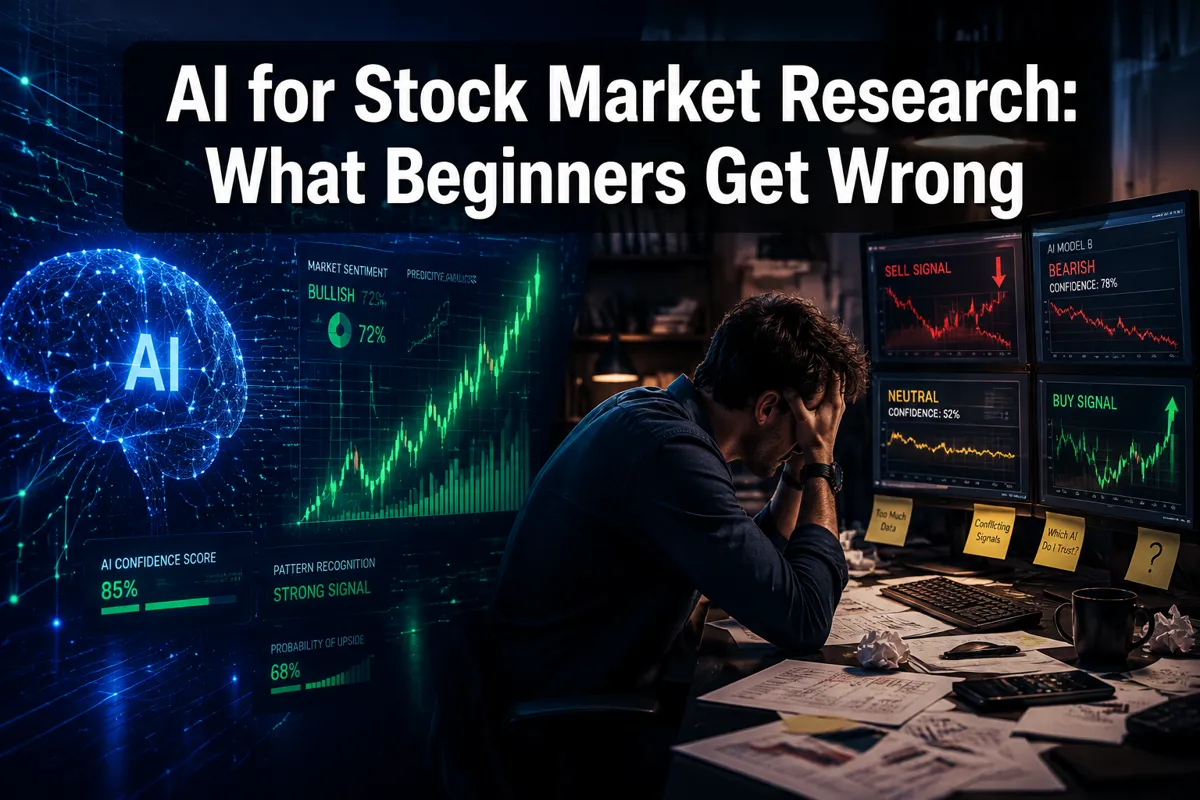
Quick Answer: AI for stock market research is a legitimate edge — but only when you understand what it actually does. Most beginners treat AI tools like a crystal ball that spits out winning trades. They're not. They're pattern-recognition and data-aggregation engines. Use them as a research layer, not a replacement for a trading process. The mistake isn't using AI. It's expecting AI to do the thinking for you.
Key Takeaways
- AI stock market tools process price data, fundamentals, sentiment, and alternative data faster than any human — but they don't predict the future.
- The biggest beginner mistake is treating an AI signal as a trade recommendation rather than a research input.
- No AI tool removes the need for risk management: position sizing, stop losses, and defined entry and exit points are still your job.
- Free AI stock market tools exist and are worth testing before committing to paid subscriptions.
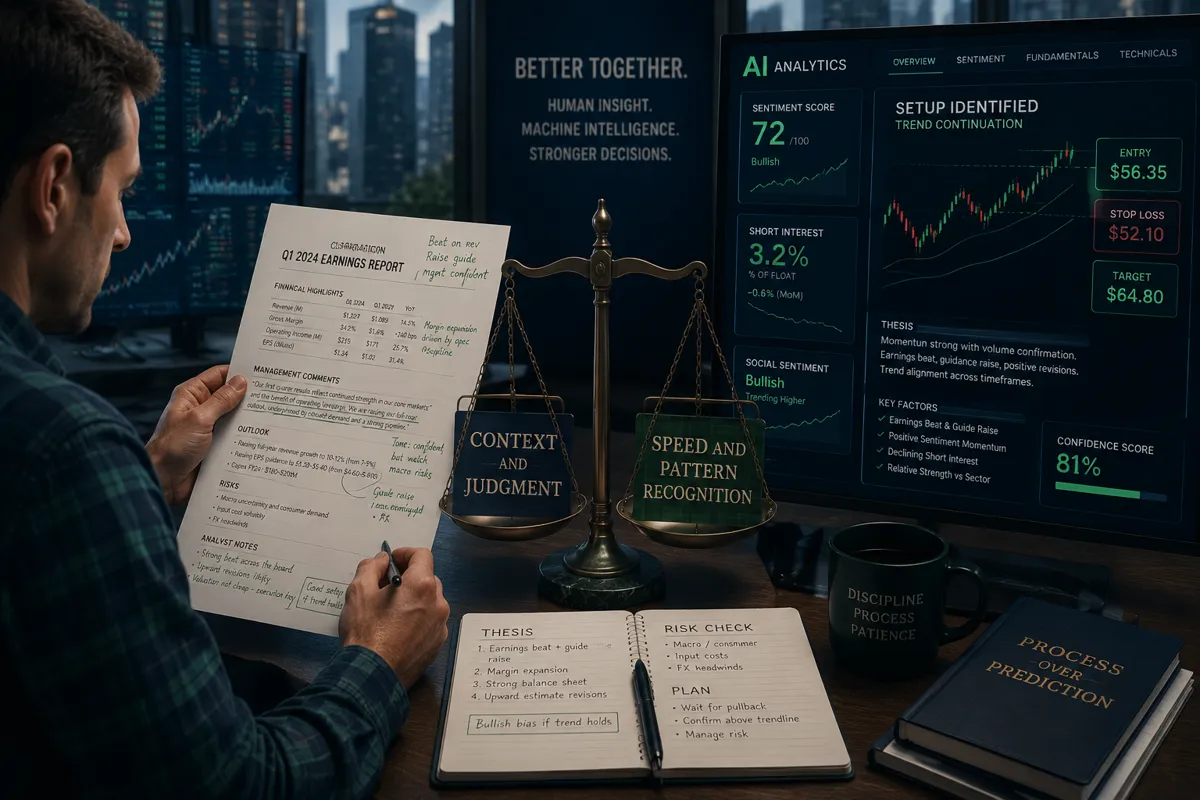
- AI is better than humans at processing volume and speed; humans are better at context, narrative, and judgment calls.
- The best setup combines AI-generated signals with a rules-based trading process you've actually tested.
- Analysis paralysis is real: more AI tools does not mean better decisions.
- Paper trade it first. Always.
What Is AI Stock Market Research and How Does It Work
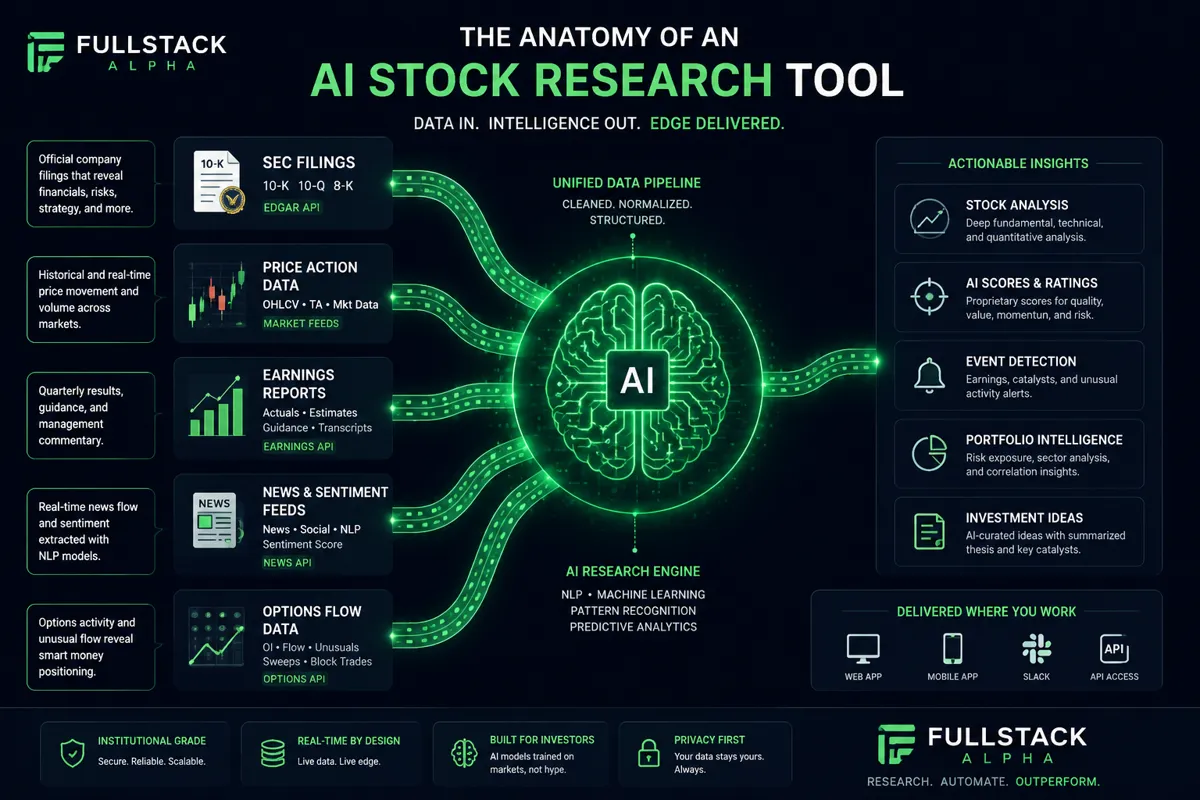
AI for stock market research means using machine learning and data-processing algorithms to analyze financial data at a scale no human team can match. In plain English: the AI ingests thousands of data points — price action, volume, earnings history, news sentiment, options flow, short interest — and surfaces patterns or scores that help you decide what to research further.
Here's what's actually happening under the hood:
- Pattern recognition: The model scans historical price charts and flags setups that have historically preceded certain outcomes (breakouts, reversals, consolidation periods).
- Sentiment analysis: Natural language processing reads news headlines, SEC filings, and earnings call transcripts to score bullish or bearish tone.
- Scoring and ranking: Tools like Danelfin assign every S&P 500 stock an AI Score from 1 to 10 based on hundreds of technical and fundamental signals — beginner-friendly because it collapses complexity into a single number.
- Alternative data: Platforms like AltIndex pull in non-traditional signals — app downloads, web traffic, satellite imagery of parking lots — that don't show up in a standard earnings report.
What AI for stock market analysis does NOT do: it doesn't know what the Fed will say on Thursday, it can't price in a CEO scandal that hasn't broken yet, and it has zero ability to account for black swan events. That wasn't in anyone's bingo card when these models were trained.
AI for Stock Market Research: What Beginners Get Wrong Most Often
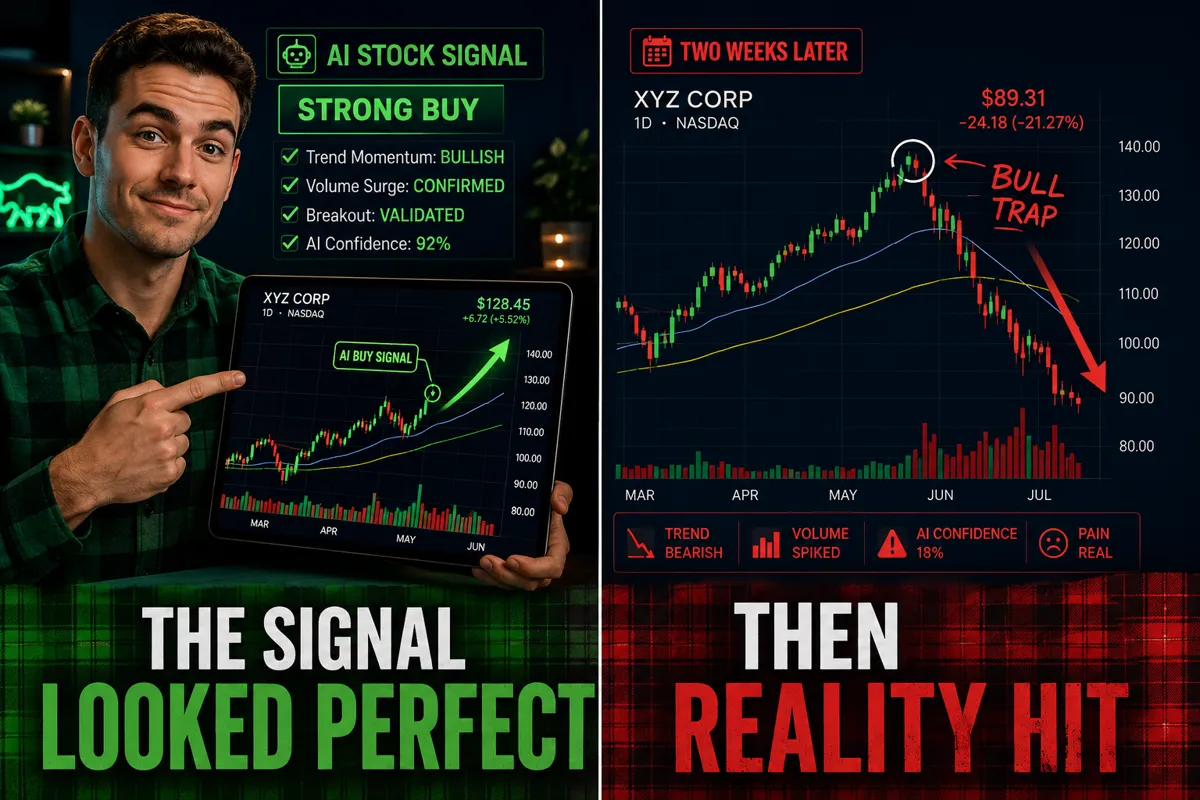
The core mistake is this: beginners confuse a signal with a trade. An AI stock market signal tells you something interesting is happening. It does not tell you whether to buy, how much to risk, or when to exit.
Here are the five most common errors, in order of how expensive they get:
1. Treating AI output as a recommendation, not a research layer.
An AI score of 9/10 means the model sees favorable conditions based on historical data. It does not mean the stock goes up. Markets are forward-looking; AI is backward-trained.
2. Skipping risk management entirely.
No stop loss. No position sizing. No defined exit. Play stupid games, win stupid prizes. The AI found the setup; you still have to manage the trade.
3. Subscribing to six tools and using none of them well.
This is analysis paralysis dressed up as due diligence. Three tools you understand beat ten tools you don't. Cut the noise, keep the alpha.
4. Ignoring the choppy tape.
AI signals work better in trending markets. In a choppy, low-conviction tape, even clean setups fail at higher rates. The tool doesn't know the macro environment the way a human reading the tape does.
5. Expecting AI stock market prediction to be precise.
AI surfaces probabilities, not certainties. A model that's right 60% of the time is genuinely useful — if your risk-reward on each trade is at least 1:2. Most beginners don't do that math.
Can AI Predict Stock Prices Accurately
No AI can reliably predict exact stock prices. What AI can do is identify conditions that have historically been associated with certain outcomes — and do it faster and at greater scale than a human analyst.
The honest benchmark: academic research on quantitative models consistently shows that even sophisticated institutional models struggle to beat a simple index fund over a 10-year period on a risk-adjusted basis. AI stock market prediction improves your research process; it doesn't guarantee outcomes.
What this means practically:
- Use AI to narrow your watchlist, not to pick a guaranteed winner.
- Combine AI signals with your own read on price action and market conditions.
- Discipline beats prediction every time. A consistent process with defined risk-reward beats chasing the "best" AI signal.
Best AI Tools for Stock Market Analysis: A Beginner's Starting Point
The best AI stock market tools for beginners are the ones that explain what they're seeing in plain English and don't require a quant background to interpret.
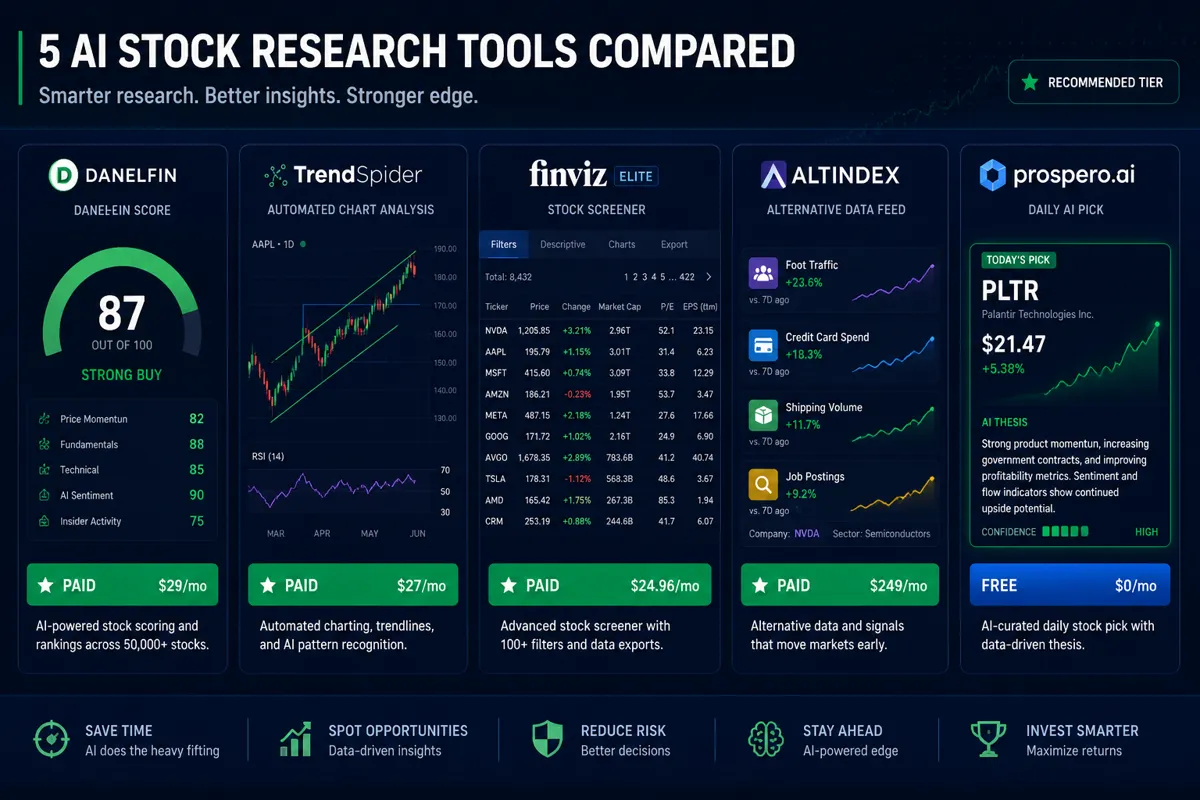
| Tool | What It Does | Best For | Cost Range |
|---|---|---|---|
| Danelfin | AI Score 1–10 per stock, plain-English signal breakdown | Total beginners | Free tier available |
| TrendSpider | Automated chart analysis, draws trendlines for you | Removing manual charting guesswork | Paid |
| Finviz Elite | Fast screener, widely used as a starting research layer | Building a watchlist quickly | ~$40/month |
| AltIndex | Alternative data signals most beginners don't know to look for | Finding early-stage fundamental shifts | Paid |
| Prospero.ai | Daily AI picks with plain-English signal explanations | Beginners who want context, not just a ticker | Paid |
For a broader comparison of 100+ AI stock market tools, the AI stock research tools directory breaks them down by use case, price, and skill level. If you want to test before you spend, there's also a set of free AI stock market tools worth running through first.
For swing traders specifically, the swing trading tool breakdown covers which AI platforms actually fit a multi-day holding strategy versus tools built for day trading.
What Data Do AI Stock Tools Actually Use
AI stock market tools pull from a wider data set than most beginners realize. Understanding the inputs helps you judge whether the output is trustworthy.
Standard data inputs:
- Historical price and volume (OHLCV data)
- Earnings reports, revenue, and margin trends
- Analyst ratings and price target revisions
- Options flow — large unusual options activity can signal institutional positioning
- Short interest data (how many shares are sold short as a percentage of float)
Alternative data inputs (where AI gets interesting):
- News and social media sentiment scores
- SEC filing language analysis (is management hedging more than usual?)
- Web traffic and app download trends
- Insider buying and selling patterns
- Congressional trading disclosures (yes, that's a real data feed)
Tools like Quiver Quantitative and Unusual Whales specialize in this alternative data layer. It's the kind of signal most retail investors don't know to look for — which is exactly why it can add genuine edge when used correctly.
Is AI Better Than Human Stock Analysis
AI beats humans on speed, volume, and consistency. Humans beat AI on context, narrative judgment, and reading the room.
Here's the honest breakdown:
Where AI wins:
- Scanning 5,000 stocks for a specific setup in under a second
- Processing earnings transcripts for sentiment shifts without fatigue
- Applying the same rules consistently without emotional bias
- Catching support and resistance levels across multiple timeframes simultaneously
Where humans win:
- Knowing that a "clean setup" in a sector under regulatory scrutiny carries different risk
- Reading macro context — Fed policy, credit conditions, geopolitical risk
- Recognizing when the market is in a bull trap versus a genuine breakout
- Adjusting position sizing based on conviction, not just a score
The best answer for retail investors: use AI for stock market analysis as the research layer, and use your own judgment for the final risk decision. Systems over hacks. Process over prediction.
Professional investors absolutely use AI. Hedge funds, prop desks, and even large RIAs have integrated machine learning into their research workflows. The difference is they also have risk management teams, compliance oversight, and decades of market history to contextualize the output. Retail traders using AI alone, without a process, are just adding a faster way to make the same mistakes.
How to Know If an AI Stock Prediction Is Trustworthy
A trustworthy AI stock market signal has three characteristics: it's transparent about its inputs, it shows historical accuracy data, and it doesn't promise specific returns.
Red flags to watch for:
- No explanation of what data the model uses
- Backtested returns that look suspiciously perfect (overfitting is real)
- No mention of drawdowns or losing periods
- Marketing language promising "guaranteed" or "consistent" profits
Green flags:
- Clear methodology documentation
- Win rate AND average risk-reward shown together (a 70% win rate with 1:0.5 risk-reward loses money)
- A track record across different market conditions, not just a bull market
- Plain-English explanation of why the signal triggered
Before trusting any AI stock market tool with real capital, paper trade it first. Run the signals through a simulated account for 30 days. If the edge doesn't show up in paper trading, it won't show up with real money — and it'll feel a lot worse when it doesn't.
What Are the Limitations of AI in Stock Market Research
AI for stock market research has real, structural limitations that no amount of compute power fixes.
The core limitations:
- Trained on the past, deployed in the present. Every AI model learns from historical data. When market structure changes — new Fed policy, a sector rotation, a liquidity crisis — the model's historical patterns may not apply.
- No causal reasoning. AI finds correlations. It doesn't understand why a pattern exists. When the correlation breaks, the model keeps firing the same signal.
- Garbage in, garbage out. If the underlying data has errors, survivorship bias, or gaps, the AI output inherits those problems.
- Crowded signals. When thousands of retail traders use the same AI tool, the signal gets priced in faster. Edge decays.
- Overextended markets fool AI too. A stock that's technically overextended but keeps running because of momentum will confuse models trained on mean-reversion patterns.
The free stock health scorecard is a useful sanity check to run alongside any AI signal — it surfaces fundamental red flags that pure price-action models miss.
How Much Does AI Stock Research Software Cost in 2026
Free AI stock market tools exist and are worth starting with. Paid tools range from about $20 to $200+ per month depending on data depth and feature set.
Rough cost tiers for 2026:
- Free: Danelfin (basic tier), Finviz (standard), Stock Analysis, basic screeners at aistockpickerapps.com/free-tools
- Entry paid ($20–$50/month): Prospero.ai, basic TrendSpider plans, Finviz Elite
- Mid-tier ($50–$150/month): TrendSpider full suite, AltIndex, MarketReader
- Professional ($150+/month): Institutional-grade alternative data feeds, full Quiver Quantitative access
The honest advice: don't pay for a tool you haven't tested in a free or trial version. Most beginners over-invest in subscriptions and under-invest in actually learning how to use one tool well. Pick one. Learn it. Then add a second.
What Beginners Should Know Before Using AI Trading Tools
Before opening any AI stock market tool, get three things straight: your strategy, your risk tolerance, and your time horizon.
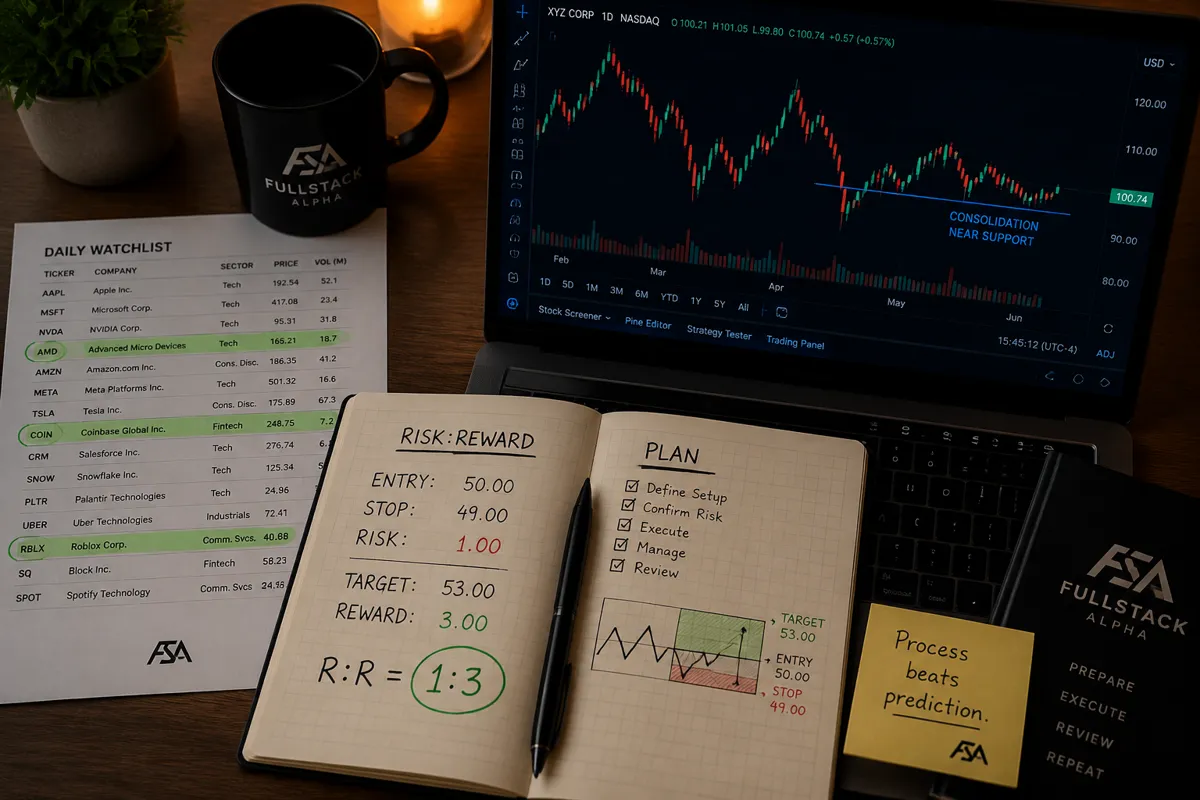
AI for stock market investing works best when it's plugged into a defined process. Without one, you're just collecting signals with no framework for acting on them.
Pre-checklist before using any AI stock tool:
- Define your strategy: swing trading, day trading, long-term investing, or options? Different tools serve different styles. The day trading tools section and the swing trading resources cover this split in detail.
- Know your risk-reward minimum before you enter any trade. If you won't take a setup with at least 1:2 risk-reward, the AI signal is irrelevant.
- Set your position sizing rules in advance. Decide how much of your account goes into any single trade before the AI tells you something looks good.
- Paper trade it first. Thirty days. No exceptions.
- Track your results. A swing trade planner or trade journal forces accountability that most beginners skip.
The FOFO (Fear of Finding Out) is real. Most traders don't track their results because they don't want to see the data. The data is the only thing that separates a system from a guess.
AI Stock Research vs. Traditional Fundamental Analysis
AI for stock market research and traditional fundamental analysis aren't competing approaches — they're complementary layers.
Traditional fundamental analysis asks: is this business worth owning? It looks at revenue growth, profit margins, debt levels, competitive position, and management quality. It's slow, deep, and context-rich.
AI stock market analysis asks: what does the data pattern suggest about near-term price behavior? It's fast, broad, and context-light.
The practical combination:
- Use AI to screen for technically strong setups in your watchlist.
- Use fundamental analysis to filter out the ones with weak business quality or earnings risk.
- Use your own judgment to assess macro context and position sizing.
Tools like Finchat and Stratosphere bridge this gap by layering AI-powered analysis on top of fundamental financial data — useful for investors who want both signals in one place.
How Long Does It Take to Learn AI Stock Market Analysis
Expect 60 to 90 days to get competent with one AI stock tool if you're using it consistently. Expect 6 to 12 months before you can honestly say you've integrated AI signals into a repeatable trading process.
The learning curve isn't the technology — most modern AI stock market tools are designed to be accessible. The real learning curve is understanding when to trust the signal and when to override it. That judgment only comes from screen time and a trade journal.
Shortcuts that actually work:
- Start with one tool, not five.
- Use the free screener tools to build pattern recognition before adding AI signals on top.
- Run the expectancy calculator on your paper trades to see if your process has positive expected value before risking real capital.
FAQ: AI for Stock Market Research
Can AI replace a financial advisor for stock research?
No. AI tools surface data patterns and signals. A financial advisor provides personalized planning, tax context, and behavioral coaching. They serve different functions. For research and screening, AI is useful. For comprehensive financial planning, it isn't a substitute.
Is AI for stock market research legal for retail investors?
Yes. Using AI tools to research and analyze stocks is entirely legal for retail investors. The same rules that apply to any investment activity apply here — no insider trading, no market manipulation. FINRA and the SEC regulate conduct, not the tools you use to research.
What's the difference between an AI stock screener and an AI trading bot?
A screener surfaces stocks that meet certain criteria. You still make the decision. A trading bot executes trades automatically based on rules or signals. Screeners are research tools; bots are execution tools. Beginners should start with screeners. If you're curious about bots, the trading bots overview covers the risk profile honestly.
Do AI stock market signals work in bear markets?
Less reliably. Most AI models are trained on data sets that include more bull market periods than bear markets, simply because bull markets last longer historically. In a sustained downtrend, signals that worked in an uptrend will generate false positives. Adjust your skepticism accordingly.
How is AI stock market research different from algorithmic trading?
AI research tools help you decide what to trade. Algorithmic trading automates the execution of a pre-defined strategy. They can overlap — some platforms do both — but they're distinct functions.
What's the best free AI stock market tool for a complete beginner?
Danelfin's free tier is a solid starting point. It assigns a plain-English AI Score to S&P 500 stocks without requiring any technical background to interpret. Pair it with Finviz's free screener to build a watchlist, and you have a functional research layer at zero cost.
Can AI catch a dead cat bounce before it happens?
Sometimes. AI models can flag when a stock is technically overextended to the downside and bouncing on low volume — a pattern consistent with a dead cat bounce rather than a genuine reversal. But no model catches it every time. Catching a falling knife is dangerous with or without AI.
Should I use AI signals during earnings season?
With extra caution. Earnings season introduces binary risk — a stock can gap up or down 15% overnight regardless of what the AI signal said the day before. AI for stock market research works best on the setup going into earnings, not as a predictor of the earnings result itself.
Conclusion: Build the Process, Then Add the AI
AI for stock market research is a real edge when it's the layer on top of a real process. It's noise when it substitutes for one.
The traders who get burned aren't using bad tools. They're using good tools without a framework. No stop loss. No defined risk-reward. No trade journal. No accountability. The AI found the setup; they just didn't know what to do with it.
Here's what to do this week:
- Pick one AI stock market tool from the free tier and spend two weeks learning it before adding anything else.
- Define your minimum risk-reward ratio before you look at a single signal.
- Paper trade every AI-generated signal for 30 days and track the results in a journal.
- Run your paper trade results through the expectancy calculator to see if your process has a positive edge.
- Then, and only then, size into real positions — small, with a stop loss defined before entry.
Signal over noise. Process over prediction. Discipline beats prediction every single time.
FullStack Alpha cuts the noise so you can keep the alpha. Browse the AI tools, screeners, and systems we actually rate at aistockpickerapps.com.