The AI Stock Market Apps Taking Over Traders' Phones in 2026...
Last updated: June 17, 2026
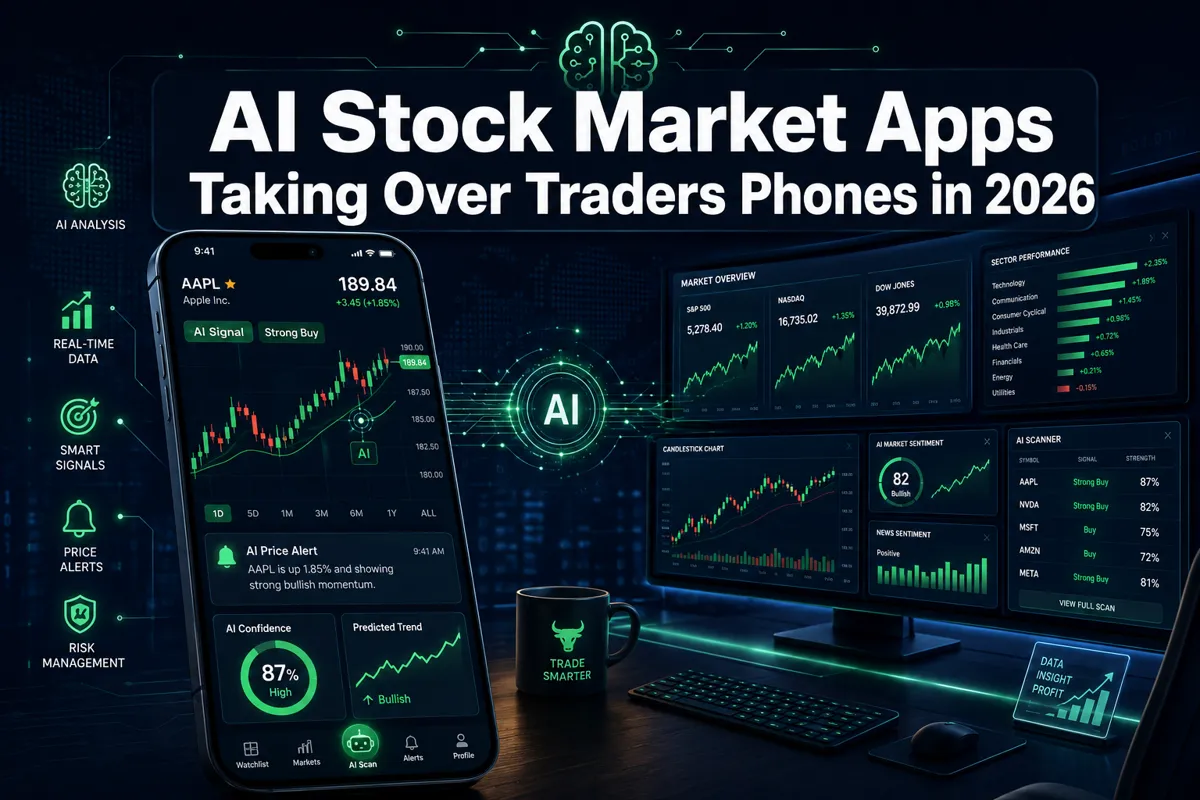
Quick Answer: AI stock market apps are mobile and desktop platforms that use machine learning, natural language processing, and real-time data feeds to scan markets, generate trade signals, and surface actionable setups. In 2026, the best ones go well beyond basic charting — they filter noise, score stocks algorithmically, and deliver alerts before most retail traders even open their laptops. They don't replace your judgment, but they do compress hours of research into minutes.
Key Takeaways
- AI stock market apps process price action, options flow, news sentiment, and fundamentals simultaneously — something no human scanner can match at speed.
- The best ai stock market apps in 2026 range from free tiers (Magnifi, basic Tickeron) to professional-grade subscriptions running $100-$300/month.
- These apps are legal and operate within SEC and FINRA frameworks — they provide analysis, not licensed financial advice.
- Accuracy claims are marketing. No app predicts markets with certainty. The value is in signal quality and risk-reward filtering, not crystal-ball outputs.
- Beginners benefit most from apps with guided scoring systems. Experienced traders need raw data, scanner customization, and fast alerts.
- The biggest mistake traders make: treating AI signals as orders instead of inputs. Process over prediction — always.
- FOFO (Fear of Finding Out) is real. Most traders avoid reviewing their own trade history. AI apps that force performance tracking are genuinely valuable.
- Paper trade any new AI tool for at least 30 days before risking real capital.
What Exactly Are AI Stock Market Apps and How Do They Work
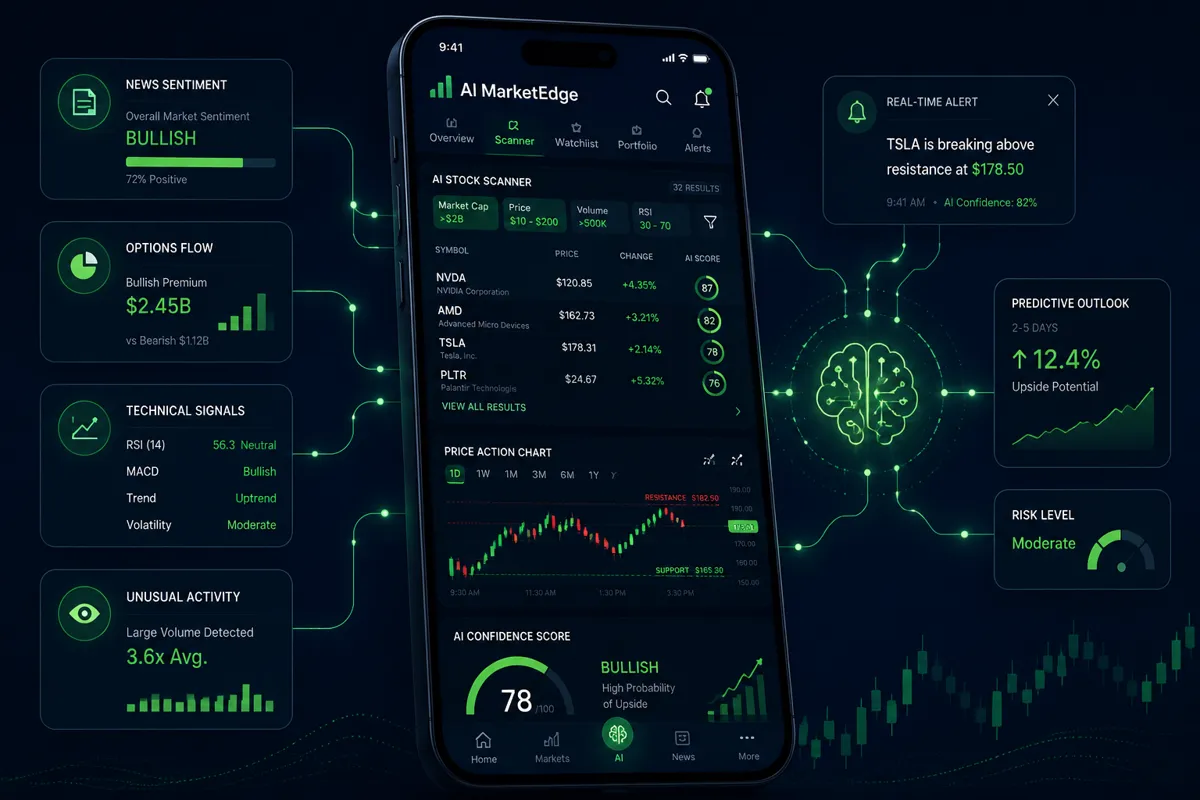
AI stock market apps are software platforms — available on Android, iPhone, and web — that use algorithms and machine learning models to analyze market data and surface trade-relevant information faster than any human could manually. They ingest price action (the raw movement of a stock's price over time), volume, options flow, earnings data, and news sentiment, then run it through predictive models to generate signals, scores, or alerts.
Here's the plain-English version: think of them as a very fast research assistant who never sleeps, never gets emotional, and doesn't care that your last trade lost money.
What they actually do under the hood:
- Scan thousands of stocks simultaneously using pre-set or AI-generated criteria
- Score stocks on technical and fundamental factors using weighted models
- Monitor options flow (large institutional bets that often precede big moves)
- Parse news and earnings transcripts for sentiment shifts
- Generate entry and exit signals based on historical pattern recognition
- Send ai stock market alert notifications when a setup meets defined criteria
What they don't do: guarantee outcomes, eliminate risk, or replace a coherent trading plan. The setup still needs a human with a stop loss and a position sizing strategy behind it.
The AI Stock Market Apps Taking Over Traders' Phones in 2026 — The Real Shortlist
Not every app in the App Store deserves a spot on your watchlist. The ai stock market apps that are actually moving the needle in 2026 share one quality: they cut the noise and surface signal. Here are the names worth knowing.
Tickeron is one of the most feature-complete ai stock market analysis apps available. It combines AI-driven pattern recognition, a stock screener, and a real-time trading robot marketplace. The pattern recognition engine scans for technical setups — flags tight consolidation, basing patterns, and breakout candidates — and attaches a confidence score to each. The full app runs on a subscription model, but there's a free tier to test the interface. See the full Tickeron breakdown here.
Magnifi functions more like an AI mobile assistant for investing than a traditional scanner. You ask it natural language questions — "show me tech ETFs with low expense ratios and strong momentum" — and it surfaces relevant options. It's one of the cleaner ai stock market apps for beginners on iPhone and Android because it doesn't require you to know scanner syntax to get useful results.
Trade Ideas is the professional-grade option. It's built for active day traders who need real-time ai stock market alert apps that fire during power hour (the first and last hour of the trading day, when volume and volatility spike). Its Holly AI generates pre-market trade ideas based on overnight pattern scans. Not cheap, but traders who use it seriously tend to stay.
Other names worth checking: Blackbox Stocks for options flow alerts, Cheddar Flow for unusual options activity, and Zen Ratings for fundamentals-driven stock scoring.
How Much Do These AI Stock Apps Cost Compared to Traditional Brokerages
Free tiers exist, but serious functionality costs money. Here's the honest breakdown for 2026.
| App | Free Tier | Paid Plans (est.) | Best For |
|---|---|---|---|
| Tickeron | Yes (limited) | $30–$200/mo | Pattern recognition, AI robots |
| Magnifi | Yes (basic) | $15–$50/mo | Beginners, natural language search |
| Trade Ideas | No | $118–$228/mo | Active day traders, real-time alerts |
| Blackbox Stocks | No | $99/mo | Options flow, momentum traders |
| Zen Ratings | Yes (limited) | $49–$149/mo | Fundamental scoring, swing traders |
Compare that to a traditional full-service brokerage, where you might pay $0 in commissions but get zero analytical edge. The cost of an AI tool isn't the subscription fee — it's whether you're using it consistently enough to justify it.
Decision rule: If you're trading less than five times a month, a free ai stock market apps free tier is enough to start. If you're actively swing trading or day trading, a paid tool that saves two hours of research per week pays for itself fast.
Can AI Stock Apps Really Predict Market Movements Better Than Humans
Straight answer: no app predicts markets reliably. Anyone selling that story is the guru you should be running from.
What AI does better than humans is process volume and speed. A model can scan 8,000 stocks for a specific price action setup in seconds. A human doing the same manually takes hours and introduces emotional bias along the way. That's the real edge — not prediction, but pattern detection at scale.
The honest framing: AI apps improve your probability of finding a clean setup. They don't change the fundamental truth that markets are partially random and that discipline beats prediction every single time.
A stock can have a perfect AI confidence score and still get stopped out because a macro event hits at 2pm. That's not the app failing — that's markets being markets. The question is whether your risk management was tight enough that the loss was small and survivable.
What Are the Risks of Using AI for Stock Trading
Using AI stock market apps without a process is like buying a professional kitchen knife and cutting toward your hand. The tool isn't the problem. The technique is.
The real risks:
- Over-reliance on signals. Treating an AI alert as an order instead of an input. The app flags the setup; you still decide the risk-reward, position sizing, and stop loss.
- Analysis paralysis. Running five AI tools simultaneously and getting contradictory signals. More data isn't always more clarity. Pick one or two tools, learn them deeply.
- Overtrading. AI apps surface a lot of setups. Not every setup deserves a trade. Play stupid games, win stupid prizes — chasing every alert is a fast way to blow up an account.
- Revenge trading. Getting stopped out on an AI-flagged trade and immediately re-entering to "get it back." The app didn't lose your money. Emotion did.
- Ignoring the broader tape. A great setup in a choppy tape (a market with no clear direction, lots of fakeouts) is still a risky trade. AI apps score individual stocks, not always the macro environment.
Use a free expectancy calculator to measure whether any tool — AI or otherwise — is actually improving your trade outcomes over time.
Which AI Trading Apps Are Best for Beginners vs Experienced Investors
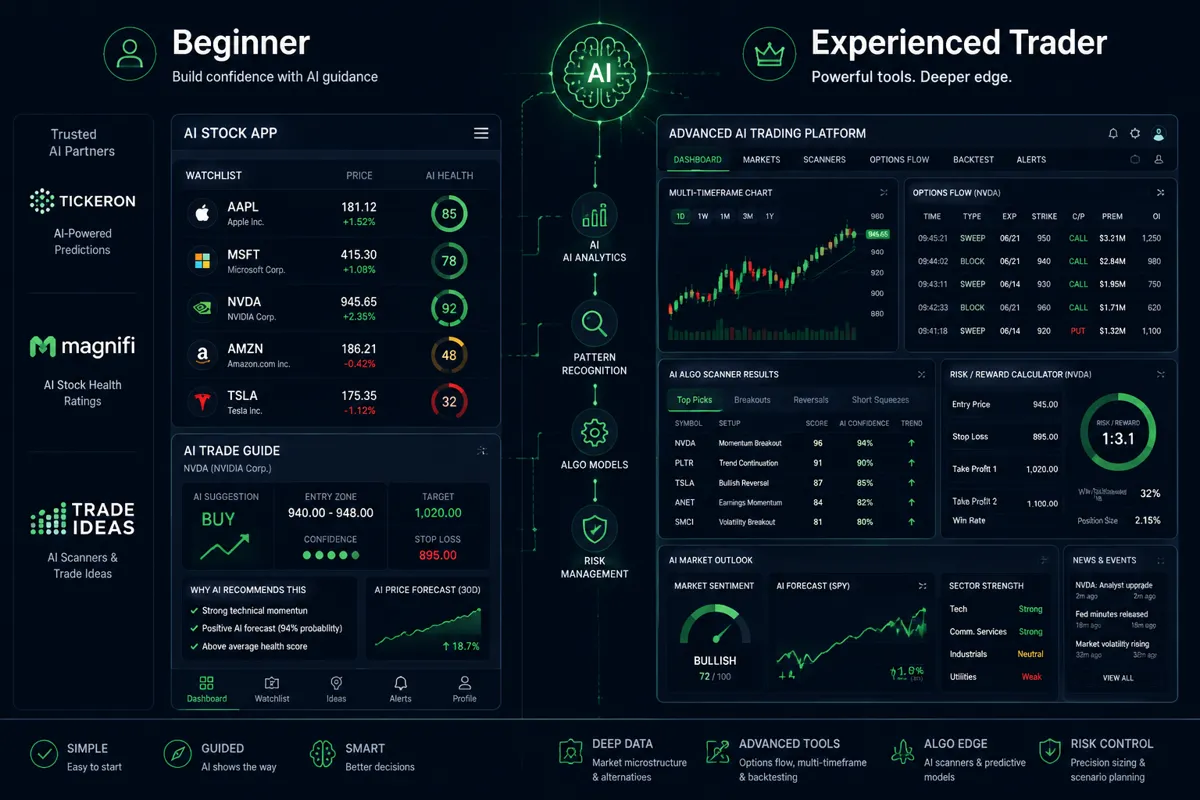
Beginners need guardrails. Experienced traders need raw data. The same app rarely serves both well.
For beginners (ai stock market apps for beginners):
- Magnifi: natural language interface, no scanner syntax required
- Tickeron: AI confidence scores give a structured starting point
- Webull: free, mobile-first, clean charting with basic AI features built in
- Simply Wall St: visual fundamental analysis, good for learning stock health concepts
The key for beginners: paper trade it first. Every one of these platforms has a paper trading mode (simulated trading with fake money). Use it for 30 days before touching real capital.
For experienced traders:
- Trade Ideas: real-time alerts, customizable scanners, Holly AI pre-market setups
- Blackbox Stocks: options flow, dark pool prints, momentum alerts
- Trade Algo: institutional-grade signal flow for active traders
- Scanz: fast real-time scanner for day traders watching low float stocks
The common mistake at both levels: skipping the free tools that help you evaluate whether a tool fits your actual trading style before paying for it.
Are AI Stock Apps Legal and Regulated by the SEC
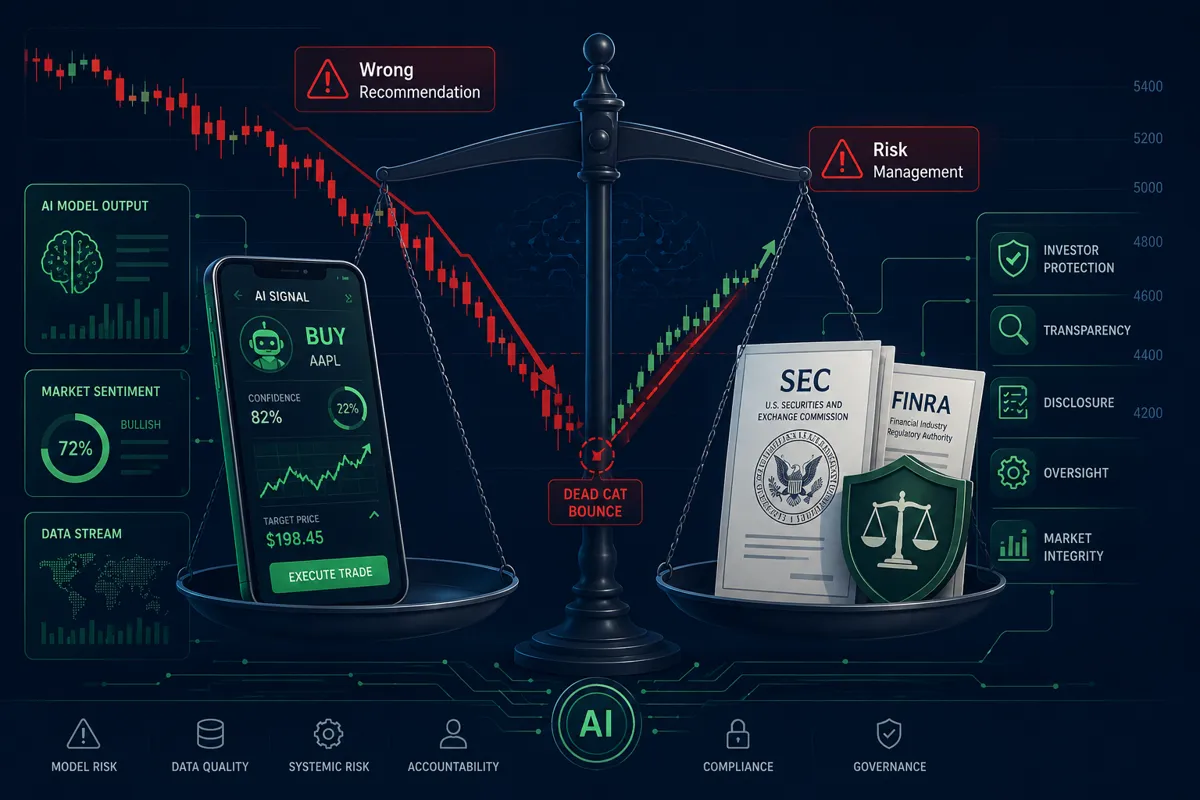
Yes, ai stock market apps are legal. They operate as financial technology platforms providing data, analysis, and algorithmic signals — not as registered investment advisors giving personalized advice.
The important distinction: an app that says "this stock scores 87/100 on our AI model" is providing data. An app that says "buy 100 shares of XYZ for your retirement account" is giving investment advice, which requires SEC registration. Most legitimate AI trading apps stay firmly on the data side of that line.
FINRA and the SEC have increased scrutiny of AI-driven financial tools, particularly around disclosure requirements. Reputable platforms are transparent about what their models do and don't do. If an app doesn't clearly disclose its methodology or makes performance guarantees, that's a red flag. Check FINRA's investor education resources at FINRA.org before handing money to any platform.
What Kind of Data Do These AI Apps Actually Use to Make Predictions
The better the data inputs, the more useful the output. Here's what top ai stock market tracking apps are actually ingesting in 2026:
- Price action and volume: the foundation — candlestick patterns, support and resistance levels, breakout signals, gap fills
- Options flow: large unusual options bets that often signal institutional positioning before a move
- News sentiment: NLP models parsing headlines, earnings call transcripts, and SEC filings for tone shifts
- Earnings data: historical earnings beats/misses, guidance changes, analyst revisions
- Macroeconomic indicators: Fed rate decisions, inflation prints, sector rotation signals
- Social sentiment: some apps monitor Reddit, Twitter/X, and StockTwits for retail momentum shifts (treat this one with appropriate skepticism)
- Dark pool prints: large off-exchange block trades that suggest institutional accumulation or distribution
The apps that combine multiple data types — not just price action — tend to produce more robust signals. A stock breaking out on price alone is interesting. A stock breaking out on price, with unusual call options activity and positive earnings revision, is a cleaner setup.
Can I Trust AI Stock Apps With My Personal Investment Strategy
Trust is earned through consistency, not marketing copy. The honest answer: use AI apps as one input in a larger process, not as the whole process.
Your personal investment strategy should define your risk tolerance, position sizing rules, and entry/exit criteria. AI apps help you find candidates that fit that strategy faster. They don't replace the strategy itself.
A practical framework:
- Define your setup criteria before opening any AI tool
- Use the app to scan for stocks that meet those criteria
- Manually review the top candidates — check the chart, the fundamentals, the sector context
- Size the position based on your own risk-reward calculation, not the app's confidence score
- Set a stop loss before entering. Always.
This is systems over hacks in practice. The AI is a filter, not a decision-maker.
What Happens If an AI Stock App Makes a Wrong Recommendation
It will. Plan for it now.
No AI model has a 100% win rate. The question isn't whether the app will be wrong — it's whether your risk management is tight enough that wrong recommendations don't crater your account.
If you're using proper position sizing (risking no more than 1-2% of your account on any single trade) and you have a stop loss in place, a wrong AI recommendation is a small, manageable loss. If you're sizing up because the AI gave it a high confidence score and you have no stop loss, a wrong recommendation becomes a portfolio event.
The app doesn't owe you anything. The market doesn't owe you anything. Your job is to manage the downside so you're still in the game when the good setups show up.
Do I Need Technical Knowledge to Use AI Trading Apps
For most modern ai stock market apps on Android and iPhone, no. The best platforms in 2026 are designed for self-directed investors who understand basic market concepts but don't need to code or configure algorithms.
That said, the more you understand what the app is actually measuring, the better you'll use it. If an app flags a "breakout from tight consolidation," knowing what that means (a stock that has traded in a narrow range and is now moving decisively above that range on volume) helps you evaluate whether it's a real setup or a bull trap (a false breakout that reverses quickly).
You don't need to be a quant. But you do need to understand the basics of price action, support and resistance, and risk management to use any AI tool responsibly. Browse the full comparison of 100+ AI stock tools to find platforms matched to your current skill level.
How Are AI Stock Apps Different From Traditional Robo-Advisors
Traditional robo-advisors (think early Betterment or Wealthfront) are passive portfolio managers. They allocate your money across diversified ETFs based on your risk profile and rebalance automatically. They're built for long-term, hands-off investors.
AI stock market apps are active trading tools. They're built for people who want to make their own decisions — faster and with better data. The key differences:
| Feature | Robo-Advisor | AI Stock Market App |
|---|---|---|
| User control | Low (automated) | High (user-directed) |
| Trading frequency | Infrequent rebalancing | Daily/weekly signals |
| Asset focus | ETFs, bonds | Individual stocks, options |
| Cost | 0.25%–0.50% AUM | Flat subscription |
| Best for | Passive investors | Active traders |
If you want to set it and forget it, a robo-advisor is the right tool. If you want to actively manage your own trades with AI-powered research, that's what this article is about.
What Are the Most Common Mistakes People Make With AI Stock Trading Apps
The mistakes are predictable. That doesn't make them any less expensive.
Mistake 1: Skipping the paper trading phase. Every experienced trader who's burned money on a new tool wishes they'd paper traded it first. Thirty days of simulated trading costs nothing and reveals whether the signals actually fit your style.
Mistake 2: Using too many apps at once. Three AI tools giving three different signals creates analysis paralysis, not clarity. Pick one primary tool, learn it deeply, then add a second only if there's a specific gap to fill.
Mistake 3: Ignoring the broader market context. An AI app might flag a perfect technical setup, but if the overall market is in a downtrend, most stocks go down regardless. Always check the macro tape before acting on individual signals.
Mistake 4: Treating confidence scores as certainty. An 85% AI confidence score means the historical pattern has resolved bullishly 85% of the time under similar conditions. It does not mean this specific trade will work. Risk management still applies.
Mistake 5: Revenge trading after a bad signal. Getting stopped out on an AI-flagged trade and immediately looking for another trade to "make it back" is revenge trading — one of the fastest ways to turn a small loss into a large one. Cut losers fast. Walk away. Come back tomorrow.
Conclusion: Build the Process, Then Use the Tools
The AI stock market apps taking over traders' phones in 2026 are genuinely useful — but only if you already have a process they can plug into. The best app in the world won't save a trader who sizes too big, skips stop losses, and chases every alert that fires.
Here's what to do this week:
- Pick one app from the shortlist above that matches your experience level. Start with a free tier or trial.
- Paper trade for 30 days. Track every signal the app generates and how it resolves. Build an honest record.
- Define your setup criteria before the app opens. Know what you're looking for so you're filtering signals, not just following them.
- Run your trades through a free swing trade planner to stress-test your risk-reward before entering.
- Review weekly. FOFO is real — most traders avoid looking at their own numbers. Don't be that trader.
Signal over noise. Process over prediction. That's the edge that compounds.
FullStack Alpha cuts the noise so you can keep the alpha. See the AI tools, scanners, and systems we actually rate at aistockpickerapp.com.
FAQ
What are the best free AI stock market apps in 2026?
Magnifi, Tickeron's free tier, and Webull offer no-cost entry points with AI-assisted features. Free tiers are limited but sufficient for learning how AI signals work before committing to a paid plan.
Are AI stock market apps available on both Android and iPhone?
Yes. All major ai stock market apps — including Tickeron, Magnifi, and Webull — have apps on both Android and iOS. Most also offer full web platforms for desktop use.
How accurate are AI stock market apps?
Accuracy varies by tool and market condition. No app is consistently accurate across all market environments. The value is in filtering setups with favorable risk-reward, not in predicting outcomes with certainty.
Can beginners use AI stock market apps safely?
Yes, with guardrails. Beginners should start with apps that have guided interfaces (Magnifi, Tickeron), use paper trading before real money, and keep position sizes small while learning.
Do AI stock market apps work for options trading?
Some do. Blackbox Stocks and Cheddar Flow are specifically built around options flow data. General AI stock apps like Tickeron cover options to varying degrees. Check the specific tool's feature set.
Is my personal data safe with AI trading apps?
Reputable platforms use standard financial-grade encryption and comply with applicable data privacy regulations. Always review the privacy policy and avoid apps that request unnecessary permissions.
What's the difference between an AI stock app and a stock screener?
A traditional screener filters stocks based on criteria you set manually. An AI stock app uses machine learning to identify patterns, score stocks dynamically, and generate signals without requiring you to define every parameter.
How do I know if an AI trading app is legitimate?
Check for clear methodology disclosure, no guaranteed return promises, transparent pricing, and verifiable company information. Cross-reference with FINRA's BrokerCheck and SEC.gov for any registered entities.
Can AI stock apps replace a financial advisor?
No. AI apps provide data and analysis tools for self-directed traders. They don't provide personalized financial planning, tax advice, or fiduciary guidance. For comprehensive financial planning, a registered advisor is appropriate.
What's the fastest way to evaluate a new AI stock app?
Use the free trial, paper trade for two to four weeks, and track signal accuracy in a simple spreadsheet. Compare the win rate and average risk-reward of signals against your existing process before paying.