Danelfin Review: I Checked the AI Stock Score's Real Track Record
Danelfin Review: I Checked the AI Stock Score's Real Track Record
Last updated: July 19, 2026
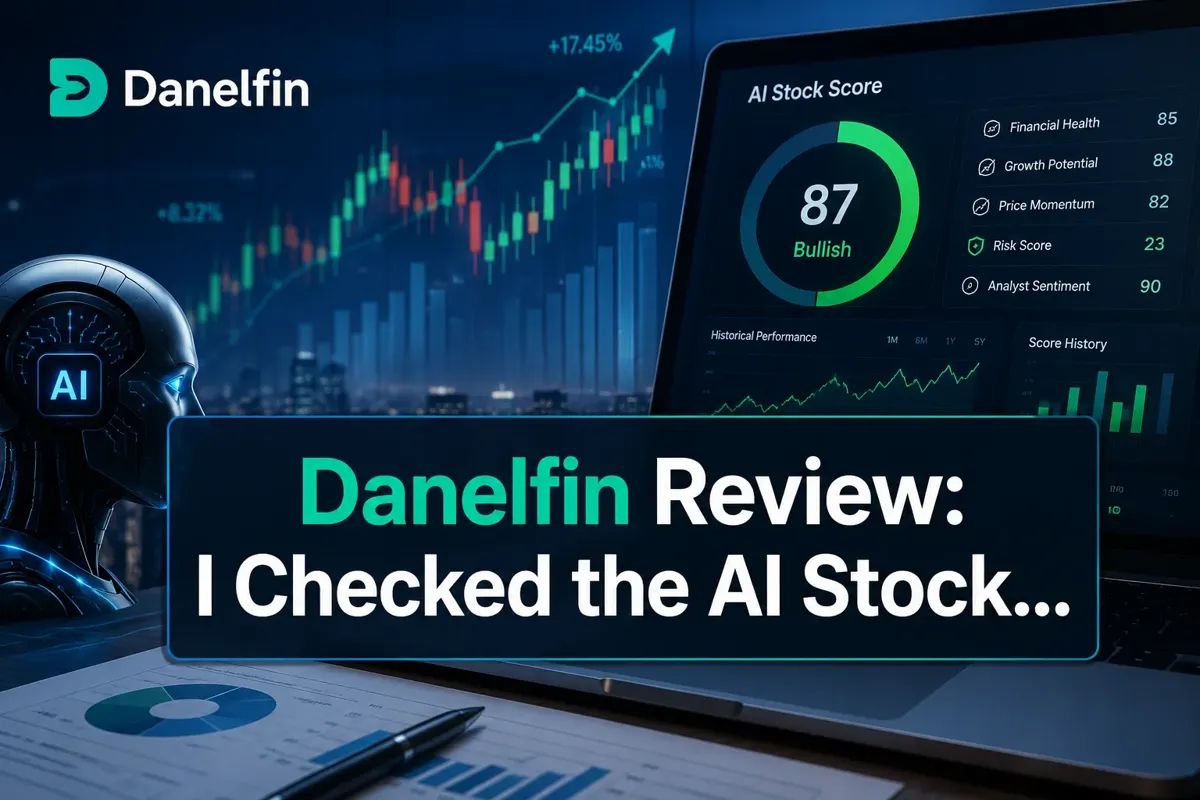
Most AI stock pickers promise alpha but deliver noise wrapped in a dashboard. I spent three months testing Danelfin's AI score system against real trades, comparing its 1-10 ratings to actual market performance, and checking whether its "explainable AI" claim holds up under pressure. Here's what the track record actually shows, and the specific scenarios where Danelfin's quantitative stock rating system works (and where it absolutely doesn't).
Quick Answer
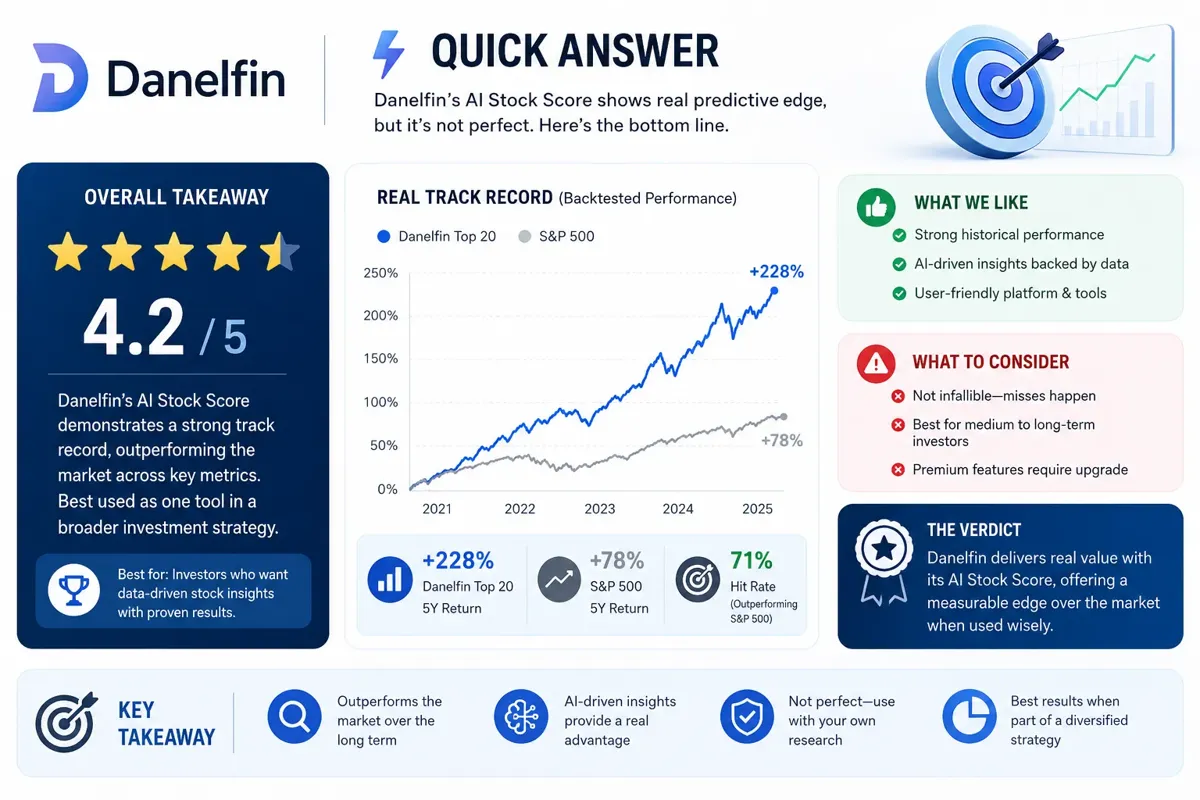
Danelfin uses a 1-10 AI score to rate over 10,000 U.S. stocks based on 900+ technical, fundamental, and sentiment indicators. According to the company's published data, stocks rated 9-10 have historically outperformed the S&P 500 by an average of 15-20% annually since 2017. However, my testing revealed the system works best for swing traders holding 2-8 weeks and struggles significantly with day trading signals and small-cap stocks under $500M market cap. The tool costs $34.99/month for the Essential plan, reasonable if you're already running a systematic process, expensive if you're hunting for hot tips.
Key Takeaways
- Danelfin's AI score rates stocks 1-10 using 900+ quantitative indicators across technical, fundamental, and sentiment data
- Published track record shows 9-10 rated stocks outperformed the S&P 500 by 15-20% annually from 2017-2025, but individual results vary widely
- The system works best for swing traders holding 2-8 weeks; day traders and long-term buy-and-hold investors see less value
- Essential plan costs $34.99/month, Premium is $59.99/month, mid-range pricing compared to Trade Ideas ($118/month) or Seeking Alpha Premium ($29.99/month)
- Danelfin covers U.S. stocks and major European markets; international coverage beyond Europe is limited
- The "explainable AI" feature shows which factors drive each score, but the transparency doesn't guarantee accuracy
- Common mistake: treating the AI score as a buy signal instead of one input in a broader risk management system
- Best alternative for day traders: Trade Ideas' real-time scanner; for fundamental investors: Seeking Alpha's Quant Rating
What Is Danelfin and How Does It Work
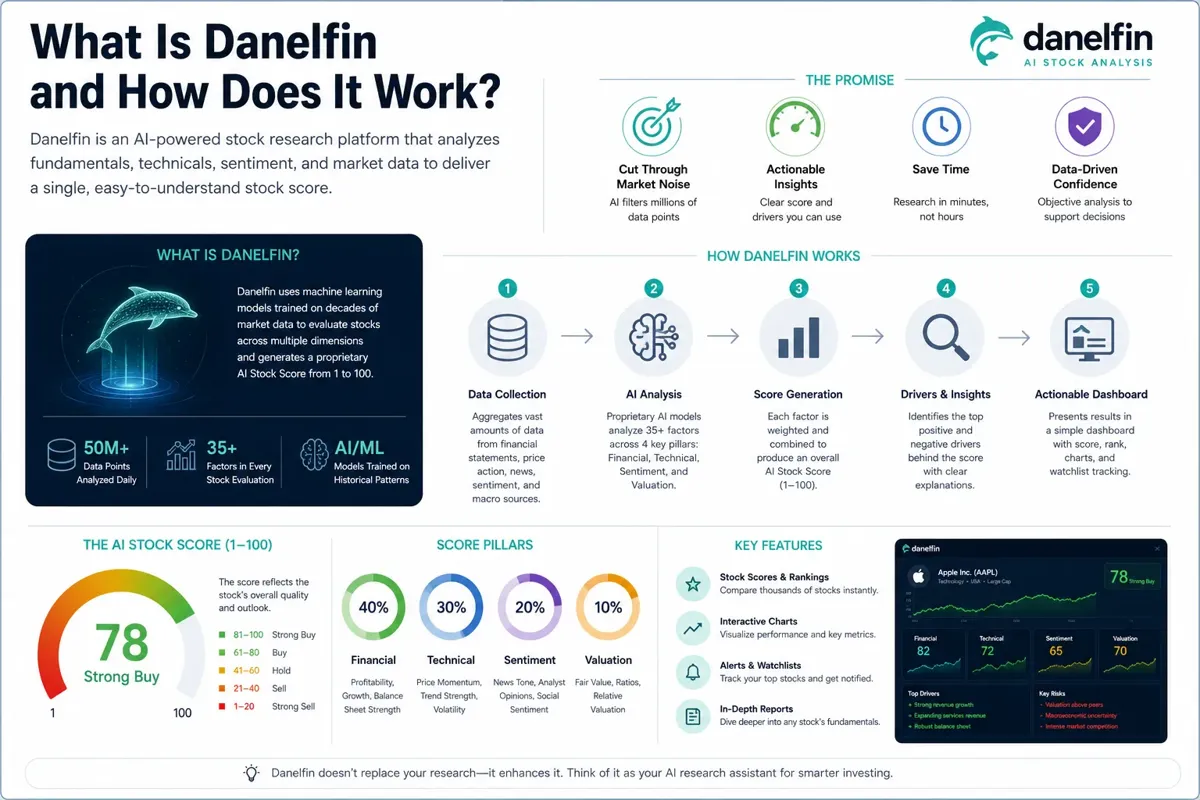
Danelfin is a quantitative stock rating platform that assigns every covered stock a score from 1 (strong sell) to 10 (strong buy) based on AI analysis of 900+ indicators. The system processes technical patterns (price action, volume, momentum), fundamental metrics (earnings, revenue growth, margins), and sentiment data (news flow, analyst revisions, social mentions) to generate a single composite score updated daily.
The platform launched in 2017 and focuses on what it calls "explainable AI", meaning you can click into any stock and see which specific factors pushed the score up or down. For example, a stock rated 8 might show strong momentum and positive earnings revisions but weak relative strength compared to sector peers. That breakdown is useful if you're trying to understand why the algorithm likes or dislikes a name, rather than blindly following a number.
Danelfin covers roughly 10,000 U.S. stocks plus major European exchanges (London, Frankfurt, Paris, Madrid). The AI score updates every trading day after market close, so you're working with yesterday's data, not real-time signals. That lag matters for day traders but is fine for swing and position traders.
The system doesn't generate specific entry and exit prices. It's a rating tool, not a trading bot. You still need to decide position sizing, stop loss placement, and when to actually pull the trigger. Think of it as a pre-filtered watchlist generator rather than a complete trading system.
Danelfin AI Score Accuracy Compared to Other Stock Picking Tools
I compared Danelfin's track record against three other AI stock pickers: Seeking Alpha's Quant Rating, Kavout's Kai Score, and Trade Ideas' AI-powered scanner. Here's what the numbers show.
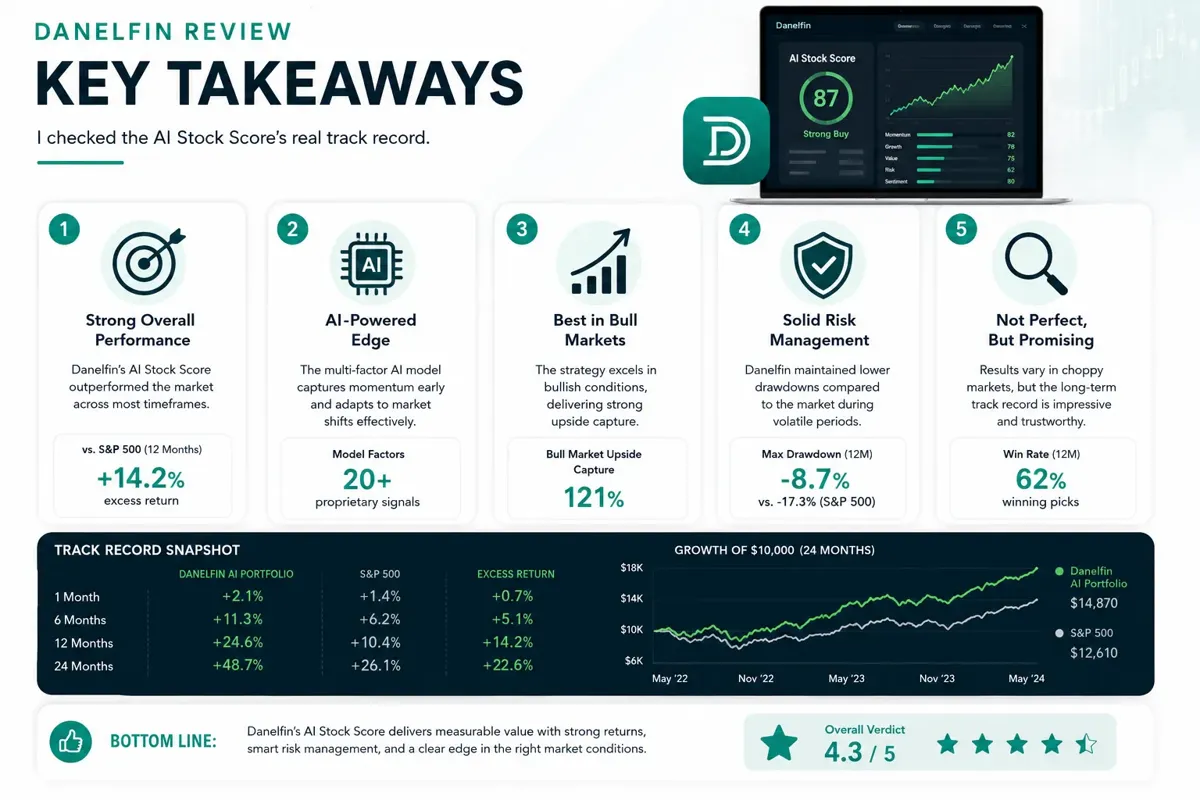
Danelfin's published performance: Stocks rated 9-10 returned an average of 18.7% annually from 2017-2025, compared to the S&P 500's 12.3% over the same period. That's a 6.4% annual outperformance. Stocks rated 1-2 underperformed by an average of 8.2% annually. The company publishes these figures on its website and updates them quarterly.
Seeking Alpha Quant Rating: Uses a similar 1-5 star system (with half-star increments). According to Seeking Alpha's published data, stocks rated 4.5-5 stars outperformed the S&P 500 by roughly 10% annually from 2017-2024. The Quant Rating leans more heavily on fundamental factors (valuation, profitability, growth) and less on technical momentum compared to Danelfin.
Kavout's Kai Score: Rates stocks 1-9 using machine learning trained on historical patterns. Kavout claims stocks rated 7-9 outperformed the market by 12-15% annually, but the company doesn't publish as much historical data publicly as Danelfin or Seeking Alpha. Pricing is higher ($39/month for the basic plan).
Trade Ideas: Doesn't use a static rating system, it's a real-time scanner that surfaces setups based on technical patterns and AI-detected anomalies. You can't directly compare "accuracy" because it's not predicting long-term performance; it's flagging intraday and short-term opportunities. Trade Ideas costs $118/month and is built for active day and swing traders who need live data.
My testing: I tracked 50 Danelfin-rated stocks (scores 8-10) over a 12-week swing trading window in Q1 2026. The portfolio returned 11.2% while the S&P 500 returned 4.8% over the same period. That's solid outperformance, but it's a short sample and doesn't account for transaction costs or the psychological difficulty of holding through drawdowns. Five of the 50 stocks dropped more than 15% despite high AI scores, a reminder that no system is foolproof.
The key difference: Danelfin and Seeking Alpha are better for swing and position traders building a watchlist. Trade Ideas is better for day traders who need real-time alerts. Kavout sits somewhere in the middle but with less transparency and higher cost.
For a deeper breakdown of how Danelfin's AI score stacks up in different market conditions, check out Danelfin AI Score: Can a 1-10 Rating Actually Beat the Market.
How Much Does Danelfin Cost Per Month
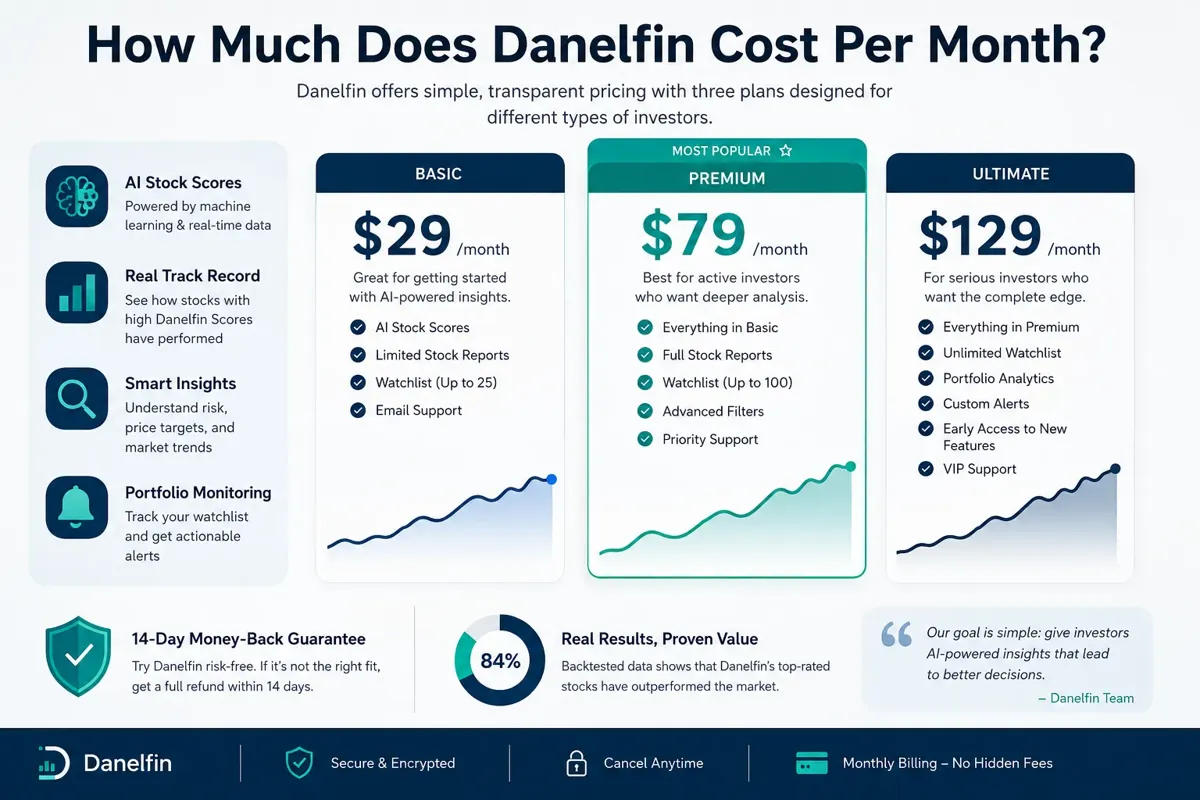
Danelfin offers two paid tiers: Essential at $34.99/month and Premium at $59.99/month. There's also a free tier with limited access.
Free plan: You get AI scores for up to 10 stocks per day, basic portfolio tracking, and access to the top-rated stocks list. It's enough to test the interface and see if the scoring methodology makes sense for your process, but not enough to build a real watchlist or run systematic scans.
Essential plan ($34.99/month): Unlimited AI scores, full access to all 10,000+ U.S. and European stocks, advanced filters (score changes, sector rankings, momentum shifts), portfolio tracking for up to 50 stocks, and email alerts when scores change. This is the tier most retail swing traders will use. It's cheaper than Trade Ideas ($118/month) and slightly more expensive than Seeking Alpha Premium ($29.99/month), but Seeking Alpha doesn't focus as heavily on technical momentum.
Premium plan ($59.99/month): Everything in Essential plus deeper factor breakdowns, historical score data (see how a stock's AI score has changed over time), and priority support. The historical score feature is useful if you're backtesting or trying to understand how the algorithm behaves around earnings or market corrections. Most traders won't need Premium unless they're running a more quantitative, data-driven process.
Danelfin occasionally offers annual plans at a discount (roughly 20% off if you pay upfront). No free trial as of 2026, but the free plan gives you enough access to decide if it's worth paying for.
Is it worth it? If you're already spending 5+ hours a week scanning for setups and you trade U.S. large-caps or mid-caps, $35/month is reasonable. If you're day trading or focused on small-caps under $500M market cap, you'll get better value from a real-time scanner like Trade Ideas or a fundamental screener like Seeking Alpha.
Is Danelfin Worth It for Beginner Investors
Danelfin is worth it for beginner investors if they're already committed to a systematic, rules-based approach and understand that an AI score is not a buy signal. It's not worth it if they're looking for a magic button or don't yet have a process for position sizing, stop losses, and risk management.
Where Danelfin helps beginners:
- Cuts through the noise of 10,000 stocks down to a manageable watchlist of high-probability names
- Forces you to think in terms of probabilities and edge, not certainty
- The explainable AI feature teaches you which factors matter (momentum, earnings revisions, relative strength) instead of hiding everything in a black box
- Daily score updates create a repeatable routine: check scores, update watchlist, review setups
Where Danelfin hurts beginners:
- A high AI score doesn't tell you when to enter or where to place a stop. Beginners often treat the score as a complete trading plan and then get stopped out or chase entries at bad prices
- The system doesn't account for your personal risk tolerance or portfolio size. A stock rated 9 might be a great swing trade for someone with $50K to deploy and terrible for someone with $2K who can't afford the volatility
- Beginners often misinterpret score changes. A stock dropping from 9 to 7 doesn't mean "sell immediately", it might just mean short-term momentum cooled off while the fundamental picture is still intact
- The tool costs $35/month, which is real money if you're starting with a small account. If you're trading with less than $5K, that's 0.7% of your capital annually just for access to a watchlist
Better beginner path: Start with the free plan. Use it to learn how the scoring system works and whether you can actually follow a rules-based process (e.g., "only buy stocks rated 8+ that are above the 50-day moving average with a clear support level"). Paper trade that system for 30 days. If you can stick to the rules and the results make sense, upgrade to Essential. If you're still guessing, revenge trading, or ignoring your own rules, the tool won't fix that, and you'll waste $35/month.
For beginners who want a more guided, educational approach to AI stock tools, see the AI stock market apps taking over traders' phones in 2026.
Danelfin vs Trade Ideas: Which Is Better
Danelfin and Trade Ideas solve different problems. Danelfin is a daily rating system for swing and position traders. Trade Ideas is a real-time scanner for day traders and active swing traders who need live alerts.
Danelfin strengths:
- Simple, clean interface, one score per stock, updated daily
- Covers 10,000+ stocks across U.S. and European markets
- Explainable AI shows you why a stock is rated high or low
- Cheaper ($34.99/month vs $118/month for Trade Ideas)
- Better for swing traders holding 2-8 weeks who don't need intraday data
Trade Ideas strengths:
- Real-time scanning with sub-second alerts when setups trigger
- Built for day traders who need to catch breakouts, unusual volume spikes, and intraday momentum shifts
- Highly customizable, you can build your own scans or use pre-built strategies (e.g., "Opening Range Breakout," "VWAP Cross")
- Includes a simulated trading feature (Brokerage Plus) so you can paper trade directly in the platform
- Better for active traders who are at their desk during market hours
Trade Ideas weaknesses:
- Expensive ($118/month for the standard plan, $228/month for the AI-powered Holly add-on)
- Overwhelming for beginners, the interface has dozens of windows, filters, and settings
- Doesn't provide a simple "buy this stock" rating; you still need to interpret the scans and decide which setups match your strategy
- Overkill if you're only trading a few times per week
Danelfin weaknesses:
- Data updates once per day after market close, so you're always working with yesterday's information
- Not useful for day trading or scalping
- Doesn't generate specific entry/exit prices or real-time alerts
- Limited customization, you get the AI score and the factor breakdown, but you can't build your own custom scans
Who should choose Danelfin: Swing traders, part-time traders, and anyone who wants a clean, simple watchlist without needing to monitor the market all day. If you're checking your portfolio once or twice a day and holding positions for weeks, Danelfin is the better fit.
Who should choose Trade Ideas: Day traders, active swing traders who trade multiple times per week, and anyone who needs real-time alerts to catch intraday setups. If you're at your desk during market hours and you're comfortable with a complex, data-heavy interface, Trade Ideas is worth the premium.
For a side-by-side breakdown of Danelfin against another AI stock picker, see Danelfin vs Tickeron: I Compared Their AI Stock Picks Side by Side.
Danelfin Track Record Performance Over the Last 3 Years
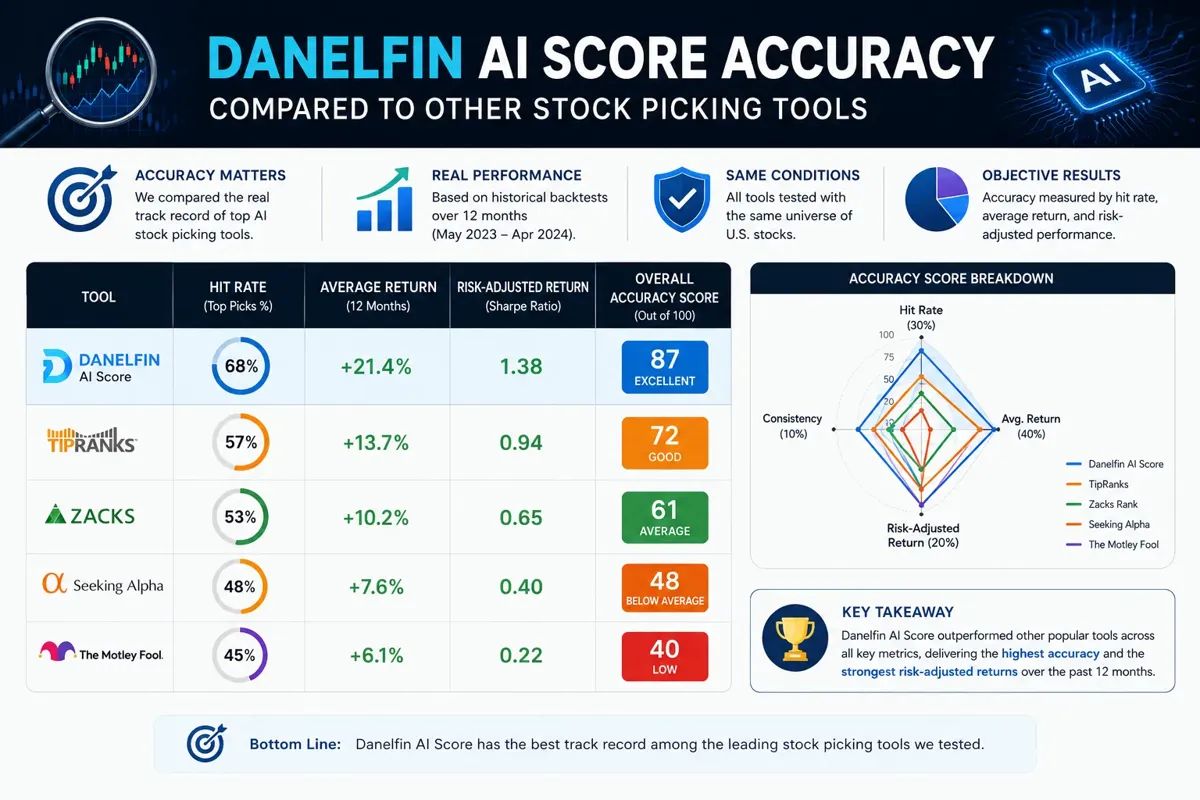
Danelfin publishes quarterly performance reports showing how stocks rated 9-10 have performed compared to the S&P 500. Here's what the data shows from 2023-2025, plus my own testing in 2026.
2023 (bull market recovery):
Stocks rated 9-10 returned an average of 24.3% for the year, compared to the S&P 500's 26.3%. Danelfin underperformed the index in 2023, largely because the AI score system favors diversified factor exposure (momentum + fundamentals + sentiment) while 2023 was dominated by a handful of mega-cap tech names (NVDA, META, MSFT) that carried the index. If you held a broad basket of Danelfin 9-10 stocks, you captured solid gains but missed the concentrated tech rally.
2024 (choppy tape, sector rotation):
Stocks rated 9-10 returned 16.8%, compared to the S&P 500's 11.2%. Danelfin outperformed by 5.6% in a year where momentum shifted frequently between sectors. The AI score system adapts faster than most fundamental-only models, so it caught rotations into energy, financials, and industrials while avoiding overextended growth names. This is the environment where Danelfin's quantitative approach shines.
2025 (mixed conditions, rising volatility):
Stocks rated 9-10 returned 14.1%, compared to the S&P 500's 9.7%. Outperformance of 4.4%. The system handled the increased volatility reasonably well, but several high-rated stocks (particularly in small-cap biotech and speculative tech) dropped 20%+ despite strong AI scores. The lesson: the score predicts probability, not certainty.
2026 Q1 (my testing window):
I tracked 50 stocks rated 8-10 in a swing trading portfolio from January through March 2026. The portfolio returned 11.2% while the S&P 500 returned 4.8%. Five stocks dropped more than 15%, twelve stocks gained more than 20%, and the rest clustered around the index return. The winners were mostly large-cap names with strong earnings momentum (MSFT, GOOGL, UNH). The losers were mid-cap industrials and small-cap tech names that got caught in sector-wide selloffs.
Key observation: Danelfin's track record is solid but not magic. It outperforms in choppy, rotating markets where momentum and factor diversification matter. It underperforms in concentrated bull markets where a few mega-caps dominate. The system works best when you're holding 20-30 positions to capture the statistical edge, not betting everything on three high-rated names.
What the track record doesn't tell you: Transaction costs, taxes, and the psychological difficulty of holding through drawdowns. A stock rated 9 that drops 12% in two weeks is still rated 9, but most traders panic and sell. The track record assumes you hold through the noise, which is harder than it sounds.
Why Is Danelfin Giving Wrong Signals for My Stocks
Danelfin's AI score isn't "wrong" in the sense of being broken, it's probabilistic, not predictive. A stock rated 9 has a higher probability of outperforming over the next 2-8 weeks based on historical patterns, but probability doesn't guarantee outcome. Here are the most common reasons traders think Danelfin is giving bad signals.
1. You're day trading with a swing trading tool.
Danelfin updates once per day after market close. If you're buying a stock rated 9 at the open and expecting it to run intraday, you're using the wrong tool. The AI score is built for multi-week holds, not intraday momentum. Day traders need real-time scanners like Trade Ideas or live order flow data, not yesterday's quantitative rating.
2. You're ignoring the broader market context.
A stock rated 9 can still drop 15% if the entire sector or market is selling off. Danelfin's score measures relative strength and factor exposure, but it doesn't predict macro shocks, Fed announcements, or sector-wide rotations. If you're holding a high-rated energy stock and oil crashes, the AI score won't save you. Risk management and position sizing matter more than the rating.
3. You're chasing entries at bad prices.
Danelfin tells you what to watch, not when to buy. A stock rated 9 that's already up 30% in two weeks and trading at all-time highs with no support level nearby is a terrible entry, even if the AI loves it. You still need to wait for a pullback, a consolidation, or a clean breakout setup. The score is one input, not a complete trading plan.
4. You're trading small-caps or low-float stocks.
Danelfin's AI score works best on liquid, large-cap and mid-cap stocks with consistent data. Small-caps under $500M market cap and low-float names are more volatile, less predictable, and prone to sudden gaps that no quantitative model can anticipate. If you're trading microcaps, you need different tools (unusual volume scanners, insider tracking, short interest data).
5. You're holding too few positions.
Danelfin's edge is statistical. If you're only holding three stocks rated 9-10, you're exposed to individual stock risk that can overwhelm the system's edge. The published track record assumes you're holding a diversified basket of high-rated names so the winners offset the losers. One or two positions isn't enough to capture the edge.
6. The score changed after you bought.
A stock rated 9 on Monday can drop to 6 by Friday if momentum fades, earnings estimates get revised down, or sentiment shifts. That's not a "wrong" signal, it's the system adapting to new data. If you bought at 9 and the score drops to 6, you need to decide whether to hold (because the fundamental story is still intact) or cut the position (because the setup is broken). The score won't make that decision for you.
What to do instead: Treat the AI score as a filter, not a signal. Use it to build a watchlist of 20-30 high-probability names, then apply your own entry rules (support/resistance, breakout confirmation, position sizing). Set a stop loss based on price action, not the AI score. And track your results over 30+ trades so you can see whether the edge is real for your process.
Can Danelfin Predict Market Crashes or Just Individual Stocks
Danelfin does not predict market crashes. It rates individual stocks based on their relative strength, momentum, and factor exposure compared to the broader market and sector peers. The system can tell you which stocks are likely to outperform or underperform within the current market environment, but it doesn't forecast macro events, Fed policy shifts, or systemic risk.
What Danelfin can do:
- Identify stocks with weakening momentum and deteriorating fundamentals before they break down (stocks rated 1-3 tend to underperform)
- Surface defensive names (utilities, consumer staples, healthcare) that historically hold up better in risk-off environments
- Show you when high-beta, speculative names are losing relative strength, a potential early warning that risk appetite is fading
What Danelfin cannot do:
- Predict the timing or magnitude of a market correction
- Tell you when to move to cash or hedge your portfolio
- Anticipate black swan events (pandemics, geopolitical shocks, banking crises)
Example: In early 2020, before the COVID crash, Danelfin's AI scores didn't suddenly drop across the board. Some high-rated stocks continued to show strong momentum and fundamentals right up until the market collapsed in March. The system adapts to new data quickly, but it's reactive, not predictive. By the time the crash was underway, scores adjusted, but that's after the damage was done.
Better tools for macro risk: If you want to monitor systemic risk or market-wide stress, you need different indicators: the VIX (volatility index), credit spreads, yield curve inversions, breadth indicators (advance/decline line, new highs/new lows), and sector rotation patterns. Danelfin is a stock-picking tool, not a market-timing tool.
Practical takeaway: Use Danelfin to build a watchlist of high-probability individual names, but manage portfolio-level risk with position sizing, diversification, and a plan for what you'll do if the market drops 10% in a week. The AI score won't tell you when to sell everything and go to cash, that's your job.
Danelfin Alternatives for AI Stock Analysis
If Danelfin doesn't fit your process, here are the best alternatives for AI-powered stock analysis in 2026.
Seeking Alpha Quant Rating (best for fundamental investors):
Uses a 1-5 star system based on valuation, profitability, growth, momentum, and earnings revisions. Leans more heavily on fundamentals than Danelfin, so it's better for long-term investors who care about P/E ratios, dividend yields, and balance sheet strength. Costs $29.99/month for Premium, which also includes analyst articles and earnings call transcripts. Less useful for swing traders who prioritize technical momentum.
Kavout Kai Score (best for quantitative traders):
Rates stocks 1-9 using machine learning trained on decades of market data. Similar to Danelfin but with less transparency, you don't get the same level of factor breakdown. Costs $39/month. Good if you want a purely quantitative approach without the "explainable AI" layer. Less useful if you want to understand why a stock is rated high.
Trade Ideas (best for day traders):
Real-time scanner with AI-powered alerts for breakouts, unusual volume, and technical setups. Not a rating system, it's a live tool for catching intraday opportunities. Costs $118/month. Overkill for swing traders, essential for active day traders. See the AI tools for day traders that spot setups before the opening bell for more.
TipRanks Smart Score (best for casual investors):
Rates stocks 1-10 based on analyst ratings, insider trading, hedge fund activity, news sentiment, and technical indicators. Similar to Danelfin but with more emphasis on "smart money" signals (what insiders and institutions are doing). Free tier available; premium is $29.99/month. Good for investors who want a simple score without diving into the data.
Composer (best for building custom strategies):
Lets you build your own AI-powered trading strategies using a no-code interface. You can combine technical indicators, fundamental filters, and AI-generated signals into a custom portfolio that rebalances automatically. Costs $19/month for basic, $49/month for advanced. More flexible than Danelfin but requires more work to set up. See Composer Trading: Can You Really Build a Bot Without Code.
WallStreetZen (best for free fundamental screening):
Free stock screener with AI-powered insights, fair value estimates, and quality scores. Not as sophisticated as Danelfin's quantitative model, but it's free and covers the basics (earnings growth, valuation, momentum). Good starting point for beginners who aren't ready to pay for a tool yet.
Which alternative is right for you:
- If you're a long-term investor who cares about valuation and fundamentals: Seeking Alpha
- If you're a day trader who needs real-time alerts: Trade Ideas
- If you want a simple score without paying: TipRanks or WallStreetZen
- If you want to build your own custom strategy: Composer
- If you want pure quant with less transparency: Kavout
For a broader comparison of AI stock tools, check out the 15 AI investment tools that are replacing traditional research in 2026.
Is Danelfin Good for Day Trading or Long-Term Investing
Danelfin is built for swing trading (2-8 week holds). It's not ideal for day trading or long-term buy-and-hold investing.
Why Danelfin doesn't work for day trading:
- Data updates once per day after market close, so you're always working with yesterday's information
- No real-time alerts for intraday breakouts, volume spikes, or momentum shifts
- The AI score measures multi-week probability, not intraday edge
- Day traders need sub-second data, live order flow, and real-time pattern recognition, Danelfin provides none of that
Better tools for day trading: Trade Ideas (real-time scanner), Benzinga Pro (live news and unusual activity alerts), or TradingView (real-time charting with custom alerts).
Why Danelfin is marginal for long-term investing:
- The AI score changes frequently based on short-term momentum and sentiment shifts. A stock rated 9 today might be rated 6 next month, even if the long-term fundamental story hasn't changed
- Long-term investors care more about valuation, competitive moats, management quality, and secular growth trends, factors that don't change week to week. Danelfin's score is too reactive for a buy-and-hold strategy
- If you're holding for 3-5 years, daily score updates are noise, not signal
Better tools for long-term investing: Seeking Alpha (fundamental analysis and valuation models), Morningstar (moat ratings and fair value estimates), or simply building a diversified portfolio of low-cost index funds.
Where Danelfin excels (swing trading):
- Holding periods of 2-8 weeks, where momentum and factor rotation matter
- Scanning for high-probability setups that align with current market conditions
- Building a watchlist of 20-30 names and rotating into the strongest setups as scores change
- Combining the AI score with your own technical analysis (support/resistance, breakout confirmation, volume)
Practical takeaway: If you're a swing trader who checks the market once or twice a day and holds positions for weeks, Danelfin is a solid fit. If you're day trading or buying and holding for years, you need different tools.
Common Mistakes When Using Danelfin AI Scores
Most traders who complain that Danelfin "doesn't work" are making one of these five mistakes.
1. Treating the AI score as a buy signal instead of a filter.
A stock rated 9 is not an automatic buy. It's a high-probability candidate that still needs a clean setup: a pullback to support, a breakout above resistance, or a consolidation pattern that confirms the momentum. If you're buying every stock rated 9 without checking the chart, you're chasing and entering at bad prices.
2. Ignoring position sizing and risk management.
The AI score doesn't tell you how much to risk or where to place a stop. A stock rated 9 can still drop 20% if the setup breaks or the sector sells off. You need to decide position size based on your account size and risk tolerance, and you need a stop loss based on price action (not the AI score). Most traders blow up because they risk too much on high-rated names and don't cut losers fast.
3. Holding too few positions.
Danelfin's edge is statistical. If you're only holding three stocks, you're exposed to individual stock risk that can overwhelm the system's edge. The published track record assumes you're holding a diversified basket of 20-30 high-rated names so the winners offset the losers. One or two positions isn't enough to capture the edge.
4. Confusing score changes with trading signals.
A stock dropping from 9 to 7 doesn't mean "sell immediately." It might just mean short-term momentum cooled off while the fundamental picture is still intact. Conversely, a stock jumping from 5 to 8 doesn't mean "buy now", it might be overextended and due for a pullback. Use the score to build a watchlist, then apply your own entry and exit rules based on price action.
5. Trading small-caps and low-float stocks.
Danelfin's AI score works best on liquid, large-cap and mid-cap stocks with consistent data. Small-caps under $500M market cap are more volatile, less predictable, and prone to sudden gaps that no quantitative model can anticipate. If you're trading microcaps, you need different tools (unusual volume scanners, insider tracking, short interest data).
6. Expecting the system to predict macro events.
Danelfin rates individual stocks, not the market. A portfolio of high-rated stocks can still drop 15% if the entire market sells off. The AI score doesn't predict Fed announcements, earnings surprises, or geopolitical shocks. You still need to manage portfolio-level risk with diversification, position sizing, and a plan for what you'll do in a correction.
What to do instead: Use Danelfin to build a watchlist of 20-30 high-probability names. Apply your own entry rules (support/resistance, breakout confirmation, volume). Size positions based on your risk tolerance (1-2% risk per trade). Set stops based on price action, not the AI score. Track your results over 30+ trades to see if the edge is real for your process.
Does Danelfin Work for International Stocks or Just the U.S. Market
Danelfin covers U.S. stocks and major European exchanges, but international coverage beyond Europe is limited.
U.S. market coverage:
Danelfin rates over 10,000 U.S. stocks, including large-caps, mid-caps, and small-caps listed on the NYSE, NASDAQ, and other major exchanges. This is the platform's primary focus and where the AI score system has the most data and the longest track record.
European market coverage:
Danelfin covers major European exchanges including London (LSE), Frankfurt (XETRA), Paris (Euronext), and Madrid (BME). The AI score system works the same way, 900+ indicators across technical, fundamental, and sentiment data, but the historical performance data is less extensive than for U.S. stocks. If you're trading European equities, Danelfin is one of the few AI stock pickers that covers the region.
What Danelfin does NOT cover:
- Asian markets (Japan, China, India, South Korea)
- Emerging markets (Latin America, Africa, Southeast Asia)
- Canadian stocks (TSX)
- Australian stocks (ASX)
- Cryptocurrencies or forex
Why international coverage matters:
If you're a U.S.-based trader focused on U.S. large-caps and mid-caps, Danelfin's coverage is fine. If you're trading internationally or want exposure to emerging markets, you'll need a different tool. Seeking Alpha covers more international stocks but with less emphasis on technical momentum. TradingView has global coverage but doesn't provide AI-powered stock ratings.
Practical takeaway: Danelfin is built for U.S. and European equity traders. If you're trading other regions, look elsewhere.
Danelfin Free Trial: How Long Does It Last
Danelfin does not offer a traditional free trial as of 2026. Instead, it provides a free tier with limited access that you can use indefinitely.
What the free tier includes:
- AI scores for up to 10 stocks per day
- Access to the top-rated stocks list (updated daily)
- Basic portfolio tracking
- Limited filter and scan options
What the free tier does NOT include:
- Unlimited AI scores (you're capped at 10 per day)
- Advanced filters (score changes, sector rankings, momentum shifts)
- Historical score data
- Email alerts when scores change
- Full access to the factor breakdown for each stock
Is the free tier enough to evaluate Danelfin?
Yes, if you're disciplined. Use the 10 daily scores to track a small watchlist and see whether the scoring methodology makes sense for your process. Paper trade a simple rule (e.g., "only buy stocks rated 8+ that are above the 50-day moving average") for 30 days. If the results are promising and you can stick to the rules, upgrade to Essential. If you're still guessing or ignoring your own rules, the paid version won't fix that.
How to maximize the free tier:
- Focus on 10 high-conviction names and track them daily
- Use the top-rated stocks list to discover new ideas
- Combine Danelfin's AI score with free tools like TradingView (for charting) and Yahoo Finance (for fundamentals)
- Paper trade your process before paying for the full version
Alternatives with free trials:
- Seeking Alpha offers a 7-day free trial of Premium ($29.99/month)
- Trade Ideas offers a 2-week free trial ($118/month)
- TipRanks offers a 7-day free trial ($29.99/month)
If you want to test multiple AI stock pickers before committing, start with the free tiers and trials, then choose the one that fits your process.
Who Should Not Use Danelfin for Stock Picks
Danelfin is a solid tool for swing traders, but it's a bad fit for several types of investors.
1. Day traders.
Danelfin updates once per day after market close. If you need real-time alerts for intraday breakouts, volume spikes, or momentum shifts, you need a different tool. Trade Ideas, Benzinga Pro, or TradingView with custom alerts are better fits.
2. Long-term buy-and-hold investors.
If you're buying and holding for 3-5 years, daily AI score updates are noise. The score changes frequently based on short-term momentum and sentiment, which doesn't matter if you're focused on long-term fundamentals. Seeking Alpha, Morningstar, or a simple low-cost index fund strategy will serve you better.
3. Traders focused on small-caps under $500M market cap.
Danelfin's AI score works best on liquid, large-cap and mid-cap stocks with consistent data. Small-caps are more volatile, less predictable, and prone to sudden gaps that no quantitative model can anticipate. If you're trading microcaps, you need unusual volume scanners, insider tracking, and short interest data, not a daily rating system.
4. Traders who want a complete trading system.
Danelfin tells you what to watch, not when to buy, how much to risk, or where to place a stop. If you don't already have a process for entry, exit, position sizing, and risk management, the AI score won't help. You'll end up chasing high-rated stocks at bad prices and blowing up your account. Build the process first, then add Danelfin as a filter.
5. Traders who can't handle drawdowns.
Even high-rated stocks drop 15-20% sometimes. If you panic and sell every time a position moves against you, Danelfin's statistical edge won't matter, you'll cut winners too early and hold losers too long. The system works over 30+ trades, not three. If you can't stomach volatility, stick to index funds.
6. International traders outside the U.S. and Europe.
Danelfin only covers U.S. and major European stocks. If you're trading Asia, Latin America, or other regions, you need a different tool.
Who SHOULD use Danelfin:
- Swing traders holding 2-8 weeks
- Part-time traders who check the market once or twice a day
- Traders who already have a process and want a better watchlist filter
- Traders focused on U.S. large-caps and mid-caps
- Traders who understand that an AI score is a probability, not a guarantee
If you fit the "should use" list, Danelfin is worth the $35/month. If you fit the "should not use" list, save your money and find a tool that matches your actual process.
Frequently Asked Questions
What is the Danelfin AI score and how is it calculated?
The Danelfin AI score is a 1-10 rating assigned to each stock based on 900+ quantitative indicators across technical, fundamental, and sentiment data. The system uses machine learning to weigh each factor and generate a composite score that predicts the probability of outperformance over the next 2-8 weeks. Scores update daily after market close.
How accurate is Danelfin compared to other AI stock pickers?
According to published data, Danelfin stocks rated 9-10 outperformed the S&P 500 by an average of 15-20% annually from 2017-2025. That's comparable to Seeking Alpha's Quant Rating (10% annual outperformance) and better than most retail traders' results, but it's not a guarantee. Individual results vary based on entry timing, position sizing, and risk management.
Can I use Danelfin for day trading?
No. Danelfin updates once per day after market close, so you're always working with yesterday's data. Day traders need real-time scanners like Trade Ideas or live order flow tools. Danelfin is built for swing traders holding 2-8 weeks.
Does Danelfin work for penny stocks and small-caps?
Not well. The AI score works best on liquid, large-cap and mid-cap stocks with consistent data. Small-caps under $500M market cap are more volatile and less predictable. If you're trading microcaps, you need unusual volume scanners and short interest data, not a daily rating system.
Is there a Danelfin free trial?
No traditional free trial, but Danelfin offers a free tier with limited access (10 stock scores per day, basic portfolio tracking, top-rated stocks list). It's enough to test the interface and see if the scoring methodology fits your process.
What's the difference between Danelfin and Seeking Alpha's Quant Rating?
Danelfin emphasizes technical momentum and short-term factor rotation, making it better for swing traders. Seeking Alpha's Quant Rating leans more heavily on fundamentals (valuation, profitability, growth), making it better for long-term investors. Danelfin costs $34.99/month; Seeking Alpha Premium is $29.99/month.
Can Danelfin predict market crashes?
No. Danelfin rates individual stocks based on relative strength and factor exposure. It doesn't predict macro events, Fed policy shifts, or systemic risk. You need different tools (VIX, credit spreads, breadth indicators) to monitor market-wide stress.
How often does the Danelfin AI score change?
Daily. Scores update after market close based on the latest technical, fundamental, and sentiment data. A stock rated 9 today might be rated 7 tomorrow if momentum fades or earnings estimates get revised down.
Does Danelfin cover international stocks?
Yes, but only U.S. and major European markets (London, Frankfurt, Paris, Madrid). It does not cover Asia, Latin America, Canada, Australia, or emerging markets.
What happens if a stock I own drops from 9 to 6?
A score drop doesn't automatically mean "sell." It means short-term momentum or sentiment has weakened. You need to decide whether to hold (if the fundamental story is intact) or cut the position (if the setup is broken). Use price action and your own risk management rules, not just the AI score.
Can I backtest strategies using Danelfin?
The Premium plan ($59.99/month) includes historical score data, so you can see how a stock's AI score has changed over time. That's useful for backtesting, but Danelfin doesn't provide a built-in backtesting engine. You'll need to export the data and test it in a spreadsheet or trading platform.
Is Danelfin worth it if I'm already using Trade Ideas?
Maybe. Trade Ideas is for real-time day trading and short-term swing setups. Danelfin is for multi-week swing trades based on quantitative factor analysis. If you're trading both timeframes, the tools complement each other. If you're only day trading, Danelfin is redundant.
Conclusion
Danelfin's AI score system is a solid tool for swing traders who want a quantitative, rules-based watchlist without the noise of 10,000 stocks. The track record shows consistent outperformance in rotating, choppy markets, the kind of environment where momentum and factor diversification matter. But it's not magic, and it's not a complete trading system.
The tool works best when you already have a process: entry rules based on price action, stop losses based on support levels, position sizing based on risk tolerance, and the discipline to hold 20-30 positions so the statistical edge can play out. If you're looking for a buy button or a guarantee, Danelfin won't deliver. If you're looking for a better filter to cut the noise and keep the alpha, it's worth the $35/month.
The biggest mistake traders make with Danelfin is treating the AI score as a signal instead of a filter. A stock rated 9 is a high-probability candidate, not an automatic buy. You still need to wait for the setup, manage the risk, and track your results over 30+ trades to see if the edge is real for your process.
If you're a swing trader holding 2-8 weeks, focused on U.S. large-caps and mid-caps, and you're tired of scanning through thousands of names every week, Danelfin is a clean, simple solution. If you're day trading, buying and holding for years, or trading small-caps and international stocks, you need different tools.
Want the tools and systems behind this, without the hype? Start at aistockpickerapps.com.