Danelfin vs Tickeron...I Compared Their AI Stock Picks Side by Side
Last updated: June 17, 2026
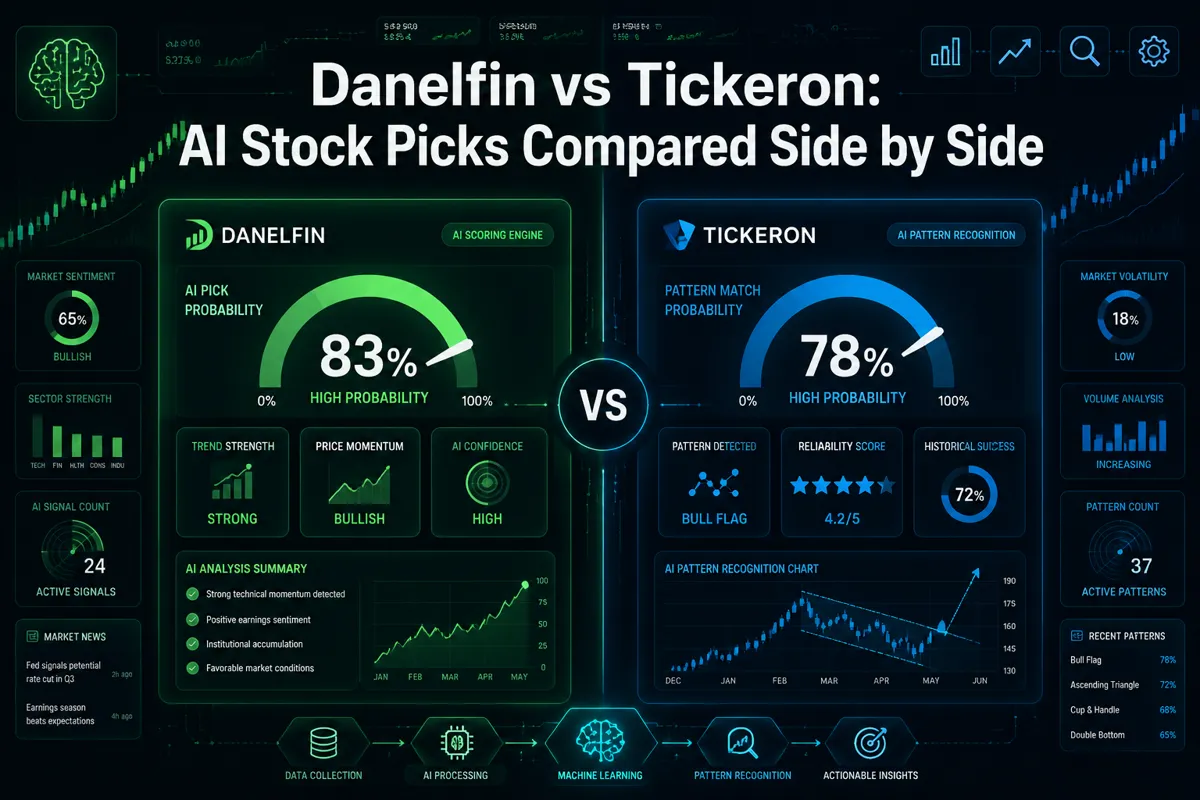
Quick Answer: Danelfin and Tickeron are two of the most talked-about AI stock rating tools in 2026, but they work very differently. Danelfin uses a machine learning probability score to rank stocks by their likelihood of beating the market over the next 90 days. Tickeron uses AI pattern recognition to identify technical chart setups and generate trade signals in real time. If you want a clean, data-driven stock screener for swing trading or investing, Danelfin is the sharper tool. If you want active trade alerts and automated pattern scanning, Tickeron has more firepower — but also more noise.
Key Takeaways
- Danelfin scores every stock on a 1-10 AI Score based on 900+ technical, fundamental, and sentiment indicators — higher scores historically correlate with better 90-day returns.
- Tickeron is built around AI-driven pattern recognition, generating buy/sell signals based on chart patterns, trend analysis, and its proprietary "Financial Learning Models."
- Danelfin is generally better for buy-and-hold swing traders and self-directed investors who want a clean signal without micromanaging entries.
- Tickeron suits active day traders and swing traders who want real-time pattern alerts and automated trading bots.
- Neither platform guarantees returns — both are probability tools, not crystal balls.
- Danelfin offers a free tier with limited stock access; Tickeron has a free account with limited signal access.
- The biggest mistake investors make with both tools is treating a score or a signal as a trade plan — it's not. Risk management still lives with you.
- For a broader look at how these two stack up against the full field, the AI stock tool comparison directory covers 100+ platforms side by side.
Danelfin vs Tickeron...I Compared Their AI Stock Picks Side by Side
Two AI stock tools. Both claim to cut through market noise. Both use machine learning. And both have real users swearing by them — and real users who bailed after three months frustrated.
So which one actually earns a spot in your process?
The short answer: they're solving different problems. Danelfin is a stock ranker. Tickeron is a trade signal engine. Comparing them head-to-head is a little like comparing a GPS to a race car — one tells you where to go, the other helps you get there fast. You might need both. You might only need one.
Here's what the side-by-side actually looks like.
What Exactly Do Danelfin and Tickeron Do for Stock Investing?
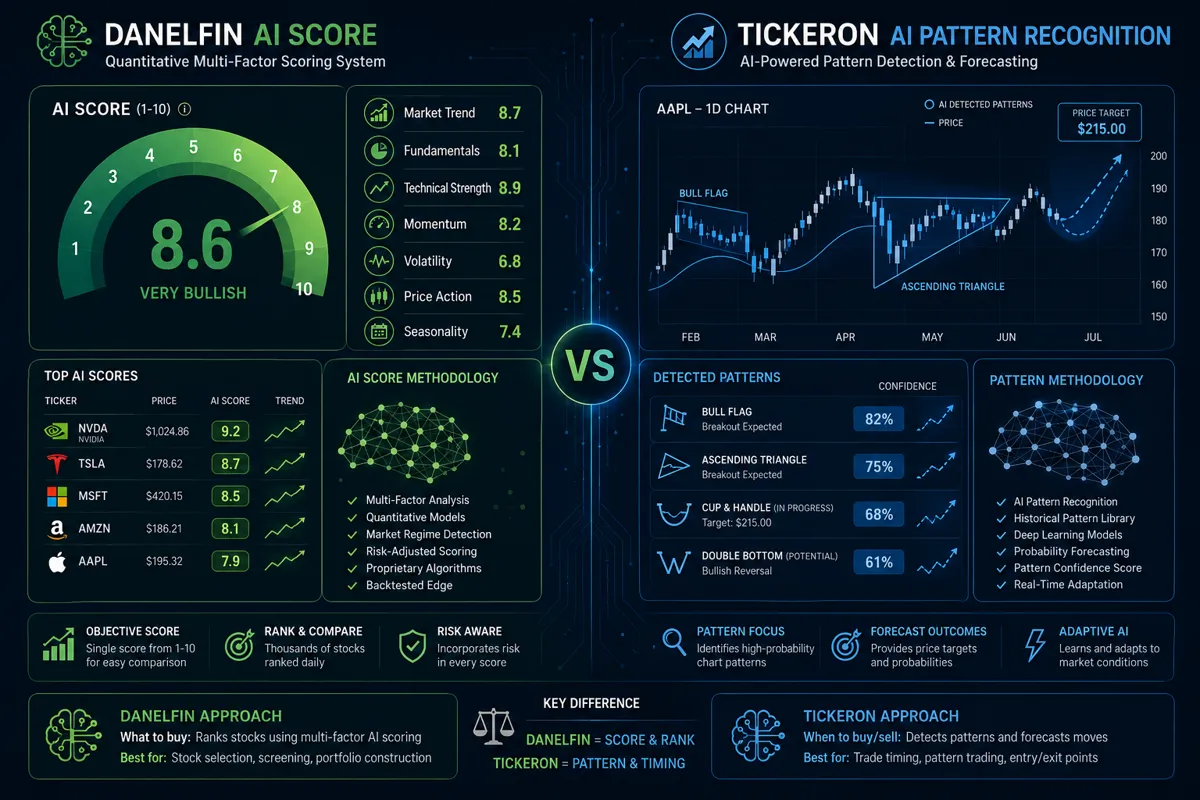
Danelfin is an AI stock rating platform that analyzes over 900 technical, fundamental, and sentiment features for each stock and compresses them into a single AI Score from 1 to 10. A score of 8 or higher signals that the stock has a statistically higher probability of outperforming the S&P 500 over the next 90 days. It's built for investors who want a clean, evidence-based shortlist — not a firehose of alerts.
Tickeron is an AI trading platform that focuses on real-time pattern recognition. It scans charts for classic technical patterns — head and shoulders, double bottoms, triangles — and generates trade signals with a stated confidence level and projected price target. Tickeron also offers AI trading bots (called "AI Robots") that can automate entries and exits based on those signals.
The practical difference: Danelfin answers "which stocks should be on my watchlist?" Tickeron answers "is now the right time to enter this trade?"
How Do Their Machine Learning Algorithms Actually Work?
Danelfin's model is trained on historical stock data going back decades. It runs each stock through a classification model that weighs hundreds of features simultaneously — price momentum, earnings revisions, short interest, analyst sentiment, and more. The output is a probability score, not a price target. Think of it as a credit score for stocks: higher score, better historical odds.
Tickeron uses what it calls Financial Learning Models (FLMs). These are pattern-recognition algorithms trained to identify recurring chart formations and match them against historical outcomes. When a pattern forms with sufficient confidence, Tickeron fires an alert. The model also tracks the historical success rate of each pattern type, so you can see, for example, that a particular ascending triangle breakout has a 68% win rate over the last five years on similar setups.
Key distinction: Danelfin's approach is more fundamental and multi-factor. Tickeron's is more technical and timing-focused. Neither replaces your own risk management — they just give you better inputs.
Which AI Stock Prediction Tool Is More Accurate?
This is the question everyone asks, and it deserves a straight answer: it depends on what you're measuring.
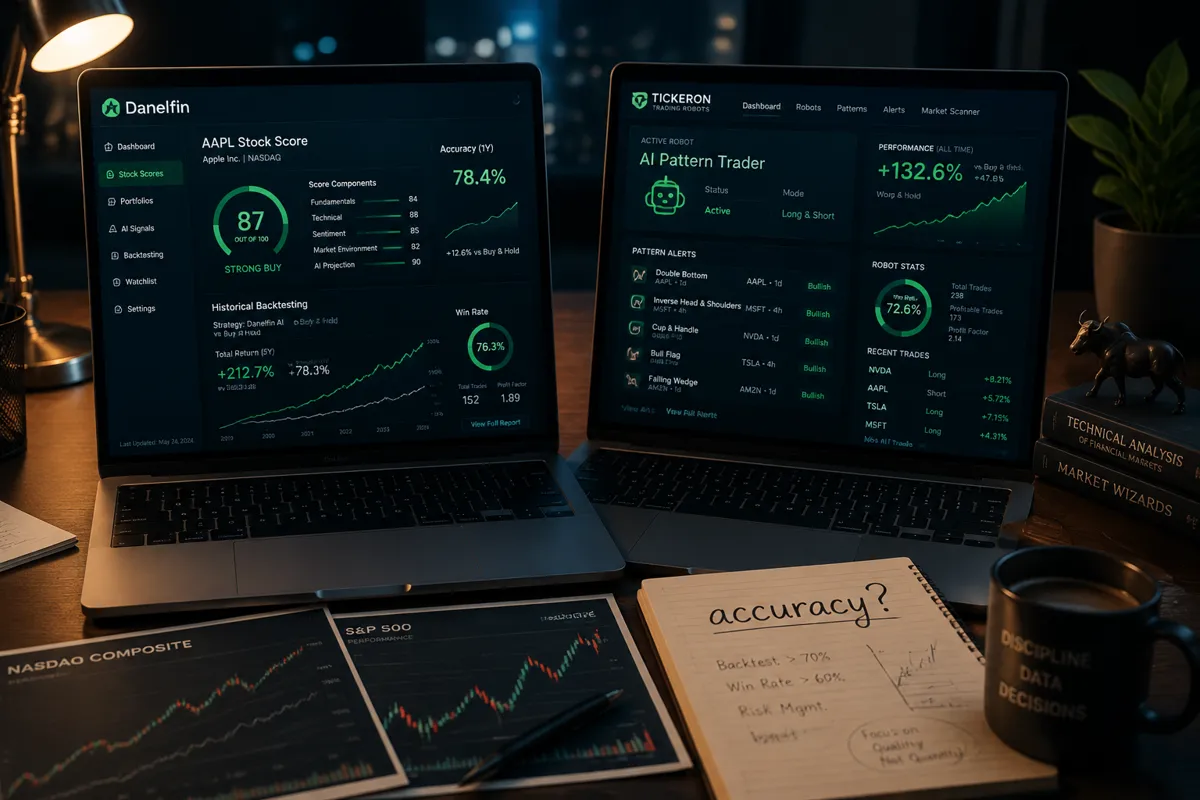
Danelfin publishes backtested performance data showing that stocks with an AI Score of 8 or higher have historically outperformed the S&P 500 over 90-day windows. That's a verifiable, auditable claim based on historical data — not a cherry-picked highlight reel. Danelfin accuracy claims are grounded in aggregate statistics across thousands of stocks, not individual picks.
Tickeron accuracy is measured differently. The platform tracks the win rate of its AI pattern signals and displays them publicly on each signal. Some patterns show win rates above 70% historically; others are closer to 50-50. The honest read: pattern recognition works until it doesn't, especially in choppy tape or during earnings season when price action gets erratic.
The real question isn't which tool is "more accurate" — it's which tool's accuracy metric matches your trading style. If you're a swing trader holding positions for weeks, Danelfin's 90-day probability score is more relevant. If you're a day trader or short-term swing trader hunting specific setups, Tickeron's pattern confidence scores matter more.
Neither tool has a verified, independently audited real-time track record published by a third party as of 2026. Treat their stated accuracy figures as useful historical context, not a guarantee of future performance.
How Much Do Danelfin and Tickeron Cost?
Danelfin pricing (as of 2026):
- Free tier: Access to AI Scores for a limited number of stocks, basic screener
- Premium plans: Start around $20-$30/month for full stock universe access, detailed factor breakdowns, and portfolio analysis
- Annual billing typically offers a meaningful discount
Tickeron pricing (as of 2026):
- Free account: Limited signal access, basic pattern scanner
- Paid tiers: Range from roughly $17/month on the low end to $90+/month for full AI Robot access and real-time alerts
- Higher tiers unlock automated trading bots and more frequent signal updates
The honest cost comparison: Danelfin is the leaner, cheaper option if all you need is a smarter stock screener. Tickeron's value scales with how actively you trade — the AI Robot features only make sense if you're placing frequent trades and have the time to manage them.
Play stupid games, win stupid prizes: paying for Tickeron's top tier and then ignoring the risk-reward settings on the bots is exactly how traders blow up accounts they spent months building.
Are There Free Trials for Danelfin and Tickeron?
Both platforms offer free access with limitations, which functions as a de facto trial.
- Danelfin lets you view AI Scores for a subset of stocks and run basic screens without a credit card. It's enough to get a feel for the scoring system before committing.
- Tickeron offers a free account that includes some pattern signals and access to the educational content. The free tier is genuinely useful for beginners who want to learn how pattern recognition works before paying for live alerts.
Recommendation: Paper trade it first. Use the free tier of whichever platform interests you, run the signals through a paper trading account for 30 days, and track your results. If the signal quality holds up in your style of trading, upgrade. If not, you saved yourself months of subscription fees.
What Are the Biggest Pros and Cons of Each Platform?
Danelfin
Pros:
- Clean, single-score output cuts analysis paralysis instantly
- Multi-factor model covers technical, fundamental, and sentiment data in one score
- Backtested performance data is transparent and publicly available
- Lower cost entry point for individual investors
- Works well for swing trading and longer-term position building
Cons:
- Doesn't provide specific entry and exit points — you still need to read the tape yourself
- 90-day window isn't useful for day traders or very short-term setups
- Limited charting tools compared to dedicated platforms like TradingView
- Free tier is genuinely limited
Tickeron
Pros:
- Real-time pattern alerts with stated confidence levels
- AI Robots can automate entries and exits for active traders
- Covers stocks, ETFs, forex, and crypto
- Educational content is strong for beginners learning technical analysis
- Pattern success rates are displayed transparently
Cons:
- Can generate a lot of signals — signal over noise becomes a real problem
- Higher tiers are expensive relative to what most retail traders actually use
- Pattern recognition struggles in choppy tape and low-float stocks
- Automation features require careful setup or you're handing the wheel to an algorithm you don't fully understand
For a deeper look at Tickeron's full feature set, the Tickeron tool profile breaks it down in detail.
Who Should Use Danelfin vs Who Should Use Tickeron?
Use Danelfin if:
- You're a swing trader or self-directed investor holding positions for days to weeks
- You want a clean, data-driven watchlist without spending hours screening manually
- You prefer a probability-based approach over pattern-based signals
- You're managing a portfolio of 10-30 stocks and want a systematic way to rank them
- Budget matters and you want the most signal for the lowest cost
Use Tickeron if:
- You're an active day trader or short-term swing trader who wants real-time alerts
- You're comfortable with technical analysis and want AI to surface setups faster
- You're interested in automated trading and want to experiment with AI bots
- You trade multiple asset classes beyond just U.S. equities
Use both if: You want Danelfin to build your watchlist (the setup) and Tickeron to time your entries (the breakout). That's actually a reasonable combination — one tool for stock selection, one for execution timing.
For investors who are still building their system and aren't sure which direction to go, the swing trading resource hub is a good starting point.
Are These AI Stock Tools Good for Beginners or Just Advanced Investors?
Both tools are accessible to beginners, but with different learning curves.
Danelfin is the more beginner-friendly of the two. The AI Score is intuitive — a 9 out of 10 is better than a 4 out of 10. You don't need to understand the underlying model to use it. The risk for beginners is treating a high score as a buy signal without thinking about position sizing, stop loss placement, or the broader market trend. The score tells you the odds; it doesn't tell you how much to risk.
Tickeron has more complexity. Pattern recognition requires at least a basic understanding of technical analysis to interpret signals correctly. A beginner who doesn't know the difference between a bull trap and a genuine breakout will struggle to use Tickeron's signals without getting stopped out repeatedly.
The honest take for beginners: Start with Danelfin to build your watchlist. Learn to read price action on TradingView or a similar charting platform. Once you understand support and resistance and can identify a clean setup, then layer in Tickeron's pattern alerts. Don't use automation features until you understand what the bots are actually doing.
If you're still figuring out which AI stock rating tools are worth your time, the research tools section covers the broader landscape.
What Kind of Stock Strategies Do They Recommend?
Danelfin is strategy-agnostic in the sense that its score applies across different holding periods, but it's most useful for:
- Momentum-based swing trades (holding 5-30 days)
- Growth stock screening with a quantitative filter
- Portfolio construction where you want to overweight higher-probability names
Tickeron is built around technical trading strategies:
- Breakout trades (buying the breakout from tight consolidation)
- Reversal patterns (double bottoms, head and shoulders)
- Trend-following entries on moving average crossovers
Neither platform tells you how to size your position or where to put your stop loss. That's your job. Discipline beats prediction — the tool gives you the signal, but the process of managing risk is entirely on you.
What Mistakes Do Investors Make When Using AI Stock Prediction Tools?
This is where most people go wrong, and it's worth saying plainly.
Mistake 1: Treating a score or signal as a complete trade plan. A Danelfin AI Score of 9 doesn't tell you where to buy, where to stop out, or how much to risk. A Tickeron pattern alert doesn't mean the stock will move in your direction. These are inputs, not instructions.
Mistake 2: Overtrading based on signal volume. Tickeron in particular can generate a high volume of alerts. More signals does not mean more alpha. FOFO — Fear of Finding Out — is real: traders take every signal because they're afraid of missing the one that works. The result is overtrading, death by a thousand small losses, and revenge trading to get back to even.
Mistake 3: Ignoring the broader market trend. A stock with a Danelfin score of 10 in a bear market can still lose you money. The trend is your friend — and if the macro trend is down, even the best AI score is fighting the tape.
Mistake 4: Skipping the paper trade phase. Both tools offer free or trial access. Use it. Paper trade the signals for at least 30 days before risking real capital. You'll learn more about how the tool behaves in real market conditions than any review can tell you.
Mistake 5: Analysis paralysis from running both tools simultaneously without a clear process. Systems over hacks. Decide which tool serves which role in your process before you subscribe to both.
For a broader look at how AI stock tools compare across the market, the full AI trading platforms directory is worth bookmarking. And if you want to check your own stock picks against a quick scoring framework, the free stock health scorecard is a solid starting point.
Which Platform Has Better Performance Tracking?
Danelfin has the edge here for transparency. The platform publishes aggregate performance data showing how stocks at different AI Score levels have historically performed relative to the S&P 500. That's the kind of auditable, data-driven track record that earns trust.
Tickeron tracks win rates by pattern type and displays them on each signal, which is useful but harder to aggregate into a single performance picture. Individual pattern win rates don't account for position sizing, holding period variation, or market regime — all of which affect real-world returns.
Bottom line: Neither platform offers a fully independent, third-party audited track record. Danelfin's aggregate score performance is more transparent and easier to evaluate. Tickeron's per-pattern win rates are useful but require more context to interpret correctly.
FAQ: Danelfin vs Tickeron
Q: Is Danelfin or Tickeron better for long-term investors?
Danelfin is the better fit. Its 90-day probability score aligns with longer holding periods, and its multi-factor model incorporates fundamental data that matters more over time than short-term chart patterns.
Q: Can Tickeron's AI Robots trade automatically without my input?
Yes, Tickeron's AI Robots can execute trades automatically through connected brokerage accounts. This requires careful configuration of risk parameters — position sizing, stop loss levels, and maximum drawdown limits. Don't enable automation without understanding exactly what rules the bot is following.
Q: Does Danelfin cover international stocks?
Danelfin covers U.S. equities and has expanded coverage to European markets. Check the current platform for the exact universe of stocks covered, as this changes with plan tier.
Q: How often does Danelfin update its AI Scores?
Danelfin updates scores daily after market close, incorporating the latest price action, earnings data, and sentiment signals.
Q: Is Tickeron good for options trading?
Tickeron has some options-related features, but it's primarily built around equity and ETF signals. For dedicated AI options tools, the AI options tools section covers platforms purpose-built for that use case.
Q: Can I use both Danelfin and Tickeron together?
Yes, and it can make sense. Use Danelfin to build a watchlist of high-probability stocks, then use Tickeron to identify specific entry points when a clean setup forms. Just make sure you have a clear process for each tool's role — otherwise you end up with two tools and twice the noise.
Q: Which is better for a complete beginner?
Danelfin. The scoring system is simpler to interpret, the cost is lower, and the risk of overtrading from signal overload is much lower than with Tickeron.
Q: Does Tickeron work for crypto and forex?
Yes. Tickeron covers crypto, forex, and ETFs in addition to equities — broader asset class coverage than Danelfin.
Q: What's the best way to evaluate either tool before paying?
Use the free tier, paper trade the signals for 30 days, and track your results in a spreadsheet. Measure win rate, average gain vs. average loss, and how often you would have gotten stopped out. That data tells you more than any review.
Q: Are there other AI stock tools worth comparing alongside these two?
Absolutely. The full AI stock tool comparison directory covers 100+ platforms with structured breakdowns. It's worth checking before committing to any single subscription.
Conclusion: Which One Earns a Spot in Your Process?
The danelfin vs tickeron debate doesn't have a universal winner. It has a right answer for your specific situation.
If you're building a systematic approach to stock selection — a real process, not a gut-feel watchlist — Danelfin's AI Score gives you a clean, data-driven filter that cuts the noise without requiring you to monitor 50 alerts a day. It's the better starting point for most retail investors.
If you're an active trader who lives in the charts, understands technical patterns, and wants AI to surface setups faster than you can scan manually, Tickeron adds genuine value — especially if you're disciplined enough to filter signals rather than chase every alert.
The worst outcome? Subscribing to both, getting overwhelmed, and making decisions based on whichever tool fired last. That's not a system. That's expensive noise.
Here's what to do next:
- Start with the free tier of whichever platform matches your trading style.
- Paper trade the signals for 30 days. Track every entry, exit, and outcome.
- Review the results honestly. If the tool's signals align with your process and improve your hit rate, upgrade. If not, move on.
- Never let a score or signal replace your own risk management. Set your stop loss. Define your position size. Know your exit before you enter.
Data over noise. Consistency over hype. Discipline beats prediction — every time.
We test the AI stock tools so you don't waste months on the wrong ones. Browse the full breakdowns at aistockpickerapps.com.