15 AI Investment Tools That Are Replacing Traditional Research in 2026
Last updated: June 16, 2026
Quick Answer: The 15 AI investment tools replacing traditional research in 2026 include platforms like Koyfin, TrendSpider, Trade Ideas, AlphaSense, TipRanks, Danelfin, and others that automate stock screening, fundamental analysis, sentiment tracking, and portfolio research. They range from free tiers to enterprise pricing, and they're built for retail investors, active traders, and long-term investors alike — no finance degree required.
Key Takeaways
- AI investment research tools now handle tasks that used to require a full analyst team: earnings digestion, sentiment analysis, pattern recognition, and risk scoring.
- Off-the-shelf AI platforms dominate adoption — 65% of investment firms now use commercial AI tools over custom-built systems.
- The best tools for beginners are Koyfin, TipRanks, and Danelfin — clean interfaces, plain-language outputs, low learning curve.
- Day traders and swing traders get the most from Trade Ideas, TrendSpider, and Tickeron — real-time signals, AI pattern alerts, and automated scanning.
- Most serious AI stock analysis tools cost between $20 and $150 per month. Several have free tiers worth using.
- AI tools do not predict crashes. They surface patterns and probabilities — not certainties. Risk management still lives with you.
- Legal gray areas exist: AI-generated investment recommendations are not regulated financial advice. Know the difference.
- The biggest mistake new users make is treating AI output as gospel. It's a signal, not a strategy.
- Systems over hacks: the traders winning with AI are the ones who built a process around the tools, not the ones chasing the hottest signal.
What Exactly Are AI Investment Tools and How Do They Work
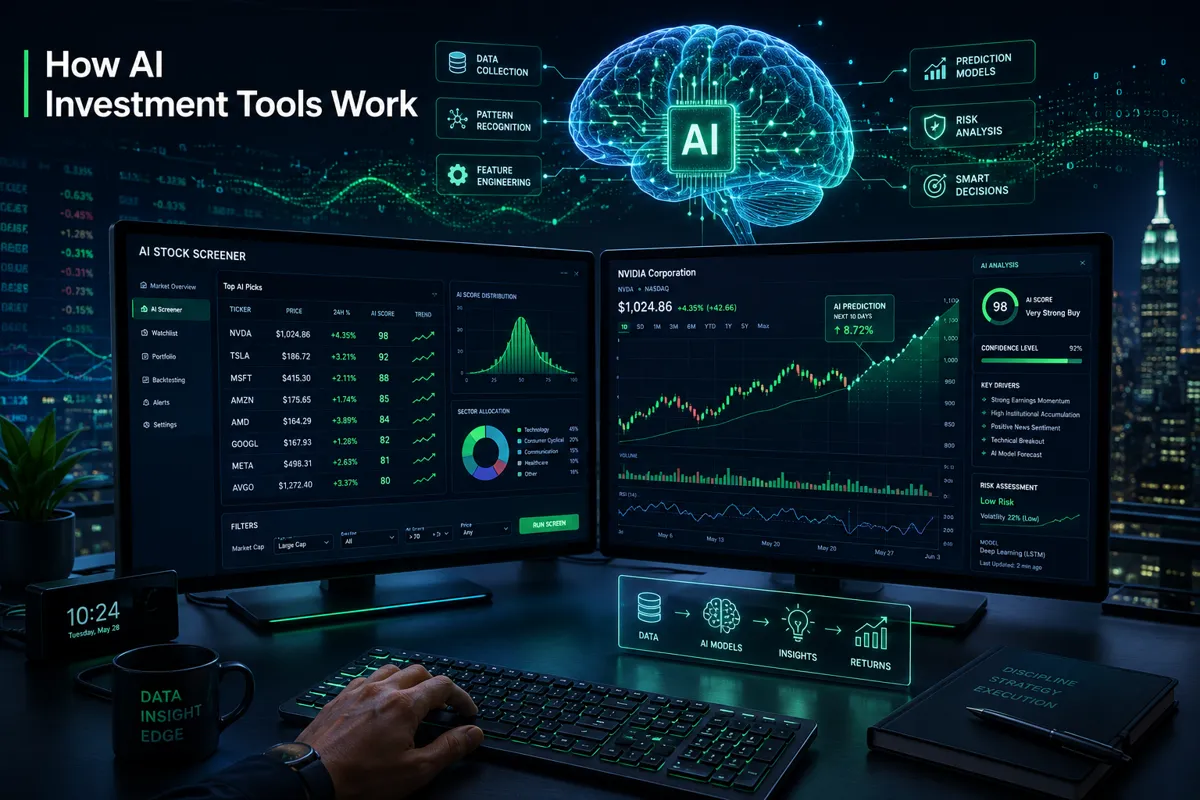
AI investment tools are software platforms that use machine learning, natural language processing, and statistical modeling to analyze market data, financial filings, news, and price action — faster and at a scale no human analyst can match.
Think of them as a research department that never sleeps, doesn't get emotional, and has read every SEC filing published in the last decade. They ingest raw data (price history, earnings transcripts, news sentiment, options flow, macro indicators) and output signals, scores, or summaries a trader or investor can actually act on.
Here's the basic architecture behind most platforms:
- Data ingestion: The tool pulls in real-time and historical data from market feeds, SEC filings, news APIs, and social sentiment sources.
- Model layer: Machine learning models (often a blend of supervised learning and large language models) identify patterns, score stocks, or summarize documents.
- Output layer: The user sees a clean signal — a buy/sell score, a chart pattern alert, a summarized earnings call, or a screener result.
The key shift in 2026 is integration. Practitioner workflows now assume AI at every research stage: idea generation, document digestion, risk analysis, and ongoing monitoring. That's not a tool — that's a system.
15 AI Investment Tools That Are Replacing Traditional Research in 2026
These aren't ranked by hype. They're grouped by what job they actually do best. Pick the ones that match your process.
AI Research and Fundamental Analysis Platforms
1. Koyfin
Koyfin is the closest thing retail investors have to a Bloomberg terminal — without the $24,000 annual price tag. It covers 500+ financial metrics, AI-generated summaries, and macro dashboards. Koyfin's platform is built for long-term investors who want to do real fundamental analysis without a finance team behind them. If you're comparing earnings growth, margins, and valuation across sectors, this is your starting point.
2. AlphaSense
Originally built for institutional research teams, AlphaSense uses AI to search across earnings call transcripts, broker research, SEC filings, and news — simultaneously. It finds the signal buried in thousands of documents in seconds. Enterprise pricing puts it out of reach for most retail traders, but it's worth knowing what the pros are using.
3. Stratosphere.io
Stratosphere.io pulls structured financial data directly from SEC filings and presents it in clean, comparable formats. It's built for the investor who wants to read the actual numbers without reformatting spreadsheets for three hours. Solid for fundamental analysis on U.S.-listed equities.
4. Brightwave
Brightwave uses generative AI to summarize and synthesize financial documents — earnings calls, analyst reports, 10-Ks. It's the "read everything, tell me what matters" tool. Early adopters in the value investing community are using it to cut research time significantly.
5. Reflexivity
Reflexivity focuses on AI-driven macro and thematic research. It's useful for investors who want to understand the broader narrative driving a sector before they drill into individual names.
AI Stock Screening and Signal Tools
6. TrendSpider
TrendSpider built an AI market analyst called Sidekick that can answer natural-language questions about charts, identify support and resistance levels automatically, and train predictive models on historical price action. TrendSpider's platform is one of the most technically sophisticated tools available to retail traders. If you're a swing trader who lives in price action, this belongs on your watchlist.
7. Trade Ideas
Trade Ideas delivers institutional-grade AI signals to retail traders. Its AI engine (called Holly) runs millions of simulations overnight and surfaces the highest-probability setups for the next trading day. Trade Ideas is built for active day traders who want a clean setup without spending three hours scanning manually before power hour.
8. Tickeron
Tickeron uses AI to identify chart patterns, generate trade ideas, and score the probability of pattern completion. It's one of the more accessible AI stock picking tools for traders who are learning technical analysis but want a second opinion from a machine.
9. Danelfin
Danelfin scores stocks using AI across 900+ technical, fundamental, and sentiment indicators — then outputs a simple 1-to-10 score. Danelfin's approach is explicitly designed as an AI-driven research alternative for retail investors. No jargon wall. Just a score, a rationale, and the data behind it.
10. TipRanks
TipRanks aggregates analyst ratings, insider transactions, hedge fund activity, and news sentiment into a single dashboard. It's one of the best AI portfolio research tools for investors who want to see what the smart money is doing — without paying for a Bloomberg subscription.
AI Sentiment and News Intelligence Tools
11. Aiera
Aiera uses AI to transcribe, summarize, and analyze earnings calls and investor events in real time. For active traders, getting a clean summary of what management actually said — before the market fully digests it — is a genuine edge during earnings season.
12. MarketReader
MarketReader explains why stocks are moving — in plain English — using AI to connect price action to news, macro events, and sector flows. It's the "why is this thing moving?" tool that cuts through the noise when the tape gets choppy.
13. Accern
Accern is an AI-powered sentiment and event detection platform. It monitors news, filings, and alternative data sources and flags material events before they're widely covered. More institutional in focus, but increasingly accessible.
AI Trading Automation Tools
14. Option Alpha
Option Alpha automates trade decisions for options traders — removing emotional bias from entry and exit rules. You define the conditions; the bot executes. It's not a signal service. It's a system builder for traders who've already done the work of defining their process. Play stupid games (trading on emotion), win stupid prizes. Option Alpha is built for people who've learned that lesson.
15. 3Commas
3Commas runs automated trading bots across crypto and equity markets. It's best for traders who want to systematize a rules-based strategy and remove themselves from the execution loop. Useful for swing traders who can't watch the tape all day.
Which AI Investment Tools Are Most Accurate Compared to Human Analysts
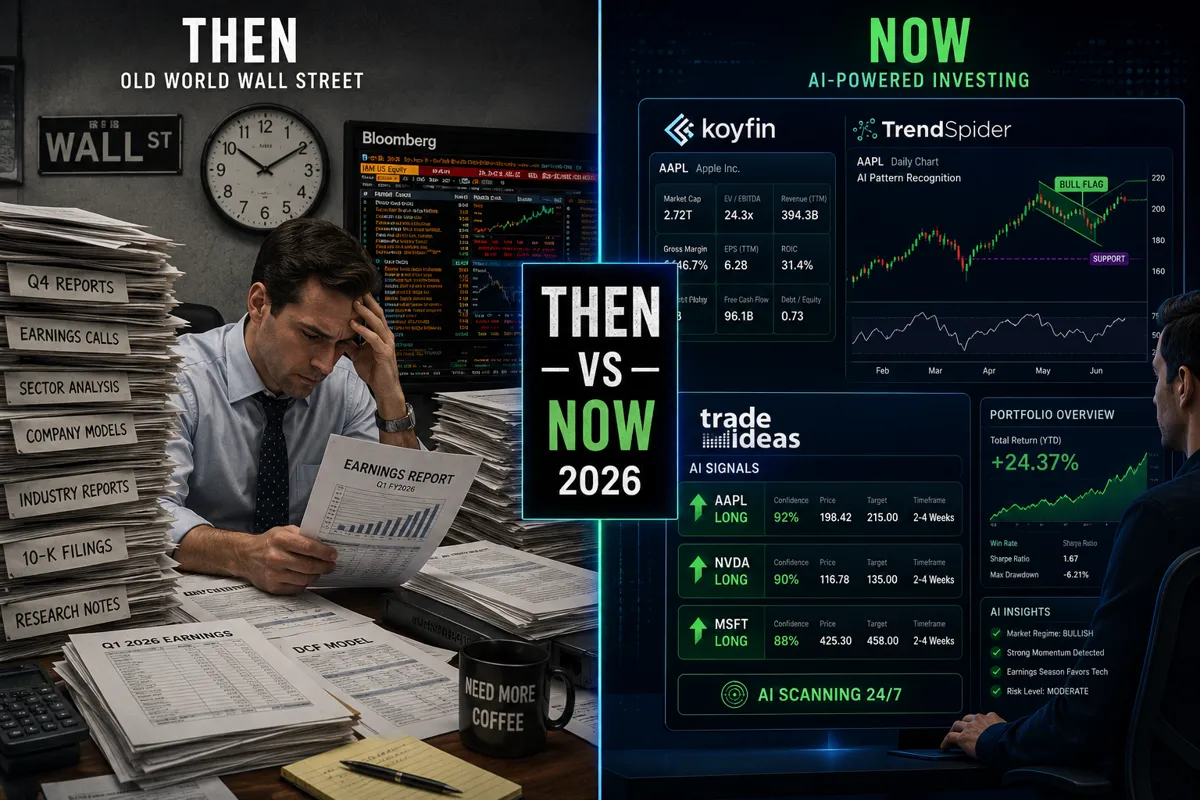
No AI tool consistently outperforms a skilled human analyst on every dimension. But they consistently outperform humans on speed, volume, and emotional neutrality.
A human analyst can deeply understand one company's competitive moat. An AI can screen 5,000 companies for the same moat characteristics in under a minute. Different jobs.
Where AI tools genuinely beat traditional research:
- Sentiment analysis at scale: Reading 10,000 news articles and earnings calls simultaneously is not something a human team does. AI does it routinely.
- Pattern recognition: TrendSpider and Tickeron identify chart patterns across thousands of tickers without fatigue or confirmation bias.
- Data consistency: AI doesn't have a bad day. It applies the same criteria to every stock, every time.
Where human analysts still have the edge:
- Qualitative judgment on management quality and competitive dynamics
- Navigating unprecedented macro events (a new pandemic, a war, a regulatory shock)
- Understanding narrative shifts before they show up in the data
The honest answer: the best process in 2026 combines both. Use AI for the heavy lifting. Use human judgment for the final call.
How Much Do Top AI Investment Research Platforms Cost
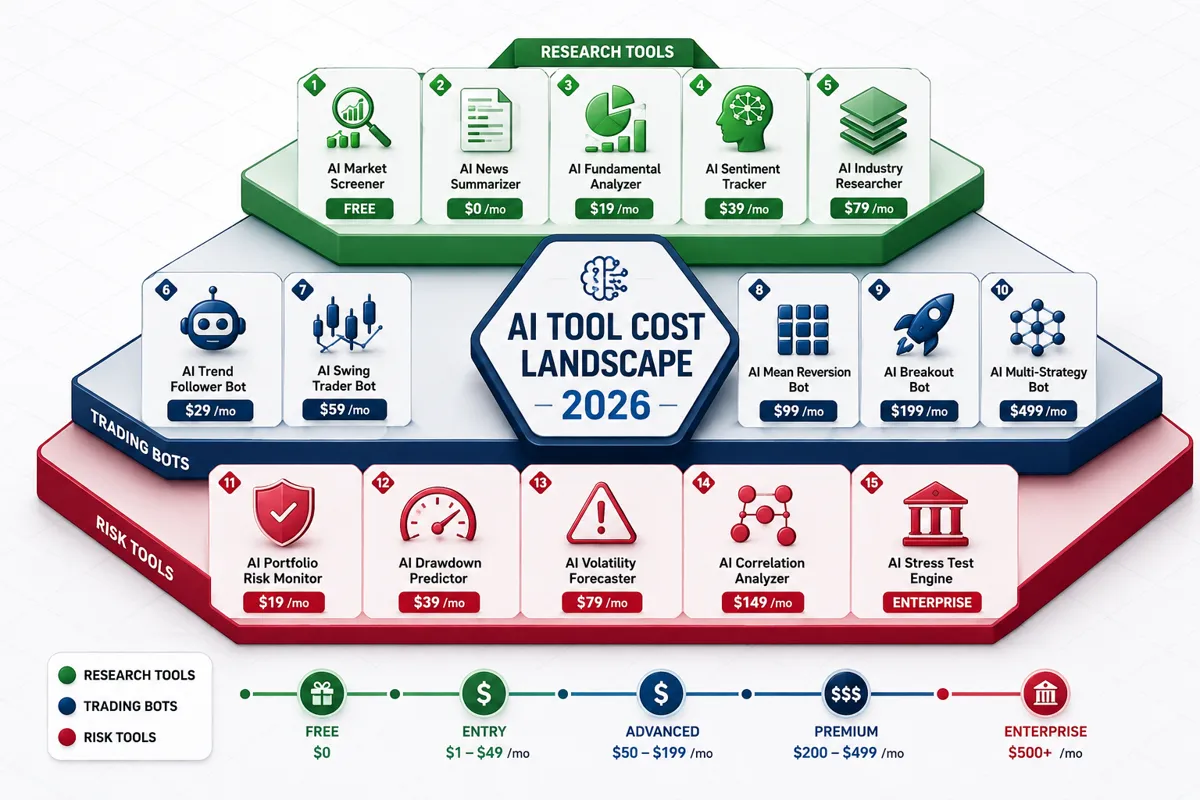
AI investment tools range from free to several thousand dollars per month, depending on the depth of data and the intended user.
| Tool | Pricing Tier | Best For |
|---|---|---|
| Koyfin | Free to ~$59/mo | Long-term investors, fundamental analysis |
| TipRanks | Free to ~$49/mo | Retail investors, analyst tracking |
| Danelfin | Free tier + paid plans | Beginners, AI stock scoring |
| TrendSpider | ~$47–$189/mo | Swing traders, technical analysis |
| Trade Ideas | ~$118–$228/mo | Active day traders |
| AlphaSense | Enterprise (custom) | Institutional research teams |
| Option Alpha | Free to ~$149/mo | Options traders, automation |
| 3Commas | ~$37–$59/mo | Automated bot trading |
Most serious retail investors can build a solid AI research stack for $50 to $150 per month. That's less than a single bad trade. Browse the full AI research tools comparison to see current pricing across 100+ platforms.
Are AI Investment Tools Good for Beginners or Just for Experienced Traders
AI investment tools are genuinely useful for beginners — with the right expectations. The key is choosing tools designed for clarity, not complexity.
Beginners should start with:
- Koyfin or TipRanks for fundamental and analyst research — clean interfaces, plain-language outputs
- Danelfin for AI stock scoring without needing to interpret raw data
- MarketReader to understand why stocks are moving before trying to trade the move
What beginners should avoid early on: jumping straight into Trade Ideas or TrendSpider without understanding what the signals mean. Analysis paralysis is real. Six scanners open and no idea what to buy is not a research problem — it's a process problem.
Paper trade it first. Use the AI tools to build your watchlist and understand the setup. Execute on paper before real money touches the screen. The free tools available here are a solid starting point for building that habit without any cost.
What Common Mistakes Do Investors Make When First Using AI Research Tools
The most common mistake is treating AI output as a trade recommendation rather than a research input. An AI score of 9/10 is not a buy signal. It's a prompt to look closer.
Other frequent errors:
- Over-relying on one tool. Signal over noise means using multiple data points, not amplifying one signal until it drowns everything else out.
- Ignoring position sizing. The AI found a great setup. Great. How much are you risking? If you can't answer that in five seconds, you're not ready to trade it.
- Skipping the stop loss. AI tools identify entries. You define exits. Getting stopped out on a clean setup is fine. Holding a losing trade because the AI "said so" is revenge trading with extra steps.
- Chasing the signal. The tool flagged a breakout three hours ago. The stock is now overextended. Chasing that is catching a falling knife in slow motion.
- Analysis paralysis. More tools don't equal better decisions. They equal more noise. Pick three signals you trust and trade only those for 30 days. That's a system. Everything else is a distraction.
Can AI Investment Tools Predict Stock Market Crashes
No. And any platform that claims otherwise is selling something you shouldn't buy.
AI tools identify patterns and probabilities based on historical data. Market crashes — real ones, the 2008-style or COVID-March-2020 kind — are driven by events that have no direct historical precedent in the data the model was trained on. The model doesn't know what it doesn't know.
What AI tools can do is flag deteriorating conditions: rising volatility, weakening breadth, unusual options activity, sentiment extremes. That's useful. It's not a crash prediction — it's a risk signal. The difference matters enormously when you're sizing positions.
Discipline beats prediction. A trader with a defined stop loss and sound position sizing survives a crash. A trader waiting for an AI to tell them the crash is coming doesn't.
What Investment Strategies Work Best With AI Research Platforms
AI investment tools amplify strategies that are already rule-based and systematic. They don't fix a strategy that has no edge.
Strategies that pair well with AI tools:
- Swing trading with technical AI: TrendSpider's pattern recognition + your own support and resistance levels = a cleaner setup with less manual scanning.
- Fundamental screening for long-term investors: Koyfin's 500+ metrics + Danelfin's AI scores = a faster way to build a high-quality watchlist without reading 50 10-Ks.
- Earnings season plays: Aiera's real-time earnings summaries + TipRanks' analyst revision tracking = faster reaction to material information during earnings season.
- Sentiment-driven momentum: Accern's event detection + MarketReader's price explanation = understanding the narrative before the price move is fully priced in.
The common thread: these tools handle the data layer. You handle the judgment layer. Systems over hacks. The AI is the research assistant. You're still the portfolio manager.
Which AI Tools Are Recommended for Different Types of Investors
The right tool depends on your time horizon and trading style. Here's the honest breakdown:
Day traders: Trade Ideas (Holly AI signals), TrendSpider (real-time pattern alerts), Tickeron (pattern probability scoring). These tools are built for speed and intraday setups. Explore day trading AI platforms for a fuller comparison.
Swing traders: TrendSpider, Koyfin (for fundamental context), TipRanks (for analyst sentiment shifts). Swing trading lives at the intersection of price action and fundamental catalyst — you need both.
Long-term investors: Koyfin, Stratosphere.io, Brightwave, Danelfin. These tools are built for patient capital — deep fundamental research, AI-summarized filings, and quality scoring over time.
Options traders: Option Alpha for automation, MarketChameleon for options flow data, TipRanks for analyst sentiment. Options trading rewards process over prediction more than any other strategy.
Beginners: Start with Danelfin, TipRanks free tier, and the AI stock prediction tools overview before committing to a paid subscription.
How Reliable Are AI Investment Recommendations Compared to Traditional Financial Advisors
AI tools and human financial advisors serve different functions. Conflating them is the source of most confusion here.
A traditional financial advisor provides personalized advice based on your full financial picture: tax situation, risk tolerance, time horizon, goals. They're regulated by FINRA and held to fiduciary or suitability standards. You can hold them accountable.
An AI investment tool provides data-driven signals based on market patterns and financial data. It doesn't know your tax bracket, your mortgage, or your retirement timeline. It's not regulated as a financial advisor. It has no fiduciary duty to you.
That said, for the specific job of stock research and idea generation, AI tools in 2026 are genuinely competitive with what most retail investors get from a human advisor — because most retail investors aren't getting deep stock research from their advisor anyway. They're getting asset allocation and financial planning, which is a different service entirely.
Use AI tools for research. Use a fiduciary advisor for financial planning. Don't mix the two jobs up.
What Technical Skills Do You Need to Use Advanced AI Investment Research Tools
Most modern AI investment tools require no coding or technical background. The interface is the product.
- Beginner-friendly (no skills needed): Koyfin, TipRanks, Danelfin, MarketReader, Aiera. Point, click, read.
- Intermediate (basic market knowledge helps): TrendSpider, Trade Ideas, Tickeron. You need to understand what a support level or a breakout means to use the output correctly.
- Advanced (coding or quant background useful): AlphaSense (for custom query building), QuantConnect (for algorithmic strategy backtesting), Alpaca (for API-based automated trading).
The honest truth: the technical barrier for most retail-facing AI tools is low. The knowledge barrier is higher. Understanding what the signal means — and when to ignore it — requires market experience, not a computer science degree.
Are There Any Free AI Investment Research Platforms
Yes. Several serious platforms offer free tiers that are genuinely useful, not just bait-and-switch trials.
- Koyfin: Free tier covers basic charting and financial data for hundreds of metrics.
- TipRanks: Free access to analyst ratings, insider transactions, and news sentiment.
- Danelfin: Free tier includes AI scores for a limited number of stocks.
- Finviz: Free stock screener with basic technical and fundamental filters — not AI-native, but widely used as a starting scanner.
- FullStack Alpha free tools: The stock health scorecard, expectancy calculator, and screener recipe builder are worth bookmarking before you spend a dollar on a subscription.
Free tools are where you build the habit. Paid tools are where you scale the edge. Start free, upgrade when the tool is clearly limiting your process — not before.
What Legal or Regulatory Concerns Exist Around AI Investment Recommendations
This is the part most AI tool marketing glosses over. Pay attention.
AI-generated investment recommendations are not regulated financial advice under current SEC or FINRA rules. That means the platform has no fiduciary duty to you, no obligation to know your financial situation, and no liability if the signal is wrong.
Key things to know:
- Not personalized advice: AI tools generate signals based on data patterns, not your individual circumstances. The SEC's investor education resources at Investor.gov are worth reviewing before treating any AI output as a personal recommendation.
- No guarantee of accuracy: Platforms are required to disclose that past performance doesn't guarantee future results. Read those disclosures — they're not legal boilerplate, they're operationally true.
- Regulatory evolution: The SEC has been actively examining AI use in financial services. The rules are changing. What's compliant today may not be compliant in 18 months.
- Conflicts of interest: Some AI tools are affiliated with brokers or earn revenue from order flow. Know who's paying for the platform you're using.
The bottom line: AI tools are research aids, not advisors. Treat them accordingly.
How Do AI Investment Tools Handle Different Global Market Conditions
Most AI investment tools are built primarily around U.S. equity markets — NYSE, NASDAQ, and major ETFs. Coverage of international markets varies significantly by platform.
- Strong global coverage: Koyfin covers international equities across major global exchanges. AlphaSense covers global filings and research. TipRanks has expanded analyst coverage internationally.
- U.S.-focused: Trade Ideas, TrendSpider, and most retail-facing day trading tools are optimized for U.S. market hours and U.S.-listed securities.
- Crypto and global assets: 3Commas and Alpaca support international crypto and some global equity access.
One honest limitation: AI models trained primarily on U.S. market data may produce less reliable signals in markets with different regulatory environments, liquidity profiles, or reporting standards. A choppy tape in an emerging market behaves differently than a choppy tape in the S&P 500. The model may not know the difference.
If you're trading international markets seriously, verify that the tool's training data and coverage actually includes those markets before trusting the output.
What Happens If an AI Investment Tool Gives Incorrect Financial Advice
If an AI tool gives you a bad signal and you lose money, the legal answer is: that's almost certainly on you. The platforms are not liable for trading losses based on their signals.
This isn't cynical — it's the reality of how these tools are structured and disclosed. Every serious platform includes disclaimers stating that their outputs are for informational purposes only, not investment advice.
What you should do:
- Read the terms of service before subscribing. Know what the platform claims to be and what it explicitly disclaims.
- Never risk more than you can afford to lose on any single signal. Position sizing is your primary risk management tool — not the AI's accuracy rate.
- Keep a trading journal. If you're using AI signals, track which ones worked, which didn't, and why. That data is yours. Use it to calibrate how much weight you give any single tool.
- Have a stop loss on every trade. The AI found the entry. You define the exit. If the trade goes wrong, the stop loss is what keeps a bad signal from becoming a blown account.
Cut losers fast. Let winners run. That rule doesn't change because an AI generated the idea.
Conclusion: Build the System, Not the Wishlist
The 15 AI investment tools replacing traditional research in 2026 aren't magic. They're infrastructure. The difference between a trader who uses them well and one who burns through subscriptions is the same difference it's always been: process over prediction.
Here's what to do next — not just know, but actually do:
- Identify your investor type (day trader, swing trader, long-term). That narrows your tool list from 15 to three or four immediately.
- Start with one free tool. Koyfin or TipRanks for long-term investors. TrendSpider's free trial for swing traders. Build the habit before spending money.
- Define your process before you subscribe. What signal are you looking for? What's your entry rule? What's your stop loss? If you can't answer those questions, no AI tool will answer them for you.
- Paper trade the AI signals for 30 days. Track the results. See where the tool adds value and where it generates noise.
- Upgrade one tool at a time. Don't build a six-tool stack on day one. That's tool overload dressed up as research.
The goal isn't to own every tool on this list. The goal is to cut the noise, keep the alpha, and build a repeatable process that works whether the market is trending or choppy.
Compare 100+ AI stock tools side by side and find the ones that actually fit your process — not the ones with the best marketing.

Frequently Asked Questions
What is the best AI investment tool for beginners in 2026?
Koyfin and TipRanks are the best starting points for beginners. Both offer free tiers, plain-language outputs, and clean interfaces that don't require a finance background to use effectively.
Can AI tools replace a financial advisor?
No. AI investment tools handle research and signal generation. A fiduciary financial advisor handles personalized financial planning, tax strategy, and goal-based advice. These are different services. Use both for different jobs.
How accurate are AI stock picking tools?
Accuracy varies by tool and market condition. No AI tool has a consistently perfect track record. Danelfin and Tickeron publish backtested performance data — review it critically and understand that past pattern accuracy doesn't guarantee future results.
Is ChatGPT useful for stock analysis?
ChatGPT can summarize financial documents, explain concepts, and help structure research questions. It's not a real-time market data tool and should not be used as a primary signal source. It works best as a research assistant, not a stock picker.
What is the cheapest serious AI investment research platform?
Koyfin's paid tier starts around $59 per month and offers institutional-quality data coverage. Danelfin and TipRanks both have useful free tiers. The free tools at FullStack Alpha are worth using before committing to any subscription.
Do AI investment tools work for options trading?
Yes, with the right tools. Option Alpha automates options trade execution. MarketChameleon covers options flow and volatility data. TipRanks tracks analyst sentiment shifts that often precede options-worthy moves.
Are AI investment tools legal to use?
Yes. Using AI tools for personal investment research is completely legal. The regulatory question is whether the platform itself is operating within SEC and FINRA guidelines — which is the platform's responsibility, not yours.
How do I avoid information overload when using multiple AI tools?
Pick one tool per job: one for fundamental research, one for technical signals, one for news sentiment. Three tools with clear roles beat six tools with overlapping functions. Signal over noise is a system choice, not just a mindset.
What is the difference between AI trading bots and AI research tools?
AI research tools surface information and signals for you to act on. AI trading bots execute trades automatically based on pre-defined rules. Bots like those on 3Commas remove you from the execution loop — which is a feature if your process is solid, and a liability if it isn't.
Can AI investment tools handle international stocks?
Some can. Koyfin and AlphaSense have strong international coverage. Most retail-focused day trading tools are optimized for U.S. markets. Verify coverage before using any tool for international equity research.
What should I do if an AI tool gives me a signal that conflicts with my own analysis?
Treat the conflict as a reason to look closer, not a reason to override one signal with the other. Document both views, identify what each is based on, and size the position smaller if you can't resolve the conflict. Uncertainty is a position sizing input, not a trading paralysis trigger.
How often should I update my AI tool stack?
Review your tools every six months. Ask: is this tool still adding signal, or is it adding noise? If you can't point to a specific way a tool improved a decision in the last 90 days, it's probably not earning its subscription fee.
References
AI Tools Investment Research - https://www.thirdbridge.com/en-us/about-us/media/perspectives/ai-tools-investment-research
Best AI Tools For Stock Research 2026 - https://barebone.ai/blog/best-ai-tools-for-stock-research-2026
How To Use AI For Investing In 2026 Real Strategies - https://getaitoolhub.com/articles/how-to-use-ai-for-investing-in-2026-real-strategies
The Best Investing Research Tools For 2026 - https://www.reddit.com/r/ValueInvesting/comments/1pyu357/the_best_investing_research_tools_for_2026/
Investment AI Trends - https://www.scnsoft.com/investment/investment-ai-trends
Build AI Investment Research Workflow 2026 - https://www.datatobrief.com/blog/build-ai-investment-research-workflow-2026
AI War And Income - https://www.blackrock.com/us/financial-professionals/insights/ai-war-and-income