Best Options Flow Platform 2026: 7 Compared on Price
Short answer: Unusual Whales is the best options flow platform for most active retail traders, pairing real-time flow with dark pool prints for roughly $48 a month.
Quick answer
The best options flow platform for most active retail traders is Unusual Whales, at roughly $48 a month, because it pairs real-time options flow with dark pool prints at a price where a bad month doesn't wreck your budget. If you want the cleanest real-time interface and don't mind paying more, Cheddar Flow is the better desk tool. If you want flow context instead of a firehose, Market Chameleon does the research job. And if you're paying nothing today, Barchart gives you delayed unusual options activity for free, which is plenty to learn how to read the tape before you buy speed.
Prices below are the publicly listed rates we saw as of September 2026. Vendors change tiers constantly. Verify on the provider's page before you enter a card.
Best options flow platform: key takeaways
Seven tools, one real question: which feed fits your holding period and your monthly budget?
- Unusual Whales sits near $48 per month and is the cheapest tool on this list that bundles real-time options flow with dark pool prints.
- Cheddar Flow runs about $59 per month on its entry plan and roughly $99 on Pro, and its speed advantage comes from a simple, low-clutter streaming feed rather than a wall of widgets.
- Barchart's unusual options activity screener is free on a 15-minute delay, with Barchart Premier around $29.95 per month for expanded screening. Free and delayed is still the best training ground.
- Real-time options data isn't free for anyone. Platforms that stream live quotes pay OPRA (the Options Price Reporting Authority) for the feed, and that cost gets passed to you. Anything free is almost certainly delayed.
- "Dark pool data" means off-exchange equity prints, reported through FINRA's trade reporting facilities. It is not secret options data, and it is not instant.
- BlackBoxStocks at roughly $99.97 per month bundles flow with a stock scanner and a live community, which is either the value or the distraction, depending on your discipline.
- Alert speed is worth less than alert precision. A feed that fires 400 alerts a day and a feed that fires 12 both take the same second to arrive. Only one is usable.
How did we pick the best options flow platform for each trader?
We ranked on five things, in this order: signal quality, transparency, price-to-value, usability, and what actual users say in places where nobody gets paid to say it.
That's the same five-pillar framework we apply to every tool on the site, and for flow platforms it translates into some very specific questions.
Signal quality. Does the feed mark aggressive orders correctly? A sweep (an order broken across multiple exchanges to fill fast) means something different from a single block print sitting on the bid. If the platform can't separate those, the feed is noise with timestamps.
Data source and latency. Is the feed real-time from OPRA, or delayed by 15 minutes? Delayed flow is fine for studying patterns and useless for intraday entries. Any platform that gets vague about this gets marked down.
Filter depth. Can you screen by premium size, expiry window, at-the-money versus far out-of-the-money, sweep versus block, and repeat activity on the same strike? Without filters, every platform becomes the same unreadable waterfall.
Alert plumbing. Push, desktop, email, Discord, webhook. And more importantly: can you cap how many fire? Unlimited alerts are a productivity tax.
Price against the free alternative. If a free tool does 80% of the job, the paid tool has to justify the other 20%. We say so when it doesn't.
One thing we did not score: win-rate claims. No flow platform can prove you'd have made money following its alerts, and the ones that imply otherwise are selling a lottery ticket with a UI. For the broader category map, see our roundup of AI options tools.
Best options flow platform picks at a glance
The best options flow platform on paper is useless if its feed speed doesn't match how long you actually hold a trade.
Here's the whole field on the decision columns that actually change your choice: whether the feed is real-time or delayed, whether you get dark pool prints, how alerts work, whether there's a usable mobile app, and whether you can test it without paying.
| Platform | Real-time vs delayed | Dark pool data | Alerts | Mobile app | Free tier | Price (monthly, listed Sept 2026) |
|---|---|---|---|---|---|---|
| Unusual Whales | Real-time | Yes, off-exchange prints | Custom in-app, Discord, webhook | Yes (iOS/Android) | Limited free view | ~$48 |
| Cheddar Flow | Real-time | Yes | Custom alerts, push, Discord | Yes (responsive/app) | No, trial only | ~$59 (Pro ~$99) |
| InsiderFinance | Real-time | Yes | Push + desktop, scored alerts | Yes | No, trial only | ~$79 |
| Market Chameleon | Mostly delayed, real-time on higher tiers | No | Email/watchlist alerts | Browser-first | Yes, meaningful free tier | ~$99 (free tier available) |
| Barchart Premier | 15-min delayed (real-time add-on) | No | Email and app alerts | Yes | Yes, strong free screener | ~$29.95 |
| BlackBoxStocks | Real-time | Yes | Push, desktop, Discord, community calls | Yes | No, trial only | ~$99.97 |
| Tradytics | Real-time on paid tiers | Yes | Dashboard + alert bots | Yes | Limited free tools | ~$49 to $99 |
Read that table as a budget decision first, not a feature decision. Under $50, you're choosing between Unusual Whales and Tradytics. At $99, you're choosing whether you want a community (BlackBoxStocks) or research depth (Market Chameleon). At $0, Barchart is the answer and it isn't close.
1. Unusual Whales: best overall options flow platform for the price
If we had to name one best options flow platform for most traders, this is it, because roughly $48 a month buys both real-time flow and dark pool prints.
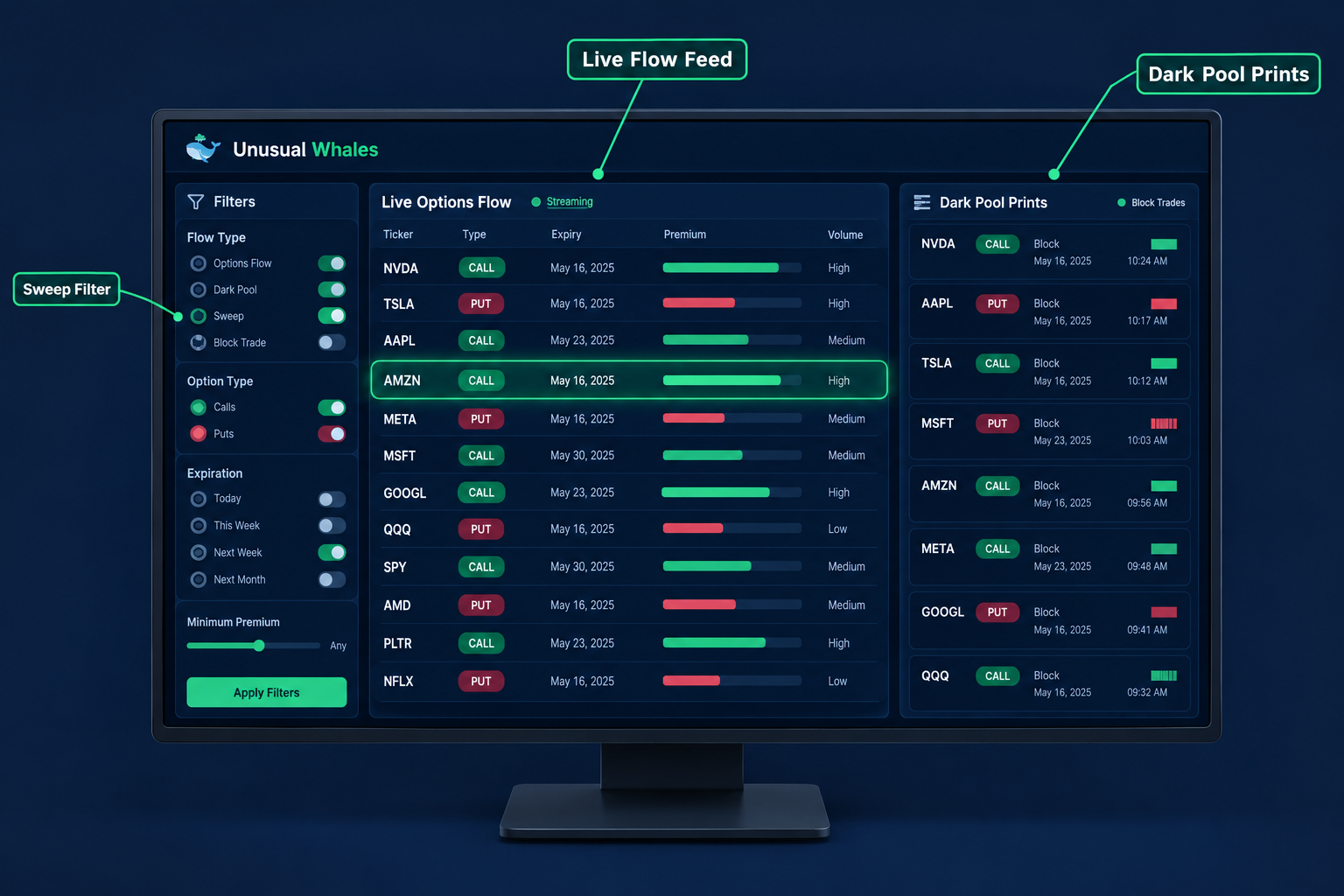
Best for: Active retail traders who want real-time flow plus dark pool prints without crossing $100 a month.
Unusual Whales became the default for a boring reason: it gives you the two feeds most traders want, at a price most traders can carry through a losing month. Real-time options flow, filterable by premium, sweep type, expiry, and ticker. Off-exchange equity prints for context. Plus a pile of extras like congressional trade tracking and earnings data that you'll either love or ignore entirely.
The interface is dense. That's the trade. You get a lot of screen for your money and a learning curve to match, and the first week is mostly you figuring out which filters to keep.
Key features
- Real-time options flow with sweep, block, and split-order tagging
- Off-exchange (dark pool) equity prints with ticker-level aggregation
- Custom alert builder with Discord and webhook delivery
- Flow analytics by ticker: net premium, call/put ratio, open interest changes
- Mobile apps for iOS and Android, plus an active Discord
✅ Pros
- Best price-to-value on this list for a real-time flow plus dark pool combination
- Deep filtering, so you can cut a 3,000-row feed down to 20 prints that matter
- Transparent about what each order tag means, which is rarer than it should be
- Large user base, so there's real public discussion when something breaks
❌ Cons
- Onboarding is thin. Powerful defaults, poor hand-holding
- Feature sprawl. Half the dashboards will never be part of your process
- The Discord culture can pull you toward chasing prints instead of running a plan
Skip it if you want a tool that tells you what to do. Unusual Whales hands you data and expects you to bring the framework.
2. Cheddar Flow: best for clean real-time speed
Cheddar Flow is the best options flow platform for traders whose bottleneck is reading speed, not data breadth.
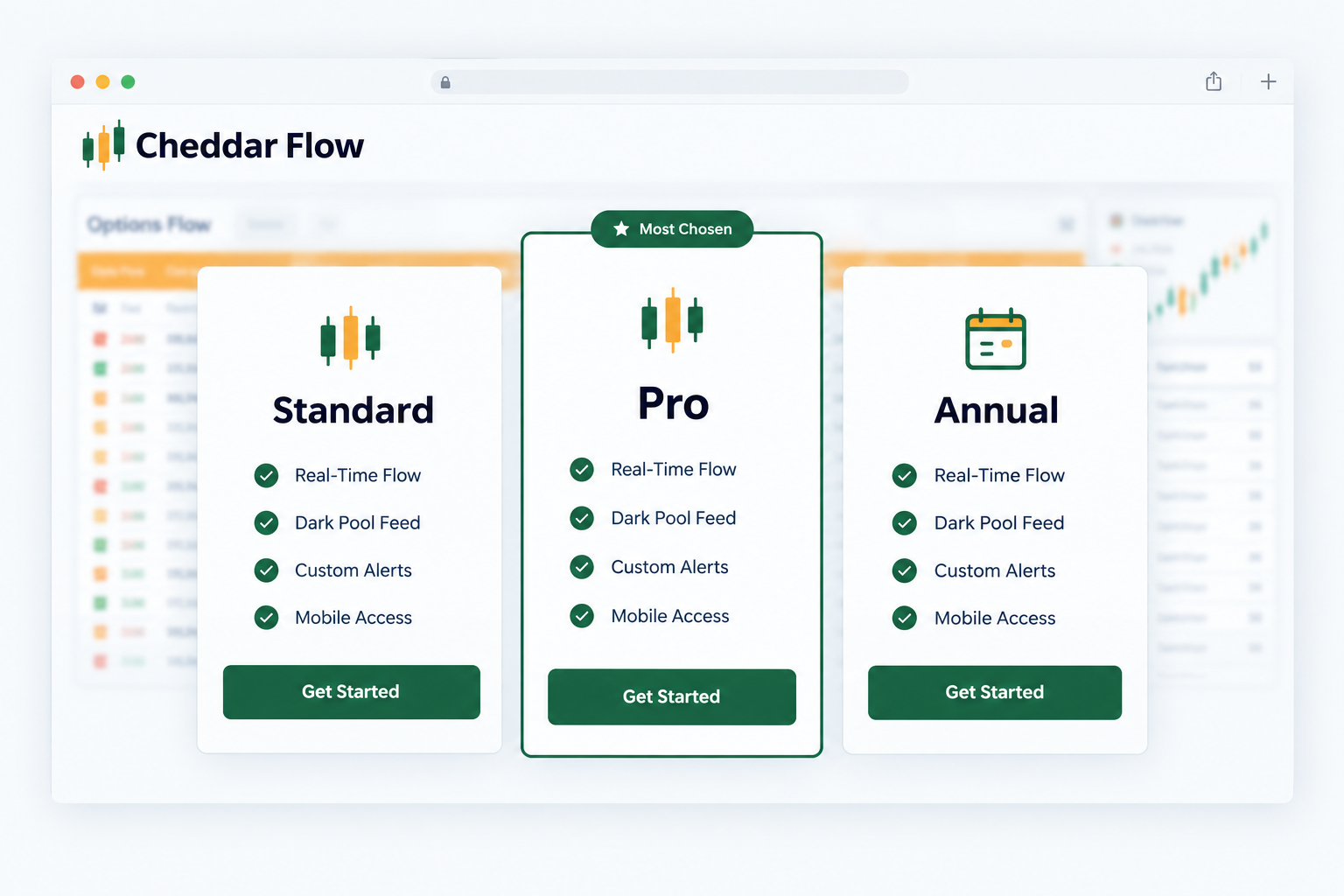
Best for: Intraday traders who want the flow feed to be the whole screen, not one tab among twenty.
Cheddar Flow made a decision most competitors didn't: fewer features, faster read. The live feed is legible at a glance, the color coding is consistent, and you can build a filtered view in under five minutes on day one. For a tool where your eyes are the bottleneck, that matters more than another module.
Entry pricing sits around $59 a month, with a Pro tier near $99 that opens up more historical data and additional filters. Compared with Unusual Whales you're paying more for less breadth, and buying back time.
Key features
- Streaming real-time options flow with sweep and block distinction
- Dark pool print feed
- Saved filter presets and custom alerts with push delivery
- Historical flow lookback on higher tiers
- Simple charting overlays tied to flow events
✅ Pros
- Fastest time to a usable, filtered view of any paid tool here
- Uncluttered layout that holds up during a fast tape
- Alert setup is genuinely simple, so people actually configure it
❌ Cons
- Costs more than Unusual Whales while offering fewer data sets
- No free tier, so evaluation depends on a trial window
- Historical and analytics depth lag the research-first tools
Choose Cheddar Flow if you've already tried a dense platform and quit because reading it during power hour felt like work.
3. InsiderFinance: best for traders who want the flow scored
Think of InsiderFinance as a triage desk for the tape: it sorts prints, it doesn't make your decisions.
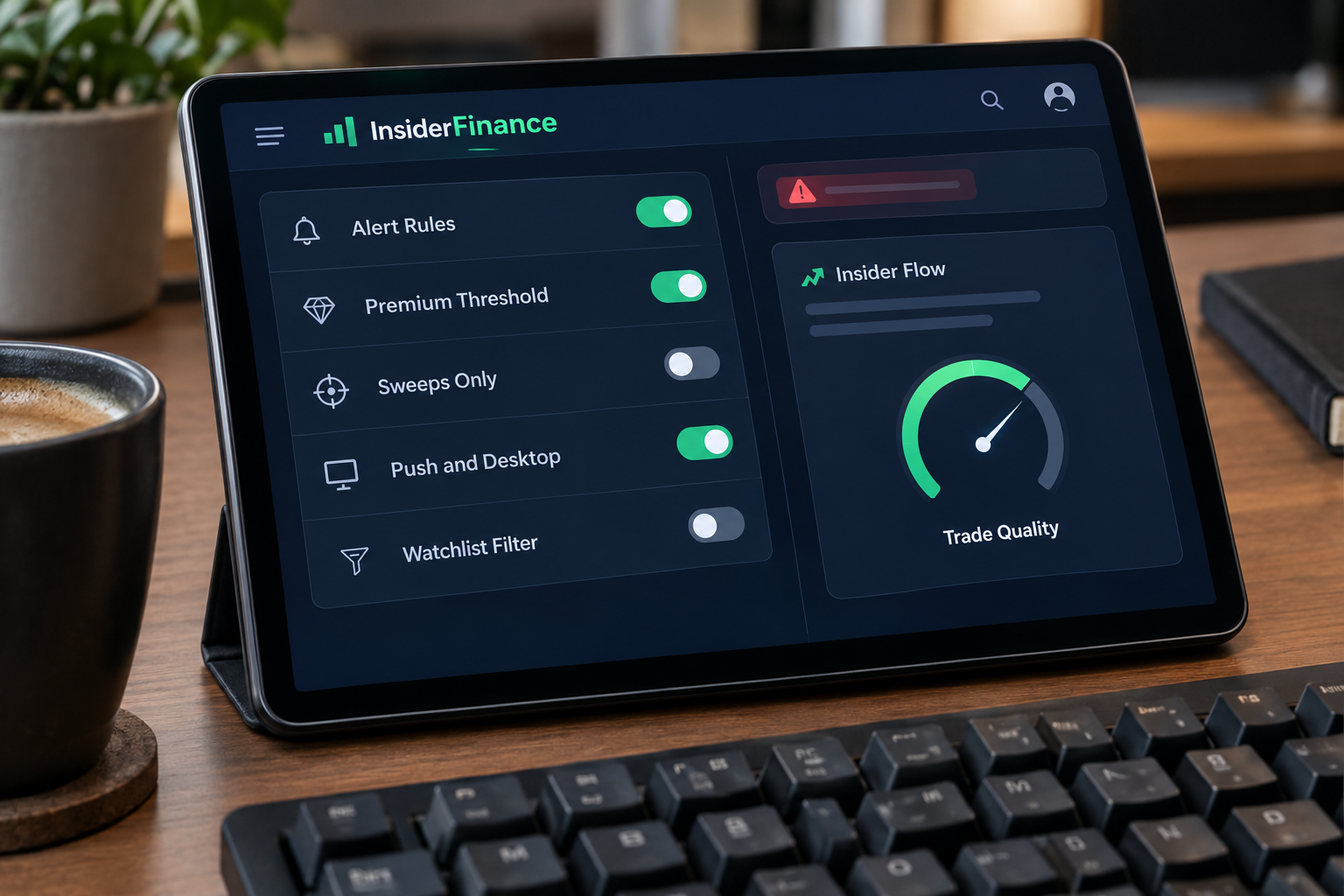
Best for: Newer flow traders who need a filter that thinks before they've built their own.
InsiderFinance layers a scoring model on top of raw flow, ranking prints by characteristics like aggressiveness, size relative to open interest, and expiry urgency. Around $79 a month, you're paying for triage. Instead of 2,000 prints, you get a shorter list with a quality read attached.
That's genuinely useful when you're starting out, and it's also the risk. A score feels like an answer. It isn't. It's a sort order.
Key features
- Real-time flow with a proprietary quality score per print
- Dark pool prints and market internals dashboard
- Push and desktop alerts tied to score thresholds
- Trade idea dashboards organized by sector and direction
- Built-in education library
✅ Pros
- Shortest list of "look at this" items among the paid tools, which cuts analysis paralysis
- Alerts can be throttled by score, so you're not buried
- Education material is aimed at real beginners rather than upsell bait
❌ Cons
- The scoring method is only partly disclosed. You're trusting a weighting you can't fully inspect
- Priced above the cheaper real-time options without a broader data edge
- Scores tempt you to act without checking the chart, which is how traders end up as exit liquidity on a print that was a hedge
Fix for that last one: never take a scored alert without checking support and resistance on the underlying chart. The print tells you money moved. The chart tells you where your stop goes.
4. Market Chameleon: best for flow context and research depth
Swing traders hunting for the best options flow platform usually need context more than speed, and that is the gap Market Chameleon fills.
Best for: Swing traders and premium sellers who want to know whether unusual activity is actually unusual.
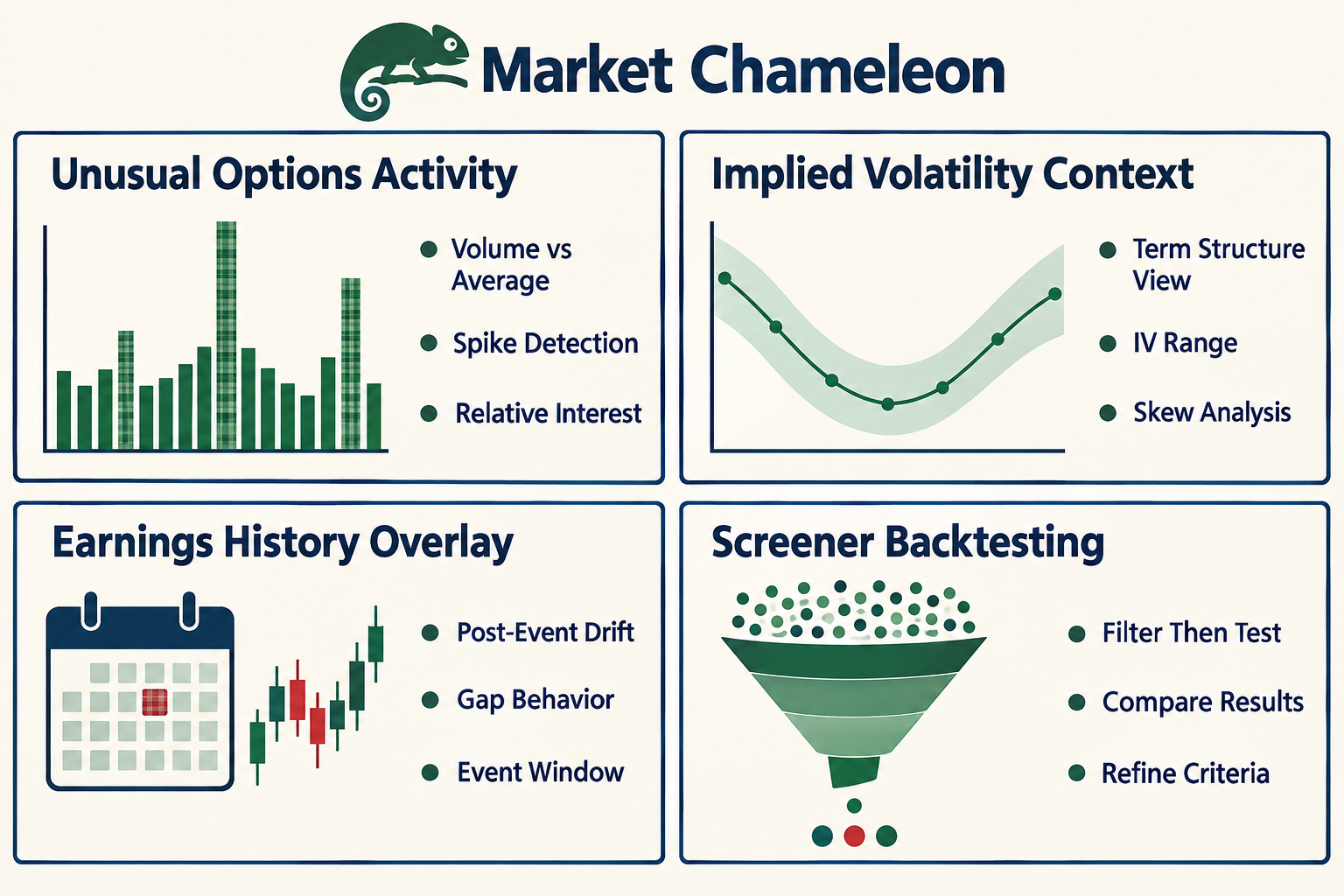
Market Chameleon isn't a live tape. It's a research bench, and for a lot of traders that's the better purchase. Unusual options activity here comes wrapped in the context that makes it interpretable: volume versus average, implied volatility rank, earnings history, term structure, expected move. Premium runs around $99 a month, and the free tier is unusually generous.
The single most common flow mistake is reacting to a big print without knowing that ticker prints big every Tuesday. Market Chameleon solves that problem better than anything else on this list.
Key features
- Unusual options activity with volume-versus-average baselines
- Implied volatility rank, term structure, and expected move data
- Earnings-move history and post-event drift stats
- Screener backtesting on option strategies
- Strong free tier with daily-use tools
✅ Pros
- Best context of any tool here. Turns a print into a question you can answer
- Free tier is legitimately useful, not a demo
- Screener backtesting lets you check whether a filter ever worked before you trade it
❌ Cons
- Not a real-time intraday flow feed on standard tiers. Wrong tool for scalping
- No dark pool equity prints
- Interface is table-heavy and dated. Function over comfort
Choose Market Chameleon if your holding period is measured in days or weeks. It pairs well with the filters we cover in our options screener breakdown.
5. Barchart Premier: best free and cheapest paid option
Before you pay for the best options flow platform on this list, spend two weeks on the free one.
Best for: Traders who haven't proven yet that paid flow changes their decisions.
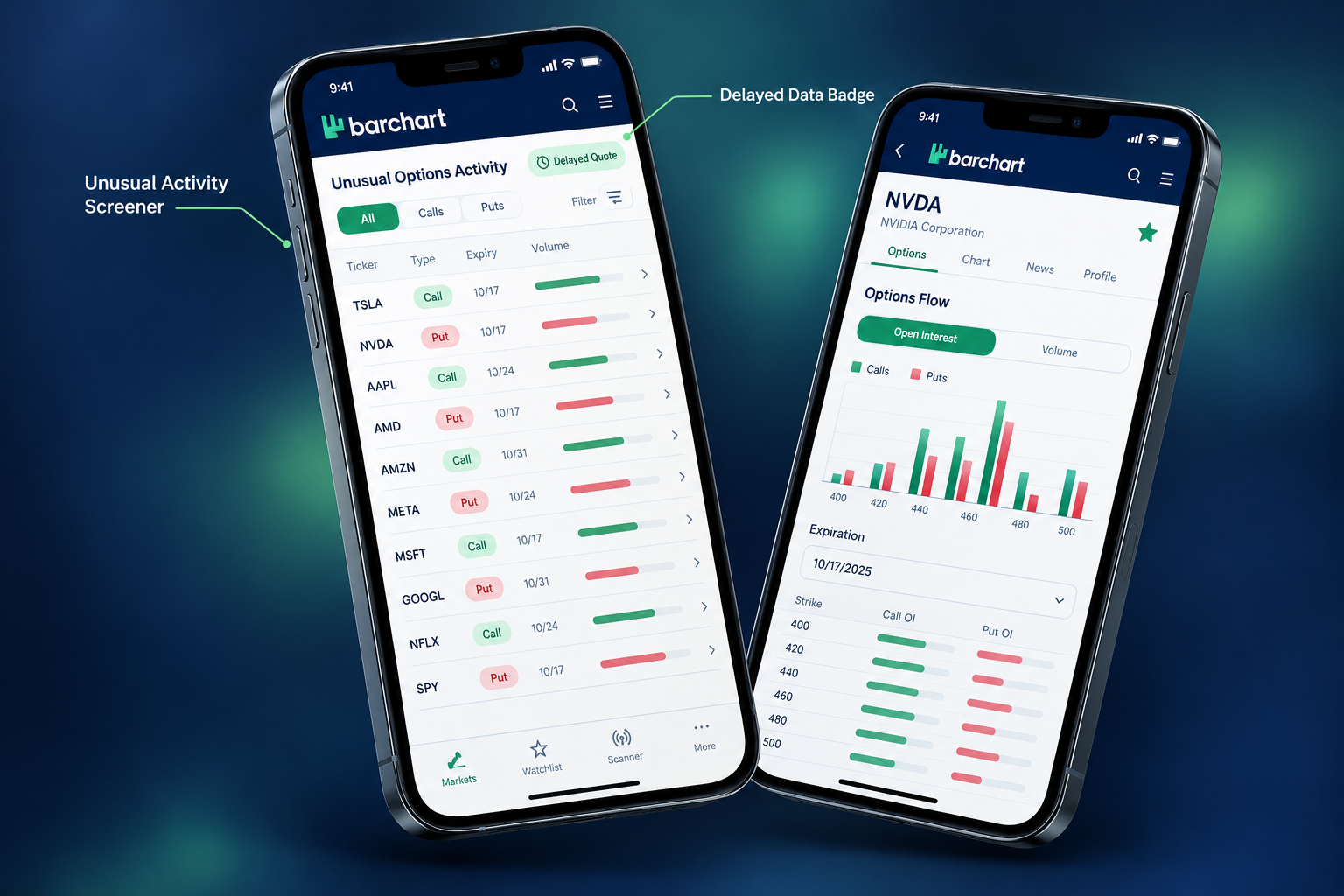
Barchart publishes a free unusual options activity screener on a 15-minute delay, and Premier sits around $29.95 a month for expanded screening, more watchlist slots, and additional data views. It is the cheapest credible entry point in this category by a wide margin.
Delayed data has one real limitation: you can't chase the print. You can still learn which prints preceded moves, which didn't, and how often "unusual" is just a rolled hedge. That's the skill. Buy speed after you have it, not before. We wrote a full walkthrough on reading Barchart's unusual options activity.
Key features
- Free unusual options activity screener (15-minute delay)
- Volume versus open interest ratios and IV data
- Premier tier adds expanded screeners, alerts, and larger watchlists
- Real-time data available as a paid add-on
- Solid mobile app
✅ Pros
- The best free option in this category, with no meaningful strings
- Premier is roughly a third the price of the $99 tier tools
- Broad market coverage beyond options, including futures and equities
❌ Cons
- Default data is delayed, so it's the wrong tool for intraday entries
- No dark pool prints and no sweep-versus-block tagging
- Alerts are basic compared with the dedicated flow platforms
Decision rule: if you can't point to three trades in the last month where 15 minutes of delay would have changed the outcome, stay here and save the $70.
6. BlackBoxStocks: best flow plus scanner bundle
Bundles only save money when they replace a subscription you already pay for.
Best for: Traders who want options flow, a stock scanner, and a live room in one subscription.
BlackBoxStocks runs about $99.97 a month (with a discounted annual rate) and bundles three things: a real-time options flow feed, an equity scanner that flags volume and volatility spikes, and an audio-plus-chat community that runs through the session.
The bundle math works if you'd otherwise pay for a scanner separately. It works against you if you're the kind of trader who starts taking other people's ideas at 10:15 because yours haven't triggered yet. Be honest about which one you are.
Key features
- Real-time options flow with dark pool prints
- Proprietary equity scanner for volume, volatility, and momentum spikes
- Live trading room with audio, chat, and moderators
- Custom alerts across desktop, push, and Discord
- Built-in charting
✅ Pros
- Replaces two subscriptions for people who need a scanner and a flow feed
- The scanner is genuinely good at surfacing unusual volume in real time
- Structured live sessions help newer traders learn what to look at
❌ Cons
- Priciest per-feature option here if you only want flow
- Community pressure is a real risk for undisciplined traders. Rooms create urgency that your plan didn't ask for
- Public sentiment is split. Reddit threads run harder on the subscription cost than the product, while app-store reviews skew warmer. That gap is the finding
Skip it if you already run a scanner you like. You'd be paying twice for the same job. Our AI trading platform comparisons cover the standalone scanner options.
7. Tradytics: best for AI-layered flow dashboards
For traders who would rather read a dashboard than a waterfall of prints, Tradytics is the best options flow platform in the group.
Best for: Data-minded traders who want flow aggregated into models rather than read line by line.
Tradytics runs roughly $49 to $99 a month depending on tier, and it takes a different angle: instead of handing you a raw tape, it aggregates flow into dashboards, ranked scans, and pattern-based models. Net premium by ticker, options sentiment gauges, algo-generated setups, dark pool activity summaries.
If you like thinking in aggregates, this is the cheapest way to get them. If you want to see the individual print that moved a name at 2:47, it's a weaker fit than Unusual Whales or Cheddar Flow.
Key features
- Real-time flow aggregation with net premium and sentiment dashboards
- Dark pool activity summaries by ticker
- AI-generated scans and pattern models
- Alert bots for dashboard triggers
- Several free tools available without a subscription
✅ Pros
- Lowest entry price on this list for real-time-based tooling
- Aggregated views cut the firehose problem at the source
- Free tools let you sample the approach before paying
❌ Cons
- Model methodology is disclosed at a high level only. You're trusting the aggregation
- Weaker for print-by-print tape reading
- More dashboards than most traders will ever use, which invites tab sprawl
Common mistake here: treating a bullish sentiment gauge as a trade signal. Aggregated flow is a weather report. You still need a setup, an entry, and a stop.
Platform picker
Options Flow Platform Picker
Which two of the seven flow platforms in this roundup fit your budget, speed needs and trading style?
What should you look for in the best options flow platform?
Start with one question: does your holding period need real-time data at all? Everything else follows from the answer.
If you hold minutes to hours, you need a real-time feed, sweep tagging, and alerts you can throttle. Budget $50 to $100 a month and accept it as a cost of doing business.
If you hold days to weeks, delayed flow plus strong context beats a fast tape. Market Chameleon or Barchart will serve you better than a streaming feed you check twice a day.
Then work through these five checks.
- Confirm the data source. Real-time US options quotes come from OPRA, and platforms pay for that entitlement. If a vendor won't say whether the feed is real-time or delayed, assume delayed. The Options Clearing Corporation publishes official volume statistics if you want a neutral baseline for how much activity is out there.
- Understand what dark pool data actually is. Off-exchange equity trades reported through FINRA's facilities. FINRA publishes weekly ATS volume data on finra.org. Useful for spotting accumulation, not a live footprint of institutional intent.
- Test the filters before the alerts. A platform's value is how small it can make the feed. If you can't get it under 30 items a day, it will train you to ignore it.
- Check the exit. Monthly billing, self-serve cancellation, no forced annual. Trustpilot complaints in this category cluster around cancellation friction far more than data quality.
- Count what you'd cancel. If a $99 bundle replaces a $39 scanner and a $49 flow tool, it's cheap. If it replaces nothing, it's a $99 habit.
One more thing, and it's the one people skip. Write your flow rule before you subscribe. Something like: "I only act on prints over $250,000 premium, 21 to 60 days to expiry, in a name already basing above its 20-day average, and I size at 1% risk with a defined stop." Paper trade it first for two weeks. If you can't follow the rule with free delayed data, speed won't save you. It'll just help you lose faster.
Do you need the best options flow platform, or will your broker do?
Flow platforms are one of three ways to see large options activity, and the other two are cheaper for some traders.
Options trading platforms (your broker). Thinkorswim, Interactive Brokers TWS, and tastytrade all show time-and-sales, volume versus open interest, and unusual volume scans at no extra cost on top of market data fees. What they don't do is tag aggression, aggregate net premium across a session, or stream a filtered cross-market feed. If you just want to see whether today's volume on a strike is abnormal, your broker already answers that. Check before you pay for a ninth tab.
Charting platforms with flow add-ons. TradingView and TrendSpider give you the chart work, the alerts engine, and some options data layers. They're the right home base if your process is primarily technical and flow is a confirmation input rather than the trigger. You'll get the setup, support and resistance, and multi-timeframe alerts in one place, with less flow granularity.
Dedicated flow platforms (the seven above). Worth the money only when flow is the trigger, not the garnish. If you're placing trades because premium showed up on a specific strike, you need tagging, filtering, and speed that brokers and charting tools don't provide.
Who each one suits:
- Trading twice a week off chart setups: your broker plus a free Barchart screener
- Technical trader adding flow confirmation: TradingView or TrendSpider, plus Market Chameleon's free tier
- Flow is your primary trigger, budget under $50: Unusual Whales or Tradytics
- Flow is your primary trigger, speed and clarity first: Cheddar Flow
- You need a scanner and a flow feed together: BlackBoxStocks
- You need context and strategy testing more than a live tape: Market Chameleon
Top 5 features to demand in the best options flow platform
- Real-time OPRA data. If you trade intraday, confirm the feed is real-time from OPRA and not on a 15-minute delay.
- Sweep versus block tagging. The feed has to separate aggressive sweeps from single block prints, or it is noise with timestamps.
- Deep filters. Screen by premium size, expiry window, moneyness and repeat strike activity until the feed drops under 30 items a day.
- Alerts you can throttle. Push, desktop, Discord or webhook delivery, with a cap on how many fire.
- A clean exit. Monthly billing and self-serve cancellation, since complaints in this category cluster around cancellation friction.
Best options flow platform FAQ
Is a paid options flow platform worth it for a small account?
Usually not at first. If you're trading a $2,000 to $10,000 account, a $99 monthly subscription is a meaningful percentage of your capital before you've placed a trade. Start with Barchart's free delayed screener, prove that flow changes your decisions, then pay for speed.
What's the cheapest real-time options flow platform?
Among the platforms reviewed here, Tradytics starts around $49 a month and Unusual Whales sits near $48 for real-time flow plus dark pool prints. Barchart Premier is cheaper at roughly $29.95, but its standard data is delayed 15 minutes.
Does dark pool data actually help options traders?
It helps as context, not as a trigger. Dark pool prints are off-exchange equity trades reported to FINRA, so large repeat prints in one ticker can flag accumulation. They arrive with reporting lag and give you no directional certainty, because a big print can be a hedge, an index rebalance, or a basket trade.
How fast do options flow alerts actually arrive?
Real-time platforms typically deliver alerts within seconds of the print, assuming the vendor holds a live OPRA entitlement. The variable that matters more is your filter configuration. An alert that arrives in two seconds and is one of 300 that day is slower in practice than a well-filtered alert that arrives in six.
Can I get options flow data for free?
Yes, on a delay. Barchart's unusual options activity screener and Market Chameleon's free tier both give you real screening on a 15-minute delay. Free real-time options flow essentially does not exist, because the underlying data feed has a licensing cost.
Do I need a flow platform if my broker already shows unusual options volume?
Not if your process is chart-first and you're checking volume versus open interest once a day. Brokers like Interactive Brokers and thinkorswim cover that. You need a dedicated platform when you're acting intraday on order aggression, sweep patterns, and net premium shifts.
Which options flow platform is best for beginners?
InsiderFinance if you want scored, pre-filtered flow and built-in education, at about $79 a month. Barchart if you'd rather learn on free delayed data first, which is the cheaper and more honest starting point.
Do flow platforms work on mobile?
Unusual Whales, Cheddar Flow, InsiderFinance, BlackBoxStocks, Tradytics, and Barchart all offer mobile access. Reading a fast tape on a phone is a poor experience regardless of the app. Use mobile for alerts and position checks, desktop for decisions.
What is the best options flow platform for most traders?
Unusual Whales, at roughly $48 a month, because it bundles real-time options flow with dark pool prints and deep filters. Cheddar Flow is the pick if clean, fast reading matters more than breadth.
What is the best options flow platform for free?
Barchart. Its unusual options activity screener is free on a 15-minute delay, and Premier costs about $29.95 a month for expanded screening.
What is the best options flow platform for swing traders?
Market Chameleon, at around $99 a month for Premium with a strong free tier. It wraps unusual activity in volume baselines, IV rank and earnings history, which matters more than speed when you hold for days.
What is the best options flow platform with dark pool data?
Unusual Whales, near $48 a month, is the cheapest tool here that bundles real-time flow with dark pool prints. Cheddar Flow, InsiderFinance, BlackBoxStocks and Tradytics include dark pool data too, while Market Chameleon and Barchart do not.
Is a free options flow tracker good enough, or should I pay?
Free is good enough until you can prove flow changes your decisions. Barchart's free screener and Market Chameleon's free tier give you real screening on a 15-minute delay, while paid real-time tools run from about $48 to $99.97 a month. Pay only when you can point to trades where the delay would have changed the outcome.
Do I need real-time options flow, or is delayed data enough?
It depends on your holding period. If you hold minutes to hours, you need a real-time OPRA feed with sweep tagging and throttled alerts. If you hold days to weeks, delayed flow plus strong context from Market Chameleon or Barchart serves you better than a fast tape.
Final verdict: the best options flow platform for your budget
Unusual Whales, around $48 a month, is the best options flow platform for most active retail traders. Real-time flow, dark pool prints, deep filters, and a price you can carry through a flat quarter.
Cheddar Flow, around $59 to $99, wins if clarity during a fast tape is your bottleneck.
InsiderFinance, around $79, is the beginner's on-ramp, as long as you treat the score as a sort order and not an answer.
Market Chameleon, around $99 with a real free tier, is the pick for swing traders and premium sellers who need context more than speed.
Barchart, free or $29.95 for Premier, is where you should start if you haven't proven that flow data changes your trades.
BlackBoxStocks, around $99.97, makes sense when it replaces a scanner subscription you're already paying for.
Tradytics, $49 to $99, fits traders who think in aggregates instead of individual prints.
Your next step, today: open the free Barchart unusual options activity screener, write down five prints over $250,000 in premium, and check where those tickers closed three days later. Do that for two weeks before you subscribe to anything. If the exercise doesn't change a single decision you'd have made, the problem was never your data speed. Cut the noise, keep the alpha.
One tool category, seven options scored on price and speed. There are 200+ more in the FullStack Alpha directory, filterable by category, price and what they actually do.
Browse the directory → aistockpickerapps.com
Related reading: AI options tools compared · Best stock options screener: 7 filters that matter · How we test and who we are
Some links in this article are affiliate links, which may earn us a commission at no extra cost to you, and never affect a score.