Best Stock Options Screener: 7 Filters That Matter
Last updated: August 31, 2026
Quick Answer: The best stock options screener is the one whose filters you understand well enough to apply in the right order. Liquidity comes first, then the calendar, then the Greeks. Apply them backwards and you get a screen full of contracts you cannot actually trade. The seven filters below are the ones that separate a tradeable setup from noise, regardless of which platform you use.
Key Takeaways
- Open interest and volume are the liquidity floor. Screen for these before anything else, or the rest of your filters are irrelevant.
- Bid-ask spread as a percentage of the option price is the true cost of entry. A wide spread on a cheap option can cost more than the premium itself.
- IV rank (IVR) tells you whether you are buying or selling volatility at a fair price. It is the single most misunderstood filter in retail options trading.
- Days to expiration belongs before delta in your filter sequence. The calendar shapes the Greek, not the other way around.
- Earnings date exclusion is not optional. An undisclosed earnings event inside your expiration window changes every probability calculation on the screen.
- Probability of profit and expected value data varies significantly across platforms. Treat those numbers as a starting point, not a verdict.
- No screen predicts profit. Options carry defined and undefined risk depending on structure, and a screener narrows a list rather than predicting an outcome.
What Does a Stock Options Screener Do That a Stock Screener Cannot?
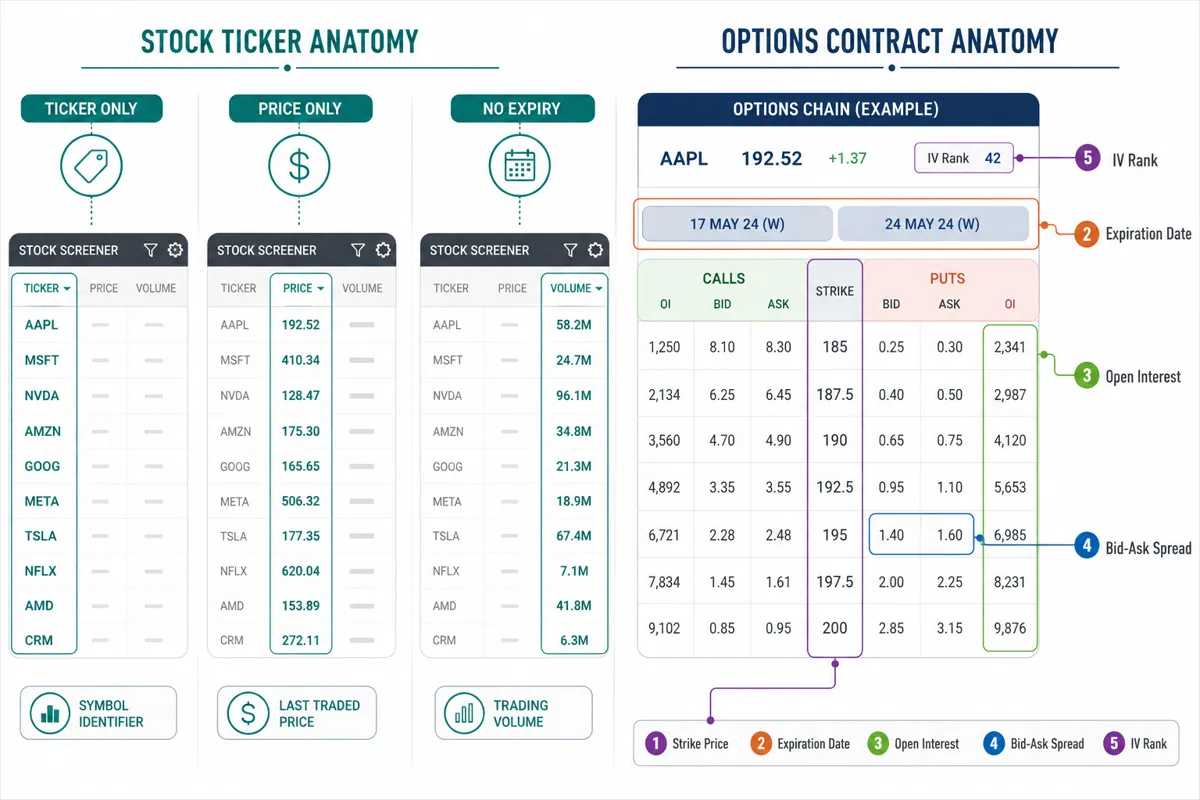
A stock options screener filters contracts, not just tickers. Where a stock screener looks at price, volume, and fundamentals for a single instrument per company, an options screener works across thousands of contracts per underlying, each with its own strike, expiration, bid, ask, open interest, implied volatility, and Greek values. That dimensional difference is why the best stock options screener needs a completely different filter logic than anything built for equities.
Contracts, Not Just Tickers
A single stock might have 200 or more active contracts on any given day. Cboe Global Markets reported 68.6 million contracts of market-wide average daily volume in Q1 2026, up from 60.4 million in Q1 2025. That volume is spread across ETFs, indexes, and individual names, and it means the market for options is now so large that manual scanning is genuinely infeasible. You need a screener with the right filters, applied in the right order, or you are drowning.
For a plain-English primer on the terms used throughout this piece, the stock market glossary at AI Stock Picker Apps covers open interest, IV rank, delta, and probability of profit in plain language.
Why Options Screening Is a Liquidity Problem First
Most traders open a screener and head straight for delta or implied volatility. That is backwards. Before any Greek matters, the contract has to be tradeable. A setup with perfect IV rank and ideal delta is worthless if the bid-ask spread is 40% of the option price or open interest is 12 contracts. The filter sequence in this article is not arbitrary. It reflects a liquidity-first logic that every serious options trader eventually learns, usually after getting burned on a wide spread.
Filter 1: Open Interest and Volume
Open interest is the number of contracts currently outstanding. Volume is how many traded today. Together they tell you whether a market actually exists for the contract you want. Without minimum thresholds on both, every other filter you set produces results you cannot execute at a fair price.
The Liquidity Floor Before Anything Else
TradeAlgo's 2026 options screener guide recommends a minimum of 100 contracts of daily volume for individual stocks and 500 for ETFs, with open interest minimums of 500 for stocks and 2,000 for ETFs. Those are reasonable starting floors. The volume-to-open-interest ratio is the sharper signal: a ratio above 2.0 often indicates meaningful new positioning rather than stale open interest being recycled.
The practical takeaway: set your open interest minimum before you touch any other filter. On Barchart's options screener, you can filter by open interest and volume directly in the main screener interface. Market Chameleon exposes both, along with a volume-versus-open-interest comparison that makes the ratio visible without manual calculation. QuantWheel also surfaces open interest and volume as primary screener filters, which is one reason it earns consistent mentions as a strong all-in-one option screener.
If you are also building stock screens to feed your options watchlist, the swing trading stock screener breakdown covers the equity-side filters that pair well with options entry criteria.
Filter 2: Bid-Ask Spread as a Percentage
The bid-ask spread on an option is the immediate cost of entry before the underlying moves a single tick. Expressing it as a percentage of the option price rather than in raw cents makes it comparable across cheap and expensive contracts.
The Cost You Pay Before the Trade Moves
A $0.10 spread on a $1.00 option is a 10% round-trip cost before commissions. A $0.10 spread on a $5.00 option is 2%. The raw number hides the difference. Market Chameleon's options screener exposes ATM bid-ask spread as a direct filter, which is one of the clearest signs that a platform is built for traders who care about execution quality, not just signal generation.
A reasonable threshold for most retail traders is a bid-ask spread below 5% of the mid-price for single-leg trades. For spreads and multi-leg strategies like an iron condor, tighter is better because you are paying the spread on two or more legs. QuantWheel's options screener flags wide-spread contracts as part of its liquidity scoring, which saves the manual calculation step.
The options flow scanner tools overview at AI Stock Picker Apps covers which platforms surface spread data in real time versus on a delayed feed.
Filter 3: Implied Volatility Rank
IV rank (IVR) measures where current implied volatility sits relative to its own 52-week range, expressed as a percentage from 0 to 100. An IVR of 80 means IV is near the top of its annual range. An IVR of 20 means it is near the bottom. This filter determines whether you are a buyer or a seller of premium.
Selling Premium Versus Buying It
High IVR (above 50) generally favors strategies that sell premium: covered calls, short puts, iron condors, and credit spreads. Low IVR (below 30) generally favors buying premium: long calls, long puts, and debit spreads. Getting this backwards is one of the most common mistakes retail options traders make. Buying options when IV is already elevated means paying an inflated price for a contract that will deflate as volatility reverts, even if the underlying moves in your direction.
Barchart's options screener exposes implied volatility as a filter, and its covered calls screener at Barchart covered calls pre-filters for high-premium call writing opportunities. Market Chameleon goes further with ATM IV as a direct screener column alongside historical context. QuantWheel includes IV rank as a core filter and displays it alongside IV percentile, which is a related but distinct metric worth understanding: IV percentile counts the percentage of days in the past year when IV was lower than today, rather than scaling to the range's high and low.
For strategies that depend on volatility context, the AI options trading tools directory lists platforms that surface both IVR and IV percentile.
Filter 4: Days to Expiration
Days to expiration (DTE) is the calendar filter, and it belongs before delta in your sequence because the DTE you choose determines which delta values are even meaningful. A 0.30 delta on a 5-DTE option behaves completely differently from a 0.30 delta on a 45-DTE option, because theta decay accelerates sharply in the final two weeks of a contract's life.
Why the Calendar Filter Comes Before the Greek
Cboe noted in early 2026 that Monday and Wednesday short-dated expirations added in January 2026 grew quickly to nearly 3 million contracts per day, with TSLA and NVDA making up more than half that flow. That is a structural shift in the market that makes DTE filtering more important than it was even 18 months ago. Screening without a DTE filter now means your results include zero-day-to-expiration contracts alongside 90-DTE LEAPs, and those two instruments have almost nothing in common from a risk-management standpoint.
A practical starting range: 21 to 45 DTE for premium-selling strategies, 30 to 60 DTE for directional debit spreads. Option Samurai offers DTE as a filter with strategy-specific presets. Barchart's options screener allows DTE range filtering in its advanced screener view. QuantWheel builds DTE into its strategy templates so the calendar filter is pre-applied when you select a strategy type.
Filter 5: Delta as a Probability Proxy
Delta measures how much an option's price changes for every one-dollar move in the underlying, but it also functions as an approximate probability that the option expires in the money. A 0.30 delta call has roughly a 30% chance of expiring ITM, and a 0.70 delta call has roughly a 70% chance.
Reading Delta Without the Math
For most retail traders, delta is most useful as a strike-selection filter rather than a hedging calculation. Selling a 0.20 delta put means you are accepting roughly an 80% probability of the option expiring worthless, which is the theoretical foundation of short-premium strategies. Buying a 0.50 delta call is close to a synthetic long position in the stock.
QuantWheel surfaces delta as a direct screener column, which makes it easy to filter for OTM options within a specific probability range. Barchart includes delta in its options chain view but requires you to pull up individual contracts rather than screening across the market by delta range. Market Chameleon exposes delta in its options screener alongside other Greeks. thinkorswim from Schwab allows delta-range screening in its scan tab, which is one reason it remains a strong choice for traders who want a full-featured platform with a free tier.
The position sizing guide covers how delta interacts with position sizing, which is the practical step after you identify a contract.
Filter 6: Earnings Date Exclusion
An earnings event inside your option's expiration window changes the implied volatility, the probability calculations, and the risk profile of the trade. Screening without filtering for earnings proximity is one of the most reliable ways to end up in a trade you did not intend to take.
The Event That Breaks Most Screens
Market Chameleon's options screener exposes earnings date as a direct filter, which is a meaningful differentiator. Most screeners show you the earnings date somewhere in the data, but fewer let you screen it out as a condition. The practical use case: if you are selling premium with a 30-DTE window and you want to avoid earnings risk, you need to exclude any underlying whose earnings date falls within that window.
The flip side is earnings-specific strategies, where traders deliberately target the elevated IV that precedes an announcement. For those setups, you want to screen for earnings proximity, not away from it. QuantWheel supports both use cases with earnings-aware filters. Barchart's screener shows earnings dates in its underlying data, and the Barchart covered calls screener flags earnings proximity in its results.
Filter 7: Probability of Profit and Expected Value
Probability of profit (POP) estimates the likelihood that a trade closes for a gain based on the current options pricing, while expected value (EV) weights that probability against the potential gain and loss. These are the most sophisticated filters on this list, and also the ones where screeners disagree with each other most visibly.
Where Screeners Disagree With Each Other
POP calculations differ across platforms because they use different models and different assumptions about the underlying's price distribution. A 68% POP on one platform might be 72% on another for the same contract. Neither is wrong, but neither is a guarantee. Treat POP as a relative ranking tool within a single platform, not as an absolute number to compare across tools.
QuantWheel includes probability of profit as a screener filter and displays it alongside the strategy's max profit and max loss, which gives you the EV context in one view. Option Samurai is notable for its POP-centric approach, building strategy screens around probability thresholds. Barchart surfaces probability data in its options chain but does not expose it as a primary screener filter in the same way. The Options Clearing Corporation provides the settlement and clearing infrastructure that makes all of this data possible, and its public resources are worth bookmarking for understanding how options contracts are standardized.
For traders building a complete screening workflow, the drowning in screener filters guide walks through how to reduce forty filter fields to the handful that actually matter.
Comparison Table: Which Screeners Expose Which Filters
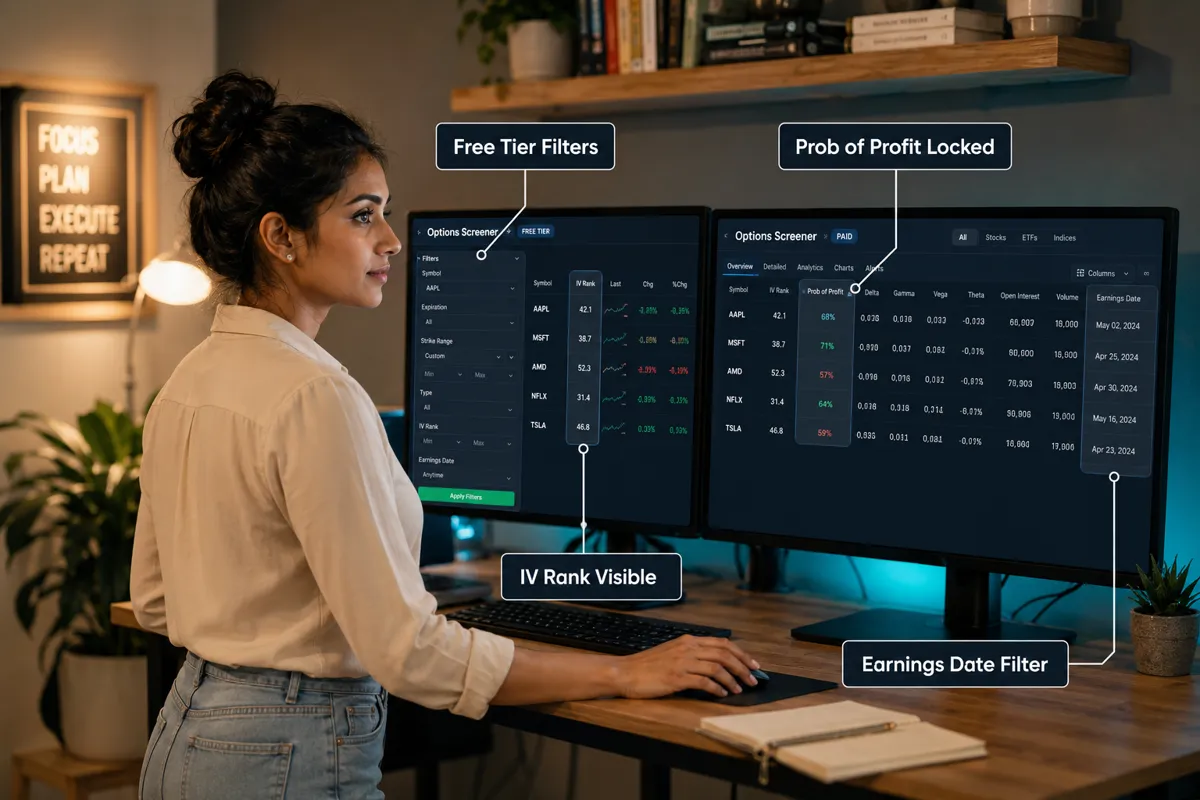
The table below shows which platforms expose each of the seven key filters, whether they offer a free tier, and their approximate starting price as of mid-2026. No screen predicts profit. This is a data availability comparison only.
| Platform | IV Rank | Prob of Profit | Unusual Activity | Free Tier | Starting Price |
|---|---|---|---|---|---|
| Option Samurai | Yes | Yes | Limited | Trial only | Paid plans vary |
| Market Chameleon | Yes | Partial | Yes | Yes (limited) | Free / Premium tier |
| Barchart | Yes | Partial | Yes | Yes | Free / Plus plans |
| OptionStrat | Yes | Yes | No | Yes (limited) | Free / Pro tier |
| Unusual Whales | No | No | Yes | Very limited | Paid subscription |
| thinkorswim | Yes | Yes | Limited | Yes (with account) | Free with Schwab |
Sources: Barchart options screener, Market Chameleon options screener, QuantWheel best options screeners guide. Pricing subject to change. Verify current plans directly with each provider.
Which Is the Best Stock Options Scanner for Live Flow?
The best stock options scanner for live flow is one that filters by premium size, order type, and expiration range simultaneously, not just by ticker or volume. A static screener and a live flow scanner are different tools solving different problems, and confusing them is one of the most common mistakes in retail options trading.
Best Stock Option Scanner Tools for Intraday Alerts
For intraday alerts, the tools that matter are those connected to OPRA (the Options Price Reporting Authority), which consolidates real-time options data from all U.S. exchanges. Unusual Whales is the most widely discussed options flow scanner in retail trading communities, primarily because its interface makes large sweeps and block trades visible quickly. Market Chameleon's option block trades screener screens actual executed trades with a minimum notional of $10,000, which filters out noise from small retail prints. QuantWheel combines flow data with screener functionality, which is a meaningful advantage for traders who want both in one place.
Options Flow Scanner Versus a Static Screen
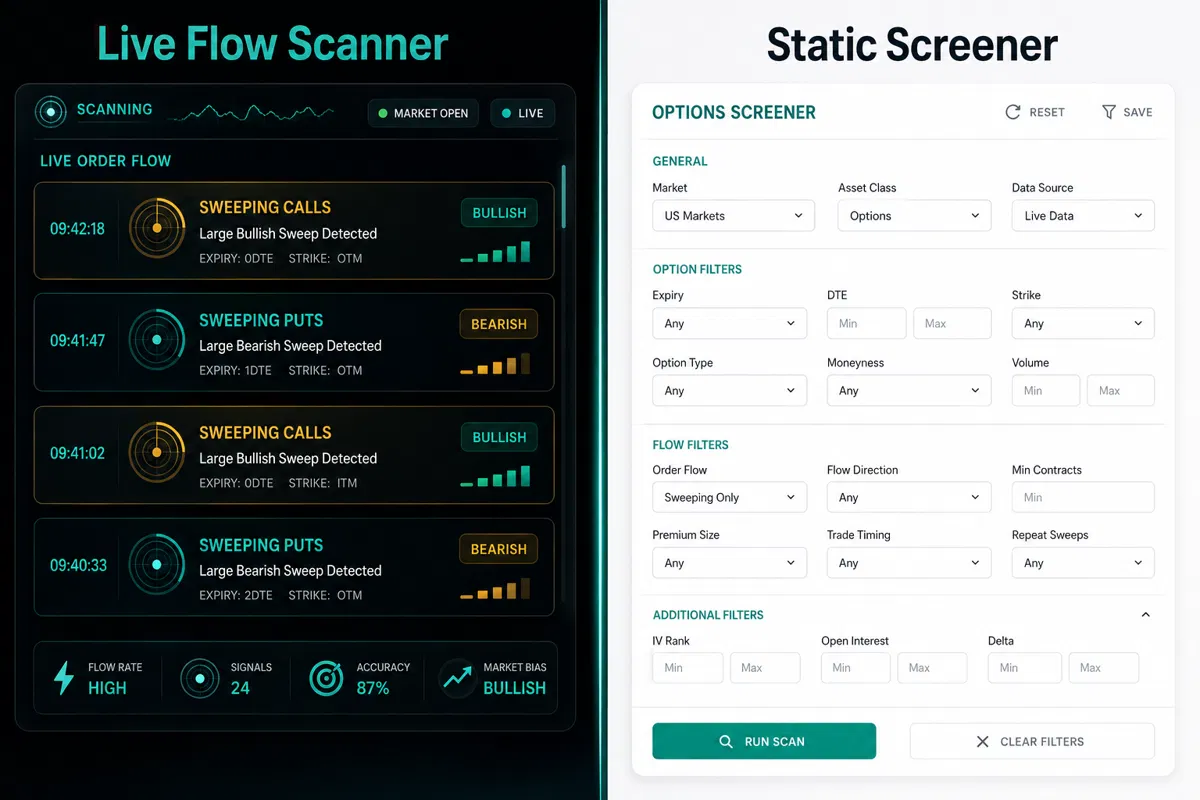
A static options screener runs a filter against the current state of the options market and returns a list. An options flow scanner monitors the tape in real time and alerts you when a trade matching your criteria executes. The static screen is for building a watchlist. The flow scanner is for catching unusual options activity as it happens. Using a flow scanner as a screener produces false signals. Using a screener as a flow scanner means you miss the timing entirely.
TradeAlgo's flow scanner guide highlights that the market has shifted toward tools filtering by ticker, premium size, sweep versus block order type, expiration range, and sector, which reflects the practical reality that raw flow feeds without constraints are just noise.
Unusual Options Activity Scanner Filters Worth Setting
Unusual options activity is typically defined as volume that significantly exceeds open interest on a contract that does not have an obvious catalyst like an earnings announcement. The most useful filters for an unusual options activity scanner are: volume-to-open-interest ratio above 2.0, minimum premium size (to exclude small retail noise), expiration range (to avoid zero-day contracts that distort the signal), and sector filter (to avoid chasing broad market moves disguised as single-stock activity). A free unusual options activity scanner with all of these filters does not currently exist in a fully featured form, though Barchart's free tier exposes some unusual volume data without a subscription.
Is There a Best Free Stock Options Screener?
Yes, free options screeners exist and some are genuinely useful, but every free tier has meaningful constraints. The best free stock options screener for most retail traders is Barchart's free options screener, which exposes volume, open interest, implied volatility, and basic Greeks without a paid account. QuantWheel also offers a free entry point with access to core screener filters.
What the Free Tiers Actually Allow
Barchart's free options screener provides access to volume, open interest, implied volatility, and the options chain with basic Greeks. Its covered calls screener is free to use and returns results ranked by premium yield. The limitation is data refresh rate and the depth of filtering available without a paid plan. Market Chameleon's free tier gives access to its options screener with some filters, though advanced features like the full ATM IV history and earnings-adjusted screening require a premium account. OptionStrat offers a free tier focused on strategy visualization and probability calculations, which makes it a strong options calculator for traders who want to model a trade before entering.
TradingView has a basic options screener in its platform, though it is less developed than dedicated options tools. Yahoo Finance and Robinhood do not offer true options screeners as of mid-2026. They show options chains but lack the multi-contract filtering that defines an actual screener.
For a curated list of free screener tools, the free AI stock screeners directory at AI Stock Picker Apps covers both equity and options tools with no-cost access.
Free Unusual Options Activity Scanner Options
Genuinely free unusual options activity scanners are rare. Barchart surfaces some unusual volume data in its free tier. Market Chameleon's option trades screener shows block trades with some free access. Full flow data with sweep and block classification, premium size filtering, and real-time alerts is almost exclusively a paid feature across all major platforms. If you want a free unusual options activity scanner with meaningful depth, the honest answer is that you are looking at a trial period rather than a permanent free tier.
How Do You Build a Screen From Scratch?
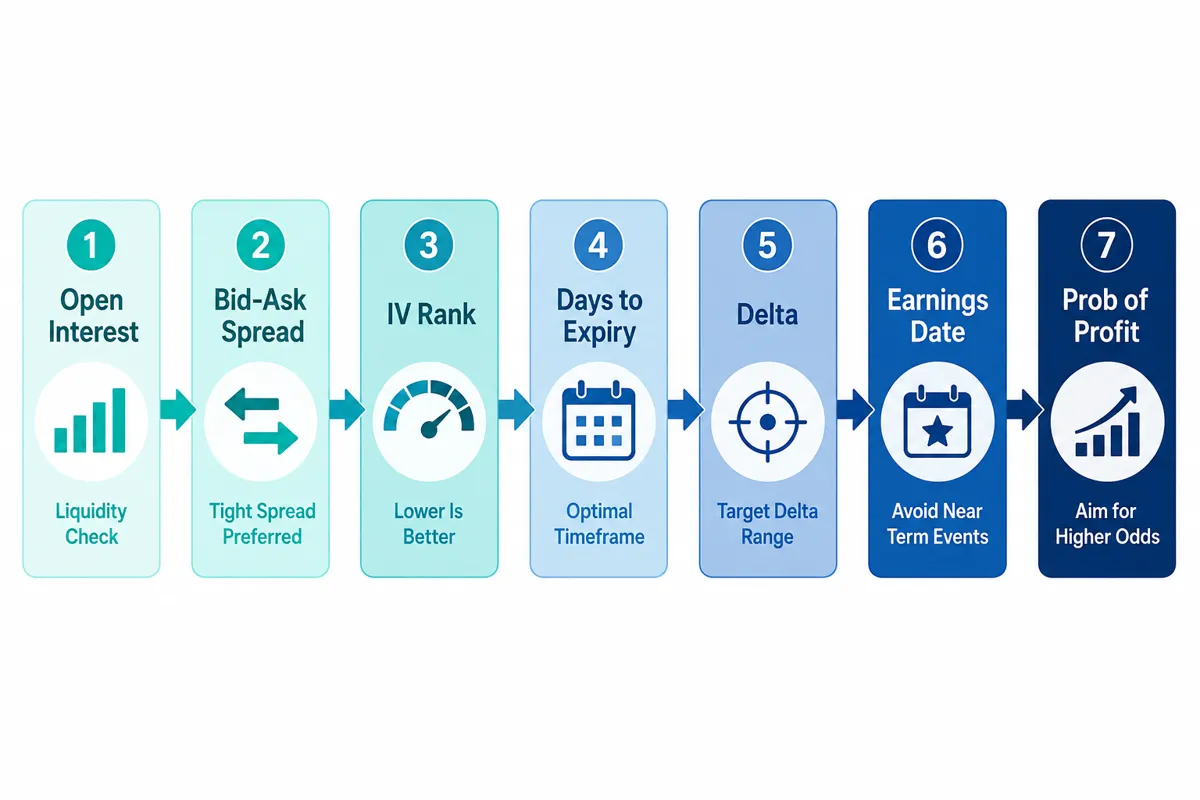
Start with the widest possible filter set and cut in the order described above: liquidity first, then spread, then IV rank, then DTE, then delta, then earnings exclusion, then probability. Each filter should cut the result set significantly. If you reach filter four with 800 results still showing, your liquidity thresholds are too loose.
Starting Wide Then Cutting in Order
A practical starting screen for a covered call strategy on liquid stocks: open interest above 500, volume above 100, bid-ask spread below 5% of mid, IVR above 40, DTE between 21 and 45, no earnings within the expiration window, delta between 0.20 and 0.35. That sequence should return a manageable list of 20 to 50 contracts from a universe of thousands. The same logic applies to short puts, long calls, and iron condor setups, with the specific thresholds adjusted for the strategy's risk profile.
The screener recipe builder tool at AI Stock Picker Apps lets you map out a filter sequence before committing to a paid platform.
Saving a Screen You Will Reuse
Every major platform covered here allows saved scans. Barchart's screener saves filter sets for registered users. QuantWheel saves strategy-specific screens with quick-access shortcuts. Market Chameleon allows saved screens on its premium tier. The discipline of saving and reusing a screen is what separates a process from a one-off search. Systems over hacks. Run the same screen every morning, review the results against your watchlist, and trade only what meets all seven criteria. That is the process.
Frequently Asked Questions
What is the best stock options screener for retail traders?
The best stock options screener for most retail traders is one that exposes all seven filters in this article, has a usable free tier, and connects to real-time data. Barchart and QuantWheel both meet those criteria at the entry level. For traders who want probability of profit as a primary filter, Option Samurai and OptionStrat are stronger choices. thinkorswim is the most powerful free option for Schwab account holders.
Is there a best free stock options screener worth using?
Barchart's free options screener is the most capable free tier currently available. It exposes volume, open interest, implied volatility, and basic Greeks without a subscription. QuantWheel and Market Chameleon also offer free access to core screener filters, though advanced features require paid plans. TradingView has a basic options screener in its free tier but it is less developed than dedicated options platforms.
What filters matter most in an options screener?
Open interest and volume matter most because they determine whether a contract is tradeable at a fair price. After liquidity, the bid-ask spread as a percentage of the option price is the most important cost filter. IV rank determines strategy direction. Days to expiration shapes every Greek. Earnings date exclusion prevents unintended event exposure. Delta and probability of profit complete the picture.
What is the difference between an options screener and a scanner?
An options screener applies filters to the current state of the market and returns a static list of contracts matching your criteria. An options scanner or flow scanner monitors the tape in real time and alerts you when a new trade matching your criteria executes. Screeners are for building a watchlist. Scanners are for catching live unusual options activity as it happens.
How do you screen for high implied volatility options?
Set an IV rank filter above 50 to find options where current implied volatility is in the upper half of its 52-week range. Barchart, Market Chameleon, and QuantWheel all expose IV rank as a direct screener filter. For selling premium, look for IVR above 60 combined with a DTE of 21 to 45 days. For buying premium, look for IVR below 30.
What is a good open interest minimum for options?
TradeAlgo's 2026 guide recommends a minimum of 500 contracts of open interest for individual stocks and 2,000 for ETFs as a starting floor. For very liquid names like SPY or QQQ options, you can set the minimum higher. For smaller-cap stocks, 500 is a reasonable threshold. Below 100 contracts of open interest, execution risk becomes significant regardless of how attractive the other filters look.
Can you screen for unusual options activity for free?
Partially. Barchart's free tier surfaces some unusual volume data. Market Chameleon's option trades screener shows block trades with limited free access. Full unusual options activity scanning with sweep and block classification, real-time alerts, and premium size filtering is almost exclusively a paid feature. A fully free unusual options activity scanner with professional-grade filters does not currently exist.
Which options screener has the best probability of profit data?
Option Samurai is the most POP-centric screener available, building its strategy screens around probability thresholds. QuantWheel also surfaces probability of profit as a primary filter alongside max profit and max loss. OptionStrat focuses on probability visualization for individual trades rather than market-wide screening. Remember that POP calculations differ across platforms because they use different models. Use POP as a relative ranking tool within a single platform.
What is Warren Buffett's favorite option strategy?
Warren Buffett has publicly discussed selling cash-secured puts on stocks he wants to own at a lower price. The logic is that he gets paid premium upfront and either keeps the premium if the stock stays above the strike, or acquires the stock at an effective price below market if it falls. He has described this approach in Berkshire Hathaway shareholder letters, framing it as getting paid to wait for a price he would be happy to pay anyway.
Which stock screener is most accurate?
Accuracy in a stock screener depends on data source and refresh rate. Screeners pulling directly from exchange feeds via OPRA or direct market data agreements are more current than those using delayed or aggregated data. For options specifically, Barchart and Market Chameleon are consistently cited for data quality. For equity screening, the AI stock screeners comparison at AI Stock Picker Apps covers accuracy and data sourcing across major platforms.
What is the most accurate indicator for option trading?
No single indicator is most accurate because options trading involves multiple simultaneous variables. IV rank is the most actionable single filter for strategy selection. Delta is the most useful for strike selection and probability approximation. Volume-to-open-interest ratio is the clearest signal of new positioning versus stale activity. Used together in the sequence described in this article, they produce a more reliable filter set than any single indicator alone.
What is the best website for options analysis?
Market Chameleon is the most data-dense options analysis site available, covering ATM IV, historical volatility, earnings impact data, and options flow in one place. QuantWheel combines screener, calculator, and strategy analysis in a single platform. Barchart is the strongest free option for traders who want breadth without a subscription. For AI-assisted options analysis, the best AI options trading tools directory covers platforms that add machine learning to the filter layer.
Final Verdict: Seven Filters, Then Pick the Tool
The best stock options screener is not the one with the most features. It is the one whose seven filters you apply in the right order, every time, without skipping the liquidity check to get to the exciting stuff. Open interest and volume first. Spread second. IV rank third. DTE fourth. Delta fifth. Earnings exclusion sixth. Probability of profit last. That sequence is the process. The platform is just the interface.
For most retail traders, Barchart is the strongest free starting point. QuantWheel is the best all-in-one paid option screener for traders who want strategy-aware filtering without switching between multiple tools. Market Chameleon wins on raw data depth. Option Samurai wins on probability-first screening. thinkorswim wins for Schwab account holders who want a free, full-featured platform. Unusual Whales is a flow tool, not a screener, and should be used as one.
No screen predicts profit. Options carry defined and undefined risk depending on structure. A screener narrows a list. What you do with that list is still your call.
200 or more AI stock tools are catalogued in the FullStack Alpha directory, filterable by category, price, and what they actually do. Browse the full directory at aistockpickerapps.com.
Disclosure: Some links in this article are affiliate links. FullStack Alpha may earn a commission if you sign up through them, at no additional cost to you.
References
Options - https://marketchameleon.com/Screeners/Options
Optiontrades - https://marketchameleon.com/Screeners/OptionTrades
Options Screener - https://www.barchart.com/options/options-screener
optionvisualizer - https://www.optionvisualizer.com/
Optiontradesscreener - https://marketchameleon.com/OptionScreener/optionTradesScreener
thetascanner - https://thetascanner.com/
Covered Calls - https://www.barchart.com/options/income-strategies/covered-calls
Options Screener Guide How To Filter For The Best Trades In 2026 - https://www.tradealgo.com/trading-guides/options/options-screener-guide-how-to-filter-for-the-best-trades-in-2026
Best Options Screeners - https://quantwheel.com/learn/best-options-screeners
Option Screening - https://www.optionvisualizer.com/features/option-screening