Best Prop Firm | 7 Firms Compared for Automated Traders
The best prop firm for an automated trader is the one whose rulebook says yes to your bot in writing, and in 2026 that list is shorter than most rankings admit. For futures automation, Lucid Trading leads: its help center permits automated systems and trade copiers, fees are one-time, and HFT and microscalping are the only bot styles it bans. For forex and CFD algos, FTMO remains the default, with expert advisors allowed below a stated 2,000 server requests a day. Two big names, Take Profit Trader and Apex Trader Funding, ban automation outright, so a "best prop firm" list that ignores bot policy can cost you a funded account.
Key insights
- Automation allowed: Lucid Trading, Topstep (with conditions), MyFundedFutures, FTMO and Darwinex Zero's MetaTrader and TradingView tracks.
- Automation banned: Take Profit Trader ("No Trading Bots or Algos") and Apex Trader Funding ("No Automation or Algorithm Usage allowed").
- Topstep's catch, even as a best prop firm contender: orders must come from your own device; VPS, VPN and remote servers are prohibited for order flow.
- Cost models differ: Lucid and Apex sell one-time evaluations, Topstep and Take Profit Trader bill monthly until you pass, Darwinex Zero runs from €45 (about $51) a month.
- Every firm caps the same thing: HFT, simulator exploitation and cross-account hedging are banned everywhere we checked.
By FullStack Alpha Editorial Team | Reviewed by Jay Rocco, Chief Editor
How Did We Score the Best Prop Firm Options?
Five things decide whether a firm deserves the best prop firm label for an automated trader. Everything else is marketing.
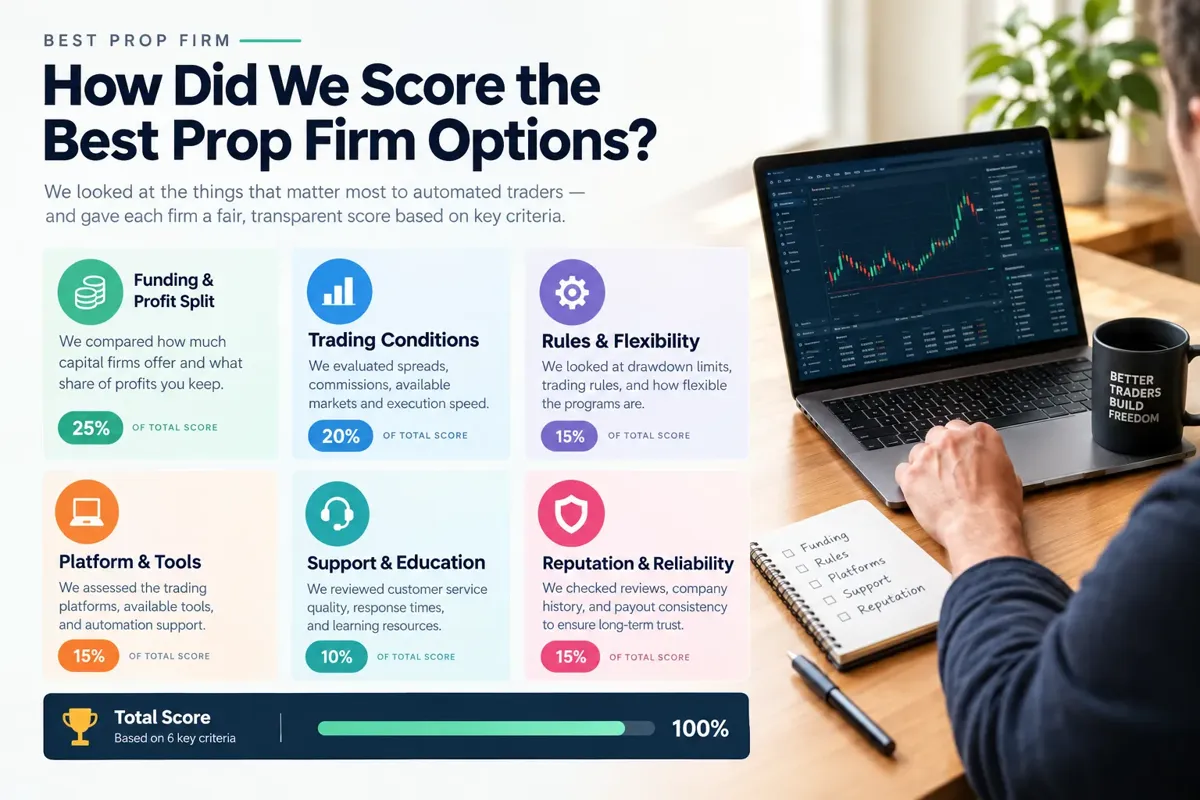
Bot policy. Not "do they allow EAs" but where, and under what limits. An expert advisor (EA) is a program that places trades for you on MetaTrader. Some firms allow your code but ban the server it runs on. Some allow copiers but ban algorithms. If the policy isn't on a public page, that is a score, and a low one.
Drawdown rule. Trailing drawdown rises with your equity, so a bot that gives back open profit can breach without a single losing closed trade. End-of-day (EOD) drawdown updates only at the close. Static drawdown never moves. Same strategy, three different survival rates.
Payout terms. Split, minimum days, caps and buffers. A 90/10 split with a $500 minimum is a different business from 80/20 with a buffer you must clear first.
Cost. Entry fee, monthly rebill, activation, resets, data and API fees. Topstep's API alone is $29 a month, or $14.50 with its code.
Trust. Years operating, whether rule changes are dated, and whether the firm is honest that funded accounts are simulated. FTMO says plainly its accounts use "fictitious funds."
How this was checked: every rule below comes from the firm's own help center or website, read in 2026. Prop rules change on short notice. Before you pay, open the official rulebook and read the automation and consistency sections first. Where a number wasn't published on the pages we checked, this best prop firm comparison says so instead of guessing.
A quick note on the model. You pay a fee for an evaluation, trade a simulated account inside risk rules, and if you pass you trade a funded account, usually still simulated, and keep a share of profit. The firm earns on fees and on the minority who stay profitable. Take Profit Trader's FAQ is unusually frank: its payouts "come from a combination of collected test fees, tech fees, and shared PRO+ profits."
Which 7 Prop Firms Compare Best at a Glance?
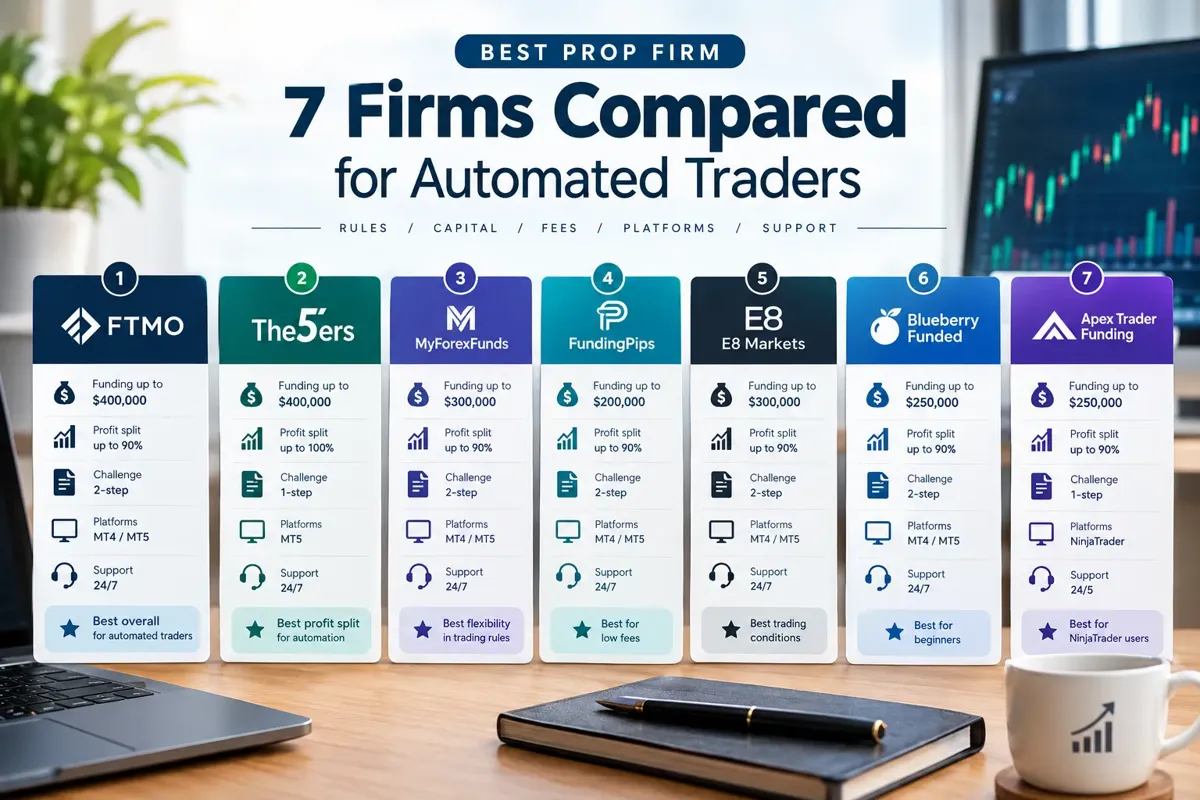
One table, every cell from the firm's own pages. Where a figure wasn't published on the pages we checked, the cell says so.
| Firm | Market / Accounts | Starting price | Drawdown type | Bot policy | Payout note |
|---|---|---|---|---|---|
| Lucid Trading | Futures; LucidPro, Flex, Daily, Direct | One-time fee, shown at checkout; no activation fee | EOD on Pro, Flex, Direct; intraday on LucidDaily funded | Automated systems and trade copiers permitted; HFT and microscalping banned | 90/10; $500 minimum request |
| Topstep | Futures; Trading Combine, Express Funded, Live Funded | $49 a month (50K Standard) plus $149 activation; Labs static 25K $75 one-time | Trailing MLL that locks; static on Labs accounts | Allowed with conditions; API $29 a month; no VPS or remote servers for orders | 90/10; $125 minimum |
| Take Profit Trader | Futures; Test, PRO, PRO+ | Monthly Test, shown at checkout (max $360); $130 PRO activation | EOD trailing in Test; intraday trailing on PRO | Bots and algos not permitted; trade copiers on own accounts allowed | 80/20 on PRO above buffer; 90/10 on PRO+ |
| Apex Trader Funding | Futures; EOD and intraday evaluations, up to 20 PAs | One-time fees on new products; heavy promo codes | EOD or intraday options | "No Automation or Algorithm Usage allowed" | 100% of approved payouts on new EOD PAs; 50% consistency |
| MyFundedFutures | Futures; Rapid, Builder, Pro plans | Not published on the help pages we checked (2026); $0 activation fee | Varies by plan; intraday and EOD Rapid options | Automated strategies allowed if they don't exploit sim fills; HFT not allowed | 90% on Rapid, 80% on Builder and Pro |
| FTMO | Forex/CFD plus FTMO Futures; simulated | €345 (about $387) for the $50K 2-Step; €89 (about $100) for $10K | 10% max loss, 5% max daily loss (2-Step) | EAs allowed below 2,000 server requests a day; futures: automation permitted, no HFT | Up to 90% reward; fee refunded on the 2-Step |
| Darwinex Zero | Multi-asset; TradingView, MT4, MT5 | From €45 a month (about $51) | No pass/fail challenge; track-record model | MetaTrader supported; EA terms not published on the pages we checked (2026) | 15% real performance fees on allocated capital |
Euro prices are converted at the October 2026 rate of about $1.12 per euro. Read that table once more and notice what's missing: not one firm says "bots fully allowed, no conditions." That is the state of the best prop firm market in 2026.
Is Lucid Trading a Strong Prop Firm for Bots?
Yes, and it is our pick for the best prop firm for futures automation. Lucid's Other Trading Activities page says "Automated trading systems and trade copiers are permitted," with the trader "fully responsible for any software errors, malfunctions, or unintended outcomes."

What gets a bot flagged: high-frequency trading (warning, then profit removal and closure), microscalping (flagged when more than 50% of profit comes from trades held five seconds or less) and hedging across accounts, including correlated pairs like long ES against short NQ.
Who it suits: a trader running a medium-frequency futures system on NinjaTrader, Tradovate, TradingView, Quantower or another of Lucid's ten-plus supported platforms, who wants one-time pricing instead of a monthly rebill.
Rules to know: LucidPro uses EOD drawdown ($2,000 on a $50K) and a 40% funded consistency rule. LucidFlex funded accounts drop consistency entirely. LucidDaily funded accounts always use intraday drawdown and ban holding through red-folder USD news. Positions close at 4:45 PM ET.
The drawback: prices only show at checkout, the refund policy refuses refunds on any traded account, and rules have been rewritten often in 2025 and 2026. Our Lucid prop firm review has every table.
Is Topstep a Strong Prop Firm for Bots?
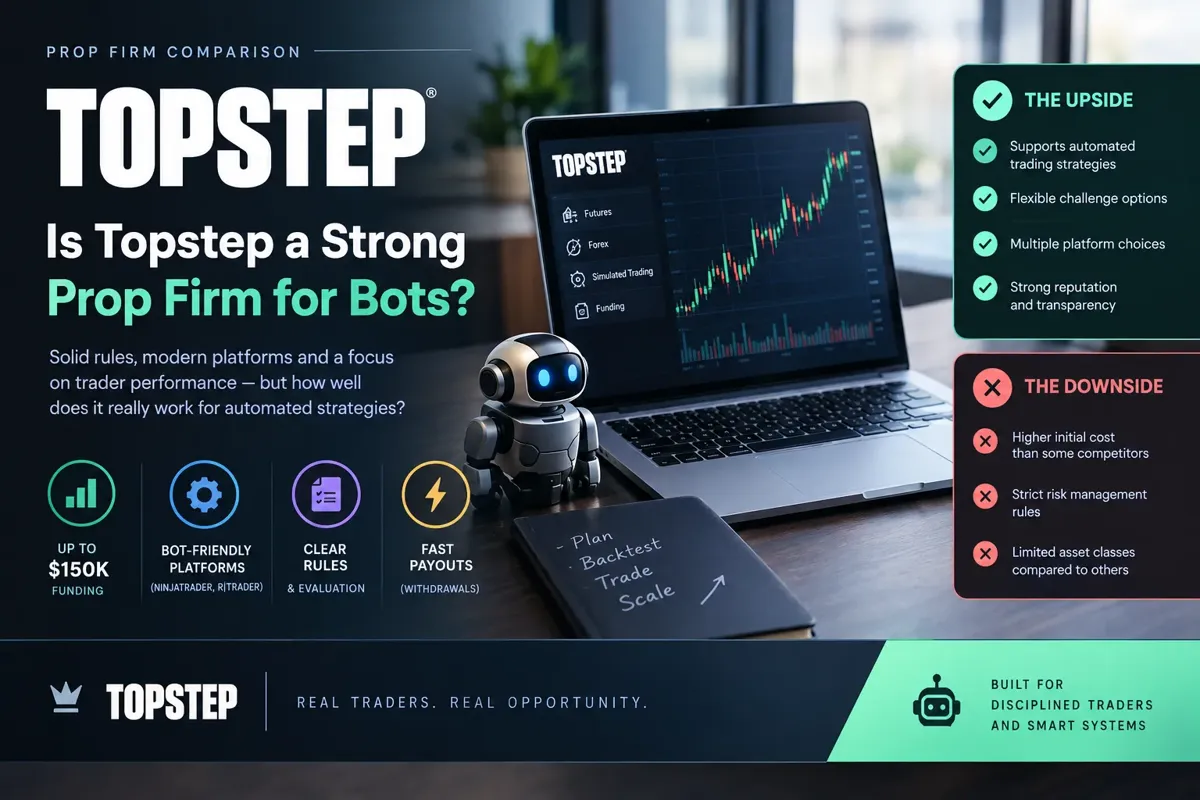
Topstep allows automation "with conditions" and offers an official route: the TopstepX API, powered by ProjectX, at $29 a month or $14.50 with the code "topstep." For a developer who wants documented REST and WebSocket access instead of a workaround, that matters.
The rule that decides everything: Topstep's API access article says all trading must originate from your personal device. VPS, VPNs and remote servers are prohibited, and a private server may store data and backtest but may not place, modify, cancel or relay orders. If your bot lives in the cloud, Topstep is the wrong firm.
Cost: $49, $99 or $199 a month on the Standard path plus $149 per Express Funded Account, or $95, $149 or $229 a month with no activation fee. The 2026 Labs drops added one-time static drawdown Combines, including a $25K at $75 and a $50K at $149.
Other limits: the trade copier works in the Combine and Express Funded Account but not the Live Funded Account. The Combine's 55% consistency target means you can't pass in one day. Everything must be flat by 3:10 PM CT.
Who it suits: a desk-based systematic trader who wants long operating history (Topstep Trader launched in 2012) and an official API. Our Topstep review walks through the payout math.
Is Take Profit Trader a Strong Prop Firm for Bots?
No. Take Profit Trader may be the best prop firm for a discretionary trader who wants day-one withdrawals, but its Universal Trading Policies open with "No Trading Bots or Algos. Automated trading systems, bots, or algorithmic execution tools are not permitted." The PRO rules add that "all trades must be manually executed by the trader."
What TPT does allow is a trade copier between accounts you own, from an approved list that includes Tradesyncer, TradeCopia and platform-native copiers. You place the trade by hand; the copier mirrors it.
Why a manual trader might still pick it: a one-step Test with a 3-day minimum, withdrawals from day one on PRO once you clear a buffer equal to your drawdown ($52,000 on a $50K), and a published pass rate of 36.22% of Tests in 2025.
The drawback for everyone: PRO uses intraday trailing drawdown, and the split is 80/20 until an invite to PRO+. Our Take Profit Trader review covers the buffer math and the NOFEE40 promo.
Is Apex Trader Funding Still a Strong Option?
For bot traders, no. Apex's prohibited activities page says "No Automation or Algorithm Usage allowed," explaining that rewards are meant for human traders, "not to reward automated systems executing preprogrammed logic."
For discretionary traders, Apex relaunched its products on March 1, 2026. The homepage lists EOD drawdown options, a 50% consistency rule, one-time fees with no recurring billing on new products, up to 20 Performance Accounts, five trading days between payouts, and a 100% payout split on approved requests in the new EOD Performance Accounts. Legacy accounts keep their old rules and recurring billing.
What else gets accounts closed at Apex: no stop losses, using the full threshold as a stop, trade copying with other traders, hedging, holding through the close and stockpiling discounted evaluations to blow them up. Apex runs aggressive promo codes; when we checked, the homepage advertised 90% off with a countdown timer. Treat any code as a same-day check.
Why do accounts get closed at prop firms generally? In order of how often the rulebooks we read warn about them: breaching a drawdown the trader misunderstood, breaking a consistency rule with one huge day, trading through a news restriction, and using automation where it is banned. All four are readable before you pay.
Which Other Prop Firms Allow Automation?
Three more worth your time, each solving a problem the first four don't.
Is MyFundedFutures the Best Prop Firm for Copy-Trading Futures Bots?
MyFundedFutures' fair-play policy lets traders use automated strategies built on their own settings, as long as the tools "do not aim to exploit the favorable fills offered in the Simulated Environment." HFT is not allowed, and live accounts using automation must follow CME guidelines.
Its copy-trading article says MyFundedFutures "allows copy trading across all account types," names Tradesyncer as its preferred copier, and notes Tradovate's built-in group copier works too. Copying other traders is banned. All plans carry a $0 activation fee.
Payout terms vary by plan. Rapid plans pay daily with a buffer ($2,100 on the 50K) and a 90% split since January 12, 2026. Builder and Pro plans pay 80%. Rapid accounts move to live automatically after a $10,000 net-profit day, with profit above $10,000 that day forfeited. Plan prices were not published on the help pages we checked (2026).
Is FTMO the Best Prop Firm for Forex and CFD Algos?
For MetaTrader and cTrader automation, FTMO is still the best prop firm reference point, and its advantage is boring: it has operated since 2015 and publishes its limits.
FTMO's forbidden trading practices ban EAs that make an account "hyperactive," defined as more than 2,000 server requests per day on trades or pending orders. They also ban software, AI or ultra-high-speed tools that manipulate or give an unfair advantage, and gap trading around major news or before long market closures. A stated number beats a vague "excessive activity" clause.
The 2-Step Challenge targets 10% then 5%, with a 10% maximum loss, a 5% maximum daily loss, a four-day trading minimum and up to 90% rewards. The fee is refunded once you pass. The $50K is €345, about $387. FTMO's Instant Account skips evaluation with a 10% max loss, 90% reward ratio and up to 1:100 leverage.
FTMO also runs FTMO Futures now. Its futures rules say "Automated trading is permitted," ban HFT and latency arbitrage, and allow copy trading across your own accounts as long as each one follows the rules independently. FTMO states that all accounts are demo accounts with fictitious funds, and that honesty is a point in its favor.
Is Darwinex Zero a Prop Firm Alternative Without a Challenge?
If the challenge model annoys you, Darwinex Zero is the alternative worth knowing. It isn't a pass/fail evaluation. Memberships start from €45 a month (about $51) and include a verified track record, monthly DarwinIA capital-allocation competitions and "15% real performance fees."
You can trade through TradingView, MetaTrader 4 or MetaTrader 5, which makes it a natural home for EAs. Its specific terms on third-party or commercial EAs were not published on the pages we checked (2026), so ask before you plug in a marketplace bot.
Darwinex Zero is a commercial name of Tradeslide Technologies Limited, an appointed representative of a firm authorised and regulated by the UK Financial Conduct Authority. That suits a trader with original code who needs a long runway rather than a 30-day sprint.
What Does the Best Prop Firm Really Cost a Bot Trader?
Sticker prices hide the bill. Here is what two months of automation looks like at the firms that publish enough numbers to do the math, using each firm's own fees.
- Topstep, $50K Standard path, pass in month two: $49 + $49 in subscriptions, $149 activation, and $29 of API access at the $14.50 discounted rate. Total: $276 before your first payout.
- Topstep, $50K No Activation Fee path, same timeline: $95 + $95 plus $29 of API access. Total: $219. If you expect to pass in one or two months, the higher monthly fee is the cheaper path.
- FTMO, $50K 2-Step: €345 (about $387) once. FTMO's challenge page lists the fee as refundable (100%) once you pass, so a successful bot costs little or nothing net. Fail, and the full fee is gone.
- Darwinex Zero: from €45 a month, or €540 (about $605) over a year. No pass/fail, so the cost is time, not attempts.
- Lucid Trading: one fee per evaluation, shown at checkout, with no monthly rebill and no activation fee. A failed attempt costs one reset, never a recurring charge.
What the math says: monthly-billed firms punish slow passes, refundable-fee firms reward fast ones, and one-time-fee firms make the cost of failure predictable. For a bot you have already backtested, the best prop firm on price is usually the one whose fee structure matches how long your system takes to hit a target.
Decision rule: estimate your pass time from your backtest's average days to reach the target, double it for live-market reality, then price every firm on that number. Anything else is comparing coupons.
Which Prop Firm Is Best for Beginners?
There is no single best prop firm for beginners, because "beginner" covers four different people.
You've never traded live and have no system. Don't buy an evaluation yet. Paper trade for 60 days, log every trade, and see if an edge exists. A prop firm amplifies a process; amplify a broken one and you just pay faster. Start with position sizing discipline, because that kills more new accounts than stock selection.
You have a manual strategy that works. Take Profit Trader's day-one withdrawals or Apex's relaunched EOD accounts are worth pricing. Neither allows automation, which is fine if you don't use any.
You want to automate a working futures strategy. Lucid first, then MyFundedFutures, then Topstep if you trade from your own desk. Pick EOD or static drawdown over intraday; trailing intraday floors punish the exact mistake new bot traders make, giving back open profit.
You bought a bot. Narrow field. Most firms police bots that copy what thousands of other users run. Before you spend anything on the bot or the account, read our breakdown of which AI trading bots are legit versus scams.
Do you need experience to join? No firm we checked asks for any. The entry gate is a card, not a résumé. Treat that as a warning, not an invitation.
What Prop Firm Rules Trip Up Bot Traders?
Four rules cause most account deaths, even at the best prop firm for your style. Each has a fix you can code.
Trailing drawdown. The floor follows your highest equity, sometimes in real time. Topstep's example: make $500, lose $500, and your Maximum Loss Limit has moved up $500 anyway. The fix: feed the firm's drawdown formula into your risk module and flatten at a buffer well above the line.
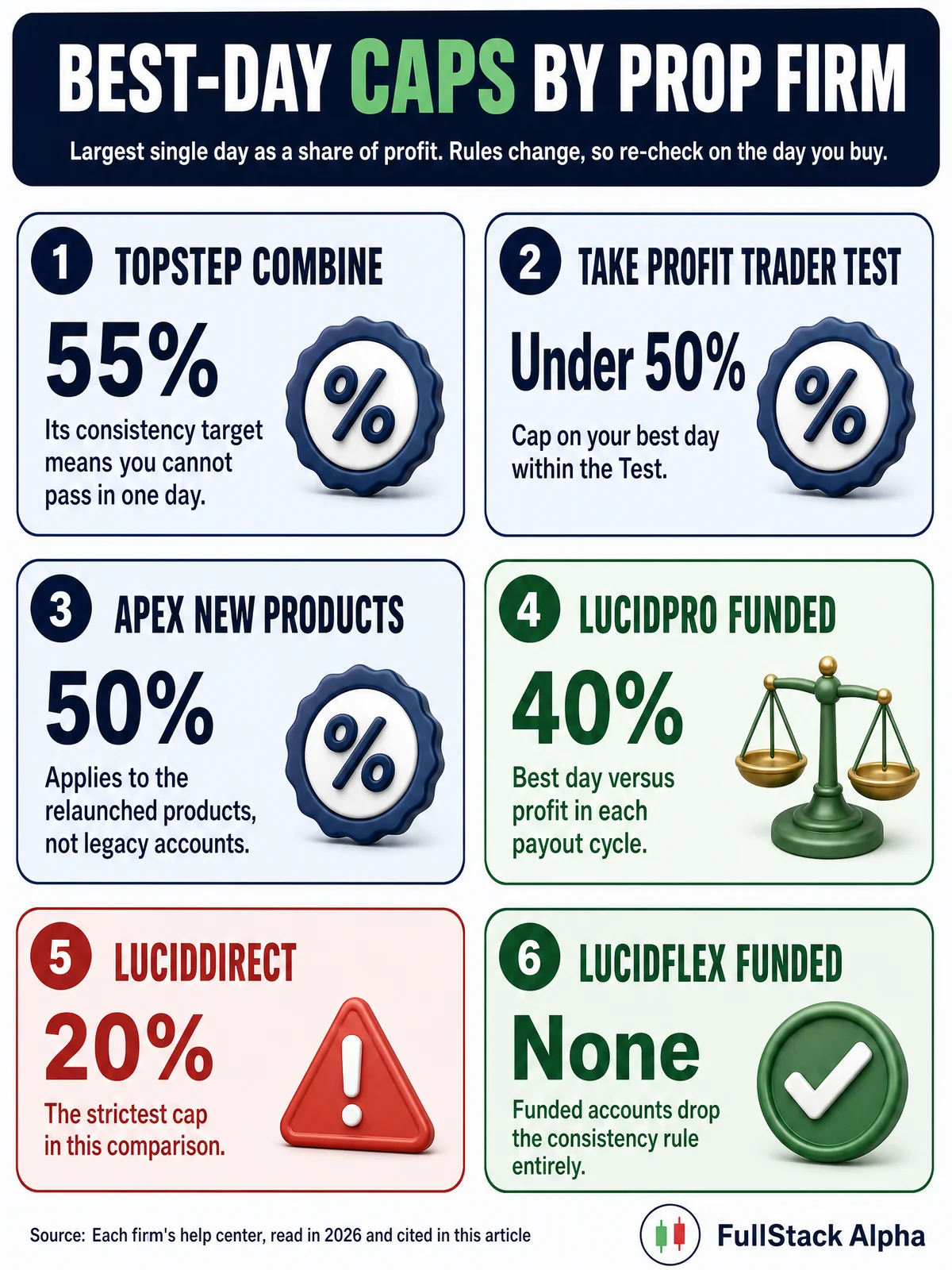
Consistency rules. Topstep's Combine caps your best day at 55% of profit, LucidPro funded at 40%, LucidDirect at 20%, Take Profit Trader's Test at under 50%, and Apex's new products at 50%. The fix: cap daily profit in code. A $3,000 day that delays a payout is worth less than four $750 days that clear it.
Banned strategies. HFT, simulator exploitation and cross-account hedging are on every list we read. FTMO is the only firm here that publishes a hard request number (2,000 a day). The fix: count your orders and API calls daily and compare against the limit.
Copy trading. Lucid, Topstep, MyFundedFutures, FTMO Futures and Take Profit Trader all allow copiers on your own accounts; all ban copying other people. Hedged copies are a separate violation. The fix: copy in one direction only, and read the multi-account clause before you fund the second account.
One more: the session close. Topstep flattens at 3:10 PM CT, Lucid at 4:45 PM ET, Take Profit Trader at 4:55 PM ET. A bot that holds past the close gets liquidated. The rulebook is a data input. Treat it like one.
How Do You Avoid Prop Firm Scams?
Prop firms sit in a lightly regulated space, and the best prop firm on paper can still be the wrong one for you. Run this checklist before paying.
- Published rules, not a support ticket. Drawdown, consistency and automation policy should be on a public page.
- Honesty about simulated versus live. FTMO, Apex and Take Profit Trader all state that funded accounts are simulated. A firm implying you trade a real $150,000 with no qualification is shading the truth.
- Dated rule changes. Lucid dated its consistency change to November 28, 2025, and Apex says its March 1, 2026 relaunch does not change legacy accounts. Changes that hit only new accounts are normal; retroactive changes are a red flag.
- Payout proof you can check. Dated receipts from long-standing accounts beat testimonials on the firm's homepage. Take Profit Trader's own disclosure says its testimonials "may not be representative."
- A sane relationship with discounts. A firm running 90% off on a countdown timer is funding operations with fees. That's not fraud, but price it in.
- Know what isn't protected. Prop evaluations are not brokerage accounts, so there is no SIPC-style protection on the fee. FINRA's investor insights pages are worth a read on this category.
One free test: email support a specific question about automation limits. A real firm answers in writing with a number. A weak one sends a template. Then run your strategy through our backtest reality check before you pay any fee.
Which Prop Firm Fits Your Budget and Your Bot?
The scorecard below matches your strategy type, budget and automation needs against the seven firms in this comparison, so you stop guessing which rulebook your bot can actually live inside. Two minutes here beats a reset fee and three weeks of wasted backtesting.
FullStack Alpha
Which of these seven rulebooks fits your setup
Answer three questions and this points at the firms in this comparison whose written rules your strategy can actually live inside.
Based on the rulebooks read for this comparison in 2026. Prop firm rules change without notice, so confirm the automation and VPS policy on the firm's own page before you pay.
Frequently Asked Questions
What is the best prop firm for trading bots?
For futures automation, the best prop firm in our 2026 review is Lucid Trading, whose help center permits automated systems and trade copiers. For forex and CFD algos, FTMO allows expert advisors below a stated 2,000 server requests a day. Always read the automation clause before you buy.
Which prop firms ban trading bots?
Take Profit Trader's Universal Trading Policies ban bots and algos on every account type. Apex Trader Funding's prohibited-activities page says no automation or algorithm usage is allowed. Both still allow manual traders, and Take Profit Trader allows trade copiers on your own accounts.
Does Topstep allow automated trading?
Yes, with conditions. Topstep offers the TopstepX API at $29 a month, or $14.50 with its code, but all orders must come from your own device. VPS, VPN and remote servers are prohibited for placing or relaying orders.
Which prop firms actually pay out?
Every firm in this comparison publishes written payout terms, and several publish company figures, such as Topstep's $1.5B+ paid and FTMO's $650M+ paid since 2015. Those are company-reported numbers. Check dated payout posts from long-standing accounts before you trust any firm.
Do prop firms allow copy trading?
Most allow copiers across accounts you own. Lucid, Topstep, MyFundedFutures, FTMO Futures and Take Profit Trader all permit it, while banning copying other traders and hedging across accounts. Topstep's copier does not work on Live Funded Accounts.
What is the best prop firm for beginners?
There isn't one best prop firm for every beginner. If you have no tested system, paper trade first; if you trade by hand, Take Profit Trader or Apex's EOD accounts are worth pricing; if you automate, start with Lucid. Pick the rulebook that matches how you actually trade.
Our Take
Ranked for bot traders: Lucid Trading first for futures automation with explicit written permission and one-time fees, FTMO first for forex and CFD algos with a published request limit, MyFundedFutures second for copy-traded futures systems, Topstep third for desk-based automation through an official API, and Darwinex Zero for original code on a long horizon. Take Profit Trader and Apex are manual-only, whatever their other strengths.
The rule to read before anything else is the automation clause, then the drawdown mechanic. Do this today: open your chosen firm's rulebook, find both sections, and check whether your strategy's best day would break the consistency rule. Prices, promo codes and bot policies change often, so re-check every number in this best prop firm comparison on the day you buy.
Want the tools that sit around your prop account scored the same way? Browse every review at FullStack Alpha
Stay alpha.