Best AI trading bot...which are legit vs scams?
Best AI Trading Bot: Which Are Legit vs Scams?
Last updated: June 30, 2026
Quick Answer
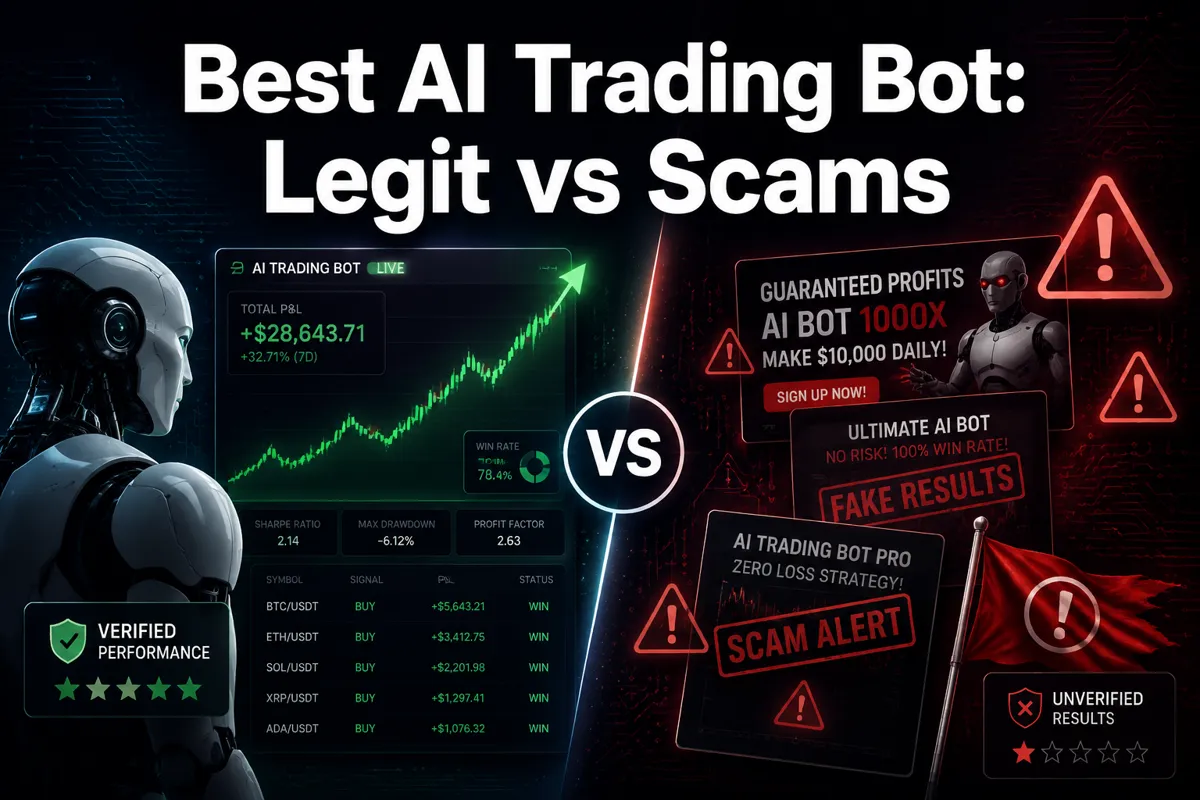
Most AI trading bots promising guaranteed returns or secret algorithms are scams designed to separate you from your money. Legitimate AI trading bots publish audited track records, show transparent methodology, charge clear fees, and never promise specific returns. The difference between legit and scam comes down to five verification signals: regulatory compliance, third-party audits, open methodology, real-time performance data, and honest risk disclosure. If a bot checks all five boxes, it's worth testing with paper money first. If it fails even one, walk away.
Key Takeaways
- Legitimate AI trading bots publish verifiable, trade-by-trade performance records — not cherry-picked screenshots or vague win-rate claims without context.
- Red flags include guaranteed return promises, pressure tactics, hidden fees, fake testimonials, and refusal to show methodology — any one of these disqualifies a platform immediately.
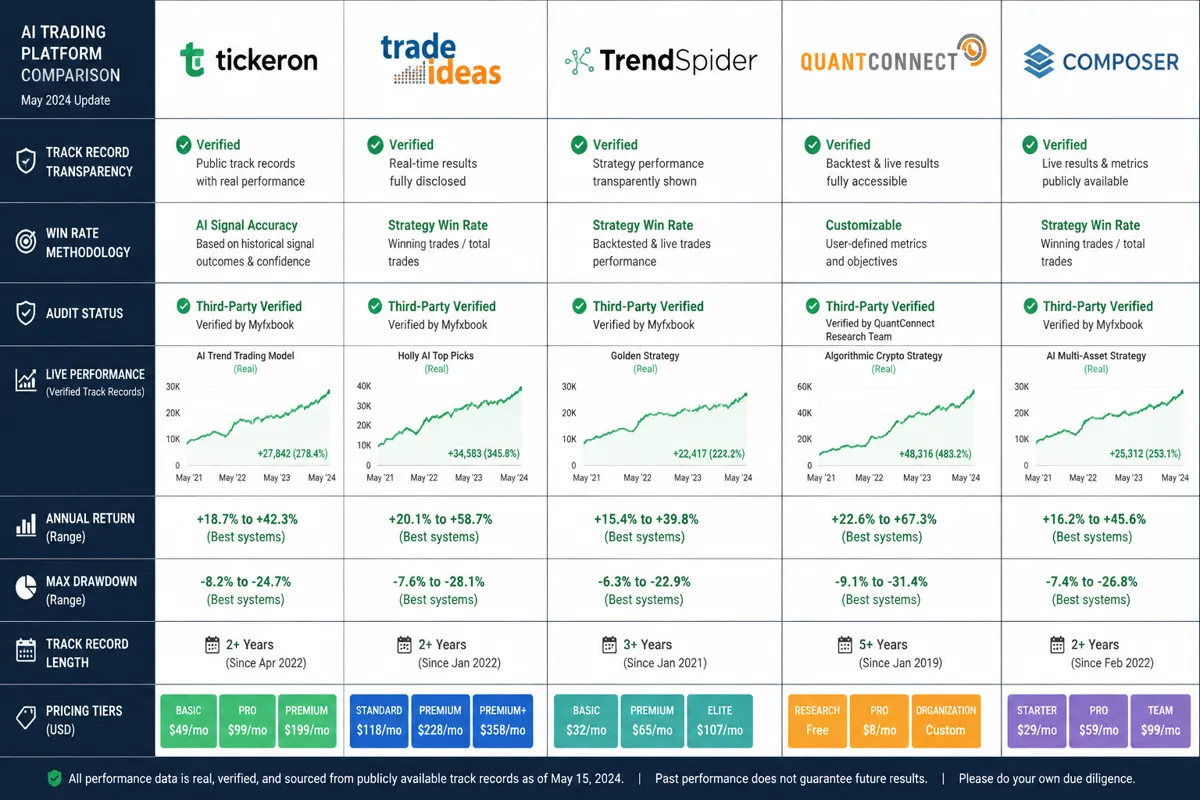
- Top verified platforms in 2026 include Tickeron, Trade Ideas, TrendSpider, QuantConnect, and Composer — each publishes audited results and transparent strategy logic.
- Free AI trading bots are rarely scams but usually lack the data quality, execution speed, and support needed for consistent profitability — you get what you pay for.
- Testing any AI trading bot with paper money for at least 30 days is non-negotiable — live performance almost always differs from backtest claims.
- AI bots work better for stocks than crypto due to regulatory oversight, market structure, and lower manipulation risk — crypto bot space remains heavily saturated with scams.
- Small accounts under $1,000 can use AI bots, but commission costs and position sizing constraints make profitability harder — most legit platforms recommend starting with $5,000 minimum.
- The biggest mistake traders make is trusting marketing claims over audited data — if the bot won't show you real fills, real slippage, and real drawdowns, it's hiding something.
What Is an AI Trading Bot and How Does It Work?
An AI trading bot is software that uses machine learning algorithms to analyze market data, identify trading opportunities, and execute buy or sell orders automatically without human intervention. The bot processes price action, volume patterns, news sentiment, technical indicators, and sometimes alternative data to make decisions based on predefined rules or adaptive learning models.
Here's how a legitimate AI trading bot actually operates:
Data ingestion and processing. The bot pulls real-time or delayed market data from exchanges or data providers — price, volume, order book depth, news feeds, social sentiment, earnings reports. Quality bots use clean, normalized data from reputable sources like Bloomberg, Refinitiv, or exchange APIs. Scam bots often use free, delayed, or manipulated data that doesn't reflect real trading conditions.
Signal generation. Machine learning models (neural networks, decision trees, reinforcement learning agents) analyze the data and generate trading signals — buy, sell, or hold. Legitimate bots explain their methodology: "This model uses a convolutional neural network trained on 10 years of S&P 500 price action to identify breakout patterns with 60% historical accuracy." Scam bots hide behind vague claims like "proprietary AI algorithm" or "secret formula."
Risk management and position sizing. Before executing a trade, the bot calculates position size based on account equity, risk tolerance, and stop-loss distance. A legit bot will show you exactly how it sizes positions and manages risk. A scam bot either ignores risk management entirely or uses aggressive sizing that blows up accounts during drawdowns.
Order execution. The bot sends orders to your broker via API. Execution quality matters — slippage, fill rates, and latency all affect real returns. Legitimate bots integrate with regulated brokers (Interactive Brokers, Alpaca, TD Ameritrade). Scam bots often require you to deposit funds directly with them, which is a massive red flag.
Performance tracking and adaptation. Quality AI bots log every trade, track performance metrics (win rate, profit factor, max drawdown, Sharpe ratio), and adapt strategies based on changing market conditions. They publish this data transparently. Scam bots show you fake dashboards with inflated returns and no way to verify the numbers.
The key difference: legitimate AI trading bots are tools that assist your process; scam bots promise to replace your judgment entirely. If a bot claims you can "set it and forget it" or "make money while you sleep" without explaining risk, methodology, or realistic expectations, it's selling a fantasy.
For a deeper comparison of AI trading platforms and how they stack up on transparency, check our full breakdown.
How to Tell If an AI Trading Bot Is a Scam or Legitimate
Separating legit AI trading bots from scams comes down to five verification signals. Miss even one, and you're likely dealing with a scam. Here's the checklist:
1. Audited, trade-by-trade performance records.
Legitimate bots publish every trade with entry price, exit price, timestamp, ticker, position size, and P&L. Third-party audits from firms like Myfxbook (for forex) or broker statements with verified account numbers add credibility. If the bot only shows you a cumulative equity curve or a win-rate percentage without underlying trade data, assume the numbers are fake.
Example: Tickeron publishes every AI-generated trade with full transparency — you can see the exact entry, exit, and result. That's the standard.
2. Transparent methodology and strategy logic.
You don't need to see the source code, but you should understand how the bot makes decisions. Does it use momentum breakouts? Mean reversion? News sentiment? Machine learning model type? Training data period? If the answer is "proprietary algorithm" with no further detail, it's a black box designed to hide poor performance or nonexistent logic.
Example: TrendSpider shows you the exact technical conditions that trigger each strategy and lets you backtest the logic yourself. That's transparency.
3. Clear, upfront fee structure with no hidden costs.
Legit bots charge subscription fees, performance fees, or both — and they tell you exactly what you'll pay before you sign up. Scam bots hide fees in fine print, charge surprise withdrawal fees, or require minimum deposits that you can't get back. If the pricing page is vague or requires a sales call to learn costs, walk away.
4. Regulatory compliance and broker integration.
Legitimate AI trading bots integrate with regulated brokers and don't hold your funds. You keep your money at Interactive Brokers, Alpaca, or another regulated entity, and the bot trades via API. Scam bots ask you to deposit directly with them, often to offshore accounts with no regulatory oversight. That's not a trading bot — it's a Ponzi scheme with extra steps.
5. Honest risk disclosure and realistic performance claims.
No legitimate bot promises guaranteed returns, specific percentage gains, or "risk-free" trading. Markets are probabilistic. Even the best AI bots lose money during certain conditions. If the marketing page says "87% win rate" without showing max drawdown, losing streaks, or market conditions where the strategy fails, it's lying by omission.
Red flags that disqualify a bot immediately:
- Promises of guaranteed returns or specific dollar amounts per day
- Pressure tactics ("only 5 spots left," "limited-time offer," "act now")
- Fake testimonials with stock photos or unverifiable names
- No way to contact support or get a refund
- Requires you to recruit others (multi-level marketing structure)
- Uses celebrity endorsements or fake news articles
- No live chat, no phone number, no physical address
- Offshore registration with no regulatory oversight
If you're evaluating a bot and it fails any of these tests, don't rationalize it. Just move on. The trading bots category on our site only includes platforms that pass all five verification signals.
Best AI Trading Bots for Beginners in 2026
Beginners need AI trading bots that prioritize education, transparency, and risk management over aggressive returns. Here are the platforms that actually help you learn instead of just taking your money:
Tickeron — best for audited track records and learning.
Tickeron publishes every AI-generated trade with full transparency, making it easy to see what works and what doesn't. The platform offers pattern recognition, trend prediction, and portfolio optimization tools. Pricing starts around $60/month. The AI confidence scores help beginners understand why the bot is making a recommendation, not just what to buy. Tickeron's track record is third-party audited, which sets the standard for legitimacy.
Trade Ideas — best for real-time scanning and simulation.
Trade Ideas uses Holly AI to scan thousands of stocks in real time and surface setups that match your criteria. The platform shows overnight simulation results so you can see how strategies would have performed before risking real money. Pricing starts around $118/month. Beginners benefit from the pre-built strategies and the ability to paper trade any setup before going live. The methodology is transparent — you can see exactly what technical conditions trigger each alert.
TrendSpider — best for strategy transparency and backtesting.
TrendSpider automates technical analysis and lets you backtest any strategy with historical data. The platform shows you the exact logic behind each signal — no black-box mystery. Pricing starts around $40/month. Beginners can learn by testing different strategies, seeing which conditions produce the best risk-reward, and understanding why certain setups fail. The automated trendline and support/resistance detection removes subjectivity from chart reading.
QuantConnect — best for open-source and community auditing.
QuantConnect is an open-source algorithmic trading platform where you can code your own strategies or use community-built algorithms. Everything is transparent and auditable. The platform is free for basic use; paid tiers start around $20/month for more data and compute power. Beginners with coding skills (or willingness to learn Python) can see exactly how strategies work and modify them. The community forums provide real feedback, not fake testimonials.
Composer — best for visual strategy building and live performance tracking.
Composer lets you build automated trading strategies with a no-code visual interface. The platform shows real live performance versus backtest results, so you can see slippage and real-world execution quality. Pricing is free for basic use; premium features cost around $30/month. Beginners can create simple strategies (like "buy the dip on QQQ when RSI drops below 30") and see how they perform without writing code.
What beginners should avoid:
- Bots that require large minimum deposits ($10,000+) before you've tested the strategy
- Platforms with no paper trading or simulation mode
- Bots that don't integrate with your existing broker
- Any bot that promises specific returns or "guaranteed" profits
- Platforms with no educational resources or support
Start with paper trading for at least 30 days. Track every trade, calculate your expectancy, and only go live when you understand the strategy's edge and risk profile. For more beginner-friendly tools, explore our day trading and swing trading tool breakdowns.
AI Trading Bot vs Manual Trading: Which Is Better?
Neither is universally better — the right choice depends on your edge, your time, and your psychology. Here's the honest breakdown:
When AI trading bots have the advantage:
- Speed and execution. Bots can scan thousands of stocks, process data, and execute trades in milliseconds. If your edge is based on pattern recognition or momentum breakouts that require fast execution, a bot wins.
- Discipline and consistency. Bots don't revenge trade, overtrade, or deviate from the plan. If your biggest problem is emotional decision-making, automation removes that variable.
- Scalability. A bot can monitor 500 stocks simultaneously and execute multiple strategies across different timeframes. Manual traders are limited by attention and time.
- Backtesting and optimization. Bots let you test strategies on years of historical data before risking real money. Manual traders rely on intuition and limited sample sizes.
When manual trading has the advantage:
- Adaptability to new information. Humans can process qualitative information — earnings call tone, management credibility, geopolitical events — that bots struggle to quantify. If your edge is based on nuanced interpretation, manual trading wins.
- Market regime changes. Bots trained on historical data can fail when market structure shifts (2020 COVID crash, 2022 rate-hike regime). Humans can recognize when conditions have changed and adjust faster.
- Lower cost for small accounts. If you're trading a $2,000 account, paying $100/month for a bot eats 5% of your capital annually before you make a single trade. Manual trading costs nothing beyond commissions.
- Learning and skill development. Manual trading forces you to understand price action, risk management, and market psychology. Bots can become a crutch that prevents you from developing real skill.
The hybrid approach (what most successful traders actually do):
Use AI bots for scanning, alerting, and idea generation — then apply manual judgment for execution and risk management. Let the bot surface setups that meet your criteria, but you decide position size, entry timing, and whether market conditions support the trade.
Example: Use Trade Ideas to scan for momentum breakouts with specific volume and price action criteria. The bot alerts you to the setup. You manually check the overall market tape, sector strength, and news flow before deciding whether to take the trade. The bot handles speed and consistency; you handle context and discretion.
Bottom line: If you have a quantifiable edge that can be coded into rules, a bot will execute it more consistently than you will. If your edge is based on judgment, context, or qualitative analysis, manual trading is better. Most traders benefit from using both.
How Much Does a Good AI Trading Bot Cost?
Legitimate AI trading bots in 2026 typically cost between $40 and $300 per month, depending on features, data quality, and execution capabilities. Here's the pricing breakdown by category:
Entry-level bots ($40–$80/month):
Basic pattern recognition, technical analysis automation, and pre-built strategies. Examples: TrendSpider ($40/month), Composer basic tier ($30/month). These are good for learning and testing but lack advanced features like real-time scanning or multi-asset support.
Mid-tier bots ($80–$150/month):
Real-time scanning, customizable strategies, backtesting, and paper trading. Examples: Trade Ideas ($118/month), Tickeron ($60–$100/month depending on tier). This is the sweet spot for serious retail traders who want transparency and performance without enterprise pricing.
Advanced bots ($150–$300/month):
Multi-asset support (stocks, options, futures, crypto), advanced machine learning models, institutional-grade data, and API access for custom strategies. Examples: QuantConnect premium tiers, BlackBoxStocks ($100–$200/month), Tradytics ($50–$200/month). These are for active traders managing larger accounts or running multiple strategies simultaneously.
Enterprise/institutional bots ($500+/month):
Custom algorithm development, dedicated support, prime broker integration, and co-location for ultra-low latency. Examples: proprietary platforms from firms like Kavout, Kensho, or custom-built solutions. Retail traders rarely need this tier.
Performance-based fees:
Some platforms charge a percentage of profits instead of (or in addition to) monthly fees. This aligns incentives but can get expensive if the bot performs well. Typical performance fees range from 10% to 30% of net profits. Always read the fine print — some platforms charge performance fees on gross profits (before losses), which is predatory.
Hidden costs to watch for:
- Data fees. Some bots require you to pay separately for real-time data feeds ($50–$100/month).
- Broker commissions. High-frequency bots can rack up commission costs even with zero-commission brokers (SEC fees, exchange fees, slippage).
- Withdrawal fees. Scam bots often charge fees to withdraw your money. Legit bots never do this because they don't hold your funds.
- Minimum account size requirements. Some platforms require $5,000 or $10,000 minimum to use certain features.
Is it worth the cost?
If the bot generates consistent positive expectancy after fees, yes. If you're paying $100/month and the bot helps you avoid one $500 revenge trade, it's paid for itself. But if you're paying $100/month and the bot's performance is flat or negative, you're just burning money.
Rule of thumb: Don't spend more than 2% of your trading account on bot fees annually. If you have a $5,000 account, that's $100/year or about $8/month. A $50,000 account can justify $1,000/year or $83/month. Scale your tool costs with your capital.
For a full cost comparison across platforms, check our trading bots category page.
Do AI Trading Bots Actually Make Money or Lose Money?
The honest answer: most AI trading bots lose money for most users, but a small percentage of well-designed, properly-used bots generate consistent positive returns. The difference comes down to three factors: strategy quality, market conditions, and user discipline.
Why most AI trading bots lose money:
1. Overfitting and curve-fitting.
Many bots are backtested on historical data until they show impressive returns — but the strategy is optimized for past conditions that won't repeat. This is called overfitting. The bot looks great in backtest, then fails immediately in live trading because it was trained on noise, not signal.
2. Slippage and execution costs.
Backtests assume perfect fills at mid-price with zero slippage. Real trading involves bid-ask spreads, partial fills, and latency. A strategy that shows 15% annual returns in backtest might deliver 5% after real-world execution costs — or go negative if the edge is small.
3. Market regime changes.
A bot trained on 2019–2021 bull market data will struggle in a 2022-style bear market or a 2023-style choppy, range-bound environment. Markets shift. Bots that can't adapt lose money when conditions change.
4. User error and poor risk management.
Even a profitable bot can lose money if the user sizes positions incorrectly, ignores stop losses, or overrides the bot's signals based on emotion. The bot is only as good as the process around it.
Why some AI trading bots do make money:
1. Transparent, audited track records.
Bots like Tickeron publish every trade with third-party verification. When you can see real fills, real slippage, and real drawdowns, you know the edge is real. These bots tend to deliver modest, consistent returns (8%–15% annually) rather than explosive gains.
2. Adaptive learning and regime detection.
Advanced bots use reinforcement learning or ensemble models that adapt to changing market conditions. They don't rely on a single strategy — they switch between momentum, mean reversion, and trend-following based on current volatility and correlation patterns.
3. Proper risk management built into the algorithm.
Profitable bots size positions based on volatility, use stop losses, and limit exposure to any single trade or sector. They're designed to survive drawdowns, not just maximize returns.
4. Realistic expectations and long-term focus.
Users who treat the bot as a tool (not a magic money printer) and give it time to work through market cycles tend to see positive results. They don't panic during losing streaks or overtrade during winning streaks.
What the data shows:
Independent studies of retail algorithmic trading (including AI bots) show that roughly 10%–20% of users achieve consistent profitability over multi-year periods. The majority break even or lose money due to poor strategy selection, inadequate testing, or emotional interference.
The takeaway: AI trading bots can make money, but only if the strategy has a real edge, the bot is transparent about performance, and the user follows the process without deviation. If you're evaluating a bot, ask for audited results covering at least two years and multiple market conditions. If the bot can't provide that, assume it doesn't work.
Red Flags to Watch Out for When Choosing an AI Trading Bot
Here are the specific warning signs that disqualify an AI trading bot immediately. If you see any of these, don't rationalize it — just walk away.
Guaranteed return promises.
Any bot that promises "guaranteed 10% monthly returns" or "risk-free profits" is lying. Markets are probabilistic. Even the best strategies lose money during certain conditions. Legitimate bots disclose risk, drawdowns, and losing periods. Scam bots promise certainty.
Pressure tactics and artificial urgency.
"Only 5 spots left," "limited-time offer," "sign up in the next 24 hours or lose access forever." These are sales tactics designed to bypass your critical thinking. Legitimate platforms don't need to pressure you — their track record speaks for itself.
Fake testimonials and stock photos.
Look closely at the testimonials. Are the photos generic stock images? Are the names unverifiable? Do the reviews sound like they were written by the same person? Scam bots use fake social proof. Legitimate platforms link to real user reviews on third-party sites like Trustpilot or Reddit.
No way to verify performance.
If the bot shows you a cumulative equity curve or a win-rate percentage but won't let you see individual trades, timestamps, or broker statements, the numbers are fake. Legitimate bots publish trade-by-trade records or integrate with third-party audit services.
Requires you to deposit funds directly with them.
This is the biggest red flag. Legitimate AI trading bots integrate with your existing broker via API. You keep your money at Interactive Brokers, Alpaca, or another regulated entity. The bot never touches your funds. If a platform asks you to deposit money directly with them (especially to an offshore account), it's not a trading bot — it's a theft mechanism.
Vague or hidden fee structure.
If the pricing page says "contact us for pricing" or buries fees in fine print, assume the costs are predatory. Legitimate platforms publish clear, upfront pricing. Watch for hidden withdrawal fees, performance fees on gross profits (instead of net), or mandatory minimum deposits you can't get back.
No regulatory oversight or compliance.
Check if the platform is registered with FINRA, SEC, or equivalent regulatory bodies in your jurisdiction. If the company is offshore with no regulatory oversight, you have zero recourse if they steal your money or disappear.
Refuses to explain methodology.
You don't need to see the source code, but you should understand the general approach. Does it use momentum? Mean reversion? Machine learning? What data does it analyze? If the answer is "proprietary algorithm" with no further detail, it's a black box designed to hide poor performance.
Celebrity endorsements or fake news articles.
Scam bots often use fake news articles ("Elon Musk endorses this AI trading bot!") or deepfake celebrity videos. Legitimate platforms don't need celebrity endorsements — they have audited track records.
Multi-level marketing or referral requirements.
If the platform pays you to recruit other users, it's a pyramid scheme disguised as a trading bot. Legitimate platforms make money from subscription fees or performance fees, not from recruiting.
No support, no refund policy, no contact information.
If you can't find a phone number, physical address, or live chat support, the platform is designed to take your money and disappear. Legitimate companies provide multiple ways to contact them and offer refund policies (usually 30 days).
Overly complex jargon designed to confuse.
Scam bots use technical-sounding language to make you feel like you don't understand trading well enough to question them. Legitimate platforms explain concepts in plain English and encourage you to ask questions.
If you see any of these red flags, stop. Don't rationalize. Don't think "maybe this one is different." It's not. The trading bots we review on our site are pre-screened to eliminate platforms with any of these warning signs.
Are Free AI Trading Bots Worth Using or All Scams?
Free AI trading bots are rarely scams, but they're also rarely profitable. Here's the nuanced reality:
Why free bots exist:
- Freemium business model. The free tier is a demo designed to upsell you to paid features. Examples: Composer free tier, QuantConnect free tier. These are legitimate but limited — you get basic functionality, delayed data, or restricted compute power.
- Data collection. Some free bots use your trading activity to train their models or sell aggregated data to hedge funds. This isn't necessarily a scam, but you're the product, not the customer.
- Open-source community projects. Platforms like QuantConnect offer free access because they're community-driven. You can use and modify strategies built by other users. These are legitimate but require technical skill to use effectively.
Why free bots usually don't make money:
- Delayed or low-quality data. Free bots often use 15-minute delayed data or free data sources with errors and gaps. You can't trade profitably on stale information.
- Limited execution speed. Free tiers often have lower priority for order execution, meaning you get worse fills and higher slippage.
- No support or education. If something breaks or you don't understand how to use the bot, you're on your own. Paid platforms provide support, tutorials, and community forums.
- Overcrowded strategies. If a free bot's strategy is public and widely used, the edge gets arbitraged away. Everyone's trading the same signals, which kills profitability.
When free bots are worth using:
- Learning and testing. Free bots are great for understanding how algorithmic trading works without risking money. Use them to paper trade, test strategies, and learn the mechanics.
- Small accounts. If you have a $500 account, paying $50/month for a bot doesn't make sense. A free bot lets you experiment without eating into your capital.
- Open-source customization. If you have coding skills, free platforms like QuantConnect let you build and test custom strategies. The free tier is a sandbox for learning.
When free bots are a waste of time:
- If you're trying to generate real income. Free bots lack the data quality, execution speed, and support needed for consistent profitability. You'll spend more time troubleshooting than trading.
- If the "free" bot requires a deposit. This is a bait-and-switch. The bot is free, but you have to deposit $1,000 to use it, and then you can't withdraw without fees. That's a scam.
- If the free bot is a trial for a high-pressure upsell. Some platforms offer a "free trial" that's really just a sales funnel. You'll get bombarded with calls and emails pushing you to upgrade.
Bottom line: Free AI trading bots are useful for learning and testing, but they're not a path to consistent profitability. If you're serious about algorithmic trading, budget for a mid-tier paid platform ($80–$150/month) that provides real-time data, transparent performance, and support. If you can't afford that yet, use a free bot to paper trade and learn, then upgrade when your account size justifies the cost.
What Are the Most Trusted AI Trading Bot Platforms?
Based on audited track records, regulatory compliance, transparent methodology, and user reviews, here are the most trusted AI trading bot platforms in 2026:
Tickeron — best for audited transparency.
Tickeron publishes every AI-generated trade with full transparency, including entry, exit, timestamp, and P&L. Third-party audits verify the results. The platform offers pattern recognition, trend prediction, and portfolio optimization. Pricing starts around $60/month. Tickeron's AI confidence scores help users understand the probability of success for each trade. The platform is registered and compliant with U.S. regulations.
Trade Ideas — best for real-time scanning and simulation.
Trade Ideas uses Holly AI to scan thousands of stocks in real time and surface setups that match your criteria. The platform shows overnight simulation results so you can see how strategies would have performed before risking real money. Pricing starts around $118/month. The methodology is transparent — you can see exactly what technical conditions trigger each alert. Trade Ideas integrates with major brokers and has been in business since 2003.
TrendSpider — best for strategy transparency and backtesting.
TrendSpider automates technical analysis and lets you backtest any strategy with historical data. The platform shows you the exact logic behind each signal — no black-box mystery. Pricing starts around $40/month. TrendSpider's automated trendline and support/resistance detection removes subjectivity from chart reading. The platform is widely used by professional traders and has strong user reviews.
QuantConnect — best for open-source and community auditing.
QuantConnect is an open-source algorithmic trading platform where you can code your own strategies or use community-built algorithms. Everything is transparent and auditable. The platform is free for basic use; paid tiers start around $20/month for more data and compute power. QuantConnect integrates with multiple brokers and has a large, active community that provides real feedback and code reviews.
Composer — best for visual strategy building and live performance tracking.
Composer lets you build automated trading strategies with a no-code visual interface. The platform shows real live performance versus backtest results, so you can see slippage and real-world execution quality. Pricing is free for basic use; premium features cost around $30/month. Composer is transparent about performance and integrates with Alpaca for execution.
What makes these platforms trustworthy:
- Audited, verifiable performance records. You can see every trade, not just a cumulative equity curve.
- Transparent methodology. You understand how the bot makes decisions.
- Regulatory compliance. Registered with FINRA, SEC, or equivalent bodies.
- Broker integration. You keep your funds at a regulated broker; the bot trades via API.
- Honest risk disclosure. They show drawdowns, losing periods, and market conditions where strategies fail.
- Active user communities. Real users discuss performance, share strategies, and provide feedback.
Platforms to avoid (despite marketing claims):
- Crypto-only bots with offshore registration. The crypto bot space is saturated with scams. If the platform is offshore and only trades crypto, proceed with extreme caution.
- Bots that require direct deposits. If you can't use your own broker, it's not a legitimate trading bot.
- Platforms with no verifiable track record. If they won't show you audited results, assume the performance is fake.
For a full comparison of trusted platforms, visit our trading bots category page.
Common Mistakes People Make When Using AI Trading Bots
Even with a legitimate AI trading bot, most users sabotage their own results. Here are the mistakes that kill profitability:
1. Trusting backtest results without live testing.
Backtests assume perfect conditions — no slippage, instant fills, zero latency. Real trading is messier. A strategy that shows 20% annual returns in backtest might deliver 8% live, or go negative if the edge is small. Always paper trade for at least 30 days before risking real money.
2. Ignoring market regime changes.
A bot trained on 2020–2021 bull market data will struggle in a bear market or choppy, range-bound environment. Markets shift. If the bot's performance degrades, don't assume it's broken — it might just be in the wrong market condition. Pause, reassess, and adjust.
3. Overriding the bot's signals based on emotion.
You set up the bot to follow a strategy, then you see a trade you don't like and manually override it. Or you see a losing streak and panic-stop the bot. This destroys consistency. If you can't trust the bot's signals, don't use the bot. If you're going to override it, you're better off trading manually.
4. Poor position sizing and risk management.
The bot generates a signal, but you size the position too large because you're confident. One bad trade wipes out weeks of gains. Proper position sizing (1%–2% risk per trade) is non-negotiable. If the bot doesn't enforce this, you have to.
5. Running too many strategies simultaneously.
You subscribe to three different bots and run all their signals at once. The strategies overlap, correlate, or contradict each other. You end up overtrading and paying more in fees than you make in profits. Pick one or two strategies, test them thoroughly, and stick with them.
6. Chasing performance and switching bots too often.
You see a bot that claims 30% returns last month, so you switch. Then that bot has a losing month, so you switch again. You're always chasing the hot hand and never giving any strategy time to work through a full market cycle. Consistency beats optimization.
7. Not accounting for fees and taxes.
The bot shows 15% returns, but after subscription fees, broker commissions, and short-term capital gains taxes, your net return is 5%. Always calculate your real, after-cost return. If the bot isn't profitable after fees, it's not worth using.
8. Using a bot as a substitute for learning.
You think the bot will do all the work, so you don't bother learning price action, risk management, or market psychology. Then the bot stops working (or you lose access), and you have no skills to fall back on. Use the bot as a tool to enhance your process, not replace it.
9. Ignoring drawdowns and expecting linear returns.
Every strategy has losing periods. If you can't handle a 15% drawdown without panicking, you'll shut off the bot at the worst possible time (right before it recovers). Understand the bot's historical max drawdown and make sure you can stomach it emotionally and financially.
10. Not keeping a trading journal.
You run the bot for three months, but you don't track individual trades, market conditions, or your own decision-making. You have no idea what's working or why. Keep a journal. Log every trade, note market conditions, and review monthly. This is how you improve.
The fix: Treat the AI trading bot like a tool in a larger process. Test it thoroughly, size positions conservatively, track performance honestly, and don't expect it to replace your judgment. The bot handles speed and consistency; you handle context and discipline.
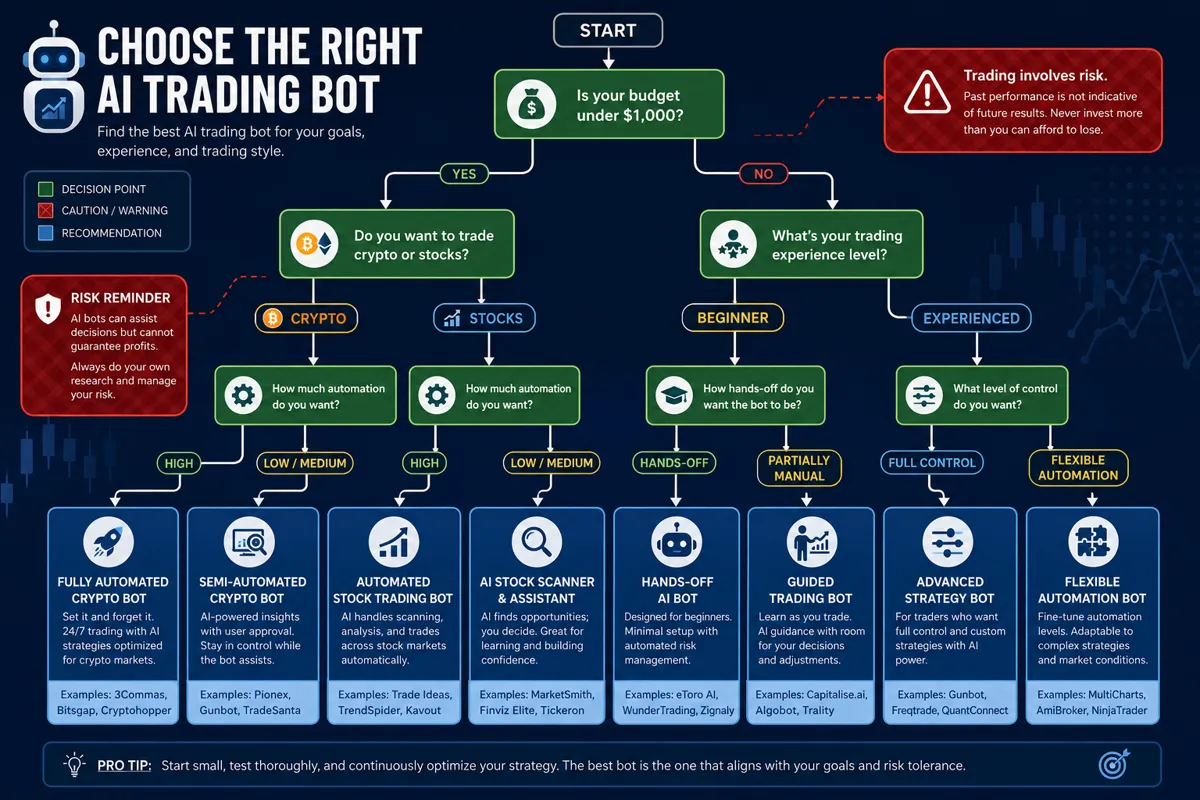
AI Trading Bots for Crypto vs Stocks: Which Is Safer?
Stocks are significantly safer than crypto for AI trading bot use in 2026. Here's why:
Regulatory oversight.
Stock markets are heavily regulated by the SEC, FINRA, and exchanges. Brokers are required to segregate customer funds, provide trade execution transparency, and follow strict compliance rules. Crypto markets have minimal regulation, especially offshore exchanges. If a crypto bot or exchange steals your money, you have little recourse.
Market structure and manipulation.
Stock markets have circuit breakers, market-wide halts, and rules against manipulation. Crypto markets are the Wild West — pump-and-dump schemes, wash trading, and spoofing are common. AI bots trained on crypto data often learn to trade noise and manipulation, not real price discovery.
Data quality and reliability.
Stock market data is standardized, audited, and available from reputable providers (Bloomberg, Refinitiv, exchanges). Crypto data varies wildly between exchanges, with frequent gaps, errors, and discrepancies. Bots trained on bad data produce bad results.
Execution quality and slippage.
Stock trades execute on regulated exchanges with tight spreads and deep liquidity (for large-cap stocks). Crypto trades often execute on thinly-traded pairs with wide spreads and high slippage. A bot that looks profitable in backtest can lose money on execution costs alone.
Scam prevalence.
The crypto bot space is saturated with scams — fake bots, Ponzi schemes, and platforms that disappear with your funds. The stock bot space has scams too, but they're easier to identify because legitimate platforms integrate with regulated brokers. If a crypto bot asks you to deposit funds directly, it's almost certainly a scam.
When crypto bots might make sense:
- Arbitrage strategies. If you're exploiting price differences between exchanges, crypto's fragmented market structure can create opportunities. But you need fast execution, low fees, and deep understanding of exchange APIs.
- Market-making on decentralized exchanges. Providing liquidity on DEXs can generate fees, but it requires technical skill and exposes you to impermanent loss and smart contract risk.
- Long-term DCA strategies. If you're dollar-cost averaging into Bitcoin or Ethereum over years, a simple bot can automate the process. But this isn't really "trading" — it's automated investing.
Bottom line: If you're choosing between stocks and crypto for AI trading bot use, stocks are safer, more transparent, and less likely to result in total loss of capital. Crypto bots can work for specific strategies (arbitrage, market-making), but the risk of scams, manipulation, and poor execution is much higher. If you're a beginner, start with stocks.
For more on stock-focused tools, check our day trading and swing trading categories.
Can AI Trading Bots Work with Small Accounts Under $1,000?
Yes, AI trading bots can technically work with accounts under $1,000, but profitability is much harder due to commission costs, position sizing constraints, and subscription fees. Here's the reality:
The math problem.
If you're paying $50/month for a bot and trading a $1,000 account, that's 5% of your capital annually just in subscription fees. You need to generate at least 5% returns just to break even on the bot cost, before accounting for broker commissions, slippage, and taxes. That's a high bar.
Position sizing constraints.
Most legitimate strategies risk 1%–2% per trade. On a $1,000 account, that's $10–$20 risk per trade. If your stop loss is $0.50 per share, you can only buy 20–40 shares. Many stocks trade above $50, which means you can't even take one full position without violating risk management rules. This limits the bot's ability to execute its strategy properly.
Commission and fee impact.
Even with zero-commission brokers, you pay SEC fees, exchange fees, and slippage. On a $1,000 account, these costs add up quickly. A bot that makes 50 trades per month might rack up $20–$30 in fees, which is 2%–3% of your capital. High-frequency bots are especially problematic for small accounts.
Pattern day trader rule (U.S. only).
If you're trading stocks in the U.S. with less than $25,000, you're limited to three day trades per five-day period. Many AI bots are designed for day trading or short-term swing trading, which means you'll hit the PDT limit quickly. This doesn't apply to cash accounts or non-U.S. traders, but it's a major constraint for most U.S. retail traders.
When small accounts can work with AI bots:
- Swing trading strategies. Bots that hold positions for days or weeks (not intraday) avoid the PDT rule and reduce commission impact. You're making fewer trades, so costs are lower.
- Free or low-cost bots. If you're using a free bot like QuantConnect or a low-cost option like Composer ($30/month), the subscription fee is manageable relative to account size.
- Fractional shares. Some brokers (Alpaca, Robinhood) allow fractional share trading, which solves the position sizing problem. You can risk $10 on a $500 stock by buying 0.02 shares.
- Crypto or forex. These markets don't have the PDT rule, and you can trade with smaller position sizes. But as discussed earlier, crypto bots carry higher scam risk and execution challenges.
What most platforms recommend.
Legitimate AI trading bot platforms typically recommend starting with at least $5,000 for stocks and $10,000 for day trading (to stay above PDT limits). Below that, the math just doesn't work for most strategies.
The better path for small accounts:
Instead of paying for an AI bot, use free tools to learn and paper trade. Build your account to $5,000+ through consistent saving and manual trading, then add automation. Use free scanners, free backtesting tools, and free educational resources. Once your account is large enough to absorb fees and execute proper position sizing, then invest in a paid bot.
Bottom line: AI trading bots can work with accounts under $1,000, but the odds are stacked against you. Fees eat into returns, position sizing is constrained, and the PDT rule limits flexibility. If you're starting with a small account, focus on learning, saving, and growing your capital before adding automation.
How to Test an AI Trading Bot Before Risking Real Money
Testing an AI trading bot properly is the difference between losing your account in a month and building a profitable system. Here's the step-by-step process:
Step 1: Paper trade for at least 30 days.
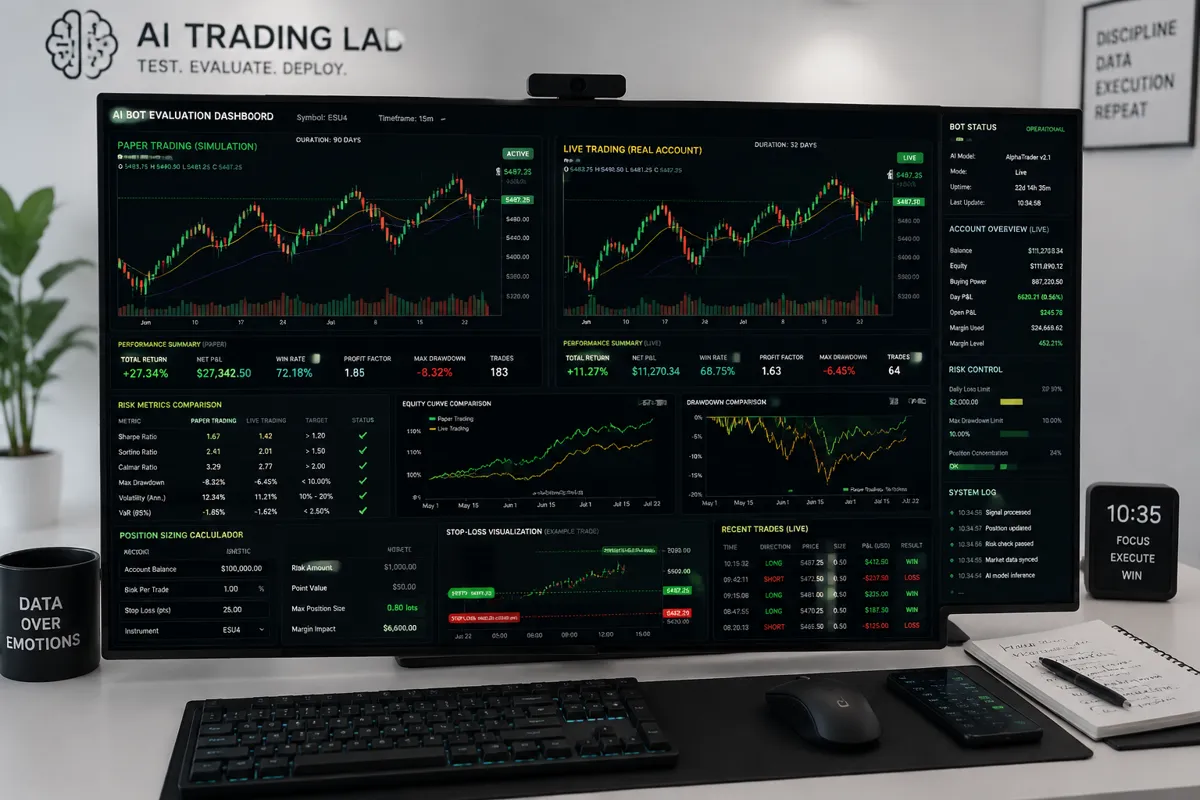
Every legitimate bot offers a paper trading or simulation mode. Use it. Run the bot's signals in a simulated environment for at least 30 days (preferably 60–90 days) to see how it performs across different market conditions. Track every trade, calculate win rate, profit factor, max drawdown, and average risk-reward.
Step 2: Compare live simulation to backtest results.
The bot's marketing page shows 20% annual returns in backtest. Your paper trading shows 8%. That 12% gap is slippage, execution costs, and real-world friction. If the gap is larger than 20%–30%, the backtest is overfitted or the strategy doesn't work in real conditions. Walk away.
Step 3: Test across multiple market conditions.
A bot that works in a trending bull market might fail in a choppy, range-bound market. Test the bot during different volatility regimes — low VIX, high VIX, trending, choppy, earnings season, quiet summer trading. If the bot only works in one condition, it's not robust.
Step 4: Verify the bot's risk management.
Check if the bot enforces stop losses, limits position size, and caps daily loss. Manually override a few trades to see if the bot prevents you from taking excessive risk. If the bot lets you size a position at 50% of your account, it has no risk management. That's a red flag.
Step 5: Track your own decision-making.
Even in paper trading, log every trade and note when you felt tempted to override the bot's signal. Did you want to skip a trade because it "felt wrong"? Did you want to double the position size because you were confident? These emotional impulses will be stronger with real money. If you can't follow the bot's signals in paper trading, you won't follow them live.
Step 6: Calculate real, after-cost returns.
Subtract subscription fees, broker commissions, and estimated taxes from your paper trading returns. If the bot shows 12% returns but costs eat 7%, your net return is 5%. Is that worth the time and risk? Be honest.
Step 7: Start live with a small position size.
Once you've paper traded successfully for 30+ days, go live with 25%–50% of your intended position size. Run this for another 30 days. Live trading always feels different than paper trading. You'll notice slippage, emotional reactions, and execution issues you didn't see in simulation. If performance holds up, scale to full size.
Step 8: Review and adjust monthly.
Every month, review your trading journal. What's working? What's not? Are you following the bot's signals consistently? Is the bot's performance degrading? If the bot stops working, pause and reassess. Don't keep trading a broken strategy just because you paid for it.
Red flags during testing:
- The bot's live performance is significantly worse than backtest. This means the strategy is overfitted or the backtest assumptions are unrealistic.
- You can't follow the bot's signals consistently. If you're constantly overriding the bot, you don't trust it. Don't use it.
- The bot has no risk management or lets you take excessive risk. This will blow up your account eventually.
- The bot's performance is highly volatile with huge drawdowns. Even if the bot is profitable on average, if you can't stomach a 30% drawdown, you'll shut it off at the worst time.
The takeaway: Testing is not optional. Most traders skip this step, go live immediately, lose money, and blame the bot. The bot might be fine — the problem is they didn't test it properly. Spend at least 30 days in paper trading, track every metric, and only go live when you're confident the strategy works and you can follow it consistently.
Why Do Some AI Trading Bots Promise Guaranteed Returns?
Because they're scams. No legitimate AI trading bot promises guaranteed returns. Here's why these claims exist and how to spot them:
Why scam bots promise guaranteed returns:
- It's effective marketing. People want certainty. Promising "guaranteed 10% monthly returns" is more compelling than "historically profitable with 15% max drawdown." Scammers know this and exploit it.
- It bypasses critical thinking. When you see "guaranteed," your brain stops asking hard questions. You don't demand audited track records, transparent methodology, or risk disclosure. You just sign up and deposit money.
- It's unenforceable. Scam bots are usually offshore with no regulatory oversight. When the "guaranteed" returns don't materialize, you have no legal recourse. The company disappears, rebrands, and starts the scam again.
Why guaranteed returns are mathematically impossible:
Markets are probabilistic, not deterministic. Even the best strategies lose money during certain conditions — high volatility, low liquidity, regime changes, black swan events. No algorithm can predict every market move. Any bot that claims otherwise is lying.
How scam bots fake guaranteed returns:
- Ponzi structure. Early users get paid with deposits from new users, not from actual trading profits. This creates the illusion of guaranteed returns until the scheme collapses.
- Cherry-picked results. The bot shows you a few winning trades and hides the losses. The "guaranteed" returns are based on a tiny, unrepresentative sample.
- Fake dashboards. The bot displays a fake equity curve with steady, linear gains. The numbers aren't connected to real trades — they're just made up.
- Manipulated backtests. The bot shows backtest results with unrealistic assumptions (zero slippage, perfect fills, no fees) and calls them "guaranteed."
What legitimate bots say instead:
- "Historically profitable with 12% average annual return and 18% max drawdown."
- "This strategy has a 58% win rate with 1.8:1 average risk-reward."
- "Past performance does not guarantee future results."
- "All trading involves risk of loss."
Legitimate bots disclose risk, show drawdowns, and never promise specific returns. They provide data and let you decide if the risk-reward fits your goals.
If a bot promises guaranteed returns, it's a scam. No exceptions. Don't rationalize it. Don't think "maybe this one is different." It's not. Walk away.
Conclusion
The best AI trading bot in 2026 is the one that publishes audited track records, shows transparent methodology, integrates with regulated brokers, discloses risk honestly, and charges clear fees. Platforms like Tickeron, Trade Ideas, TrendSpider, QuantConnect, and Composer set the standard for legitimacy. Everything else is noise or worse.
Most AI trading bots lose money for most users — not because the bots are scams, but because users skip testing, ignore risk management, override signals emotionally, or chase performance instead of sticking with a process. The bot is a tool. It's only as good as the system around it.
If you're evaluating a bot, run it through the five verification signals: audited performance, transparent methodology, clear fees, regulatory compliance, and honest risk disclosure. If it fails any of these, walk away. If it passes all five, paper trade it for 30 days, track every metric, and only go live when you're confident the strategy works and you can follow it consistently.
The difference between legit and scam isn't subtle. Scams promise guaranteed returns, pressure you to act fast, hide fees, require direct deposits, and refuse to show real trade data. Legit bots do the opposite on every point. Trust the data, not the marketing.
Next steps:
- Review the trading bots we've vetted for transparency and performance.
- Use our free expectancy calculator to evaluate any bot's real edge after costs.
- Explore day trading and swing trading tools that complement bot strategies.
- Check our screeners category for manual scanning tools if you're not ready for full automation.
FullStack Alpha cuts the noise so you can keep the alpha. See the AI tools, scanners, and systems we actually rate at aistockpickerapps.com.