Best AI Stock Picker for Beginners on a Budget: 9 Under $20


The best ai stock picker for beginners isn't the one with the most features. It's the one whose annual cost doesn't quietly eat your account before your process has a chance to work. Every tool below has a genuine free tier, and most publish a paid price under $20 a month. 

Quick answer: 
Which AI Stock Picker App Is Best for a Beginner Investor With a Limited Budget?
Prospero.ai, at $0 for the core free app, is the best starting point for a beginner with a limited budget, because it delivers ranked daily picks, options flow, dark-pool activity, and social sentiment without asking for a card first.
Here is the full best ai stock picker for beginners shortlist, in order:
Finviz, free screener that still beats most paid ones (Elite is $39.50/mo, so stay free)
Simply Wall St, visual company analysis for people who hate spreadsheets, Premium $10.95/mo billed annually
Kavout, quantitative ranking, Pro at $16/mo billed annually or $20 month to month
Magnifi, free tier plus commission-free trading, $99/year premium
WallStreetZen, fundamental due diligence automated, Premium $19.50/mo billed yearly
Public, brokerage with AI explanations baked in, $0 commissions on US stocks and ETFs
Before you crown the best ai stock picker for beginners, know what you're actually buying.
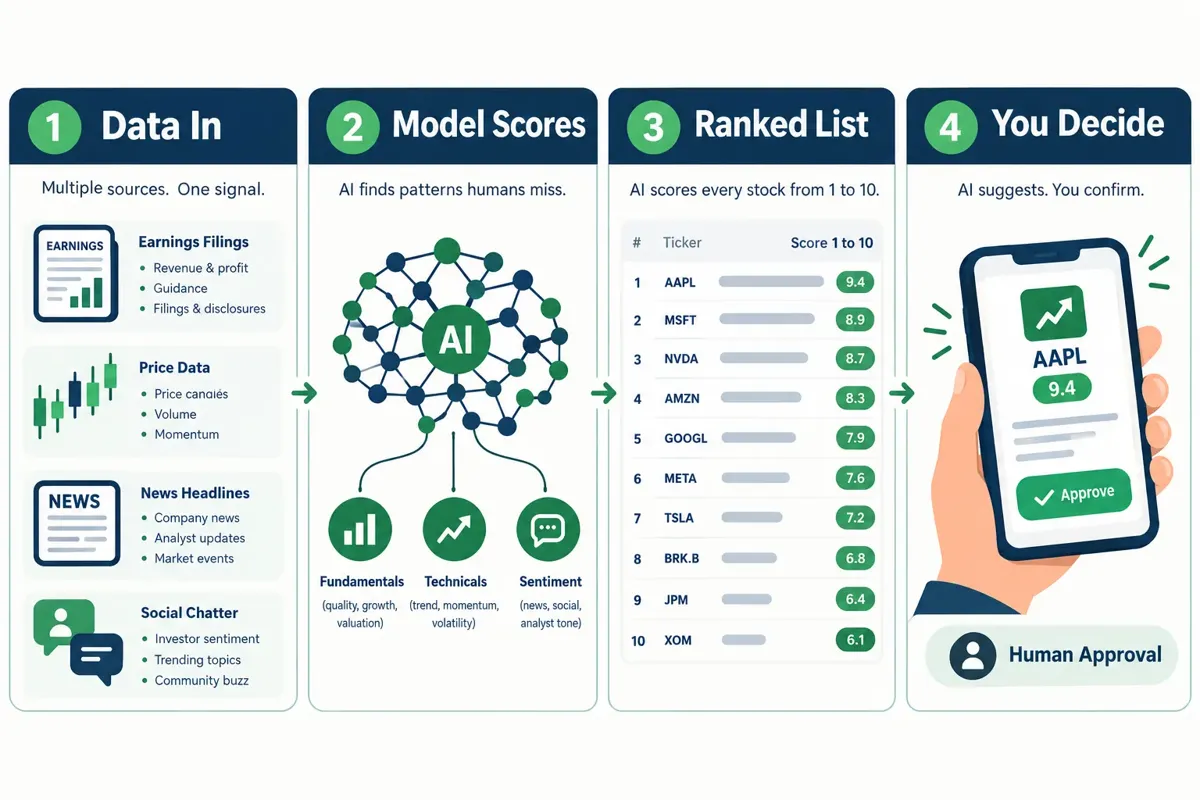
An AI stock picker ingests data a human can't read fast enough. Earnings filings, price action, analyst revisions, options flow, news sentiment, sometimes social chatter. It scores or ranks tickers based on patterns it learned from historical data. It does not know the future. It tells you which names currently look statistically similar to names that performed well before.
That distinction matters more than any feature list. A score is a starting point for your research, not a verdict.
1. Prospero.ai: The Free Tier That Doesn't Feel Like Bait
Most free trading apps are a demo with a paywall bolted on at the exact moment you find something useful. Prospero.ai is the exception, and the reason it opens this best ai stock picker for beginners list. The free iOS and Android app includes daily stock picks, 10 proprietary signals, options-flow analysis, dark-pool activity, social sentiment, and an in-app learning guide.
Options flow means watching large, unusual options trades, which can hint that someone with conviction is positioning. Dark-pool activity tracks shares traded off public exchanges, often by institutions. Neither is a crystal ball. Both are context a beginner would otherwise never see.
What makes this the best free ai investing app for beginners is the learning guide sitting next to the signals. Most tools hand you a number and leave. Prospero at least tries to explain what the number means.
The drawback: daily picks create a dangerous habit. You start feeling obligated to trade something every day. That's overtrading, and it kills small accounts faster than bad picks. Use the picks as a watchlist, not a to-do list.
A free product has to monetize eventually. Watch what moves behind a paywall.
2. Finviz: The Free Screener Veterans Still Open Every Morning
Walk into any room of self-directed traders and ask what they use to filter stocks. Finviz comes up before anything with "AI" in the name.
The free version runs fundamental, technical, and descriptive filters across the US market, plus heatmaps and basic charts, with delayed data. Finviz Elite costs $39.50 a month or $299.50 a year, over budget. Stay free. For a beginner trying to learn why a stock shows up on a list, the free tier teaches more than most paid subscriptions.
Here's the honest part: Finviz isn't an AI stock picker. It's a rules engine. You set the filters, it returns matches. No model, no score, no prediction.
That's a feature, not a bug, when you're starting out. You learn which filters actually correlate with the moves you want. You can compare its output with alternatives in our free stock charts comparison of 
Use Finviz to build the muscle an AI tool will later do for you. Knowing what a scan is doing beats trusting a black box that won't show its work.
3. Danelfin: The One That Shows Its Homework
Danelfin rates stocks 1 to 10 using fundamental, technical, and sentiment inputs, and publishes the factors behind the score. Plus costs $22 a month billed annually ($264 a year) and about $29 month to month.
Plain truth: the paid plan is over the $20 line. Danelfin earns its spot because the free plan is real, $0 forever with 10 stock or ETF reports a month, and the transparency beats most tools charging double.
Why does explainability matter to a beginner? Because when a stock you own drops 12%, the only thing stopping you from panic-selling is understanding why you bought it. A number with no reasoning attached gives you nothing to hold onto.
Danelfin's weak spot is public discussion. Very few retail traders are talking about it in the wild, which means there's little independent corroboration of how the scores hold up in real accounts. We broke the scoring down against competitors in Danelfin vs Zen Ratings vs Kavout.
Treat an AI score like a credit score for a stock. It summarizes risk. It doesn't tell you to make the loan.
4. Simply Wall St: Company Analysis for People Who Hate Spreadsheets
A balance sheet is a wall of numbers. Simply Wall St turns it into a snowflake chart with five axes: value, future, past, health, and dividend.
For a 23-year-old who just opened a brokerage account and has never read a 10-K, that visual does something a spreadsheet can't. It makes the shape of a company obvious in three seconds. Overpriced but growing fast looks different from cheap and shrinking.
The free plan covers 5 company reports a month, one portfolio with up to 10 holdings, and three watchlists. Premium is $10.95 a month billed annually ($131.40 a year) and raises you to 30 reports a month. For long-term investors rather than traders, it's one of the better entry points on this list.
The honest criticism: simplification cuts both ways. A five-point visual can make a complicated company look settled when it isn't. The valuation estimates lean on discounted cash flow models that are only as good as their growth assumptions, and those assumptions change constantly.
Use it to generate questions, not conclusions. When the "health" axis looks thin, go read the actual debt schedule.
5. Kavout: Quantitative Ranking at the Lowest Real Price Here
Kavout runs a free plan with 10 research credits a month. Pro costs $16 a month billed annually ($192 a year) or $20 month to month. Its core output is the Kai Score, a quantitative ranking, plus AI stock ranking, smart signals, and research agents.
Pro is one of the cheapest genuine paid tiers on this list, which makes it the default cheap ai stock picker for someone who wants a model score without committing serious money.
Quantitative ranking means the system sorts the universe by measured factors, momentum, valuation, quality, and sentiment among them, then surfaces the top of the list. It's the same basic approach institutional quant funds have run for 30 years, just packaged for a phone.
What to watch: ranking systems perform differently across market regimes. A momentum-weighted model that looked brilliant in a trending market can get shredded in a choppy tape where every breakout fails. Ask what environment the backtest covered.
Any model that only tested on a bull market tested on one weather pattern.
6. Magnifi: Free Portfolio Analysis Plus Actual Trading
Magnifi runs a free tier that includes portfolio analysis, risk and exposure analysis, investment discovery, simulations, and commission-free trading. Premium is $99 per year, adding scenario analysis and predictive portfolio forecasting.
Ninety-nine a year is $8.25 a month, comfortably under the line.
The standout feature for a beginner is exposure analysis. Most new investors think they're diversified because they own eight stocks. Then a tool shows them that seven of those eight move with the same semiconductor cycle, and the portfolio is one bet wearing eight costumes.
Magnifi's conversational interface lets you ask plain-English questions about your holdings. That lowers the barrier for anyone intimidated by jargon. It also risks making you feel more informed than you are, because a confident answer from a chatbot reads identically whether it's right or wrong.
If a chat-style interface is what you want, compare options in our rundown of AI stock chat assistants.
7. WallStreetZen: Due Diligence, Automated
WallStreetZen runs automated checks across a company's financials and returns a plain-language verdict on each one. Revenue growth, debt levels, insider ownership, analyst accuracy.
That last one deserves attention. It tracks how accurate individual analysts have historically been, which quietly reveals how much of Wall Street commentary is noise. Not every price target is worth the pixels it's printed on.
The free tier gives limited stock reports. Premium is $19.50 a month billed yearly, just under the line; monthly billing costs more.
The limitation is scope. This is a fundamentals tool for people holding positions for months or years. If you want intraday scanning or breakout alerts, you're in the wrong aisle. Check our guide to the best stock apps for day trading instead.
Match the tool's time horizon to your own. A fundamental screener is useless if you're exiting by 3:45 pm.
8. Stock Rover: Deep Screening Without the Institutional Price Tag
Straight answer first: Stock Rover has no paid plan under $20. Essentials starts at $24 a month on 2-year billing, $29 a month billed annually, or $34 month to month. It's here for its free plan, which covers basic research on individual stocks.
What the paid tiers buy is depth. Hundreds of metrics, custom screeners, portfolio rebalancing analysis, and historical financial data going back years. Serious dividend and value investors live inside it.
That depth is also the problem for a beginner. The first-week experience is overwhelming. Hundreds of fields, dozens of pre-built screens, and no obvious place to start. Plenty of people pay for a month, open it twice, and quietly cancel. Try the 14-day free trial first.
If that sounds familiar, you're hitting analysis paralysis, the state where more information makes the decision harder instead of easier. The fix: pick five metrics, build one screen, and ignore the other 495 for 30 days.
Head to head with the free alternative in our Stock Rover vs Finviz breakdown.
9. Public: A Brokerage That Explains Itself
Public rounds out the list as the best stock app for beginners who want the AI layer sitting inside the account rather than in a separate tab.
Commission-free trading on US stocks and ETFs, fractional shares, and AI-generated explanations attached to price moves and earnings. When a stock you hold gaps 8%, the app tells you what happened. That single feature prevents a lot of panic selling, because the most dangerous moment for a new investor is a move they can't explain.
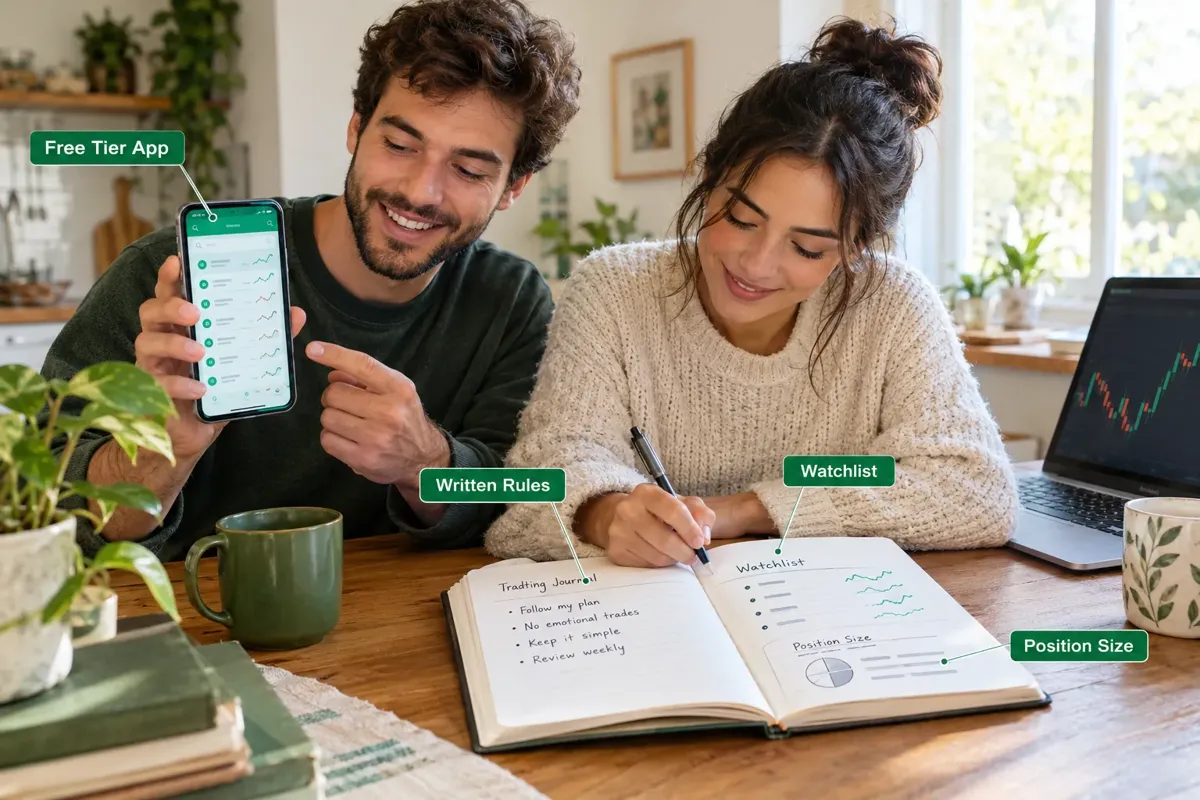
Fractional shares matter for a small account. With $500, buying whole shares of five expensive names is impossible. Fractional access means position sizing stays sane. Position sizing is simply deciding how much of your account any single trade gets, and it's the one discipline that separates survivors from statistics.
The criticism: broker-built AI has an incentive to keep you engaged and transacting. Read the explanations, then go verify them somewhere that doesn't profit from your order flow.
Comparison: All 9 Side by Side
Best AI Stock Picker for Beginners: All 9 Compared
Prices in USD from vendor pricing pages, October 2026; annual billing where noted. Danelfin and Stock Rover paid plans exceed $20; both keep real free plans. Verify before subscribing.
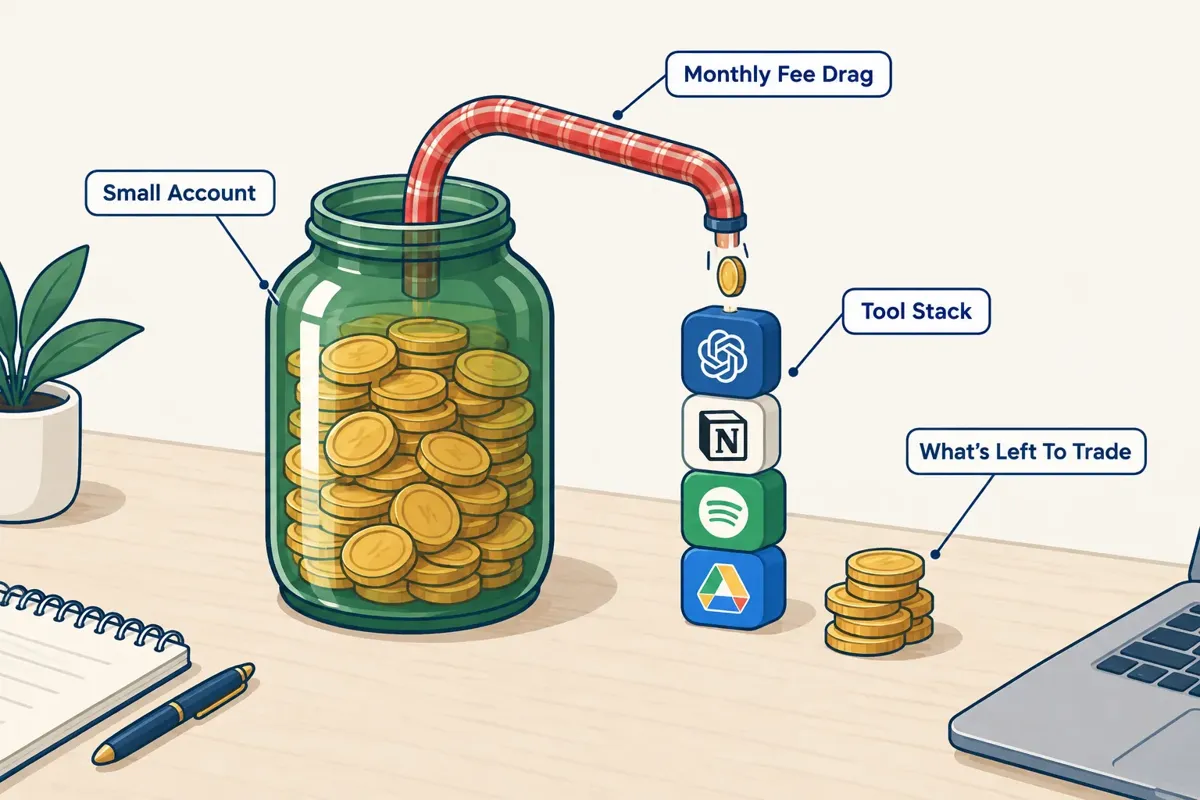
What Does $20 a Month Really Cost a Small Account?
Twenty dollars sounds like nothing. Two coffees. A streaming bundle. Then you run it against the account, which is where the best ai stock picker for beginners question really gets settled.
On a $1,000 account: $240 a year is 24% of your capital. Your tools have to generate a 24% return before you break even on the software. The S&P 500's long-run average annual return is roughly 10%. You'd need to more than double the market's typical year just to pay the subscription.
On a $5,000 account: $240 a year is 4.8%. Still a real hurdle, but survivable. Your portfolio only needs to beat its own benchmark by about five points.
Two subscriptions at $20 doubles both numbers. Three makes a $1,000 account mathematically absurd.
The rule: no single tool should cost more than 1% of your account per year, and your total stack shouldn't pass 2%. That means under $1,000, you use free tools only. Between $1,000 and $5,000, one cheap paid tool at most. Past $10,000, a $20 subscription stops being reckless.
Fees compound against you with the same patience that returns compound for you. A $20 monthly habit held for 20 years is $4,800 of capital that never got invested, before growth.
Start with the AI stock tools for beginners shortlist and pick free until the account can carry the cost.
How to Pick Your First Tool in 10 Minutes
Choosing the best ai stock picker for beginners takes ten minutes and a rule set, not a weekend.
- Multiply your account size by 1%. That's your yearly software budget. Under $1,000, use a free ai stock picker.
- Match your time horizon. Holding for months: Simply Wall St or WallStreetZen. Watching daily moves: Prospero or Finviz.
- Read the vendor's pricing page yourself. Monthly price, annual price, free plan limits. Tiers change.
- Choose one tool. Delete the rest.
- Set a 30-day review. Opened it fewer than ten times? Cancel or downgrade.
- Paper trade every signal first.
What Should a Beginner Skip?
Knowing what to avoid matters as much as finding the best ai stock picker for beginners.
Skip anything that promises accuracy percentages. A September 2026 research summary covering work by Jiayi Chen and Guiling Wang at the New Jersey Institute of Technology found that across nine comparisons, giving models more reasoning capacity did not reliably improve net portfolio returns after trading costs. The same summary reported that model picks weren't even reproducible: GPT repeated roughly 15 of 20 picks across repeated runs, 
Read that again. Ask the same model the same question twice and you get a meaningfully different list. Treating a single AI output as a stable thesis is building on sand. We dug into the number games in why AI stock prediction accuracy figures lie.
Skip anything that won't say how it works. On October 5, 2026, investor-protection authorities warned about scams built around supposed proprietary AI trading systems, fabricated performance displays, unusual payment demands, and unregistered firms [Investor.gov]. The pattern is consistent. Vague methodology, dazzling screenshots, pressure to pay fast.
Skip autonomous trading bots entirely in year one. FINRA's 2026 oversight work flags specific risks in autonomous AI agents: acting without human approval, exceeding intended authority, weak auditability, hallucinations, and poorly designed incentives. FINRA's guidance treats AI as something requiring supervision and model-risk management, not a replacement for judgment. A bot executing trades you don't understand is leverage on your ignorance. If automation is your long-term goal, start with our AI trading for beginners guide and learn the guardrails first.
Skip the professional-grade scanners. Trade Ideas Standard runs $127 a month and Premium $254 on monthly billing. Those are built for active day traders processing hundreds of setups. For a beginner, they're a fire hose aimed at a teacup.
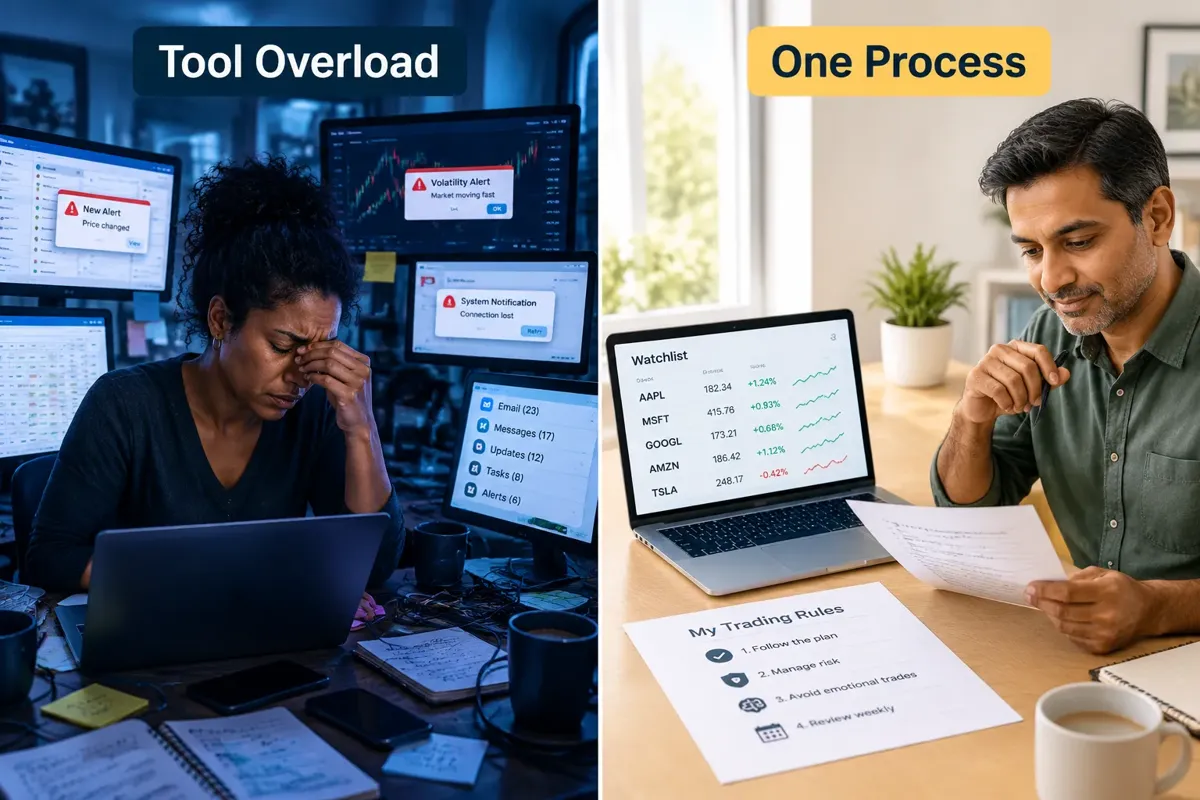
Skip stacking tools. The most common beginner failure isn't picking the wrong app. It's running six at once, getting conflicting signals, and freezing. Pick two. Run them for 90 days. Write down every decision and why you made it.
One more skip: skip real money for the first month. Paper trade it first. The habits you build with fake money are the habits you'll run with real money, except the fake version doesn't charge tuition.
How These Differ From Robo-Advisors
A robo-advisor makes decisions for you. You answer a risk questionnaire, it builds a diversified portfolio of ETFs, rebalances automatically, and charges around 0.25% a year. Zero stock picking involved.
An AI stock picker hands you research and leaves the decision in your hands. More control, more responsibility, more ways to hurt yourself. Even the best ai stock picker for beginners won't rebalance a portfolio for you.
Comparison sites generally split the AI category in two: research assistants like Prospero, Magnifi, and Danelfin, versus automated trading systems like Trade Ideas and certain 
If you don't want to make decisions, a robo-advisor is the honest answer and nobody should talk you out of it. If you want to learn to make decisions, the research tools give you training wheels. Both are legitimate. Pretending a stock picker is passive is where people get hurt.
Do These Tools Hold Up When the Market Falls?
Less well than their marketing suggests, and that includes the best ai stock picker for beginners on this list.
Most retail AI tools train on historical data heavily weighted toward bull markets, because that's what the last 15 years mostly were. Models learn that dips get bought. In a genuine downturn, that pattern inverts, and the tool keeps flagging "oversold" names that get more oversold.
Your downside protection is your stop loss and your position sizing, not your software. A stop loss is a pre-set exit price that caps the damage on a trade gone wrong. No AI score replaces that. Our honest guide to AI stock trading for retail traders covers how to build those rules.
FAQ
What are the best AI stock picker apps available to buy or subscribe to right now? The best ai stock picker for beginners with a small account is Prospero.ai (free). Kavout ($16/mo annually), Simply Wall St ($10.95/mo annually), and Magnifi ($99/year) cover the realistic paid range. Danelfin at $22/mo annually is the step up if explainability matters most, though it sits over $20. Verify current pricing on each vendor's page before subscribing, since tiers change.
Is there a free AI stock picker? Yes. Prospero.ai's iOS and Android app includes daily picks, 10 signals, options flow, dark-pool data, and sentiment at no cost. Finviz, Magnifi, and Public also run usable free tiers. A free ai stock picker is the correct starting point for any account under $1,000.
Do AI stock pickers actually make money? Some users do, some don't, and no honest tool can promise either. Research summarized in September 2026 found that stronger model reasoning did not reliably improve net returns after trading costs across nine comparisons. Profit comes from your risk management, not the tool's score.
How accurate are AI stock pickers at predicting prices? They don't predict prices. They rank probabilities based on historical patterns. The same model asked twice can return different lists, which tells you how much precision to assume. Treat any published accuracy figure as marketing until the methodology is auditable.
Are AI stock pickers safe for beginners with no experience? Research tools are reasonably safe because you stay in control, which is why every best ai stock picker for beginners pick here is a research tool, not a bot. Autonomous trading agents aren't, and FINRA has flagged risks including agents exceeding their intended authority and poor auditability. Keep a human, specifically you, approving every trade.
Is it better to start with an AI stock picker or manual research? Both, in that order. Use the tool to narrow 5,000 tickers to 10, then do the manual work on those 10 yourself. Skipping the manual step means you've outsourced thinking, and you'll have nothing to fall back on when the position turns against you.
The Takeaway
Do one thing this week: open Prospero or Finviz, build a single watchlist of five names, and write one sentence per name explaining why it's there. No money, no subscription, no rush. If you can't write the sentence, the stock doesn't belong on the list.
The best ai stock picker for beginners is the one you'll still open in month three, with a written process attached. Software scores stocks. Process keeps accounts alive. Systems over hacks.
References
- Trade Ideas pricing. trade-ideas.com.
- The 10 Best AI Stock Pickers in 2026 Tools That Actually Beat the Market. prospero.ai.
- Danelfin plans and pricing. danelfin.com.
- Kavout pricing plans. kavout.com.
- Magnifi pricing. magnifi.com.
- Simply Wall St plans. simplywall.st.
- WallStreetZen plans. wallstreetzen.com.
- Stock Rover plans. stockrover.com.
- Finviz Elite. finviz.com.
- Public fee schedule. public.com.
Still choosing the best ai stock picker for beginners for a small account?
All nine have a $0 starting point, free plan or free trading, so your first tool can cost nothing.
Compare the AI stock tools for beginners in the directory
This is education, not financial advice.
Your market edge starts with the right tool. Stay alpha.
Some links on this page may be affiliate links. Rankings are never influenced by them.