Danelfin vs Zen Ratings vs Kavout: Which AI Stock Score Wins?
Last updated: July 19, 2026
The average retail trader checks six different stock screeners before making a single trade, and still picks wrong half the time. That's not a research problem. That's a signal problem. When Danelfin, Zen Ratings, and Kavout all claim their AI stock score beats the market, which one actually cuts through the noise?
Quick Answer
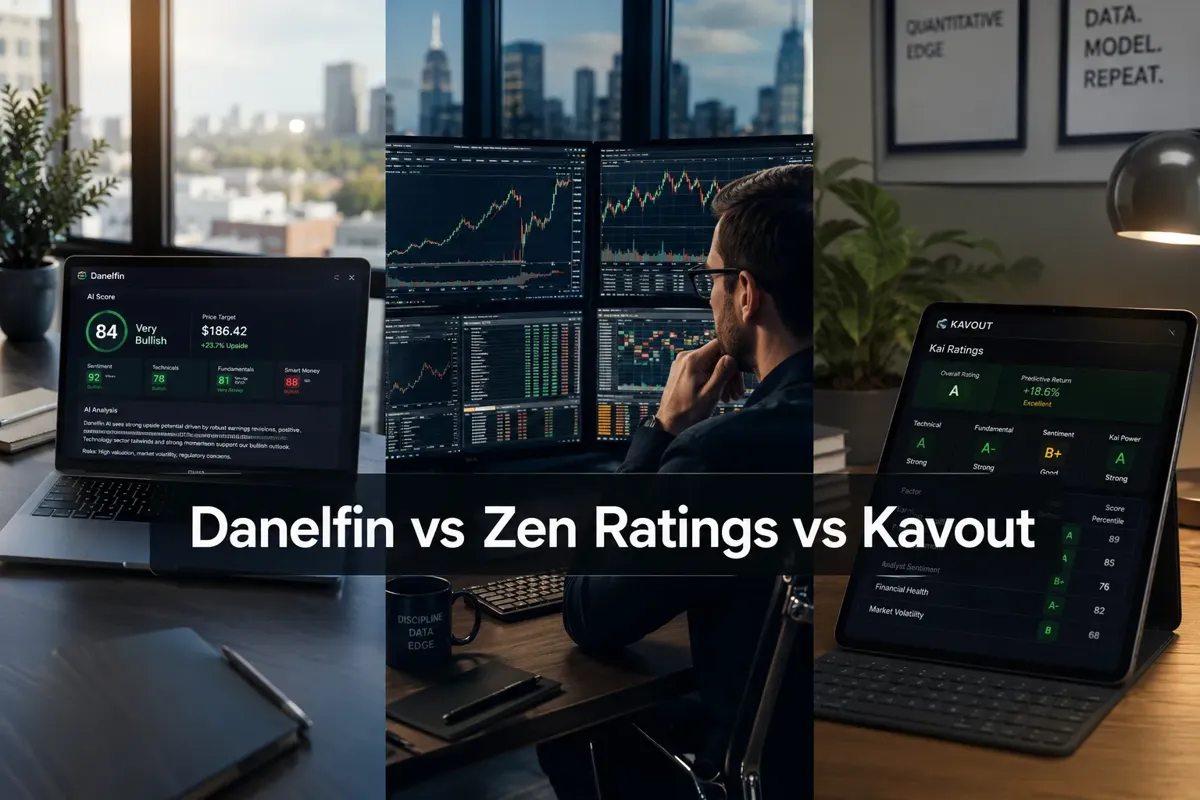
Danelfin vs Zen Ratings vs Kavout: Which AI Stock Score Wins? depends entirely on your trading style and what you're willing to pay for. Danelfin offers the most accessible entry point with a simple 1-10 AI score focused on technical and fundamental indicators, making it ideal for swing traders who want quick directional signals. Zen Ratings (part of WallStreetZen) delivers predictive analytics with probability-weighted outcomes, better suited for long-term investors who want to understand why a stock might move. Kavout's K Score brings institutional-grade quantitative analysis to retail, but its complexity and price point make it overkill for beginners. None of them are magic, all three are tools that work best when combined with your own risk management and position sizing discipline.
Key Takeaways
- Danelfin's AI score (1-10 scale) analyzes 900+ technical and fundamental indicators daily, best for swing traders who want simple directional signals without deep-dive research.
- Zen Ratings uses machine learning to predict 3-month and 12-month price targets with probability ranges, ideal for buy-and-hold investors who want explainable AI stock ratings.
- Kavout's K Score (0-9 scale) applies hedge-fund-grade quantitative models across fundamentals, technicals, and alternative data, powerful but expensive for most retail traders.
- Pricing reality: Danelfin starts at $34.99/month, WallStreetZen Premium (includes Zen Ratings) runs $20-30/month, Kavout Premium costs $39/month, none offer meaningful free tiers for serious analysis.
- Accuracy claims are marketing: All three platforms report 60-70% win rates in backtests, but real-world performance depends on your entry timing, stop-loss discipline, and position sizing.
- Best for beginners: WallStreetZen's Zen Ratings, because it explains why the AI likes or dislikes a stock in plain English, not just a number.
- Best for active traders: Danelfin, because daily score updates and technical-heavy weighting align with short-term price action and momentum setups.
- Common mistake: Blindly following any AI stock score without confirming the setup with your own chart reading, support and resistance levels, and risk-reward ratio.
Danelfin vs Zen Ratings vs Kavout: Which AI Stock Score Wins?
Let's cut to the setup: you're comparing three AI stock scoring systems because you're tired of analysis paralysis and you want a repeatable process that tells you what to buy. Fair. But here's the truth none of these platforms advertise, an AI stock score is not a trading system. It's a filter. A starting point. A way to narrow 5,000 tickers down to 50 worth your time.
The winner depends on what you're filtering for. Are you a swing trader hunting 5-10% moves over two weeks? A long-term investor building a dividend growth portfolio? A day trader who needs real-time momentum signals? Each of these tools was built for a different seat at the table, and using the wrong one is like bringing a scalpel to a chainsaw job.
Danelfin is the swing trader's scanner. It updates daily, weights technical indicators heavily, and spits out a single number (1-10) that tells you if the AI thinks a stock is likely to outperform in the next 3 months. It's fast, visual, and doesn't require a finance degree to interpret.
Zen Ratings is the patient investor's research assistant. It predicts 3-month and 12-month price targets, shows you the probability distribution of outcomes, and explains why the model likes or hates a stock. It's slower, more transparent, and better for someone building a watchlist they'll hold for quarters, not days.
Kavout is the quant's playground. It runs institutional-grade models across fundamentals, technicals, sentiment, and alternative data, then outputs a K Score (0-9) that's designed to mirror how hedge funds rank stocks. It's powerful, but it's also expensive and assumes you already know what you're doing.
None of them "win" in a vacuum. The right AI stock picker is the one that matches your timeframe, your risk tolerance, and your willingness to do the work after the score tells you where to look. Let's break down how each one actually works, what it costs, and where it falls short.
For a deeper dive into how these tools stack up against the broader universe of AI stock analysis platforms, check out our complete comparison of 100+ AI stock tools.
What Is Danelfin AI Stock Scoring and How Does It Work?
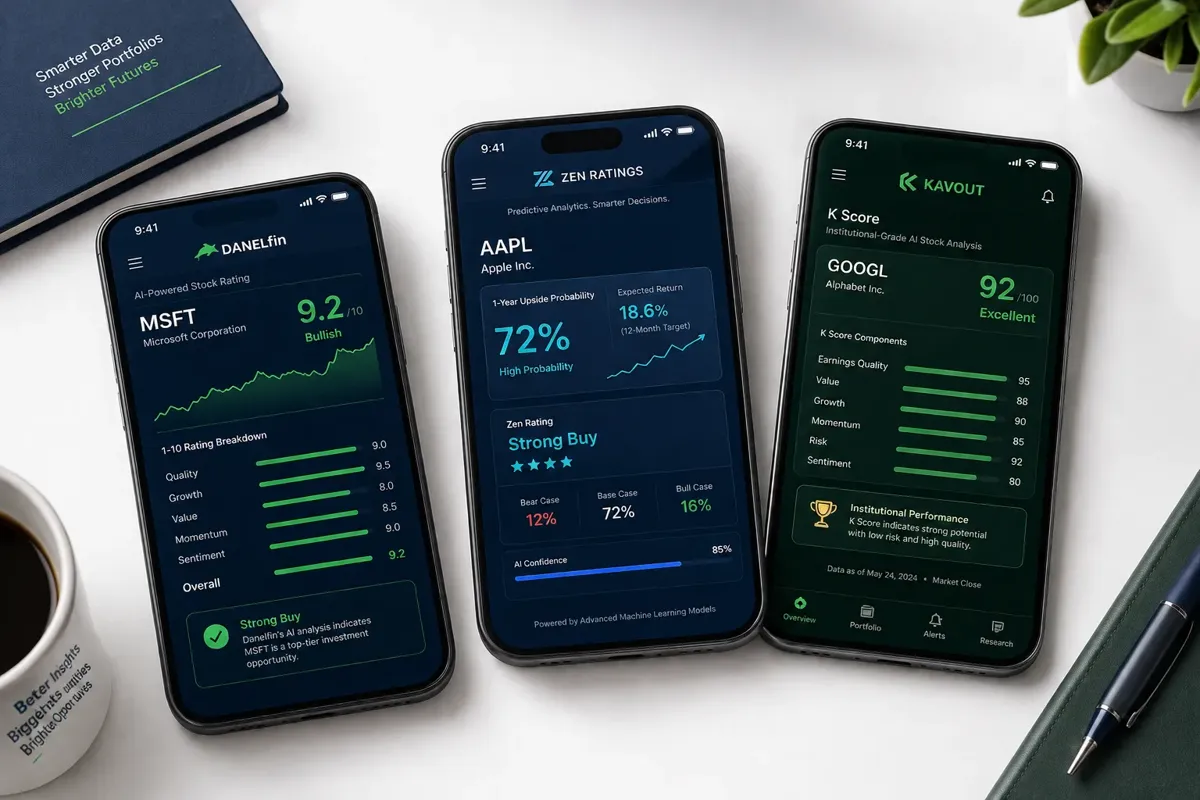
Danelfin is an AI-driven stock rating platform that assigns every U.S.-listed stock a daily score from 1 to 10 based on 900+ technical, fundamental, and sentiment indicators. The higher the score, the more likely the AI believes the stock will outperform the S&P 500 over the next three months. It's designed for retail traders who want a single, actionable number without wading through pages of analyst reports.
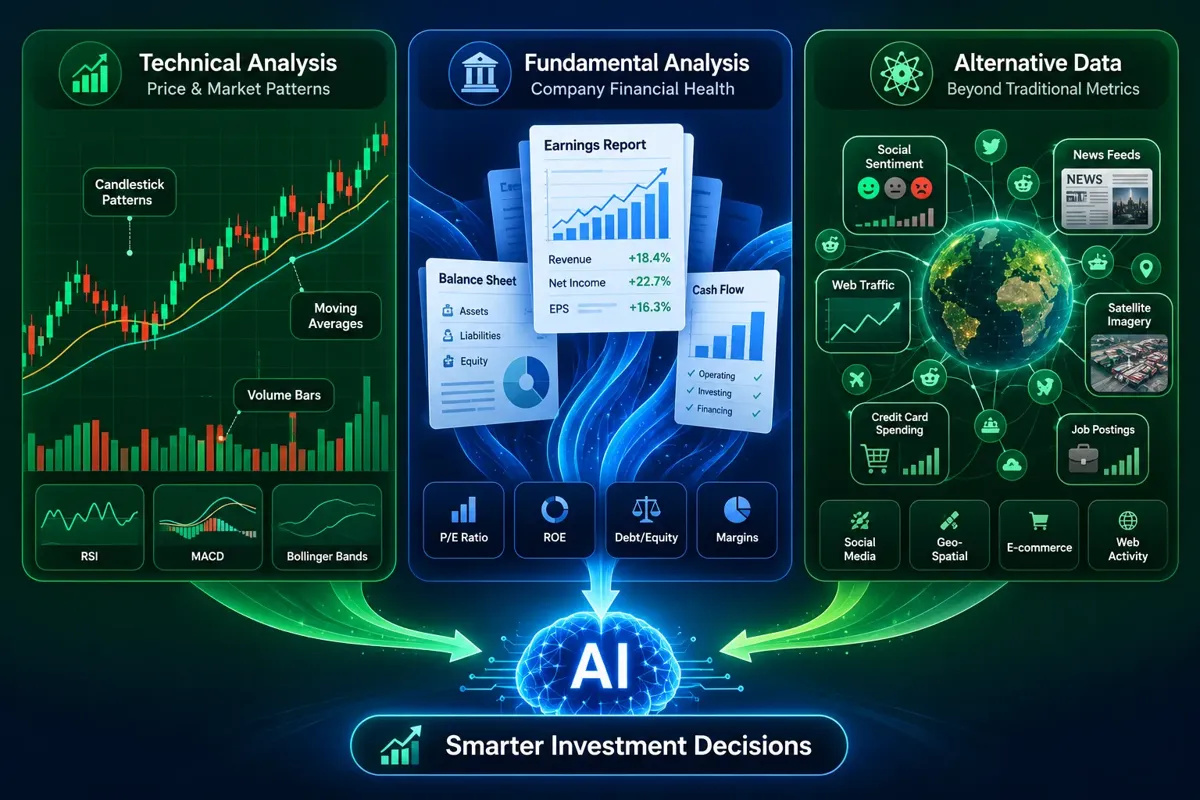
Here's how the Danelfin AI score actually works under the hood. The platform ingests data from three main buckets: technical indicators (price action, volume, momentum, moving averages), fundamental metrics (earnings growth, revenue trends, profitability ratios), and market sentiment (analyst upgrades, institutional ownership changes, social media buzz). Every day, the AI recalculates each stock's score by running these 900+ inputs through a machine learning model trained on historical market data. Stocks scoring 7 or higher are flagged as "bullish", meaning the AI expects them to beat the market. Stocks scoring 3 or lower are "bearish."
The appeal is simplicity. You don't need to know what a Sharpe ratio is or how to read a balance sheet. You scan the top-rated stocks in your sector, filter by market cap or momentum, and build a watchlist. Danelfin updates scores daily, so if a stock's technical setup deteriorates or earnings sentiment shifts, the score drops, giving you an early warning to cut losers fast.
But here's the catch: Danelfin is heavily weighted toward technical indicators, which makes it great for swing traders hunting short-term breakouts but less useful for long-term investors who care more about valuation and business quality. A stock can score a 9 because it's riding a tight consolidation and volume surge, but if the fundamentals are garbage, you're catching a dead cat bounce, not a winner.
The platform also doesn't explain why a stock scored the way it did in granular detail. You get a score, a few top contributing factors, and a chart. That's it. If you're the type of trader who needs to understand the model's logic before you trust it, Danelfin will feel like a black box.
Pricing: Danelfin starts at $34.99/month for the Trader plan, which includes daily AI scores, portfolio tracking, and basic screening. The Pro plan ($49.99/month) adds advanced filters and alerts. There's a 7-day free trial, but it's limited, you can't access historical scores or backtest strategies without paying.
For a detailed breakdown of how Danelfin's AI score performs in real-world conditions, see our Danelfin AI score review.
What Are Zen Ratings and How Do They Predict Stock Performance?

Zen Ratings is the AI stock scoring engine inside WallStreetZen, a research platform built for self-directed investors who want more than a number, they want to know why the AI thinks a stock will move. Unlike Danelfin's 1-10 scale, Zen Ratings predicts actual price targets (3-month and 12-month) and shows you the probability distribution of outcomes. It's explainable AI for people who don't trust black-box algorithms.
Here's how it works. Zen Ratings runs a machine learning model trained on decades of stock price data, fundamental metrics, analyst estimates, and market conditions. For every stock, it generates a predicted price range and assigns a probability to each outcome. For example, it might say: "AAPL has a 60% chance of trading between $180 and $200 in three months, a 25% chance of going higher, and a 15% chance of dropping below $180." That's not a hot tip, it's a risk-weighted forecast you can actually use to size a position.
The model also breaks down what's driving the prediction. If Zen Ratings is bullish on a stock, it'll tell you whether that's because of strong earnings growth, improving margins, positive analyst revisions, or technical momentum. If it's bearish, you'll see the red flags: deteriorating fundamentals, negative sentiment, or overvaluation. This transparency is what separates Zen Ratings from most AI stock pickers, you're not flying blind.
Where Zen Ratings shines: long-term investors who want to build a watchlist of undervalued stocks with strong fundamentals and hold them for quarters or years. The 12-month price targets are particularly useful for buy-and-hold strategies, and the probability ranges help you avoid overconfidence. If a stock has a 40% chance of hitting your target and a 30% chance of dropping 20%, that's not a setup, that's a coin flip.
Where it falls short: active traders. Zen Ratings updates less frequently than Danelfin (weekly, not daily), and it's not optimized for short-term price action or momentum plays. If you're swing trading breakouts or gap fills, you need faster signals. Zen Ratings is built for patience, not power hour.
Pricing: WallStreetZen Premium costs $20-30/month depending on the billing cycle and includes Zen Ratings, fair value estimates, earnings calendars, and portfolio tracking. It's one of the better value propositions in the AI stock picker space, you're getting a full research platform, not just a score.
If you're comparing Zen Ratings to other AI-driven research tools, our AI stock picker comparison guide walks through the key differences in methodology and use cases.
Kavout K Score Explained for Beginners
Kavout is the institutional-grade option in this comparison. It's built by quants, for quants, and it shows. The platform's flagship metric, the K Score, is a 0-9 ranking system that applies hedge-fund-level quantitative models to every stock in the U.S. market. A K Score of 9 means the stock ranks in the top decile across Kavout's multi-factor model. A K Score of 0 means it's in the bottom decile. Simple in theory, complex in execution.
Here's what makes the Kavout K Score different from Danelfin and Zen Ratings: it's not just technical and fundamental analysis. Kavout layers in alternative data, satellite imagery of retail parking lots, credit card transaction trends, web traffic patterns, social sentiment, supply chain signals, and runs it all through a machine learning model trained on decades of factor performance. The result is a score that's supposed to capture what institutional investors see before the rest of the market catches on.
The K Score updates daily and is designed for both short-term momentum plays and long-term factor investing. Kavout also offers a "Kai" AI assistant that explains the score's drivers, sector rankings, and peer comparisons. It's more transparent than Danelfin but less beginner-friendly than Zen Ratings.
Where Kavout wins: if you're a quantitatively-minded trader who wants access to alternative data and institutional-grade models without paying for a Bloomberg terminal. The K Score is particularly strong at identifying stocks with improving fundamentals before earnings season, which gives you an edge on entry timing.
Where it loses: price and complexity. At $39/month for the Premium plan, Kavout is the most expensive option in this comparison, and the interface assumes you already know what a Fama-French factor is. If you're a beginner who just wants to know what to buy, Kavout will overwhelm you. It's a power tool for people who've already built a system and want better data inputs.
Free version: Kavout offers a limited free tier that shows K Scores for a handful of stocks, but you can't screen, backtest, or access the full universe without paying. It's a demo, not a tool.
For a detailed breakdown of how the K Score performs in real-world portfolios, see our Kavout Kai Score review.
Danelfin vs Zen Ratings Accuracy Comparison: Which Is Better?
Let's talk about the question everyone asks and no one answers honestly: which AI stock score is more accurate?
Here's the truth: all three platforms, Danelfin, Zen Ratings, and Kavout, report backtested win rates in the 60-70% range when you follow their top-rated stocks. That sounds great until you realize two things. First, backtests are not live trading. They assume perfect entry and exit timing, zero slippage, and no emotional decision-making. Second, a 65% win rate doesn't mean you make money, it means you win more trades than you lose, but if your winners are small and your losers are big, you're still bleeding capital.
Danelfin's accuracy claim: The platform says stocks scoring 7+ outperform the S&P 500 by an average of 15-20% over three months in backtests. That's measured from the day the score hits 7 to three months later, assuming you bought at the open and sold at the close. In reality, most traders don't catch the exact entry, and most don't hold for the full three months. They get shaken out by volatility, chase after the breakout, or revenge trade after a stop-out. The score is accurate in hindsight; the execution is where retail traders lose.
Zen Ratings' accuracy claim: WallStreetZen reports that stocks with bullish Zen Ratings (predicted to outperform) beat the market 60-65% of the time over 12 months. The key difference here is timeframe. Zen Ratings is optimized for longer holds, which means it's less sensitive to short-term noise and more focused on fundamental trends. If you're a swing trader, that 12-month horizon is useless. If you're a buy-and-hold investor, it's exactly what you need.
Kavout's accuracy claim: Kavout says the top-decile K Score stocks (scores of 8-9) outperform the bottom decile by 20-30% annually in backtests. Again, that's a relative comparison, not an absolute return. If the market drops 10% and your K Score 9 stocks drop 5%, you "outperformed", but you still lost money. Kavout's edge is in relative ranking, not market timing.
So which is better? It depends on what you're measuring. If you're a swing trader who needs daily updates and technical-heavy signals, Danelfin is more accurate for your use case because it's optimized for short-term price action. If you're a long-term investor who wants to avoid value traps and overvalued growth stocks, Zen Ratings is more accurate because it's built for fundamental-driven moves over quarters, not days. If you're a quant who wants to layer alternative data into a multi-factor model, Kavout is more accurate because it's the only one pulling in non-traditional signals.
The real question isn't "which AI stock score is more accurate?" It's "which one matches my trading timeframe, risk tolerance, and discipline?" Because the best AI stock picker in the world won't save you if you're overtrading, revenge trading, or ignoring your stop loss.
For a side-by-side breakdown of how Danelfin compares to another popular AI stock picker, check out our Danelfin vs Tickeron comparison.
How Much Does Danelfin Cost vs Zen Ratings vs Kavout Pricing?
Let's talk money. Because no matter how good the AI stock score is, if it costs more than you're making, it's a losing trade.
Danelfin pricing:
- Trader Plan: $34.99/month (billed monthly) or $29.99/month (billed annually). Includes daily AI scores for all U.S. stocks, portfolio tracking, basic screening, and alerts.
- Pro Plan: $49.99/month (billed monthly) or $41.99/month (billed annually). Adds advanced filters, historical score data, and backtesting tools.
- Free trial: 7 days, but it's limited, you can't access historical data or run backtests.
WallStreetZen (Zen Ratings) pricing:
- Premium Plan: $20-30/month depending on billing cycle (annual is cheaper). Includes Zen Ratings, fair value estimates, earnings calendars, portfolio tracking, and full access to the research platform.
- Free tier: Limited access to Zen Ratings for a handful of stocks, but you can't screen or access the full universe.
Kavout pricing:
- Premium Plan: $39/month (billed monthly) or $29/month (billed annually). Includes K Scores for all U.S. stocks, Kai AI assistant, sector rankings, and screening tools.
- Free tier: Shows K Scores for a few stocks, but no screening, backtesting, or full data access.
Value comparison: If you're on a budget, WallStreetZen is the best bang for your buck. You're getting a full research platform with explainable AI ratings, fair value estimates, and earnings data for $20-30/month. That's cheaper than Danelfin and Kavout, and you're not just buying a score, you're buying context.
If you're an active swing trader who needs daily updates and technical-heavy signals, Danelfin at $34.99/month is worth it, but only if you're actually trading the signals. If you're checking the score once a week and not executing, you're wasting money.
If you're a quant or a serious trader who wants institutional-grade data and alternative signals, Kavout at $39/month is the premium option. But it's overkill for beginners, and the free tier is too limited to evaluate whether it's worth the upgrade.
The real cost: None of these tools are expensive compared to losing 10% on a bad trade because you didn't do your homework. But they're all expensive if you're not using them as part of a disciplined system. An AI stock score is a filter, not a strategy. If you're paying $35/month for Danelfin and still revenge trading or ignoring your stop loss, the problem isn't the tool, it's the process.
For a broader look at how these platforms compare to other AI stock tools in terms of pricing and features, see our AI stock picker comparison tool.
Which AI Stock Picker Is Best for Day Traders vs Long-Term Investors?
This is where the rubber meets the road. Danelfin vs Zen Ratings vs Kavout: Which AI Stock Score Wins? depends entirely on your trading timeframe and what you're optimizing for.
Best for day traders: None of them. Day trading requires real-time data, sub-second execution, and signals that update intraday, not daily. If you're scalping 0.5% moves in power hour, you need a platform like Trade Ideas or BlackBoxStocks that scans for momentum, volume spikes, and unusual options activity in real time. Danelfin, Zen Ratings, and Kavout all update daily or weekly, which makes them useless for intraday setups.
Best for swing traders: Danelfin. It updates daily, weights technical indicators heavily, and is optimized for 3-month price moves. If you're hunting breakouts, tight consolidations, or momentum plays that last 5-20 days, Danelfin's AI score aligns with your timeframe. The 7+ bullish threshold is a clean filter for building a watchlist, and the daily updates mean you can cut losers fast if the score drops.
Best for long-term investors: Zen Ratings. It's built for buy-and-hold strategies, predicts 12-month price targets, and explains why the AI likes a stock based on fundamentals and valuation. If you're building a portfolio you'll hold for quarters or years, Zen Ratings helps you avoid value traps and overvalued growth stocks. The probability-weighted forecasts also force you to think in terms of risk-reward, not just upside.
Best for quantitative traders: Kavout. If you're running a multi-factor model, layering in alternative data, or trying to replicate institutional strategies, Kavout's K Score is the most sophisticated option. It's not beginner-friendly, but it's the only platform in this comparison that pulls in non-traditional signals like satellite imagery and credit card data.
Best for beginners: Zen Ratings (via WallStreetZen). It's the most transparent, the most affordable, and the easiest to understand. You're not just getting a score, you're getting an explanation of what's driving the prediction, which helps you learn how to evaluate stocks on your own over time. Danelfin and Kavout both feel like black boxes if you're new to trading.
The setup: If you're a swing trader, use Danelfin to build your watchlist, then confirm the setup with your own chart reading, support and resistance, volume, and risk-reward. If you're a long-term investor, use Zen Ratings to filter for undervalued stocks with strong fundamentals, then do your own due diligence on the business model and competitive moat. If you're a quant, use Kavout to layer in alternative data, then backtest the signals against your own factor models.
No AI stock score replaces the work. It just tells you where to start looking.
For more on how to build a repeatable system around AI stock tools, check out our swing trade planner.
Do Danelfin, Zen Ratings, and Kavout Work for Penny Stocks?
Short answer: no, not really. And if you're asking this question, you're probably about to play a stupid game and win a stupid prize.
Here's why. Penny stocks, defined as stocks trading under $5 per share, are illiquid, volatile, and prone to manipulation. Most AI stock scoring systems, including Danelfin, Zen Ratings, and Kavout, are trained on large-cap and mid-cap stocks with consistent trading volume, reliable financial data, and institutional coverage. Penny stocks don't have any of that. They have thin order books, erratic price action, and fundamentals that are either nonexistent or fraudulent.
Danelfin technically covers penny stocks, but the AI score is less reliable because the technical indicators it relies on (volume, momentum, moving averages) break down when there's no liquidity. A penny stock can spike 50% on 10,000 shares of volume, and Danelfin's model will flag it as bullish, but that's not a signal, it's a pump-and-dump.
Zen Ratings doesn't cover most penny stocks because they lack the fundamental data and analyst coverage the model needs to generate predictions. If a stock doesn't have earnings reports, revenue trends, or institutional ownership, Zen Ratings has nothing to work with.
Kavout covers a broader universe than Zen Ratings, but the K Score is still optimized for stocks with reliable data. If you're trading sub-$5 stocks with no earnings and no institutional interest, the K Score is guessing, not analyzing.
The real issue: Penny stocks are not a stock-picking problem. They're a risk management problem. Even if an AI score could accurately predict which penny stock will 10x, you'd still lose money because the bid-ask spread is so wide you can't get a clean entry or exit. You're fighting slippage, low volume, and market makers who see your order coming a mile away.
If you're trading penny stocks because you think they're the only way to make big returns with a small account, you're wrong. You can make 20-30% on a $10,000 account by swing trading liquid mid-caps with clean setups and tight stop losses. You don't need to chase $0.50 stocks that might go to $5, you need to trade stocks that move predictably and let you manage risk.
Bottom line: Don't use Danelfin, Zen Ratings, or Kavout for penny stocks. And honestly, don't trade penny stocks at all unless you're willing to lose 100% of the capital you put into them. If you want to speculate, buy a lottery ticket. At least the odds are printed on the back.
For a more disciplined approach to finding high-probability setups, see our screener recipe builder.
Common Mistakes When Using AI Stock Scoring Tools

Most traders don't fail because they picked the wrong AI stock picker. They fail because they used the right tool the wrong way. Here are the mistakes that cost you money, not the score.
Mistake 1: Blindly following the score without confirming the setup.
An AI score is a filter, not a trade signal. If Danelfin gives a stock a 9, that doesn't mean you buy at market open. It means you add it to your watchlist and wait for a clean entry, a breakout above resistance, a gap fill, a tight consolidation with volume. The score tells you what to watch. The chart tells you when to enter.
Mistake 2: Ignoring position sizing and risk management.
A 10/10 AI score doesn't mean you bet the farm. If the stock gaps down 5% the next day, you're still losing money. Every trade needs a stop loss, a position size based on your account risk tolerance (1-2% per trade), and a predefined exit plan. The AI doesn't manage risk for you, you do.
Mistake 3: Chasing after the score already ran.
If a stock scored a 9 two weeks ago and already rallied 15%, you're not early, you're late. AI stock scores are most useful when you catch them before the move, not after. Use the score to build a watchlist, then wait for a pullback or consolidation to enter. Don't chase.
Mistake 4: Using the wrong tool for your timeframe.
If you're a swing trader using Zen Ratings (optimized for 12-month holds), you're going to get stopped out on short-term volatility. If you're a long-term investor using Danelfin (optimized for 3-month moves), you're going to overtrade and rack up commissions. Match the tool to your strategy, not the other way around.
Mistake 5: Overtrading because the AI gave you too many signals.
Just because Danelfin flags 50 stocks with a score of 7+ doesn't mean you trade all 50. Pick the 5-10 with the cleanest setups, the best risk-reward, and the strongest sector momentum. More trades = more commissions, more slippage, and more opportunities to screw up.
Mistake 6: Ignoring the macro environment.
An AI stock score doesn't care if the Fed just hiked rates, if earnings season is about to tank the market, or if the VIX is spiking. If the tape is choppy and the market is in a downtrend, even the best AI picks will struggle. Trade the market you have, not the market the AI thinks you should have.
Mistake 7: Expecting the AI to replace your own judgment.
The AI doesn't know your risk tolerance, your account size, your tax situation, or your emotional state. It's a tool, not a guru. If a stock scores high but you don't understand the business model, the sector, or the catalyst, don't trade it. Discipline beats prediction, every time.
For a deeper dive into how to avoid these mistakes and build a repeatable process, see our AI stock picker comparison guide.
Are AI Stock Scores Actually Accurate or Just Hype?
Let's address the elephant in the room: are AI stock scores actually accurate, or are they just another way to sell subscriptions to retail traders who don't know better?
The honest answer: they're accurate enough to be useful, but not accurate enough to replace your own judgment. And anyone who tells you otherwise is selling something.
Here's what "accurate" actually means in this context. When Danelfin says stocks scoring 7+ outperform the S&P 500 by 15-20% over three months, that's a backtested average. It doesn't mean every stock with a 7+ score goes up. It means that on average, across hundreds of trades, the 7+ cohort beats the market. Some stocks in that cohort will go up 50%. Some will go down 20%. The AI is predicting a probability distribution, not a guarantee.
Zen Ratings is more transparent about this. It shows you the probability range of outcomes, "60% chance of $180-200, 25% chance of higher, 15% chance of lower", which forces you to think in terms of risk-reward instead of certainty. That's more intellectually honest than a single number, but it's also harder to act on if you're not used to probabilistic thinking.
Kavout is somewhere in between. The K Score is a relative ranking, not an absolute prediction. A K Score of 9 means the stock ranks in the top decile across Kavout's multi-factor model, it doesn't mean the stock will go up. It means it's more likely to outperform its peers if the market cooperates.
The hype problem: Most AI stock pickers market themselves as if they've solved the market. They show you backtests with 70% win rates and 20% annual returns, and they imply that if you just follow the score, you'll get the same results. That's not how it works. Backtests assume perfect execution, zero slippage, and no emotional decision-making. Real trading involves getting stopped out, chasing after the breakout, and holding losers too long because you're hoping they'll come back.
The accuracy problem: AI models are only as good as the data they're trained on. If the market regime changes, if we go from a low-rate bull market to a high-rate bear market, the model's predictions will lag until it retrains on the new data. That's why you see AI stock scores that worked great in 2020-2021 (low rates, stimulus, meme stock mania) struggle in 2022-2023 (rate hikes, recession fears, value rotation).
So are they useful? Yes, if you use them as a starting point, not a finish line. An AI stock score can save you hours of research by narrowing 5,000 stocks down to 50 worth your time. But you still need to confirm the setup with your own chart reading, check the fundamentals, and manage your risk. The AI doesn't replace the work, it just tells you where to focus.
For a detailed breakdown of how AI stock scores perform in real-world conditions, see our AI stock picker comparison tool.
Danelfin Free Trial vs Kavout Free Version: What Do You Get?
If you're trying to decide between Danelfin, Zen Ratings, and Kavout without spending money upfront, here's what the free tiers actually give you, and what they don't.
Danelfin free trial:
- Duration: 7 days.
- What you get: Full access to daily AI scores for all U.S. stocks, portfolio tracking, basic screening, and alerts.
- What you don't get: Historical score data, backtesting tools, or advanced filters. After 7 days, you're locked out unless you upgrade.
- Verdict: The trial is long enough to test whether the daily score updates fit your workflow, but it's not long enough to backtest a strategy or evaluate long-term performance. If you're a swing trader, 7 days is enough to see if the signals align with your setups. If you're a long-term investor, it's too short to be useful.
Kavout free version:
- Duration: Unlimited, but heavily restricted.
- What you get: K Scores for a handful of stocks (usually the top 10-20 by market cap), basic sector rankings, and limited access to the Kai AI assistant.
- What you don't get: Full screening, backtesting, historical data, or access to the full stock universe. You can see the K Score for AAPL, but you can't screen for all K Score 9 stocks in the tech sector.
- Verdict: The free version is a demo, not a tool. It's enough to understand how the K Score works, but it's not enough to build a watchlist or execute a strategy. If you're serious about using Kavout, you'll need to upgrade.
WallStreetZen (Zen Ratings) free tier:
- Duration: Unlimited, but limited access.
- What you get: Zen Ratings for a few stocks, basic fair value estimates, and limited earnings calendar access.
- What you don't get: Full screening, portfolio tracking, or access to the full stock universe.
- Verdict: The free tier is more generous than Kavout's, but it's still not enough to build a real watchlist. If you're evaluating a handful of stocks you already own, it's useful. If you're trying to discover new ideas, you'll hit the paywall fast.
Which free tier is best? If you're trying to evaluate these tools without paying, Danelfin's 7-day trial gives you the most access. You can screen, track, and test the signals for a full week, which is enough to decide if it fits your process. Kavout and WallStreetZen's free tiers are too limited to make an informed decision, you're better off paying for one month and canceling if it doesn't work.
For a broader look at which AI stock tools offer the best free tiers, see our AI stock picker comparison guide.
Best Alternative to Danelfin, Zen Ratings, and Kavout
If you've read this far and you're thinking "none of these are quite right for me," here are the alternatives worth considering.
If you want a more transparent AI stock picker: Seeking Alpha Quant offers a quantitative rating system (1-5 scale) that breaks down exactly how each stock scores across valuation, growth, profitability, momentum, and revisions. It's more explainable than Danelfin and cheaper than Kavout, and it integrates with Seeking Alpha's broader research platform.
If you want a technical-focused scanner: TradingView offers custom screeners, real-time alerts, and the best charting tools in the retail space. It's not AI-driven, but it's more flexible than any of the platforms in this comparison. If you're a swing trader who wants to build your own system, TradingView is the foundation.
If you want institutional-grade research without the price tag: Finviz offers free screening, heat maps, and sector analysis. It's not AI-driven, but it's fast, visual, and powerful enough for most retail traders. The Elite plan ($39.50/month) adds real-time data and advanced filters.
If you want AI-driven news and sentiment analysis: LevelFields scans news, earnings, and events to identify stocks likely to move based on historical patterns. It's more event-driven than Danelfin or Kavout, which makes it useful for swing traders hunting catalyst-driven setups.
If you want a full research platform with AI tools: Atom Finance combines AI-driven insights, portfolio tracking, earnings calendars, and news aggregation in one platform. It's more expensive than WallStreetZen but more comprehensive.
The setup: If you're a swing trader, pair Danelfin with TradingView for chart confirmation. If you're a long-term investor, pair Zen Ratings with Seeking Alpha Quant for fundamental validation. If you're a quant, pair Kavout with your own backtesting platform (QuantConnect, Alpaca, etc.) to layer in custom factors.
No single tool does everything. The best AI stock picker is the one that fits your process, not the one with the best marketing.
For a full breakdown of 100+ AI stock tools and how they compare, see our AI stock picker comparison tool.
Which AI Stock Tool Is Better for Beginners with No Experience?
If you're brand new to trading and you're trying to figure out which AI stock score to trust, here's the straight answer: start with WallStreetZen (Zen Ratings).
Here's why. Zen Ratings is the most transparent, the most affordable, and the easiest to understand. It doesn't just give you a score, it explains why the AI likes or dislikes a stock, which helps you learn how to evaluate stocks on your own over time. You're not just following signals blindly; you're building a mental model of what makes a good stock.
Danelfin is too technical-heavy for beginners. If you don't already know how to read a chart, identify support and resistance, or understand momentum indicators, Danelfin's 1-10 score won't teach you. It'll just give you a number, and you'll have no idea whether to trust it.
Kavout is overkill. If you're a beginner, you don't need institutional-grade quantitative models and alternative data. You need to learn the basics: how to read a balance sheet, how to identify a clean setup, how to size a position, and how to set a stop loss. Kavout assumes you already know all of that.
What beginners actually need: A platform that teaches you how to think about stocks, not just what to buy. Zen Ratings does that. It shows you the predicted price range, the probability of outcomes, and the factors driving the prediction. Over time, you'll start to recognize patterns, "Oh, this stock is undervalued because earnings are growing faster than the price" or "This stock is overvalued because the P/E ratio is 50x and growth is slowing."
The mistake most beginners make: They think they need the most advanced tool to compete with professionals. That's backwards. Professionals win because they have discipline, risk management, and a repeatable process, not because they have better tools. Start simple, learn the fundamentals, and upgrade your tools as your skills improve.
The setup for beginners:
- Start with WallStreetZen (Zen Ratings) to learn how to evaluate stocks.
- Paper trade your ideas for 30 days before risking real money.
- Once you're consistently profitable in paper trading, upgrade to a paid tool that matches your timeframe (Danelfin for swing trading, Kavout for quant strategies).
- Never risk more than 1-2% of your account on a single trade, no matter how good the AI score looks.
For more on how to build a repeatable process as a beginner, see our swing trade planner.
Can You Lose Money Following AI Stock Scores Blindly?
Yes. Absolutely. Without question. And if you're asking this question, you already know the answer, you're just hoping someone will tell you it's safe. It's not.
Here's the reality: an AI stock score is a probability estimate, not a guarantee. When Danelfin gives a stock a 9, it's saying "based on historical data, stocks with this profile outperform the market 70% of the time over the next three months." That means 30% of the time, they don't. If you blindly follow the score without confirming the setup, managing your risk, or understanding the macro environment, you're going to be in that 30%.
How you lose money following AI scores:
1. You enter at the wrong time.
The AI score updates daily, but the market moves intraday. If a stock scores a 9 at market close and gaps up 5% the next morning, you're chasing. If you buy at the top of the gap and it reverses, you're holding a loser.
2. You ignore the stop loss.
The AI doesn't tell you where to cut your losses. If a stock scores a 9 and drops 10% the next week, you need a predefined exit plan. Most traders don't have one, so they hold and hope, and turn a 10% loss into a 30% loss.
3. You overtrade.
If Danelfin flags 50 stocks with a score of 7+, and you try to trade all 50, you're going to rack up commissions, slippage, and mental fatigue. More trades = more opportunities to screw up.
4. You ignore the macro environment.
If the market is in a downtrend, even the best AI picks will struggle. The AI doesn't know if the Fed just hiked rates, if earnings season is about to tank the market, or if the VIX is spiking. You need to trade the market you have, not the market the AI thinks you should have.
5. You don't understand the business.
If a stock scores high but you don't understand the business model, the sector, or the catalyst, you're flying blind. The AI might be right about the technical setup, but if the company reports bad earnings or loses a major contract, the score won't save you.
The bottom line: AI stock scores are useful, but they're not a substitute for your own judgment, risk management, and discipline. If you're following signals blindly without understanding why the AI likes a stock, you're not trading, you're gambling.
For a deeper dive into how to use AI stock scores as part of a disciplined system, see our AI stock picker comparison guide.
Do Professional Investors Actually Use Danelfin, Zen Ratings, or Kavout?
Short answer: no, not really. And if you're trying to justify buying one of these tools because "the pros use it," you're asking the wrong question.
Here's the reality. Professional investors, hedge funds, asset managers, institutional traders, don't use retail AI stock pickers like Danelfin, Zen Ratings, or Kavout. They use Bloomberg terminals, FactSet, Refinitiv, and proprietary quantitative models built by in-house quant teams. They have access to data feeds, alternative data sources, and execution infrastructure that retail traders can't afford.
Kavout is the closest thing to an institutional tool in this comparison. It's built by quants, uses hedge-fund-grade models, and pulls in alternative data like satellite imagery and credit card transactions. But even Kavout is marketed to retail traders, not institutions. If you're a hedge fund, you're not paying $39/month for a K Score, you're paying $20,000/month for a Bloomberg terminal and building your own models.
Danelfin and Zen Ratings are explicitly retail tools. They're designed for self-directed investors who want a simple, actionable score without the complexity of institutional platforms. That's not a bad thing, it's the whole point. But don't confuse "retail-friendly" with "institutional-grade."
Why this matters: If you're trying to compete with professionals, you're not going to win by using the same tools they use. You're going to win by playing a different game. Professionals have better data, faster execution, and more capital, but they also have constraints. They can't trade small-caps or low-float stocks because they move the market. They can't hold positions for just a few days because their compliance teams won't let them. They can't take 20% positions in a single stock because their risk models cap them at 2%.
You, as a retail trader, have advantages the pros don't: flexibility, speed, and the ability to trade small-caps and momentum plays without moving the market. The best AI stock picker for you is the one that helps you exploit your edge, not the one that tries to replicate theirs.
The setup: Stop worrying about what the pros use. Focus on building a repeatable process that fits your timeframe, your risk tolerance, and your account size. Use AI stock scores as a filter to narrow your watchlist, then confirm the setup with your own chart reading and risk management. That's how you compete.
For more on how to build a repeatable system that works for retail traders, see our swing trade planner.
FAQ
What is the difference between Danelfin, Zen Ratings, and Kavout?
Danelfin uses a 1-10 AI score optimized for swing traders and 3-month price moves, Zen Ratings predicts 3-month and 12-month price targets with probability ranges for long-term investors, and Kavout applies institutional-grade quantitative models with a 0-9 K Score that includes alternative data.
Which AI stock score is most accurate?
All three report 60-70% win rates in backtests, but accuracy depends on your timeframe. Danelfin is more accurate for short-term technical setups, Zen Ratings is more accurate for long-term fundamental trends, and Kavout is more accurate for multi-factor quantitative strategies.
Can beginners use Danelfin, Zen Ratings, or Kavout?
Yes, but Zen Ratings (via WallStreetZen) is the best starting point because it explains why the AI likes a stock, not just the score. Danelfin and Kavout assume you already know how to read charts and manage risk.
Do AI stock scores work for penny stocks?
No. Penny stocks lack the liquidity, reliable data, and institutional coverage that AI models need to generate accurate predictions. All three platforms are optimized for large-cap and mid-cap stocks.
How much do Danelfin, Zen Ratings, and Kavout cost?
Danelfin starts at $34.99/month, WallStreetZen Premium (includes Zen Ratings) costs $20-30/month, and Kavout Premium costs $39/month. All offer limited free tiers or trials.
Can you lose money following AI stock scores?
Yes. AI scores are probability estimates, not guarantees. You can lose money if you enter at the wrong time, ignore your stop loss, overtrade, or don't understand the business you're trading.
Which AI stock picker is best for swing traders?
Danelfin, because it updates daily, weights technical indicators heavily, and is optimized for 3-month price moves. Zen Ratings and Kavout are better for longer-term holds.
Which AI stock picker is best for long-term investors?
Zen Ratings (via WallStreetZen), because it predicts 12-month price targets, explains the fundamental drivers, and helps you avoid value traps and overvalued growth stocks.
Do professional investors use Danelfin, Zen Ratings, or Kavout?
No. Professionals use Bloomberg terminals, FactSet, and proprietary models. These platforms are designed for retail traders, not institutions.
What is the best alternative to Danelfin, Zen Ratings, and Kavout?
Seeking Alpha Quant for explainable quantitative ratings, TradingView for technical analysis and custom screeners, Finviz for free screening and sector analysis, or LevelFields for event-driven AI signals.
Can you use AI stock scores without a paid subscription?
Danelfin offers a 7-day free trial, Kavout and WallStreetZen offer limited free tiers, but none are useful for building a real watchlist or executing a strategy without upgrading.
How often do Danelfin, Zen Ratings, and Kavout update their scores?
Danelfin and Kavout update daily. Zen Ratings updates weekly. If you're a day trader, none of them update fast enough, you need real-time scanners like Trade Ideas or BlackBoxStocks.
Conclusion
So, Danelfin vs Zen Ratings vs Kavout: Which AI Stock Score Wins? The answer is the one that matches your trading timeframe, your risk tolerance, and your willingness to do the work after the score tells you where to look.
If you're a swing trader hunting 3-month breakouts and momentum plays, Danelfin is your filter. It updates daily, weights technical indicators heavily, and gives you a clean 1-10 score to build a watchlist. But you still need to confirm the setup with your own chart reading, manage your stop loss, and size your positions properly.
If you're a long-term investor building a portfolio you'll hold for quarters or years, Zen Ratings (via WallStreetZen) is the most transparent and affordable option. It predicts 12-month price targets, explains the fundamental drivers, and forces you to think in terms of probability and risk-reward. It's the best tool for learning how to evaluate stocks on your own.
If you're a quantitatively-minded trader who wants institutional-grade models and alternative data, Kavout is the premium option. It's powerful, sophisticated, and expensive, but it's overkill for beginners and unnecessary for most retail traders.
None of these tools are magic. They're filters. They narrow 5,000 stocks down to 50 worth your time, but they don't replace your own judgment, risk management, or discipline. The best AI stock picker is the one that fits your process, not the one with the best marketing.
The setup: Pick the tool that matches your timeframe. Use it to build a watchlist. Confirm the setup with your own chart reading. Manage your risk with stop losses and position sizing. Cut losers fast. Let winners run. Paper trade it first. That's how you win, not by finding the perfect AI score, but by building a repeatable process and sticking to it.
FullStack Alpha cuts the noise so you can keep the alpha. See the AI tools, scanners, and systems we actually rate at aistockpickerapps.com.