Stock Rover vs Finviz: Which Screener Is Worth Your Money
Last updated: July 1, 2026
Quick Answer
Stock Rover wins for fundamental investors who need deep research, portfolio tracking, and long-term analysis — especially if you're building a dividend or value portfolio. Finviz wins for technical traders who want fast visual scanning, real-time momentum plays, and don't need portfolio management. If you're asking which gives you more for your money, the answer depends entirely on whether you're buying stocks to hold or setups to trade. Most investors waste money subscribing to both when they only need one.
Key Takeaways
- Stock Rover excels at fundamental analysis, portfolio tracking, and research-grade metrics — built for investors who hold positions and care about balance sheets.
- Finviz is faster for technical screening, heat maps, and visual scanning — built for traders who need to spot momentum and chart setups quickly.
- Stock Rover's paid tiers ($7.99–$27.99/month) unlock portfolio analytics and deeper screening; Finviz Elite ($39.50/month) adds real-time data and advanced charts.
- Finviz Free is genuinely useful for casual scanning; Stock Rover Free is more limited and pushes you toward paid tiers faster.
- Neither tool is overkill for beginners, but Stock Rover has a steeper learning curve if you've never analyzed fundamentals.
- Common mistake: paying for both when your actual trading style only requires one — know whether you're screening for setups or researching for conviction.
- Stock Rover is better for dividend investors, value investors, and portfolio builders; Finviz is better for swing traders, day traders, and momentum scanners.
Stock Rover vs Finviz: Which Screener Gives You More for Your Money?
Here's the straight answer: Stock Rover gives you more value if you're a fundamental investor who needs research depth, portfolio tracking, and long-term analysis. Finviz gives you more value if you're a technical trader who needs speed, visual scanning, and real-time momentum plays.
The real question isn't which one is objectively better — it's which one matches how you actually trade. Most retail investors waste money subscribing to tools that don't align with their process. If you're holding stocks for quarters or years, you need Stock Rover's research engine. If you're scanning for breakouts and trading within days or weeks, you need Finviz's speed and heat maps.
The decision rule: Choose Stock Rover if you care about earnings growth, dividend safety, valuation metrics, and portfolio performance tracking. Choose Finviz if you care about price action, technical patterns, sector rotation, and getting in and out fast. If you're trying to do both, you're probably overtrading — and that's a bigger problem than which screener you pick.
What Is Stock Rover and How Does It Work?
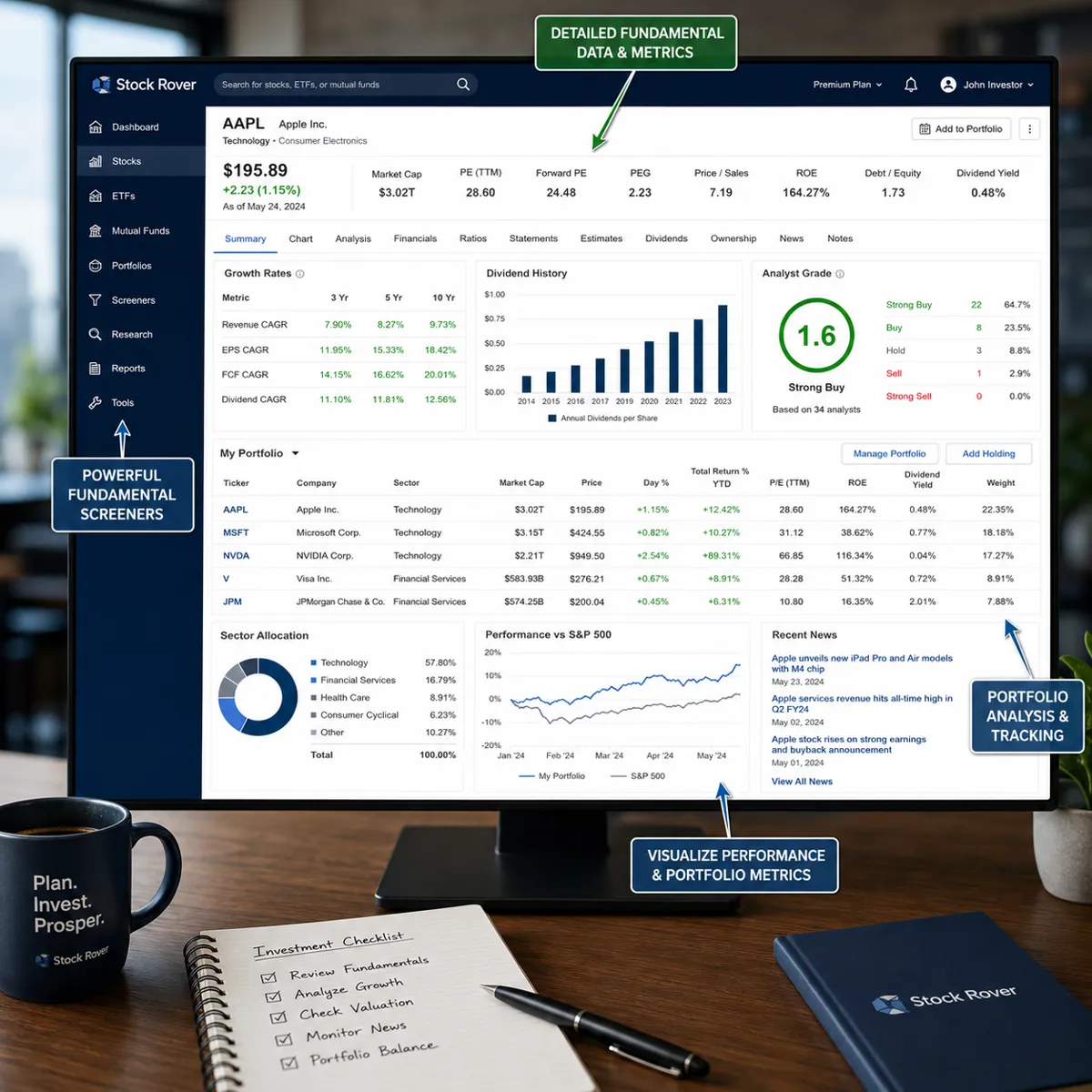
Stock Rover is a fundamental analysis and portfolio management platform built for investors who want research-grade data without paying for institutional tools. It combines stock screening, financial statement analysis, portfolio tracking, and research reports in one interface.
Core features:
- Fundamental screener: Filter by 650+ metrics including growth rates, profitability ratios, dividend metrics, valuation multiples, and analyst grades.
- Portfolio tracking: Monitor multiple portfolios, track performance, analyze holdings, and run what-if scenarios.
- Research pages: Detailed stock pages with 10 years of financial history, peer comparisons, and quality grades.
- Charting: Basic technical charts with fundamental overlays (P/E ratio, revenue growth, etc.).
Stock Rover works by pulling fundamental data from financial statements and market data providers, then organizing it into sortable tables and visual dashboards. You build screens by selecting metrics, setting ranges, and sorting results. The platform is desktop-focused (web-based) with a clean but data-dense interface.
Who it's for: Long-term investors, dividend investors, value investors, and anyone building a portfolio who wants to understand what they own and why. If you're the type who reads 10-Ks or cares about return on equity, Stock Rover is built for you.
What it's not for: Day traders, momentum chasers, or anyone who needs real-time Level 2 data and second-by-second scanning. Stock Rover updates daily, not intraday.
For more on how screeners fit into a broader trading system, see our guide to stock screeners.
What Is Finviz and What Features Does It Offer?
Finviz (Financial Visualizations) is a fast, visual stock screener built for technical traders and momentum investors who need to scan the market quickly. It's famous for its heat map, clean interface, and speed — you can filter 8,000+ stocks in seconds.
Core features:
- Stock screener: Filter by technical indicators, fundamental metrics, and descriptive criteria (sector, market cap, float, etc.).
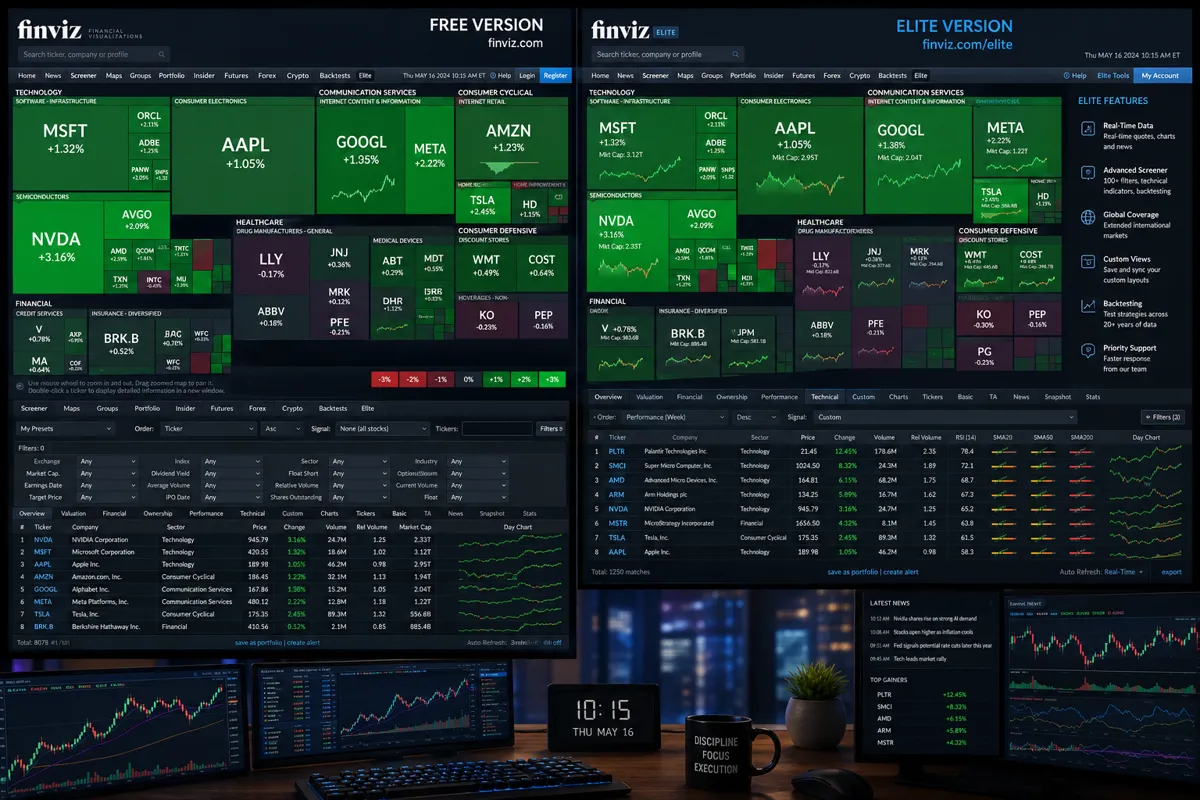
- Heat map: Visual representation of market performance by sector, size, and price change — scan the entire market in one glance.
- Charts: Clean technical charts with indicators, patterns, and drawing tools (Elite only for advanced features).
- News aggregation: Real-time news feed for individual stocks and the broader market.
- Futures and Forex: Quick overview of global markets, commodities, and currencies.
Finviz works by aggregating data from multiple sources and presenting it in a highly visual, scannable format. The free version updates with a 15-minute delay; Elite updates in real-time. The interface is fast, minimal, and designed for traders who want to spot opportunities and move on.
Who it's for: Swing traders, day traders, technical analysts, and anyone who trades momentum, breakouts, or chart patterns. If you're scanning for setups every morning or looking for what's moving right now, Finviz is built for you.
What it's not for: Fundamental investors who need deep financial analysis, portfolio tracking, or long-term research. Finviz shows you what's happening; it doesn't tell you why a company is worth owning for five years.
Stock Rover vs Finviz: Which One Is Better for Beginners?
Finviz is easier for beginners to start using immediately because the interface is simpler and the visual feedback (heat maps, mini charts) makes it obvious what's moving. Stock Rover has more features and data, which means a steeper learning curve if you've never analyzed fundamentals.
Finviz for beginners:
- Faster to learn — you can run a basic screen in under five minutes.
- Visual interface makes it easier to spot patterns and momentum.
- Free version is genuinely useful without feeling crippled.
- Less overwhelming if you're not familiar with financial metrics.
Stock Rover for beginners:
- More educational — forces you to learn what metrics actually matter.
- Better for building long-term habits (research, portfolio tracking, discipline).
- Free version is more limited — you'll hit the paywall faster.
- Steeper learning curve but more valuable if you're serious about investing.
The verdict: If you're a beginner who wants to learn technical trading and momentum scanning, start with Finviz Free. If you're a beginner who wants to learn fundamental investing and portfolio management, start with Stock Rover Free and upgrade when you're ready to track real money.
Common beginner mistake: Jumping between tools every week because you're not sure what you're looking for. Pick one, learn it deeply, and use it consistently for at least 30 days before deciding if it fits your process.
How Much Does Stock Rover Cost Per Month?
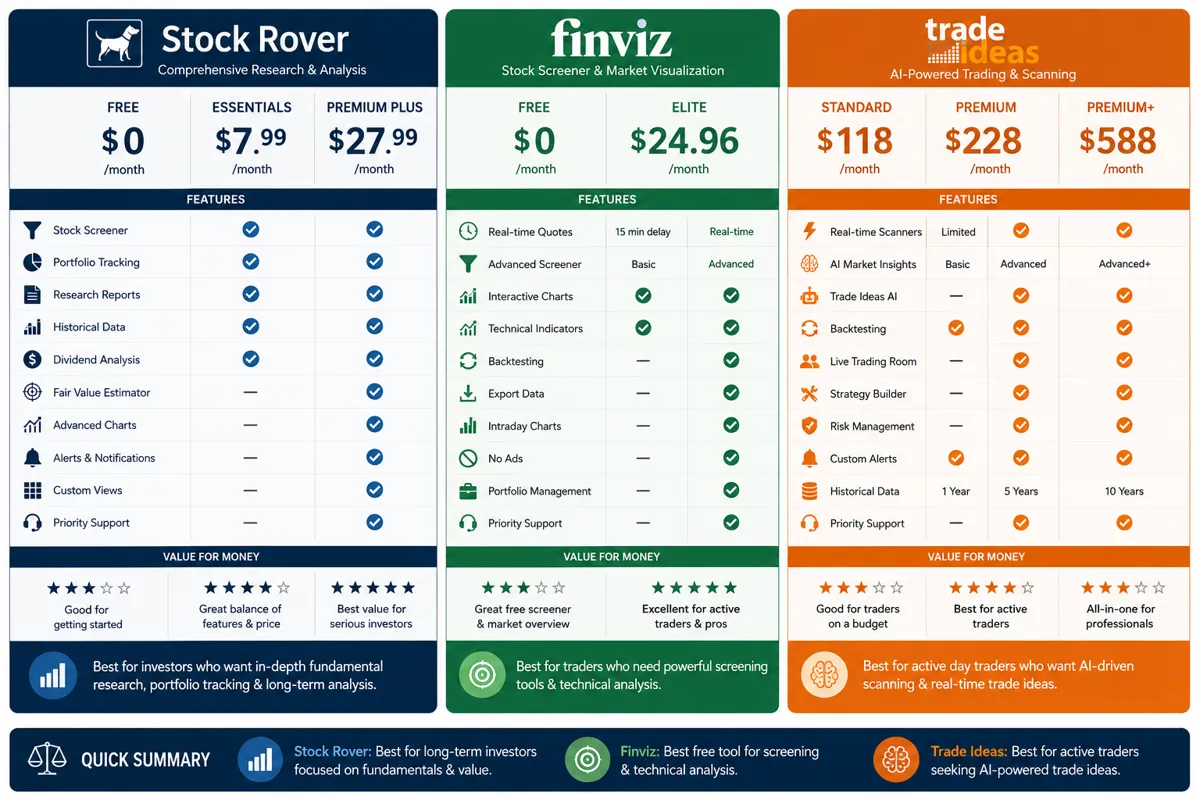
Stock Rover offers three pricing tiers as of 2026:
| Plan | Monthly Price | Annual Price | Key Features |
|---|---|---|---|
| Free | $0 | $0 | Basic screening (limited metrics), 1 portfolio, 20 stocks per portfolio, delayed data |
| Essentials | $7.99 | $79.90/year | Full screening (650+ metrics), 10 portfolios, 100 stocks per portfolio, export data |
| Premium Plus | $27.99 | $279.90/year | Everything in Essentials + portfolio analytics, research reports, advanced charting, unlimited portfolios |
What you're paying for:
- Essentials ($7.99/month): Unlocks the full screener and enough portfolio capacity for most individual investors. This is the tier most people should start with if they're serious about fundamental analysis.
- Premium Plus ($27.99/month): Adds portfolio performance analytics, peer comparisons, and research-grade reports. Worth it if you're managing multiple accounts or want institutional-level analysis.
Is Stock Rover worth it? If you're a fundamental investor who holds positions for months or years, the Essentials plan at $7.99/month is one of the best values in the screener market. You're getting research-grade data that would cost hundreds per month from Bloomberg or FactSet. If you're a casual investor who checks your portfolio once a month, the free version might be enough.
Value comparison: At $7.99/month, Stock Rover Essentials costs less than two coffees and gives you access to data that can help you avoid a single bad stock pick — which easily pays for itself. The Premium Plus tier at $27.99/month is harder to justify unless you're actively managing a six-figure portfolio or need the advanced analytics for tax-loss harvesting and rebalancing.
For more on how Stock Rover compares to other fundamental tools, see our Stock Rover review.
Is Finviz Free or Do You Need to Pay?
Finviz offers a free version that's genuinely useful and a paid Elite tier that adds real-time data and advanced features.
| Plan | Price | Key Features |
|---|---|---|
| Finviz Free | $0 | Stock screener (delayed 15 min), heat map, basic charts, news, futures/forex overview |
| Finviz Elite | $39.50/month or $299.50/year | Real-time data, advanced charts, intraday scanning, email alerts, export data, ad-free |
What you're paying for with Elite:
- Real-time data: Critical for day traders and anyone trading momentum — 15-minute delays can cost you entries and exits.
- Advanced charting: More indicators, drawing tools, and pattern recognition.
- Email alerts: Get notified when stocks hit your criteria (price, volume, technical signals).
- Intraday scanning: Scan for setups that develop during the trading day, not just at close.
Is Finviz Elite worth it? If you're a day trader or active swing trader who needs real-time data, Elite at $39.50/month is a reasonable cost of doing business. If you're a casual scanner who checks setups once a day after close, the free version is probably enough.
The free version is not a trial: Unlike most freemium tools, Finviz Free is a fully functional screener with no time limit. You can use it indefinitely. The main limitation is the 15-minute delay, which only matters if you're trading intraday.
Value comparison: At $39.50/month, Finviz Elite is more expensive than Stock Rover Essentials but cheaper than most real-time data feeds. If you're comparing it to Trade Ideas or BlackBox Stocks, Finviz is significantly cheaper but also less feature-rich for day trading.
Stock Rover Premium vs Finviz Elite: Pricing Comparison
Here's the direct pricing comparison for 2026:
| Feature | Stock Rover Premium Plus | Finviz Elite |
|---|---|---|
| Monthly Price | $27.99 | $39.50 |
| Annual Price | $279.90 | $299.50 |
| Data Speed | End-of-day | Real-time |
| Screening Metrics | 650+ fundamental | 70+ technical + fundamental |
| Portfolio Tracking | Advanced (performance, analytics) | None |
| Charting | Basic technical + fundamental overlays | Advanced technical |
| Research Reports | Yes (detailed) | No |
| Alerts | No | Yes (email) |
| Best For | Fundamental investors, portfolio builders | Technical traders, momentum scanners |
Which gives you more for your money?
- Stock Rover Premium Plus gives you more depth — better for investors who need research, portfolio management, and long-term analysis.
- Finviz Elite gives you more speed — better for traders who need real-time data, fast scanning, and intraday alerts.
The honest take: Most retail investors don't need both. If you're holding stocks for quarters or years, Stock Rover Premium Plus at $27.99/month is the better value. If you're trading setups within days or weeks, Finviz Elite at $39.50/month is the better value. If you're trying to justify both, you're probably overcomplicating your process.
Alternative consideration: Stock Rover Essentials ($7.99/month) + Finviz Free ($0) gives you 80% of the value for a fraction of the cost. Most investors would be better served by this combo than paying for both premium tiers.
For more on how these tools compare to other screeners, see our comparison of AI stock screeners.
What Can Finviz Do That Stock Rover Cannot?
Finviz beats Stock Rover in four areas: speed, visual scanning, real-time data, and technical focus.
1. Heat maps and visual market scanning
Finviz's heat map lets you scan the entire market in seconds — see which sectors are moving, which stocks are leading, and where money is flowing. Stock Rover has no equivalent visual tool. If you're a visual learner or need to spot sector rotation quickly, Finviz wins.
2. Real-time data (Elite only)
Finviz Elite updates in real-time; Stock Rover updates end-of-day. If you're day trading or need to catch intraday breakouts, Stock Rover's delayed data makes it useless for that purpose.
3. Faster screening for technical setups
Finviz is built for speed — you can run a technical screen (volume spike + breakout + relative strength) in under 30 seconds. Stock Rover's interface is slower and more focused on fundamental analysis, which means more clicks to get to technical filters.
4. News aggregation and market overview
Finviz pulls in real-time news, earnings calendars, and global market data (futures, forex, bonds) on the homepage. Stock Rover focuses on individual stock research and doesn't aggregate broader market context as well.
5. Intraday alerts (Elite only)
Finviz Elite sends email alerts when stocks hit your criteria during the trading day. Stock Rover has no alert system — you have to manually check your screens.
What Finviz cannot do that Stock Rover can: Deep fundamental analysis, portfolio tracking, research reports, and long-term performance analytics. Finviz shows you what's moving; Stock Rover tells you if it's worth owning.
Does Stock Rover Have Better Charting Tools Than Finviz?
No — Finviz has better charting tools for technical analysis, especially if you're comparing Finviz Elite to any Stock Rover tier.
Finviz charting strengths:
- Clean, fast-loading charts with 50+ technical indicators.
- Pattern recognition and drawing tools (trendlines, support/resistance).
- Multiple timeframes (intraday, daily, weekly, monthly).
- Elite adds advanced indicators and more customization.
Stock Rover charting strengths:
- Fundamental overlays (P/E ratio, revenue growth, dividend history) on price charts.
- Peer comparison charts (compare multiple stocks on one chart).
- Long-term historical data (10+ years).
The verdict: If you're a technical trader who needs to analyze price action, patterns, and indicators, Finviz charts are better. If you're a fundamental investor who wants to see how valuation metrics correlate with price over time, Stock Rover's fundamental overlays are more useful.
What both lack: Neither tool is a replacement for dedicated charting platforms like TradingView or TrendSpider. If you're serious about technical analysis, you'll eventually want a real charting platform. Finviz is good enough for quick scans; Stock Rover's charts are more of a bonus feature than a core strength.
For more on advanced charting tools, see our TrendSpider review.
Which Stock Screener Is Best for Dividend Investors?
Stock Rover is significantly better for dividend investors — it's not even close.
Why Stock Rover wins for dividend investing:
- Dividend-specific metrics: Dividend yield, payout ratio, dividend growth rate, consecutive years of increases, dividend safety scores.
- Historical dividend data: See 10+ years of dividend history, track growth trends, and identify consistent payers.
- Screening for dividend aristocrats: Filter for companies with 25+ years of consecutive dividend increases.
- Portfolio dividend tracking: See total dividend income, yield on cost, and projected annual income across your entire portfolio.
- Dividend safety analysis: Stock Rover grades dividend safety based on payout ratio, earnings stability, and cash flow coverage.
What Finviz offers for dividend investors:
- Basic dividend yield filter.
- Ex-dividend date calendar.
- That's it.
The verdict: If you're building a dividend portfolio or care about passive income, Stock Rover is worth the subscription cost just for the dividend tools alone. Finviz can show you high-yield stocks, but it can't tell you if those dividends are safe or sustainable.
Dividend investor workflow with Stock Rover:
- Screen for dividend yield > 3%, payout ratio < 60%, 5-year dividend growth > 5%.
- Sort by dividend safety grade.
- Review historical dividend growth charts.
- Add to portfolio and track total income.
You can't replicate this workflow in Finviz without manually checking each stock's financials elsewhere.
For more on dividend investing strategies, see our guide to long-term investing tools.
Common Mistakes When Using Stock Rover Filters
Most Stock Rover users waste time building overly complex screens that filter out good stocks or return too many mediocre results. Here are the mistakes that kill your screening efficiency:
1. Using too many filters at once
Adding 15 criteria to a screen sounds thorough but usually returns zero results or filters out stocks that fail one arbitrary metric. Start with 3-5 core filters, review results, then add constraints.
2. Ignoring the "Grade" columns
Stock Rover assigns quality grades (A-F) for growth, value, momentum, and overall quality. These composite scores save you time — use them as a first pass instead of manually screening 20 individual metrics.
3. Not saving and tracking your screens
Building a screen once and never revisiting it is a waste. Save your best screens, run them weekly, and track which setups actually work over time. Stock Rover lets you save unlimited screens — use that feature.
4. Screening for perfection instead of opportunity
No stock passes every fundamental test. If you're filtering for 20% revenue growth + 15% earnings growth + P/E under 15 + debt-to-equity under 0.5, you're screening for unicorns. Relax one or two constraints and focus on the metrics that matter most for your strategy.
5. Forgetting to sort results
Stock Rover returns results in random order by default. Always sort by a key metric (dividend yield, revenue growth, quality grade) so the best candidates rise to the top.
6. Not using the portfolio tracker
Stock Rover's portfolio tools are half the value of the platform. If you're only using the screener and ignoring portfolio tracking, you're leaving money on the table. Track what you own, monitor performance, and use the data to improve your process.
Better approach: Start with a simple 3-filter screen (market cap > $2B, dividend yield > 3%, quality grade B or better), review the top 20 results, then add one or two more filters to narrow it down. Iterate based on what actually works in your portfolio.
Why Is My Finviz Screener Not Showing Results?
If your Finviz screen returns zero results, you've probably set conflicting filters or unrealistic criteria. Here's how to troubleshoot:
1. Check for conflicting technical filters
Example: You can't screen for "Price above SMA200" AND "Price below SMA50" at the same time — those conditions contradict each other. Review your filters and remove conflicts.
2. Relax overly tight ranges
Screening for P/E between 10-12, volume above 5M, and price change between +2% and +3% is too narrow. Widen your ranges or remove the least important filter.
3. Remove redundant fundamental filters
If you're filtering for both "Debt/Equity < 0.5" and "Current Ratio > 2," you're double-filtering for financial health. Pick one and relax the other.
4. Check market cap and sector filters
If you've filtered for "Mega Cap" and "Biotechnology," you might only get 3-5 results because there aren't many mega-cap biotech companies. Expand your market cap range or remove the sector filter.
5. Clear all filters and start over
Sometimes the fastest fix is to hit "Reset" and rebuild your screen from scratch with fewer filters. Start with 2-3 core criteria, confirm you get results, then add more.
6. Use the "Any" option for multi-select filters
Finviz lets you select multiple options for some filters (sector, industry). If you're getting zero results, try selecting "Any" instead of a specific choice to see if the filter is the problem.
Pro tip: Finviz shows you how many stocks match your criteria in real-time as you add filters. Watch that number — if it drops to zero after adding a filter, you know which one is the problem.
Alternatives to Stock Rover and Finviz for Stock Screening
If neither Stock Rover nor Finviz fits your needs, here are the best alternatives for 2026:
For fundamental investors (Stock Rover alternatives):
- Simply Wall St: Visual fundamental analysis with infographics and "snowflake" ratings. Easier to understand than Stock Rover but less customizable. ~$12/month.
- Morningstar Premium: Institutional-grade research, analyst reports, and fair value estimates. More expensive ($34.95/month) but deeper analysis.
- Seeking Alpha Premium: Combines fundamental data with crowd-sourced analysis and earnings call transcripts. $29.99/month.
For technical traders (Finviz alternatives):
- Trade Ideas: AI-powered scanner with real-time alerts and backtesting. More expensive ($118/month) but significantly more powerful for day trading.
- TradingView: Best charting platform with a decent screener. Free tier is usable; Pro starts at $14.95/month.
- TC2000: Fast scanning and charting with real-time data. $9.99-$29.99/month depending on tier.
For hybrid investors/traders:
- TrendSpider: Combines technical analysis, pattern recognition, and automated trendlines. $49-$129/month.
- Koyfin: Free fundamental and technical data with institutional-quality charts. Premium adds more features.
The honest take: Most retail investors don't need more than Stock Rover Essentials ($7.99/month) for fundamentals and Finviz Free ($0) for technical scanning. If you're considering more expensive alternatives, make sure you're actually using the features that justify the cost.
For a full breakdown of screener options, see our complete guide to stock screeners.
Is Stock Rover Worth It for Casual Investors or Overkill?
Stock Rover is not overkill for casual investors — but the free version is probably enough if you're only checking your portfolio once a month and making 2-3 trades per year.
Stock Rover is worth it if you:
- Hold 10+ individual stocks and want to track performance across multiple accounts.
- Care about dividend income and want to monitor yield, growth, and safety.
- Make investment decisions based on fundamentals (earnings, revenue, valuation).
- Want to learn how to analyze stocks properly instead of guessing.
Stock Rover is overkill if you:
- Only invest in index funds and don't pick individual stocks.
- Trade based on price action and don't care about balance sheets.
- Check your portfolio once a quarter and never rebalance.
- Already have fundamental data through your broker (Fidelity, Schwab, etc.).
The middle ground: Start with Stock Rover Free. If you find yourself hitting the limits (only 1 portfolio, limited screening metrics), upgrade to Essentials for $7.99/month. If you're still not using it weekly after 3 months, downgrade back to free.
What "casual investor" actually means: If you're investing $500/month into a diversified portfolio and holding for decades, you don't need Stock Rover. If you're picking 10-15 individual stocks and want to understand what you own, Stock Rover is one of the best educational tools you can buy — even if you only use it once a week.
Can Finviz Replace Stock Rover for Portfolio Tracking?
No — Finviz has zero portfolio tracking features. It's a screener and market scanner, not a portfolio management tool.
What Finviz cannot do:
- Track your holdings across multiple accounts.
- Calculate portfolio performance, returns, or risk metrics.
- Monitor dividend income or yield on cost.
- Run what-if scenarios or rebalancing analysis.
- Store historical portfolio data.
What Stock Rover does for portfolio tracking:
- Import holdings from brokers or enter manually.
- Track performance by account, sector, or individual position.
- Monitor dividend income and projected annual yield.
- Analyze portfolio concentration and risk.
- Compare your portfolio to benchmarks (S&P 500, etc.).
- Run hypothetical trades to see impact before executing.
The verdict: If you need portfolio tracking, Stock Rover is worth the subscription cost just for that feature alone. Finviz is a screening tool, not a portfolio manager. Trying to use Finviz for portfolio tracking is like trying to use a hammer as a screwdriver — wrong tool for the job.
Workaround: You can use Finviz to screen for new ideas and a separate portfolio tracker (Google Sheets, Personal Capital, or your broker's tools) to manage holdings. But if you're already paying for Stock Rover, you get both in one platform.
Stock Rover vs Finviz Comparison: The Final Verdict
Here's the decision framework for Stock Rover vs Finviz in 2026:
Choose Stock Rover if:
- You're a fundamental investor who holds stocks for months or years.
- You care about earnings, revenue growth, valuation, and dividend safety.
- You want to track portfolio performance and analyze what you own.
- You're building a dividend portfolio or value investing strategy.
- You're willing to spend time learning how to analyze stocks properly.
Choose Finviz if:
- You're a technical trader who holds stocks for days or weeks.
- You care about price action, momentum, breakouts, and chart patterns.
- You need to scan the market quickly and spot opportunities fast.
- You want real-time data and intraday alerts (Elite).
- You prefer visual scanning (heat maps) over data tables.
Choose both if:
- You're a hybrid investor/trader who screens fundamentally and trades technically.
- You have the budget ($7.99 + $39.50 = $47.49/month minimum).
- You actually use both tools weekly and can justify the cost.
Choose neither if:
- You only invest in index funds and don't pick individual stocks.
- Your broker already provides the screening and research tools you need.
- You're not actively trading or investing enough to justify the cost.
The most common mistake: Paying for tools you don't use. If you subscribe to Stock Rover and only log in once a month, you're wasting money. If you pay for Finviz Elite and only check it after market close, you're paying for real-time data you don't need.
The best value combo for most investors: Stock Rover Essentials ($7.99/month) for fundamental research and portfolio tracking + Finviz Free ($0) for quick technical scanning. This gives you 80% of the value for $7.99/month total.
For more on building a complete trading system, see our guide to AI stock tools.
Frequently Asked Questions
What is the main difference between Stock Rover and Finviz?
Stock Rover focuses on fundamental analysis and portfolio management for long-term investors. Finviz focuses on technical screening and visual market scanning for active traders. Stock Rover is deeper; Finviz is faster.
Is Stock Rover better than Finviz for beginners?
Finviz is easier to learn initially because of its visual interface and simpler design. Stock Rover has a steeper learning curve but teaches you more about fundamental investing. Choose based on whether you want to learn technical or fundamental analysis first.
Can I use Finviz for free forever?
Yes — Finviz Free has no time limit and includes the full screener with 15-minute delayed data. You only need Elite if you require real-time data, advanced charts, or intraday alerts.
How much does Stock Rover cost compared to Finviz?
Stock Rover Essentials costs $7.99/month; Premium Plus costs $27.99/month. Finviz Elite costs $39.50/month. Stock Rover is cheaper but focuses on fundamentals; Finviz Elite is more expensive but includes real-time data for trading.
Which screener is better for finding dividend stocks?
Stock Rover is significantly better for dividend investors — it includes dividend-specific metrics, historical dividend data, safety grades, and portfolio income tracking. Finviz only shows basic dividend yield.
Does Finviz have portfolio tracking like Stock Rover?
No — Finviz has zero portfolio tracking features. It's a screener and market scanner only. If you need portfolio management, you must use Stock Rover or a separate tool.
Can Stock Rover show real-time data?
No — Stock Rover updates end-of-day only. If you need real-time data for day trading, you need Finviz Elite or a different platform.
What can Finviz Elite do that the free version cannot?
Finviz Elite adds real-time data, advanced charting, intraday scanning, email alerts, data export, and removes ads. The free version has 15-minute delayed data and basic charts.
Is Stock Rover worth paying for if I already use my broker's screener?
If your broker offers deep fundamental screening and portfolio analytics (Fidelity and Schwab do), you might not need Stock Rover. If your broker's tools are basic, Stock Rover's $7.99/month Essentials plan is worth it for the depth and customization.
Which tool is better for swing trading?
Finviz is better for swing trading because it's faster for technical screening, shows momentum visually, and updates in real-time (Elite). Stock Rover is too slow and fundamental-focused for swing trading setups.
Can I screen for penny stocks on Stock Rover or Finviz?
Both tools can screen for low-priced stocks, but neither is optimized for penny stocks. Finviz is better for finding low-float, high-volume penny stock setups. Stock Rover's fundamental focus is less useful for penny stocks that often lack reliable financial data.
Do Stock Rover or Finviz offer mobile apps?
Stock Rover is web-based only (works on mobile browsers but not optimized). Finviz has no official mobile app but the website is mobile-responsive. Neither is ideal for mobile-first users.
Conclusion
Stock Rover vs Finviz isn't a question of which tool is objectively better — it's a question of which tool matches how you actually trade. Stock Rover wins for fundamental investors who need research depth, portfolio tracking, and long-term analysis. Finviz wins for technical traders who need speed, visual scanning, and real-time momentum plays.
Most retail investors waste money subscribing to tools that don't align with their process. If you're holding stocks for quarters or years, Stock Rover Essentials at $7.99/month is one of the best values in the market. If you're scanning for breakouts and trading within days, Finviz Elite at $39.50/month is worth the cost for real-time data.
The best value combo for most investors: Stock Rover Essentials for fundamental research + Finviz Free for technical scanning. This gives you 80% of the value for $7.99/month total. If you're trying to justify both premium tiers, you're probably overcomplicating your process — and that's a bigger problem than which screener you pick.
Next steps:
- Define your actual trading style — are you screening for setups or researching for conviction?
- Start with the free versions of both tools and use them for 30 days.
- Upgrade to paid tiers only if you're hitting limits and actually using the features weekly.
- Track which tool helps you make better decisions, then cut the one you're not using.
Systems over hacks. Process over prediction. The right tool is the one you'll actually use consistently — not the one with the most features.
Want the tools and setups behind this, without the hype? Start at aistockpickerapps.com.