AI Stock Screeners vs the Old Filters You're Still Wasting Time On...
Last updated: June 17, 2026
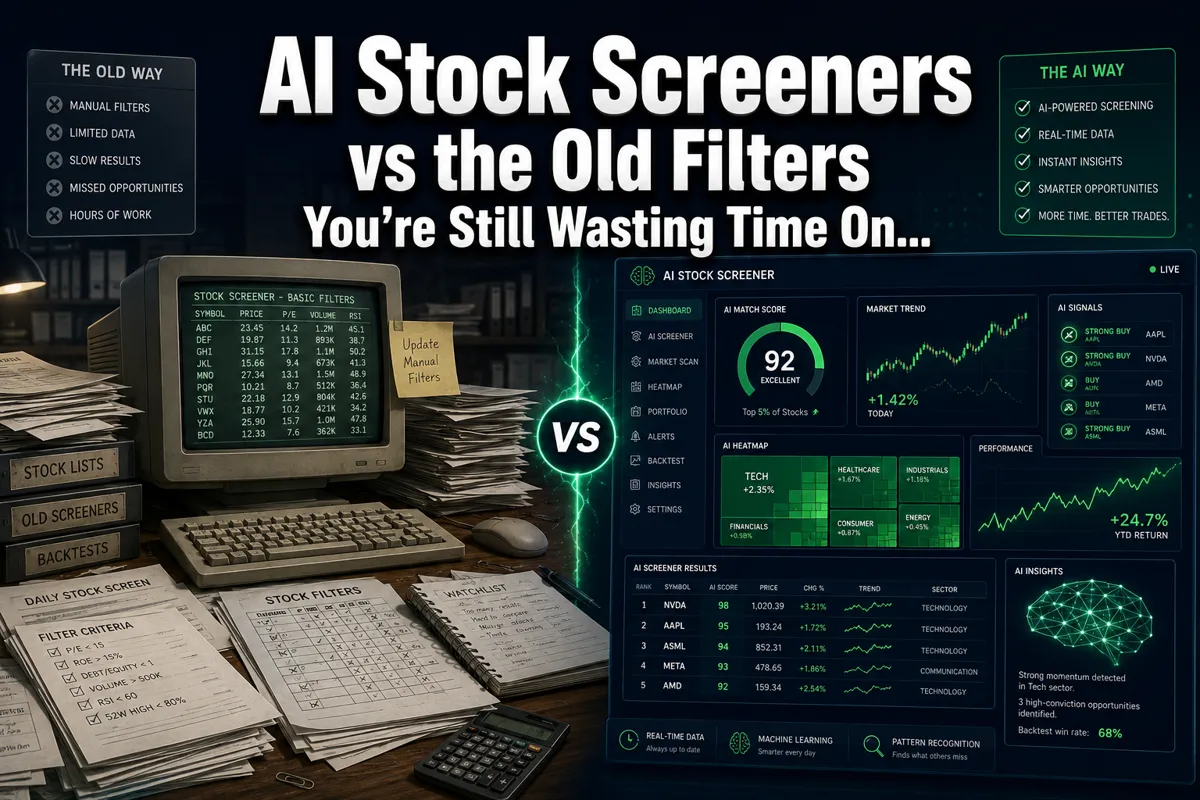
Quick Answer: AI stock screeners process real-time price action, sentiment data, and pattern recognition simultaneously — something traditional static filters simply cannot do. If you're still running the same P/E ratio and volume filters you set up three years ago, you're not screening stocks. You're screening out time. The gap between AI-powered screening and old-school filters has widened enough in 2026 that the comparison is almost unfair.
Key Takeaways
- Traditional stock filters are static rule-sets; AI stock screeners learn, adapt, and surface setups you'd never find manually
- The best AI stock screeners in 2026 combine technical pattern recognition, sentiment analysis, and fundamental scoring in a single pass
- Free AI stock screeners exist and work — Finviz is still a solid baseline, but it has clear limits compared to AI-native tools
- AI screeners are useful for both day traders and swing traders; the use case determines which tool fits
- Bigger mistakes come from misusing the output — overtrading signals, ignoring risk-reward, skipping the stop loss — not from the tool itself
- No screener, AI or otherwise, predicts stock performance with certainty; accuracy claims should be treated with healthy skepticism
- Beginners need fewer filters, not more; start with one clean setup and build from there
- Volatile markets expose the limits of any screener — AI tools handle choppy tape better than static filters, but they're not bulletproof
AI Stock Screeners vs the Old Filters You're Still Wasting Time On...
The average retail trader has at least three screeners open right now. One is Finviz with filters nobody's touched since 2022. One is a broker's built-in scanner running a 50-day moving average crossover. And one is a Discord someone recommended that sends 40 alerts a day, most of which go nowhere.
That's not a research process. That's analysis paralysis with extra steps.
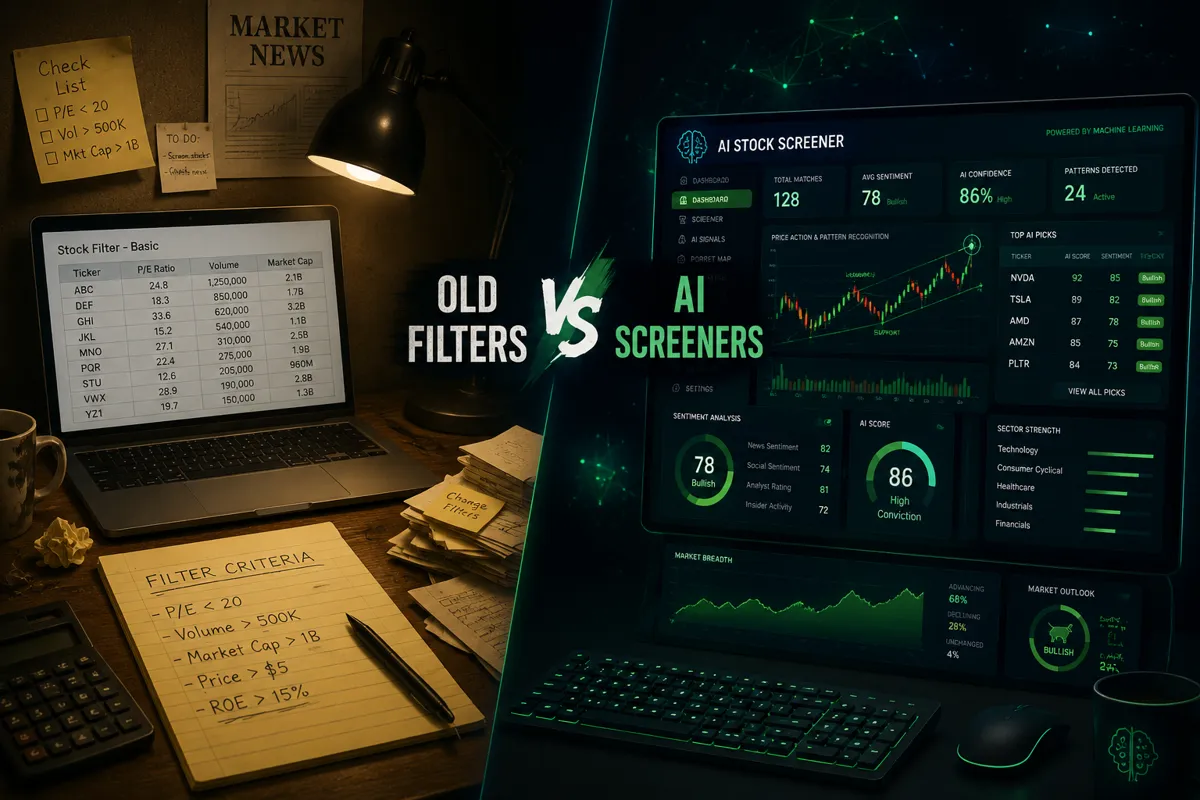
Traditional stock filters work on a simple if-then logic: show me every stock where price is above the 200-day moving average AND volume is above 500,000 shares AND P/E is under 20. Clean, logical, and completely blind to everything else happening in the market at that moment. They don't know if a sector is rotating. They can't read a news catalyst. They have no idea the setup is forming inside a broader downtrend that will eat your position alive.
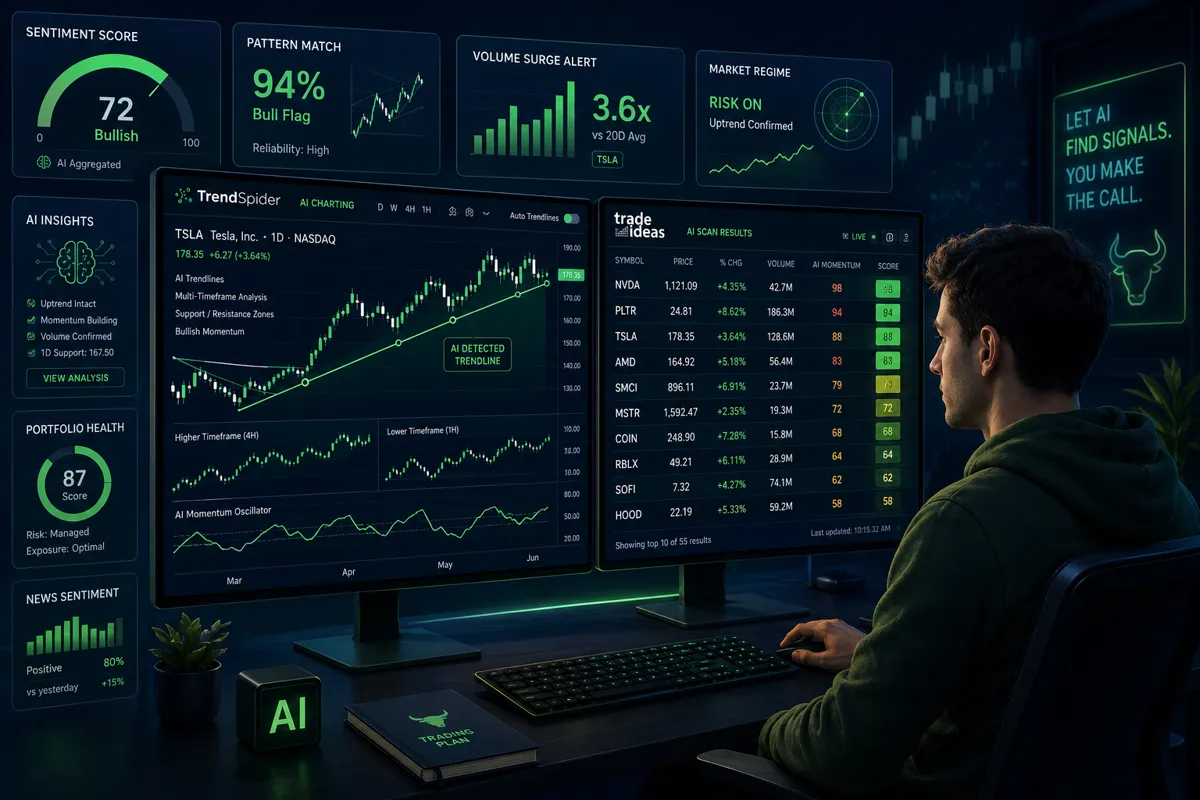
AI stock screeners operate differently. Instead of running a static checklist, they layer multiple data streams — price action, volume patterns, options flow, news sentiment, earnings history, and sector momentum — and rank or flag stocks based on weighted signals. The better platforms, like TrendSpider and Trade Ideas, use machine learning to recognize chart patterns and market conditions that would take a human analyst hours to spot manually.
The core difference: old filters tell you what a stock looks like right now. AI screeners tell you what it's been doing, what the market is doing around it, and whether the setup has historically led anywhere worth trading.
That's not a small upgrade. That's a different category of tool.
What Exactly Makes an AI Stock Screener Different From Traditional Stock Filters
AI stock screeners differ from traditional filters in three fundamental ways: they process multiple data types simultaneously, they adapt to changing market conditions, and they rank results by signal quality rather than just returning a raw list.
Traditional filters are binary — a stock either passes your criteria or it doesn't. There's no weighting, no context, no sense of whether the setup is clean or choppy. You get a list of 200 names and then you're on your own.
AI-powered screening adds layers:
- Pattern recognition: Tools like TrendSpider's AI screener automatically detect technical formations — flags, wedges, tight consolidation zones, basing patterns — without requiring you to manually scan every chart
- Sentiment scoring: Platforms like Accern and news sentiment tools pull real-time news and social signals to flag when a catalyst is building before price fully reacts
- Adaptive ranking: Instead of a flat list, AI screeners score and rank results, so the cleanest setups rise to the top
The practical result: you spend less time scrolling and more time evaluating the two or three setups that actually deserve attention. Signal over noise. That's the whole game.
How Much Do AI Stock Screeners Cost Compared to Regular Screening Tools
Free AI stock screeners exist, but the genuinely powerful ones run between $50 and $250 per month. Traditional screeners are cheaper — sometimes free — but the cost comparison misses the point if the cheaper tool wastes more of your time.
Here's a realistic cost breakdown for 2026:
| Tool | Type | Monthly Cost | Best For |
|---|---|---|---|
| Finviz (free) | Traditional filter | $0 | Baseline fundamental + technical scans |
| Finviz Elite | Traditional + some AI features | ~$40/mo | Faster data, real-time alerts |
| TrendSpider | AI-assisted charting + screener | ~$65–$130/mo | Pattern recognition, swing traders |
| Trade Ideas | Real-time AI scan engine | ~$118–$228/mo | Active day traders, real-time setups |
| Stock Rover | Fundamental + AI scoring | ~$8–$28/mo | Long-term investors, fundamental screens |
The Finviz vs AI screener debate is really a question of what your time is worth. Finviz is excellent for a free baseline — running a quick scan on P/E, float, and relative strength before market open costs nothing. But it doesn't read patterns, doesn't score sentiment, and doesn't surface the setup you didn't know to look for.
If you're trading actively, paying $100/month for a tool that cuts your research time in half and surfaces cleaner setups is not an expense. It's a process investment.
Which AI Stock Screener Works Best for Beginners
For beginners, the best AI stock screener is one with a clean interface, pre-built scans, and enough explanation to understand why a stock appeared on the list — not just that it did. Tools like Stock Analysis and the free Stock Health Scorecard are solid starting points before spending money on premium platforms.
The mistake beginners make is buying the most powerful tool first. Trade Ideas is a phenomenal platform — but if you don't understand what a gap fill or a tight consolidation looks like, 40 real-time AI alerts will just create more confusion, not less.
A sensible beginner path:
- Start with Finviz free to understand how filters work — price, volume, sector, basic technicals
- Add a free AI tool like the Screener Recipe Builder to build custom scans without coding
- Paper trade every setup the screener surfaces before risking real capital — paper trade it first is not optional advice, it's the process
- Upgrade to TrendSpider or Trade Ideas only after you can explain why a setup looks good without the tool telling you
The goal isn't to let the AI make decisions. The goal is to use AI to find candidates faster, then apply your own judgment to the risk-reward before entering.
Can AI Stock Screeners Really Predict Stock Performance Better Than Manual Research
No screener — AI or otherwise — predicts stock performance with reliability. What AI stock screeners do better than manual research is surface high-probability setups faster and with less cognitive bias. That's a meaningful edge, but it's not prediction.
The distinction matters. A screener that flags a stock in tight consolidation near a key support level with rising volume is identifying a setup with favorable risk-reward characteristics. Whether the breakout follows through depends on the broader market, the sector, news flow, and about a dozen other variables no algorithm fully controls.
What the research actually supports: AI tools that incorporate multiple data signals — technical, fundamental, and sentiment — have shown better signal-to-noise ratios than single-factor traditional filters. But "better signal-to-noise" is not the same as "accurate prediction."
Discipline beats prediction. A clean setup with a defined stop loss and a sensible position size beats a "high-confidence AI signal" with no exit plan every single time. The screener finds the candidate. Your process determines the outcome.
How Accurate Are AI Stock Screeners Compared to Human Financial Analysts
AI stock screeners are faster and more consistent than human analysts at processing large datasets and identifying technical patterns. Human analysts retain an edge in qualitative judgment — reading management tone, assessing competitive dynamics, understanding macro context.
The honest answer is that accuracy comparisons are hard to make cleanly because they measure different things. An AI screener running pattern recognition on 8,000 stocks in real-time will surface more potential setups than any human team. But it won't tell you whether a CEO's earnings call language signals confidence or desperation.
Tools like AlphaSense and Accern bridge this gap by applying natural language processing to earnings transcripts, filings, and news — bringing qualitative signal into the AI screening layer. That's where the real accuracy improvement lives.
For retail traders, the practical takeaway is this: use AI screeners to handle the quantitative heavy lifting, and reserve your human judgment for the qualitative filter before you pull the trigger.
Are AI Stock Screeners Good for Day Traders or Just Long-Term Investors
AI stock screeners work well for both day traders and long-term investors, but the tools and settings differ significantly. Day traders need real-time scanning with low-float alerts, momentum signals, and gap detection. Long-term investors need fundamental scoring, earnings trend analysis, and sector rotation signals.
For day trading, Trade Ideas is the benchmark — it runs real-time AI scans during market hours, flags unusual volume, and surfaces low-float momentum plays during power hour. The ai trading platforms category has several options built specifically for active traders who need speed over depth.
For swing trading, TrendSpider's pattern recognition and multi-timeframe analysis is more useful than a raw real-time scanner. Finding a stock in tight consolidation above support with a clean entry and a defined stop loss is a swing trading process, not a day trading one. The swing trading tools category covers platforms built around this timeframe.
Long-term investors doing fundamental screening will get more value from Stock Rover or InvestingPro than from a momentum-focused day trading scanner.
The rule: match the screener to the timeframe. Using a day trading scanner to find long-term holds is like using a GPS set to walking directions for a highway trip. Technically functional, practically useless.
What Are the Biggest Mistakes People Make When First Using AI Stock Screening Tools
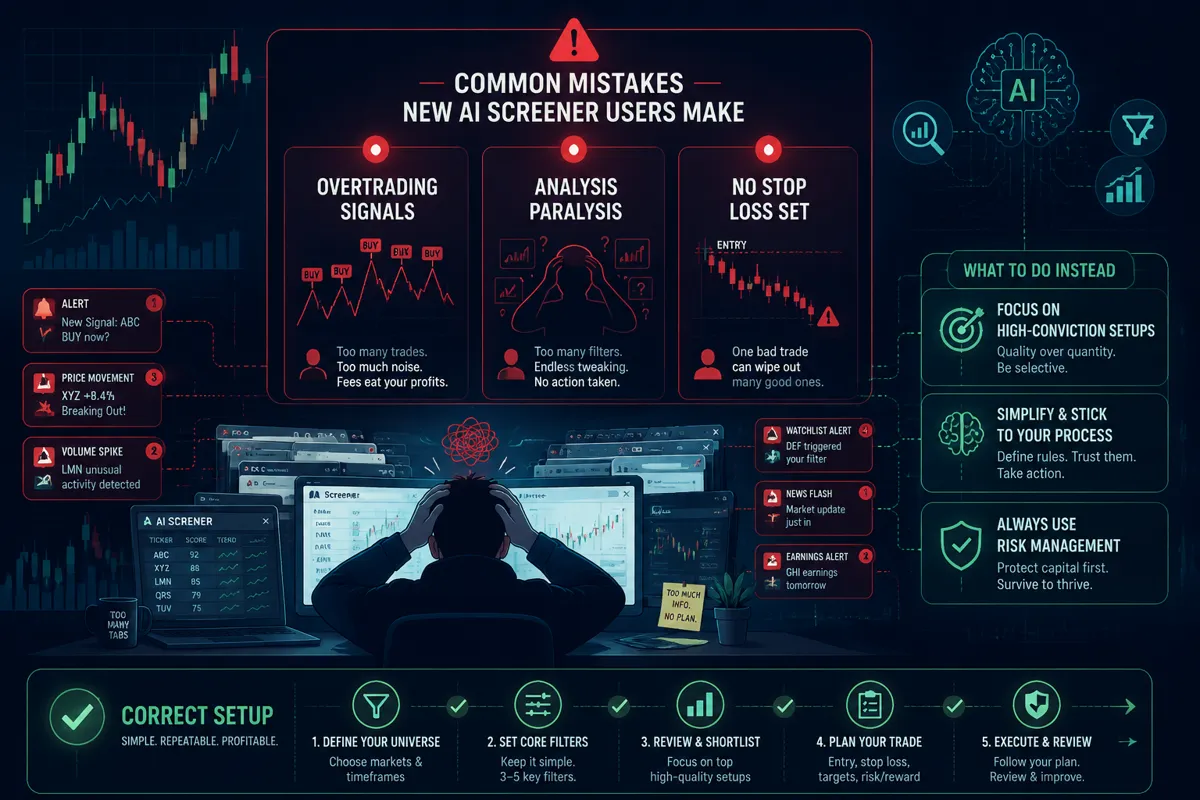
The biggest mistake is treating AI screener output as a buy signal rather than a candidate list. The second biggest mistake is running too many scans simultaneously and ending up with more names than any trader can reasonably evaluate.
Other common errors:
- Ignoring risk-reward: A screener surfaces the setup. If you don't define your stop loss and target before entering, you're not trading — you're gambling. Play stupid games, win stupid prizes.
- Overtrading signals: More alerts does not mean more opportunity. A choppy tape produces false breakouts constantly. Fewer, cleaner setups beat high-volume noise every time.
- Skipping the chart: AI pattern recognition is a starting point, not a conclusion. Always look at the actual price action before committing capital. Is it overextended? Is there a bull trap forming? The chart tells the story.
- No position sizing discipline: Even a high-quality setup can go wrong. If you're putting 30% of your account into a single AI-flagged name because the confidence score was high, you're one bad earnings report away from a painful lesson.
- Revenge trading after a stop-out: Getting stopped out hurts. Immediately re-entering because the screener flagged the same stock again is revenge trading, not process. Walk away and reset.
The fix for all of these is the same: build a written checklist for every trade and don't enter unless the setup meets every criterion. Systems over hacks.
What Technical Skills Do You Need to Use an AI Stock Screener Effectively
Most modern AI stock screeners require no coding and no advanced technical background. The ability to read a basic candlestick chart, understand support and resistance levels, and interpret volume is enough to get started with most platforms.
That said, the more you understand about what the AI is measuring, the better you'll use it. Knowing what a basing pattern looks like, why tight consolidation before a breakout matters, and how to read relative strength will help you filter the screener's output intelligently instead of blindly following alerts.
For traders who want to go deeper — running custom algorithms or backtesting strategies — platforms like QuantConnect require Python or C# skills. But that's a professional-grade use case, not a requirement for most retail traders.
The free tools section at AI Stock Picker Apps includes calculators and planners that help build the analytical foundation without requiring any technical background.
Are There Any Free AI Stock Screening Tools That Actually Work
Yes. Finviz's free tier remains one of the most functional no-cost screening tools available in 2026, even if it's not AI-native. For genuinely AI-powered free options, the Stock Health Scorecard and the Swing Trade Planner offer real analytical value without a subscription.
The honest caveat: free AI tools typically offer limited real-time data, fewer customization options, and no backtesting. They're useful for building a watchlist and understanding the screening process, but serious active traders will eventually hit the ceiling.
Free tools worth using:
- Finviz (free tier) — fundamental and technical filters, solid for initial screening
- Stock Health Scorecard — AI-assisted fundamental scoring, no cost
- Screener Recipe Builder — build custom scan logic without coding
- Webull's built-in screener — free with account, decent for basic technical scans
The FOFO (Fear of Finding Out) that keeps traders from upgrading to paid tools is understandable. But if you're trading real capital and your screening process is entirely free, you're probably leaving edge on the table.
Which Industries Benefit Most From AI-Powered Stock Screening
High-volatility, data-rich sectors benefit most from AI stock screeners. Technology, biotech, energy, and financial services generate the most screening signal because they have frequent catalysts, high options activity, and large institutional footprints that AI tools can detect.
Biotech is a specific case worth noting. FDA catalyst dates, clinical trial timelines, and short interest levels create setups that traditional filters miss entirely. AI tools that incorporate news sentiment and options flow can flag unusual activity before a binary event — though the risk-reward on these setups requires careful position sizing and defined stops.
Conversely, slow-moving utility stocks and consumer staples generate fewer meaningful signals for AI screeners. The patterns are less dynamic, the volatility is lower, and the edge from AI pattern recognition shrinks accordingly.
What Kind of Investor Shouldn't Rely on AI Stock Screeners
Passive investors running index funds don't need AI stock screeners. If the strategy is buying and holding a diversified ETF portfolio and rebalancing annually, a screener of any kind adds complexity without adding value.
AI stock screeners are also a poor fit for investors who aren't ready to act on signals. If analysis paralysis is already a problem — if every setup leads to more research instead of a decision — adding a tool that surfaces more candidates makes the problem worse, not better.
The screener is a filter for action. If action isn't part of the process, the filter is just noise.
How Do AI Stock Screeners Handle Volatile Market Conditions
In volatile markets, AI stock screeners produce more signals — many of which are false. A choppy tape generates breakouts that immediately reverse, bull traps that look like clean setups, and dead cat bounces that fool momentum algorithms.
The better AI platforms handle this by incorporating volatility filters and market-regime detection. Trade Ideas, for example, adjusts scan parameters based on overall market conditions. TrendSpider's multi-timeframe analysis helps traders distinguish between a genuine breakout and an overextended move in a volatile environment.
The practical rule: in high-volatility conditions, tighten your criteria. Require more confirmation before acting on a screener signal. Raise your risk-reward threshold. Reduce position sizing. The screener doesn't know the market is in a choppy tape — you do. That's where human judgment still wins.
Frequently Asked Questions
What is an AI stock screener?
An AI stock screener is a tool that uses machine learning and multi-signal analysis — combining technical patterns, fundamental data, sentiment, and volume — to surface stock setups automatically. Unlike traditional filters, it adapts to market conditions and ranks results by signal quality.
Is Finviz an AI screener?
Finviz is primarily a traditional filter-based screener. Its free and Elite tiers offer powerful fundamental and technical filtering, but it doesn't use machine learning or adaptive pattern recognition the way AI-native tools like TrendSpider or Trade Ideas do.
How do I choose between TrendSpider and Trade Ideas?
TrendSpider is better for swing traders who want AI-assisted chart analysis and pattern detection across multiple timeframes. Trade Ideas is better for active day traders who need real-time AI scanning during market hours. Both are strong tools — the choice depends on your trading timeframe.
Can a beginner use an AI stock screener without losing money?
A screener doesn't cause losses — poor risk management does. Beginners should paper trade every setup the screener surfaces before using real capital. Start with free tools, learn to read price action, and only upgrade to paid platforms once the process is clear.
Do AI stock screeners work for options trading?
Yes. Several AI platforms incorporate options flow data — unusual call or put activity, open interest changes, implied volatility spikes — which can signal institutional positioning before a move. Check the AI options tools category for platforms built specifically around this use case.
How often should I update my screener filters?
Traditional filters need manual updates when market conditions change — sector rotations, volatility regime shifts, earnings season dynamics. AI screeners that adapt automatically require less maintenance, but you should still review your core criteria quarterly to make sure they match your current strategy.
What's the difference between a screener and a trading bot?
A screener finds candidates. A trading bot executes trades automatically based on rules. They serve different functions. Most retail traders should master screening before considering automation — understand the setup before you automate the entry.
Are AI stock screeners legal for retail investors?
Yes, completely. AI stock screeners are research tools, not trading systems that exploit insider information. FINRA and the SEC regulate trading activity, not the tools used for research. Using an AI screener is no different legally than using a spreadsheet or a charting platform.
Which free AI screener is best for swing trading?
For swing trading specifically, the Swing Trade Planner and Finviz's free tier offer the most practical value at no cost. For more advanced pattern recognition, TrendSpider's paid tier is worth the investment once the basics are solid.
Can AI screeners replace a financial advisor?
No. AI screeners surface trade candidates based on quantitative signals. A financial advisor provides holistic financial planning, tax strategy, and behavioral coaching. They serve entirely different purposes. Don't conflate a research tool with financial advice.
Conclusion: Cut the Noise, Build the Process
The debate between AI stock screeners vs the old filters you're still wasting time on isn't really about technology. It's about whether your process is built for the market as it actually operates in 2026, or the market as it operated when you set up those filters.
Traditional screeners aren't useless. Finviz is still a legitimate starting point. But if the screening process ends at a static filter list and a gut feeling, that's not a system — it's a habit dressed up as a process.
AI stock screeners give retail traders access to the kind of multi-signal analysis that used to require a research team. Pattern recognition, sentiment scoring, real-time scanning, adaptive ranking — these aren't luxuries. They're the baseline for anyone serious about finding clean setups in a noisy market.
Here's what to do next:
- Audit your current screening process. Write down exactly what criteria you're using and when you last updated them
- Run the same watchlist through Finviz and one AI-native tool side by side for two weeks. Compare the candidates each surfaces
- Pick one setup type — a breakout from tight consolidation, a gap fill, a basing pattern — and screen exclusively for that for 30 days
- Paper trade every signal before committing capital. Build the expectancy data before risking real money
- Use the free AI screener tools to start without cost, then upgrade when the process is clear
Data over noise. Consistency over hype. The screener finds the candidate — your process determines what happens next.
We test the AI stock tools so you don't waste months on the wrong ones. Browse the full breakdowns at aistockpickerapps.com.