AI Stock Prediction: Why the Accuracy Number Lies
Last updated: August 28, 2026
Quick Answer: An ai stock prediction tool advertising "87% accuracy" is telling you almost nothing useful. That number only means something if you know what was predicted, over what time period, on what data, and whether it held up in live trading or only in a backtest. Without those four answers, the accuracy claim is marketing copy, not evidence.
Key Takeaways
- An accuracy percentage from an ai stock prediction tool is meaningless without a stated time horizon, a defined prediction target, and confirmation of whether it came from live trading or a backtest on historical data.
- Backtesting fits a model to data it has already seen. Research published in peer-reviewed journals confirms that models trained on historical price data routinely overfit, meaning they perform well on past data and poorly on new data.
- "Accuracy" can be gamed: a model that predicts "the market goes up" every single day in a bull year can claim 70%+ accuracy while being completely useless as a trading tool.
- No AI stock prediction tool can guarantee future returns. Past model performance, including backtested performance, is not a reliable indicator of future results. This is not a disclaimer formality; it is a mathematical fact.
- Vendor-claimed accuracy figures (such as Tickeron's win-rate statistics or Danelfin's AI Score outperformance data) are not independently audited unless explicitly stated. Treat them as vendor-claimed until proven otherwise.
- The July 2026 wave of agentic AI trading platforms, including launches from OmniPhi, Horizon Trade, and eToro's "Tori" agent, has made the accuracy-number problem worse, not better. More tools, more claims, same missing context.
- The right question is not "what is the accuracy?" It is: "accuracy on what, over what period, tested how, and at what risk?"
What Is an AI Stock Prediction, and What Does It Actually Measure?
An ai stock prediction is a probability estimate, not a guarantee. The tool takes in data, runs it through a model, and outputs a score, signal, or directional call that says something like "this stock has a 78% chance of rising over the next 10 days." What it measures depends entirely on how the model was built and what it was trained to predict.
Most ai stock predictor tools are measuring one of three things: price direction (up or down), a ranked score relative to other stocks, or a pattern match to historical setups. None of those are the same thing, and none of them are the same as "will this trade make money."
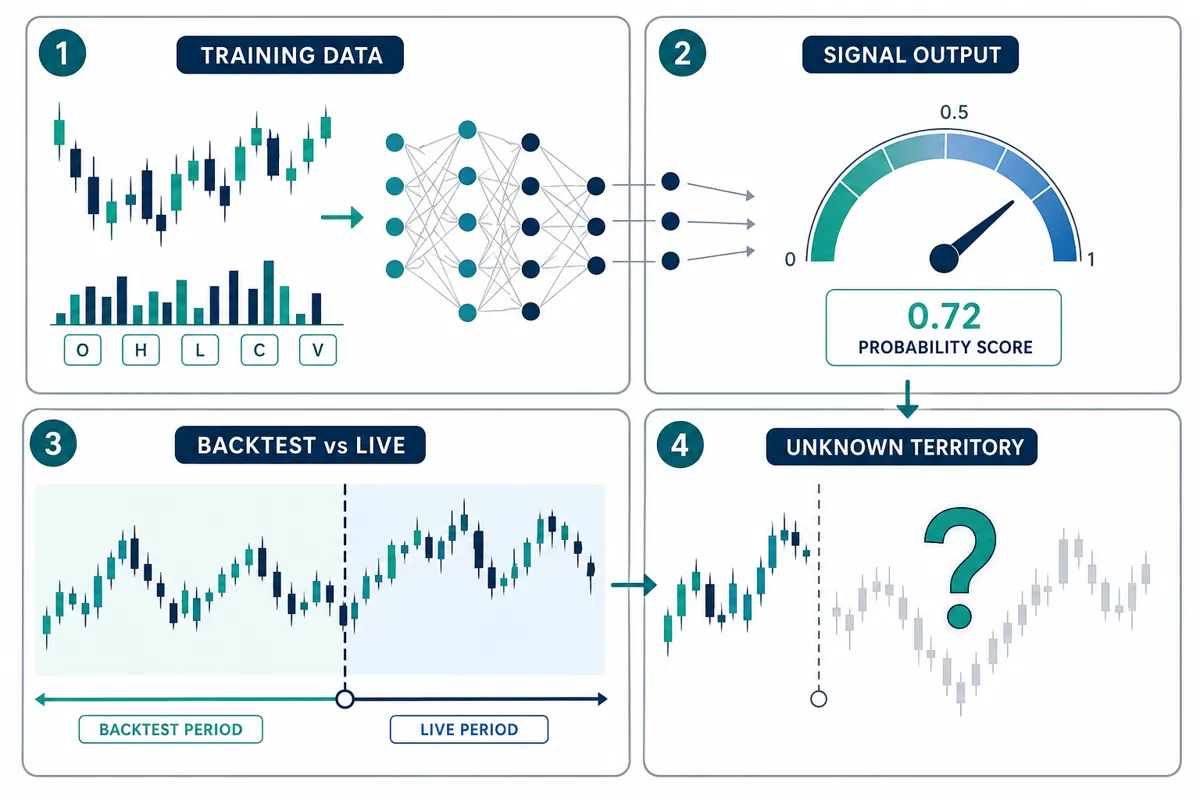
What goes into the model matters. Academic research on deep learning for stock market prediction shows that models typically train on combinations of historical price data (open, high, low, close, volume), technical indicators, and increasingly, alternative data like sentiment scores from news and earnings call transcripts. Some tools, like Danelfin, publish their factor breakdown. Many do not.
The three things a prediction score does not tell you: - Whether the predicted move is large enough to cover your transaction costs and spread - What happens to your position if the model is wrong (the risk side of the trade) - Whether the signal was generated on data the model had already seen
For a deeper look at how these tools actually work under the hood, the AI stock trading honest guide for retail traders breaks down the mechanics without the sales pitch.
Why Is the AI Stock Prediction Accuracy Number Meaningless Without a Time Period?
The accuracy number is meaningless without a time period because markets change regimes, and a model trained in one regime will fail in another. A tool that was 87% accurate during a low-volatility bull run in 2023 may have been 51% accurate during the choppy tape of early 2025. You need both numbers to know anything.
Here is the specific problem. Say a tool claims "87% accuracy" but does not tell you:
- Whether that is a 1-day, 10-day, or 90-day prediction window
- Whether it was measured during a trending market or a range-bound one
- Whether it counts a 0.1% move as a "correct" prediction the same way it counts a 15% move
A concrete example of how this gets abused: A model predicts "positive return" for a stock over a 30-day window. In a market that goes up 70% of all 30-day periods, the model can claim 70% accuracy by predicting "up" every single time. That is not a model. That is a coin flip with good PR.
The time period also determines whether the accuracy figure is statistically meaningful. A 200-trade backtest over 18 months in a trending market is not the same as a 2,000-trade live record across multiple market conditions. Research on AI-based stock market models consistently shows that short evaluation windows produce misleading accuracy estimates.
Ask these four questions before trusting any accuracy claim: 1. What is the exact prediction window (1 day, 1 week, 1 month)? 2. What market conditions covered the test period (bull, bear, sideways)? 3. How many predictions were made, and what was the sample size? 4. Was this a backtest or a live, forward-tested record?
What Does a Backtest Prove, and What Can It Never Prove?
A backtest proves that a model found patterns in historical data. It cannot prove that those patterns will repeat. This distinction is the single most important thing to understand about ai stock prediction accuracy claims.
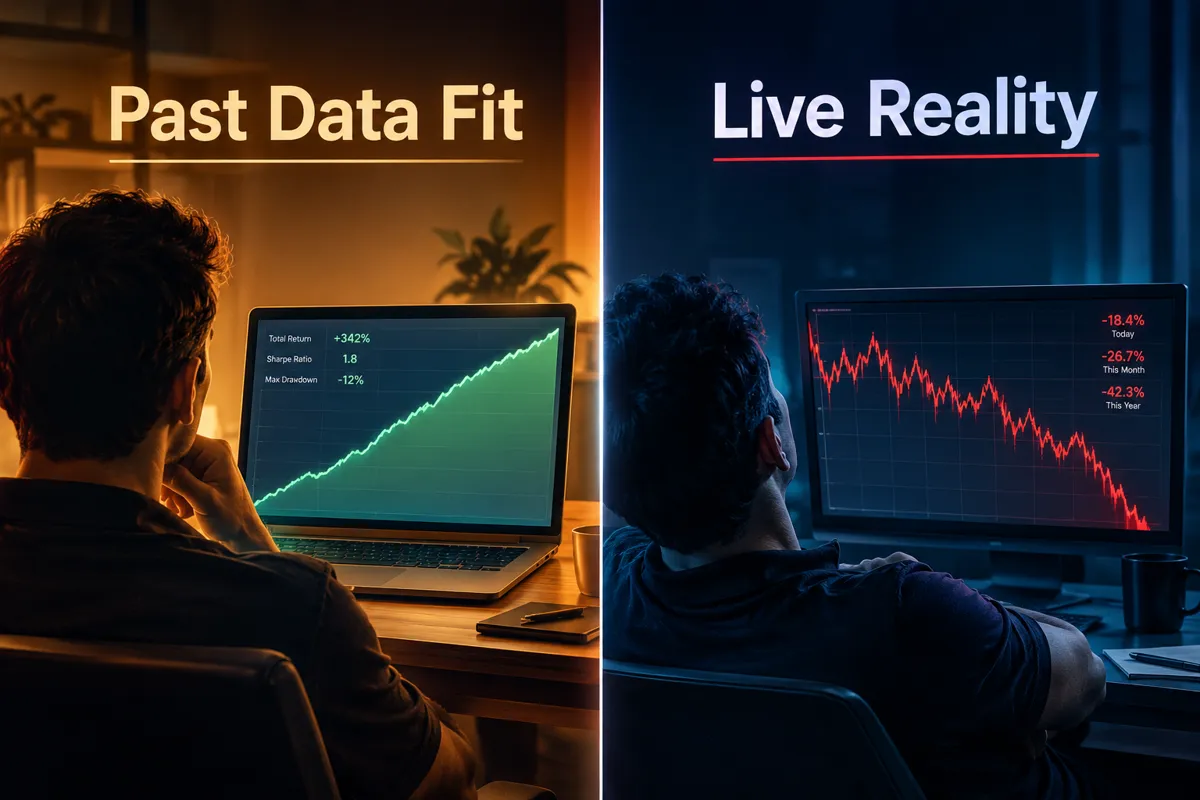
Here is what a backtest actually does: it takes a model, runs it against historical price data, and measures how often the model's signals would have been correct. The problem is that the model is being tested on data it was, directly or indirectly, built to fit. This is called overfitting, and it is endemic in AI stock market prediction research.
What a backtest proves: - The model can identify patterns that existed in a specific historical dataset - The strategy had a positive expected value under past market conditions - The signals were internally consistent with the training data
What a backtest can never prove: - That those patterns will appear in future data - That the model will perform similarly in different volatility regimes - That the strategy survives real execution costs, slippage, and liquidity constraints - That the model is not overfitted to a specific bull or bear cycle
The academic literature is blunt about this. Studies on machine learning models for stock prediction consistently find a significant gap between backtest performance and live performance, often called the "backtest overfitting" problem. One reason: researchers and tool builders often run dozens of model variations, pick the one with the best backtest result, and present that number. The other variations disappear. This is survivorship bias baked into the methodology itself.
The practical test: Ask the vendor for a live, forward-tested track record with timestamps. Not a backtest. Not a simulation. Actual signals sent to actual users, with the results recorded in real time. If they cannot produce that, the accuracy number is a backtest number, and you should treat it accordingly.
If you want to see what a genuinely transparent track record looks like in practice, the Danelfin review with its actual AI Score track record is one of the more honest examples in this space.
How Do You Judge an AI Stock Prediction Claim Before Trusting It?
Judge an ai stock prediction claim by asking five specific questions. If the vendor cannot answer all five, the claim is incomplete, and an incomplete claim is not evidence.
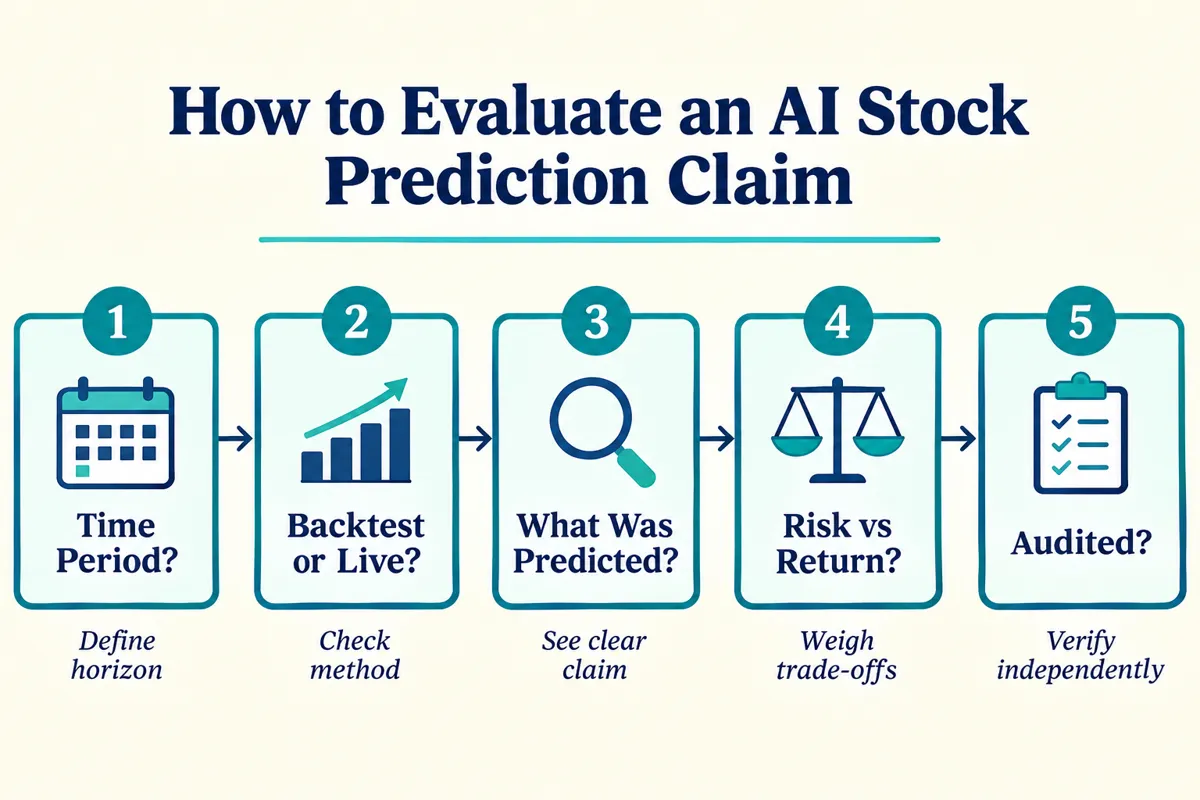
The five-question framework:
1. What exactly was predicted? Direction only (up/down)? A specific price target? A ranked score relative to peers? These are completely different claims with completely different accuracy standards.
2. Over what time window? A 1-day prediction and a 30-day prediction are different models with different accuracy benchmarks. Mixing them in one "accuracy" number is a red flag.
3. Backtest or live record? Backtest accuracy is a lower bar. Live, forward-tested accuracy is what matters. If the answer is "both," ask for the live number specifically.
4. What was the benchmark? Did the model beat a simple "buy and hold" strategy? Did it beat a coin flip? An 87% accuracy rate sounds impressive until you realize the S&P 500 was up 73% of all rolling 30-day periods during the same window.
5. What is the risk-reward on the wrong 13%? Accuracy without loss magnitude is useless. A model that is right 87% of the time but loses 40% on each wrong call and gains 2% on each right call is a losing strategy. Position sizing and stop loss discipline matter more than raw accuracy.
This is the process over prediction mindset in practice. Discipline beats prediction every time you apply it consistently.
For beginners who want to understand what questions to ask before spending money on any of these tools, what beginners get wrong about AI for stock market research is worth reading before you open your wallet.
Which AI Stock Prediction Tools Are Transparent, and Which Are Not?
Transparency in ai stock prediction tools means publishing the methodology, disclosing whether accuracy figures come from backtests or live data, and showing the factor breakdown behind any score. Most tools fail at least one of these. A few do not.
The table below compares four named tools across the claims they make and the context they provide. All accuracy figures are vendor-claimed unless otherwise noted.
| Tool | Claimed Accuracy | Time Period Disclosed? | Live vs Backtest | Methodology Transparent? |
|---|---|---|---|---|
| Danelfin | AI Score 10 stocks outperform market (vendor-claimed) | Yes, rolling 3-month windows disclosed | Mix of live and historical; live stats published | High, 900+ factors listed, open factor model |
| Tickeron | Pattern-specific win rates shown per signal (vendor-claimed) | Partial, shown per pattern, not aggregate | Primarily pattern backtest; some live signal history | Moderate, pattern logic explained, model weights not disclosed |
| Incite AI | 95% accuracy claimed in marketing (vendor-claimed) | No, period not specified in public materials | Unclear; no audited live record publicly available | Low, "proprietary AI" with no factor breakdown |
| Zen Ratings | A-rated stocks outperform (vendor-claimed) | Yes, multi-year historical performance windows shown | Historical backtest basis; some live tracking shown | Moderate, sub-factor grades visible, model logic partial |
The pattern is clear. Tools that disclose their factors, show rolling time windows, and separate live from backtest data are the ones worth spending time on. Tools that say "proprietary AI" and stop talking are asking you to trust a black box with your money.
For a direct head-to-head on Danelfin, Zen Ratings, and Kavout, the Danelfin vs Zen Ratings vs Kavout comparison runs through exactly these transparency criteria.
Can AI Actually Predict the Stock Market?
AI can identify statistical patterns in historical market data with genuine skill. It cannot predict the stock market with certainty, and no tool, regardless of the accuracy number on its landing page, can guarantee future returns. Those are two different statements, and both are true simultaneously.
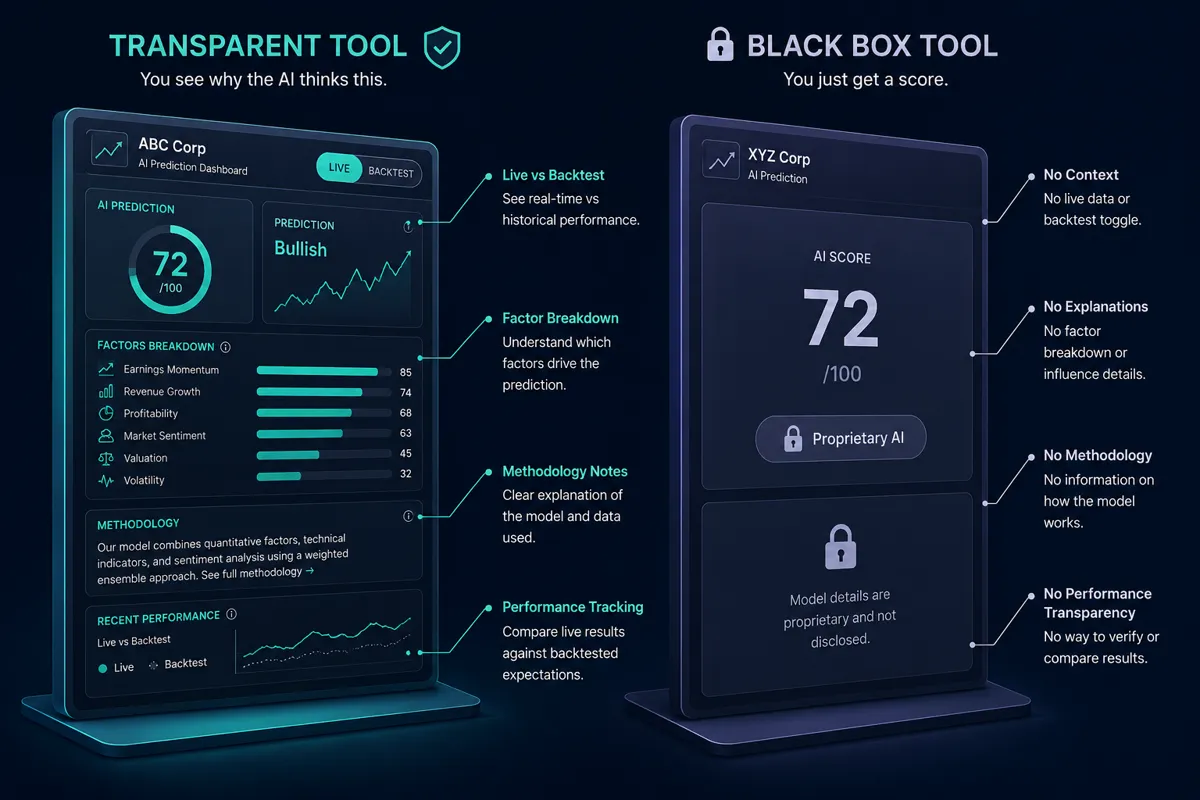
The honest answer from the research: machine learning models, particularly LSTM networks and transformer-based architectures, do show statistically significant predictive power on certain short-horizon tasks under controlled conditions. That is real. The gap between "statistically significant in a research paper" and "reliably profitable after costs in a live account" is also real, and it is large.
What AI for stock prediction is genuinely good at in 2026: - Screening thousands of stocks against multi-factor criteria faster than any human - Flagging unusual options flow, earnings sentiment shifts, and technical setups that match historical patterns - Reducing the watchlist from 5,000 names to 20 worth researching - Providing a structured, repeatable process that removes some emotional bias from stock selection
What AI stock market prediction cannot do: - Account for events that have no historical precedent (a novel geopolitical shock, a surprise Fed move, a pandemic) - Predict the exact timing of a breakout with high confidence - Eliminate the need for risk management, position sizing, and a stop loss - Replace your own judgment about the setup
The July 2026 wave of agentic platforms, including Horizon Trade's automated strategy builder (which reportedly had 23,000 traders on its waitlist), OmniPhi's autonomous trading agents, and eToro's "Tori" portfolio monitor, all represent genuine capability improvements. None of them changed the fundamental math. More automation does not equal more certainty. It equals faster execution of whatever the model says, right or wrong.
Signal over noise is the actual job. An AI tool that cuts your watchlist from 5,000 to 20 and gives you a clean setup to evaluate is doing something valuable. A tool that tells you "buy this stock, 87% chance it goes up," without showing you the methodology, is selling you a feeling.
For a broader look at which tools are actually worth the subscription in 2026, the best AI stock tools for 2026 roundup and the honest AI stock tool reviews from real users are both worth reading before you commit to anything.
If you want to start with free options before paying for anything, the free AI stock prediction tools directory lists what is available without a subscription.
FAQ
Can AI predict the stock market accurately? AI models can identify patterns in historical data with measurable accuracy on specific short-horizon tasks. They cannot predict the market with certainty. No tool can. Any vendor claiming otherwise is making a claim that no academic research, audited track record, or regulatory body supports.
What does AI stock prediction accuracy actually mean? It means the percentage of times a model's directional call (up or down) matched what the stock actually did, over a specific period, on a specific dataset. Without knowing the time window, the market conditions, and whether it was a backtest or live record, the number tells you almost nothing.
What is the best AI stock prediction tool available? There is no single best tool for every trader. The tools with the highest transparency scores, meaning they publish their methodology, disclose time windows, and separate live from backtest data, are the most trustworthy starting points. Danelfin scores well on transparency. For a full comparison, see the best AI stock predictors directory.
Is AI stock prediction reliable for day trading? Less reliable than for swing or position trading. Intraday price action is noisier, and most AI stock predictor tools are built on daily or weekly data. The signal-to-noise ratio drops significantly at intraday timeframes, and execution speed becomes a factor that most retail-facing tools cannot address.
Why do AI stock prediction tools fail sometimes? Three main reasons: overfitting to historical data that does not repeat, regime changes where market behavior shifts in ways the model was not trained on, and the fact that as more traders use the same signals, the edge in those signals erodes. A pattern that worked in 2022 may be fully arbitraged away by 2026.
Is AI stock prediction good for long-term investing? It can be useful as a screening layer, helping identify stocks with strong multi-factor scores for further research. It is not a replacement for fundamental analysis, valuation work, or a long-term investment thesis. Tools like Stock Rover combine AI scoring with deep fundamental data, which is a more appropriate fit for long-term investors than pure prediction tools.
What data do AI stock predictors use? Most use some combination of price and volume history, technical indicators, fundamental data (earnings, revenue, margins), and alternative data like news sentiment, analyst revisions, and options flow. The more factors a tool uses and discloses, the more you can evaluate whether its signals are grounded in something real.
How do I use AI stock prediction responsibly? Use it as a filter, not a final answer. Let the AI narrow your watchlist. Then apply your own analysis to the setups it surfaces. Always define your risk-reward before entering, set a stop loss, and size the position based on what you can afford to lose, not on the model's confidence score. Paper trade it first if you are new to a tool. Consistency over hype, every time.
Final Verdict
An ai stock prediction accuracy number without context is the financial equivalent of a restaurant claiming "97% of customers loved it" without telling you how many customers they asked, when, or what the other 3% said.
The tools that earn trust in 2026 are the ones that show their work: published methodology, disclosed time windows, live track records separated from backtests, and honest acknowledgment of what the model cannot do. That is a short list. Most tools do not clear that bar.
The ones that do, Danelfin being the clearest example on transparency, are worth evaluating seriously. The ones hiding behind "proprietary AI" and a bold accuracy percentage are asking you to play stupid games. You know how that ends.
Process over prediction. Signal over noise. Cut the noise, keep the alpha.
The FullStack Alpha directory catalogues 200+ AI stock tools by category and price, filterable by what you actually need. Browse the directory at aistockpickerapps.com.
Affiliate disclosure: FullStack Alpha may earn a commission on purchases made through links in this article, at no additional cost to you.
References
Cs 2312 - https://peerj.com/articles/cs-2312.pdf arxiv - https://arxiv.org/html/2408.12408v1 Pmc11069555 - https://pmc.ncbi.nlm.nih.gov/articles/PMC11069555/ F9ac0d5cdbc47ee0d1b44aa6fdaa21f845986ede - https://www.semanticscholar.org/paper/Deep-Learning-for-Stock-Market-Prediction:-A-Review-Ohliati-Yuniarty/f9ac0d5cdbc47ee0d1b44aa6fdaa21f845986ede Pmc11381530 - https://pmc.ncbi.nlm.nih.gov/articles/PMC11381530/
AI Stock Prediction Claim Evaluator
Answer five questions about a tool's accuracy claim. Get an instant trust rating.