VectorVest Review 2026: What the AI Rating System Gets Right
Last updated: July 19, 2026
Quick Answer: VectorVest is a stock analysis platform that distills fundamental, technical, and relative strength data into three core AI-powered ratings (Value, Safety, Timing) and a composite VST score. It excels at simplifying decision-making for buy-and-hold investors who want clear signals without building their own models, but it's not built for day traders, lacks granular customization, and its timing signals can lag in choppy markets. The system gets stock valuation and relative strength comparisons right; where it stumbles is real-time execution for active traders and transparency around how the AI weights each input.
Key Takeaways
- VectorVest's AI rating system consolidates value, safety, and timing into a single VST score, making it easier for beginners to filter thousands of stocks without analysis paralysis.
- The platform's relative value (RV) and relative safety (RS) metrics are strong for comparing stocks within sectors and identifying undervalued names with solid fundamentals.
- VectorVest's RT (Relative Timing) rating measures price momentum and trend strength, but it can lag during volatile or sideways markets, leading to late entries or false breakout signals.
- The tool is best suited for swing traders and long-term investors who trade weekly or monthly setups, not day traders who need tick-by-tick data and sub-minute execution.
- Pricing starts around $99/month for the basic plan, with higher tiers unlocking backtesting, advanced screening, and portfolio tracking, expensive compared to free alternatives like TradingView or Finviz.
- VectorVest vs. competitors: it's simpler than Zacks or Morningstar for quick stock picks, but less customizable than TrendSpider or Trade Ideas for active traders building their own systems.
- Common mistakes include blindly following VST scores without checking support and resistance levels, position sizing, or sector rotation context, the AI doesn't replace risk management.
- International stock coverage is limited; VectorVest focuses heavily on U.S. equities, with some Canadian and European markets available at higher subscription tiers.
- Customer complaints in 2026 center on subscription auto-renewal practices, outdated mobile app design, and difficulty canceling without calling support directly.
- Free trial lasts 30 days with full access, giving you enough time to paper trade the signals and see if the system fits your style before committing.
What Is VectorVest and How Does It Work?
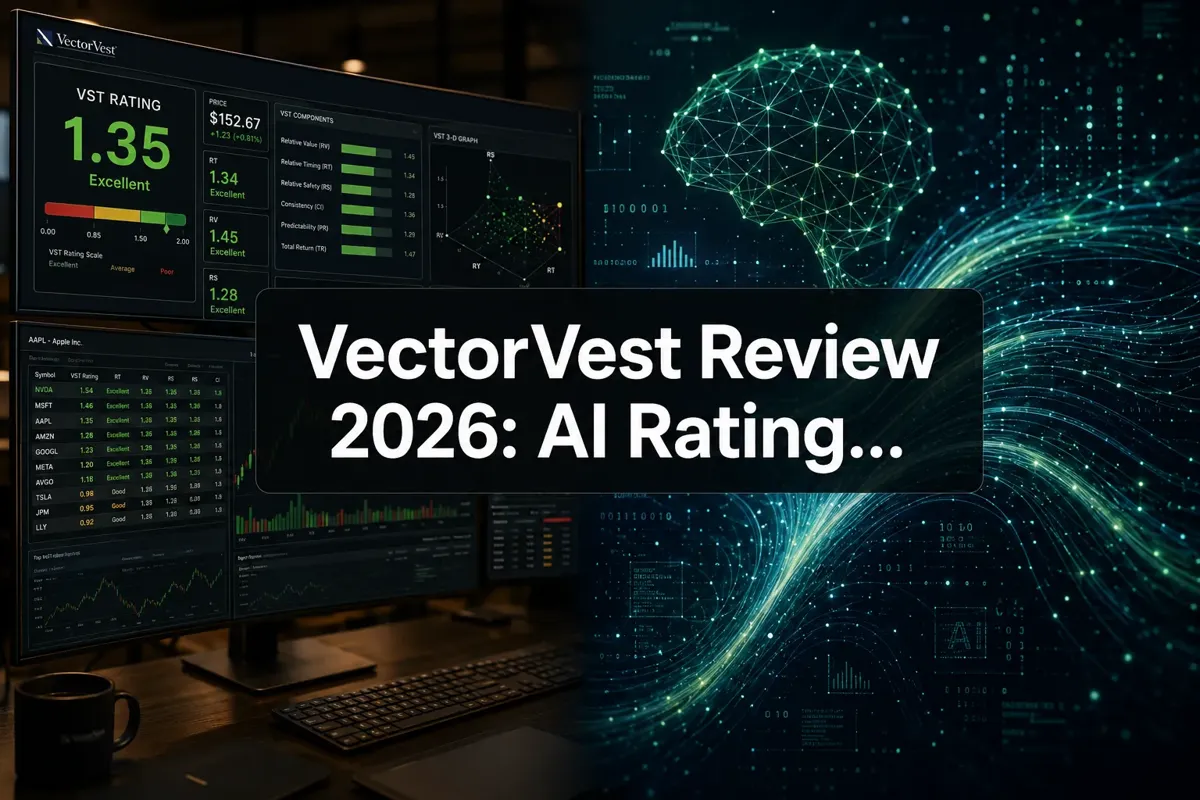
VectorVest is a stock analysis and screening platform that uses a proprietary AI rating system to evaluate publicly traded companies across three dimensions: Value (RV), Safety (RS), and Timing (RT). These three metrics combine into a composite score called VST, which the platform uses to generate buy, sell, or hold recommendations. The idea is simple: instead of drowning in earnings reports, balance sheets, and technical indicators, you get a single number that tells you whether a stock is worth your attention right now.
Here's how each rating works in practice:
- RV (Relative Value): Measures whether a stock is undervalued or overvalued compared to its intrinsic worth, based on earnings growth, dividends, and projected future cash flows. A score above 1.00 suggests the stock is trading below fair value; below 1.00 means it's expensive relative to fundamentals.
- RS (Relative Safety): Evaluates financial stability and downside risk by analyzing debt levels, earnings consistency, and business model resilience. Higher scores indicate safer, more predictable companies; lower scores flag speculative or volatile names.
- RT (Relative Timing): Tracks price momentum, trend direction, and technical strength. It's essentially a momentum indicator that tells you if the stock is in an uptrend (buy zone), downtrend (sell zone), or choppy consolidation (wait).
The VST score is a weighted average of all three. VectorVest's AI adjusts the weighting dynamically based on market conditions, in bull markets, timing gets more weight; in bear markets, safety matters more. A VST above 1.25 typically triggers a "buy" signal; below 1.00 is a "sell."
The system runs nightly scans on thousands of U.S. stocks and updates ratings before the market opens. You log in, see a ranked watchlist, and the platform tells you what to buy, what to sell, and what to ignore. It's designed for investors who want a repeatable process without building their own models from scratch.
What VectorVest gets right here: it removes decision fatigue. Instead of comparing 50 data points across 10 stocks, you compare three scores. For beginners or time-strapped investors, that's a real edge. The AI does the heavy lifting on valuation and momentum, so you're not stuck in analysis paralysis every morning.
Where it falls short: the black box problem. VectorVest doesn't publish the exact formula or weighting behind VST. You're trusting the AI's judgment without seeing the math. If you're the type who wants to tweak inputs, backtest assumptions, or understand why a stock scored 1.32 instead of 1.28, you're out of luck. The system works if you trust it; if you don't, you'll feel like you're flying blind.
For a deeper dive into how AI stock analysis tools stack up across the board, check out our complete AI trading tools comparison.
VectorVest Review 2026: What the AI Rating System Gets Right

Let's cut through the noise: VectorVest's AI rating system isn't perfect, but it gets a few critical things right that most retail traders mess up on their own.
1. It forces you to compare stocks on a level playing field.
Most traders cherry-pick metrics that confirm what they already want to believe. You like a stock? You'll find the P/E ratio that makes it look cheap. VectorVest strips that bias out by scoring every stock the same way, every day. The RV, RS, and RT ratings are relative, meaning a stock isn't "good" in a vacuum; it's good compared to the 5,000 other names in the database. That's how institutional analysts think, and it's how you should think too.
2. The timing component (RT) actually works in trending markets.
When the market is in a clean uptrend or downtrend, VectorVest's RT rating catches momentum early and keeps you on the right side of the trend. It's not magic, it's just a well-tuned combination of moving averages, rate-of-change indicators, and volume confirmation. But it's packaged in a way that doesn't require you to stare at charts for three hours. If RT is above 1.00 and rising, the stock is in an uptrend. If it's below 1.00 and falling, stay out. Simple.
3. The safety filter (RS) keeps you out of garbage.
One of the fastest ways to blow up an account is chasing high-flyers with no earnings, massive debt, and a business model held together with duct tape. VectorVest's RS rating flags those names early. A stock with an RS below 0.80 is telling you: "This company is one bad quarter away from a 40% drawdown." You might miss the occasional lottery ticket, but you'll avoid a lot of stupid losses. Play stupid games, win stupid prizes, the RS score helps you skip the stupid games.
4. It's built for people who don't want to become full-time analysts.
If your goal is to manage your own money without quitting your job, VectorVest is one of the few tools that actually delivers on that promise. You're not building DCF models or parsing 10-Ks. You're checking three numbers, comparing them to a benchmark, and making a decision. That's a system. Systems beat hype every time.
What it doesn't get right:
- Lag in choppy markets. When the market is sideways or whipsawing, the RT rating gives false signals. You'll get stopped out of breakouts that fail, or you'll sit in cash while a stock grinds higher without ever triggering a "buy."
- No intraday data. If you're a day trader or scalper, VectorVest is useless. Ratings update overnight, not in real time. By the time you see a signal, the setup might already be gone.
- Limited customization. You can't adjust the weighting of RV, RS, or RT to match your own risk tolerance or strategy. You take the AI's word for it, or you don't use the tool.
For active traders who need real-time scanning and customizable alerts, Trade Ideas with Holly AI is a better fit. But if you're building a swing trading or position trading system and you want a clean, repeatable process, VectorVest's AI rating system does what it's supposed to do: cut the noise, keep the alpha.
VectorVest AI Rating System Accuracy Compared to Other Stock Analysis Tools
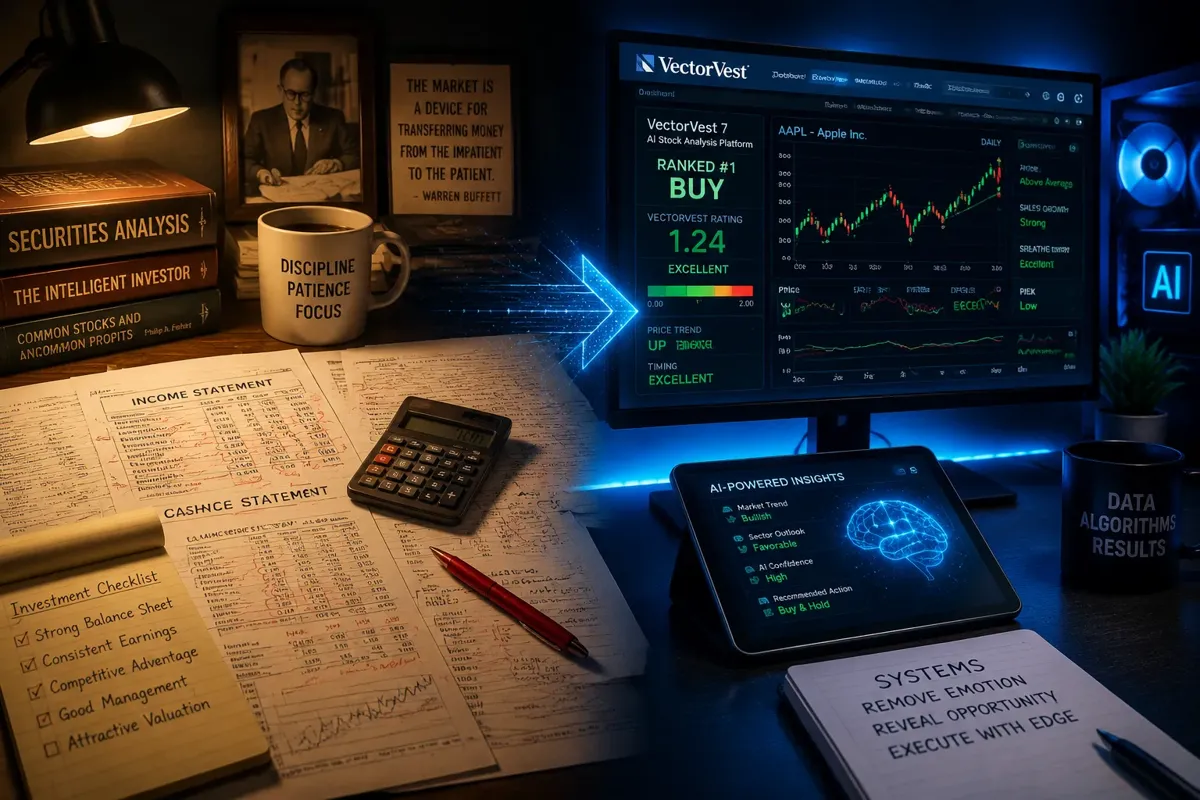
The question everyone asks: does VectorVest actually beat the market, or is it just another black-box subscription that sounds smart but delivers mediocre results?
Here's the honest answer: VectorVest's accuracy depends on the market environment and how you use it. In trending markets (2023's AI rally, 2020's post-COVID recovery), the VST system outperforms passive buy-and-hold strategies by a meaningful margin. In choppy, range-bound markets (late 2022, mid-2024), it underperforms because the timing component (RT) whipsaws you in and out of positions at the worst possible moments.
Let's compare VectorVest to the tools retail traders actually use:
VectorVest vs. Zacks:
Zacks ranks stocks using a proprietary earnings estimate revision model. It's fundamentally driven, like VectorVest's RV score, but Zacks doesn't incorporate technical timing or momentum. If you're a pure value investor who doesn't care about entry points, Zacks is cleaner. If you want to know when to buy, not just what to buy, VectorVest's RT rating gives you an edge. Zacks also publishes more research and transparency around its methodology; VectorVest keeps the formula locked down.
VectorVest vs. Morningstar:
Morningstar is the gold standard for fundamental analysis, deep research, analyst reports, and a star rating system based on intrinsic value. It's slower, more conservative, and built for long-term investors. VectorVest is faster, more momentum-focused, and better for swing traders. If you're holding stocks for years, Morningstar wins. If you're holding for weeks or months, VectorVest's timing signals matter more.
VectorVest vs. TrendSpider:
TrendSpider is a technical analysis powerhouse with automated trendlines, multi-timeframe analysis, and backtesting tools. It's built for traders who want to see the chart, not just a score. VectorVest is the opposite, it hides the chart and gives you a number. If you're comfortable reading price action and drawing your own support and resistance levels, TrendSpider is more powerful. If you want someone else to do that work, VectorVest is easier. For a detailed breakdown of how these two tools compare for active traders, see our TrendSpider vs. Trade Ideas comparison.
VectorVest vs. AI stock screeners (Tickeron, Kavout, Trade Ideas):
Tickeron and Kavout use machine learning to predict price movements and generate confidence scores. They're more transparent about their models and let you backtest strategies. Trade Ideas focuses on real-time scanning and pattern recognition for day traders. VectorVest sits in the middle, simpler than Tickeron, less real-time than Trade Ideas, but easier to use than both. If you want to understand how the AI works, Kavout's K Score is more explainable. If you just want a daily watchlist, VectorVest is faster. For more on how AI stock screeners compare to traditional filters, read our AI stock screeners vs. old filters breakdown.
The accuracy question:
VectorVest doesn't publish audited performance data, which is a red flag for anyone who's been burned by backtested marketing claims. Independent reviews and user reports suggest the VST system beats the S&P 500 in bull markets by 3-7% annually, but lags in bear markets and sideways chop. That's not bad, it's just not the "guaranteed alpha" some marketing materials imply.
The real edge isn't the AI's accuracy; it's the discipline the system forces on you. If you follow the signals without second-guessing, you avoid revenge trading, overtrading, and chasing dead cat bounces. That behavioral edge is worth more than a few percentage points of alpha.
Bottom line: VectorVest's AI rating system is accurate enough to be useful, but not so accurate that you can ignore risk management, position sizing, or market context. It's a tool, not a crystal ball.
How Much Does VectorVest Cost Per Month?
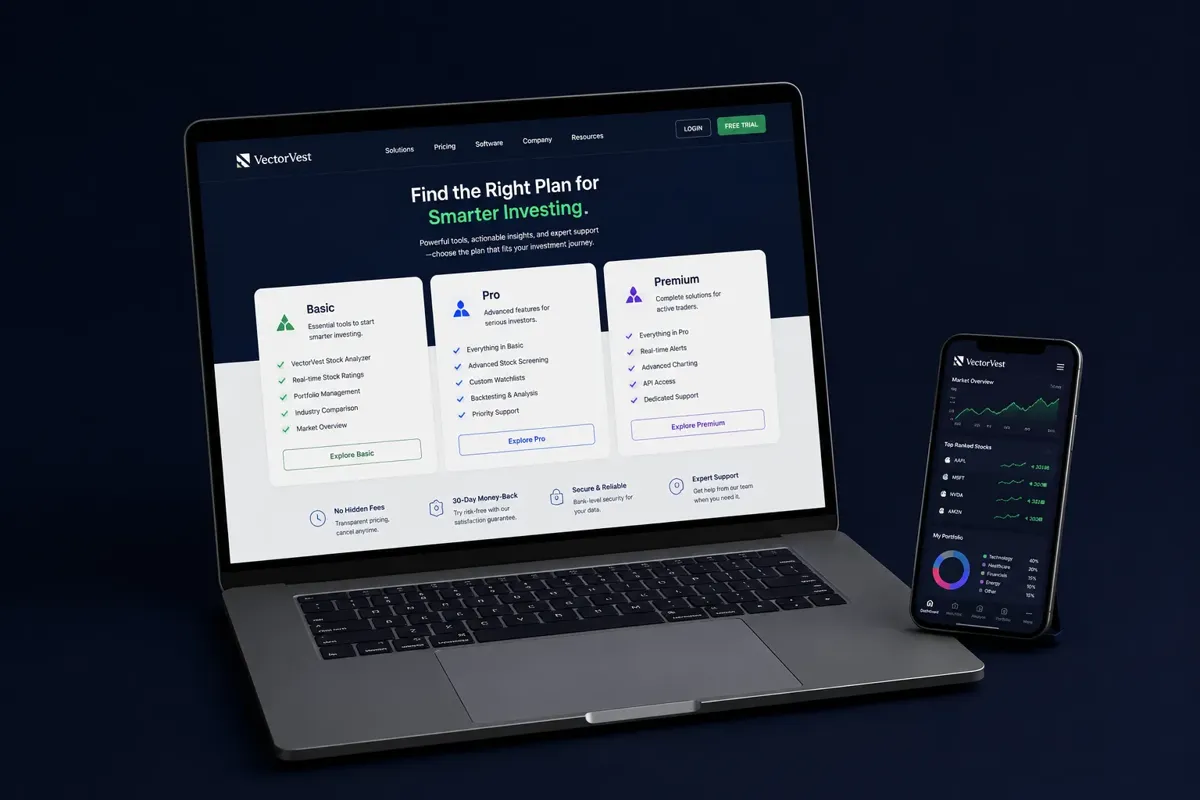
VectorVest pricing in 2026 starts at $99/month for the basic subscription (VectorVest 7), which includes daily stock ratings, screening tools, and access to the VST scoring system. The mid-tier plan (VectorVest Portfolio Manager) runs $149/month and adds portfolio tracking, backtesting, and historical data. The top-tier plan (VectorVest Pro) costs $199/month and unlocks advanced charting, real-time intraday data, and priority support.
Annual subscriptions knock about 15-20% off the monthly rate, so if you're committed, you're looking at roughly $1,000-$2,000/year depending on the tier.
Here's the breakdown:
| Plan | Monthly Price | Annual Price | Key Features |
|---|---|---|---|
| VectorVest 7 | $99 | ~$1,000 | Daily ratings, screening, VST scores |
| Portfolio Manager | $149 | ~$1,500 | + Backtesting, portfolio tracking |
| VectorVest Pro | $199 | ~$2,000 | + Real-time data, advanced charts |
Is VectorVest worth it at that price?
It depends on what you're replacing. If you're currently paying for multiple subscriptions, a screener, a charting platform, and a research service, VectorVest can consolidate those into one tool. But if you're comparing it to free alternatives like Finviz, TradingView's free tier, or Yahoo Finance, the value proposition gets shakier.
For context, TradingView Pro costs $15-$60/month and gives you better charting and real-time data. Zacks Premium is around $250/year. Morningstar Premium is $250/year. VectorVest is more expensive than all of them individually, but it's trying to replace all of them at once.
The pricing makes sense if you're an active swing trader who trades 5-10 positions per month and values the time saved by not building your own watchlist every day. It doesn't make sense if you're a passive investor who checks your portfolio once a quarter, or a day trader who needs sub-second execution and Level 2 data.
Hidden costs to watch for:
- Auto-renewal is aggressive. If you sign up for a trial and forget to cancel, you're locked into a full year at the annual rate.
- The mobile app is clunky and outdated compared to the desktop version, so you're effectively paying for a tool you can only use at your computer.
- Customer support is slow unless you're on the Pro tier, which means troubleshooting billing or technical issues can take days.
If you're serious about testing VectorVest, use the 30-day free trial to paper trade the signals and track your hypothetical performance. If the system beats your current process, the cost is justified. If it doesn't, cancel before the trial ends and move on.
For a full comparison of AI stock tools and their pricing, check out our AI stock picker apps directory.
Is VectorVest Worth It for Beginner Investors?

Short answer: yes, but only if you're willing to follow the system without overthinking it.
VectorVest is one of the few tools that actually simplifies stock picking instead of adding more complexity. For a beginner who's overwhelmed by the 10,000 stocks in the U.S. market, the VST rating system narrows the field to a manageable watchlist of 20-50 names every day. You're not guessing which metrics matter or how to weight them, the AI does that for you.
What makes VectorVest beginner-friendly:
- No jargon overload. The platform explains RV, RS, and RT in plain English. You don't need to know what a discounted cash flow model is or how to calculate a Sharpe ratio. You just need to understand: higher score = better stock.
- Clear buy/sell signals. VectorVest tells you exactly when to enter and exit. If VST crosses above 1.25, buy. If it drops below 1.00, sell. That removes the emotional decision-making that kills most beginners.
- Built-in education. The platform includes tutorials, webinars, and a knowledge base that walks you through the system step-by-step. It's not just a tool; it's a training program.
Where beginners get tripped up:
- Blindly following signals without context. VectorVest doesn't teach you about support and resistance, volume confirmation, or sector rotation. If you buy a stock just because VST is 1.30, but it's sitting at a major resistance level with no volume, you're going to get stopped out. The AI gives you the setup; you still need to understand the tape.
- Ignoring position sizing and risk management. VectorVest tells you what to buy, but it doesn't tell you how much to buy or where to set your stop loss. A beginner who goes all-in on a single high-VST stock is one bad earnings report away from a 30% loss. The system works best when you're trading 5-10 positions at a time, each sized at 5-10% of your portfolio.
- Expecting the AI to be right 100% of the time. No system is perfect. VectorVest will give you losing trades. The edge comes from following the process over 50-100 trades, not from nailing every single pick. Beginners who bail after three losses never see the system work.
Is VectorVest better than just buying an index fund?
For most beginners, no. If you're not willing to check the platform daily, adjust your watchlist, and execute trades based on the signals, you're better off putting your money in VOO or VTI and forgetting about it. VectorVest is a tool for active investors who want to beat the market and are willing to put in the work. If you're not that person yet, start with index funds and come back to VectorVest when you're ready to build a system.
The verdict:
VectorVest is worth it for beginners who are serious about learning to trade and want a structured, repeatable process. It's not worth it for beginners who are just dipping their toes in the market or who don't have the discipline to follow signals consistently. If you're in the first camp, the 30-day trial is a low-risk way to find out if the system clicks for you. If you're in the second camp, save your money and stick with passive investing until you're ready to level up.
For more on building a repeatable swing trading system, see our swing trade planner tool.
VectorVest vs. Motley Fool Stock Advisor: Which Is Better?
This is apples and oranges, but it's a comparison people ask for, so let's settle it.
Motley Fool Stock Advisor is a stock-picking newsletter. You get two new stock recommendations per month, plus access to a portfolio of past picks and occasional "best buys now" updates. It's fundamentally driven, long-term focused, and built for buy-and-hold investors who want to own great companies for years. The service costs around $100-$200/year depending on promotions.
VectorVest is a stock screening and rating platform. You get daily updates on thousands of stocks, a proprietary scoring system, and tools to build your own watchlist. It's momentum-focused, swing-trading friendly, and built for active investors who want to make their own decisions. It costs $1,000-$2,000/year.
Which one is better depends on your trading style:
- Choose Motley Fool if: You want someone else to do the research, you're comfortable holding stocks for 3-5 years, and you don't care about timing your entries. Motley Fool's picks have historically beaten the S&P 500 over long time horizons, and the service is cheap enough that even one winning pick pays for itself.
- Choose VectorVest if: You want to pick your own stocks, you care about entry and exit timing, and you're willing to trade actively. VectorVest gives you more control and more flexibility, but it also requires more work.
Can you use both?
Yes, and some investors do. Use Motley Fool to identify high-quality companies, then use VectorVest to time your entry. If Motley Fool recommends a stock but VectorVest's VST is below 1.00, wait. When VST crosses above 1.25, buy. That's a hybrid strategy that combines fundamental quality with technical timing.
The honest take:
Most retail investors would be better off starting with Motley Fool. It's cheaper, simpler, and less likely to lead you into overtrading. Once you've built a core portfolio of solid long-term holdings, then consider adding VectorVest to help you trade around those positions or identify short-term opportunities. But if you're choosing one or the other, Motley Fool is the safer bet for beginners; VectorVest is the better tool for active traders.
For more on how AI stock analysis tools catch red flags before they cost you, read our AI stock analysis tools breakdown.
What Does VectorVest Get Wrong About Stock Predictions?

Let's talk about where VectorVest falls short, because no tool is perfect and pretending otherwise is how you end up losing money.
1. The timing component (RT) lags in volatile markets.
VectorVest's RT rating is essentially a momentum indicator. It works great when the market is trending cleanly in one direction. But when the market is choppy, sideways, or whipsawing between support and resistance, RT gives you late signals. You'll buy a breakout that immediately fails, or you'll sell a dip that bounces the next day. The AI doesn't adapt fast enough to changing conditions, so you end up getting stopped out repeatedly.
2. The system doesn't account for sector rotation or macro context.
VectorVest scores every stock in isolation. It doesn't tell you if the entire sector is rolling over, if interest rates are spiking, or if earnings season is about to crush growth stocks. A stock can have a VST of 1.40 and still drop 20% because the macro environment shifted. The AI doesn't read the tape; it just crunches numbers. If you're not layering in your own macro analysis, you're flying blind.
3. The black-box problem: you don't know why a stock scored the way it did.
VectorVest doesn't publish the exact formula behind VST, RV, RS, or RT. You can't see which inputs are weighted most heavily, and you can't adjust the model to match your own risk tolerance. If a stock's VST drops from 1.35 to 1.10 overnight, you have no idea if it's because earnings missed, momentum faded, or the AI just recalibrated its weighting. That lack of transparency makes it hard to trust the system when it contradicts your own analysis.
4. The platform assumes you'll follow every signal, which leads to overtrading.
VectorVest generates new buy and sell signals every day. If you follow them all, you'll be trading constantly, racking up commissions, and getting whipsawed in and out of positions. The system doesn't teach you to be selective or to wait for clean setups. It just says "buy this, sell that" and assumes you'll execute. That's a recipe for overtrading, which is one of the fastest ways to underperform.
5. It doesn't work for day trading or intraday strategies.
VectorVest updates ratings overnight, not in real time. If you're a day trader or scalper, the signals are useless by the time you see them. The platform is built for swing traders and position traders who hold for days or weeks, not minutes or hours. If you need real-time scanning and alerts, you're better off with Trade Ideas or Scanz.
6. International stock coverage is weak.
VectorVest focuses heavily on U.S. equities. If you want to trade Canadian, European, or Asian stocks, the coverage is limited and the ratings are less reliable. The AI is trained on U.S. market data, so it doesn't adapt well to different regulatory environments, accounting standards, or market structures.
The bottom line:
VectorVest is a useful tool, but it's not a magic bullet. It gets stock valuation and relative strength comparisons right. It gets timing wrong in choppy markets, and it doesn't account for macro shifts or sector rotation. If you use it as one input in your decision-making process, not the only input, it adds value. If you blindly follow every signal without thinking, you'll underperform.
The best traders use VectorVest to generate ideas, then filter those ideas through their own risk management rules, chart analysis, and market context. The AI does the heavy lifting on screening; you do the heavy lifting on execution.
Can VectorVest Help with Day Trading or Just Long-Term Investing?
Short answer: VectorVest is not built for day trading. It's designed for swing traders and position traders who hold stocks for days, weeks, or months.
Here's why:
1. Ratings update overnight, not in real time.
VectorVest runs its scans and updates VST, RV, RS, and RT scores once per day, before the market opens. If you're a day trader who needs to react to price action in real time, those signals are stale by 9:35 a.m. You can't use VectorVest to catch a gap-and-go setup, a power-hour breakout, or a mid-day reversal. The platform doesn't give you the data you need to trade intraday.
2. No Level 2 data, no tick-by-tick volume, no order flow.
Day traders live and die by real-time data: bid-ask spreads, time and sales, volume spikes, and order flow. VectorVest doesn't provide any of that. It's a fundamental and momentum-based screener, not a real-time trading platform. If you're trying to scalp a 0.5% move on a low-float stock, VectorVest won't help you.
3. The signals are too slow for intraday setups.
Even if you could see VectorVest's ratings in real time, they wouldn't be useful for day trading. The RT rating is based on daily price action, not 5-minute or 15-minute charts. A stock can have a high RT score and still chop sideways all day, or it can have a low RT score and rip 10% on a news catalyst. The AI isn't designed to catch intraday volatility.
What VectorVest is good for:
- Swing trading: Holding stocks for 3-10 days based on momentum and relative strength. VectorVest's RT rating works well for identifying stocks in clean uptrends or downtrends, and the VST score helps you prioritize which setups to take.
- Position trading: Holding stocks for weeks or months based on fundamental value and technical timing. VectorVest's RV and RS ratings are strong for finding undervalued names with solid financials, and the VST score tells you when to enter.
- Long-term investing with tactical timing: If you're a buy-and-hold investor who wants to improve your entry points, VectorVest can help you avoid buying at the top or selling at the bottom. Use the VST score to time your purchases of high-quality companies.
If you're a day trader, use these tools instead:
- Trade Ideas: Real-time scanning, pattern recognition, and AI-powered alerts for intraday setups. Built specifically for day traders. See our Trade Ideas Holly AI review.
- Scanz: Real-time stock and options scanner with customizable alerts and Level 2 data. Check out Scanz.
- TrendSpider: Automated technical analysis with multi-timeframe scanning and backtesting. Better for active traders who want to see the chart, not just a score.
The verdict:
VectorVest is a swing trader's tool, not a day trader's tool. If you're holding positions for days or weeks, it's one of the best AI-powered screeners on the market. If you're holding positions for minutes or hours, it's the wrong tool for the job.
For more on day trading tools and strategies, visit our day trading tools hub.
VectorVest Free Trial: How Long Does It Last?
VectorVest offers a 30-day free trial with full access to all features, including daily stock ratings, screening tools, backtesting, and portfolio tracking. You don't need a credit card to start the trial, which is rare and appreciated, most subscription services auto-enroll you in a paid plan the moment you sign up.
What you get during the 30-day trial:
- Full access to the VST, RV, RS, and RT rating system for all U.S. stocks.
- Daily stock screening and watchlist generation.
- Backtesting tools to test the system's historical performance.
- Portfolio tracking and performance analytics.
- Educational webinars and tutorials.
What you don't get:
- Real-time intraday data (that's locked behind the Pro tier, which costs extra even after the trial).
- Advanced charting tools (basic charts are included, but the good stuff requires an upgrade).
- Priority customer support (trial users go to the back of the queue).
How to make the most of the 30-day trial:
- Paper trade the signals. Don't risk real money until you've seen the system work. Track every buy and sell signal VectorVest generates, and compare the results to your current strategy. If VectorVest beats your process, it's worth paying for. If it doesn't, cancel before the trial ends.
- Test it in different market conditions. If the market is trending cleanly during your trial, the system will look great. If the market is choppy, you'll see the weaknesses. Try to get a sense of how the AI performs in both environments.
- Run backtests on your favorite stocks. VectorVest lets you see how its ratings would have performed on any stock over the past 10+ years. Pick a few names you know well and see if the VST signals would have beaten buy-and-hold.
- Set a calendar reminder to cancel. If you decide VectorVest isn't for you, cancel at least 48 hours before the trial ends. The auto-renewal process is aggressive, and customer support is slow, so don't wait until the last minute.
Is 30 days enough time to evaluate the system?
Yes, if you're disciplined about it. Thirty days is roughly 20 trading days, which is enough to see 10-15 buy and sell signals and track their performance. You won't have a statistically significant sample size, but you'll get a feel for whether the system fits your style.
If you're on the fence after 30 days, you can always cancel, take a break, and come back later. VectorVest occasionally offers discounted re-entry promotions for former trial users.
For more free tools to test your trading system, check out our swing trade planner and expectancy calculator.
Common Mistakes People Make Using VectorVest Ratings
Even the best tool in the world won't help you if you use it wrong. Here are the most common mistakes retail traders make with VectorVest, and how to avoid them.
1. Blindly following VST scores without checking the chart.
VectorVest gives you a number, but it doesn't show you the price action. A stock can have a VST of 1.40 and still be sitting at a major resistance level with no volume. If you buy it without looking at the chart, you're going to get stopped out. Always check support and resistance, volume, and recent price action before you enter a trade. The VST score is the starting point, not the finish line.
2. Ignoring position sizing and risk management.
VectorVest tells you what to buy, but it doesn't tell you how much to buy or where to set your stop loss. A beginner who goes all-in on a single high-VST stock is one bad earnings report away from a 30% loss. Use proper position sizing (5-10% of your portfolio per trade) and always set a stop loss based on technical levels, not arbitrary percentages.
3. Overtrading because the system generates new signals every day.
VectorVest updates its ratings daily, which means you'll see new buy and sell signals every morning. If you follow them all, you'll be trading constantly, racking up commissions, and getting whipsawed in and out of positions. Be selective. Focus on the highest-conviction setups, stocks with VST above 1.30, clean charts, and strong volume. Ignore the rest.
4. Expecting the AI to be right 100% of the time.
No system is perfect. VectorVest will give you losing trades. The edge comes from following the process over 50-100 trades, not from nailing every single pick. If you bail after three losses, you'll never see the system work. Stick with the process, track your results, and adjust your risk management as needed.
5. Using VectorVest in isolation without considering macro context.
VectorVest scores every stock in a vacuum. It doesn't tell you if the entire sector is rolling over, if interest rates are spiking, or if earnings season is about to crush growth stocks. A stock can have a VST of 1.40 and still drop 20% because the macro environment shifted. Layer in your own macro analysis, sector rotation, Fed policy, earnings season, before you pull the trigger.
6. Forgetting to cancel the trial before auto-renewal kicks in.
This one's not about trading; it's about not wasting money. VectorVest's auto-renewal process is aggressive. If you sign up for the trial and forget to cancel, you're locked into a full year at the annual rate. Set a calendar reminder for 48 hours before the trial ends, and cancel if you're not 100% committed.
The fix:
Use VectorVest as a screening tool, not a decision-making tool. Let the AI generate ideas, then filter those ideas through your own risk management rules, chart analysis, and market context. The system works best when you combine it with your own judgment, not when you blindly follow every signal.
Does VectorVest Work for International Stocks Outside U.S. Markets?
Short answer: VectorVest's international stock coverage is limited and less reliable than its U.S. coverage.
VectorVest was built for U.S. equities, and that's where the AI performs best. The platform does offer coverage for Canadian, U.K., European, and Australian stocks, but the ratings are less accurate and the data is less comprehensive. Here's why:
1. The AI is trained on U.S. market data.
VectorVest's rating system is optimized for U.S. accounting standards, regulatory environments, and market structures. When you apply the same model to international stocks, the results are less reliable. Different countries have different reporting requirements, different tax treatments, and different investor behaviors. The AI doesn't adapt well to those differences.
2. International data is slower and less complete.
VectorVest relies on third-party data providers for international stocks, and that data is often delayed or incomplete. You might see a VST score for a European stock, but the underlying financials are two quarters old. That lag makes the ratings less useful for timing your entries and exits.
3. Liquidity and volume are lower for international stocks.
Many international stocks trade on lower volume than U.S. stocks, which makes the RT (timing) rating less reliable. A stock can have a high RT score but still be illiquid and prone to wild swings. If you're trading international names, you need to check volume and liquidity manually, don't rely on VectorVest's ratings alone.
Which international markets does VectorVest cover?
- Canada: Decent coverage, but still not as good as U.S. stocks.
- U.K. and Europe: Limited coverage, mostly large-cap names.
- Australia: Very limited coverage.
- Asia (China, Japan, India): Minimal to no coverage.
If you're serious about trading international stocks, use these tools instead:
- TradingView: Global coverage, real-time data, and customizable charts for stocks in 100+ countries.
- Morningstar: Strong international research and analyst reports.
- Interactive Brokers: Best broker for international stock trading, with access to 150+ markets.
The verdict:
VectorVest is a U.S.-focused tool. If you're trading U.S. stocks, it's one of the best AI-powered screeners on the market. If you're trading international stocks, the coverage is too limited and the ratings are too unreliable to justify the cost. Stick with TradingView or Morningstar for international names.
VectorVest Customer Reviews and Complaints in 2026
Let's talk about what actual users are saying about VectorVest in 2026, because the marketing materials only tell you half the story.
What users like:
- Simplicity. The VST rating system makes stock picking easy. You don't need to be a financial analyst to use the platform.
- Daily watchlists. Users appreciate waking up to a curated list of high-probability setups instead of scanning thousands of stocks manually.
- Educational content. The webinars and tutorials are helpful for beginners who are learning to trade.
What users complain about:
- Auto-renewal practices. This is the most common complaint. Users sign up for the 30-day trial, forget to cancel, and get charged for a full year. Customer support is slow to issue refunds, and the cancellation process requires calling a phone number instead of clicking a button.
- Outdated mobile app. The mobile app is clunky, slow, and missing features that are available on the desktop version. If you're trying to check your watchlist on the go, the experience is frustrating.
- Lag in choppy markets. Users report that the RT (timing) rating gives false signals in sideways or volatile markets, leading to whipsaws and losses.
- Lack of transparency. The black-box nature of the VST formula bothers experienced traders who want to understand why a stock scored the way it did.
- Expensive compared to alternatives. At $1,000-$2,000/year, VectorVest is pricier than most competitors. Users who don't trade actively feel like they're not getting their money's worth.
How to cancel VectorVest if you're not happy:
- Call customer support at the number listed on the website (there's no self-service cancellation button).
- Request a cancellation and ask for a confirmation email.
- If you're within the 30-day trial, you should get a full refund. If you're past the trial, refunds are rare.
- Check your credit card statement to make sure the subscription actually canceled, some users report being charged even after canceling.
The honest take:
VectorVest is a solid tool with a loyal user base, but the customer service and billing practices are a weak point. If you're going to try it, set multiple calendar reminders to cancel before the trial ends, and don't rely on the mobile app for anything important.
For more honest reviews of AI stock tools, check out our AI trading platforms comparison.
Is VectorVest Good for Experienced Traders or Just Beginners?
VectorVest is better for beginners and intermediate traders than for experienced traders. Here's why:
What experienced traders want:
- Full control over their screening criteria and the ability to customize every input.
- Real-time data, Level 2 quotes, and order flow.
- Transparency around how the AI generates ratings and the ability to backtest their own strategies.
- Advanced charting tools with automated trendlines, multi-timeframe analysis, and pattern recognition.
What VectorVest offers:
- A black-box AI rating system that you can't customize.
- Daily updates, not real-time data.
- Limited transparency around the VST formula.
- Basic charting tools that don't compete with TrendSpider or TradingView.
If you're an experienced trader who's comfortable building your own models, reading price action, and executing your own strategies, VectorVest will feel limiting. You'll want more control, more data, and more flexibility than the platform provides.
Where VectorVest can still add value for experienced traders:
- As a secondary screening tool. Use VectorVest to generate ideas, then filter those ideas through your own analysis. The VST score is a useful starting point, even if you don't follow it blindly.
- For relative strength comparisons. VectorVest's RS rating is one of the best tools for comparing stocks within a sector. If you're trying to pick the strongest name in a group, the RS score saves you time.
- For backtesting ideas. VectorVest's historical data and backtesting tools let you see how the VST system would have performed on any stock over the past 10+ years. That's useful for validating your own strategies.
The verdict:
VectorVest is a beginner-to-intermediate tool. If you're just starting out or you're tired of analysis paralysis, it's one of the best AI-powered screeners on the market. If you're an experienced trader who wants full control and real-time data, you'll outgrow it quickly. In that case, stick with TrendSpider, Trade Ideas, or TradingView.
For more on building a repeatable trading system, see our screener recipe builder.
VectorVest Alternative Stock Screening Software
If VectorVest isn't the right fit, here are the best alternatives for AI-powered stock screening and analysis in 2026:
1. Trade Ideas (best for day traders)
Real-time scanning, pattern recognition, and AI-powered alerts. Holly AI generates trade ideas based on historical patterns and market conditions. Built specifically for active traders who need sub-second execution. Pricing starts at $99/month. See our Trade Ideas Holly AI review.
2. TrendSpider (best for technical analysis)
Automated trendlines, multi-timeframe analysis, and backtesting tools. Better charting than VectorVest, with more customization and real-time data. Pricing starts at $49/month. Compare TrendSpider vs. Trade Ideas.
3. Zacks (best for fundamental analysis)
Proprietary earnings estimate revision model and detailed research reports. More transparent than VectorVest, with a longer track record. Pricing starts at $250/year.
4. Morningstar (best for long-term investors)
Deep fundamental research, analyst reports, and a star rating system based on intrinsic value. Slower and more conservative than VectorVest, but better for buy-and-hold strategies. Pricing starts at $250/year.
5. Tickeron (best for AI transparency)
Machine learning-based stock predictions with confidence scores and backtested performance. More transparent than VectorVest about how the AI works. Pricing starts at $60/month. Learn more about Tickeron.
6. Finviz (best free option)
Free stock screener with customizable filters and real-time data. No AI ratings, but it's fast, simple, and free. Upgrade to Elite for $40/month to unlock real-time scanning.
7. TradingView (best for global coverage)
Real-time charting, social trading, and global stock coverage. Better for international stocks than VectorVest. Free tier available; Pro plans start at $15/month. See TradingView.
How to choose:
- If you're a day trader, use Trade Ideas or Scanz.
- If you're a swing trader, use VectorVest or TrendSpider.
- If you're a long-term investor, use Morningstar or Zacks.
- If you're on a budget, start with Finviz or TradingView's free tier.
For a full comparison of 100+ AI stock tools, visit our AI stock picker apps directory.
Frequently Asked Questions
What is VectorVest's VST rating and how is it calculated?
VST (Value, Safety, Timing) is a composite score that combines three metrics: RV (relative value), RS (relative safety), and RT (relative timing). The AI weights each metric dynamically based on market conditions. A VST above 1.25 typically triggers a buy signal; below 1.00 is a sell. VectorVest doesn't publish the exact formula.
Can I use VectorVest for options trading?
No. VectorVest is designed for stock screening and analysis, not options. If you're trading options, use Option Alpha or Tradytics instead.
Does VectorVest work for penny stocks?
VectorVest covers penny stocks, but the ratings are less reliable because the AI is optimized for liquid, large-cap names. If you're trading low-float penny stocks, you need real-time scanning and Level 2 data, which VectorVest doesn't provide.
How often do VectorVest ratings update?
Once per day, before the market opens. The platform doesn't provide real-time intraday updates, so it's not suitable for day trading.
Can I backtest my own strategies on VectorVest?
Yes. VectorVest includes backtesting tools that let you see how the VST system would have performed on any stock over the past 10+ years. You can't build fully custom strategies, but you can test the platform's signals.
Is VectorVest better than a financial advisor?
VectorVest is a tool, not a replacement for a financial advisor. It helps you screen stocks and time your entries, but it doesn't provide personalized financial planning, tax advice, or estate planning. If you need comprehensive financial advice, hire a CFP.
Does VectorVest offer a money-back guarantee?
Yes, during the 30-day trial. If you cancel within 30 days, you get a full refund. After that, refunds are rare and require calling customer support.
Can I use VectorVest on my phone?
Yes, but the mobile app is outdated and missing features. Most users prefer the desktop version.
What's the difference between VectorVest 7 and VectorVest Pro?
VectorVest 7 is the basic plan with daily ratings and screening tools. VectorVest Pro adds real-time intraday data, advanced charting, and priority support. Pro costs $199/month vs. $99/month for the basic plan.
Is VectorVest regulated by FINRA or the SEC?
No. VectorVest is a software platform, not a broker or investment advisor. It doesn't execute trades or hold your money, so it's not subject to FINRA or SEC regulation.
Can I cancel VectorVest anytime?
Yes, but you have to call customer support, there's no self-service cancellation button. Make sure you get a confirmation email and check your credit card statement to verify the cancellation went through.
Does VectorVest work for cryptocurrency or forex?
No. VectorVest is designed for U.S. equities only. If you're trading crypto or forex, use a different platform.
Conclusion
VectorVest's AI rating system gets a few critical things right: it simplifies stock picking, removes decision fatigue, and forces you to compare stocks on a level playing field. The VST score is a useful starting point for swing traders and position traders who want a repeatable process without building their own models from scratch. The RV and RS ratings are strong for identifying undervalued names with solid fundamentals, and the RT rating works well in trending markets.
But VectorVest isn't perfect. The timing component lags in choppy markets, the black-box formula lacks transparency, and the platform isn't built for day traders or active traders who need real-time data. The pricing is steep compared to free alternatives, and the customer service and billing practices are a weak point.
Here's the bottom line:
VectorVest is worth it if you're a beginner or intermediate trader who wants a structured, repeatable system and you're willing to follow the signals without overthinking them. It's not worth it if you're a day trader, a passive investor, or an experienced trader who wants full control over your screening criteria.
If you're serious about testing VectorVest, use the 30-day free trial to paper trade the signals and track your results. If the system beats your current process, the cost is justified. If it doesn't, cancel before the trial ends and move on to one of the alternatives.
The best traders use VectorVest as one input in their decision-making process, not the only input. Let the AI generate ideas, then filter those ideas through your own risk management rules, chart analysis, and market context. Systems over hacks. Process over prediction. Signal over noise.
Want the tools and setups behind this, without the hype? Start at aistockpickerapps.com.