Probors Stock Tracker: Is the Congress Trade Feed Worth It?

Last updated: October 28, 2026
Search "probors stock" and you'll find two very different people. One wants a ticker symbol. The other wants to know whether the probors stock tracker, a $30-a-month congressional trade feed, is worth the money. Let's handle the first one in one sentence so nobody wastes a brokerage login: 
Quick answer: what the Probors stock tracker covers and whether it is worth paying for
The probors stock tracker is a congressional and insider trade tracker that pulls House and Senate STOCK Act disclosures, SEC Form 4 insider filings, whale activity, market charts, alerts, and AI research briefs into one workspace, with REST API and MCP access in beta. It is worth paying for if you're building a systematic research process around disclosure data. It is not worth paying for if you expect real-time trade signals, because the underlying filings can legally arrive up to 45 days after the trade.
That lag is the whole ballgame. Every tracker in this category, ProBors included, is competing on interface, filters, and speed-of-delivery-after-filing. None of them can beat the filing deadline, because the deadline is set by law, not by software.
The practical read: ProBors sells better organization of public data, not a shortcut to information nobody else has.
Here's the rest of it, including who should actually pay, how the pricing works, and whether the academic evidence supports the "copy Congress" thesis at all. (Spoiler-free preview: the newer research is unkind.)
What is Probors, and is it a public stock?
ProBors is a private subscription software product. You cannot buy shares in it. If you typed "probors stock symbol" into a search bar, the answer is that none exists, and anyone offering you pre-IPO shares in it should be treated the way you'd treat a DM from a stranger with a Lambo in the profile picture.
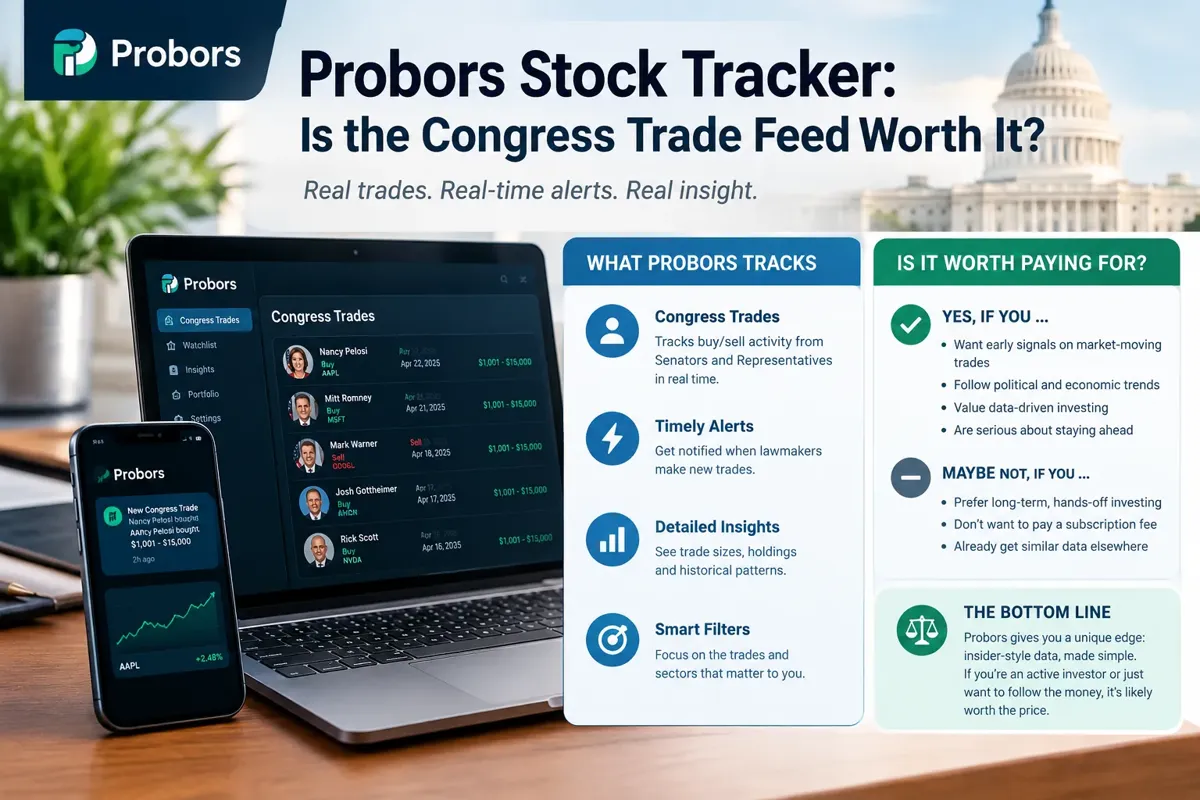
The confusion is understandable. The word "stock" sits next to the brand name in every search result because the Probors stock tracker follows stocks. That's it. No ticker, no exchange listing, no filing with the SEC as an issuer.
What the product actually does
The probors stock tracker bundles several data streams into one dashboard:
- Congressional disclosures from House and Senate Periodic Transaction Reports, filed under the STOCK Act
- SEC Form 4 insider filings from corporate officers and directors
- Whale activity, meaning the largest insider buys and sells
- Market charts and alerts so you can watch a ticker after a disclosure hits
- AI research briefs that summarize a politician's portfolio or a cluster of filings
- Politician portfolio pages showing holdings over time
- Developer access via REST API and an MCP connection, both labeled beta
The API limits are published: 60 general requests per minute and 1,000 per day, with market data capped at 20 per minute and 200 per day (checked October 2026). ProBors says those limits may change while the API and MCP are in beta, which matters if you're planning to run an automated screen. Our guide to trading automations covers what a realistic automated workflow needs. You're not going to build a high-frequency anything on 200 market-data calls a day.
MCP access is the quietly interesting part
MCP, short for Model Context Protocol, is a standard that lets an AI assistant like 
It's also in beta. Treat beta as beta. Paper trade it first, verify a few results by hand against the original filing, and don't build a process on top of a feature that could change next quarter. If you want the broader context on where these connections fit, the roundup of AI stock tools with MCP support covers the category, and our coverage of Claude trading bots shows what an AI assistant can and can't safely do with market data.
Market truth: the data behind ProBors is free and public. What you're buying is the plumbing.
How does the Probors congress trade feed work?
The probors stock tracker feed works by pulling filings from the official House and Senate disclosure portals, parsing them, and pushing them to your dashboard and alerts. The pipeline is fast. The source is not. Under the STOCK Act, a Periodic Transaction Report is required for any purchase, sale, or exchange over $1,000, and must be filed within 30 days of the member being notified, but no later than 45 days after the transaction, per the Senate Ethics Committee's own guidance.
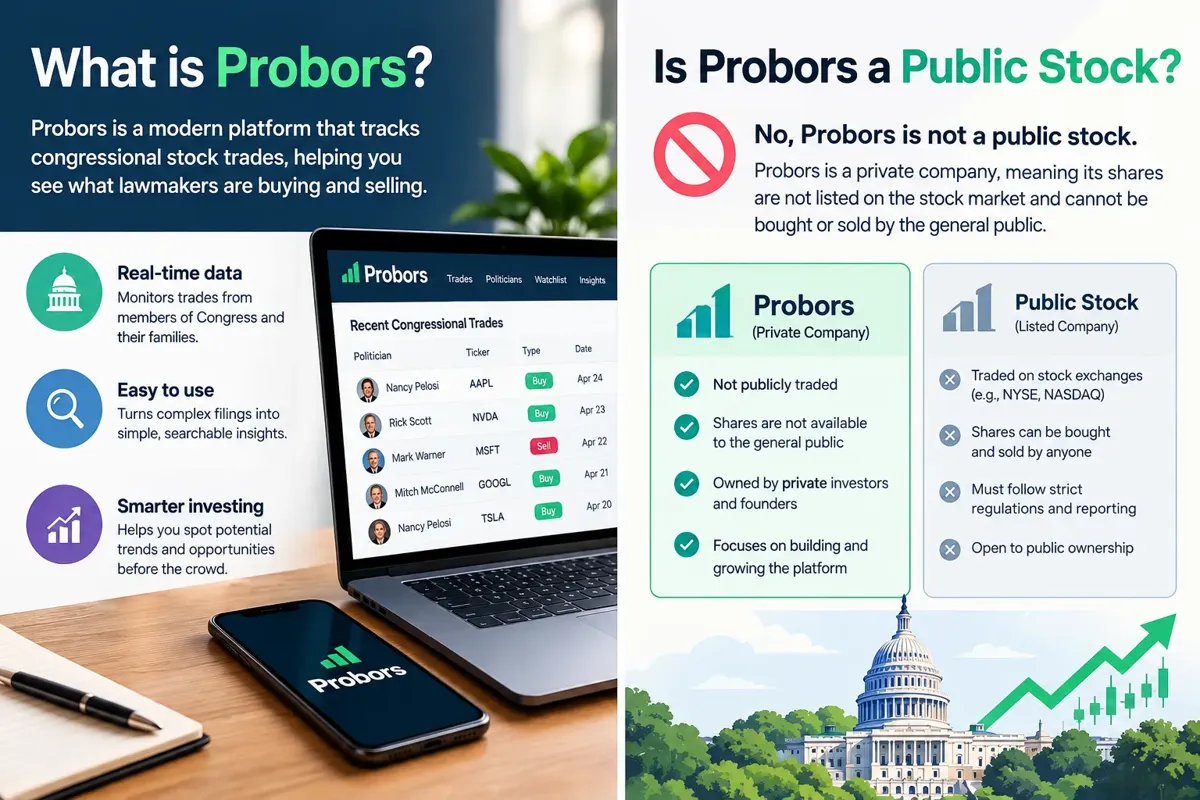
So the chain looks like this:
- The trade happens. Day zero. Nobody outside the member's household knows.
- The member gets notified by their broker or advisor.
- A PTR is filed, within 30 days of notification and no later than 45 days after the trade.
- You get the alert and see the ticker, the transaction date, the filing date, and the value range.
Steps 4 and 5 are quick. Steps 1 through 3 can take six weeks. Software can't compress a legal deadline.
To its credit, ProBors doesn't hide this. The platform displays both transaction date and filing lag, so a disclosure filed on day 43 of 45 announces exactly what it is. That's more honest than a lot of competitors who lead with the ticker and bury the date.
The value ranges are the second problem
Congressional disclosures report size in brackets, not exact dollars. A filing might say $15,001 to $50,000, or $1,000,000 to $5,000,000. You cannot replicate a politician's portfolio with any precision, and you cannot calculate their actual return without assumptions you'd have to invent.
That makes "Senator X is up 40% this year" a headline, not a number. Anyone publishing precise congressional returns is modeling, not measuring.
Where the filters earn their keep
ProBors has been publishing guides for new filtering tools through 2026, including a More Filters dialog, pagination, column sorting, estimated-value filters, and House-only research views. That direction tells you something about who the product is for: people who want to screen systematically, not people who want to browse headlines.
A filter stack that actually helps looks like:
- Value range above $50,000 (small trades are noise)
- First-time position in a ticker (new conviction beats a routine add)
- Committee-sector overlap (an Energy Committee member buying a pipeline name)
- Filing lag under 20 days (less price decay)
- Multiple members in the same name inside 30 days (clustering)
Common mistake: treating every disclosure as a signal. Most of them are rebalancing, managed accounts, or a spouse's advisor doing their job.
About that signal score
The probors stock tracker assigns a signal score built from filing delay, committee-sector overlap, first-time holdings, insider buying in the same ticker, multi-politician clusters, option-versus-stock classification, and above-average trade size. It's a prioritization tool. It sorts a long list into a shorter one.
What it isn't: a validated return model. ProBors does not publicly show that a score of 91 predicts any specific forward return or probability of outperformance. Use the score to decide what to read first, not what to buy.
How much does Probors cost, and is the AppSumo lifetime deal still available?
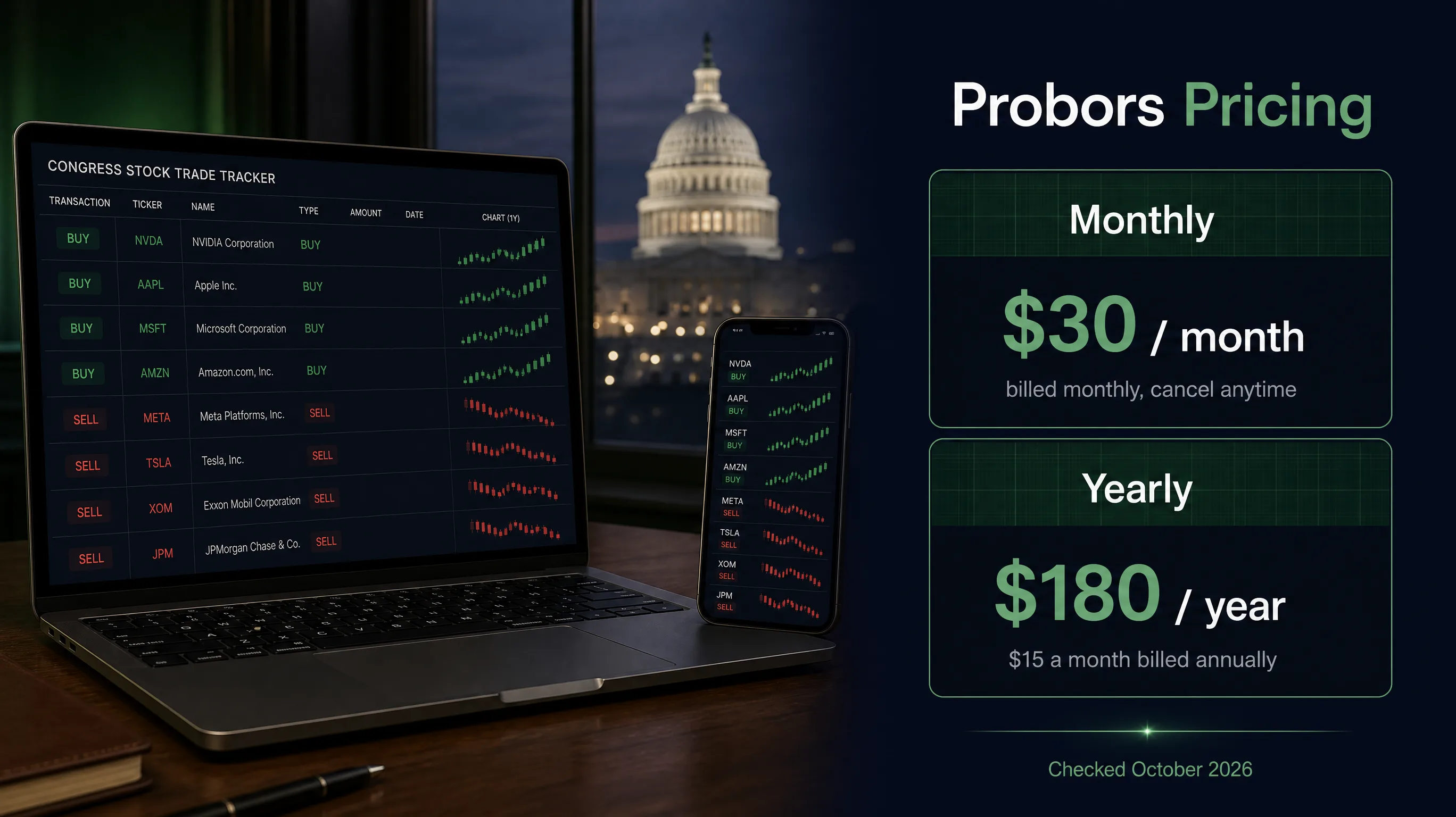
The probors stock tracker advertises a launch price of $30 per month against a stated regular price of $75 per month, or $180 per year, which works out to $15 a month billed annually (checked October 2026). On the probors appsumo question: ProBors did run an 
What's in the subscription
Both plans include the same workspace, 700 AI credits a month, and REST API and MCP access. The difference is the refund terms (checked October 2026):
That's backwards from what most people assume. The annual plan, the bigger commitment, is the one with the safety net. The monthly plan, the "I'll just try it" option, is the one with no exit. ProBors says a yearly refund inside 14 days is issued minus one monthly fee, so the true cost of a test drive is about one month. If you're testing the product, the annual plan is still the lower-risk way in, provided you actually evaluate it inside two weeks and cancel if it doesn't fit.
The AI credits are metered
The subscription includes 700 AI credits per month. Extra packs are listed at $5.99 for 100 credits, $12.99 for 250, and $34.99 for 700 (checked October 2026).
So the headline price isn't unlimited AI research. If you lean hard on the AI briefs, you're looking at a variable cost on top of the base. Someone generating a brief on every interesting filing will burn through 700 credits faster than they expect.
Do the math before you subscribe: if you'd realistically need 1,400 credits a month, your real cost on the annual plan is closer to $50 a month, not $15. That changes the comparison with everything else in the category.
How to cancel
Cancellation runs through the billing portal in your account settings on probors.com. Monthly subscribers should expect no refund for the current period based on the stated terms, so cancel before your renewal date rather than after. Annual subscribers have the 14-day window and should treat day 14 as a hard deadline on the calendar, not a vibe.
Decision rule: if you can't name three specific screens you'll run weekly, don't subscribe. You'll pay $180 for a dashboard you check twice.
How do you track what stocks Congress is buying?
You track congressional buying by reading Periodic Transaction Reports filed under the STOCK Act, either directly from the House and Senate disclosure portals for free, or through a congress stock tracker that parses and organizes them for you. The data source is identical either way. You're paying for speed, filters, and alerts.
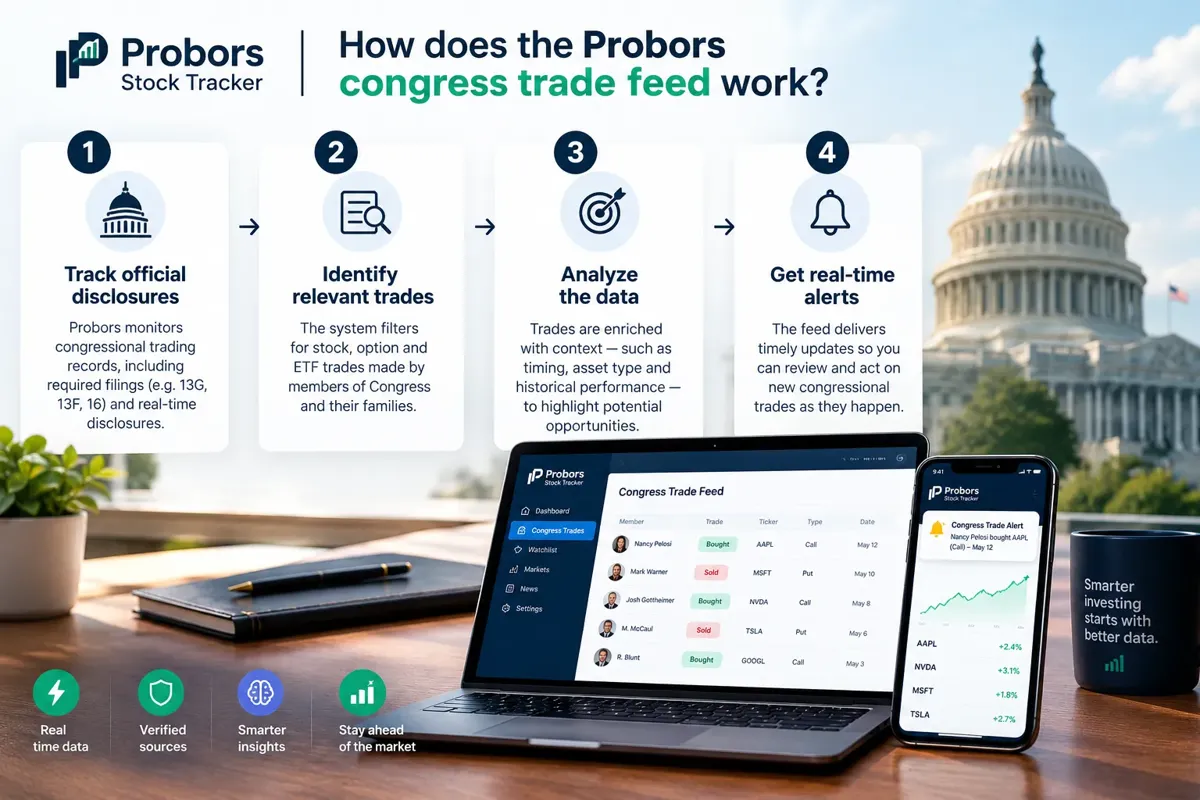
The manual route, free
- Go to the House Clerk's financial disclosure search and the Senate Ethics Committee's public disclosure portal.
- Search by member, by date range, or browse the latest PTR filings.
- Open the PDF. Note the transaction date, the filing date, the ticker, the type (purchase, sale, exchange), and the value bracket.
- Log it in a spreadsheet with the lag in days.
- Check whether the stock already moved during the lag window.
Step 5 is the one people skip, and it's the one that matters most. If a name is up 22% since the transaction date, you're not acting on a disclosure. You're catching a falling knife in reverse, chasing a move that already happened.
The paid route
A tracker collapses those five steps into one feed with alerts. You get push notifications, sortable tables, politician portfolio pages, and in the case of ProBors, AI summaries and API access. The value is time saved and consistency gained, not information advantage.
Build the process, then pick the tool
Observation: most people buy the tracker first and figure out the process never.
What actually works is writing your rules before you open an account. Something like:
- Universe: disclosures over $50,000, filed within 25 days, in a sector the member's committee touches
- Confirmation: the stock is still within 5% of its price on the transaction date
- Setup: it's basing or in tight consolidation near support, not already overextended
- Sizing: a fixed percentage of account per position, no exceptions
- Exit: a stop loss placed before entry, and a target or trailing rule
Notice four of those five rules have nothing to do with Congress. The disclosure is an idea generator. Your risk management is what decides whether the idea costs you money.
If you'd rather compare the field before committing, the directory of insider and congress trade trackers lays out the options side by side, the ProBors tool page has the current breakdown, and the ProBors alternatives list shows who else covers the same filings.
Systems over hacks. A tracker without rules is just a faster way to be impulsive.
Probors stock tracker vs Quiver Quantitative vs Unusual Whales
These three tools serve different jobs. ProBors is the research workspace with AI briefs and API/MCP access. 

The wider tracker market is crowded and keeps getting more so. Several comparison roundups published in 2026 rank long lists of rivals, and alternatives pages for 

Choose by job, not by feature count
- Choose the probors stock tracker if you want disclosures, Form 4 insider data, and AI summaries in one place, and you'd actually use the API or MCP connection.
- Choose Quiver if your instinct is "prove it with a backtest" and you want to test whether a strategy held up historically before risking a dollar.
- Choose Unusual Whales if options flow is your primary read and congressional data is a supporting input. Our Unusual Whales scorecard covers where that platform fits.
- Choose free portals if you check disclosures monthly and don't need alerts.
Edge case worth naming: if you already pay for a scanner, a charting platform, and a research tool like 
Is copying Congress trades profitable?
The recent evidence says no, or at best, not reliably. The older evidence said yes. The gap between those two findings is mostly the STOCK Act itself, which forced disclosure and, apparently, changed behavior.
Here's the research arc in plain terms:
- Ziobrowski, Cheng, Boyd and Ziobrowski (Journal of Financial and Quantitative Analysis, 2004), studying Senate trades from 1993 to 1998, found that a portfolio mimicking senators' purchases beat the market by 85 basis points per month. That's the study every "Congress beats the market" headline traces back to, and it predates the STOCK Act.
- Eggers and Hainmueller (Journal of Politics, 2013) later found no convincing evidence of superior congressional portfolio performance.
- Belmont, Sacerdote, Sehgal and Van Hoek (Journal of Public Economics, 2022), covering January 2012 through December 2020, found no evidence that senators or House members produced superior aggregate performance. In the cited analysis, House purchases underperformed by about 26 basis points over a six-month horizon.
- NBER Working Paper 35041 by Dartmouth's Haotian Chen and Bruce Sacerdote, covering 2012 to 2023, reports that congressional portfolios underperformed or at best matched market benchmarks after the STOCK Act.
Four studies, one direction of travel. The more recent and post-disclosure the data, the weaker the case for treating congressional filings as privileged information.
Why individual trades still go viral
Because survivorship bias is undefeated. A member buys a chip name, it doubles, screenshots circulate. Nobody screenshots the rest of that quarter's disclosures that went sideways. The aggregate is the honest picture, and the aggregate is unremarkable.
There's also the mechanical problem: the lag. By the time a 40-day-old purchase hits your phone, the market has had six weeks to price in whatever the member knew, plus two earnings headlines and a Fed meeting. You're reading yesterday's weather forecast.
Where the data is genuinely useful
Not as a buy signal. As a lens.
- Sector rotation hints. A cluster of defense purchases across multiple members is a theme worth investigating with your own analysis.
- Policy-adjacent flags. Committee-sector overlap can point you toward where regulatory attention is heading.
- Idea generation. Add the ticker to your watchlist, then apply your actual setup criteria: price action, support and resistance, a clean base, a defined risk-reward.
- Conviction checks. A first-time position by a member who rarely buys individual names is more interesting than a routine rebalance.
The disclosure gets the ticker on your list. Your process decides if it ever becomes a position. If you want the broader argument on where AI-assisted tools actually help versus where they add noise, the honest guide to AI stock trading covers it.
Nobody is promising returns here
Not ProBors, not us, not any tracker worth your money. Buying a stock because a politician did, with no stop loss and no sizing rule, is how small accounts get cooked. Play stupid games.
Discipline beats prediction. The tracker gives you a list. The list is not a strategy.
On the legal question
Tracking and acting on congressional disclosures is legal. The filings are public records published by the House and Senate specifically so citizens can see them. Congressional trading regulation remains unsettled, though. On September 30, 2026, the Senate failed to advance the Stop Insider Trading Act by a 53 to 47 vote, short of the 60 needed to begin debate. The bill would have barred members, spouses, and dependents from buying individual stocks and required public notice at least seven days before a sale. Until something like that passes, the current disclosure regime stands, and so does the business model of every tracker built on it.
Can you track politician stock trades for free?
Yes. You can track politician trades free using the House Clerk's financial disclosure portal and the Senate Ethics Committee's public disclosure site, both of which publish every Periodic Transaction Report at no cost. Several third-party sites also mirror the data with free tiers, trading convenience for ads or limited history.
The free stack that actually works
- House Clerk disclosure search for House PTRs.
- Senate Ethics public disclosure portal for Senate PTRs.
- A free third-party mirror for a cleaner table view and basic search.
- A spreadsheet where you log ticker, transaction date, filing date, lag, value bracket, and member committee.
- Free charting such as
TradingView to check whether the stock already moved. Our comparison of free stock charts on TradingView,
Finviz and Yahoo covers which one to use for this.
Cost: zero dollars and maybe two hours a week. That's the real price of the free route.
What you give up
- Alerts. Free portals don't push notifications. You check, or you miss it.
- Filters. No value-range screening, no committee cross-referencing, no clustering detection.
- Parsing. Some filings are scanned PDFs. Manual entry is tedious and error-prone.
- History. Free third-party tiers often cap how far back you can look.
- API access. If you want to automate anything, free portals aren't built for it.
The honest cost comparison
At $180 a year, the probors stock tracker costs about $15 a month. If the free route takes you two hours a week, that's roughly eight hours a month. You're effectively paying under $2 an hour to buy that time back. For most people with a job, that's a fine trade. For someone with more time than money and a small account, the free stack is perfectly respectable.
Decision rule: if you'd check disclosures weekly regardless, pay for the tool. If you'd check them twice a year, don't.
Troubleshooting a feed that stops updating
If a tracker feed looks frozen, check these in order before emailing support:
- Is Congress in session? Recess periods mean fewer trades and fewer filings. Quiet weeks are normal, not a bug.
- Is it a weekend or holiday? Disclosure portals don't post on federal holidays.
- Are your filters too tight? An estimated-value filter set above $1 million will show almost nothing for weeks at a time.
- Is your API quota exhausted? The probors stock tracker publishes limits of 1,000 general requests per day and 200 market-data requests per day. Hit the cap and your automation goes silent.
- Have you cross-checked the official portal? If a PTR appears there and not in your feed after 24 hours, that's a genuine parsing issue worth reporting.
The mistakes that cost people money
- Treating a 43-day-old filing as breaking news. It isn't.
- Buying without a stop loss because "a senator did it." Position sizing comes before conviction, always.
- Replicating the dollar amount when the filing only gives a range. You're guessing.
- Ignoring sales. A member trimming a large holding is information too, and people only watch the buys.
- Confusing the signal score with a probability. It ranks what to read, not what will work.
- Collecting trackers. Three subscriptions showing the same public filings is not three edges. It's one edge and two bills.
FAQ
Is there a ProBors stock or ticker symbol? No. ProBors is a privately held software product with no public listing, no ticker, and no shares available to retail investors. Any offer to sell you ProBors equity should be treated as a scam.
Does ProBors have a free trial or demo? No free trial was advertised on the pricing page as of October 2026. The annual plan carries a 14-day refund window, minus one monthly fee, while the monthly plan is non-refundable, so the annual plan is the closest thing to a trial. Verify current terms on probors.com before subscribing.
How accurate are ProBors congressional trade alerts? The alerts accurately reflect what was filed, because they're parsed from official House and Senate disclosures. The data mirrors the source; timeliness is capped by law at up to 45 days after the trade, and values are reported in ranges, not exact dollar figures.
Can you legally trade based on congresspeople's stock disclosures? Yes. Periodic Transaction Reports are public records published under the STOCK Act, and acting on public information is legal. A proposed Senate bill to restrict congressional stock buying failed to advance on September 30, 2026, by a 53 to 47 vote, so the current disclosure system remains in place.
Is the probors stock tracker worth it for day traders? Generally no. Day trading needs intraday catalysts, and congressional disclosures can be weeks old by the time they publish. Day traders are better served by real-time scanners, like the ones covered in our best stock apps for day trading breakdown. Swing traders and longer-horizon investors get more from disclosure data.
How do I cancel my ProBors subscription? Cancel through the billing section of your account on probors.com. Monthly plans are described as non-refundable, so cancel before your renewal date. Annual subscribers should act inside the 14-day refund window if they want most of their money back, since one monthly fee is kept.
Are there free alternatives to ProBors? Yes. The House Clerk and Senate Ethics disclosure portals publish the same underlying filings at no cost, and several third-party sites offer free tiers with limited filtering and history. You trade convenience, alerts, and API access for a zero price tag.
Conclusion: what to actually do next
The probors stock tracker is a competent, actively developed congressional and insider trade tracker at a launch price that undercuts its own stated regular rate by 60%. The interface, filters, and API/MCP access are real value for anyone screening disclosures systematically. What it cannot do, what nothing can do, is beat a 45-day statutory filing deadline or turn range-bracketed values into precise entries.
The research is the part most buyers skip. Post-STOCK Act studies covering 2012 through 2023 consistently show congressional portfolios matching or trailing benchmarks. Buying a tracker because you believe Congress has an edge is buying into a thesis the recent data doesn't support.
Buying one because you want a clean, filterable view of public disclosure data as an idea generator? That's a reasonable purchase.
Your next three steps:
- Write your rules first. Minimum trade value, maximum filing lag, committee overlap requirement, and a hard stop loss level. One page. Before you spend a dollar.
- Run the free stack for 30 days. House and Senate portals plus a spreadsheet. If you actually do it weekly, you've proven you'd use a paid tool. If you don't, you just saved $180.
- If you subscribe, start annual and calendar day 14. The refund window, minus one monthly fee, is the only safety net on offer, and it closes quietly.
References
- probors.com.
- Blog. probors.com.
- Best Congress Stock Trackers. insiderscope.us.
- Best Congress Trading Trackers. stocksetups.com.
- Best Congress Stock Trackers Compared 2026. alphayou.net.
- Best Congressional Trading Trackers. insidercat.com.
- Capitol Trades. findmymoat.com.
- Unusual Whales Alternatives. tradercongress.com.
- Capitol Trades. yieldtheory.app.
- Periodic Transaction Requirements. U.S. Senate Select Committee on Ethics.
- Ziobrowski, Cheng, Boyd and Ziobrowski, "Abnormal Returns from the Common Stock Investments of the U.S. Senate," Journal of Financial and Quantitative Analysis, 2004. ideas.repec.org.
- Belmont, Sacerdote, Sehgal and Van Hoek, "Do Senators and House Members Beat the Stock Market? Evidence from the STOCK Act," Journal of Public Economics, 2022. ideas.repec.org.
- Chen and Sacerdote, "Capital in the Capitol: Congressional Trades Resemble Uninformed Retail Trading," NBER Working Paper 35041. nber.org.
- Senate vote on the Stop Insider Trading Act, September 30, 2026. deseret.com.
- ProBors listing. appsumo.com.
Picking a congress stock tracker? Start with the job, not the feature list. Every tracker reads the same public STOCK Act filings, so filters, alerts and price decide the winner. Compare insider and congress trade trackers in the directory →
This is education, not financial advice.
Your market edge starts with the right tool. Stay alpha.
Some links on this page may be affiliate links. Rankings are never influenced by them.