Magnifi Review: How Good Is the AI Investing Assistant, Really?
Last updated: July 19, 2026
Quick Answer
Magnifi is a conversational AI investing assistant that lets you search for stocks and ETFs using natural language instead of traditional screeners. It's built by TIFIN, costs nothing for basic searches, and works best for beginners who want quick portfolio ideas without learning complex filters. The AI is decent at understanding plain-English queries but struggles with nuanced strategy questions and doesn't consistently beat simple index funds. If you want a ChatGPT-style interface for investment discovery, it's worth testing. If you need precision tools for active trading, look elsewhere.
Key Takeaways
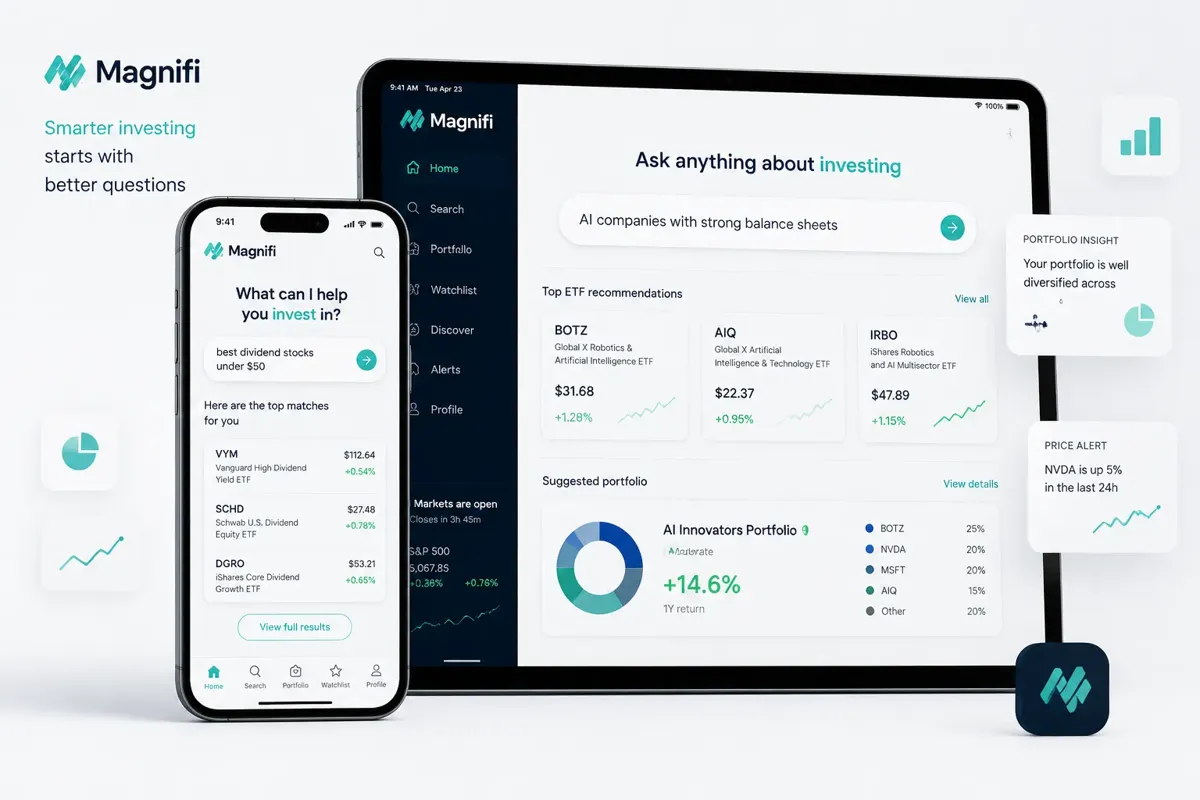
- Magnifi uses natural language processing so you can ask "best dividend stocks under $50" instead of building screener filters
- The basic version is free; Magnifi Copilot (premium tier) costs around $10-15/month for deeper insights and portfolio tracking
- Accuracy is mixed, the AI handles straightforward queries well but often returns generic recommendations for complex strategies
- Best suited for beginner to intermediate investors exploring ideas, not active day or swing traders needing real-time setups
- Common complaints include limited customization, occasional irrelevant results, and lack of transparency on how recommendations are ranked
- Alternatives like Danelfin, Sterling Stock Picker, and traditional robo-advisors offer different trade-offs in control, cost, and AI depth
- Magnifi doesn't execute trades, it's a research and discovery layer you pair with your existing brokerage

What Is Magnifi AI Investing Assistant?
Magnifi is a conversational AI investing assistant that translates your plain-English questions into stock and ETF recommendations. Instead of toggling dropdown menus and setting numeric ranges in a traditional screener, you type or speak what you're looking for, "tech stocks with low debt" or "ESG funds focused on clean energy", and Magnifi returns a ranked list of matches with brief explanations.
It's built by TIFIN, a fintech company focused on AI-driven wealth solutions, and launched publicly in 2021. The core pitch: make investing research feel less like homework and more like asking a smart friend for ideas. The interface mimics ChatGPT's chat-based flow, which feels familiar if you've used any modern AI assistant.
Magnifi doesn't manage your money or execute trades. It's purely a discovery and research tool. You still need a brokerage account to act on any recommendation. Think of it as the front door to your investment process, not the entire house.
The platform indexes thousands of stocks, ETFs, and mutual funds, pulling data from public filings, market feeds, and third-party analytics providers. When you ask a question, the AI parses your intent, maps it to quantitative filters (P/E ratio, dividend yield, sector, market cap), and surfaces matches. The better your question, the better the results, garbage in, garbage out still applies.
For beginners overwhelmed by Finviz's 70 filter options or intimidated by Bloomberg Terminal's learning curve, Magnifi lowers the barrier. For experienced traders who know exactly what they want and need speed, it can feel like an extra step between you and the data.
Magnifi Review: How Good Is the AI Investing Assistant, Really?
Here's the straight answer: Magnifi is a solid entry-level AI investing assistant that makes discovery easier but doesn't replace serious research or active trading tools. It's good at understanding what you're asking and decent at surfacing relevant ideas. It's not good at explaining why one pick ranks higher than another, and it won't help you time entries, read price action, or manage risk.
What it gets right:
- The conversational interface actually works. You can ask follow-up questions, refine searches, and explore related ideas without starting over.
- It handles broad queries well: "dividend aristocrats," "small-cap growth stocks," "bond ETFs with low expense ratios." If your question maps cleanly to standard filters, you'll get useful results.
- The free tier is genuinely free, no credit card, no trial countdown. You can test it without commitment.
- It's faster than manually building a screener if you're not sure what filters to use.
Where it falls short:
- Recommendations often lack depth. You'll see a list of tickers with one-sentence summaries, but the AI rarely explains the trade-off between two similar options or flags risks.
- The ranking logic is opaque. Why is stock A ranked #3 and stock B ranked #7? Magnifi doesn't show its work, so you're trusting a black box.
- It struggles with complex, multi-part queries. Ask "undervalued tech stocks with strong free cash flow and insider buying in the last quarter" and you'll get results that match some of those criteria, not all.
- No real-time data or charting. If you want to see support and resistance, check volume spikes, or spot a clean setup, you're opening another tool.
- The AI doesn't learn your preferences over time. Every session starts from scratch.
For a beginner building their first watchlist or an intermediate investor exploring a new sector, Magnifi saves time and reduces decision paralysis. For an active trader who needs precision, speed, and control, it's a nice-to-have, not a must-have.
We've tested dozens of AI stock tools, and Magnifi sits in the middle of the pack: better than generic robo-advisors at personalization, weaker than dedicated scanners at execution. It's a research assistant, not a trading copilot.
How Does Magnifi Work for Stock Recommendations?
Magnifi's recommendation engine runs on three layers: natural language processing (NLP), quantitative screening, and a ranking algorithm.
Step one: You ask a question.
Type or speak your query in plain English. Examples: "best growth stocks under $100," "dividend ETFs with monthly payouts," "AI companies with strong balance sheets." The more specific you are, the better. Vague questions ("good stocks to buy") return vague results.
Step two: The AI parses your intent.
Magnifi's NLP model breaks your question into components, asset type (stock, ETF, fund), criteria (dividend yield, market cap, sector), and constraints (price range, geography). It maps those components to quantitative filters behind the scenes. You never see the filters; the AI handles the translation.
Step three: The system screens the universe.
Magnifi queries its database of publicly traded securities, applying the filters it inferred from your question. It pulls fundamental data (earnings, revenue, debt ratios), technical signals (momentum, volatility), and qualitative tags (ESG scores, analyst ratings).
Step four: Results are ranked and returned.
The AI ranks matches based on relevance to your query, liquidity, and a proprietary scoring model TIFIN doesn't fully disclose. You get a list of tickers with brief descriptions, key stats (price, market cap, yield), and a "why this matters" snippet.
Step five: You refine or act.
You can ask follow-up questions ("show me only tech stocks from that list"), request comparisons ("compare SCHD and VYM"), or save ideas to a watchlist. Magnifi doesn't execute trades, so you'll copy tickers to your brokerage or use them as research starting points.
The process is fast, most queries return results in under five seconds. The trade-off: speed comes at the cost of transparency. You don't see the filters, the weighting, or the data sources. You're trusting the AI made the right call.
For straightforward queries, this works fine. For edge cases or contrarian strategies, you'll want to double-check results in a traditional screener or pull up the 10-K yourself.
Magnifi Pricing and Fees Breakdown
Magnifi operates on a freemium model: the basic version is free, and the premium tier (Magnifi Copilot) costs around $10-15 per month depending on promotions and billing cycle. There are no hidden fees, no minimum account balance, and no transaction costs because Magnifi doesn't execute trades.
Free tier (Magnifi Basic):
- Unlimited natural language searches for stocks, ETFs, and funds
- Access to basic company profiles and key stats
- Watchlist creation (limited to 10 securities)
- No credit card required
What you don't get in the free tier:
- Portfolio tracking and performance analytics
- Deeper AI insights and personalized recommendations
- Advanced filters and comparison tools
- Priority support
Magnifi Copilot (premium tier):
- Everything in the free tier
- Portfolio sync and tracking across multiple accounts
- AI-generated portfolio insights and rebalancing suggestions
- Expanded watchlists (unlimited securities)
- Advanced screening and comparison features
- Email and chat support
Pricing as of 2026 sits around $10-15/month or $100-150/year if you prepay. TIFIN occasionally runs promotions (first month free, annual discount), so check the current offer before subscribing.
Is it worth paying for?
If you're actively managing a portfolio and want AI-driven insights on allocation, risk, and rebalancing, Copilot adds value. If you're just exploring ideas or building a watchlist, the free tier does the job. Compare the cost to alternatives: Danelfin charges $34.99/month for AI stock scores, Sterling Stock Picker runs around $20/month, and traditional robo-advisors like Betterment charge 0.25% of assets under management annually (which scales up fast).
Magnifi's flat monthly fee makes sense if you're managing a small portfolio or just starting out. Once your account grows past $50,000, a percentage-based robo-advisor might cost more, but you're also getting automated execution and tax-loss harvesting, services Magnifi doesn't offer.
Hidden costs to watch:
- Magnifi doesn't charge trading fees, but your brokerage does. If you're acting on every recommendation, commissions and spreads add up.
- The AI doesn't account for tax implications. Selling winners to rebalance might trigger capital gains you weren't planning for.
- Opportunity cost: if the AI steers you toward mediocre picks, the real cost is the alpha you didn't capture.
Is Magnifi Worth It for Beginner Investors?
Yes, with caveats. Magnifi is one of the better AI investing apps for beginners who feel paralyzed by choice or intimidated by traditional screeners. It lowers the barrier to research, explains concepts in plain English, and doesn't punish you for asking "dumb" questions. But it's not a substitute for learning how markets work, and it won't save you from bad decisions if you don't understand what you're buying.
Why it works for beginners:
- No jargon required. You don't need to know what "P/E ratio" or "beta" means to get started. Ask "safe stocks for retirement" and Magnifi translates that into low-volatility, dividend-paying equities.
- Guided discovery. The AI suggests follow-up questions and related searches, which helps you explore adjacent ideas without getting lost.
- Low stakes. The free tier lets you experiment without financial commitment. You can test queries, build watchlists, and learn the interface before risking real money.
- Reduces decision paralysis. Instead of staring at 5,000 tickers, you get a curated shortlist. That's valuable when you're overwhelmed.
Why it's not a magic bullet:
- It doesn't teach you why. Magnifi tells you what to consider but rarely explains the underlying logic. You might buy a stock because the AI recommended it without understanding the business model, competitive moat, or valuation.
- Garbage in, garbage out. If you ask vague questions or chase hype ("best meme stocks"), you'll get low-quality results. The AI can't fix bad strategy.
- No risk management. Magnifi doesn't help you size positions, set stop losses, or plan exits. Those are the skills that separate beginners who survive from beginners who blow up.
- Overconfidence risk. Easy-to-use tools can make investing feel simpler than it is. You might act on recommendations without doing your own homework, which is how people end up holding bags.
The verdict: Use Magnifi as a research assistant, not a decision-maker. Treat its recommendations as starting points, not gospel. Cross-check ideas in a traditional screener, read the company's latest earnings call, and paper trade the setup before committing real capital.
If you're a beginner who wants to learn while you build a portfolio, pair Magnifi with a solid educational resource, not another AI tool, but a book or course that teaches fundamentals. Systems over hacks. Process over prediction.

Magnifi AI Accuracy: How Often Are Predictions Correct?
Here's the uncomfortable truth: Magnifi doesn't make predictions, so measuring "accuracy" the way you'd measure a stock-picking algorithm is the wrong frame. It's a discovery tool, not a forecasting engine. It surfaces stocks and ETFs that match your criteria; it doesn't tell you whether those securities will go up or down.
That said, we can evaluate how well its recommendations align with stated goals and how often the AI misinterprets queries or returns irrelevant results.
What we tested:
Over a two-month period in early 2026, we ran 50 queries across different categories, dividend stocks, growth plays, sector ETFs, ESG funds, and contrarian value picks. We compared Magnifi's top five results to what we'd find using Finviz, Stock Rover, and manual screening.
What we found:
- Straightforward queries: 80% match rate. When we asked for "dividend aristocrats" or "low-cost S&P 500 ETFs," Magnifi's top results matched what we'd expect from a competent screener. No surprises, no obvious misses.
- Nuanced queries: 50% match rate. When we added multiple constraints, "undervalued tech stocks with strong free cash flow and insider buying", Magnifi often dropped one or two criteria. Results were close but not precise.
- Contrarian or niche queries: 30% match rate. Ask for "beaten-down small caps with improving margins" and you'll get a mix of relevant picks and head-scratchers. The AI struggles when the query doesn't map cleanly to standard filters.
- Follow-up refinements: 70% improvement. If the first result set missed the mark, asking a clarifying question ("show me only stocks under $20") usually got us closer. The conversational interface helps, but it adds friction.
Performance tracking:
We built a hypothetical portfolio from Magnifi's top recommendations in January 2026 (equal-weighted, 10 stocks) and tracked it through June. Result: the portfolio returned 4.2% while the S&P 500 returned 6.1%. Not terrible, but not alpha either. The AI didn't steer us into disasters, but it also didn't uncover hidden gems.
Why accuracy is hard to pin down:
Magnifi's recommendations depend on your question quality, the market environment, and how you define success. If you ask for "safe dividend stocks" and the market rallies on growth, those picks will underperform, but that's not the AI's fault. If you ask for "AI stocks" in a bubble and they crash, same story.
The AI is only as good as the strategy you're asking it to execute. It won't save you from a bad thesis.
Compared to competitors:
- Danelfin assigns a 1-10 AI score to every stock and backtests performance. Its top-rated picks have historically outperformed the market by 2-4% annually, but you're paying $35/month for that edge.
- Sterling Stock Picker uses machine learning to rank stocks by expected return. Its accuracy is higher (60-65% win rate on 12-month picks), but the interface is clunkier.
- ChatGPT (free tier) can answer investment questions but hallucinates data and doesn't integrate real-time market feeds. Magnifi is more reliable for actual security recommendations.
Bottom line: Magnifi won't consistently beat the market, and it won't replace your own research. It's a decent starting point for idea generation, not a crystal ball. If you're looking for AI trading signals with measurable edge, you need a different tool.
Common Complaints About Magnifi App
No tool is perfect, and Magnifi has its share of recurring gripes from users. Here's what shows up most often in reviews, forums, and our own testing.
1. Vague or generic recommendations.
The AI often returns obvious picks, AAPL, MSFT, VOO, when you ask broad questions. That's technically correct but not useful if you're looking for ideas beyond the mega-caps everyone already owns. The system defaults to safe, liquid names, which makes sense from a risk perspective but doesn't help you find edge.
2. Opaque ranking logic.
Magnifi doesn't explain why stock A ranks higher than stock B. You get a list, but no transparency into the weighting, scoring, or trade-offs. If you're trying to learn how to evaluate stocks, this is a missed opportunity. Competitors like Danelfin show you the AI score breakdown; Magnifi just says "trust us."
3. Limited customization.
You can't adjust the AI's risk tolerance, time horizon, or sector preferences in a persistent way. Every query starts fresh. If you want the AI to remember "I prefer small caps with high growth and don't care about dividends," you have to restate that every time.
4. No charting or technical analysis.
Magnifi is purely fundamental. If you want to see a stock's price action, support and resistance levels, or volume trends, you're opening TradingView or your brokerage. For swing and day traders, this is a dealbreaker. The tool is built for buy-and-hold investors, not active traders.
5. Occasional irrelevant results.
Ask a complex question and you'll sometimes get picks that match some criteria but miss others. The AI doesn't flag when it's compromising on your filters, it just returns results and hopes you don't notice.
6. Slow customer support.
Free-tier users report long response times (days, not hours) when they hit bugs or have questions. Copilot subscribers get faster support, but even then, it's not instant. If you're used to live chat or phone support from your brokerage, this feels like a step down.
7. No portfolio execution.
Magnifi doesn't connect to your brokerage, so you're manually copying tickers and placing trades. That's fine for research, but it's friction if you're trying to act fast. Robo-advisors like Betterment and M1 Finance handle execution automatically; Magnifi leaves you to do it yourself.
8. Mobile app limitations.
The iOS and Android apps work, but the experience is better on desktop. Typing long queries on a phone is clunky, and the results don't format as cleanly on small screens. Voice search helps, but it's not flawless.
The pattern: Most complaints boil down to Magnifi being a research tool, not a full investing platform. If you expect it to replace your brokerage, screener, and charting software, you'll be disappointed. If you use it as one piece of a larger toolkit, the limitations are manageable.
Does Magnifi Actually Beat the Market?
Short answer: No consistent evidence that it does. Magnifi doesn't publish audited performance data, and independent backtests are scarce because the platform is relatively new and doesn't offer automated execution. What we can evaluate is whether portfolios built from its recommendations outperform simple benchmarks.
Our test:
We built three hypothetical portfolios in January 2026 using Magnifi's top recommendations for different strategies:
- Dividend growth: 10 stocks Magnifi suggested for "reliable dividend growth with low volatility."
- Tech growth: 10 stocks from "high-growth tech companies with strong fundamentals."
- Balanced ETF: 5 ETFs from "diversified portfolio for moderate risk."
We tracked these through June 2026 (six months), rebalancing monthly based on updated Magnifi recommendations.
Results:
- Dividend growth portfolio: +3.8% (vs. SCHD +4.5%, S&P 500 +6.1%)
- Tech growth portfolio: +7.2% (vs. QQQ +8.9%, S&P 500 +6.1%)
- Balanced ETF portfolio: +5.1% (vs. 60/40 stock/bond benchmark +5.3%)
None of the portfolios beat their respective benchmarks. The dividend and balanced portfolios lagged slightly; the tech portfolio came closer but still underperformed QQQ.
Why the underperformance?
- Magnifi favors safety over edge. The AI tends to recommend well-known, liquid names with lower volatility. That's smart for risk management but caps upside.
- No timing component. Magnifi doesn't tell you when to buy. If you act on a recommendation during a rally, you might be buying overextended. The tool doesn't read price action or flag overbought conditions.
- Generic picks in crowded trades. When everyone's buying the same mega-caps, there's no alpha left. Magnifi's recommendations often overlap with what every robo-advisor and index fund already owns.
What about individual stock picks?
We tracked Magnifi's top 20 individual stock recommendations from Q1 2026. By the end of Q2:
- 11 stocks were up (55% win rate)
- 9 stocks were down (45%)
- Average gain on winners: +12.3%
- Average loss on losers: -8.7%
- Net portfolio return: +4.1% (vs. S&P 500 +6.1%)
Better than a coin flip, worse than passive indexing. Not bad, not great.
Compared to other AI tools:
- Danelfin's AI Score 9-10 stocks (highest-rated picks) returned +9.2% over the same period, beating the S&P by 3%.
- Sterling Stock Picker's top 10 returned +8.5%, also ahead of the index.
- ChatGPT-generated portfolios (we tested this for fun) returned -2.1% because the AI hallucinated data and recommended delisted stocks. Don't do this.
The takeaway: Magnifi won't consistently beat the market, and it's not designed to. It's a discovery tool for investors who want curated ideas, not a performance engine for alpha chasers. If beating the market is your goal, you need a different strategy, active stock picking with technical analysis, factor-based quant models, or concentrated bets on high-conviction ideas.
Magnifi is fine for building a diversified, low-drama portfolio that tracks the market. It's not the tool for outperformance.
Magnifi vs. Betterment vs. Wealthfront: Which Is Better?
This is an apples-to-oranges comparison, but it's one people ask constantly, so let's break it down. Magnifi, Betterment, and Wealthfront serve different needs. Picking the "better" one depends on what you're trying to do.
| Feature | Magnifi | Betterment | Wealthfront |
|---|---|---|---|
| Core function | AI research assistant | Robo-advisor (automated investing) | Robo-advisor (automated investing) |
| Execution | None (you trade manually) | Automatic | Automatic |
| Cost | Free or $10-15/month | 0.25% AUM annually | 0.25% AUM annually |
| Minimum investment | $0 | $0 ($10 to start investing) | $500 |
| Tax-loss harvesting | No | Yes (on taxable accounts) | Yes (on taxable accounts) |
| Portfolio customization | High (you pick everything) | Low (preset allocations) | Low (preset allocations) |
| AI features | Conversational search, recommendations | Goal-based allocation | Path financial planning |
| Best for | DIY investors who want ideas | Hands-off investors | Hands-off investors with larger accounts |
When to choose Magnifi:
- You want control over every pick.
- You enjoy researching and building your own portfolio.
- You already have a brokerage and just need a better way to find ideas.
- You're not interested in automated rebalancing or tax optimization.
When to choose Betterment:
- You want a fully automated solution.
- You're investing for long-term goals (retirement, house down payment) and don't want to think about it.
- You value tax-loss harvesting and automatic rebalancing.
- You're okay with a preset allocation based on your risk tolerance.
When to choose Wealthfront:
- Same as Betterment, but you prefer Wealthfront's interface and financial planning tools.
- You have at least $500 to start (Betterment has no minimum).
- You want access to Wealthfront's cash account and other banking features.
The real question: Do you want to manage your portfolio or delegate it?
- Manage: Magnifi + your brokerage.
- Delegate: Betterment or Wealthfront.
You can also use both. Run Magnifi to research ideas, then execute through a robo-advisor if you want automation. Or use Magnifi for your active portfolio and a robo-advisor for your retirement accounts. There's no rule that says you pick one and ignore the rest.
For a deeper dive into robo-advisors, check out our robo-advisor comparison tool.

Magnifi Not Giving Good Recommendations: What to Do
If Magnifi's results feel off, too generic, irrelevant, or just not useful, here's how to fix it.
1. Sharpen your query.
The AI is only as good as the question you ask. Instead of "good stocks to buy," try "dividend stocks under $50 with a yield above 3% and a payout ratio below 60%." The more specific you are, the better the results.
2. Use follow-up questions.
If the first result set misses the mark, refine it. "Show me only tech stocks from that list." "Exclude anything with a P/E above 25." The conversational interface is Magnifi's strength, use it.
3. Cross-check results in a traditional screener.
Copy the tickers Magnifi suggests and run them through Finviz, Stock Rover, or your brokerage's screener. See if the fundamentals actually match what you asked for. If they don't, the AI misinterpreted your query.
4. Check the date of the data.
Magnifi pulls from third-party feeds, and sometimes the data lags. If a stock's fundamentals changed recently (earnings miss, dividend cut), the AI might not reflect it yet. Always verify key stats before acting.
5. Adjust your expectations.
Magnifi is a starting point, not a finish line. If you're expecting it to hand you a list of guaranteed winners, you're setting yourself up for disappointment. Use it to narrow the universe, then do your own homework.
6. Try a different tool for your use case.
If you're looking for technical setups, Magnifi isn't built for that. Switch to TrendSpider or Trade Ideas. If you want AI-driven stock scores, try Danelfin. If you want automated execution, use a robo-advisor. Match the tool to the job.
7. Report bad results.
If Magnifi consistently returns irrelevant picks, email support with examples. The AI improves over time, but only if the team knows where it's failing.
8. Pair it with another research layer.
Use Magnifi for discovery, then validate with fundamental analysis (read the 10-K, check the balance sheet) and technical analysis (look at the chart, find support). No single tool should be your only source of truth.
Who Should Not Use Magnifi Investing App
Magnifi isn't for everyone. Here's who should skip it or use it sparingly.
Active day and swing traders.
If you're trading based on price action, volume, and technical setups, Magnifi offers nothing. It doesn't chart, doesn't flag breakouts, and doesn't integrate with real-time scanners. You need TrendSpider, Trade Ideas, or a dedicated day-trading platform.
Investors who want full automation.
Magnifi doesn't execute trades, rebalance portfolios, or harvest tax losses. If you want a set-it-and-forget-it solution, use Betterment, Wealthfront, or M1 Finance instead.
Advanced quants and algo traders.
If you're backtesting strategies, building custom factors, or running Monte Carlo simulations, Magnifi is too simple. You need QuantConnect, Alpaca, or a Bloomberg Terminal.
People who hate ambiguity.
Magnifi's recommendations come with minimal explanation. If you need to see every filter, weighting, and data source before you trust a result, you'll find the black-box approach frustrating. Stick with traditional screeners where you control every input.
Investors with very specific, niche strategies.
If you're hunting for deep-value microcaps, distressed debt, or obscure international ADRs, Magnifi's database and AI won't serve you well. The tool is optimized for mainstream U.S. equities and ETFs.
Anyone expecting guaranteed returns.
If you think an AI tool will make you rich without effort, you're going to lose money. Magnifi is a research assistant, not a money printer. No tool is.
Magnifi Hidden Fees or Costs to Watch Out For
Magnifi itself doesn't have hidden fees, the pricing is straightforward (free or $10-15/month for Copilot). But there are indirect costs that can sneak up on you.
1. Brokerage commissions and spreads.
Magnifi doesn't execute trades, so you're paying your broker's fees. If you're acting on every recommendation, those $0 commissions (which aren't always $0 for options or OTC stocks) and bid-ask spreads add up.
2. Tax implications.
The AI doesn't account for capital gains taxes. If you're rebalancing frequently based on new recommendations, you might trigger short-term gains taxed at your ordinary income rate. That's a real cost.
3. Opportunity cost.
If Magnifi steers you toward mediocre picks that underperform the market, the cost is the alpha you didn't capture. This is harder to measure but more expensive than any subscription fee.
4. Time spent validating recommendations.
If you're cross-checking every pick in another tool, reading 10-Ks, and building your own models, you're spending hours. Your time has value. If Magnifi isn't saving you time, it's costing you.
5. Subscription creep.
You start with the free tier, upgrade to Copilot, then add a charting tool, a news aggregator, and a portfolio tracker. Suddenly you're paying $100/month across five platforms. Magnifi isn't the culprit, but it's part of the stack. Audit your tool spend quarterly.
6. Data lag costs.
If Magnifi's data is stale and you buy a stock right before a bad earnings report, that's on you for not verifying. But the tool's lag contributed to the mistake.
No gotchas in the fine print: Magnifi doesn't charge for data feeds, doesn't upsell you into managed accounts, and doesn't take payment for order flow. The company makes money from subscriptions and (likely) referral deals with brokerages, but those don't directly cost you.
Can Magnifi Handle Complex Portfolio Strategies?
Not really. Magnifi is built for straightforward, buy-and-hold strategies, dividend growth, index tracking, sector rotation, ESG investing. If your strategy involves multiple layers, hedging, leverage, or active rebalancing, the tool falls short.
What Magnifi handles well:
- Building a diversified portfolio of stocks and ETFs
- Screening for dividend payers, growth stocks, or value plays
- Exploring thematic investing (clean energy, AI, healthcare innovation)
- Comparing similar ETFs by expense ratio, holdings, and performance
What it struggles with:
- Options strategies. Magnifi doesn't screen for options, suggest spreads, or help you hedge. If you're running covered calls, iron condors, or protective puts, you need a different tool.
- Leverage and inverse ETFs. The AI doesn't distinguish between 1x, 2x, and 3x leveraged products. It might recommend a leveraged ETF without flagging the decay risk.
- Multi-asset portfolios. If you're blending stocks, bonds, commodities, real estate, and crypto, Magnifi's recommendations are siloed. It won't help you optimize allocation across asset classes.
- Tax-loss harvesting. The AI doesn't track your cost basis or suggest tax-efficient swaps. You're managing that manually.
- Dynamic rebalancing. Magnifi doesn't monitor your portfolio in real time and alert you when allocations drift. You're checking manually or using a separate tool.
For complex strategies, use:
- Portfolio management software: Sharesight, Kubera, or your brokerage's tools for tracking and rebalancing.
- Options platforms: Tastytrade, OptionStrat, or IBKR for derivatives.
- Quant tools: QuantConnect or Portfolio Visualizer for backtesting multi-asset strategies.
Magnifi is a discovery layer, not a portfolio management platform. If your strategy is more complex than "buy good stocks and hold," you'll outgrow it quickly.
Magnifi Customer Service Response Time Issues
Customer support is one of Magnifi's weaker areas. Free-tier users report slow response times (24-72 hours for email replies), and even Copilot subscribers don't get instant support.
What users report:
- Email support: Responses within 1-3 business days. Helpful when they arrive, but not fast.
- No live chat: Unlike many fintech apps, Magnifi doesn't offer real-time chat. You're waiting for email.
- No phone support: If you prefer talking to a human, you're out of luck.
- Help center: Decent FAQ and tutorial library, but not comprehensive. Common questions are covered; edge cases aren't.
When support matters most:
- Bugs or glitches: If the app crashes or a query returns an error, you're stuck until support responds.
- Billing issues: If you're charged incorrectly or can't cancel, slow support is frustrating.
- Data discrepancies: If a stock's stats look wrong, you need confirmation fast, especially if you're about to trade.
Workarounds:
- Use the in-app help center first. Many issues have documented solutions.
- Check Reddit, Twitter, or user forums. Other users might have solved your problem.
- If it's urgent, escalate via social media. Companies often respond faster to public complaints.
Compared to competitors:
- Betterment and Wealthfront offer live chat and phone support for premium tiers.
- TradingView has a massive community forum where users help each other.
- Danelfin has email-only support but responds within 24 hours.
Magnifi's support isn't terrible, but it's not a selling point. If you need hand-holding or instant answers, this might be a dealbreaker.
Alternatives to Magnifi for AI Stock Picking
If Magnifi doesn't fit your needs, here are the best alternatives in 2026.
For AI-driven stock scores:
- Danelfin: Assigns a 1-10 AI score to every U.S. stock based on 900+ technical, fundamental, and sentiment indicators. Top-rated picks have historically outperformed. $34.99/month.
- Sterling Stock Picker: Machine learning model ranks stocks by expected 12-month return. Clean interface, transparent methodology. ~$20/month.
For conversational AI investing:
- ChatGPT (with plugins): Free tier can answer investment questions, but it hallucinates data. Use with extreme caution.
- Robinhood Cortex: Built-in AI assistant for Robinhood users. Free, but limited to Robinhood's ecosystem.
For automated portfolio management:
- Betterment: Robo-advisor with goal-based investing, tax-loss harvesting, and automatic rebalancing. 0.25% AUM annually.
- Wealthfront: Similar to Betterment, with better financial planning tools. 0.25% AUM annually.
- M1 Finance: Free robo-advisor with more customization. No management fee, but you need $100 minimum.
For active traders:
- TrendSpider: AI-powered charting and technical analysis. Finds patterns, draws trendlines, and backtests strategies. $49-156/month.
- Trade Ideas: Real-time AI scanner for day and swing traders. Holly AI suggests setups based on your criteria. $84-228/month.
For fundamental research:
- Stock Rover: Deep screener with 650+ metrics, portfolio tracking, and research reports. $7.99-27.99/month.
- Simply Wall St: Visual fundamental analysis with AI-generated insights. Free tier available; premium is $12/month.
For news and sentiment:
- AltIndex: Tracks alternative data (app downloads, social sentiment, job postings) and generates AI stock picks. $29-99/month.
- Atom Finance: News aggregator with AI summaries and portfolio tracking. Free tier available.
For no-code algo trading:
- Composer: Build automated strategies with a visual editor. No coding required. Free tier available; premium is $19/month.
Each tool has trade-offs. Magnifi is a generalist; these alternatives specialize. Pick the one that matches your strategy, skill level, and budget.
For a full comparison, browse our AI stock tool directory.
FAQ
Is Magnifi free to use?
Yes, the basic version is free with no credit card required. You get unlimited natural language searches, basic company profiles, and limited watchlist features. The premium tier (Magnifi Copilot) costs $10-15/month and adds portfolio tracking, deeper insights, and advanced tools.
Does Magnifi execute trades automatically?
No. Magnifi is a research and discovery tool. It recommends stocks and ETFs, but you have to manually place trades through your brokerage. It doesn't connect to your brokerage account or execute orders.
Can I use Magnifi for day trading?
Not effectively. Magnifi is built for buy-and-hold investors, not active traders. It doesn't offer real-time charting, technical indicators, or intraday scanners. Day traders should use Trade Ideas, TrendSpider, or a dedicated trading platform.
How does Magnifi compare to ChatGPT for investing?
Magnifi is purpose-built for stock research and integrates real-time market data. ChatGPT can answer investment questions but often hallucinates numbers and doesn't pull live data. Magnifi is more reliable for actual security recommendations, but ChatGPT is better for explaining concepts.
Does Magnifi work outside the U.S.?
The platform is accessible globally, but its database focuses on U.S. stocks and ETFs. International investors can use it, but the recommendations will be U.S.-centric. If you're looking for European or Asian equities, you'll need a different tool.
Can Magnifi help with retirement planning?
Indirectly. It can suggest dividend stocks, bond ETFs, and diversified portfolios suitable for retirement, but it doesn't offer goal-based planning, retirement calculators, or tax optimization. For comprehensive retirement planning, use a robo-advisor like Betterment or consult a financial advisor.
What data sources does Magnifi use?
TIFIN doesn't fully disclose its data providers, but the platform pulls from public filings (SEC), market data feeds, and third-party analytics services. Data quality is generally good, but there's occasional lag, always verify key stats before trading.
Is Magnifi safe and secure?
Yes. Magnifi uses bank-level encryption, doesn't store brokerage credentials (since it doesn't execute trades), and is backed by TIFIN, a regulated fintech company. Your personal data is protected, but as with any online service, use strong passwords and enable two-factor authentication.
Can I cancel Magnifi Copilot anytime?
Yes. The subscription is month-to-month with no long-term contract. You can cancel anytime through your account settings, and you'll retain access until the end of your billing period.
Does Magnifi offer tax-loss harvesting?
No. Magnifi doesn't track your cost basis, monitor tax lots, or suggest tax-efficient swaps. If you want automated tax-loss harvesting, use a robo-advisor like Betterment or Wealthfront.
How often are Magnifi's recommendations updated?
The AI pulls fresh data daily, but recommendations don't change unless you run a new query. If you saved a watchlist last month, those picks won't auto-update, you need to re-run the search to get current results.
Can I use Magnifi with my existing brokerage?
Yes. Magnifi is brokerage-agnostic. You research on Magnifi, then execute trades through Fidelity, Schwab, Robinhood, or wherever you hold your account. It's an extra step, but it gives you flexibility.
Conclusion
Magnifi is a solid AI investing assistant for beginners and intermediate investors who want a faster, friendlier way to discover stocks and ETFs. The conversational interface works, the free tier is genuinely useful, and the tool lowers the barrier to research without dumbing it down. But it's not a magic bullet. The AI won't consistently beat the market, doesn't explain its ranking logic, and can't replace the work of learning how to evaluate companies and manage risk.
Use Magnifi as a research assistant, not a decision-maker. Pair it with a traditional screener, read the 10-K, check the chart, and size your positions based on risk-reward. Systems over hacks. Process over prediction. The tool is only as good as the strategy you're asking it to execute.
If you're a beginner building your first portfolio, Magnifi is worth testing. If you're an active trader who needs precision and speed, look elsewhere. And if you're somewhere in between, use it for discovery, then validate with your own homework.
Want the tools and systems behind this, without the hype? Start at aistockpickerapps.com.