AI Trading Signals: How Accurate Are They, Really?
Last updated: June 30, 2026
Quick Answer: AI trading signals can be useful, but their accuracy varies widely — from genuinely data-backed tools with published win rates around 54–65% to outright scams dressed up in machine-learning language. No AI signal service has cracked consistent market prediction. The ones worth your time are transparent about their data, pair signals with solid risk management, and treat accuracy as one input — not a guarantee.
Key Takeaways
- AI trading signals accuracy typically ranges from 54% to 65% in verified, backtested systems — not the 80–90% figures most marketing pages claim.
- A 55% win rate is only profitable if your risk-reward ratio is working. Win rate alone means nothing without position sizing and stop loss discipline.
- The best AI trading signal platforms — Trade Ideas, Tickeron, TrendSpider, Danelfin, and Prospero.ai — publish real performance data. If a service won't show you the numbers, that's your answer.
- AI signals fail most often during choppy tape, major macro events, and low-liquidity conditions — situations where historical patterns break down fast.
- Free AI trading signals exist, but they're usually lagging indicators or marketing funnels. You get what you pay for.
- Beginners should paper trade AI signals for at least 30 days before risking real capital.
- AI signals work best as a filter, not a trigger. They narrow the watchlist; your process makes the trade.
- Crypto AI signals tend to show higher volatility and lower reliability than equity signals due to thinner markets and manipulation risk.
What Are AI Trading Signals and How Do They Work?
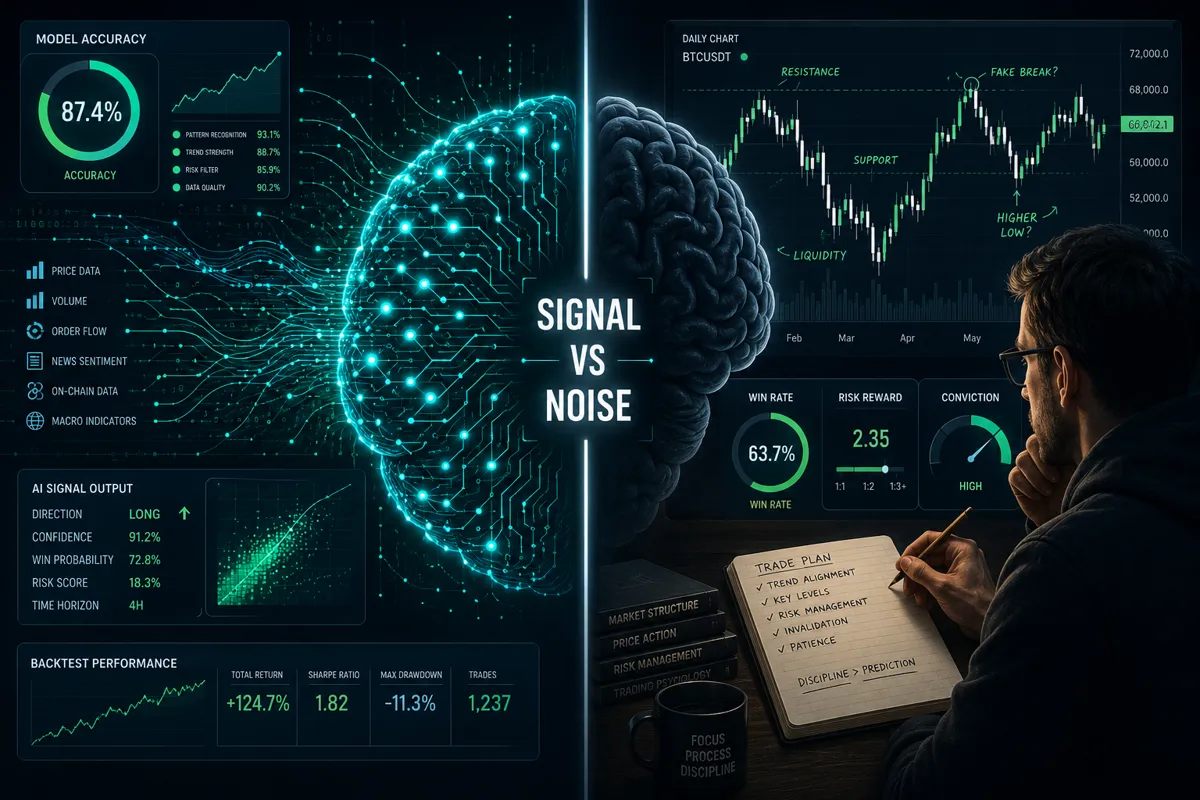
AI trading signals are automated alerts generated by machine learning models that analyze market data and flag potential buy or sell opportunities. Instead of a human drawing trendlines at midnight, an algorithm scans thousands of data points — price action, volume, options flow, sentiment — and outputs a directional call.
Here's the basic pipeline:
- Data ingestion: The model pulls in historical price data, real-time quotes, earnings calendars, news sentiment, and sometimes social media activity.
- Pattern recognition: Machine learning models (often neural networks or gradient-boosted trees) identify setups that historically preceded price moves.
- Signal output: The system generates a signal — long, short, or neutral — often with a confidence score, suggested entry and exit levels, and a stop loss.
- Delivery: Signals arrive via app alerts, email, SMS, or directly to a brokerage API for automated execution.
The difference between a real AI signal and a dressed-up moving-average crossover is the model's ability to process non-linear relationships across multiple data streams simultaneously. A traditional indicator like RSI looks at one variable. A trained model can weigh dozens at once.
That said, the model is only as good as the data it trained on — and the market it's trading into. Past patterns are not a contract.
AI Trading Signals: How Accurate Are They, Really?
This is the question that matters, and the honest answer is: it depends heavily on the platform, the asset class, and how you define "accurate."
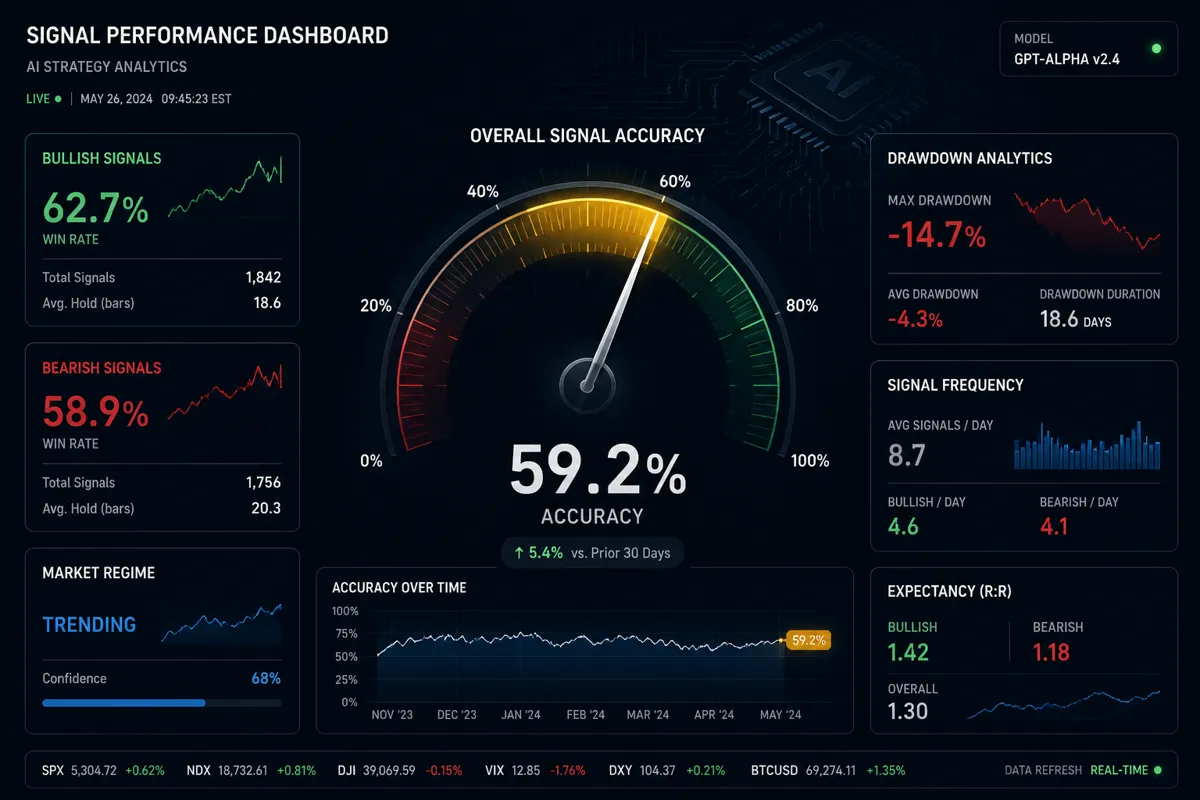
Published performance data from credible platforms gives a clearer picture than marketing copy:
- Danelfin publishes 3-month directional accuracy data for its AI Score signals. Their top-rated stocks (score 9–10) have historically outperformed the S&P 500 by a measurable margin, though individual signal accuracy sits in the 58–65% range depending on the period.
- Prospero.ai reports a 54% win rate versus the S&P 500 benchmark on its daily AI signals — modest, but statistically meaningful when compounded with proper risk-reward.
- Tickeron publishes confidence levels and win rates for its AI robot signals by pattern type, with some pattern categories showing 60%+ historical accuracy on backtested data.
- Trade Ideas runs its Holly AI signals through overnight simulation data that users can audit — one of the more transparent approaches in the space.
The uncomfortable truth: A 54–60% win rate sounds underwhelming. But a coin flip is 50%. If your risk-reward ratio is 2:1 — meaning you risk $1 to make $2 — a 54% win rate produces positive expected value over time. That's not a hot tip. That's math.
The problem is most retail traders don't run the math. They chase the 80% accuracy claims, ignore the fine print about backtesting conditions, and get burned when live performance looks nothing like the marketing deck.
AI trading signals accuracy statistics to remember:
| Platform | Signal Type | Reported Accuracy | Notes |
|---|---|---|---|
| Danelfin | AI Score (stocks) | 58–65% | 3-month directional, published |
| Prospero.ai | Daily signals | 54% vs S&P | Benchmark comparison |
| Tickeron | Pattern signals | 55–62% | Varies by pattern type |
| Trade Ideas (Holly) | Overnight sim | Varies | Auditable simulation data |
| TrendSpider | Multi-timeframe alerts | N/A | Confirmation tool, not standalone |
How Accurate Are AI Trading Signals Compared to Human Traders?
AI signals, on average, outperform discretionary retail traders — but that's a low bar. Research consistently shows that roughly 70–80% of retail day traders lose money over a full year (FINRA and SEC investor education data support this range). Beating that cohort isn't a flex.
The more relevant comparison is against systematic human traders — people running rule-based strategies with defined entries, exits, and position sizing. That's where AI signals get more competitive but less dominant.
AI has clear advantages: it doesn't get revenge trading urges at 3 PM, it doesn't overtrade after a losing streak, and it can monitor hundreds of tickers simultaneously without analysis paralysis. It processes real-time AI trading signals faster than any human can read the tape.
Human traders have advantages too: contextual judgment during black swan events, the ability to recognize when a setup is technically valid but fundamentally broken, and the common sense to step aside when the tape is just choppy and unreadable.
The practical takeaway: AI signals are a better starting point than gut instinct for most retail traders. They're not a replacement for a trading system with defined risk management.
Can You Actually Make Money With AI Trading Signals?
Yes — but not passively, and not without a process. That wasn't in our bingo card, but it's the truth.
The traders who profit from AI trading signals treat them as one input in a broader system. They use signals to build the watchlist, confirm the setup, and time the entry. They still define their stop loss before they enter. They still size positions based on risk-reward, not excitement.
The traders who lose money with AI signals do the opposite: they follow every alert blindly, skip the stop loss because "the AI said it's going up," and revenge trade after getting stopped out.
For day traders, real-time AI trading signals for day traders can add genuine edge — especially for scanning pre-market movers, identifying gap fill candidates, and flagging unusual options activity before power hour. The signal narrows the field. Your execution determines the outcome.
For swing traders, AI signals work well when they confirm what price action and support and resistance levels are already suggesting. A clean setup with AI confirmation beats an AI alert on a stock in a choppy tape every time.
What's the Difference Between AI Signals and Traditional Technical Analysis?
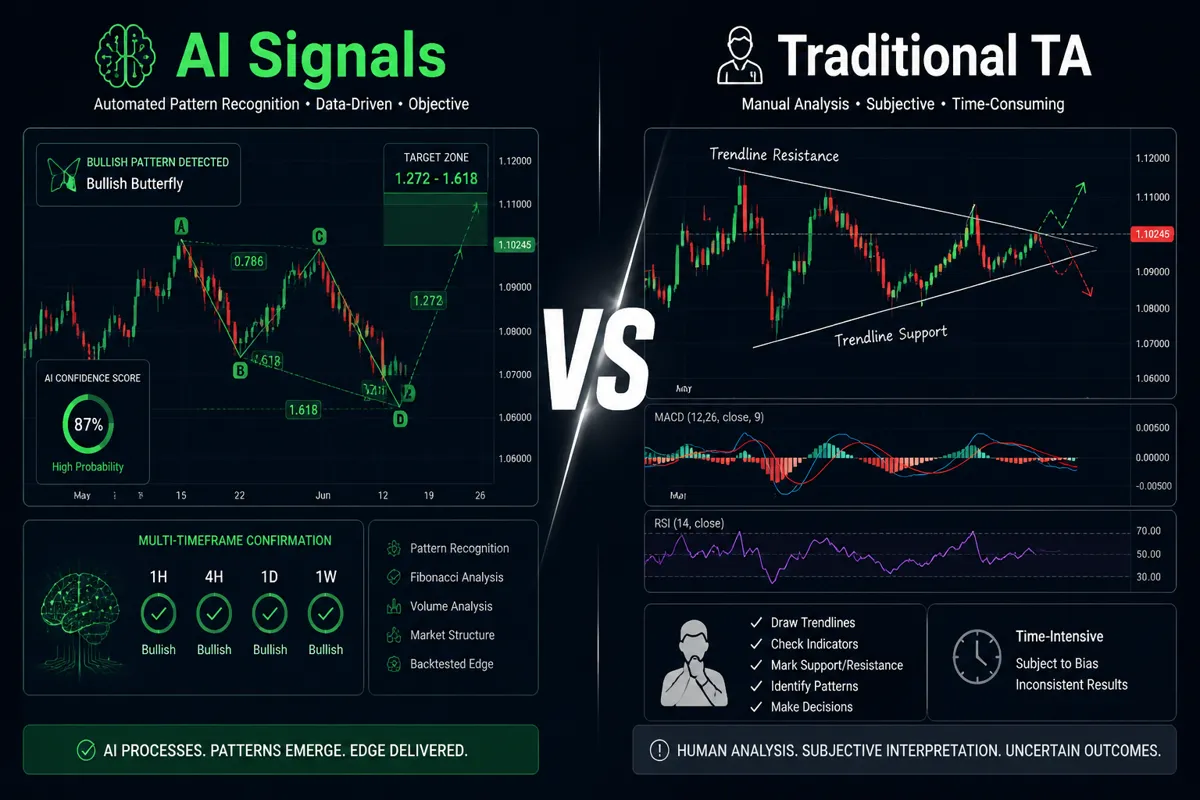
Traditional technical analysis (TA) uses fixed, rules-based indicators — moving averages, RSI, MACD, Bollinger Bands — applied manually or through basic screeners. It's deterministic: if X happens, the indicator shows Y.
AI trading signals are probabilistic. The model doesn't say "RSI crossed 30, therefore buy." It says "based on 847 similar historical setups across these 12 variables, there's a 61% probability of a 3% move higher within 5 sessions."
Key differences:
- Scope: Traditional TA analyzes one chart at a time. AI scans thousands simultaneously.
- Adaptability: Traditional indicators are static. AI models can be retrained on new data.
- Complexity: TA is transparent — you can see exactly why the signal fired. AI models, especially deep learning systems, can be black boxes.
- Speed: AI generates real-time AI trading signals faster than any manual scan.
TrendSpider sits at an interesting intersection — it automates traditional TA with multi-timeframe confirmation and scripted alert conditions, making it a hybrid between classical analysis and AI-assisted signal generation.
The honest position: AI signals and traditional TA aren't competitors. The best traders use AI to filter the universe, then apply price action and support and resistance analysis to confirm the setup before pulling the trigger.
How Much Do AI Trading Signal Services Cost?
AI trading signal services range from free to several hundred dollars per month. Here's the realistic breakdown:
Free AI trading signals:
- Usually lagging, limited in scope, or a lead magnet for a paid tier.
- Tools like Finviz's basic screener and some features in Webull offer signal-adjacent functionality at no cost.
- Treat free signals as a starting point, not a complete system.
Entry-level paid ($20–$80/month):
- Platforms like Tickeron and basic TrendSpider tiers fall here.
- You get automated alerts, backtested patterns, and confidence scores.
- Good for intermediate traders building a process.
Mid-tier ($80–$200/month):
- Danelfin, Prospero.ai, and Trade Ideas with Holly AI signals land in this range.
- More sophisticated models, published performance data, and better customization.
Institutional-grade ($200+/month):
- Tools like AlphaSense and platforms built for professional workflows.
- Overkill for most retail traders.
The cost question isn't really "how much does it cost?" It's "does the edge justify the cost?" A $150/month signal service that improves your win rate by 5 percentage points on a $50,000 account is a bargain. The same service on a $5,000 account needs careful math before you commit.
Why Do AI Trading Signals Sometimes Fail or Give Wrong Predictions?
AI signals fail for specific, predictable reasons — and knowing them is half the battle.
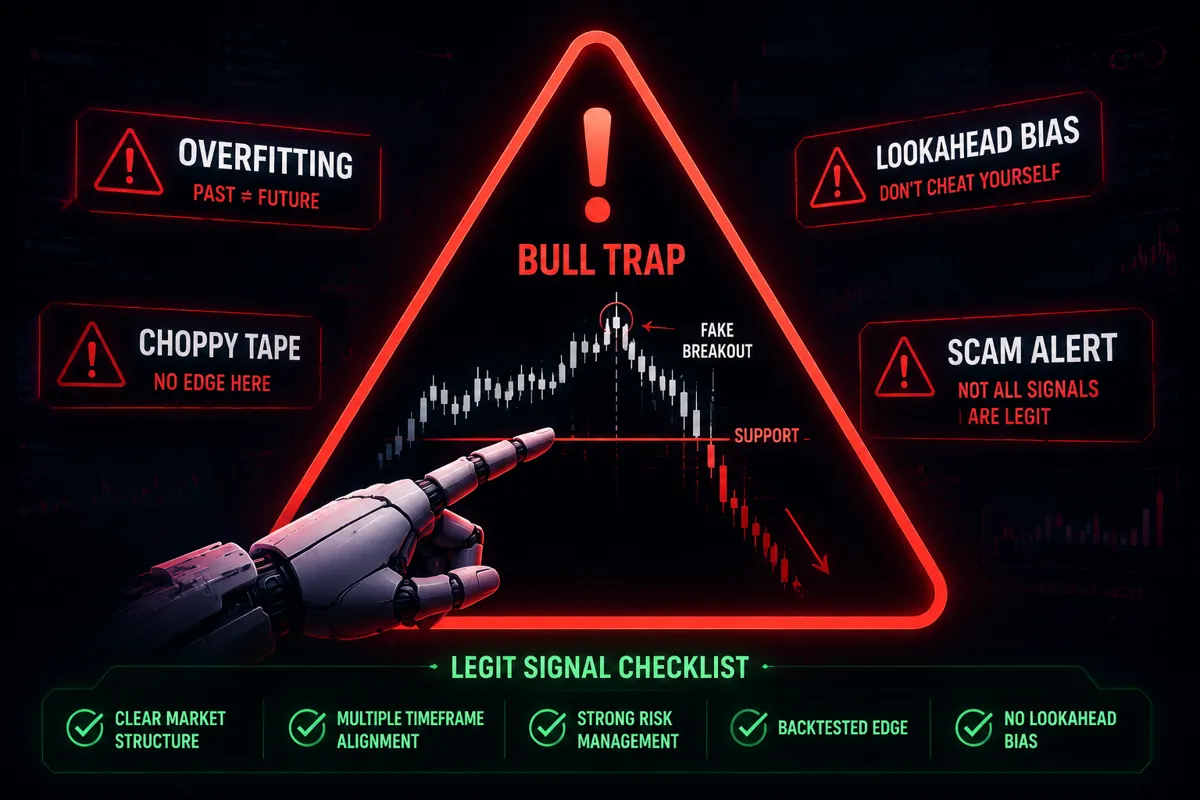
Overfitting: The model was trained too tightly on historical data and learned patterns that don't generalize. It looks perfect in backtesting, falls apart in live trading. This is the most common failure mode in AI trading signals performance data.
Lookahead bias: The backtest accidentally used future data to generate past signals. The results look great; the live performance is a disaster.
Regime changes: Markets shift. A model trained on 2019–2022 data may not handle 2026's macro environment correctly. During earnings season, major Fed announcements, or geopolitical shocks, historical patterns break down fast.
Choppy tape: In low-conviction, sideways markets, AI models generate noise. The setup looks clean on the model; price action says otherwise. This is where discipline beats prediction — knowing when not to trade is a skill the algorithm doesn't have.
Data quality: Garbage in, garbage out. Signals built on thin or manipulated data (common in low-float stocks and crypto) are unreliable by design.
The fix: Use AI signals as a filter, not a final word. Confirm with price action. Always have a stop loss. If the signal fires in a choppy tape with no clear support and resistance level, skip it. Play stupid games, win stupid prizes.
Best AI Trading Signal Platforms and Services in 2026
The best AI trading signal platforms are the ones that show you their data. Transparency is the filter.
Trade Ideas (Holly AI): Runs overnight simulations that users can audit. Solid for day traders who want pre-market setups and real-time AI trading signals during power hour. Explore Trade Ideas.
Tickeron: Publishes confidence levels and win rates by pattern type. Good for traders who want to understand why a signal fired, not just that it fired.
TrendSpider: Automated multi-timeframe confirmation and scripted alerts. Best used as a confirmation layer on top of your existing process. See TrendSpider's full breakdown.
Danelfin: AI Score signals with published 3-month directional accuracy. Strong for swing traders and investors who want a data-backed stock ranking system.
Prospero.ai: Daily AI signals with a published 54% vs S&P benchmark win rate. Straightforward, honest about limitations. Check Prospero.ai.
For a broader comparison of platforms across categories, the AI trading platforms directory covers 100+ tools with side-by-side specs.
Are AI Trading Signals Worth It for Beginners?
For beginners, AI trading signals are a double-edged tool. They can accelerate learning — or they can become a crutch that prevents it.
The case for beginners using AI signals: they reduce the universe of stocks to analyze, they introduce structure around entries and exits, and they make risk-reward thinking more concrete.
The case against jumping straight to AI signals: if you don't understand why a signal fired, you can't evaluate whether to follow it. You're just pressing buttons based on an alert you don't understand. That's not trading — that's gambling with extra steps.
The right approach for beginners:
- Learn the basics of price action, support and resistance, and position sizing first.
- Paper trade AI signals for at least 30 days. Track every signal, every outcome.
- Use the swing trade planner to build the habit of defining risk before entry.
- Only go live when you understand your own win rate and risk-reward on paper.
FOFO — fear of finding out — is real. Most beginners avoid tracking their paper trades because they don't want to see the results. Track them anyway. That data is the only honest feedback you'll get.
Common Mistakes People Make With AI Trading Signals
The signal isn't the problem. The behavior around it usually is.
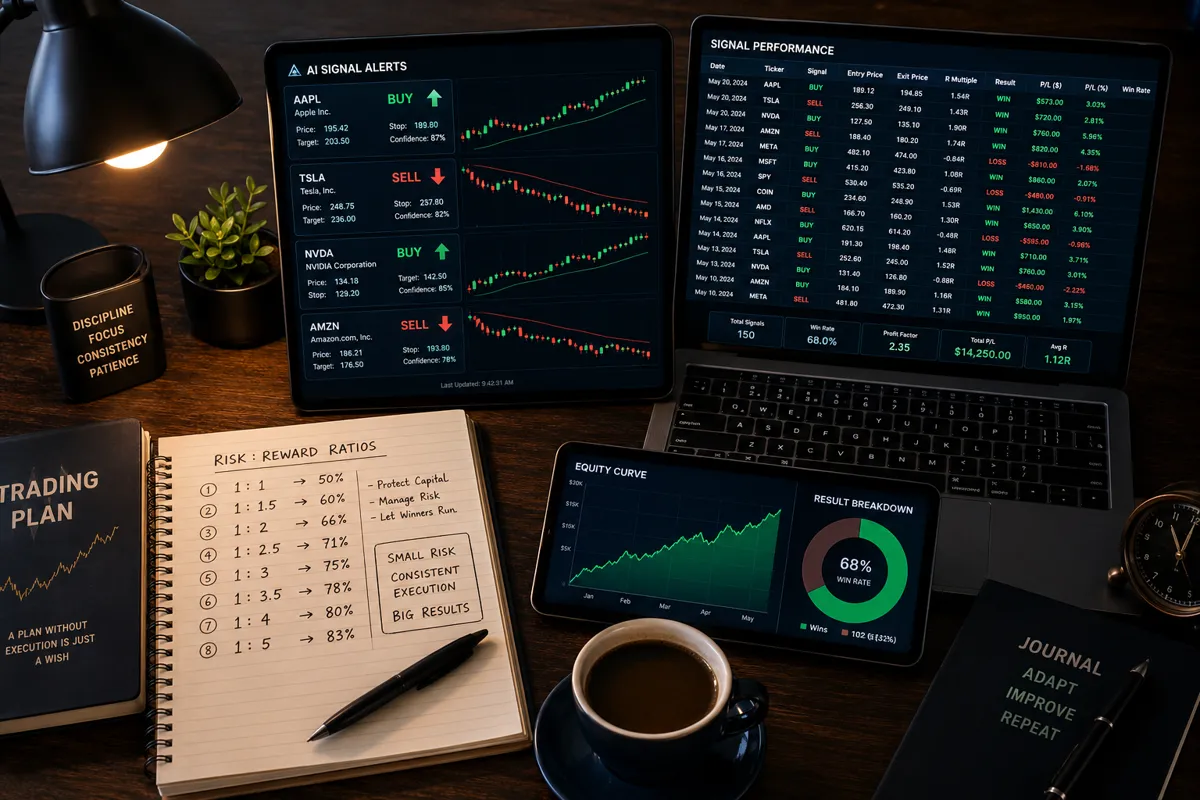
Mistake 1: Treating signals as certainties. A 62% win rate means 38% of signals lose. If you're not sizing positions to survive the losing streak, you'll blow up on a statistically normal drawdown.
Mistake 2: Overtrading. More signals does not mean more profit. Chasing every alert leads to overtrading, which compounds losses through commissions, slippage, and emotional fatigue.
Mistake 3: Skipping the stop loss. "The AI said it was going up" is not a risk management strategy. Every trade needs a defined stop loss before entry. Getting stopped out on a small loss is the system working correctly.
Mistake 4: Ignoring the broader trend. A buy signal on a stock in a confirmed downtrend is catching a falling knife. The trend is your friend — trade with it, not against it.
Mistake 5: Revenge trading after a bad signal. One bad signal leads to a revenge trade, which leads to a bigger loss, which leads to another revenge trade. That's how accounts go to zero. Cut losers fast, step away, reset.
How Do I Know If an AI Trading Signal Service Is Legit or a Scam?
Most scam signal services share the same tells. Here's the filter:
Red flags:
- Claims of 80–90%+ accuracy with no auditable data
- No published backtest methodology or live performance record
- Testimonials only, no verifiable track record
- Signals delivered only via Discord or Telegram with no platform infrastructure
- Promises of consistent returns or "guaranteed profits" — illegal under SEC rules
Green flags:
- Published win rates with sample size and time period disclosed
- Transparent about what data the model uses
- Clear explanation of backtesting methodology
- Registered with or compliant with FINRA/SEC guidelines where applicable
- Free trial or paper trading mode so you can verify before paying
The SEC's investor education resources at investor.gov have clear guidance on what constitutes investment advice fraud. If a signal service is making return guarantees, that's not just hype — it may be illegal.
Signal over noise means choosing tools that earn your trust with data, not promises.
Can AI Trading Signals Work in a Bear Market?
AI signals can work in a bear market, but most retail traders use them wrong when conditions turn. The models that perform in bull markets — trained heavily on uptrend setups — often generate false buy signals in sustained downtrends.
The setups that hold up better in bear markets:
- Short-side signals from platforms that model both long and short setups
- Mean-reversion signals on oversold bounces, with tight stops
- Sector rotation signals that identify relative strength even in a down tape
The honest caveat: bear markets are where AI trading signals accuracy statistics take the biggest hit. Volatility spikes, correlations break down, and historical patterns become less reliable. This is when process over prediction matters most — knowing when to reduce position sizing and sit on the sideline is a legitimate strategy.
AI trading bots that run automated strategies need explicit bear market rules built in, or they'll keep generating long signals into a falling market. That's not a technology problem — it's a design problem.
What Data Do AI Models Use to Generate Trading Signals?
The data inputs vary by platform, but the most common categories are:
- Price and volume data: The foundation. Candlestick patterns, moving averages, breakout levels, basing patterns.
- Options flow: Unusual options activity can signal institutional positioning before a move.
- Earnings and fundamental data: EPS estimates, revenue growth, analyst revisions.
- News and sentiment: Natural language processing on headlines, SEC filings, and earnings call transcripts.
- Macro indicators: Interest rate data, sector rotation signals, VIX levels.
- Alternative data: Satellite imagery, credit card transaction data, web traffic — used by more sophisticated institutional-grade tools.
The more data sources a model integrates, the more complex the signal — and the harder it is to audit. For retail traders, platforms that explain their signal logic in plain English are more useful than black-box systems, even if the black box has more data.
Are AI Trading Signals Better for Crypto or Stock Trading?
For most retail traders, AI trading signals are more reliable in equities than in crypto. Here's why:
Equities advantages: Regulated markets, higher liquidity, more historical data for training, less susceptibility to manipulation on large-cap names.
Crypto disadvantages: Thinner order books, higher manipulation risk (especially on low-cap tokens), 24/7 trading that creates data gaps, and market structure that changes faster than most models can retrain.
That said, some crypto AI signal platforms have shown reasonable performance on major pairs like BTC/USD and ETH/USD, where liquidity is deep enough to reduce manipulation risk. The further you go down the market cap spectrum in crypto, the less reliable any AI signal becomes.
For equity traders, tools like AI stock screeners built specifically for U.S. markets tend to outperform general-purpose crypto/equity hybrid platforms on stock-specific signals.
How Often Should I Follow AI Trading Signals?
Not every signal. That's the answer most people don't want to hear.
The goal is to filter signals through your own system — not to automate your decision-making entirely. Follow a signal when:
- It aligns with the broader trend (the trend is your friend)
- The risk-reward ratio meets your minimum threshold (typically 2:1 or better)
- There's a clear support level for your stop loss
- The setup is clean — tight consolidation, defined entry, not overextended
Skip the signal when:
- The tape is choppy and directionless
- You're in a losing streak and feeling the pull toward revenge trading
- The signal fires on a stock with no clear support and resistance structure
- You can't define your stop loss before entry
Discipline beats prediction. The traders who follow every signal eventually blow up on a bad streak. The traders who filter signals through a consistent process build edge over time. That's the difference between systems over hacks and just buying whatever blinks green.
Conclusion: Cut the Noise, Keep the Alpha
AI trading signals are a real tool with real limitations. They're not magic, they're not a shortcut, and they're definitely not a replacement for a trading process. But used correctly — as a filter, not a trigger — they can meaningfully improve the quality of your setups and reduce the time you spend staring at 400 tickers.
The best AI trading signals in 2026 come from platforms that show you their data: Trade Ideas, Tickeron, TrendSpider, Danelfin, and Prospero.ai all publish performance metrics you can actually evaluate. Start there.
Your next three moves:
- Pick one signal platform with published accuracy data and run it in paper trade mode for 30 days. Track every signal, every outcome.
- Before going live, calculate your expected value: win rate x average win minus loss rate x average loss. If it's positive with a 2:1 risk-reward, you have something worth trading.
- Build the stop loss habit before you build the signal habit. Signals tell you when to enter. Risk management tells you how to survive being wrong.
Data over noise. Process over prediction. That's how you actually use AI trading signals.
Want the tools and setups behind this, without the hype? Browse the full breakdown of AI signal platforms, screeners, and trading systems at aistockpickerapps.com.
Frequently Asked Questions
What is a realistic accuracy rate for AI trading signals?
Verified platforms typically report 54–65% directional accuracy on backtested data. Live trading performance is often lower. Any service claiming 80–90% accuracy without auditable data should be treated with serious skepticism.
Are free AI trading signals worth using?
Free signals can be a useful starting point for building a watchlist, but they're rarely sufficient as a standalone trading system. Most free tiers are lagging, limited in scope, or designed to funnel you toward a paid product.
Do AI trading signals work for swing trading?
Yes, particularly when signals confirm what price action and support and resistance levels are already suggesting. AI signals for swing trading work best as a confirmation layer, not the primary trigger.
How do I backtest an AI trading signal service?
Look for platforms that publish their own backtesting methodology with sample size, time period, and market conditions disclosed. Better yet, run the signals yourself in paper trade mode for 30–60 days and track the results independently.
Can AI trading signals predict earnings moves?
Some platforms incorporate earnings data and options flow to flag pre-earnings setups, but predicting the actual earnings reaction is notoriously difficult even for institutional models. Treat any earnings-related signal with extra caution and tighter position sizing.
What's the difference between an AI signal and a trading bot?
An AI signal is an alert that suggests a potential trade. A trading bot automatically executes trades based on signals without human intervention. Signals require your decision; bots act autonomously. Both have their place, but bots require more sophisticated risk management rules built in from the start.
Are AI trading signals regulated?
In the U.S., if a signal service provides personalized investment advice for compensation, it may need to register as an investment adviser with the SEC or state regulators. General signals that don't constitute personalized advice occupy a gray area. Check FINRA.org for guidance on what constitutes regulated advice.
How quickly do AI trading signals go stale?
Day trading signals can go stale within minutes. Swing trading signals typically have a 1–5 day relevance window. Always check current price action and volume before acting on any signal, regardless of when it was generated.
What's the biggest mistake beginners make with AI signals?
Treating them as certainties rather than probabilities. A signal with a 60% win rate will be wrong 40% of the time. Without a stop loss and proper position sizing, that 40% can wipe out all the gains from the 60%.
Is there an AI signal service specifically for options trading?
Yes. Several platforms specialize in options flow signals and AI-driven options strategies. Check the AI options tools directory for a curated breakdown.