Best AI Stocks to Buy: How to Separate Real From Hype
{"cover":"Professional landscape format (1536x1024) hero image with bold text overlay: 'Best AI Stocks to Buy: How to Separate Real From Hype' in extra large 72pt white bold sans-serif font with dark drop shadow, centered upper third composition. Background shows a dramatic split-screen: left side glowing green stock charts trending upward on dark Bloomberg-terminal-style screens, right side showing red warning signals and bubble burst imagery. Color palette: navy blue (#0A1128), plaid green (#5FA777), soft white text, plaid red (#A63D40) accent warnings. Magazine cover aesthetic, editorial quality, high contrast, fintech premium style.","content":["Landscape format (1536x1024) editorial illustration showing two AI company profiles side by side on a dark navy background: one labeled 'Real Revenue' with solid green bar charts, actual earnings growth lines, and a balance sheet graphic; the other labeled 'Pure Hype' showing a hollow rocket icon, press release headlines, and a flat revenue line. Bold typography annotations highlight key differences. Color scheme: navy, plaid green, plaid red. Clean financial data visualization aesthetic, FullStack Alpha brand style.","Landscape format (1536x1024) showing a structured investor evaluation checklist on a dark terminal-style screen. Columns display AI stock fundamentals metrics: revenue growth percentage, gross margin, free cash flow, P/E ratio, and R&D spend. Green checkmarks next to strong metrics, red flags next to weak ones. Background features faint candlestick chart patterns. Typography is bold sans-serif with white and green text on navy. Professional fintech dashboard aesthetic, data-forward composition.","Landscape format (1536x1024) dramatic visual comparison of NVIDIA versus a generic AI sector stock. Left panel shows NVIDIA logo with actual GPU hardware imagery, data center racks, and a rising revenue curve. Right panel shows a vague 'AI startup' silhouette with question marks and a flat earnings line. Dark navy background with plaid green and red accents. Bold text annotations: 'Infrastructure vs. Narrative.' Editorial financial magazine style, high contrast, premium quality.","Landscape format (1536x1024) showing a risk spectrum bar chart laid horizontally across a dark navy background. Left end labeled 'Conservative: AI ETFs' with blue-green color blocks and diversification icons. Center labeled 'Moderate: Large Cap AI' with steady growth curves. Right end labeled 'Aggressive: Small Cap AI Plays' with volatile red and green spikes. Each tier shows a sample position sizing percentage. Clean infographic style, bold sans-serif labels, FullStack Alpha color palette, editorial quality.","Landscape format (1536x1024) showing a trader at a dark workstation with multiple screens displaying AI stock screener interfaces — Danelfin AI Score dashboard, Kavout Kai Score ranking table, and a Stock Rover fundamentals panel. One screen shows a watchlist with AI sector stocks filtered by revenue growth and free cash flow. Ambient lighting is cool blue and green. Composition is over-the-shoulder angle, focused on the screens. Professional, cinematic, fintech aesthetic. Navy, green, and white color palette."]

Last updated: June 30, 2026
Quick Answer: The best AI stocks to buy in 2026 are companies with real, growing revenue directly tied to AI products or infrastructure — not companies that added "AI" to their press release last quarter. Evaluate them on revenue growth, gross margin, free cash flow, and competitive moat. If a company can't show you where the money is actually coming from, that's your answer.
Key Takeaways
- Revenue growth and free cash flow are the two filters that cut hype from substance faster than any headline will.
- AI infrastructure companies (chips, data centers, cloud) have clearer monetization paths than most "AI software" plays.
- Overvalued AI stocks share a pattern: sky-high price-to-sales ratios with no clear path to profitability.
- An AI ETF gives you sector exposure without single-stock risk — the right choice depends on your risk tolerance and time horizon.
- Common mistakes include chasing momentum after a big run-up, ignoring position sizing, and skipping a stop loss.
- Tools like Danelfin, Kavout, and Stock Rover can help you screen AI sector stocks objectively instead of emotionally.
- No AI stock is a guaranteed winner. Discipline beats prediction every time.
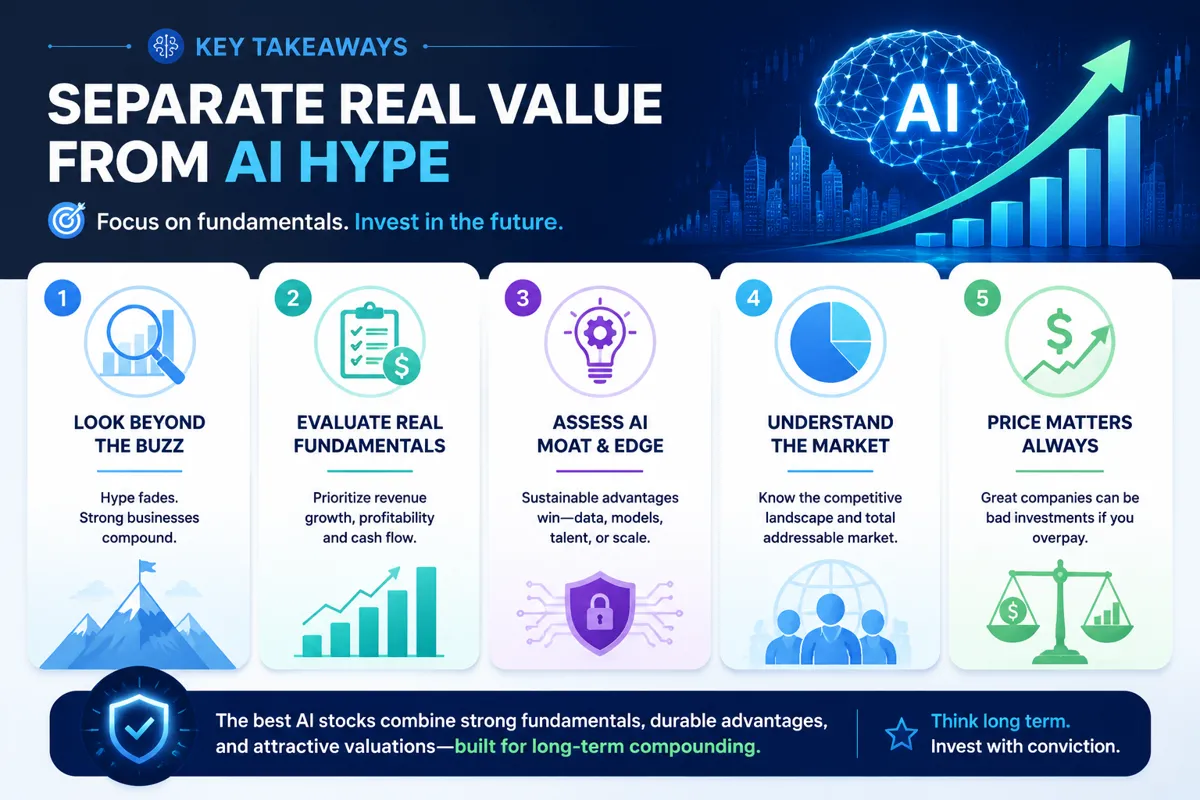
What Makes an AI Stock Actually Good vs. Just Hype
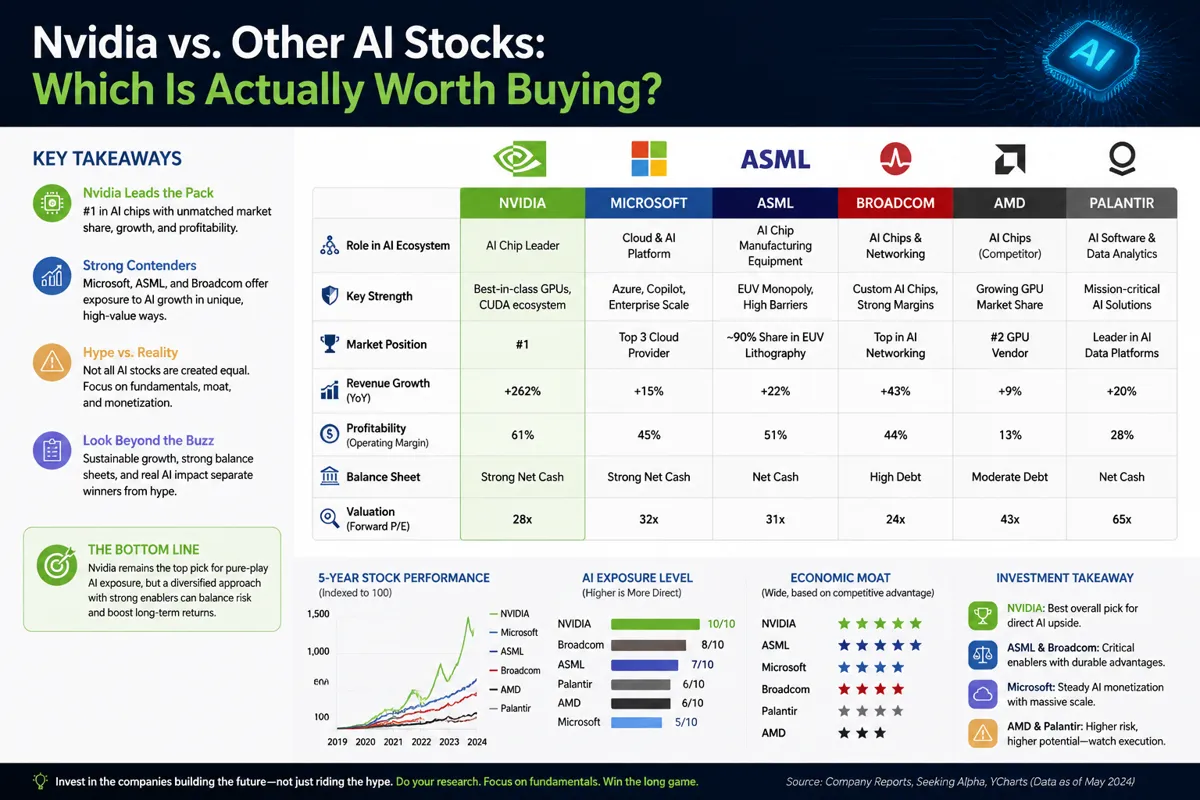
A real AI stock has revenue that grows because of its AI product, not despite its marketing. Hype stocks have a narrative; real stocks have a business model you can trace to a line on an income statement.
Here's the fast filter: ask where the revenue comes from. If the answer involves actual AI-driven products with paying customers, growing margins, and repeat business — that's signal. If the answer is "they're investing heavily in AI for future growth" with no current monetization — that's noise.
Three markers that separate signal from noise:
- Gross margin above 50% (software-like economics suggest pricing power)
- Year-over-year revenue growth of 20% or more, sustained across multiple quarters
- Free cash flow positive, or a credible, near-term path to it
The best AI stocks to buy in 2026 will share at least two of those three. Companies that fail all three are speculation, not investing. Play stupid games, win stupid prizes.
Best AI Stocks to Buy: How to Separate Real From Hype for Beginners
If you're newer to evaluating AI sector stocks, start with the companies that have the clearest revenue story — not the flashiest product demo. For beginners, the priority is understanding what you own before you own it.
Start with the infrastructure layer. The companies building the picks and shovels of the AI economy — chips, cloud computing, networking hardware — have more transparent business models than pure-play AI software startups. Their customers are enterprises with long-term contracts, not consumers with short attention spans.
A beginner's starting checklist:
- Can you explain in one sentence what the company sells and who buys it?
- Is AI revenue a growing percentage of total revenue, or just a talking point?
- Does the company have a moat — patents, switching costs, network effects?
- Is the stock trading at a price-to-earnings or price-to-sales ratio that makes sense given growth rate?
If you can't answer those four questions from public filings, you're not investing — you're guessing. Use a tool like Stock Rover's fundamental data layer to pull the numbers before you touch the watchlist.
How to Evaluate AI Companies for Investing: The AI Stock Fundamentals Checklist
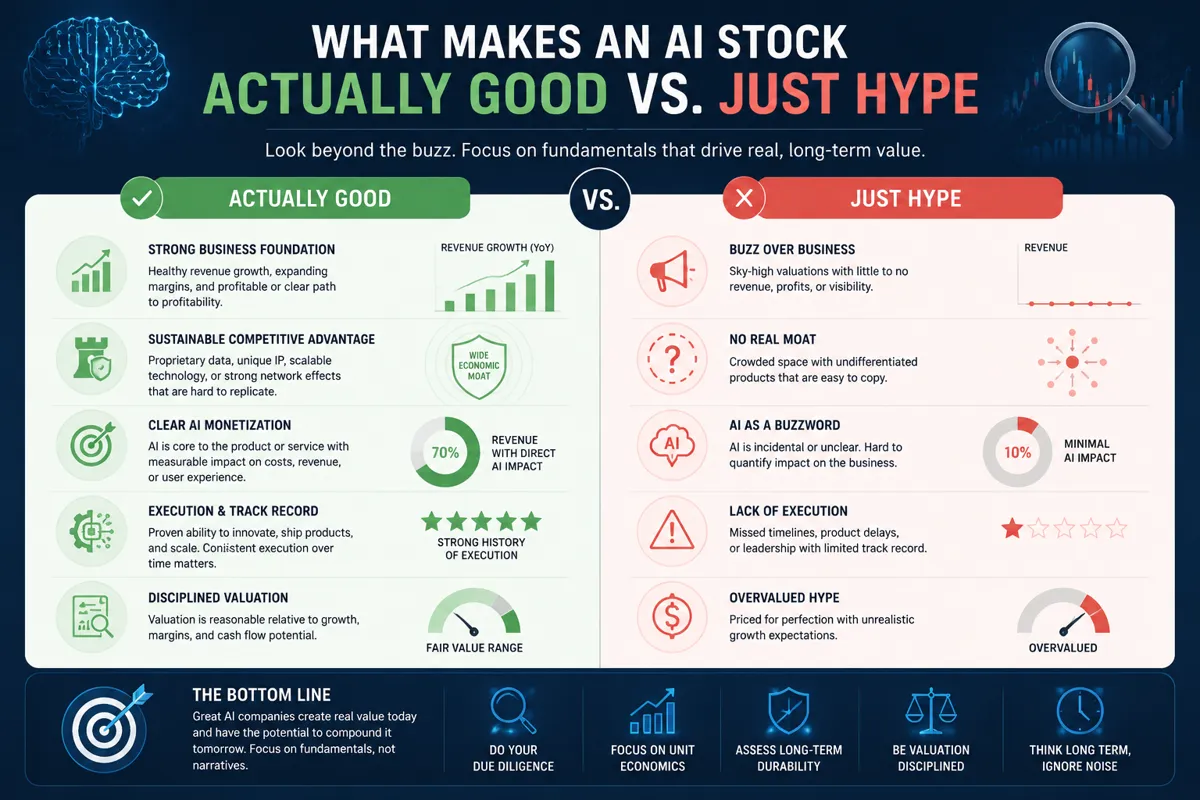
Evaluating AI companies for investing means applying the same fundamentals framework you'd use for any growth stock, with a few AI-specific additions. The sector has a history of rewarding narrative over numbers in the short term — and punishing that trade violently later.
The AI stock fundamentals checklist:
| Metric | What to Look For | Red Flag |
|---|---|---|
| Revenue Growth (YoY) | 20%+ sustained | Declining or single-digit |
| Gross Margin | 50%+ for software | Under 30% with no improvement trend |
| Free Cash Flow | Positive or improving | Burning cash with no timeline |
| R&D as % of Revenue | Healthy reinvestment | Declining while competition rises |
| Customer Concentration | Diversified base | One customer over 30% of revenue |
| Price-to-Sales Ratio | Reasonable vs. growth rate | P/S over 20x with slowing growth |
| AI Revenue Specificity | Disclosed and growing | Bundled into vague "cloud" or "tech" |
Tools like Danelfin use an AI Score to rank stocks across these kinds of quantitative factors, removing emotional bias from the screening process. Kavout's Kai Score does something similar — it applies machine learning to rank AI sector names by expected return probability, not by how loud the CEO was on the last earnings call.
Use the AI stock screeners at aistockpickerapps.com to filter by these fundamentals before anything else. That's the setup. Everything else is noise.
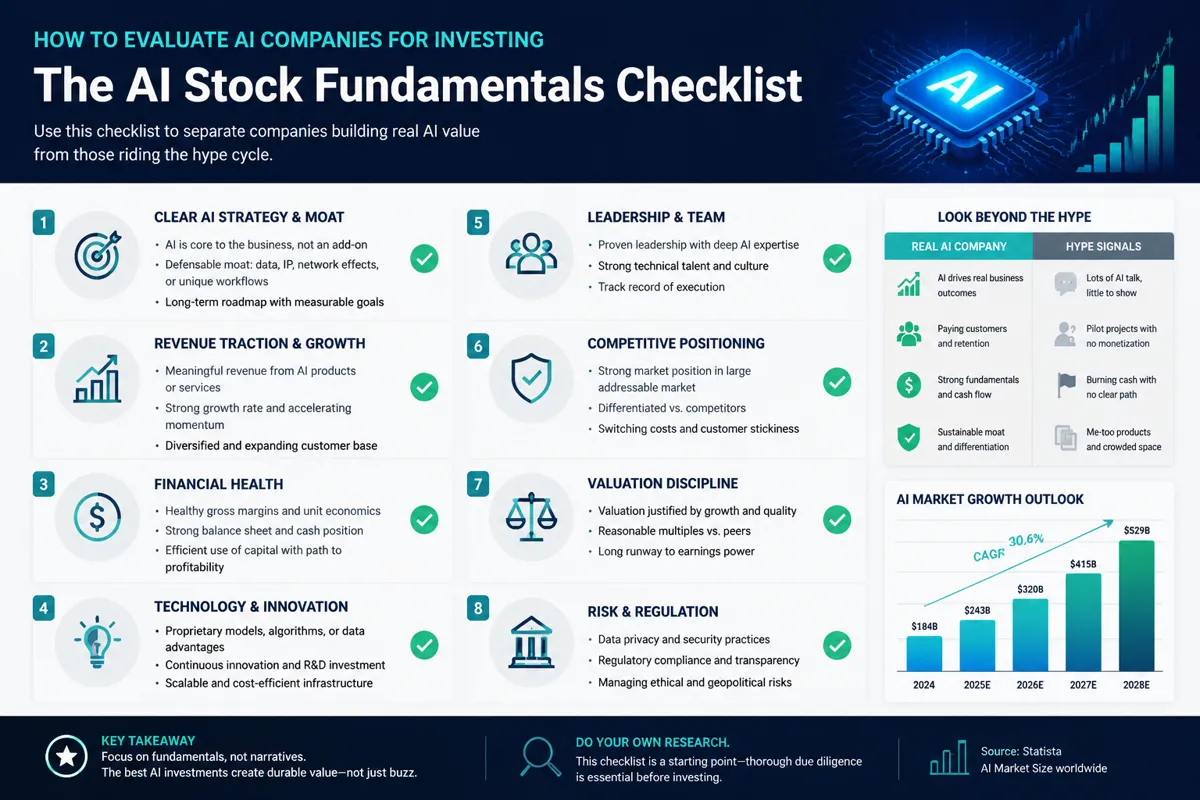
Nvidia vs. Other AI Stocks: Which Is Actually Worth Buying?
Nvidia is the clearest example of a real AI business in the current market because its revenue growth is directly tied to AI infrastructure demand — data centers buying GPUs to train and run large language models. That's a verifiable, audited revenue stream. The question isn't whether Nvidia is a real business. It is. The question is whether the price already reflects everything good that could happen.
Microsoft's AI story is also grounded in actual product revenue — Azure AI services, Copilot integrations across enterprise software, and OpenAI's commercial layer. Microsoft ai stock analysis shows a company monetizing AI across existing distribution, which reduces execution risk compared to pure-play startups.
The honest comparison:
- Nvidia: high conviction on the business, valuation risk is real at elevated multiples
- Microsoft: lower growth rate, but more durable and diversified AI revenue
- Pure-play AI software startups: higher upside narrative, much higher risk of zero
The best ai stocks to buy aren't always the ones with the biggest headlines. Sometimes the cleanest setup is the boring one with consistent earnings beats and a moat nobody's talking about. That wasn't in our bingo card, but boring often wins.
Which AI Stocks Are Overvalued Right Now
AI stocks that are overvalued right now share a specific fingerprint: price-to-sales ratios above 20x with revenue growth that's decelerating, or companies that rebranded existing products as "AI-powered" without a measurable impact on margins.
Watch for these patterns in ai bubble risk stocks:
- Revenue growth slowing from 60% to 25% while valuation stays elevated
- Gross margin compression as AI infrastructure costs rise
- Insider selling at a pace that outstrips normal diversification
- Guidance that keeps getting revised downward
The AI sector has already had its first shakeout. Companies that raised money on "AI potential" without a product are gone or going. The ones still standing at stretched valuations deserve scrutiny, not automatic trust. Overextended stocks can stay overextended longer than your account can stay solvent — but that's not a reason to buy them. It's a reason to wait for a cleaner entry.
Cheapest AI Stocks With Real Potential vs. AI Stocks That Crashed

Not every cheap AI stock is a bargain, and not every AI stock that crashed deserved to. The distinction matters. Some crashed because the business was always hollow — pure narrative, no revenue. Others got caught in sector-wide selling despite solid fundamentals, which can create a real opportunity.
What happened to AI stocks that crashed:
- Many 2023-2024 AI darlings were priced for perfection and delivered imperfection
- Companies with no clear monetization path saw their valuations collapse when rates stayed higher for longer
- Some legitimate businesses got dragged down in the sector selloff and recovered; others didn't
How to tell if a cheap AI stock has real potential:
- Revenue is growing even as the stock price is down (price-action divergence from fundamentals)
- The company has cash on the balance sheet — it's not one bad quarter from a dilutive raise
- The business has customers who are expanding usage, not churning
Use a tool like AltIndex to look at alternative data signals — employee headcount trends, web traffic, app downloads — as a leading indicator of whether a cheap AI stock is genuinely recovering or just dead cat bouncing.
AI Stocks for Different Risk Levels: How Much Should You Invest
How much to invest in AI stocks depends on your risk tolerance, time horizon, and whether you're treating this as a long-term position or a shorter-term trade. There's no universal number — but there is a framework.
Risk-based allocation guide:
- Conservative: 5-10% of portfolio in AI exposure, primarily through diversified AI ETFs or large-cap names with strong balance sheets
- Moderate: 10-20%, split between established AI infrastructure companies and one or two higher-conviction individual names
- Aggressive: 20-30%, with individual stock picks, smaller AI infrastructure plays, and willingness to absorb higher volatility
Position sizing is the part most retail investors skip. They pick the stock right and size it wrong — either too small to matter or too large to survive a drawdown. The rule is simple: never size a position so large that a 30% drop changes your behavior. If it would make you panic-sell, it's too big.
For ai stocks vs ai etf decisions: if you can't spend four hours per quarter reading earnings transcripts and SEC filings, the ETF is the right answer. Seriously. Explore robo-advisor and ETF options that give you AI sector exposure without single-stock concentration risk.
AI Stocks for Long-Term vs. Short-Term Trading
For long-term investing in AI sector stocks, the priority is identifying companies with durable competitive advantages — the kind that compound over years, not quarters. For short-term trading, the priority shifts to price action, momentum, and risk-reward on specific setups.
Long-term lens:
- Focus on companies with expanding gross margins, growing recurring revenue, and strong R&D investment
- Ignore short-term price volatility unless fundamentals change
- Re-evaluate quarterly, not daily
Short-term trading lens:
- Look for tight consolidation after a strong earnings report — that's a potential breakout setup
- Use support and resistance levels to define your entry and exit before you place the trade
- Set a stop loss. Getting stopped out on a small loss beats catching a falling knife on a big one
The trend is your friend until it isn't. AI infrastructure stocks have been in a multi-year uptrend with periodic corrections. Trying to short that trend because something "feels overvalued" is analysis paralysis dressed up as discipline. Trade the setup in front of you, not the narrative in your head.
Are AI Stocks Still Worth Buying Now?
Yes — with the right framework. The AI sector in 2026 is past its first hype peak, which means the market is starting to separate companies with real earnings power from those that were riding the narrative. That's actually a better environment for research-driven investors than the early euphoria phase was.
The companies building AI infrastructure — compute, networking, cloud services — are reporting real revenue tied to real enterprise contracts. The software layer is more mixed: some companies are monetizing AI features effectively; others are still in "investment mode" with no clear payoff timeline.
The honest answer on whether to buy now:
- If you've done the fundamentals work and the valuation makes sense relative to growth — yes
- If you're buying because AI is "the future" and you don't want to miss it — that's FOFO (fear of finding out), not investing
- If you're chasing a stock that's already up 80% in three months with no pullback — that's not a clean setup
Use tools like Danelfin's AI Score screening or Kavout's quantitative ranking to screen AI sector stocks objectively. Let the data tell you where the signal is. Cut the noise, keep the alpha.
Should You Buy Individual AI Stocks or an AI ETF?
Buy individual AI stocks if you have time to research, a clear process for evaluating AI stock valuation metrics, and the discipline to manage position sizing and stop losses. Buy an AI ETF if you want sector exposure without the homework.
This isn't a trick question. Most retail investors are better served by an ETF that holds 30-50 AI-related companies than by concentrating in two or three names they picked from a social media thread. The ETF won't give you the upside of catching the next Nvidia early — but it also won't give you the downside of catching the next AI company that turned out to be mostly PowerPoint.
Common mistakes people make buying AI stocks:
- Buying after a 40% run because of FOMO, then selling at the first 15% dip
- Ignoring valuation entirely because "AI is different this time"
- Overtrading — revenge trading after a loss by doubling down on a different AI name
- Skipping the stop loss because they're "long-term investors" on a short-term trade
- Treating every AI company the same because the sector label matches
Systems over hacks. Process over prediction. If your process for evaluating the best ai stocks to buy doesn't survive a bad quarter, it's not a process — it's a hope. Explore AI investing tools and research resources to build a repeatable evaluation framework.
Conclusion: Build the Process, Then Pick the Stocks
The best AI stocks to buy in 2026 aren't a secret list. They're the output of a repeatable evaluation process applied consistently — revenue growth, gross margins, free cash flow, competitive moat, and a valuation that makes sense given the growth rate. That's it. That's the whole game.
The hype will keep coming. Every earnings season brings a new wave of AI announcements, analyst upgrades, and social media conviction. Most of it is noise. Some of it is signal. The job is to know the difference before you put capital at risk, not after.
Here's what to do this week:
- Pull the last four quarters of revenue growth for any AI stock on your watchlist. Is growth accelerating or decelerating?
- Check gross margin trend. Is the company getting more efficient or less?
- Run the stock through a screener like Finviz Elite or the AI screener tools at aistockpickerapps.com filtered by the fundamentals checklist above.
- Decide your position size before you enter — not after the stock moves.
- Set a stop loss. Write it down. Honor it.
Discipline beats prediction. Every time.
Disclaimer: This article is for educational purposes only and does not constitute financial advice. No specific securities are recommended. All investing involves risk, including the potential loss of principal. Past performance does not guarantee future results. Consult a licensed financial advisor before making investment decisions.
FullStack Alpha cuts the noise so you can keep the alpha. See the AI tools, screeners, and systems we actually rate at aistockpickerapps.com.