Best AI Stock Picker Apps 2026: 15 Ranked With Real Prices


Below: 15 apps, ranked by what you get for what you pay, with every price checked against the vendor's own pricing page in October 2026. Where a vendor doesn't publish a price, we say so instead of guessing. No vague "contact sales" entries. No tools that are a public language model with a subscription button glued on.
Quick answer: the top pick and its price
For most self-directed traders in 2026, the best AI stock picker for the money is 

What are the best AI stock picker apps available to buy or subscribe to right now?
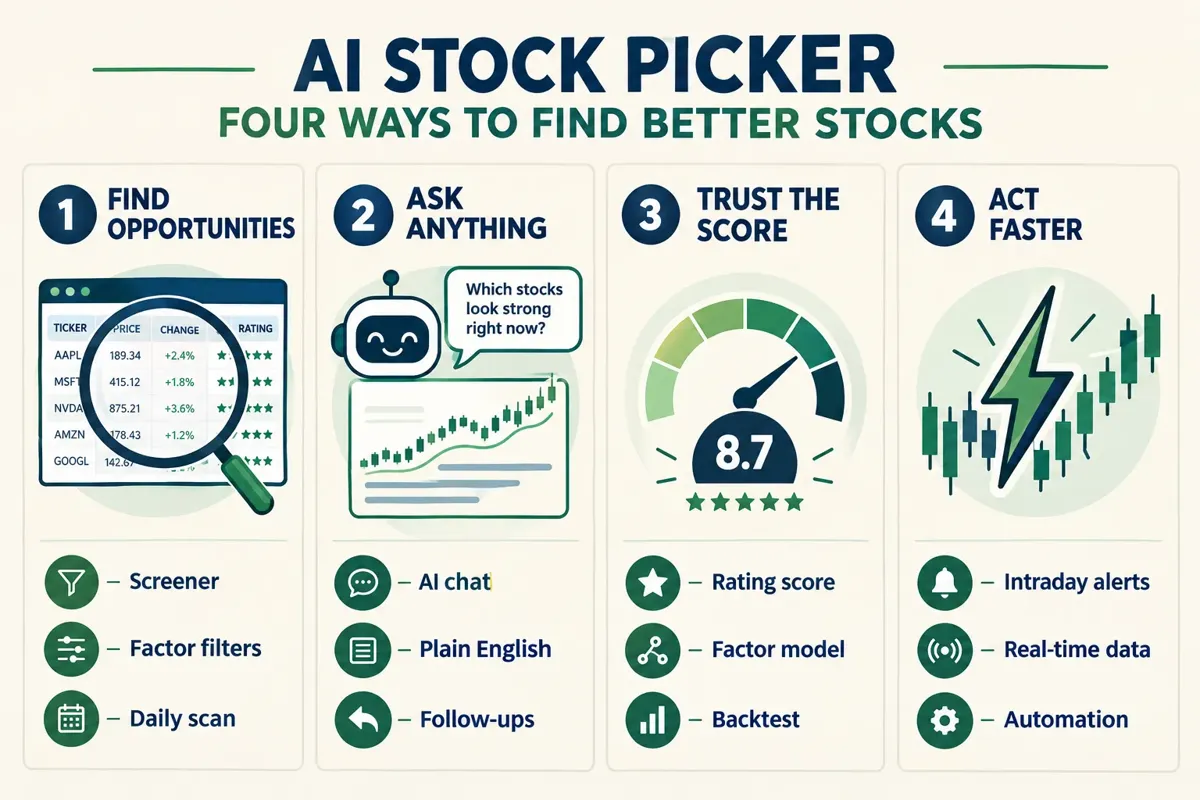
Prospero is the best overall AI stock picker app right now, and it's free to start. Here's the shortlist:
Simply Wall St, best visual research for long-term investors
Trade Ideas, best for intraday scanning, $127/mo Standard (checked October 2026)
Stock Rover (via comparison tools), deepest metric library
Intellectia AI, fastest AI chat for research
Seeking Alpha, best analyst coverage plus quant grades
TrendSpider, best chart automation
Kavout, best global stock coverage
Tickeron, best bot marketplace
Sterling Stock Picker, best lifetime deal
Magnifi, best natural-language portfolio assistant
RockFlow, best mobile-first AI investing app
- Peakwise AI, best newcomer for pattern alerts
More research-first options are catalogued in the AI stock research tools roundup, and current discounts sit on the deals page.
So what does the best AI stock picker actually do for you? Three jobs, mostly. It screens thousands of tickers against factor models faster than you can open a spreadsheet. It summarizes filings, earnings calls, and news so you're not reading a 10-K at midnight. And it ranks or scores names so your watchlist starts at ten ideas instead of four hundred. That's it. It doesn't predict Thursday.
The 15 best AI stock picker apps, ranked
1. Prospero, Best Overall Value
Prospero wins the top slot for a boring reason: time to first useful output. You open it, you get ranked signals, you're done in under ten minutes. Most tools in this category require you to build the screen before the screen builds you anything.
The free tier is genuinely usable, not a demo with a paywall two clicks deep. Prospero markets the app as free, and its site doesn't list a paid tier price (price not published, checked October 2026). For a trader running a $5,000 account, free beats every number in the comparison table below. Full breakdown in our Prospero AI scorecard.
Where it's weaker: the methodology disclosure isn't as deep as Danelfin's. You get the signal and a confidence framing, not a full factor decomposition. If you're the kind of investor who needs to see every input before you trust an output, that'll bother you.
The practical use case is a morning filter. Run the signals, cross-check two or three names against your own setup rules, and ignore everything else. The app narrows the field. You still pick the trade.
2. Danelfin, Best Transparency
Danelfin publishes its factor model. In a category full of "proprietary AI" that means "we'd rather not say," that's rare enough to be the main selling point.
Danelfin scores stocks from 1 to 10 on an AI Score built from hundreds of fundamental, technical, and sentiment indicators, and it shows you which buckets drove the number. There's a free plan with 10 stock reports a month. Plus costs $264/year ($22/month billed yearly), Pro $708/year and Elite $1,608/year, and paying monthly instead of yearly costs about 25% more (checked October 2026). Our Danelfin scorecard covers the score's track record.
The honest problem: public discussion of Danelfin is thin. Search Reddit for real usage threads and you'll find a handful, not a hundred. That's not proof the tool is bad. It's proof you can't easily corroborate your own experience against other users, which is a real cost when you're deciding whether a bad month is the model or the market.
Use it as a second opinion on names you already like. A high AI Score on a stock you found yourself is a confirmation. A high AI Score on a stock you've never heard of is homework.
3. Simply Wall St, Best Visual Research
The "snowflake" diagram is either gimmicky or the single clearest way to see a company's value, future, past, health, and dividend profile in one glance. After a year of using it, most people land on the second answer.
Simply Wall St offers Free, Premium and Unlimited plans, and new accounts get 7 days of Premium before dropping to Free. Its plans page doesn't show Premium or Unlimited prices without signing in (price not published, checked October 2026). See the Simply Wall St scorecard. It's built for people who hold positions for months and years, not minutes. If you're day trading, skip it entirely.
The AI layer writes plain-English company narratives from the underlying data, which beginners find enormously helpful and advanced users sometimes find padded. Both reactions are fair.
Its real strength is portfolio-level. Connect your holdings and it flags concentration risk, dividend sustainability questions, and valuation drift. That's the stuff that quietly wrecks long-term returns while everyone argues about entries.
4. WallStreetZen, Best Fundamentals on a Budget
WallStreetZen runs 38 automated due-diligence checks on a stock and tells you which ones it failed. For a beginner trying to avoid catching a falling knife, meaning buying something cheap that keeps getting cheaper, that's a useful guardrail.
Premium costs $19.50/month billed yearly (about $234/year), with a $1 14-day trial and a free plan that covers the basics (checked October 2026). WallStreetZen also scores analysts by their actual track record, which is a quiet reminder that most price targets are marketing.
Limitation: it's fundamentals-first. Technical traders will find the charting thin. Pair it with something that reads price action if that's your style.
5. Trade Ideas, Best for Intraday Scanning
Trade Ideas is the serious one, and the price tells you that. Standard is $127/month or $1,068/year; Premium is $254/month or $2,136/year (checked October 2026). A free account lets you look around before paying. Standard gets you real-time data, paper trading, 308 alerts, 249 filters, and the AI Assistant. Premium adds Holly AI signals, OddsMaker backtesting, and Money Machine automated trading. Before you hand any app the trigger, read what fully automated AI trading apps actually do.
Trade Ideas is the answer to "best AI stock picker for day trading" and a poor answer to "best for long term." Our Trade Ideas scorecard grades it pillar by pillar. Holly runs overnight simulations and produces a short list of intraday candidates before the open. That's genuinely different from a screener.
Is it worth $254 a month? Only if you trade enough size that the subscription is a rounding error. On a $5,000 account, that's a 61% annual cost drag before you place a single trade. Play stupid games. We dug into the real numbers in our Trade Ideas review covering Holly AI's tested win rate.
The usability curve is steep. Budget two weeks before it stops feeling like a cockpit.
6. Stock Rover, Deepest Metric Library
More than 800 metrics, historical screening back years, equation-based custom filters, and as of its October 2026 update, natural-language AI screen creation. Billed annually, the four tiers run $29, $49, $79 and $149 per month (Premium through Ultimate Pro); billed monthly, they run $34, $70, $99 and $199 (checked October 2026). Every plan has a 14-day free trial.
That last bit matters. You can type "profitable small caps with rising free cash flow and low debt" and get a working screen instead of building it filter by filter. That's the single biggest usability jump in the screener category this year.
Where it falls down: it's a desktop-first experience. The mobile app is functional, not pleasant. If you do most of your research on a phone, this isn't your tool. Our Stock Rover vs 
7. Intellectia AI, Fastest AI Chat for Research
Intellectia AI is built around conversation. Ask it why a stock gapped down, and it pulls the catalyst, the filing, and the sentiment shift in one response. There's a free tier for light use. Paid plans start with Basic at $14.95/month or $143.52/year, and Pro runs $29.95/month or $287.52/year (checked October 2026).
The value is speed on catalyst questions. Earnings season produces a hundred moves a day and no human reads a hundred transcripts. This reads them.
The caution: chat interfaces make everything sound confident. A summary of a bad earnings report is still a summary of a bad earnings report. Treat the output as a research shortcut, not a verdict. Check the primary filing when the position size is real. More in our Intellectia AI scorecard.
8. Seeking Alpha, Best Analyst Coverage Plus Quant
Seeking Alpha Premium lists at $299/year (about $25/month), and the vendor runs bundle sales with Alpha Picks (checked October 2026). What you're buying is the Quant Rating system plus thousands of contributor articles, which is a strange but effective combination of machine scoring and human argument.
Seeking Alpha Quant grades stocks A through F on valuation, growth, profitability, momentum, and revisions. The grades update daily. They're mechanical, which is their virtue, because they don't change their mind because a CEO gave a good interview.
The contributor content is uneven by design. Some of it's excellent. Some of it is someone's thesis with a chart. Reading the bear case under a stock you're long is the actual exercise, and this is one of the few places you can reliably find one. Our full review of Seeking Alpha weighs the Quant grades against the noise.
9. TrendSpider, Best Chart Automation
TrendSpider draws your trendlines, support and resistance levels, and Fibonacci zones automatically, then alerts you when price interacts with them. List prices run $54 to $89 per month for Standard up to $214 to $349 for Advanced, depending on billing cycle, and any plan can be trialed for 14 days at $19 (checked October 2026). A Halloween sale was cutting first-year prices when we checked.

TrendSpider isn't strictly a stock picker. It's a technical analysis engine with AI automation layered on, which makes it the best choice for someone who already has a setup and wants the chart work done faster. If your edge is a clean breakout from a tight consolidation, meaning price coiling in a narrow range before it moves, this finds those across hundreds of names.
What it won't do is tell you what to buy. That's a feature if you have a process and a problem if you don't. Our TrendSpider scorecard has the details.
10. Kavout, Best Global Coverage
Kavout expanded global market access on October 28, 2026, giving Pro and Premium users stocks and ETFs from Hong Kong, Japan, India and more, with no regional surcharges or extra credits. For anyone trading outside U.S. large caps, that's the differentiator.
Kavout blends strategies associated with Joel Greenblatt, Peter Lynch, and Joseph Piotroski with quality, value, and momentum factors. Its K Score ranks names on a 1 to 9 scale. There's a free plan with 10 research credits a month. Pro costs $16/month billed as $192/year, and Premium $39/month billed as $468/year (checked October 2026).
The naming of those strategies is a transparency win. You know what school of thought you're buying. We compared the scoring systems head to head in Danelfin vs Zen Ratings vs Kavout, and the Kavout scorecard covers the rest.
11. Tickeron, Best Bot Marketplace
Tickeron sells access to AI trading agents with published historical performance, plus pattern recognition across stocks, ETFs, and forex. There's a free Member tier. Daily Buy/Sell Signals list at $240/year (a Halloween sale had it at $60/year when we checked), and the bundled Beginner, Swing Trader and Day Trader plans cost $80, $90 and $250 per month (checked October 2026).
Published bot track records are vendor-claimed until independently audited, which is why we track whether trading bots are actually profitable. Read them that way. A 70% win rate with a terrible risk-reward ratio, meaning your losers are bigger than your winners, loses money cheerfully.
Where Tickeron earns its spot: the pattern recognition alerts are fast and the breadth of asset classes is wide. Where it loses points: the sheer number of products makes it hard to know what you actually bought.
12. Sterling Stock Picker, Best Lifetime Deal
Sterling Stock Picker got prominent coverage in 
The pricing is the headline. On its own site, Sterling charges $29/month or $243/year, both with the first 30 days free (checked October 2026). Third-party promotions, such as one covered by 
The trade-off is depth. A four-state output is clear, which is the point, but it hides the reasoning. You won't learn much from it. Sterling Stock Picker is a decision tool, not an education tool. Know which one you need.
13. Magnifi, Best Natural-Language Assistant
Magnifi lets you ask portfolio questions in plain English, then shows you relevant securities and how they'd fit what you already hold. There's a free plan, and Premium costs $99/year (about $8.25/month); the vendor doesn't publish a monthly-billing price (checked October 2026).
Magnifi sits closest to the robo-advisor border, which answers a common question: an AI stock picker surfaces ideas and leaves the decision to you, while a robo-advisor takes your money and allocates it automatically. Magnifi suggests. It doesn't execute on your behalf without you.
Good for investors building a diversified portfolio who want conversational guidance. Not built for active traders. The data refresh isn't intraday enough for that. See our Magnifi scorecard.
14. RockFlow, Best Mobile-First
RockFlow was built phone-first, which makes it the most natural answer to anyone searching for an AI stock picker app for iPhone. Its Bobby AI agent handles research, idea generation, and trade execution inside one app. RockFlow's site doesn't list a subscription price for Bobby (price not published, checked October 2026).
Roughly 67% of retail trading volume is mobile, so building for the phone isn't a compromise anymore. It's the default.
The downside of mobile-first is screen real estate. Deep comparative research across six tickers is painful on a 6-inch display no matter how good the design is. Use RockFlow for monitoring and quick decisions. Do the heavy lifting elsewhere.
15. Peakwise AI, Best Newcomer
Peakwise AI is the youngest tool on this list, focused on AI stock scores, chart analysis and alerts. You can start free; paid plans are priced in euros at €19.99/month for Basic (about $22) and €49.99/month for Pro (about $56), with yearly billing 30% cheaper (checked October 2026).
Newer tools score lower on community verdict by definition. There's almost nothing to corroborate against. That's not a flaw in the product. It's a flaw in your ability to verify it, which is a different problem with the same cost.
Worth watching rather than committing to. Paper trade it first, meaning run the signals on a simulated account for 30 days before real money touches them. If the setups hold up, upgrade. If they don't, you lost nothing but a month. More early-stage tools are tracked on the new AI stock apps to watch page.
Comparison table: all 15 at a glance
This best AI stock picker comparison uses prices checked on each vendor's own pricing page in October 2026, in USD (Peakwise converted from euros). They change often, so check before you buy.
How we ranked them
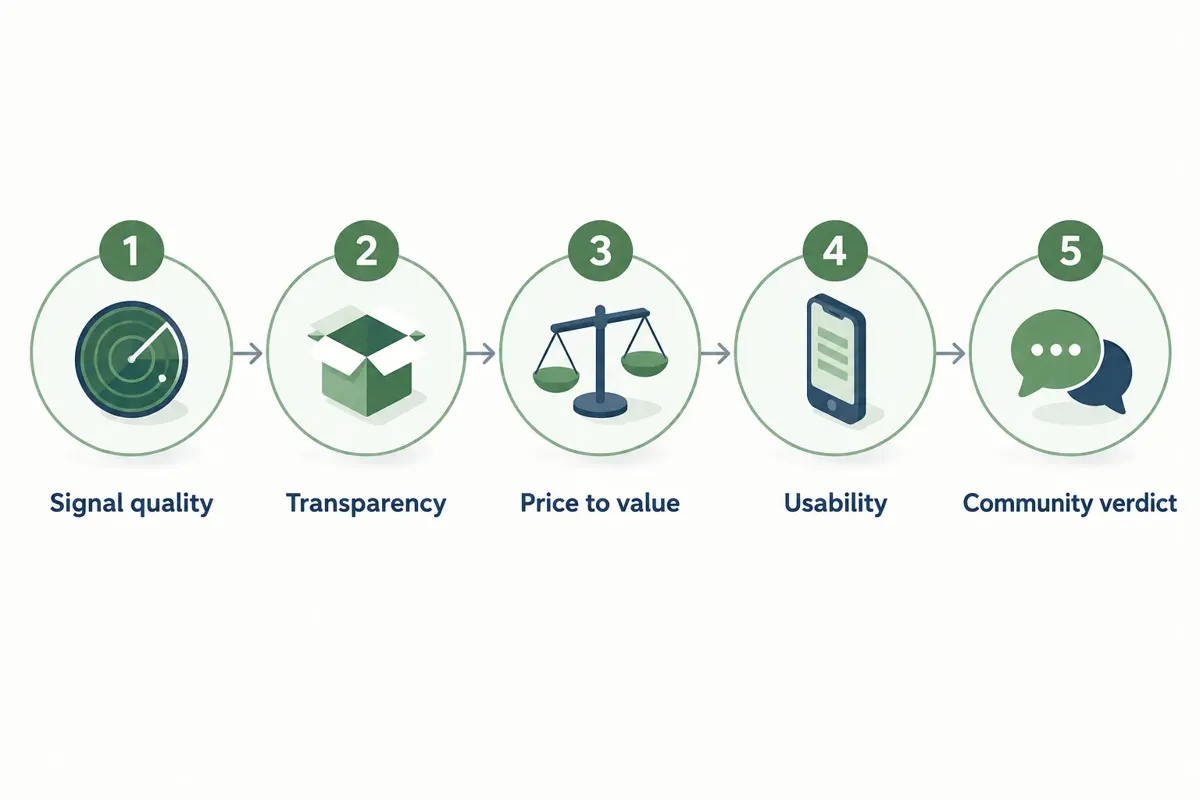
Five pillars, weighted equally. Signal quality: does the output hold up and arrive in time to act on? A scan that surfaces a mover four minutes late is a history lesson, not a trade. Transparency: can you see the method, or is it a black box with a checkout page? Price-to-value: what you pay against what the same money buys elsewhere. Usability: how fast do you get something useful, and does the mobile app work? Community verdict: what actual users say across Reddit, G2, Trustpilot, and the app stores, read against each other rather than averaged into mush.
That last one is where most rankings cheat. A tool rated 4.6 on G2 and torn apart on Reddit is a different product than one rated consistently. The gap is the finding.
The ranking order for this best AI stock picker list is value for the money, not raw power. Trade Ideas may be the most capable tool on this list and it sits fifth, because $1,068 a year is a real decision for a $10,000 account.
Do AI stock apps really work?
Short answer: even the best AI stock picker works as a research accelerator. They do not work as fortune tellers, and anyone selling the second thing is selling you something else.
A 2026 academic survey of more than 2,000 retail investors found users mostly employ generative AI to interpret financial information, contextualize market moves, screen stocks, and monitor company news. Not to outsource the decision. That's the healthy pattern.
Adoption numbers vary wildly by who's asking. Morningstar found 63% of U.S. participants weren't using AI for investment decisions at all. Amundi's September 2026 study found roughly 70% of retail investors had used AI to help decide something, with 59% of those acting on a recommendation. Investing.com's survey of 938 U.S. retail investors landed at 62%, as cited by Prospero's own roundup. Three credible studies, three different answers, which should tell you how early this still is.
So why did your AI stock picker lose money? Usually one of four reasons. You took the signal without a stop loss, meaning no predefined exit if you're wrong. You sized the position too large because the confidence score looked high. You traded a long-term signal on a one-week horizon. Or the market simply did something nobody's model saw, which happens several times a year and always will.
How accurate are they really? Published win rates are vendor-claimed unless independently audited. Treat a 70% number the same way you'd treat a 70% number on a weight loss ad. Ask what the losers cost. We went deeper on this in why the AI stock prediction accuracy number lies.
Is it legal? Yes. FINRA's October 27, 2026 guidance confirmed existing securities laws and rules apply when firms use generative AI, with emphasis on supervision, governance, and model risk management. The SEC named AI an examination priority for fiscal 2027. Regulation is tightening around the firms, not around you using a screener. You're allowed to use software to pick stocks. You're responsible for the trade either way.
The biggest mistakes people make: running six tools at once and getting analysis paralysis, chasing a signal that already ran 18% because the alert fired late, and revenge trading after a bad signal to prove the subscription was worth it. Pick three tools at most. Write your rules. Run them for 30 days. Let the results argue back.
Is there a free AI stock picker?
Yes, several. If you're hunting for the best AI stock picker app free of charge, the right one is whichever free tier covers your actual workflow rather than whichever has the longest feature list.
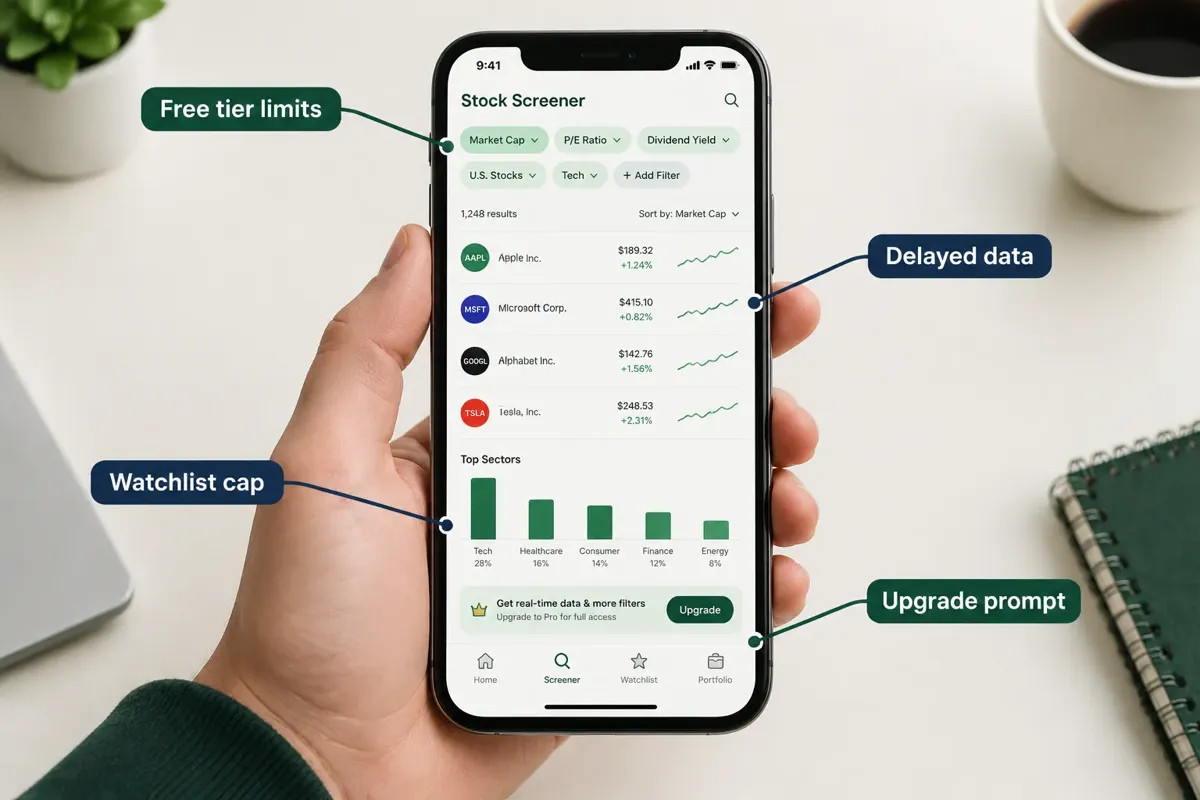
Prospero, Danelfin, Simply Wall St, WallStreetZen, Intellectia, Kavout, and Magnifi all run usable free plans (checked October 2026). What free tiers typically cut: real-time data (you get 15-minute delayed quotes), watchlist size, number of AI queries per day, and historical depth on screens. For a long-term investor checking positions weekly, none of those limits matter. For someone trading the power hour, meaning the last hour of the session when volume spikes, delayed data is useless.
A reasonable free stack: one screener for ideas, one charting tool for the setup, one news tool for catalysts. That covers most of what a $40/month subscription does. The full list lives on the free AI stock screeners page.
The honest alternative to all of this: a low-cost index fund and a boring monthly contribution. For most people, that beats stock picking with or without AI. The tools on this list are for people who've decided to actively manage a portion of their money and want to do it with better information. If that's not you, saving the $40 is the better trade.
FAQ
Which AI stock picker app is best for a beginner investor with a limited budget? WallStreetZen ($19.50/month billed yearly) or Simply Wall St, both with usable free plans. Both explain their reasoning, which matters more than signal speed when you're learning. Avoid anything over $100/month until you've run a process for six months. Is it safe for beginners? Safe as the position sizing you use with it, and no safer.
Where can I get the best deal on an AI stock picker app subscription? Annual billing cuts 20-40% off most tools on this list. Sterling Stock Picker's third-party lifetime promotions have run between $49.97 and $69.99 against much higher list prices. Current discounts across tools are tracked on the deals page. Never buy an annual plan before using the free trial.
What's the difference between an AI stock picker and a robo-advisor? A stock picker gives you ideas and leaves you to decide and execute. A robo-advisor takes your money, allocates it across funds automatically, and rebalances without asking. Pickers are for self-directed investors. Robos are for people who'd rather not look.
Should I trust AI stock recommendations? Trust them the way you'd trust a sharp colleague's idea: as a starting point that still needs your own check. Morningstar found a wide gap between stated trust in AI and actual reliance on it. That gap is appropriate, even with the best AI stock picker.
What's the best AI stock app for day trading versus long-term investing? Day trading: Trade Ideas or TrendSpider, because they operate on intraday data. Long-term: Simply Wall St, Danelfin, or Seeking Alpha, because they score fundamentals that move over quarters, not minutes. Using a long-term rating to day trade is how people lose money with good tools.
Is the best AI stock picker the same for every investor? No. A day trader and a dividend investor need different tools, which is why this list names a best-for on every entry.
Who should actually use these? Self-directed investors with a defined process who want to screen faster and read less. Not people looking for someone to tell them what to buy.
Conclusion
The best AI stock picker is the one that fits the trading you actually do, not the one with the most impressive demo. Prospero takes the top slot on value, Danelfin on transparency, Trade Ideas on intraday power if the price makes sense for your account size.
Here's the next step: pick one tool from this list, run its free tier or trial for 30 days alongside a written set of entry and exit rules, and track every signal you took and skipped. At day 31, you'll know whether the subscription earns its keep. That beats guessing.
Fewer tabs, fewer alerts, one process you follow.
References
- Best AI Stock Picker. wallstreetzen.com.
- This AI Investing App Gives Busy Founders a Clear Call on Every Stock. entrepreneur.com.
- AI Stock Picks and 150 Money Lessons Are 69 99 for Life. macworld.com.
- The 10 Best AI Stock Pickers in 2026 Tools That Actually Beat the Market. prospero.ai.
Still deciding which AI stock picker earns your money? Every tool in the FullStack Alpha directory is filterable by category, price and what it actually does. Compare the best AI stock research tools
This is education, not financial advice.
Your market edge starts with the right tool. Stay alpha.
Some links on this page may be affiliate links. Rankings are never influenced by them.