Top Prop Firm Picks (2026): 7 Ranked by Payout Rules
Last updated: October 22, 2026
Quick Answer
The top prop firm for most traders in 2026 is Topstep, because its end-of-day trailing drawdown lets a normal intraday pullback happen without killing the account, and the trader keeps 100% of the first $10,000 in profits. Apex Trader Funding wins on scale, with up to 20 funded accounts and 100% of the first $25,000. Tradeify is the pick if you want end-of-day drawdown, a 90/10 split, and zero activation fees in one package.
Most traders lose a funded account to a rule, not to the market. That's what this guide ranks on.
Top prop firm picks: key takeaways
- Topstep (est. 2012) uses an end-of-day trailing maximum loss limit of $2,000 on a 50K account and charges $49 to $149 per month for the Trading Combine, plus a $149 activation fee.
- Apex Trader Funding lets you choose your drawdown type at checkout under Apex 4.0 (March 2026), pays 100% of the first $25,000, and allows up to 20 funded accounts.
- Tradeify is the only pick with end-of-day drawdown on every account, a standard 90/10 split, and $0 activation fees.
- MyFundedFutures Core runs around $77 per month with no activation fee, but its best split (Rapid, 90/10) comes with a 4% intraday trailing drawdown.
- Take Profit Trader funds you in as few as three trading days and allows day-one withdrawals, with a $50 fee on requests of $250 or less.
- Bulenox allows expert advisors across 20+ platforms, and applies a 40% consistency rule plus a subjective "flipping" review.
- FundedNext applies end-of-day trailing drawdown to every futures account with no daily loss limit, and claims $144 million in 2025 payouts (a company figure, not an audited one).
Comparison table: all 7 top prop firm picks
| Firm | Markets | Evaluation steps | Daily loss rule | Max drawdown type | Profit split | Payout frequency | Evaluation price |
|---|---|---|---|---|---|---|---|
| Topstep | Futures | 1 step (Trading Combine) | Optional, trader-configured | End-of-day trailing | 100% of first $10K, then split | After 5 winning days | ~$49 to $149/mo + $149 activation |
| Apex Trader Funding | Futures | 1 step | Only on end-of-day accounts | Your choice at checkout: end-of-day or intraday trailing | 100% of first $25K, then split | 6-step ladder with Safety Net | One-time fee by size (intraday priced lower) |
| FundedNext | Futures, forex, CFDs | 1 step (Bolt / Rapid / Legacy) | None on futures | End-of-day trailing, all accounts | Up to 100% on some futures programs | Claims 24-hour payouts (conditions apply) | By size across 25K / 50K / 100K |
| Tradeify | Futures | 1 step (Select Flex / Elite) | Varies by plan | End-of-day, all accounts | 90/10 | Per plan schedule | By size, $0 activation |
| Take Profit Trader | Futures | 1 step (Trading Test) | Buffer + news rule | Intraday trailing on PRO, end-of-day on PRO+ | 80/20 on PRO, 90/10 on PRO+ | Day one, then on request | ~$150 to $360/mo + $130 activation |
| MyFundedFutures | Futures | 1 step (4 plan types) | None on most plans | Plan-dependent: intraday 4%, end-of-day trailing, or static | 90/10 (Rapid), 80/20 (Pro) | Daily, 48-hour, or bi-weekly by plan | Core ~$77/mo, $0 activation |
| Bulenox | Futures | 1 step | Varies by account | Trailing | 100% of first $10K, then split | On request | By size + activation fee (poorly disclosed) |
How did we rank each top prop firm?
We ranked on the rules that decide whether you ever see a dollar, not on marketing copy or account size. Four things did the heavy lifting: the drawdown mechanic, the cost of getting from evaluation to first payout, the consistency rule, and how much of the rulebook is numeric versus discretionary.
Drawdown sits at the top. A trailing drawdown is the moving floor under your account, and the three flavors are not close to equivalent:
- Intraday trailing follows your unrealized profit tick by tick. Go up $800 on an open trade and your loss limit rises $800 with it. Give that back and the account can close while your day is still green. This is the harshest mechanic in the category.
- End-of-day trailing recalculates once, at session close, off your closed balance. A normal pullback inside the session doesn't move the floor.
- Static drawdown never moves. Almost nobody sells it. MyFundedFutures Flex does.
Same strategy, same target, three different pass rates. If you've been paying for resets and can't explain why, that's your answer.
Second: total cost to funded. A $49 evaluation with a $149 activation fee costs more than a $120 evaluation with none, and monthly billing makes a slow pass expensive.
Third: consistency rules. A 30% rule means no single day can make up more than 30% of your total profit at payout time. One monster day can lock your withdrawal.
Fourth: discretion. Numeric rules you can plan around. Subjective reviews you can't. For neutral background on futures mechanics, CME Group's education pages are the least-marketed source in this space.
1. Topstep
Best for: traders who want the longest operating record and a drawdown rule that survives an ordinary pullback.
Topstep has been running since 2012, longer than any other top prop firm on this list. Buy a Trading Combine subscription, hit the profit target while respecting risk limits, get funded.
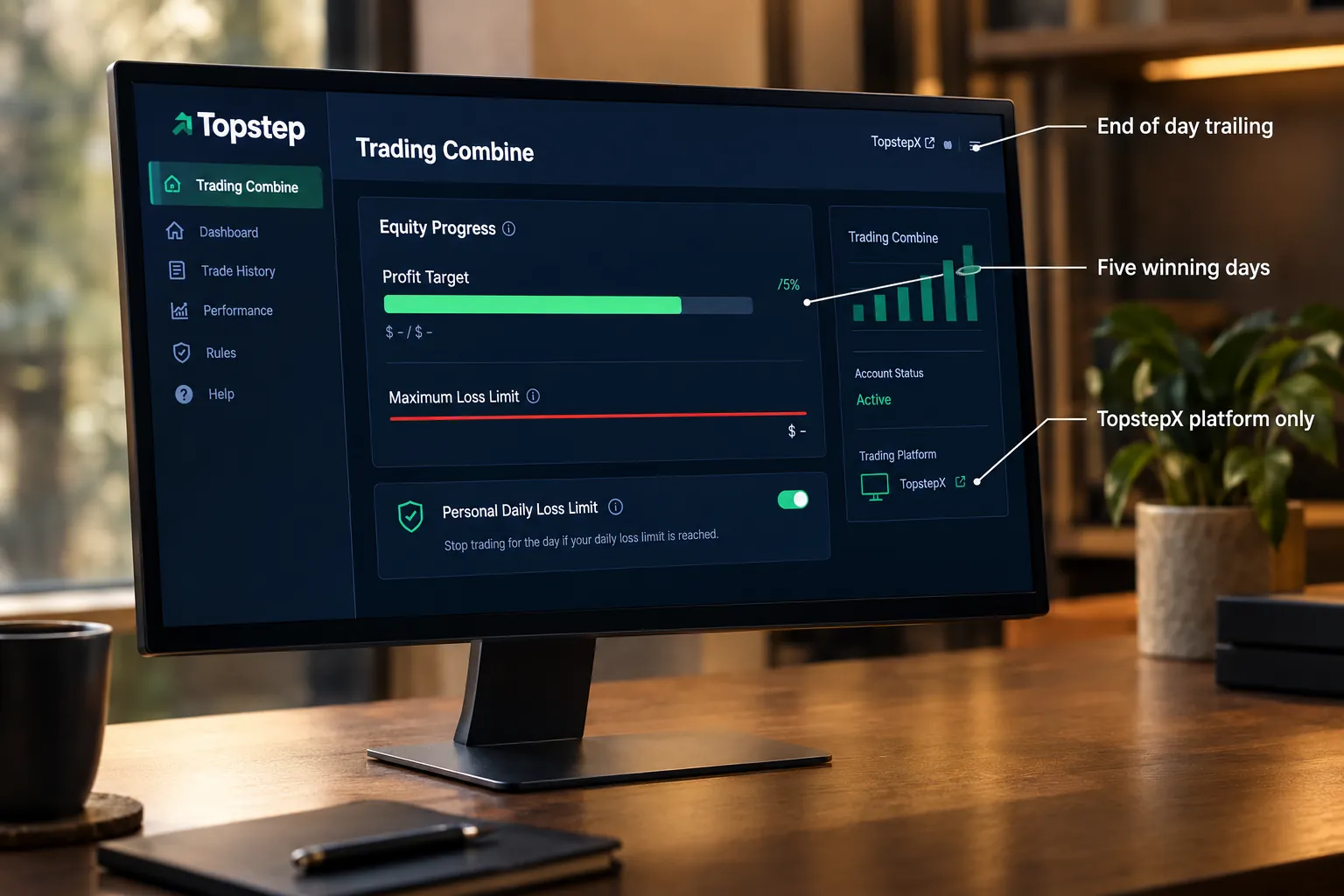
The mechanic that matters: the maximum loss limit is end-of-day trailing. On a 50K account it's $2,000, recalculated once at session close. If you're up $900 on an open ES trade and it pulls back to $200, your floor doesn't move. Traders on intraday firms lose accounts in exactly that moment.
Topstep also offers a separate personal daily loss limit you set yourself. Useful if you're prone to revenge trading, but track it as its own number.
Payouts: 100% of the first $10,000 in profits, withdrawals after five winning days, up to five funded accounts. Since July 2025, new accounts are locked to TopstepX, Topstep's own platform, so budget time to rebuild hotkeys and layouts.
✅ Pros - End-of-day trailing drawdown survives a green-then-pullback session - Longest operating record in futures prop trading - 100% of the first $10,000 in profits - Strong education and coaching resources
❌ Cons - $149 activation fee on top of monthly billing - New accounts locked to TopstepX - Five winning days before the first withdrawal - Five-account cap, next to Apex's 20
Check current Topstep pricing →
2. Apex Trader Funding
Best for: traders running one setup across many accounts, and anyone who wants to pick the drawdown mechanic themselves.
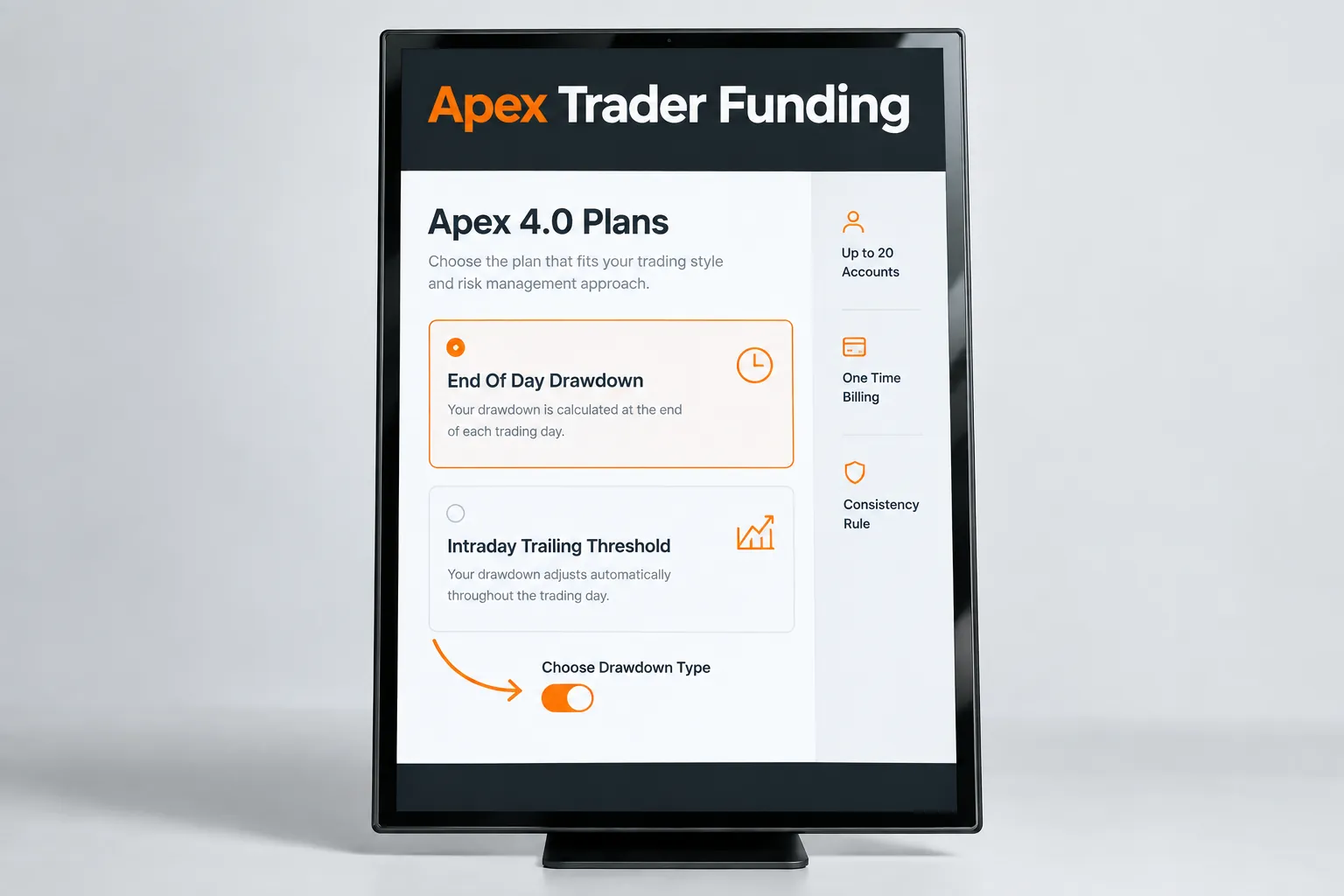
Apex rebuilt its model in March 2026 as Apex 4.0, adding an end-of-day drawdown option next to the intraday version it was known for. That change moved Apex from "high scale, harsh rules" to a real contender for top prop firm.
You choose at checkout. End-of-day accounts recalculate at 4:59 PM Eastern and carry a daily loss limit. Intraday accounts update in real time including unrealized profit, carry no daily loss limit, and cost less.
The detail almost nobody mentions: the intraday trail behaves differently by platform. On Rithmic and WealthCharts evaluations it locks once it reaches the profit target balance. On Tradovate it trails with no stop. Same product name, different risk. Pick your platform on purpose.
You keep 100% of the first $25,000, the best first tranche in the group, but the path runs through a six-step ladder with a Safety Net buffer and a 30% consistency rule. Up to 20 funded accounts at once is leverage on process if your setup is mechanical. If you're still tinkering with entries, it's 20 copies of the same mistake.
✅ Pros - Up to 20 funded accounts, highest in the category - 100% of the first $25,000 in profits - Drawdown type chosen at checkout - One-time billing instead of a subscription
❌ Cons - Intraday trail differs on Rithmic and WealthCharts versus Tradovate - 30% consistency rule - Six-step payout ladder delays the first meaningful withdrawal - Older forum threads describe a model that no longer exists
3. FundedNext
Best for: traders who want end-of-day drawdown by default and refuse to study a plan matrix to get it.
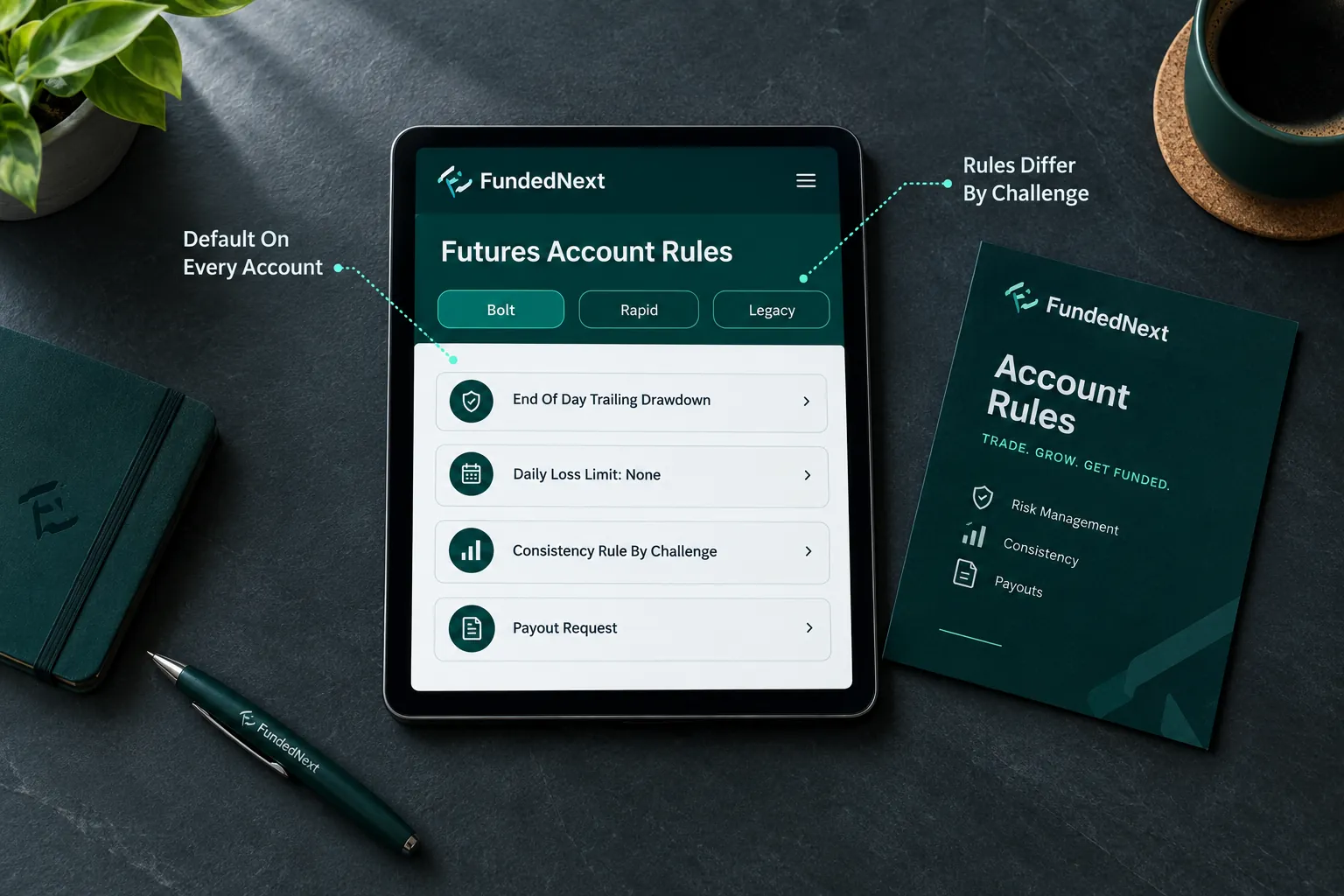
FundedNext applies end-of-day trailing drawdown across every futures account, evaluation and funded. No opt-in, no tier that quietly pushes you onto the intraday version. In a category that usually charges extra for the softer mechanic, that's a real position.
Three challenge types (Bolt, Rapid, Legacy) cover 25K, 50K, and 100K accounts. Rapid carries no consistency rule during the evaluation; Bolt carries one. There's no daily loss limit on futures accounts, and splits reach up to 100% on some futures programs.
The caveat is verification. FundedNext reports $144 million in 2025 payouts and advertises a 24-hour payout guarantee. Both are company claims, neither is independently audited, and the guarantee has conditions. Treat any prop firm's marketing numbers like a backtest with no live results.
✅ Pros - End-of-day trailing drawdown on every futures account - No daily loss limit on futures - Rapid has no consistency rule during the evaluation - Futures, forex, and CFDs under one roof
❌ Cons - Payout figures are unverified company claims - Consistency rules differ by challenge type - Shorter futures track record than Topstep or Apex - Futures rules can shift with unrelated forex product changes
Compare FundedNext challenges →
4. Tradeify
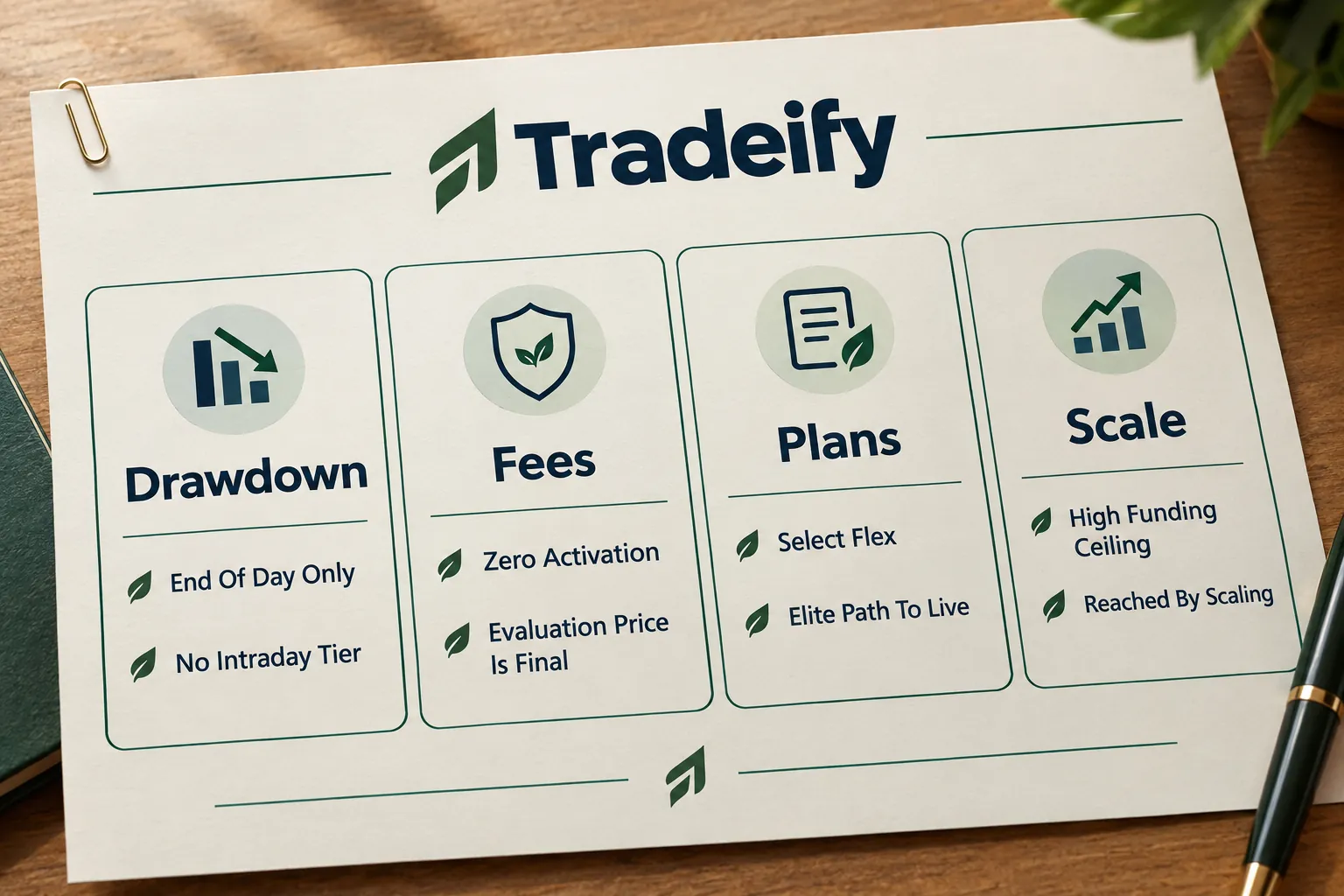
Best for: traders who want end-of-day drawdown, a 90/10 split, and no activation fee without picking the perfect plan.
Tradeify bundles three things the category normally charges for or hides behind a tier. End-of-day drawdown on every account. A 90/10 split as standard. Zero activation fees. The evaluation price is the full cost to get funded.
The Select Flex program carries no consistency rule on the funded account, which almost nobody offers. If your strategy takes a few large wins and lots of scratches, a consistency rule is what quietly blocks your payout. Removing it is worth more than a slightly better split. Elite is the documented path toward live capital, with funding up to $750,000 reached by scaling, not purchased outright.
The honest downside is age: a shorter payout record, a smaller community, and fewer independent reviews than an older top prop firm like Topstep. Trustpilot is reported around 4.8, but ratings move. Check it the day you buy.
✅ Pros - End-of-day drawdown on every account - 90/10 split as standard - Zero activation fees - Select Flex has no consistency rule on the funded account
❌ Cons - Shorter operating and payout history - Fewer independent reviews to verify rules against - Less published education than the established names - High funding ceilings require scaling
5. Take Profit Trader
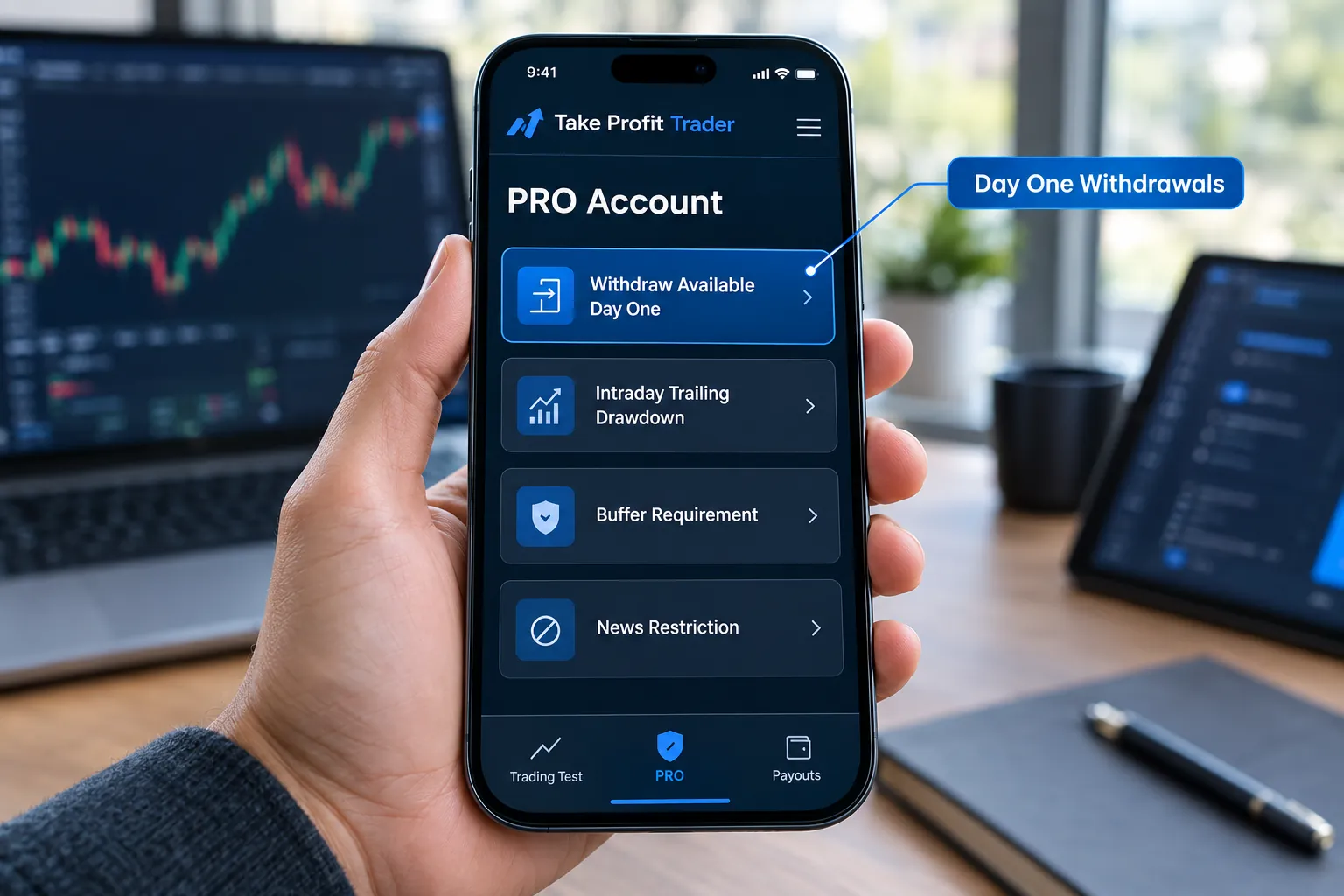
Best for: traders who want cash out fast and can hold discipline under an intraday trailing rule.
Take Profit Trader is the speed pick. One step, the Trading Test, leads to a simulated PRO account. Funding can take three trading days, and withdrawals are available from day one with no minimum profitable days. That's the fastest proof on this list that money actually comes out.
The trade-off: PRO uses intraday trailing drawdown, a buffer requirement that holds back part of the balance, and a news rule around major releases. The split is 80/20. A one-time $130 activation fee is charged before the funded account exists, and subscriptions run roughly $150 to $360 per month by size. The 90/10 split and end-of-day drawdown live on PRO+, a discretionary live tier typically offered after roughly $5,000 of PRO profits.
Credit where it's due: the firm publishes its own pass figure, stating 20.37% of registered users passed a trading test between January 1 and August 31, 2023. Most firms publish nothing.
✅ Pros - Day-one withdrawals on PRO - Fastest funding path here - Publishes its own pass rate - Up to three PRO resets
❌ Cons - PRO uses intraday trailing drawdown - $130 activation fee before funding - $50 fee on withdrawals of $250 or less - 90/10 split only on discretionary PRO+
6. MyFundedFutures
Best for: traders who want to match the plan to their style, and who understand the best split comes attached to the harshest drawdown.
MyFundedFutures (MFFU) applies different drawdown types to different plans instead of one house rule. Genuinely useful, and easy to get wrong.
- Rapid, 25K to 150K, 90/10 split, 4% intraday trailing drawdown, daily payouts, 50% consistency rule.
- Pro, 50K to 150K, 80/20 split, end-of-day trailing drawdown, bi-weekly payouts, capped at $100,000 cumulative payouts.
- Flex, 25K and 50K, end-of-day static drawdown, lowest entry price.
- Builder, single 50K account, fixed buffer drawdown set at checkout, 48-hour payouts.
Core sits around $77 per month with zero activation fee on every plan, and most plans carry no daily loss limit. The catch is the pairing: Rapid pays 90/10 and carries the 4% intraday trail. The marketing leads with the split. The drawdown is the price.
MFFU also publishes a disclosure most firms bury: fewer than 1% of participants progress to a live capital stage. That's the base rate for this whole industry, stated out loud.
✅ Pros - Rapid pays a 90/10 split - Zero activation fee on every plan - Flex offers static drawdown, which almost nobody sells - Most plans carry no daily loss limit
❌ Cons - The best split comes with 4% intraday trailing drawdown - Pro caps cumulative payouts at $100,000 - Tier 1 news restrictions - Plan choice is a drawdown choice the checkout doesn't lead with
7. Bulenox
Best for: algorithmic and semi-automated futures traders who need EA support and platform choice more than a clean rulebook.
Bulenox is here for one reason: it allows expert advisors and automated trading across more than 20 platforms. Most futures prop firms restrict automation or ban it. If your edge is coded, test it on futures backtesting software first, and read our breakdown of what retail traders get wrong about algorithmic trading before you fund anything.
You keep 100% of the first $10,000, and the 40% consistency rule is looser than the 30% several rivals apply. Then the problems. Activation fees on funded accounts are widely reported as unclear before purchase, and Bulenox runs a subjective review for "flipping." You can't model a rule that lives in someone's opinion. That discretion is why it sits at number seven.
✅ Pros - Allows expert advisors and automated trading - Supports 20+ platforms - 100% of the first $10,000 in profits - 40% consistency rule
❌ Cons - Activation fees widely reported as unclear pre-purchase - Discretionary "flipping" review - Less transparent rule documentation - Fewer published payout figures
📌 What You Should Know
Five things separate a top prop firm that wants you to pass from one that profits when you fail. Check all five before you enter a card number.
- End-of-day drawdown, or the option to choose it. The floor should recalculate at session close, not chase unrealized profit.
- Activation fees on the same page as the evaluation price. Not after you pass.
- A numeric consistency rule, or none. "No day above 30% of profit" is tradable. "We review for flipping" is not.
- A published payout path. Winning days, buffer, ladder, schedule. Vague payout terms are the most expensive kind of vague.
- Platform honesty. Being locked to one front end isn't automatically bad. Finding out after you pay is.
One more fact that changes the math in 2026: futures accounts were never under the pattern day trader rule, and FINRA's replacement of the $25,000 PDT minimum for stock margin accounts took effect June 4, 2026, with brokers phasing it in through October 2027. Self-funding is a more realistic alternative than it was a year ago. See our list of the best futures trading brokers if you're weighing that route.
⚠️ What to Look Out For
Pick the rule set that survives your own trading, not the top prop firm with the loudest split.
- Your give-back pattern versus intraday trailing. If you scale out of runners or hold through midday chop, an intraday trail will close you on a green day. Choose end-of-day: Topstep, Tradeify, FundedNext, or MFFU Pro.
- Lumpy wins versus consistency rules. A strategy that makes most of its money on two days a month will stall at payout under a 30% rule.
- Monthly billing on a slow pass. If your pass might take more than eight weeks, one-time billing is cheaper.
- The biggest account you can afford. A 150K account with a 4% intraday trail is a $6,000 moving floor and a temptation to oversize. A 50K account you pass beats a 150K account you reset three times. Paper trade the rule set first, and read why paper trading proves nothing until slippage shows up. Size it first with our free trade plan and position size calculator.
- News rules. Take Profit Trader and MFFU restrict Tier 1 releases. If CPI mornings are your setup, that matters more than the split.
- Untracked resets. Log every evaluation fee and reset in a journal. The real cost to funded is usually more than the sticker price. Our best trading journal comparison covers the tools that track it automatically.
Top 10 futures prop firms, rankings, and best prop firms 2026: what those searches really ask
People search this topic a dozen ways. Here's the short answer to each.
- Best prop firms 2026 / best futures prop firms 2026: the seven above, ranked on payout rules. Prices and rules change monthly, so treat any list older than 90 days as stale.
- Top 10 futures prop firms / top 5 futures prop firms: most "top 10" lists pad the bottom with forex firms. For US futures traders, these seven cover the realistic shortlist.
- Top prop firms for futures / best prop firms for futures in the US: filter for CME-approved data, US-friendly payout methods, and a clear restricted-countries list before ranking anything.
- Prop firm ranking: a top prop firm ranking is only as good as its criteria. Ours weights drawdown type first, because that rule decides most failures.
- Straight to funded and instant funding prop firms: skipping the evaluation usually means a higher upfront price and tighter funded rules. You pay for speed either way.
- FXIFY and Alpha Trader: two popular forex-side firms, covered in our FXIFY prop firm rules and Alpha Trader prop firm rules guides.
- Topstep prop firm review: Topstep ranks first here on track record and end-of-day drawdown; the TopstepX platform lock is the main trade-off.
How do these compare to other options?
Prop funding is the fastest route to rules-based size, which is different from size.
Trading your own account. No evaluation fee, no consistency rule, no trailing drawdown. You keep 100% of everything and eat 100% of every loss. Suits: traders with capital they can afford to lose, and strategies that need overnight holds or news trading. If you're starting small, see how to day trade without $25K.
Broker-backed funding and registered prop desks. Capital and training with real oversight, sometimes a path to employment. Slower, with more vetting. Suits: traders who want a career track rather than a payout.
Evaluation-based prop firms (all seven above). Any top prop firm rents you risk: pay a fee, accept tight rules, trade size you don't own. Suits: traders with a working strategy, a small account, and the discipline to follow someone else's rulebook.
The honest comparison: a prop firm swaps market risk for rule risk. MFFU's own under-1% figure tells you how that usually resolves. You're buying a structured test, not a job. Our breakdown of how prop firms make money shows where the fees go.
FAQ
Which is the top prop firm in 2026? Topstep, for most traders: 14 years of operating history, end-of-day trailing drawdown, and 100% of the first $10,000. Apex is better for 20 accounts or a bigger first tranche. Tradeify is better for zero activation fees and 90/10.
What is the most profitable prop firm? On first-tranche terms, Apex pays the most: 100% of the first $25,000. On ongoing split, Tradeify and MFFU Rapid at 90/10 are highest here. Your strategy still decides profitability, not the split.
Which prop firm actually pays? Topstep and Apex have the longest documented payout histories in futures prop trading. Take Profit Trader's day-one withdrawals are the fastest proof that money moves. No firm can promise a payout, because payouts require profits.
How do futures prop firms work? You pay an evaluation fee, trade a simulated account under set rules, and if you hit the profit target without breaking the drawdown, you get a funded account and a share of profits. The firm earns from fees, which is why the rules matter so much.
How do you pass a prop firm challenge? Trade smaller than the rules allow, pick a drawdown type that fits your give-back pattern, and stop for the day well before the daily limit. Most failures are sizing failures, not strategy failures.
Is there a free prop firm account? Not really. Some firms run free trials or practice accounts, but funded evaluations cost money. A free paper account at your broker is the honest way to test a strategy first.
What is the difference between intraday and end-of-day trailing drawdown? Intraday trailing follows unrealized profit in real time, so your limit rises with an open winner and doesn't fall back. End-of-day recalculates once at session close using your closed balance. End-of-day is materially easier to pass with the same strategy.
What is a consistency rule and does it block payouts? It caps how much of your total profit can come from one day at payout time: Apex 30%, Bulenox 40%, MFFU Rapid 50%. It doesn't take your money, but it can delay a withdrawal until you add smaller winning days.
Can I use automated trading at a prop firm? Bulenox explicitly permits expert advisors across 20+ platforms. Most futures prop firms restrict or ban automation. Confirm the policy in writing before you deploy a coded strategy, and give any bot an external kill switch so it can't trade through a drawdown limit.
Final verdict
Topstep is the top prop firm if you want the most established name and a drawdown rule that tolerates a normal pullback. Apex Trader Funding fits one setup across many accounts, as long as you confirm which platform your intraday trail runs on. Tradeify packages end-of-day drawdown, 90/10, and zero activation fees. FundedNext suits traders who want end-of-day by default. Take Profit Trader suits anyone who needs money out in days. MyFundedFutures suits traders matching plan to style, eyes open about Rapid's 4% intraday rule. Bulenox is for coded strategies with nowhere else to go.
Your next step is one calculation, not seven: write down your worst intraday give-back over your last 20 trades, then buy only the account whose drawdown floor survives that number. That single step eliminates most of this list and most of the resets you'd otherwise pay for. Cut the noise, keep the alpha.
FullStack Alpha has tested 200 AI stock tools. Seven prop firms are compared here, and the rest of the trading tools live in the FullStack Alpha directory, filterable by category, price, and what they actually do. Browse the directory → aistockpickerapps.com
This article contains affiliate links, and we may earn a commission if you sign up through them at no extra cost to you.