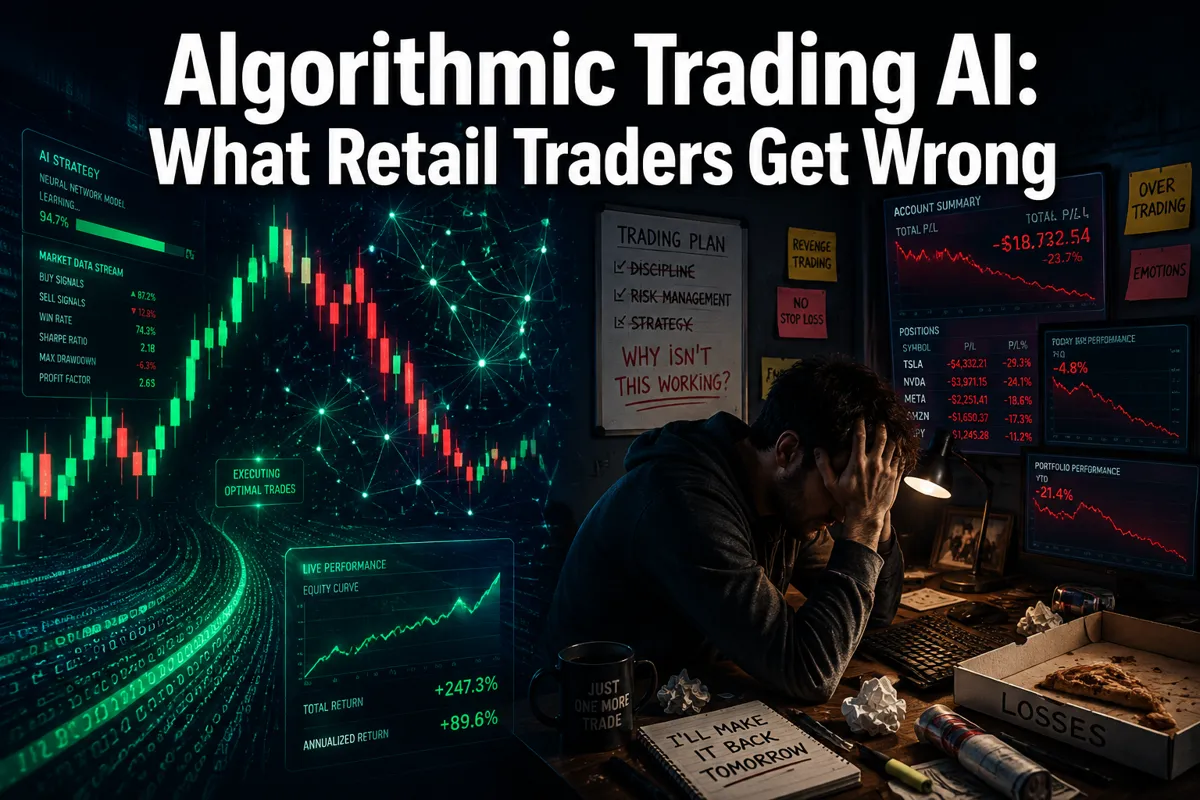
Algorithmic Trading AI: What Retail Traders Get Wrong
Last updated: June 30, 2026
Quick Answer: Most retail traders fail at algorithmic trading AI not because the technology doesn't work, but because they misunderstand what it actually does. Algo trading doesn't eliminate risk or replace judgment — it systematizes your edge, if you have one. If you don't have a proven edge going in, you're just automating your losses at scale.
Key Takeaways
- Algorithmic trading AI executes rules-based strategies automatically, but it cannot invent an edge that doesn't exist in your logic.
- Overfitting is the single biggest technical failure point: a backtest that looks perfect is usually a red flag, not a green light.
- Retail traders need far less capital to start than they think, but far more process discipline than most have.
- Algorithmic trading is legal and regulated for retail traders in the U.S. under SEC and FINRA oversight.
- Manual trading beats algo trading when the market regime shifts unexpectedly; neither is universally superior.
- No-code platforms like Capitalise.ai and Composer have genuinely lowered the barrier to entry, but low barriers attract underprepared traders.
- Backtesting without out-of-sample testing is the algo equivalent of studying the answer key and calling it exam prep.
- Latency matters far less for swing traders than for day traders; most retail algos don't need co-location servers.
- The tools exist. The process discipline is the actual gap.
What Is Algorithmic Trading and How Does It Work?
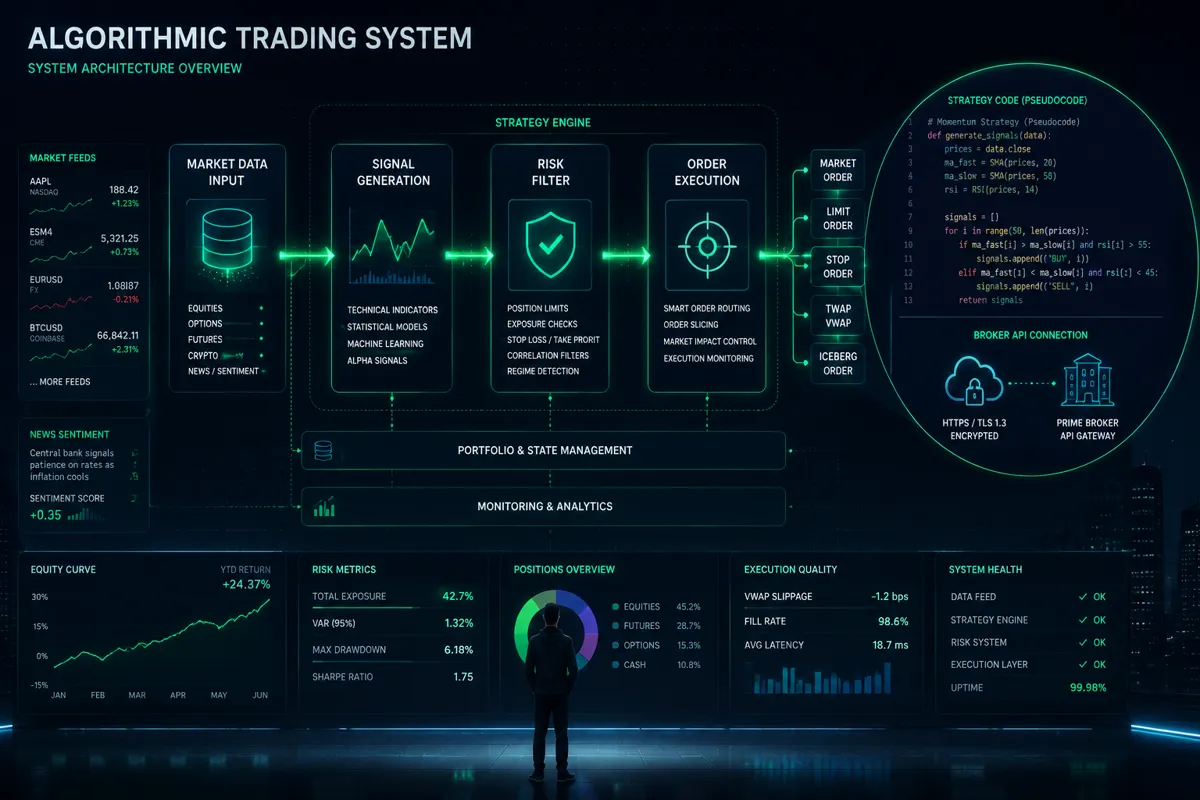
Algorithmic trading uses computer programs to execute buy and sell orders based on a predefined set of rules — price levels, volume thresholds, technical indicators, or statistical signals. The algorithm monitors the market continuously and fires orders the moment conditions are met, without a human clicking a button.
Here's the simple version: you define the rules, the machine follows them. If a stock closes above its 20-day moving average on above-average volume, buy. If it drops 5% from entry, sell. The algo doesn't hesitate, doesn't second-guess, and doesn't revenge trade after a bad morning.
The three core components of any trading algorithm:
- Signal generation — the logic that identifies a potential trade (price action, momentum, mean reversion, etc.)
- Risk management rules — position sizing, stop loss levels, maximum drawdown limits
- Execution layer — the connection between your logic and your broker's order system
Algorithmic trading AI in 2026 adds a machine learning layer on top of this. Instead of static rules, AI models can adapt to new data patterns. That sounds powerful. It also creates a whole new category of ways to get it wrong.
Algorithmic Trading AI: What Retail Traders Get Wrong (The Core Misunderstanding)
The biggest mistake retail traders make with algorithmic trading AI is treating it as a black box that prints money. It isn't. It's a mirror. It reflects whatever logic and process you put into it — amplified and automated.
Most retail traders come to algo trading after manual trading has frustrated them. They're tired of emotional decisions, missed entries, and getting stopped out on gut-feel trades. The instinct to systematize is correct. The execution is usually where it falls apart.
The three core misunderstandings, in order of how often they blow up accounts:
Confusing a backtest with a strategy. A backtest tells you how rules would have performed on historical data. It says nothing guaranteed about future performance. Play stupid games, win stupid prizes — and running a backtest without out-of-sample validation is the game.
Assuming more complexity equals more accuracy. A 47-indicator algorithm is not smarter than a 3-indicator one. It's usually just better at fitting noise. Algorithmic trading AI accuracy often peaks with simpler, more robust logic.
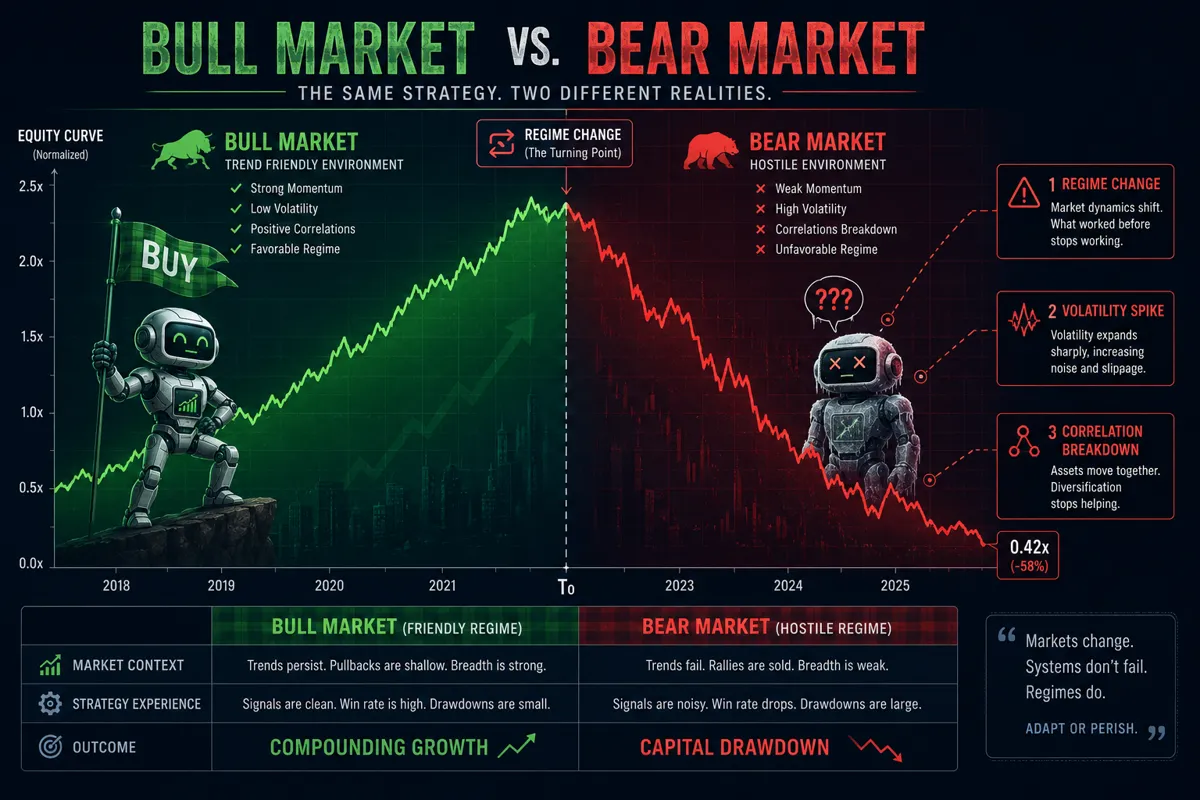
Ignoring regime change. An algo built in a trending bull market will often collapse in a choppy tape or a bear market. The market doesn't care about your backtest's Sharpe ratio.
The fix isn't a better algorithm. It's a better process. Systems over hacks.
Why Do Most Retail Traders Fail at Algorithmic Trading?
Retail traders fail at algorithmic trading for three reasons that have nothing to do with the technology: they skip process validation, they underfund the strategy, and they abandon the system the first time it draws down.
Process validation failures:
- Backtesting on the same data used to build the strategy (data snooping)
- Not accounting for slippage, commissions, or realistic fill prices
- Ignoring the maximum drawdown — only looking at total return
Capital and execution failures:
- Running a strategy that requires $50,000 in buying power on a $5,000 account
- Using a broker with slow execution that kills the edge on short-term strategies
- Not paper trading the system live before committing real capital — paper trade it first, always
Psychological failures (yes, even with algos):
- Turning the bot off during a drawdown, then turning it back on after it recovers — capturing the losses but missing the rebound
- Constantly tweaking parameters after every losing week (that's just manual trading with extra steps)
- FOFO — Fear of Following Orders — second-guessing the system in real time
Retail algo trading mistakes are rarely technical. They're behavioral.
Algorithmic Trading AI vs Manual Trading: Which Is Better?
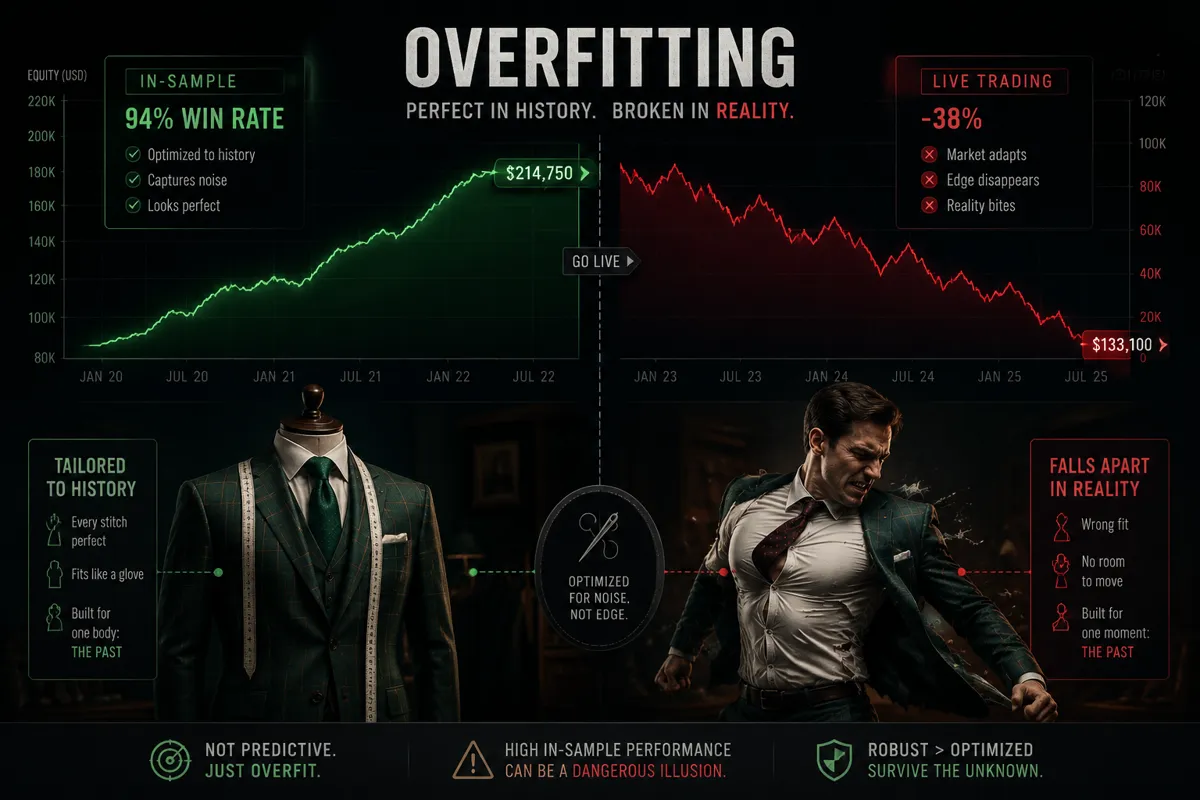
Neither is universally better. Algorithmic trading AI has a structural advantage in consistency and speed; manual trading has an advantage in adaptability and reading context that isn't in the data.
Choose algorithmic trading if:
- You have a clearly defined, rules-based edge you've validated
- You trade high-frequency or need to monitor multiple instruments simultaneously
- Your biggest enemy is your own emotional decision-making
Choose manual trading if:
- Your edge depends on reading the tape, interpreting news flow, or recognizing patterns that aren't easily quantified
- You're in earnings season and macro context matters more than price signals
- You're still building your process and haven't identified a repeatable edge yet
The honest answer for most retail traders in 2026: a hybrid approach. Use algorithmic trading AI to scan, filter, and alert. Use human judgment for final execution and position sizing. That's not a cop-out — that's how a lot of professional desks actually operate.
For day trading specifically, the AI day trading tools landscape has matured enough that retail traders can access institutional-grade scanning and signal logic without writing a single line of code.
How Much Money Do You Need to Start Algorithmic Trading?
You can technically start with as little as $500 on some platforms, but a realistic minimum for a meaningful retail algo trading strategy is $5,000 to $10,000. For U.S. equities day trading, the SEC's Pattern Day Trader rule requires a $25,000 minimum in a margin account if you're making more than three day trades per week.
Realistic capital tiers:
| Capital Level | What's Realistic |
|---|---|
| Under $2,500 | Paper trading, strategy validation only |
| $2,500 – $10,000 | Swing trading algos, crypto bots, small position sizing |
| $10,000 – $25,000 | Swing and position trading, limited day trading |
| $25,000+ | Full day trading algo access, more diversified strategies |
The capital question is often the wrong question. Traders ask "how much do I need?" when they should be asking "is my strategy validated enough to risk any real capital?" Risk-reward and position sizing matter more than account size at the start.
Best Algorithmic Trading Platforms for Beginners
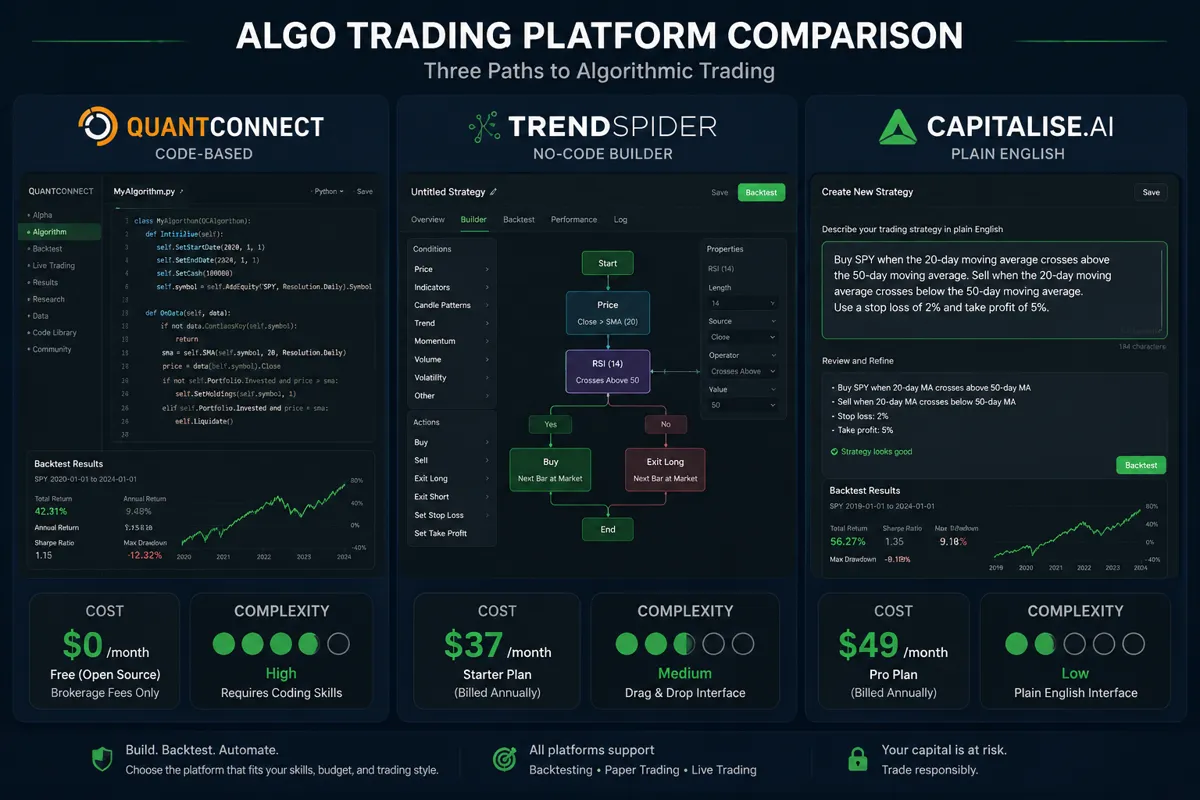
The best algorithmic trading platforms for beginners in 2026 depend on your technical comfort level. If you can code, QuantConnect gives you institutional-grade infrastructure for free. If you can't, no-code algorithmic trading tools like Capitalise.ai, Composer, and TrendSpider have genuinely changed the game.
Platform breakdown by skill level:
- QuantConnect — Open-source, Python/C#, connects to live brokers. Best for traders who want full control and can write code. Free tier available. Compare it against other algo platforms.
- TrendSpider — Visual, no-code strategy builder. Drag-and-drop algo logic with backtesting built in. Good for technical traders who think in charts.
- Capitalise.ai — Plain-English rule creation. Type "buy AAPL when RSI crosses above 30" and it builds the algo. Zero coding required.
- Composer — Drag-and-drop algo builder with direct broker execution. Strong for ETF rotation strategies.
- Trade Ideas — Holly AI runs overnight simulations and surfaces setups for the next day's session. More of an AI-assisted scanning layer than a pure algo executor.
For a side-by-side look at trading bots and algo execution tools, the directory covers costs, broker integrations, and use cases in detail.
Algorithmic Trading AI Overfitting: What It Is and Why It Destroys Retail Accounts
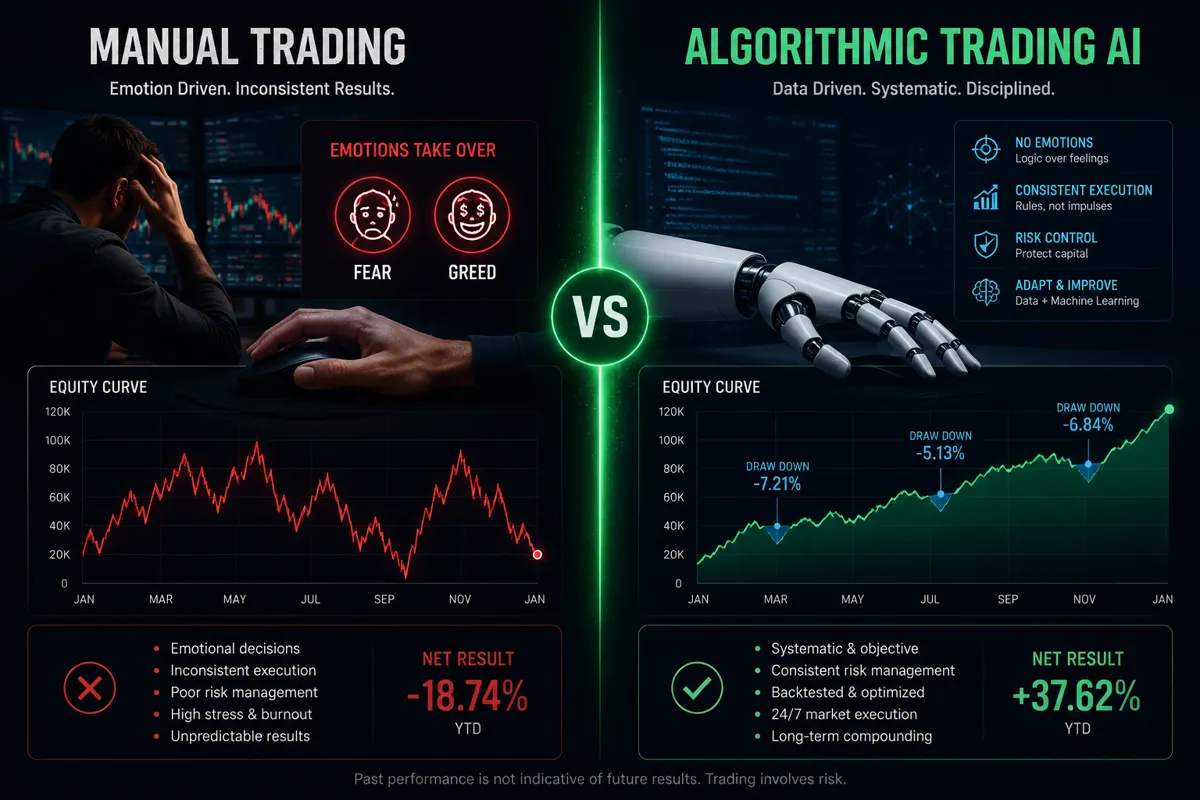
Overfitting is when your algorithm is so precisely tuned to historical data that it performs brilliantly in backtests and falls apart in live trading. It's the single most common technical failure in retail algo trading.
Think of it like this: you study for an exam using only the exact questions from last year's test. You ace the practice run. Then the real exam uses different questions, and you're lost. That's overfitting.
How to spot it:
- Backtest win rate above 80% with a Sharpe ratio above 3 — almost always overfit
- Strategy uses more than 5-7 parameters that were all optimized on the same dataset
- Performance degrades sharply when you test on data from a different time period
How to fix it:
- Split your data: train on 70%, test on the remaining 30% you never touched
- Use walk-forward testing — test in rolling windows, not one giant historical block
- Prefer simpler logic. If a 3-variable rule works, a 12-variable rule isn't better, it's just more fragile
Algorithmic trading AI accuracy in live markets is almost always lower than backtested accuracy. Build that assumption into your expectations before you risk a dollar.
How to Backtest a Trading Algorithm Correctly
A correct backtest accounts for realistic execution costs, uses out-of-sample data, and tests across multiple market regimes. Most retail backtests fail on all three counts.
The algo backtesting checklist:
- Include commissions and slippage in every simulation — assume you'll pay more than you think
- Use point-in-time data (no look-ahead bias — your algo shouldn't "know" tomorrow's close today)
- Split data into in-sample (training) and out-of-sample (validation) sets before you optimize anything
- Test across at least one bull market, one bear market, and one sideways/choppy period
- Check maximum drawdown, not just total return — a 200% return with a 70% drawdown is not a strategy you can actually trade
- Run a Monte Carlo simulation to stress-test the sequence of returns
For swing trading strategy builders that include backtesting modules, the quality of the historical data feed matters as much as the testing methodology. Garbage data in, garbage results out.
Is Algorithmic Trading Legal and Regulated for Retail Traders?
Yes, algorithmic trading is completely legal for retail traders in the U.S. The SEC and FINRA regulate the activity, and retail traders have the same legal right to use automated execution as institutional players.
A few important regulatory notes:
- You must trade through a registered broker-dealer — your algo can't connect directly to an exchange
- Market manipulation via algos (spoofing, layering) is illegal and actively prosecuted
- Wash trading — buying and selling the same security to create artificial volume — is prohibited
- Some brokers restrict certain types of high-frequency algo activity in retail accounts; check your broker's terms
The FINRA website (finra.org) has plain-English guidance on automated trading rules for retail investors. No exotic legal structure is required to run an algo as a retail trader.
Algorithmic Trading AI Latency and Execution Speed: Does It Matter for Retail Traders?
For most retail algorithmic trading strategies, latency is not the primary problem. Latency — the time delay between a signal and an executed order — matters enormously for high-frequency trading strategies that compete on microseconds. That's not what most retail traders are running.
When latency matters:
- Scalping strategies that target 1-5 cent moves on high-volume stocks
- Arbitrage strategies exploiting tiny price differences across exchanges
- Market-making strategies (generally not available to retail anyway)
When latency doesn't matter much:
- Swing trading algos holding positions for days or weeks
- End-of-day signal strategies that execute at the open or close
- ETF rotation systems that rebalance weekly or monthly
If you're running a swing trading algo on a standard retail broker, a 50-millisecond execution delay is irrelevant. The edge is in the logic and the risk management, not the fiber-optic cable. Don't let latency anxiety push you into expensive co-location services you don't need.
Should You Use Machine Learning for Stock Trading, or Is It a Scam?
Machine learning for stock trading is real, it works in specific applications, and it's also one of the most overhyped concepts in retail finance. It's not a scam — but most retail implementations of it are underpowered, poorly validated, and oversold.
Where ML genuinely adds value:
- Sentiment analysis on earnings call transcripts and news flow
- Pattern recognition across large datasets of price and volume history
- Regime classification — identifying whether the market is trending, mean-reverting, or in high-volatility mode
Where it tends to fail for retail traders:
- Predicting short-term price direction with high accuracy (the market is noisy enough that this rarely generalizes)
- Replacing fundamental analysis entirely
- Running on datasets too small to train a meaningful model
The honest take: use ML as a filter and a signal layer, not as an oracle. Tools like Trade Ideas and QuantConnect incorporate ML components that have been validated at scale. Building your own LSTM neural network to predict tomorrow's open on a 2-year dataset is a different story — that's a science project, not a trading strategy.
How Much Does Algorithmic Trading Software Cost?
Algorithmic trading software ranges from free to several thousand dollars per month. The cost depends on whether you need a coding environment, a no-code builder, live data feeds, and broker execution integration.
Rough cost ranges in 2026:
| Tool Type | Monthly Cost Range |
|---|---|
| Open-source (QuantConnect free tier) | $0 |
| No-code builders (Capitalise.ai, Composer) | $30 – $150/month |
| Professional platforms (TrendSpider) | $65 – $200/month |
| Institutional-grade data + execution | $500 – $2,000+/month |
The free and low-cost tier is genuinely functional for most retail algo strategies. Spending more doesn't automatically produce better results — that's the systems over hacks principle in action. Start with the minimum viable tool, validate your strategy, then upgrade if the edge justifies it.
For a full algo trading platform comparison including pricing, broker integrations, and use cases, the directory covers more than 100 tools with filters by cost and complexity.
Why Algorithmic Trading Works in Bull Markets but Fails in Bear Markets
Most retail algo strategies are implicitly long-biased and trend-following, which means they're built to perform in rising, trending markets. When the market regime shifts — into a bear market, a choppy tape, or a high-volatility sideways grind — those strategies stop working.
This is called regime sensitivity, and it's That wasn't in our bingo card for most retail algo traders the first time they experience it.
Why it happens:
- Trend-following signals generate false breakouts in sideways markets (bull traps everywhere)
- Volatility spikes widen spreads and increase slippage, killing the edge on tight setups
- Correlations between assets change — diversification assumptions built into the backtest break down
- Mean-reversion strategies that work in low-volatility environments get destroyed by momentum during panic selling
What to do about it:
- Build a regime filter into your algo — a simple VIX threshold or 200-day moving average slope can tell the system to reduce position sizing or go flat
- Backtest explicitly across 2008, 2020, and 2022 — if your algo didn't survive those, it's not ready
- Accept that no single strategy works in all market conditions. Discipline beats prediction: know when your setup isn't present and sit on your hands
The trend is your friend — until the trend ends. Build that into the code.
Conclusion: Stop Automating the Wrong Things
Algorithmic trading AI is one of the most powerful tools available to retail traders in 2026. It's also one of the most misused. The technology isn't the problem. The process is.
Most retail traders come to algo trading looking for a shortcut around the hard work of building a real edge. They backtest until the numbers look good, deploy capital, and then watch the live account do something the backtest never showed. That's not bad luck. That's a predictable outcome of skipping the process.
Here's what to actually do:
- Define your edge in plain English before you write a single rule. If you can't explain why the strategy should work, no algorithm will save you.
- Backtest correctly — out-of-sample data, realistic costs, multiple market regimes.
- Paper trade it live for at least 30 days before risking real capital.
- Start with a no-code tool (Capitalise.ai or Composer) if you're not a developer. The barrier to entry is low enough that there's no excuse to skip validation.
- Build a regime filter. Know when your strategy is designed to work and when to stand aside.
- Track your results with a trading journal. TraderSync is built for exactly this — pattern recognition on your own execution data.
Cut the noise, keep the alpha. The edge isn't in the algorithm. It's in the process behind it.
Want the tools and setups behind this, without the hype? Browse the full breakdown of AI trading platforms and algo tools at aistockpickerapps.com.
FAQ: Algorithmic Trading AI for Retail Traders
Q: Can a complete beginner start algorithmic trading without coding skills?
Yes. No-code platforms like Capitalise.ai and Composer let you build and deploy trading algorithms using plain English rules or drag-and-drop logic. No programming required. Start with paper trading before going live.
Q: How accurate is algorithmic trading AI in real markets?
Algorithmic trading AI accuracy in live markets is almost always lower than backtested performance. A strategy with a 65% win rate in backtesting might realistically deliver 52-58% live due to slippage, regime change, and data overfitting. Accuracy is less important than risk-reward ratio and consistency.
Q: Is algorithmic trading the same as high-frequency trading?
No. High-frequency trading (HFT) involves thousands of trades per second using co-located servers and microsecond execution. Most retail algorithmic trading operates on timeframes of minutes to days and doesn't require specialized infrastructure.
Q: What's the difference between a trading bot and an algorithmic trading system?
A trading bot is typically a pre-built, often simple automation tool (common in crypto). An algorithmic trading system is a more comprehensive framework that includes signal generation, risk management, and execution logic. The terms are often used interchangeably, but the underlying complexity can vary significantly.
Q: How do I know if my algo strategy is overfit?
If your backtest shows a win rate above 80% or a Sharpe ratio above 3, treat it as a warning sign. Test the exact same rules on a separate dataset you never used during development. If performance drops significantly, the strategy is overfit.
Q: Do I need a special broker for algorithmic trading?
Not necessarily. Brokers like Alpaca, Interactive Brokers, and Tradier offer API access for automated execution. Standard retail brokers like Fidelity and TD Ameritrade have more restrictions on automated trading. Check your broker's API documentation and terms before building a system.
Q: What is the Pattern Day Trader rule and how does it affect algo trading?
The PDT rule requires a minimum $25,000 balance in a U.S. margin account to make more than three day trades in a rolling five-day period. It applies to algorithmic day trading the same as manual day trading. Swing trading algos that hold positions overnight are not affected.
Q: Can algorithmic trading AI predict stock prices?
No system reliably predicts stock prices with high accuracy. Algorithmic trading AI identifies statistical edges and probabilities — conditions where certain outcomes have historically been more likely. That's fundamentally different from prediction. Anyone selling "AI price prediction" as a certainty is selling something you shouldn't buy.
Q: How long does it take to build a working algo trading strategy?
Realistically, 3-6 months from concept to validated live strategy — including research, backtesting, out-of-sample testing, and a paper trading period. Rushing this process is how retail traders end up automating losses.
Q: What's the best free tool for algo backtesting?
QuantConnect's free tier is the strongest free option for traders who can code in Python or C#. For no-code backtesting, TrendSpider and Capitalise.ai offer trial periods with backtesting functionality included.