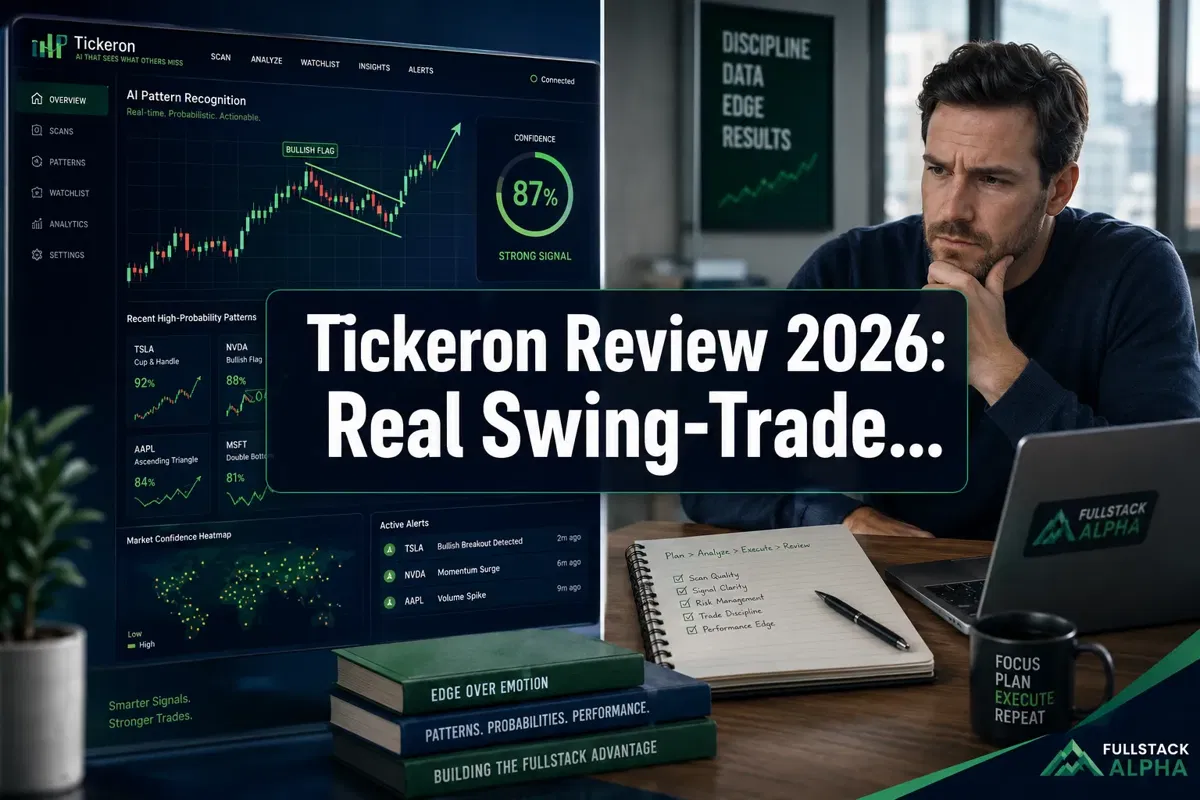
Tickeron Review 2026: Real Swing-Trade Edge or Overpriced Hype?
Last updated: July 19, 2026
Quick Answer
Tickeron is an AI-powered trading platform that scans for technical patterns, generates confidence-scored trade signals, and offers automated "AI robots" for swing and day trading. The platform costs between $65 and $360 per month depending on the tier, and while its pattern recognition engine is legitimately sophisticated, the accuracy claims require context: high confidence scores don't guarantee profitable trades, and most retail traders struggle to use the signals profitably without a solid risk management system already in place. It's a real tool with real AI, not snake oil, but it's also not a money printer, and the pricing puts it squarely in the "you better know what you're doing" category.
Key Takeaways
- Tickeron uses machine learning models to scan thousands of stocks for technical patterns and assigns confidence scores (up to 90%) based on historical pattern performance, not future guarantees.
- Pricing ranges from $65/month (basic scanner access) to $360/month (full AI robots, backtesting, and advanced pattern search), making it one of the pricier retail AI tools in 2026.
- The AI robots are pre-built algorithmic strategies that execute trades automatically via broker integration, but they require you to trust the system during drawdowns and losing streaks.
- Pattern recognition accuracy is high for identifying setups, but profitability depends entirely on your entry timing, position sizing, and stop-loss discipline, the AI doesn't manage risk for you.
- Tickeron works best for intermediate to advanced swing traders who already understand technical analysis and want to scale their watchlist process, not beginners hoping the AI will do the thinking.
- Common complaints include alert lag versus real-time broker prices, overfitting in backtests, and a steep learning curve for the platform's full feature set.
- Refund policy is limited: 14-day money-back guarantee on annual plans only, no refunds on monthly subscriptions after the first charge.
- Best alternatives for swing traders include Trade Ideas (better real-time scanning), TrendSpider (superior charting and automation), and Finviz (budget-friendly screening without AI hype).
What Is Tickeron and How Does It Work for Swing Trading?
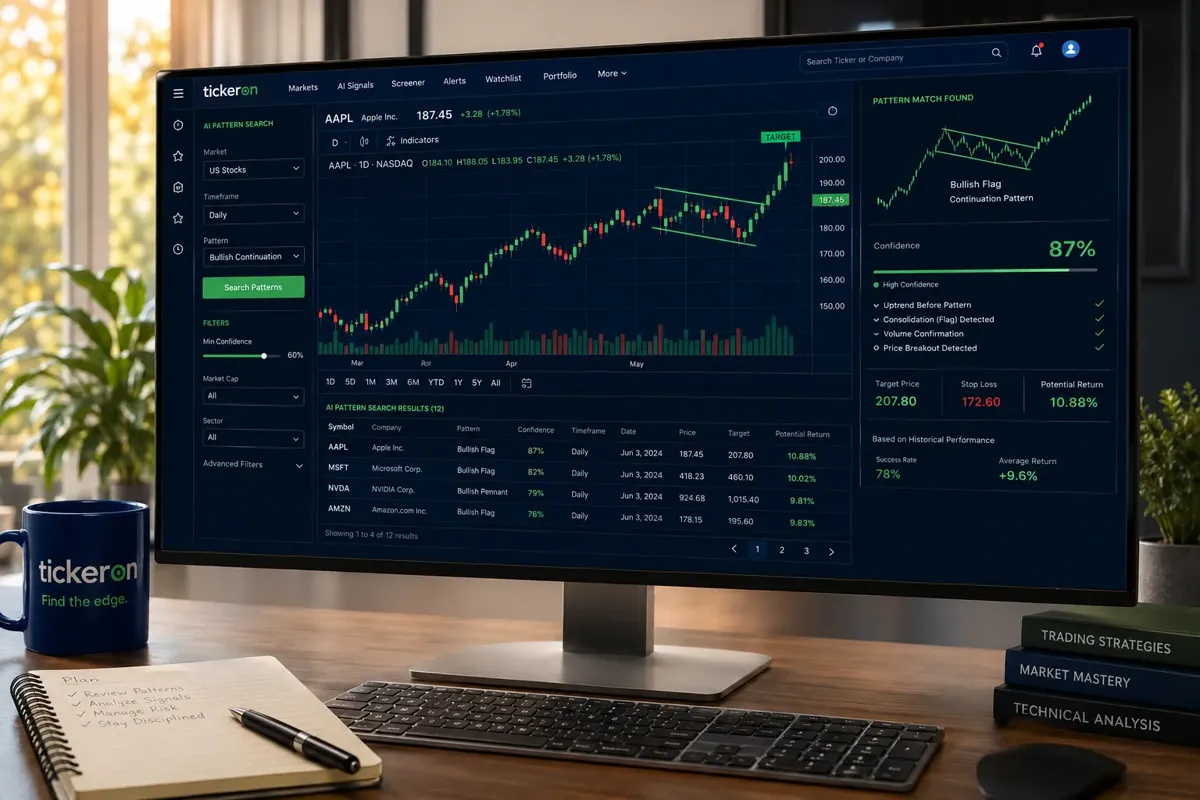
Tickeron is a subscription-based AI trading platform that combines technical pattern recognition, confidence-scored trade signals, and automated trading robots. The system scans the entire U.S. equity market (stocks and ETFs) for classic chart patterns, head and shoulders, triangles, channels, breakouts, and assigns each setup a confidence score based on how often that pattern has led to profitable moves historically.
For swing traders, the value proposition is simple: instead of manually scanning hundreds of charts every night looking for clean setups, Tickeron's AI does the heavy lifting and surfaces only the patterns that meet your criteria. You set filters for market cap, volume, sector, and pattern type, and the platform delivers a daily watchlist with entry points, price targets, and stop-loss levels already calculated.
The platform also offers "AI robots", pre-built algorithmic strategies that can execute trades automatically through integrated brokers like Alpaca or Interactive Brokers. These robots follow specific technical rules (trend-following, mean reversion, breakout strategies) and trade without human intervention once you activate them. Think of them as plug-and-play algo systems for retail traders who don't code.
The AI behind Tickeron isn't magic. It's pattern-matching software trained on decades of historical price data. When the system says a bullish flag has an 85% confidence score, it means that specific pattern setup has resolved upward 85% of the time in the past under similar market conditions. It does not mean your trade has an 85% chance of being profitable, because the AI doesn't know where you'll enter, how much you'll risk, or when you'll panic-sell during a pullback.
That distinction matters. Tickeron gives you the setup. You still have to execute the trade, manage the position, and handle the psychology when it moves against you. The platform is a scanner and signal generator, not a portfolio manager.
For swing traders specifically, Tickeron's pattern search and confidence scoring can save hours of chart time and help you catch moves before they break out. But it works best when you already know what a clean setup looks like and have a repeatable process for position sizing and risk management. If you're still learning support and resistance or don't have a stop-loss system, the AI won't fix that, it'll just give you more ways to lose money faster.
Tickeron Review 2026: Real Swing-Trade Edge or Overpriced Hype?
So here's the real question: does Tickeron actually give you an edge, or is it just expensive software that makes you feel smarter while your account bleeds?
The honest answer is both, depending on who's using it.
Tickeron's AI pattern recognition is legitimate. The confidence scores are based on real backtested data, the pattern library is comprehensive, and the platform surfaces setups you'd otherwise miss unless you were scanning charts for four hours a night. For an intermediate swing trader who already has a system and just needs better signal flow, Tickeron can absolutely improve your watchlist quality and help you catch breakouts earlier.
But, and this is a big but, the platform doesn't teach you how to trade. It doesn't manage your risk. It doesn't tell you when to cut a loser or let a winner run. It gives you a confidence score and a suggested entry, and then you're on your own. If you don't already have a process for position sizing, stop placement, and trade management, Tickeron will just help you lose money more efficiently.
The pricing is also a real barrier. At $65 to $360 per month, this isn't a tool you casually try for a month and forget about. You need to be trading with enough capital and frequency that the signals actually pay for themselves. If you're swing trading a $5,000 account and taking two trades a month, the subscription cost alone will eat a meaningful chunk of your returns. The math only works if you're actively trading and the signals are improving your win rate or helping you find better setups than you'd find on your own.
The AI robots add another layer of complexity. They're powerful if you trust them and let them run through drawdowns, but most retail traders can't handle watching an algo lose money for three weeks straight without intervening. The robots work on probabilities over hundreds of trades, not on being right every time. If you're the type of trader who checks your account every hour and second-guesses every red day, automated strategies will drive you insane.
So is it worth it? For the right trader, yes. If you're already profitable, you understand technical setups, you have a risk management system, and you want to scale your watchlist process with AI-powered pattern scanning, Tickeron is one of the better tools in the space. It's not hype, it's a real scanner with real edge for people who know how to use it.
But if you're a beginner hoping the AI will tell you what to buy and make you profitable, you're going to be disappointed. Tickeron is a tool, not a strategy. It amplifies what you already know, it doesn't replace the work of learning how to trade.
For more on how AI tools fit into a real trading system, check out our breakdown of 7 AI tools swing traders are using to catch moves before everyone else.
Tickeron Pricing Plans 2026: How Much Does It Cost?
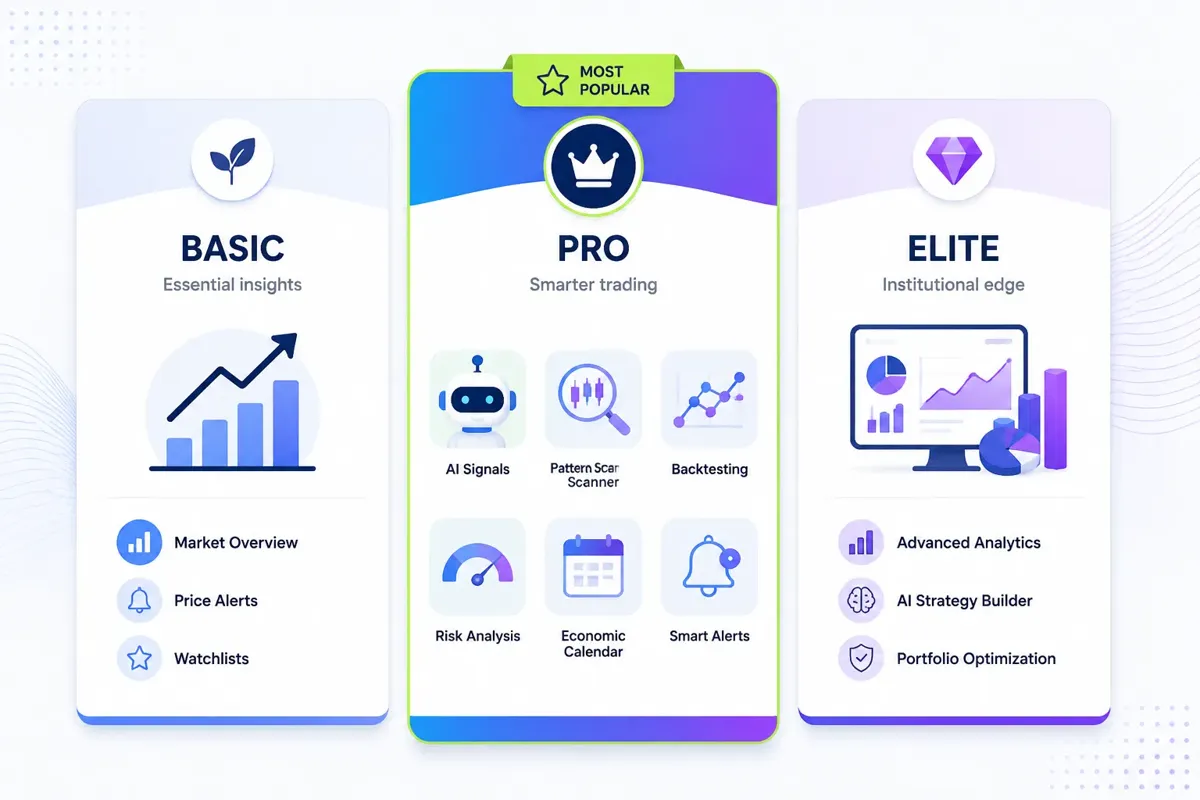
Tickeron offers three main subscription tiers, and the pricing is aggressive compared to most retail trading tools. Here's the breakdown as of 2026:
Basic Plan: $65/month
- Access to pattern search and technical analysis scanner
- Confidence-scored trade signals for stocks and ETFs
- Basic AI trend predictions
- Limited to 10 AI robot activations per month
- No backtesting or advanced analytics
Premium Plan: $180/month
- Everything in Basic
- Unlimited AI robot activations
- Full backtesting suite with historical performance data
- Advanced pattern recognition (including rare setups)
- Real-time alerts and notifications
- Access to Tickeron's financial learning models (FLMs)
Professional Plan: $360/month
- Everything in Premium
- Priority support and onboarding
- API access for custom integrations
- Advanced portfolio analytics and risk metrics
- Institutional-grade AI agents for multi-strategy automation
All plans offer a 14-day money-back guarantee, but only on annual subscriptions. If you pay monthly, you're locked in after the first charge, no refunds. That's a red flag if you're testing the platform for the first time. The smart move is to go annual if you're serious, or accept that your first month is a sunk cost if it doesn't fit your style.
The pricing is steep, especially compared to alternatives like Finviz Elite ($40/month) or even TrendSpider ($50,$100/month depending on the plan). You're paying a premium for the AI pattern recognition and the automated robots, so the value equation only works if you're actually using those features and they're improving your results.
For most swing traders, the Premium plan at $180/month is the sweet spot. It gives you full access to the pattern scanner, unlimited robot activations, and backtesting so you can validate setups before risking real money. The Basic plan is too limited for serious use, and the Professional plan is overkill unless you're running multiple strategies or need API access for custom algo development.
One more thing: Tickeron occasionally runs promotions (20-30% off annual plans), especially around Black Friday and New Year. If you're planning to subscribe, wait for a discount, the full-price annual cost is over $2,000 for Premium, and that's a real commitment.
Tickeron vs Trade Ideas: Which Is Better for Swing Traders?
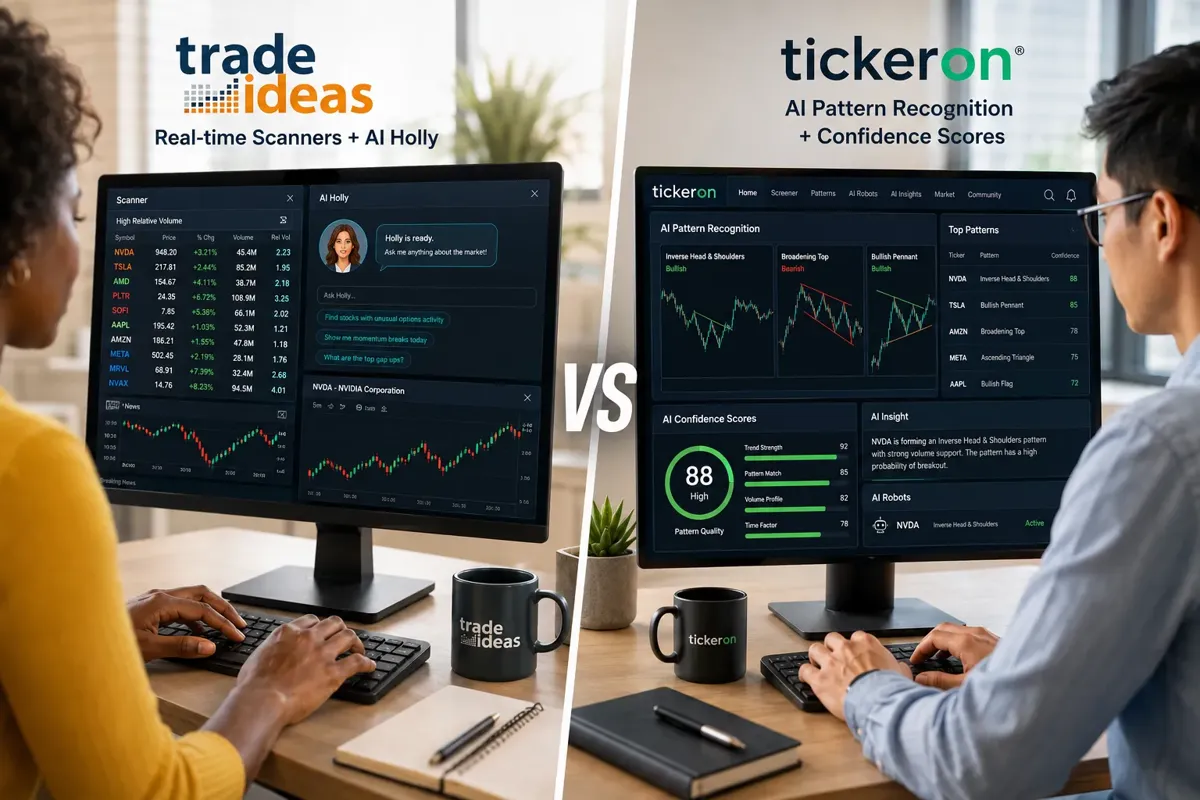
This is the comparison most traders ask about, because Trade Ideas and Tickeron are the two dominant AI-powered scanners in the retail space. They're both expensive, both use AI, and both promise to surface high-probability setups before the crowd sees them. But they're built for different types of traders.
Trade Ideas is a real-time scanning monster. It's built for day traders and active swing traders who want live alerts the second a stock breaks out, hits unusual volume, or triggers a custom technical setup. The AI engine (Holly) is fast, the scanner is endlessly customizable, and the platform integrates directly with most brokers for one-click order entry. If you're the type of trader who watches the tape during market hours and wants to catch moves as they happen, Trade Ideas is the better tool.
Tickeron is more of a nightly research platform. It's designed for swing traders who do their homework after the close, build a watchlist, and execute trades the next morning. The pattern recognition is more sophisticated than Trade Ideas (Tickeron's confidence scores are based on deeper historical analysis), and the AI robots give you automated execution if you want to set-and-forget. But the alerts are slower, the interface is clunkier, and it's not built for real-time intraday scanning.
Here's the practical breakdown:
Choose Trade Ideas if:
- You trade during market hours and want real-time alerts
- You need fast, customizable scanning with live data
- You're a day trader or active swing trader who takes multiple positions per week
- You want a platform that integrates tightly with your broker for fast execution
Choose Tickeron if:
- You do your research after the close and trade on a swing timeframe (days to weeks)
- You want AI-scored pattern recognition with historical confidence data
- You're interested in automated trading robots that execute strategies for you
- You prefer a more hands-off approach and don't need real-time alerts
For most swing traders, Trade Ideas is the better value. It's faster, more flexible, and the real-time scanning gives you an edge that Tickeron's end-of-day signals can't match. But if you're specifically looking for pattern-based setups with historical confidence scoring and you like the idea of automated robots, Tickeron has features Trade Ideas doesn't offer.
You can compare both tools side-by-side in our AI stock tools comparison hub.
Does Tickeron Actually Help You Make Money Swing Trading?
This is the only question that matters, and the answer is frustratingly nuanced: Tickeron can help you make money, but only if you already know how to trade.
The platform's AI doesn't create edge out of thin air. What it does is scale your ability to find clean setups. If you already know what a tight consolidation looks like, understand support and resistance, and have a repeatable process for entries and exits, Tickeron will help you find more of those setups faster. It's a force multiplier for traders who have a system.
But if you're a beginner or struggling trader hoping the AI will tell you what to buy and make you profitable, you're going to lose money. The confidence scores are seductive, an 85% bullish pattern sounds like a sure thing, but that number only reflects historical pattern performance, not your ability to execute the trade correctly. You still have to time the entry, size the position, set a stop loss, and manage the trade through volatility. The AI doesn't do any of that.
The real edge Tickeron offers is pattern recognition at scale. Manually scanning for head-and-shoulders reversals or ascending triangles across 5,000 stocks every night is impossible. Tickeron does it in seconds and surfaces only the setups that meet your criteria. That's valuable if you know what to do with the information.
The AI robots are a different story. They can be profitable if you let them run and don't interfere, but most retail traders can't handle the psychological pressure of watching an algo lose money for weeks before it recovers. The robots are designed to win over hundreds of trades, not to be right every time. If you're going to override the system every time it hits a drawdown, you're better off trading manually.
Here's the uncomfortable truth: Tickeron is a tool for traders who are already making money and want to scale their process. It's not a training platform, it's not a strategy, and it's not a shortcut. If you're not profitable without it, you won't be profitable with it. The AI will just help you lose money faster and with more confidence.
For traders who do have a system, Tickeron's pattern scanner and confidence scoring can absolutely improve your watchlist quality and help you catch breakouts earlier. But you have to bring the discipline, the risk management, and the emotional control. The AI handles the scanning. You handle everything else.
Tickeron AI Accuracy Rate: How Often Are Predictions Correct?
Tickeron markets its AI confidence scores aggressively, you'll see patterns labeled with 80%, 85%, even 90% confidence ratings. The natural assumption is that these numbers represent your odds of making money on the trade. They don't.
The confidence score reflects how often that specific pattern setup has resolved in the predicted direction historically. If a bullish flag pattern has an 85% confidence score, it means that in Tickeron's backtested data, that pattern led to an upward move 85% of the time under similar market conditions. It's a historical win rate for the pattern, not a prediction of your trade outcome.
Here's why that distinction matters: even if the pattern resolves correctly, you can still lose money. You might enter too early and get stopped out before the breakout. You might enter too late and chase it at the top. You might size the position wrong, set your stop too tight, or panic-sell during a normal pullback. The AI doesn't control any of that, you do.
Tickeron's pattern recognition is legitimately good. The machine learning models are trained on decades of price data, and the platform does a solid job identifying technical setups that have historically worked. But "historically worked" and "will make you money this time" are not the same thing.
The other issue is overfitting. Backtests always look better than live trading because the AI is optimized on historical data. When you run a strategy forward in real time, slippage, commissions, and market conditions that weren't in the training data all degrade performance. Tickeron's backtested accuracy rates are real, but they're also best-case scenarios. Expect live results to be 10-20% worse than the backtest suggests.
So what's the actual accuracy rate in live trading? Tickeron doesn't publish that data, and user-reported results vary wildly. Some traders report win rates in the 60-70% range on swing trades using the AI signals. Others report break-even or losing performance, usually because they're not managing risk correctly or they're overtrading the signals.
The bottom line: Tickeron's AI is accurate at identifying patterns. Whether those patterns make you money depends entirely on your execution, risk management, and discipline. The confidence score is a useful data point, but it's not a guarantee. Treat it like a weather forecast, helpful context, not a promise.
For a deeper look at how AI prediction accuracy translates (or doesn't) into real trading edge, see our review of Kavout's KAI Score.
Is Tickeron Worth It for Beginner Traders or Too Advanced?
Short answer: Tickeron is too advanced for most beginners, and it's expensive enough that using it without a solid foundation is a fast way to burn money.
The platform assumes you already understand technical analysis. It doesn't teach you what a bull flag is, why support and resistance matter, or how to size a position. It gives you a confidence-scored pattern and expects you to know what to do with it. If you're still learning the basics, the AI will overwhelm you with signals you don't know how to filter or execute.
Beginners also tend to over-rely on the confidence scores. An 85% bullish pattern feels like a sure thing, so they go all-in without a stop loss or risk plan. Then the pattern fails (because 85% isn't 100%), and they lose more than they should have because they didn't manage the trade correctly. The AI doesn't teach risk management, it assumes you already have it.
The pricing is another barrier. At $65 to $360 per month, Tickeron is one of the more expensive retail tools in the space. If you're trading a small account (under $10,000) and you're still learning, the subscription cost will eat a meaningful percentage of your capital. You're better off spending that money on education and using free or low-cost scanners like Finviz or TradingView until you're consistently profitable.
That said, if you're a beginner who's serious about learning and you're willing to paper trade the signals for three to six months before risking real money, Tickeron can be a valuable learning tool. The pattern recognition will teach you what clean setups look like, and the confidence scores will help you understand which patterns have better historical odds. But you have to commit to the learning process and not treat the AI as a magic money button.
For most beginners, the better path is to start with simpler, cheaper tools and upgrade to Tickeron once you're profitable and ready to scale. Learn the basics with Finviz or TradingView, build a repeatable process, and then add AI-powered pattern scanning once you know what you're looking for.
If you're looking for beginner-friendly AI tools that won't break the bank, check out our guide to AI stock market apps taking over traders' phones in 2026.
Common Mistakes People Make When Using Tickeron Signals
Even experienced traders screw up when they first start using Tickeron. Here are the most common mistakes that turn a useful tool into an expensive lesson:
1. Trusting the confidence score without confirming the setup yourself.
The AI might flag a bullish pattern with 85% confidence, but if the stock is overextended, the volume is weak, or the broader market is choppy, that confidence score doesn't mean much. Always confirm the setup with your own chart analysis before taking the trade.
2. Overtrading the signals.
Tickeron surfaces a lot of patterns every day. New traders see 50 high-confidence setups and try to trade all of them. That's a recipe for overtrading, poor execution, and death by a thousand small losses. Pick your best three to five setups and ignore the rest.
3. Ignoring risk management.
The AI gives you an entry and a target, but it doesn't manage your stop loss or position size. If you're not calculating risk-reward and setting stops before you enter, the confidence score won't save you. Most losing Tickeron trades happen because the trader didn't cut the loss fast enough.
4. Chasing alerts after the move has already started.
Tickeron's alerts can lag real-time price action, especially on the lower-tier plans. By the time you get the notification, the stock might have already broken out and run 5%. Chasing it at that point turns a good setup into a bad entry. Wait for a pullback or skip the trade.
5. Using the AI robots without understanding the strategy.
The automated robots are powerful, but they're also black boxes. If you don't understand the logic behind the strategy (trend-following, mean reversion, breakout), you won't know when it's working correctly or when it's broken. Never run a robot live until you've backtested it and understand its drawdown profile.
6. Expecting the AI to be right every time.
Even a 90% confidence pattern fails 10% of the time. If you're not prepared for losing trades and you don't have a process for cutting losers fast, you'll blow up your account chasing the "sure things."
7. Not paper trading the signals first.
Most traders skip the paper trading phase and go straight to live money because they're impatient. Then they lose money, blame the AI, and cancel the subscription. Paper trade Tickeron's signals for at least 30 days before risking real capital. Learn how the platform works, how the patterns resolve, and how to manage the trades.
The pattern here is clear: Tickeron gives you the setup, but you still have to execute the trade correctly. The mistakes aren't the AI's fault, they're execution and discipline failures. Fix those, and the platform becomes a lot more useful.
Tickeron Refund Policy: Can You Get Your Money Back?
Tickeron's refund policy is restrictive, and it's one of the most common complaints in user reviews. Here's how it works:
- 14-day money-back guarantee on annual plans only. If you pay for a full year upfront, you have 14 days to test the platform and request a refund if it's not a fit.
- No refunds on monthly subscriptions. If you subscribe month-to-month, you're locked in after the first charge. You can cancel to stop future billing, but you won't get a refund for the current month.
- No partial refunds on annual plans after 14 days. If you're six months into an annual subscription and decide to cancel, you don't get a prorated refund for the unused months.
This policy is designed to push users toward annual plans (which are cheaper per month and give Tickeron more committed revenue), but it's also a risk if you're testing the platform for the first time. The smart move is to start with a monthly plan, accept that the first month is a sunk cost, and upgrade to annual only if you're confident the platform fits your trading style.
If you do request a refund within the 14-day window on an annual plan, the process is straightforward, email support with your account details and reason for cancellation. Most refunds are processed within 5-7 business days.
The lack of monthly refunds is frustrating, but it's not uncommon in the SaaS trading tool space. Trade Ideas, TrendSpider, and most other premium platforms have similar policies. The lesson: don't subscribe to Tickeron (or any expensive trading tool) unless you're ready to commit to at least one month of testing.
What Are the Best Alternatives to Tickeron for Swing Trading?
If Tickeron's pricing or feature set doesn't fit your needs, here are the best alternatives for swing traders in 2026:
Trade Ideas ($118,$228/month)
Best for real-time scanning and intraday alerts. Faster than Tickeron, more customizable, and better for active traders who want live signals during market hours. The AI engine (Holly) is top-tier, and the platform integrates directly with most brokers. Compare Trade Ideas here.
TrendSpider ($50,$100/month)
Best for charting and technical analysis automation. TrendSpider's multi-timeframe analysis and automated trendline drawing are superior to Tickeron's charting tools. It's also cheaper and better for traders who want to do their own analysis with AI-powered assistance. See TrendSpider breakdown.
Finviz Elite ($40/month)
Best budget alternative. Finviz doesn't have AI pattern recognition, but its screener is fast, reliable, and covers all the technical filters swing traders need. If you're on a tight budget and you know how to scan manually, Finviz Elite is the best value in the space.
TradingView Pro+ ($30,$60/month)
Best for charting and community-driven signals. TradingView's charting is industry-standard, and the social trading features let you follow experienced traders and see their setups in real time. It's not AI-powered, but it's cheaper and more flexible than Tickeron.
AltIndex ($99/month)
Best for alternative data signals. If you want AI-driven trade ideas based on sentiment, web traffic, and social data instead of pure technical patterns, AltIndex is a strong complement to traditional scanners. Read our AltIndex review.
For a full side-by-side comparison of AI trading tools, check out our swing trading tools hub.
Who Should Not Use Tickeron: When Is It a Bad Fit?
Tickeron isn't for everyone. Here's who should skip it:
Beginner traders with less than six months of experience. If you're still learning what a clean setup looks like, Tickeron will overwhelm you with signals you don't know how to filter. Start with simpler tools and free education first.
Traders with small accounts (under $5,000). The subscription cost is too high relative to your capital. You'll spend more on the tool than you'll make in profits while you're learning.
Day traders who need real-time alerts. Tickeron's alerts lag real-time price action. If you're trading intraday moves, Trade Ideas or TrendSpider are better fits.
Traders who want a plug-and-play solution. Tickeron requires active decision-making. The AI gives you signals, but you still have to execute, manage, and close the trades. If you want fully automated investing, look at robo-advisors or ETF portfolios instead.
Traders who don't understand technical analysis. If you don't know what support, resistance, or a breakout are, the AI signals won't help you. Learn the basics first, then add AI tools.
Anyone expecting guaranteed returns. If you think the AI will make you profitable without effort, you'll be disappointed. Tickeron is a tool, not a strategy.

Tickeron Pattern Search Feature: Does It Work for Day Trading Too?
Tickeron's pattern search is built primarily for swing trading, but it can work for day trading with some caveats.
The pattern recognition engine scans daily charts by default, which means it's optimized for setups that play out over days to weeks, not hours. You can adjust the timeframe to intraday (15-minute, 30-minute, 1-hour charts), but the confidence scores are less reliable on shorter timeframes because there's less historical data to train the AI.
Day traders who use Tickeron typically use it for pre-market research, scanning for overnight patterns and gap setups, and then execute the trades manually during market hours. The platform isn't fast enough for real-time intraday scanning, so if you're trying to catch breakouts as they happen, you'll miss moves.
The AI robots can technically run on intraday timeframes, but most day traders don't trust automated systems for fast-moving intraday trades. The execution lag and slippage on volatile stocks can turn a profitable backtest into a losing live strategy.
Bottom line: Tickeron's pattern search works for day trading if you're using it for pre-market research and you're executing trades manually. But if you need real-time intraday scanning and alerts, Trade Ideas is the better tool.
Why Are My Tickeron Alerts Not Matching My Broker Prices?
This is one of the most common frustrations with Tickeron, and it usually comes down to data lag and execution timing.
Tickeron's alerts are based on end-of-day data or delayed intraday data, depending on your subscription tier. By the time you receive the alert, the stock's price may have already moved. If you're comparing the alert price to your broker's real-time quote, there will be a gap.
The other issue is slippage. Tickeron's suggested entry price assumes you can execute at the exact moment the pattern triggers. In reality, you're placing a market order seconds or minutes later, and the price has moved. On low-volume stocks or during volatile market conditions, that slippage can be significant.
Here's how to minimize the problem:
- Use limit orders instead of market orders to control your entry price.
- Don't chase alerts that have already moved 3-5% from the suggested entry. Wait for a pullback or skip the trade.
- Upgrade to a higher-tier plan if you're on the Basic subscription, Premium and Professional plans have faster data feeds.
- Cross-check Tickeron's alerts with your broker's real-time chart before entering. If the setup no longer looks clean, don't force the trade.
The alert lag is a real limitation of the platform, and it's one reason why active day traders prefer Trade Ideas or TrendSpider. For swing traders who are executing trades at the open or after the close, the lag is less of an issue.
Tickeron Real User Reviews: Complaints and Success Stories
User reviews of Tickeron are mixed, and the pattern is clear: traders who already have a system and use the platform as a scanner tend to like it. Traders who expected the AI to make them profitable without effort tend to hate it.
Common positive feedback:
- "The pattern recognition is legit. I've been swing trading for five years, and Tickeron surfaces setups I would have missed manually."
- "The confidence scores help me prioritize which setups to focus on. I'm not wasting time on low-probability trades anymore."
- "The AI robots are profitable if you let them run and don't interfere. I've been running the trend-following robot for six months and it's up 12%."
Common complaints:
- "The alerts are too slow. By the time I get the notification, the stock has already moved."
- "The backtests look great, but live performance is way worse. I think the AI is overfitted."
- "The platform is clunky and hard to navigate. It took me two weeks just to figure out how to set up custom scans."
- "I lost money following the signals because I didn't know when to cut losses. The AI doesn't teach you risk management."
- "The refund policy is terrible. I paid for a month, realized it wasn't for me, and couldn't get my money back."
The success stories tend to come from intermediate to advanced traders who use Tickeron as one tool in a broader system. The complaints come from beginners who expected the AI to do the work for them.
If you're considering Tickeron, read the user reviews on Reddit, TrustPilot, and trading forums. Look for reviews from traders with similar experience levels and trading styles to yours. That'll give you a better sense of whether the platform is a fit.
How Long Does It Take to Learn Tickeron Platform?
The learning curve for Tickeron is steeper than most retail trading tools, and it varies depending on your experience level.
If you're an experienced trader who already understands technical analysis: expect 1-2 weeks to get comfortable with the platform. You'll need time to learn the interface, set up custom scans, and understand how the confidence scores work. But the core concepts (patterns, support/resistance, breakouts) are familiar, so you're mostly learning the software, not the strategy.
If you're a beginner or intermediate trader still learning technical analysis: expect 4-8 weeks to get comfortable, and longer to use the platform profitably. You'll need to learn both the software and the underlying trading concepts. Tickeron doesn't teach you what a bull flag is or why it works, it assumes you already know. If you don't, you'll spend time Googling patterns and trying to figure out why the AI flagged a particular setup.
If you're planning to use the AI robots: add another 2-4 weeks to backtest the strategies, understand their logic, and get comfortable with automated execution. Most traders underestimate how hard it is to trust an algo during a losing streak.
Tickeron offers video tutorials and a knowledge base, but the onboarding is minimal. You're mostly learning by trial and error. The smart move is to paper trade the signals for at least 30 days before risking real money. Use that time to learn the platform, test different scan settings, and figure out which patterns fit your trading style.
The platform is powerful, but it's not beginner-friendly. If you're not willing to invest the time to learn it properly, you're better off with a simpler tool like Finviz or TradingView.
FAQ
Is Tickeron AI legit or a scam?
Tickeron is a legitimate AI-powered trading platform with real pattern recognition technology and backtested confidence scores. It's not a scam, but it's also not a guaranteed money-maker. The AI surfaces setups, you still have to execute and manage the trades correctly.
Can you make money with Tickeron?
Yes, but only if you already have a profitable trading system and you use Tickeron to scale your watchlist process. The AI doesn't create edge out of thin air. If you're not profitable without it, you won't be profitable with it.
Does Tickeron work for beginners?
Not really. The platform assumes you already understand technical analysis and risk management. Beginners are better off starting with simpler, cheaper tools and upgrading to Tickeron once they're consistently profitable.
What's the difference between Tickeron and Trade Ideas?
Trade Ideas is faster and better for real-time intraday scanning. Tickeron is better for end-of-day swing trade research and offers automated AI robots. Trade Ideas is for active traders; Tickeron is for swing traders who do their homework after the close.
How accurate are Tickeron's AI predictions?
The confidence scores reflect historical pattern performance, not future guarantees. An 85% confidence pattern means it resolved correctly 85% of the time in backtests, but your trade outcome depends on execution, risk management, and market conditions.
Can I get a refund if Tickeron doesn't work for me?
Only if you bought an annual plan and request a refund within 14 days. Monthly subscriptions are non-refundable after the first charge.
What brokers does Tickeron integrate with?
Tickeron integrates with Alpaca, Interactive Brokers, and a few other brokers for automated robot execution. Check the platform's current broker list before subscribing if automated trading is important to you.
How much does Tickeron cost per month?
Plans range from $65/month (Basic) to $360/month (Professional). Most swing traders use the Premium plan at $180/month.
Is Tickeron better than Finviz?
Tickeron has more advanced AI pattern recognition and automated robots. Finviz is cheaper, faster, and better for manual screening. Choose Tickeron if you want AI-powered signals; choose Finviz if you want a fast, affordable screener.
Do Tickeron's AI robots actually work?
They can be profitable if you let them run without interference and you understand the strategy. Most retail traders struggle with the psychology of watching an algo lose money during drawdowns.
Why are my Tickeron alerts delayed?
Alerts are based on end-of-day or delayed intraday data, depending on your plan. By the time you receive the alert, the stock's price may have moved. Use limit orders and cross-check with real-time charts before entering.
Can I use Tickeron for day trading?
You can use it for pre-market research, but the alerts are too slow for real-time intraday scanning. Trade Ideas is a better fit for day traders.
Conclusion
Tickeron is a powerful AI-driven pattern recognition platform that can genuinely improve your swing trading watchlist, if you already know what you're doing. The confidence-scored signals, automated robots, and comprehensive pattern library are real tools with real edge for intermediate to advanced traders who need to scale their scanning process. But the platform is expensive, the learning curve is steep, and it assumes you already have a profitable system in place.
If you're a beginner hoping the AI will make you profitable, skip Tickeron and focus on learning the fundamentals first. If you're an experienced swing trader looking to catch more setups and automate parts of your process, Tickeron is worth testing, just start with a monthly plan, paper trade the signals for 30 days, and don't expect the AI to do the work for you.
The platform is a scanner, not a strategy. It amplifies what you already know. Bring the discipline, the risk management, and the patience, and Tickeron can be a valuable addition to your toolkit. Show up expecting magic, and you'll just lose money faster.
For more honest breakdowns of AI trading tools that actually work, visit aistockpickerapps.com, where we cut the noise so you can keep the alpha.