SpotGamma Review 2026 | Pricing, GEX Levels and 3 Alternatives
This SpotGamma review comes down to one line: SpotGamma earns its price tag only if you actually trade off gamma exposure every single day, not just glance at it when the market gets weird.
Quick Answer
SpotGamma is a dealer-positioning research platform built around GEX, short for gamma exposure, the metric that estimates how much market makers need to buy or sell futures and shares to stay hedged on their options book. Its plan page lists Essential at $99 a month, Alpha at $299 a month and Institutional at $1,999 a month, which sits well above free tools like Barchart or the SPX charts SpotGamma itself gives away. Whether it's worth it depends entirely on whether you trade index options often enough to need intraday dealer flow, not just a daily snapshot.
Quick pick: SpotGamma alternatives
- Unusual Whales: best for options flow plus a cheap entry tier, starting free (delayed data) or $50/mo for Retail Basic.
- DeepCharts Deep Gamma: best for creator-style GEX walkthroughs with a 14-day trial.
- Barchart: best for free-to-cheap market data without a dedicated gamma model, starting at $0/mo.
Skip it if: you only hold swing or long-term positions and never touch 0DTE, weeklies, or index options.
Key Takeaways
- SpotGamma's plan page lists three monthly plans: Essential at $99, Alpha at $299 and Institutional at $1,999. Annual plans are offered too.
- The real-time options indicator called HIRO and the intraday gamma map called TRACE are the headline tools, built on SpotGamma's proprietary Options Inventory Model.
- A free daily SPX Gamma Exposure chart exists, but single-name coverage across 3,500-plus stocks and ETFs stays paywalled.
- SpotGamma landed in Robinhood's app marketplace at $10 a month after a one-month free trial, announced September 29, 2026.
- Unusual Whales undercuts SpotGamma on price with a free delayed tier and paid plans from $50 to $120 a month, plus a $30 a month Robinhood app version.
- A comparison of options analytics platforms notes SpotGamma stays browser-first with no public retail API, unlike API-focused rivals.
- Reddit's verdict on GEX tools in general is blunt: one trader on r/options summed it up as help with context, not entries.
What is SpotGamma and how does it work?
SpotGamma is an options analytics platform built to track dealer positioning, mainly through a metric called GEX, or gamma exposure. It works by modeling how much of the S&P 500 options market is held by market makers, then estimating how those dealers have to hedge as price moves, which creates predictable zones of support and resistance.

Here's the mechanic in plain English. When a dealer sells you a call option, they're short gamma on that contract. To stay hedged as the stock or index moves, they have to buy more stock when price rises and sell more when it falls. That buying and selling isn't random. It's mechanical, and it tends to cluster around specific strikes, which is exactly what SpotGamma's GEX charts try to map.
SpotGamma calls this the SPX Gamma Exposure model, and it's the foundation under everything else the platform sells. The company built TRACE as an intraday visualization layer on top of that core GEX engine, and HIRO as a real-time read on options flow, so subscribers aren't just staring at yesterday's close.
Think of GEX like a weather map for market plumbing. It doesn't tell you which way the wind is blowing tomorrow. It tells you where the pressure systems are sitting right now, so you can decide how much risk to carry into the next session.
Is SpotGamma good for day trading or swing trading?
SpotGamma leans harder toward index day trading and short-horizon swing trading than it does toward buy-and-hold investing. The intraday HIRO feed and TRACE heatmap only matter if you're actively watching price action during the session, which rules out most long-term portfolio holders.
A swing trader holding SPY or QQQ for a few days can still use the daily GEX levels to set a watchlist and mark key strikes before the open. A scalper trading 0DTE options needs the real-time tools or the product is basically decoration.
Can beginners use SpotGamma, or is it advanced only?
Beginners can read the free SPX chart in five minutes, but the paid dashboards assume you already understand options Greeks, strike selection, and basic risk management. SpotGamma doesn't hold your hand through "what is a put." It assumes you already know, and jumps straight to dealer behavior.
If you're new to options, paper trade a basic strategy first, learn what a stop loss actually does to your account, and come back to gamma exposure once strikes and expirations aren't foreign words anymore.
SpotGamma: what do you get for the money?
SpotGamma sells access to a dashboard, not a signal service that tells you what to buy. You get GEX charts, HIRO's real-time options flow indicator, TRACE's intraday gamma visualization, a daily research note, and coverage across thousands of individual names instead of just the index.
The company also ships supporting tools folded into the same subscription: FlowPatrol for options-flow reports, an unusual-activity screener, and a Volatility Dashboard, all sitting inside the same dashboard shell rather than as separate purchases.
Here's the honest breakdown of what each slice actually does:
- Daily GEX levels: the core product. Shows where dealer gamma clusters, which strikes act like magnets or walls.
- HIRO: a live options-flow indicator meant to show buying and selling pressure as it happens, not after the fact.
- TRACE: an intraday heatmap layered on top of GEX, built on SpotGamma's proprietary gamma model.
- Equity Hub: extends GEX-style coverage to roughly 3,500 stocks and ETFs instead of index-only data.
- Research notes: a daily write-up framing the session's setup around dealer positioning.
Does SpotGamma have a mobile app?
We could not confirm a dedicated SpotGamma mobile app on its own site. The dashboard is browser-based. The mobile entry point we can confirm is SpotGamma's listing in Robinhood's app marketplace, priced at $10 a month after a one-month free trial, announced September 29, 2026.
Is SpotGamma on Robinhood?
Yes. SpotGamma is one of the Agent Apps inside Robinhood's marketplace, priced at $10 a month with a one-month free trial. That is a separate and cheaper entry point than subscribing through SpotGamma's own site.
Treat it as a cheap way to sample the concept. It is a separate product from a direct subscription, so do not assume it includes everything in the Alpha plan.
SpotGamma pricing: how much does it cost?
SpotGamma pricing is simpler than most reviews make it sound. The official plan page lists three monthly plans: Essential at $99 a month, Alpha at $299 a month, and Institutional at $1,999 a month.

- Essential, $99 a month. Pitched at swing traders, options flow traders and support and resistance traders. The page lists the Founder's Note, FlowPatrol, key index levels, weekly webinars, Discord access and Equity Hub coverage of 3,500+ US stocks.
- Alpha, $299 a month. Marked "Most Popular" and pitched at intraday traders, volatility sellers and momentum traders. Its Equity Hub line adds the Synthetic OI lens.
- Institutional, $1,999 a month. Built for funds and desks, not retail accounts.
Two honest flags. First, the page has a separate Annual Plans tab, and we did not confirm the yearly rates, so check them there. Second, feature lists change, so confirm which plan includes HIRO and TRACE on the plan page before you type in a card number. If you are hunting for a SpotGamma coupon, we found no verified code to print here.
For context on where this sits in the wider market, a comparison of SpotGamma, FlashAlpha, and Unusual Whales puts SpotGamma at the pricier end of retail options analytics tools.
Is there a SpotGamma free trial?
SpotGamma's own site doesn't advertise a blanket free trial on its main subscription tiers as of this writing, so confirm current terms on the official plans page before assuming one exists. The one confirmed free trial is the Robinhood marketplace version, which gives a full month free before billing $10 a month.
If you want a genuine no-cost SpotGamma free alternative to test the concept first, SpotGamma itself gives away a free SPX Gamma Exposure chart and a related free GEX levels tool, both limited to index-level daily snapshots with none of the intraday or single-stock coverage.
What do the GEX levels show, and what do they miss?
GEX levels show where dealer hedging flow is likely to create support, resistance, or outright acceleration in price, based on how options positioning is stacked across strikes. What they miss is everything outside the options market itself: news shocks, earnings surprises, macro data, and plain old panic.
A GEX chart reading "positive gamma" above a certain strike generally means dealers are long gamma there, which tends to dampen moves, since they're selling into rallies and buying into dips to stay hedged. Below the "gamma flip" point, dealers often sit short gamma, which can accelerate moves in either direction because their hedging adds fuel instead of friction.
Picture SPX gamma flipping right around a round number, say the 6,128 strike in a hypothetical session. Above that level, price tends to grind. Below it, moves get sharper and faster, because dealer hedging flow stops acting like a shock absorber and starts acting like an accelerant. That's the entire value of the chart in one sentence, and it's also the entire limit of the chart. It tells you about mechanical flow, not about whether an earnings miss is coming tomorrow morning.
How accurate is SpotGamma's GEX data?
GEX data is an estimate built on public options open interest and modeled dealer behavior, not a direct read of actual dealer books, so treat it as a strong probability tool rather than a certainty. SpotGamma's own explanation of the GEX model is upfront that it's a positioning estimate, built to show likely zones, not guaranteed turning points.
That's not a knock specific to SpotGamma. Every GEX provider, SpotGamma included, is modeling the same public options data with proprietary assumptions layered on top, which is exactly why different platforms sometimes show slightly different flip points for the same index on the same day.
How to read SpotGamma charts and interpret the data
Start with three things on any SpotGamma chart: the zero gamma or "flip" level, the nearest call wall above price, and the nearest put wall below price. Those three lines are your rough map of where price might stall or snap.
- Call wall: heavy call open interest above spot. Price often struggles to push through on light volume.
- Put wall: heavy put open interest below spot. Often acts like a floor until flow shifts.
- Zero gamma / flip point: the level separating calmer, mean-reverting price action from sharper, trending price action.
None of that replaces your own entry and exit plan. It's context for where to tighten your stop loss or expect a fast move, not a signal to buy or sell on its own. That's reading the tape with an extra layer of information, not a crystal ball.
Is SpotGamma worth it for options traders?
SpotGamma is worth it for active index options traders who trade multiple sessions a week and need intraday dealer-flow context, not for someone who checks options once a month. The math is simple: if $99 to $299 a month is a rounding error against your position sizing, and you genuinely use the data every session, it pays for itself in better-timed entries around known pressure zones.

If you're trading a handful of contracts a month on a small account, that same subscription cost could be bigger than your actual trading edge. That's not a dig at SpotGamma. It's basic risk-reward math on a subscription instead of a trade.
A trader stuck between "I need this" and "I'm paying for a feeling of control" should ask one question: did I check the GEX chart before my last five trades, or after I already lost money and wanted an explanation? If it's the second one, the problem isn't the tool.
Which 3 SpotGamma alternatives are worth a look?
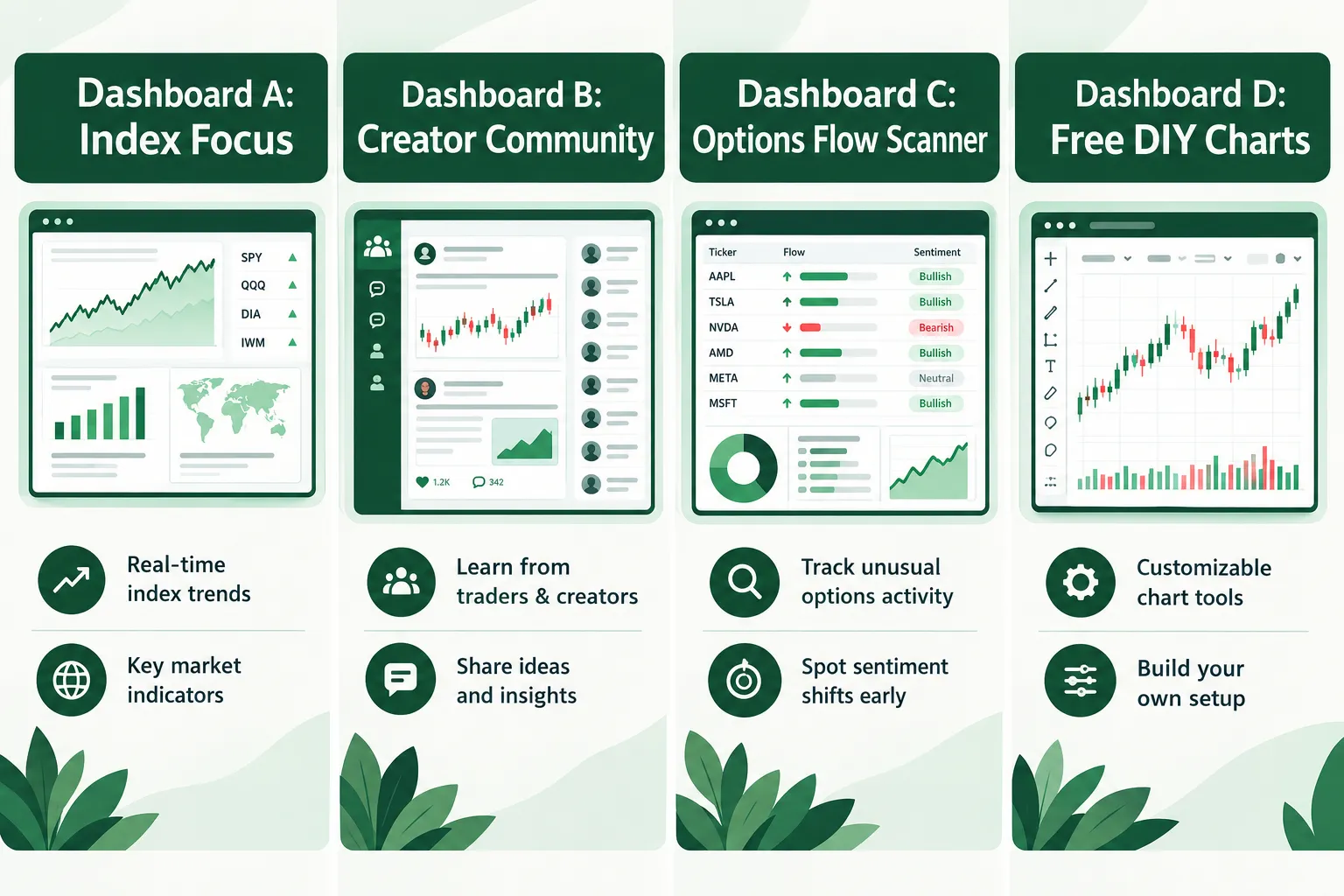
The three strongest SpotGamma alternatives in 2026 are DeepCharts Deep Gamma for a creator-driven GEX workflow, Unusual Whales for options flow plus a genuinely free tier, and a free do-it-yourself setup using Barchart or a broker API for traders who refuse to pay a subscription at all.
DeepCharts Deep Gamma leans on creator Andrea Cimi's GEX explainer content, which has pulled nearly 100,000 views and pins a 14-day free trial link in the description. One viewer, @MarMoro777, put it plainly: "I got Deep Gamma ans still trying to wrap my head around it. great potential." That's a fair summary of a newer tool with promise but a learning curve, and it's worth remembering Cimi is a partner, so his own marketing around it should be read as promotional, not neutral.
Unusual Whales is the most direct head-to-head with SpotGamma on price. Its free tier runs on data delayed two trading days, Retail Basic runs $50 a month, Pro runs $75 a month, Max runs $120 a month, and its dedicated Options Trader app on Robinhood runs $30 a month, three times SpotGamma's Robinhood listing. Anyone typing "SpotGamma vs Unusual Whales" into a search bar is really asking "do I need gamma exposure specifically, or do I just want options flow," and that's a real fork in the road, not a trivial one.
Free DIY tools like Barchart cover the budget end. Barchart runs a free tier at $0, a Plus tier at $9.99 a month, and a Premier tier at $29.95 a month, and while it doesn't build a dedicated gamma exposure model, it covers basic options chains, unusual volume, and price charts for a fraction of SpotGamma's cost. Pair it with a broker that exposes an options chain API, like IBKR, and a motivated trader can approximate a rough gamma picture by hand on SPY or SPX, with far more manual work and zero HIRO-style real-time alerts.
SpotGamma vs thinkorswim: which is better?
SpotGamma and thinkorswim aren't really competitors, they're complements. Thinkorswim, Schwab's platform, is a charting and execution platform with solid options chain tools. It is not built around a dealer-positioning model the way SpotGamma is.
A trader using thinkorswim for execution and charting while adding SpotGamma, DeepCharts, or Unusual Whales for the dealer-flow layer is a common and sensible stack. Choosing one "instead" of the other misunderstands what each tool actually does.
| Tool | GEX Data | Best For | Main Drawback | Price |
|---|---|---|---|---|
| SpotGamma | GEX levels, HIRO, TRACE, Equity Hub on 3,500+ names | Active index options traders wanting institutional-style dealer flow | No public API, steep top-tier price | $99 to $299/mo, Institutional $1,999/mo |
| DeepCharts Deep Gamma | Creator-driven GEX visuals | Traders who learn from video walkthroughs | Newer product, learning curve, partner-promoted | 14-day free trial, paid plans vary |
| Unusual Whales | Options flow plus basic GEX context | Flow-focused traders on a tighter budget | Less gamma-specific depth than SpotGamma | Free to $120/mo |
| Barchart (free DIY) | No dedicated gamma model, raw chains and volume | Budget-conscious traders building their own process | No dealer-positioning model at all | $0 to $29.95/mo |
If gamma exposure and dealer positioning are the whole reason you're shopping, SpotGamma and DeepCharts stay in the running. If options flow matters more than gamma specifically, Unusual Whales earns a real look. If you want to learn mechanics for free before paying anyone, start with Barchart and SpotGamma's own free charts and work up from there. For a broader rundown of flow-focused platforms, see this breakdown of the best options flow platforms.
What do real users say?
Real user commentary on gamma exposure tools in general skews cautious, treating GEX as context rather than a trading system on its own. On r/options, trader u/zibudada summarized the category bluntly: "Short answer: it helps with context, not with entries."
That one line does more work than most marketing pages. GEX, whether from SpotGamma, Unusual Whales, or any competitor, tells you about dealer plumbing, not about when to press the entry and exit button. Traders who expect a signal-generating machine tend to walk away disappointed. Traders who use it to size positions and set smarter stop loss levels tend to stick around.
On the newer-tool side, @MarMoro777's comment on Deep Gamma's explainer video, "I got Deep Gamma ans still trying to wrap my head around it. great potential," captures the same honest tension: interest in the concept, real friction learning the tool. That's typical for anyone new to gamma exposure, regardless of which platform they pick.
Common mistakes traders make with SpotGamma
The most common mistake is treating a GEX level like a guaranteed wall instead of a probability zone, then getting blindsided when price blows through it on a news catalyst the chart never priced in. GEX reflects options positioning, not headlines.
A second mistake is paying for the $299 Alpha plan while only checking the dashboard once a day. If you're not watching intraday, you're paying for a feature set you're not using, and the $99 Essential plan or the free SPX chart probably covers your actual habits.
A third mistake, and the most expensive one, is using a gamma level as the entire trade plan. No position sizing, no stop loss, no plan for being wrong. Data over noise only works if you still build a system around the data. Process over prediction isn't a slogan, it's the difference between a clean setup and a gamble with extra steps.
Final Verdict
SpotGamma does one thing well: it packages dealer-positioning data into readable charts and a daily research note that would otherwise take real modeling work to replicate yourself. That's genuinely useful for active index options traders who live in the options market every session.
It's a tougher sell for anyone trading occasionally or expecting the dashboard to hand them trade signals instead of context. At $99 to $299 a month depending on plan, SpotGamma sits well above free tools like Barchart and mid-tier flow platforms like Unusual Whales, and that gap only makes sense if you're using the real-time tools often enough to justify it.
Choose SpotGamma if: you trade SPX, SPY, or other index options multiple times a week and want institutional-style dealer-flow context without building your own model.
Choose an alternative if: you're budget-conscious or just want options flow without paying specifically for a gamma exposure model.
Don't let a subscription bill convince you it's doing more of the thinking than it actually is.
One tool, reviewed here from its official pages and public user comments, not from hands-on testing. There are 200+ more AI stock tools catalogued in the FullStack Alpha directory, filterable by category, price, and what they actually do.
See the options and flow shortlist.
For traders weighing a broader AI charting stack alongside gamma data, it's worth comparing a pattern-recognition tool like TrendSpider, an options-flow specialist like Flow Greeks, or a dedicated OptionsFlow dashboard before committing a full budget to one platform. Unusual activity scanners like Tradytics and event-driven dashboards like MarketReader round out a reasonable stack for SPY and SPX options traders. For a wider look at the core concept behind all of this, read the gamma exposure explainer and the companion gamma exposure chart guide.
Frequently Asked Questions
Is SpotGamma worth the cost?
It's worth the cost for active index options traders who check GEX levels every session and actually act on them. It's a weak fit for occasional traders, since $99 to $299 a month adds up fast against infrequent trading. Test the free SPX chart first, then decide if the paid tiers earn a spot on your monthly budget.
How does SpotGamma work?
SpotGamma models how options dealers hedge their positions as price moves, estimating zones of support and resistance from aggregate gamma exposure (GEX) across strikes. It layers HIRO, a real-time options-flow indicator, and TRACE, an intraday gamma heatmap, on top of that core model.
How much is SpotGamma?
SpotGamma's plan page lists Essential at $99 a month, Alpha at $299 a month and Institutional at $1,999 a month, with a separate annual option. A SpotGamma app also sits in Robinhood's marketplace at $10 a month after a one-month free trial. Confirm current numbers on SpotGamma's official pricing page before subscribing.
Can you make $1000 a day with day trading?
Some traders have hit $1,000 days, and plenty more have lost that much in a single session. No tool, including SpotGamma, guarantees a daily dollar figure. Focus on risk management and consistency over any specific daily target.
Does SpotGamma have a free trial?
SpotGamma's main subscription site doesn't currently advertise a blanket free trial, so check the official plans page for the latest terms. The confirmed free trial is a one-month offer through SpotGamma's app on Robinhood's marketplace, before billing switches to $10 a month.
Is there a free SpotGamma alternative?
Yes. SpotGamma itself publishes a free daily SPX Gamma Exposure chart, and Barchart offers a $0 tier with basic options data, though neither includes intraday updates, single-stock GEX, or real-time flow tools like HIRO and TRACE.
Is SpotGamma on Robinhood?
Yes. SpotGamma launched as an Agent App inside Robinhood's marketplace on September 29, 2026, priced at $10 a month after a one-month free trial. It is a separate product from a direct subscription, so do not assume it includes everything in the Alpha plan.
Prices, tier names, and trial terms move around more than most trading platforms admit, so treat every number above as a snapshot, not gospel.
This is education, not financial advice.
Your market edge starts with the right tool. Stay alpha.
This article contains affiliate links, and we may earn a commission if you sign up through one.