Best Stocks for Covered Call Writing: 7 That Fit the Job
Last updated: August 31, 2026
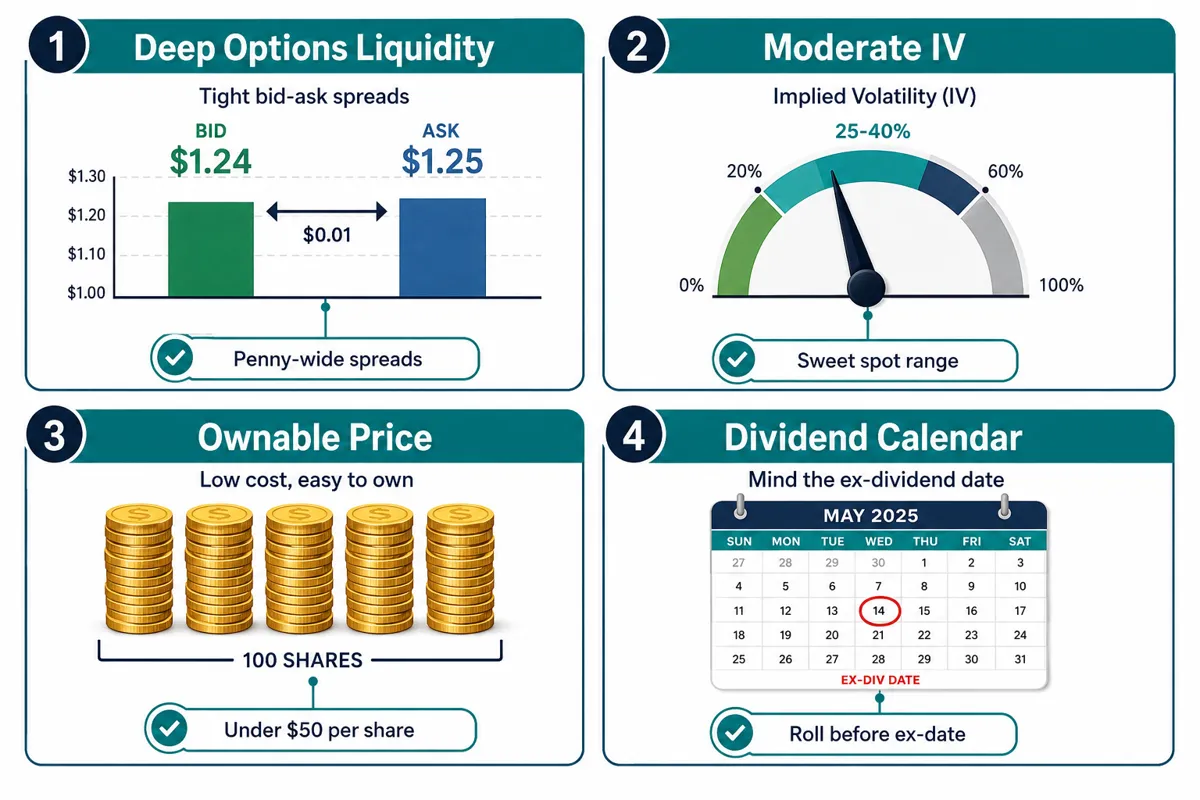
Quick Answer: The best stocks for covered call writing share four measurable traits: deep options liquidity, moderate implied volatility, a share price you can own in 100-share lots without overconcentrating, and a dividend calendar you can plan around. The ticker matters far less than whether the underlying stock meets those four criteria. This guide names seven examples that fit the job in 2026 and explains exactly why each one qualifies.
Key Takeaways
- A covered call caps your upside and does not protect against a falling share price. The maximum loss is owning the stock as it declines, minus the premium collected.
- The four screening traits matter more than any specific stock name. Tickers change; criteria do not.
- Options market liquidity is at record levels in 2026. Cboe reported average daily volume of 72.8 million contracts in Q2 2026, up more than 19% year over year, which means tighter spreads and better fills for covered call writers.
- Dividend stocks work well for covered call writing because premium stacks on top of a cash payout, but the ex-dividend date creates early assignment risk that must be managed actively.
- A 30-day to 45-day expiration window is the most commonly cited sweet spot for covered call writing because theta decay accelerates in that range.
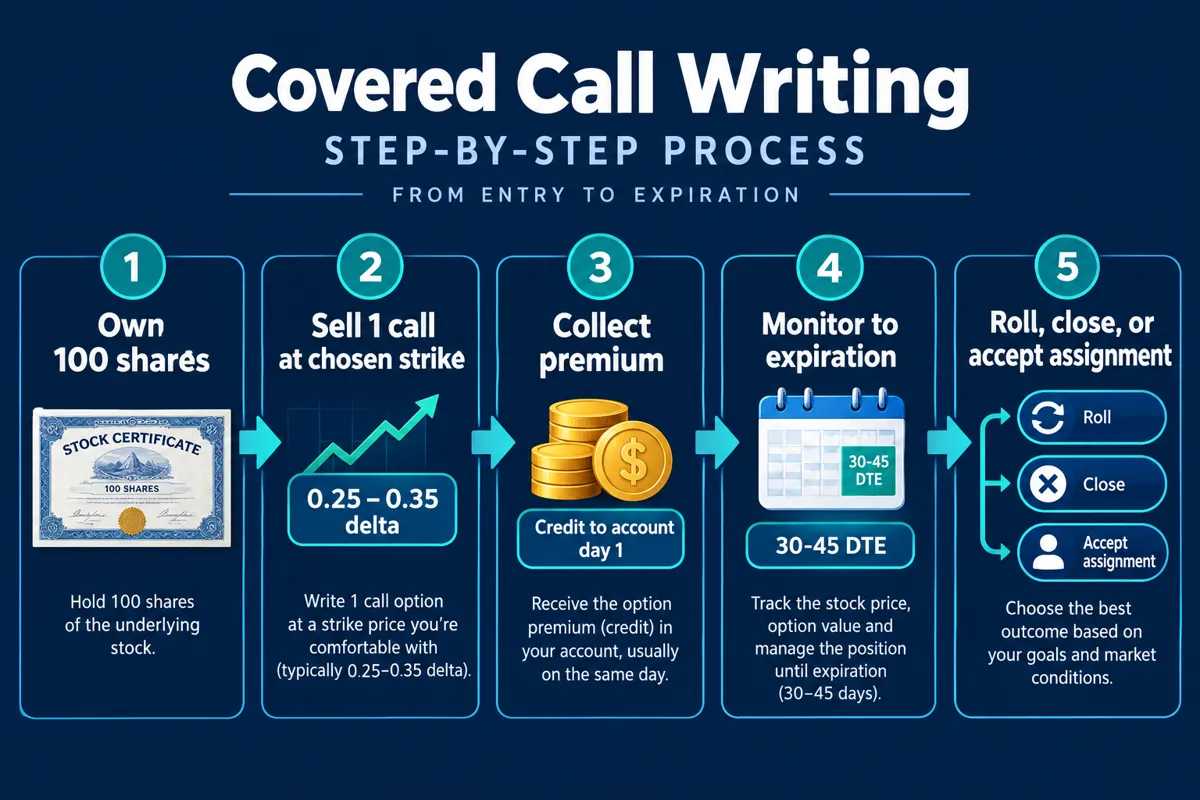
- Delta between 0.25 and 0.35 on the short call gives a reasonable balance between premium collected and probability of assignment.
- Covered call ETFs like QYLD and XYLD are a legitimate alternative for investors who want the income without managing individual positions, but they surrender more upside than a disciplined DIY approach typically does.
- Never treat premium collected as guaranteed income. Options prices move, and a position can be closed at a loss before expiration.
What Makes a Stock Good for Covered Call Writing?
The best stocks for covered call writing are not simply the ones with the highest premium. High premium usually means high volatility, which means higher assignment risk and a stock that can move against you fast. The real screen is about four structural traits that let the strategy work consistently rather than occasionally.
Trait 1: Deep Options Liquidity
Deep options liquidity means tight bid/ask spreads, high open interest across multiple strikes, and enough daily volume that you can enter, roll, or close a position without paying a wide spread. A call option on a thinly traded stock might show a $0.50 bid and a $1.20 ask. That $0.70 spread is slippage you absorb immediately. On a liquid name like Apple (AAPL) or SPY, the spread on a near-the-money call is often a penny or two.
Cboe Global Markets publishes daily volume and open interest data by underlying. Run any candidate through that screener before committing. If the at-the-money call for the nearest monthly expiration has fewer than 500 contracts of open interest, the stock is not liquid enough for a consistent covered call writing strategy.
The Options Clearing Corporation processes settlement for every standardized option in the U.S. market. Standardized contracts covering 100 shares each are the only contracts worth using for this strategy. Avoid any underlying that does not have standardized listed options.
Trait 2: Moderate Implied Volatility
Implied volatility (IV) is the market's forward-looking estimate of how much a stock might move, expressed as an annualized percentage. Higher IV means higher option premiums, but it also means the stock is expected to swing more, which raises assignment risk and the chance the stock falls hard enough to wipe out the premium.
The sweet spot for covered call writing is roughly 20% to 40% IV on the underlying. Below 20%, the premium is so thin it barely justifies the effort. Above 50%, the stock is behaving like a speculative name, and a covered call provides almost no real downside buffer.
IV Rank (sometimes called IVR) is a more useful measure than raw IV. It compares current IV to the stock's own 52-week range. An IV Rank of 50 means current IV sits at the midpoint of its own history. Selling calls when IV Rank is elevated relative to the stock's own baseline means you're collecting more premium than usual, which is the setup worth waiting for.
Trait 3: A Price You Can Own in 100-Share Lots
A standard call option contract covers 100 shares. To write a covered call, you must own at least 100 shares of the underlying stock. That means the price per share directly determines the capital required to run the strategy.
At $200 per share, 100 shares costs $20,000 before any premium. At $40 per share, the same 100 shares costs $4,000. For most retail investors, the best stocks for covered calls under $50 are the ones that actually fit the account. A stock can be a perfect covered call candidate on every other metric and still be unusable if you cannot afford 100 shares without overconcentrating your portfolio.
This is not a flaw in the strategy. It is a position sizing constraint. Respect it.
Trait 4: A Dividend Calendar You Can Work Around
Dividends and covered calls interact in a specific and sometimes painful way. If you sell a call that is in the money (ITM) and the stock has an upcoming ex-dividend date, the call buyer may exercise early to capture the dividend. Early assignment means your shares get called away before expiration, and you miss the dividend you were counting on.
The fix is straightforward: know the ex-dividend date before you sell the call. Either sell a call with a strike far enough out of the money that early assignment is unlikely, or wait until after the ex-dividend date to open the position. The IRS also has qualified covered call rules that affect whether dividends retain qualified dividend treatment. A call that is too deep in the money or too short in duration can strip the dividend of its lower tax rate. More on that in the tax section below.
The 7 Stocks That Fit the Job
These seven names are examples that meet the four screening traits as of mid-2026. They are not buy recommendations. Every stock can fall, and a covered call does not protect against that. Use these as a starting point for your own research, not as a shopping list.
1. Coca-Cola (KO): A Large-Cap Dividend Payer With Weekly Options
Coca-Cola trades around $65 to $70 per share as of mid-2026, making 100 shares accessible at roughly $6,500 to $7,000. The stock carries a dividend yield of approximately 3.0% to 3.1%, paid quarterly, and has raised its dividend for more than 60 consecutive years, making it one of the most reliable dividend payers in the market. KO options are liquid across weekly and monthly expirations, with tight spreads on near-the-money strikes.
IV on KO typically runs in the 15% to 22% range, which is on the lower end. That means premium is modest, but so is assignment risk. KO suits investors who want a conservative covered call writing strategy where the dividend does most of the income work and the call premium is a bonus. The ex-dividend date falls roughly every 90 days, and because KO moves slowly, managing around it is straightforward.
2. AT&T (T): A Sub-$20 Name for Smaller Accounts
AT&T trades in the $17 to $20 range, which means 100 shares costs roughly $1,700 to $2,000. That is one of the lowest capital requirements among liquid, optionable large caps, making it one of the best stocks for covered calls under $50 and arguably the most accessible name on this list for small accounts. AT&T's dividend yield sits around 5.5% to 6.0% as of 2026, among the highest of any name with liquid weekly options.
The tradeoff is that AT&T carries more headline risk than KO. Regulatory changes, debt levels, and competitive pressure from Verizon (VZ) can move the stock. IV on T runs roughly 20% to 28%, which is moderate and supports reasonable premium on 30-day calls. The combination of a high dividend yield and moderate IV makes AT&T a popular choice among income-focused covered call writers. Just note that a $17 stock does not generate large absolute dollar premiums per contract, so position sizing matters.
3. Microsoft (MSFT): A Mega-Cap Tech Name With Deep Chains
Microsoft is one of the most liquid options underlyings in the entire market. The options chain runs deep across dozens of strikes and multiple weekly expirations, with bid/ask spreads on near-the-money calls that are often a penny or two wide. MSFT trades around $420 to $450 per share as of mid-2026, which means 100 shares requires $42,000 to $45,000 in capital. That is a significant commitment, but the liquidity and chain depth are unmatched among single-stock names.
Microsoft's subscription-driven revenue model keeps the stock relatively stable compared to pure-growth tech names, and its AI infrastructure buildout has kept institutional interest high. IV on MSFT typically runs 22% to 30%, which is moderate for a mega-cap tech stock. The dividend yield is modest at around 0.7% to 0.8%, so covered call writers on MSFT are primarily premium hunters rather than dividend stackers. For investors who already own MSFT as a core holding, selling calls against it is a natural fit.
4. Verizon (VZ): A Telecom Name for Premium Plus Yield
Verizon trades around $40 to $44 per share, putting 100 shares in the $4,000 to $4,400 range. Its dividend yield sits near 6.0% to 6.5%, one of the highest among S&P 500 components, and the options chain is liquid with weekly expirations available. IV on VZ runs roughly 18% to 25%, slightly lower than AT&T but still sufficient for meaningful call premium on 30-day contracts.
The case for VZ as a covered call stock is the combination of a high dividend yield and a stock that trades in a relatively tight range. Telecom stocks do not typically make dramatic moves in either direction, which means the covered call writer rarely faces the painful scenario of watching the stock sprint past the strike price. The risk is the opposite: a slow, grinding decline in share price that erodes more value than the premium and dividend combined can offset.
5. Intel (INTC): A Semiconductor Name for Higher Premium
Intel trades around $20 to $25 per share as of mid-2026, making 100 shares accessible at $2,000 to $2,500. The stock has faced significant competitive pressure from AMD and Nvidia, which has kept IV elevated relative to its own history. IV on INTC runs roughly 35% to 50%, which generates substantially more premium per contract than a stable consumer staple name.
Higher premium comes with higher risk. Intel's share price has been volatile, and a covered call writer who owns INTC for the premium income is also carrying a stock that can drop 10% to 15% on an earnings miss. The strategy works on Intel when the stock is in a period of tight consolidation and IV is elevated, not when it is already in a downtrend. Use a screener to check IV Rank before entering. If IV Rank is above 60, the premium is genuinely elevated relative to Intel's own baseline, and that is the setup worth considering.
6. Ford (F): An Energy-Adjacent Cyclical for Volatility-Driven Premium
Ford trades around $10 to $12 per share, one of the lowest-priced optionable large caps on this list. At $10 to $12, 100 shares costs $1,000 to $1,200, making it one of the most accessible names for small accounts. Ford's IV typically runs 30% to 45%, driven by cyclical sensitivity to auto sales data, EV transition news, and broader economic conditions.
The dividend yield on Ford fluctuates more than a utility or telecom, but when the company is paying a regular dividend, it adds to the income stack. Ford is not a set-and-forget covered call stock. It requires active management because the stock can move sharply on macro news. But for an investor who wants to practice covered call writing on a low-cost underlying with enough premium to make the effort worthwhile, Ford fits the job. Paper trade it first before committing real capital.
7. SPY (S&P 500 ETF): The Low-Maintenance Option
SPY is the SPDR S&P 500 ETF Trust, the most liquid options underlying in the world. Cboe reported ETF options volume up 24.6% year over year in Q1 2026, and SPY accounts for a substantial share of that volume. The bid/ask spread on SPY options is routinely one cent wide. Open interest across hundreds of strikes and multiple weekly expirations is measured in the hundreds of thousands of contracts.
SPY trades around $540 to $580 per share as of mid-2026, which means 100 shares requires $54,000 to $58,000 in capital. That is a high bar for smaller accounts. But for investors who already hold SPY as a core position, selling calls against it is the cleanest covered call writing setup available. IV on SPY (tracked via the VIX, which measures 30-day implied volatility on the S&P 500) typically runs 12% to 20% in calm markets and spikes during sell-offs. Premium is modest in low-volatility environments but the liquidity and simplicity are unmatched. QQQ (Nasdaq-100 ETF) is a comparable alternative with slightly higher IV and a lower share price around $470 to $500.
Comparison Table: Covered Call Candidates on the Four Traits
| Stock | Approx. Share Price | Options Liquidity | IV Level | Dividend Yield | Best Suited For |
|---|---|---|---|---|---|
| KO | $65 to $70 | High | 15% to 22% | ~3.0% | Conservative income, dividend stackers |
| T | $17 to $20 | High | 20% to 28% | ~5.5% to 6.0% | Small accounts, high-yield income |
| MSFT | $420 to $450 | Very High | 22% to 30% | ~0.7% to 0.8% | Premium hunters with large accounts |
| VZ | $40 to $44 | High | 18% to 25% | ~6.0% to 6.5% | Yield-focused, range-bound traders |
| INTC | $20 to $25 | High | 35% to 50% | ~1.5% to 2.0% | Higher premium, active management |
| F | $10 to $12 | High | 30% to 45% | Variable | Lowest capital entry, practice accounts |
| SPY | $540 to $580 | Deepest available | 12% to 20% | ~1.2% to 1.4% | Existing holders, low-maintenance |
All figures are approximate ranges based on mid-2026 market conditions. Verify current data before trading.
Which Best Stocks for Covered Calls Suit a Small Account?
The best stocks for covered calls in a small account are those with a share price low enough that 100 shares does not consume the entire account. AT&T (T) at $17 to $20, Ford (F) at $10 to $12, and Intel (INTC) at $20 to $25 are the three names on this list that fit that constraint. Each has liquid options and enough IV to generate meaningful premium relative to the capital required.
Best Stocks for Covered Calls Under $50
Among the seven names on this list, AT&T, Ford, Intel, and Verizon all trade under $50 per share. That puts 100 shares in the $1,000 to $4,400 range, which is accessible for accounts in the $5,000 to $15,000 range without overconcentrating in a single position. Pfizer (PFE) is another name worth screening, trading around $25 to $30 with a dividend yield above 5% and liquid weekly options, though its IV and business outlook should be checked before entering.
For investors searching for the best stocks for covered calls under $50, the priority should still be options liquidity first. A $15 stock with thin options volume is worse than a $45 stock with deep chains. Check open interest on the front-month at-the-money call before anything else.
Why 100 Shares Is the Real Barrier
This is the constraint most beginners underestimate. A standard call option contract covers exactly 100 shares. There is no fractional contract. You cannot write a covered call on 50 shares. The capital required is 100 times the share price, and that number determines whether the strategy is viable in your account.
For a $10,000 account, owning 100 shares of a $90 stock consumes 90% of the account in a single position. That is not position sizing, that is a concentration bet. The best stocks for covered call writing at the small account level are the ones where 100 shares represents 20% to 30% of the account at most, leaving room to diversify across two or three positions.
Covered Calls and Cash Secured Puts Together
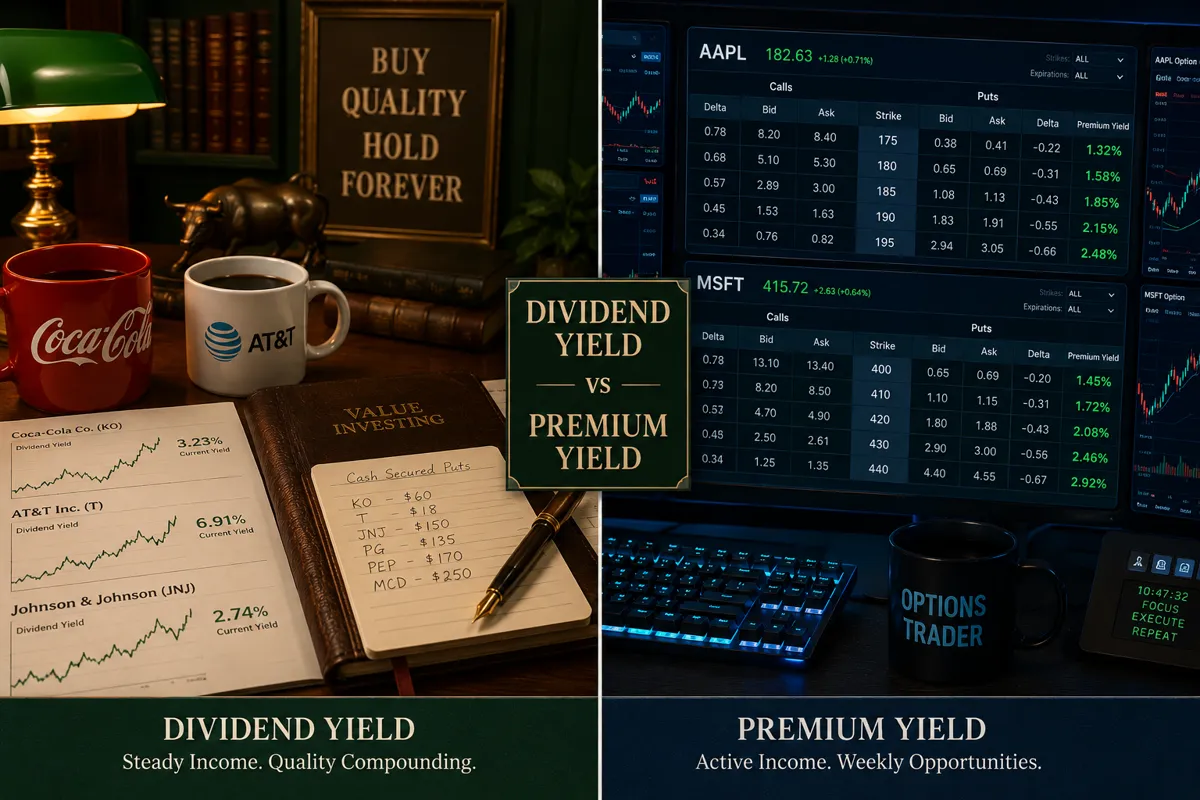
Cash secured puts are the mirror strategy: you sell a put option and hold enough cash to buy 100 shares if assigned. The premium mechanics are similar, and many income investors run both strategies together, using cash secured puts to get into positions at a lower price and covered calls to generate income once they own the shares.
The best stocks for covered calls and cash secured puts are the same stocks: liquid, moderate IV, ownable in 100-share lots. The difference is directional. A cash secured put is bullish to neutral. A covered call is neutral to mildly bullish. Running both on the same underlying in a wheel strategy is a legitimate income approach, but it requires understanding that you can end up owning a stock that keeps falling regardless of the premium you've collected.
How Do You Pick a Strike and Expiration?
Picking a strike and expiration is where covered call writing strategy becomes a real decision rather than a mechanical exercise. The strike price determines how much upside you surrender, and the expiration determines how much time value you collect. Both choices carry tradeoffs that depend on your goals.
Delta as a Shorthand for Assignment Odds
Delta is the option's sensitivity to a $1 move in the underlying stock. A call with a delta of 0.30 moves roughly $0.30 for every $1 the stock rises. But delta also serves as a rough probability estimate: a 0.30-delta call has approximately a 30% chance of expiring in the money (ITM), which means roughly a 70% chance it expires worthless and you keep the premium.
Most covered call writers target a delta between 0.25 and 0.35 on the short call. That range offers a reasonable balance between premium collected and the probability that the stock gets called away. A 0.20-delta call is safer from assignment but generates less premium. A 0.50-delta call generates more premium but has a coin-flip chance of assignment.
The strike premium annualized calculation helps compare options across different expirations. Take the premium collected, divide by the share price, divide by the days to expiration, and multiply by 365. That gives you an annualized call yield for comparison purposes. A 30-DTE call yielding 1.5% of the stock price annualizes to roughly 18%, which is the kind of number that makes the strategy worth running on a stable underlying.
Covered Call Writing Strategy Across 30 to 45 Days
The 30-day to 45-day expiration window is where theta decay, the daily erosion of an option's time value, works most efficiently for the seller. Theta accelerates as expiration approaches, which means the call you sold loses value faster in its final 30 days than in its first 30 days. Selling a 30-DTE call and closing it at 50% of max profit (when the premium has decayed by half) is a common management rule that keeps the position active and reduces gamma risk near expiration.
A 30-DTE call on a stock with 25% IV and a 0.30 delta will typically generate a call yield of 1% to 2% of the stock price per month on the names in this list. That is not a guaranteed figure. It is an illustrative range based on covered call return data for moderate-IV underlyings. Actual premiums depend on current market conditions, the specific strike chosen, and the bid/ask spread at execution.
Covered Call Writing Example, Start to Finish
Here is an illustrative example with round numbers, clearly labeled as such. Assume you own 100 shares of a stock trading at $40.00. You sell one 30-DTE call at the $42 strike and collect $0.80 per share, or $80 total for the contract. The call yield is $80 divided by $4,000 (the cost of 100 shares), or 2.0% for the 30-day period.
If the stock stays below $42 at expiration, the call expires worthless, you keep the $80 premium, and you can sell another call. If the stock rises above $42, your shares get called away at $42. You keep the $80 premium plus the $200 gain from $40 to $42, for a total of $280 on a $4,000 position. Your upside is capped at $42 regardless of how high the stock goes. If the stock falls to $35, you lose $500 on the shares and keep the $80 premium, for a net loss of $420. The premium softened the blow but did not prevent the loss.
What Goes Wrong With Covered Call Writing?
Covered call writing is one of the most forgiving options strategies for beginners, but it has specific failure modes that are predictable and avoidable. Most traders who lose money on covered calls make the same four mistakes.
Capping the Upside You Actually Wanted
The most common complaint is not a loss. It is watching a stock you own sprint 30% past your strike price while you collect a $0.80 premium. That is not a loss on paper, but it is a significant opportunity cost. Play stupid games, win stupid prizes applies here: if you sell a covered call on a stock you are holding specifically for a large breakout, you have defeated the purpose of owning it.
The fix is simple: do not sell covered calls on your highest-conviction long-term holdings. Reserve the strategy for stocks you own for income or stability, not for stocks where the entire thesis is a big move higher. The best stocks for covered call writing are the ones where you would be genuinely comfortable having the shares called away at the strike price.
Early Assignment Around the Ex-Dividend Date
Early assignment is rare on out-of-the-money calls, but it becomes a real risk when the call is ITM and the stock has an upcoming ex-dividend date. A call buyer who holds an ITM call the day before the ex-dividend date may exercise early to capture the dividend. If that happens, your shares are gone before expiration, and you miss the dividend.
The concrete rule: check the ex-dividend date before selling any call. If the ex-dividend date falls within the expiration window, either sell a strike that is far enough out of the money that early exercise is not rational, or wait until after the ex-dividend date to open the position. This is especially important on high-yield names like AT&T and Verizon, where the dividend is a meaningful part of the total yield.
Holding a Falling Stock for the Premium
A covered call does not protect against a falling stock price. The premium collected on a 30-DTE call is typically 1% to 2% of the stock price. A stock that falls 15% has erased months of premium income. The maximum loss on a covered call position is the full decline in the underlying stock, minus the premium collected.
This is the risk that most beginners underestimate. They focus on the premium as income and forget that the stock they own is the real risk in the position. If you would not be comfortable owning the stock without the call, you should not be running a covered call on it. Catching a falling knife while selling a call against it is not a strategy. It is a way to lose money more slowly.
Tax Treatment and Qualified Covered Calls
The IRS has specific rules about qualified covered calls that affect how dividends on the underlying stock are taxed. Under IRS Publication 550, a covered call must meet certain criteria to be considered "qualified" and allow the underlying dividend to retain its qualified dividend treatment (taxed at the lower capital gains rate rather than ordinary income rates).
A call is generally qualified if it is not deep in the money and has more than 30 days to expiration. A call that is too deep ITM or too short in duration can cause the holding period for the underlying shares to be suspended, which can strip the dividend of its qualified status. This matters most on high-yield names where the dividend tax treatment is a significant part of the total return. Consult a tax professional before running covered calls on dividend stocks in a taxable account.
The tax treatment in an IRA or Roth IRA is different: dividends and options premium are sheltered from current taxation in those accounts, which is one reason covered call writing in a retirement account is popular. Most major brokers allow covered calls in IRAs. Check with your specific broker, as some restrict the strategy to certain account types.
Weekly vs. Monthly: Which Expiration Works Better?
Weekly expirations give you more flexibility to manage around earnings, dividends, and macro events, but they require more active management and generate smaller absolute premiums per contract. Monthly expirations (typically the third Friday of each month) generate more premium per trade and require less frequent attention, but they expose you to more events within the expiration window.
For most investors running covered call writing as an income strategy, monthly expirations in the 30-day to 45-day range are the standard starting point. Weekly options are better suited for experienced traders who want to fine-tune strike selection around specific events or who are actively managing a larger portfolio of positions.
Cboe added short-dated Monday and Wednesday expiration cycles for eight single-stock classes in early 2026, and those contracts quickly grew to nearly 3 million contracts per day. That volume is dominated by speculative flow in names like TSLA and NVDA, not by covered call writers. For the seven stocks on this list, the standard weekly and monthly expirations provide all the flexibility most investors need.
Covered-Call ETFs vs. Doing It Yourself
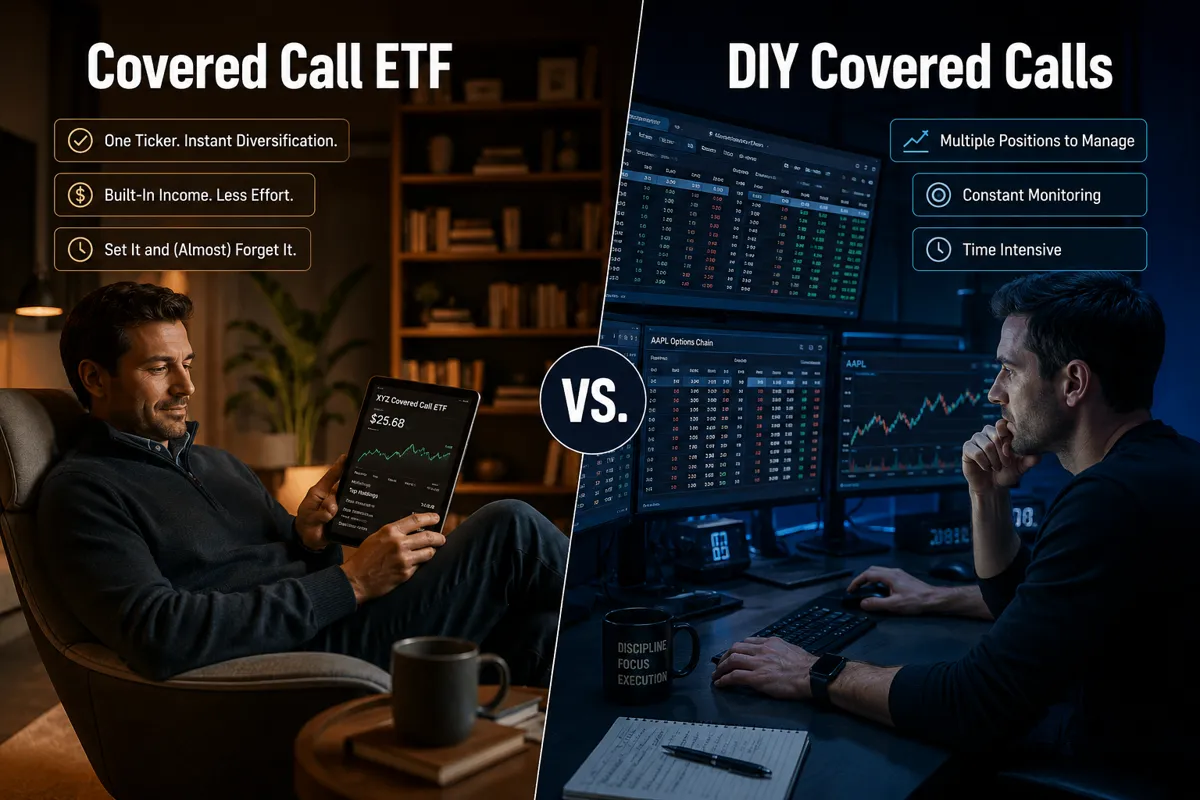
Covered-call ETFs like QYLD (Global X Nasdaq 100 Covered Call ETF), XYLD (Global X S&P 500 Covered Call ETF), and JEPI (JPMorgan Equity Premium Income ETF) run systematic covered call strategies on index underlyings and distribute the premium as monthly income. They are a legitimate alternative for investors who want the income without managing individual positions.
The tradeoff is that ETFs like QYLD write at-the-money calls every month, which caps virtually all upside participation. A DIY covered call writer who sells out-of-the-money calls retains more upside potential. Covered call ETF data from ETF Beacon shows that QYLD has historically distributed yields in the 10% to 12% range annually, but total return (price appreciation plus distributions) has lagged a simple buy-and-hold of QQQ over most multi-year periods because of the aggressive upside cap.
JEPI takes a different approach, using equity-linked notes (ELNs) rather than direct call writing, which gives it a smoother income profile and more upside participation than QYLD. Covered call ETF analysis from Dividend Vision notes that JEPI's 30-day SEC yield has run in the 7% to 9% range in recent years, with lower volatility than pure covered-call ETFs.
For investors who want to screen and compare covered-call ETFs alongside individual stock options, the AI ETF screener tools compared on aistockpickerapps.com can help filter by yield, expense ratio, and strategy type.
How Market Conditions Affect Your Covered Call Strategy
Market conditions directly determine how much premium you can collect and how much assignment risk you face. In a low-volatility bull market, IV compresses, premiums shrink, and the stocks you own tend to run past your strikes. In a high-volatility environment, premiums are fat but the underlying stocks can fall sharply, turning a premium-collection strategy into a damage-control exercise.
The VIX is the standard measure of 30-day implied volatility on the S&P 500. When the VIX is below 15, covered call writing on index underlyings like SPY generates thin premium. When the VIX spikes above 25, premiums are attractive but the market is telling you something is wrong. Selling calls into a spike is a legitimate strategy, but it requires owning stocks you are genuinely comfortable holding through volatility.
IV Rank is more useful than the VIX for individual stock selection. A stock with an IV Rank above 50 is offering more premium than it has historically, which is the setup worth targeting. A stock with an IV Rank below 20 is offering thin premium relative to its own baseline, and the covered call yield total may not justify the effort.
Unusual options activity can also signal that something is happening in a stock before it becomes public knowledge. A screener that flags unusual call volume or unusual put volume can help you avoid selling calls into a stock that is about to move sharply. The AI stock screener tool that finds winners while you sleep and similar tools can surface unusual options activity flags that a manual scan would miss.
For a broader view of how AI tools can help with stock research and options analysis, the best AI options trading tools on aistockpickerapps.com covers the current field in 2026.
Building a Diversified Covered Call Portfolio
A single covered call position is a trade. A portfolio of covered calls across three to five uncorrelated underlyings is a strategy. The difference matters because a single stock can blow up and wipe out months of premium income. Spreading across sectors, price ranges, and volatility profiles reduces that risk.
A practical starting portfolio for a $20,000 account might look like this: 100 shares of AT&T (T) at roughly $1,800, 100 shares of Ford (F) at roughly $1,100, 100 shares of Intel (INTC) at roughly $2,200, and 100 shares of Verizon (VZ) at roughly $4,200. That is approximately $9,300 in stock positions, leaving the rest as cash buffer. Each position generates its own premium on a 30-day cycle, and the four stocks span telecom, auto, semiconductor, and telecom again, with different IV profiles and dividend calendars.
The goal is not to maximize yield total yield from any single position. It is to build a consistent, repeatable income stream across positions where no single stock failure destroys the account. Systems over hacks. Process over prediction. That is the framework that survives a rough quarter.
For position sizing guidance that applies directly to this kind of portfolio construction, the position sizing mistake that wipes out 90% of new traders is worth reading before you deploy capital.
The 5 Biggest Covered Call Mistakes
Selling calls on stocks you want to keep long. If you own Apple (AAPL) because you think it will double, selling a covered call against it caps that thesis. Reserve the strategy for stocks you own for income or stability.
Ignoring the ex-dividend date. Early assignment around the ex-dividend date is predictable and avoidable. Check the calendar before every trade.
Chasing premium on volatile stocks without understanding the downside. A stock with 60% IV offers fat premium and a fat chance of falling 20%. The premium rarely compensates for the risk on truly volatile names.
Never closing early. Holding a call all the way to expiration to squeeze out the last few cents of premium exposes you to gamma risk, where a small move near expiration can flip the outcome. Close at 50% of max profit and move on.
Treating premium as income before it is realized. Premium collected is not income until the position is closed or expires. An open position can be closed at a loss. Count the money when the trade is done, not when you open it.

FullStack Alpha tool
Covered Call Premium Calculator
A premium in dollars tells you nothing until it is annualised against the capital it ties up. Enter one contract and see what the trade actually pays, called away or not.
Per 100 shares, before commissions, taxes and assignment risk. Early assignment around an ex-dividend date can end the trade sooner than expiry.
Frequently Asked Questions
What are the best stocks for covered calls right now?
The best stocks for covered calls right now are those that meet all four screening traits: deep options liquidity, moderate implied volatility (roughly 20% to 40%), a share price that allows 100-share ownership without overconcentrating, and a dividend calendar you can plan around. As of mid-2026, names like Coca-Cola (KO), AT&T (T), Verizon (VZ), and SPY consistently meet those criteria. Always verify current IV, open interest, and the upcoming ex-dividend date before entering any position.
What are the best stocks for covered calls under $50?
AT&T (T) at $17 to $20, Ford (F) at $10 to $12, Intel (INTC) at $20 to $25, and Verizon (VZ) at $40 to $44 are the names on this list that trade under $50. Pfizer (PFE) is another candidate worth screening in the $25 to $30 range. All have liquid options chains and enough IV to generate meaningful premium. Prioritize open interest on the front-month at-the-money call as the first check on any sub-$50 candidate.
How much can you make writing covered calls?
There is no guaranteed income figure for covered call writing, and anyone who gives you a specific monthly return is either guessing or misleading you. As an illustrative range based on covered call return data, moderate-IV underlyings with 30-day expirations typically generate a call yield of 1% to 2% of the stock price per month when selling a 0.25 to 0.35 delta call. That annualizes to roughly 12% to 24% on the premium alone, but actual results depend on IV levels, strike selection, assignment frequency, and whether the underlying stock rises, falls, or stays flat.
What delta should you sell a covered call at?
Most covered call writers target a delta between 0.25 and 0.35 on the short call. A 0.30-delta call has approximately a 70% probability of expiring worthless, meaning you keep the full premium. Lower delta (0.15 to 0.20) reduces assignment risk but also reduces premium. Higher delta (0.40 to 0.50) increases premium but raises the chance your shares get called away. The right delta depends on your income target versus your willingness to have the stock called away.
Can you lose money writing covered calls?
Yes. A covered call does not protect against a falling stock price. If the stock you own declines significantly, the premium collected partially offsets the loss but does not eliminate it. The maximum loss on a covered call position is the full decline in the underlying stock, minus the premium collected. A stock that falls 20% while you collected 1.5% in premium is still a net loss of 18.5%. The strategy reduces losses on a declining stock but does not prevent them.
Do covered calls affect qualified dividend treatment?
They can. Under IRS rules, a covered call that is deep in the money or has fewer than 30 days to expiration may suspend the holding period for the underlying shares, which can cause dividends to lose their qualified dividend tax treatment. To preserve qualified dividend treatment, sell calls that are not deep ITM and have at least 30 days to expiration. Consult a tax professional for guidance specific to your situation, especially if you are running the strategy in a taxable account on high-yield dividend stocks.
What happens if your covered call gets assigned?
Assignment means the call buyer exercises their right to buy your 100 shares at the strike price. Your shares are sold at the strike price, you keep the premium you collected, and the position is closed. If the stock has risen above the strike price, you miss the gain above the strike. If you did not want to sell the shares, you can attempt to roll the call to a higher strike or later expiration before assignment occurs, but there is no guarantee you can do so at a favorable price.
Are covered call ETFs better than writing your own?
It depends on your goals and account size. Covered call ETFs like QYLD, XYLD, and JEPI are simpler, require no options knowledge, and distribute monthly income automatically. But they cap upside aggressively and charge an expense ratio (QYLD charges 0.60% annually). A DIY covered call writer who sells out-of-the-money calls retains more upside and pays only trading commissions. DIY is better for investors with larger accounts and the time to manage positions. ETFs are better for hands-off investors or those with accounts too small to own 100 shares of the underlying.
Is writing covered calls profitable?
Writing covered calls can be profitable, but it is not automatically so. The strategy generates income from premium collected on calls sold against shares you already own. Profitability depends on the underlying stock holding its value or rising modestly, IV being sufficient to generate meaningful premium, and active management to avoid large losses from stock declines. Academic research on buy-write strategies, including the Cboe BXM index which tracks a systematic covered call strategy on the S&P 500, shows that buy-write strategies have historically produced returns similar to the index with lower volatility, not dramatically higher returns.
Does Warren Buffett use covered calls?
Warren Buffett and Berkshire Hathaway have used options strategies, most notably selling cash-secured puts on large-cap stocks they wanted to own at lower prices. Berkshire sold puts on major indices during the 2008 financial crisis, collecting significant premium. Buffett has not publicly described a systematic covered call writing program. His general philosophy favors owning businesses for the long term without capping upside, which is structurally at odds with regular covered call writing on core holdings.
Which stock is best for a Poor Man's covered call?
A Poor Man's covered call (PMCC) replaces the 100 shares of stock with a deep in-the-money LEAPS call option as a lower-cost substitute for the long stock position. The best underlying for a PMCC is a liquid, large-cap stock with active LEAPS (options with more than one year to expiration). AAPL, MSFT, and SPY are the most commonly cited candidates because they have deep LEAPS chains with tight spreads. The LEAPS call should have a delta of 0.80 or higher and at least 12 months to expiration. The short call is sold against it in the same way as a standard covered call, but the capital required is a fraction of owning 100 shares outright.
What are the top 10 covered call ETFs?
The most widely cited covered call ETFs in 2026 include QYLD (Global X Nasdaq 100 Covered Call), XYLD (Global X S&P 500 Covered Call), RYLD (Global X Russell 2000 Covered Call), JEPI (JPMorgan Equity Premium Income), JEPQ (JPMorgan Nasdaq Equity Premium Income), DIVO (Amplify CWP Enhanced Dividend Income), PBP (Invesco S&P 500 BuyWrite), HYLB with covered call overlays, NUSI (Nationwide Risk-Managed Income), and SPYI (NEOS S&P 500 High Income). ETF Beacon's covered call ETF rankings and Dividend Vision's covered call ETF analysis both provide current yield, expense ratio, and strategy comparisons for these funds.
Final Verdict: Screen for the Four Traits, Then Pick the Ticker
The best stocks for covered call writing are not a fixed list. They are any stocks that pass four tests: deep options liquidity, moderate implied volatility, a price you can own in 100-share lots, and a dividend calendar you can plan around. The seven names in this article pass those tests as of mid-2026. Some will continue to pass them next year. Some will not. That is why the criteria matter more than the tickers.
Run any candidate through a screener. Check open interest on the front-month at-the-money call. Check IV Rank against the stock's own 52-week range. Know the ex-dividend date before you sell anything. And never forget that the stock you own is the real risk in this strategy. The premium is a partial offset, not a safety net.
Discipline beats prediction. The covered call writing strategy does not require you to know where the market is going. It requires you to own the right stocks, sell the right calls, and manage positions without letting emotion override the process.
One tool that can help surface candidates and flag unusual options activity before you commit capital: the best AI options trading tools directory on aistockpickerapps.com covers the current field of screeners and scanners built specifically for options traders.
One tool that can help you research the underlying stocks before you commit: the AI stock screener tool that finds winners while you sleep runs the fundamental and technical filters that matter for covered call candidates.
200+ AI stock tools catalogued and scored in the FullStack Alpha directory. Browse by category, price, and use case.
Find the right tool for your covered call process at aistockpickerapps.com
Affiliate disclosure: FullStack Alpha may earn a commission from links to tools and brokers on this page, at no cost to you.
References
Symbol Data - https://www.cboe.com/us/options/market_statistics/symbol_data/?mkt=opt
Covered Call ETFs - https://etfbeacon.com/best/covered-call-etfs
Covered Call Returns - https://quantwheel.com/learn/covered-call-returns
Covered Call ETFs - https://www.dividendvision.com/best/covered-call-etfs
Cboe Q2 2026 Earnings Call Transcript - https://www.fool.com/earnings/call-transcripts/2026/08/07/cboe-cboe-q2-2026-earnings-call-transcript/
Covered Calls Monthly Performance EN January 2026 - https://www.globalx.ca/wp-content/uploads/2026/02/Covered-Calls-Monthly-Performance-EN-January-2026.pdf