The AI Stock Screener Tool That Finds Winners While You Sleep
{"cover":"Professional landscape format (1536x1024) hero image with bold text overlay: 'The AI Stock Screener Tool That Finds Winners While You Sleep' in extra large 72pt white bold sans-serif font with deep shadow effect, centered upper third composition. Background shows a dramatic split scene: left side a dark bedroom with a sleeping figure, right side a glowing futuristic trading terminal with green candlestick charts, AI neural network nodes, and real-time stock data streams. Color palette: deep navy #0A1128, forest green #1F5E43, soft white accents. Magazine cover aesthetic, high contrast, editorial quality, cinematic lighting.","content":["Landscape format (1536x1024) editorial illustration showing a glowing AI brain made of circuit board patterns overlaid on a multi-screen trading dashboard displaying stock screener filters, candlestick charts, and real-time price action data. Neural network lines connect fundamental metrics, volume spikes, and technical indicators. Color scheme: navy blue background, plaid green data streams, white UI elements. Clean fintech aesthetic, no humans, data-forward composition, sharp focus on the AI processing layer.","Landscape format (1536x1024) side-by-side comparison infographic showing traditional manual stock research on the left (cluttered spreadsheets, sticky notes, multiple browser tabs, tired analyst) versus AI stock screener interface on the right (clean dashboard, automated filters, green signal alerts, real-time watchlist). Bold label text: 'Manual vs AI Screening'. Navy and forest green color scheme, flat design with editorial quality, high contrast, professional financial aesthetic.","Landscape format (1536x1024) data visualization showing a tiered pricing comparison chart for AI stock screening tools from free tier to professional tier. Bar graphs and feature comparison table with green checkmarks and red X marks. Background shows a blurred trading terminal. Bold typography labels: 'Free', 'Mid-Tier', 'Pro'. Color palette: navy blue, forest green, plaid red for negatives, soft white text. Clean SaaS pricing aesthetic, editorial quality, no faces.","Landscape format (1536x1024) close-up bird's-eye view of a trader's desk with multiple monitors showing AI stock screener results for small-cap and large-cap stocks. One screen highlights a low-float breakout setup with volume spike annotations. Scattered around the desk: a coffee cup, a printed watchlist, a risk-reward calculation notebook. Warm desk lamp lighting contrasting with cool blue monitor glow. Realistic editorial photography style, forest green and navy color accents, high detail.","Landscape format (1536x1024) conceptual illustration of common investor mistakes visualized as warning road signs on a financial highway. Signs read: 'Overtrading Ahead', 'Bull Trap Zone', 'Analysis Paralysis', 'Revenge Trading Exit'. Background shows a choppy stock chart with red candles. A lone trader figure stands at a crossroads holding an AI screener tablet showing clean green signals. Color scheme: plaid red warnings, forest green safe path, navy sky. Editorial graphic novel aesthetic, bold typography, high contrast."}
Last updated: June 16, 2026
Quick Answer: An AI stock screener tool is automated software that uses machine learning and pattern recognition to scan thousands of stocks simultaneously, filtering them against technical, fundamental, and sentiment criteria — so you wake up with a curated watchlist instead of a six-hour research backlog. The best tools in 2026 combine real-time price action alerts, natural language query inputs, and multi-factor scoring to surface clean setups before the market opens. They don't predict the future. They cut the noise and keep the alpha.
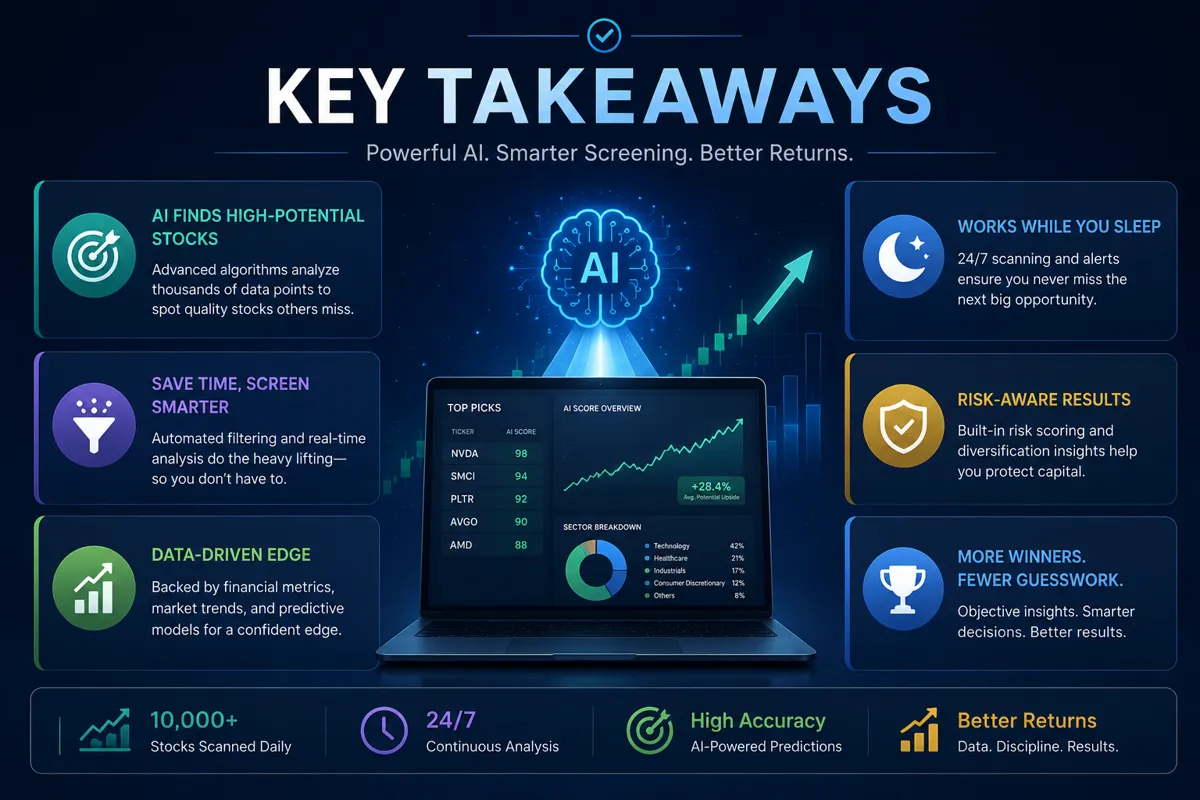
Key Takeaways
- AI stock screeners scan thousands of tickers in seconds using machine learning, replacing hours of manual chart review.
- The best free AI stock screener options (like Finviz's basic tier) cover fundamentals and technicals — paid tiers add real-time alerts and AI scoring.
- Tools like Trade Ideas' Holly AI and TrendSpider run continuous scans 24/7, flagging breakout setups and support/resistance levels automatically.
- AI screeners are useful for both day traders (real-time momentum scans) and swing traders (overnight watchlist building) — the use case determines which tool fits.
- No AI screener predicts winning stocks with certainty. They improve your process by narrowing the field to high-probability setups.
- Common mistakes include over-filtering, ignoring risk-reward on flagged stocks, and treating AI signals as buy orders rather than starting points.
- Zero technical skills are required to use most modern AI screeners — natural language query tools have made the barrier to entry almost nonexistent.
- Small-cap and low-float stocks are well-served by AI screeners, especially those with real-time volume spike detection.
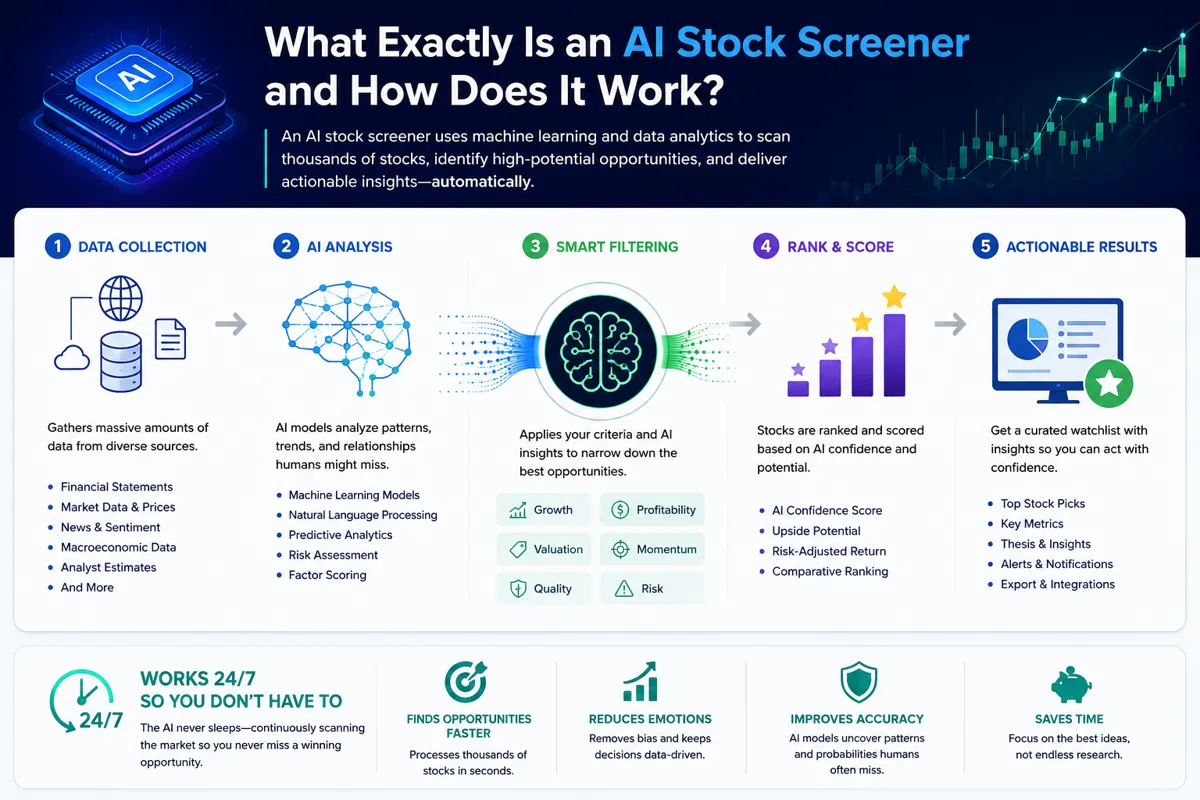
What Exactly Is an AI Stock Screener and How Does It Work
An AI stock screener is software that automatically filters a universe of stocks using algorithms trained on historical price data, fundamental metrics, and market patterns. Unlike a traditional screener that simply matches static criteria (P/E below 15, volume above 500K), an AI-powered version learns from past setups, weights signals dynamically, and surfaces candidates that match the profile of stocks that have historically moved.
Here's the basic mechanics:
- Data ingestion: The tool pulls real-time or end-of-day price data, volume, earnings reports, SEC filings, and sometimes news sentiment.
- Pattern recognition: Machine learning models compare current price action against historical setups — tight consolidation before a breakout, basing near support, volume accumulation patterns.
- Scoring and ranking: Each stock gets a composite score. Some tools use a 1–10 scale. Others give buy/hold/sell verdicts. Pineify's AI Stock Picker, for example, combines fundamental, technical, and sentiment data into a single predictive score to reduce emotional bias.
- Alert delivery: The screener pushes flagged stocks to a watchlist, email, or mobile alert — often before power hour.
The practical takeaway: think of it as a research assistant that never sleeps, never gets bored, and doesn't revenge trade after a bad week. It narrows 8,000 stocks down to the 12 worth looking at tonight.
The AI Stock Screener Tool That Finds Winners While You Sleep — What It Actually Does Overnight
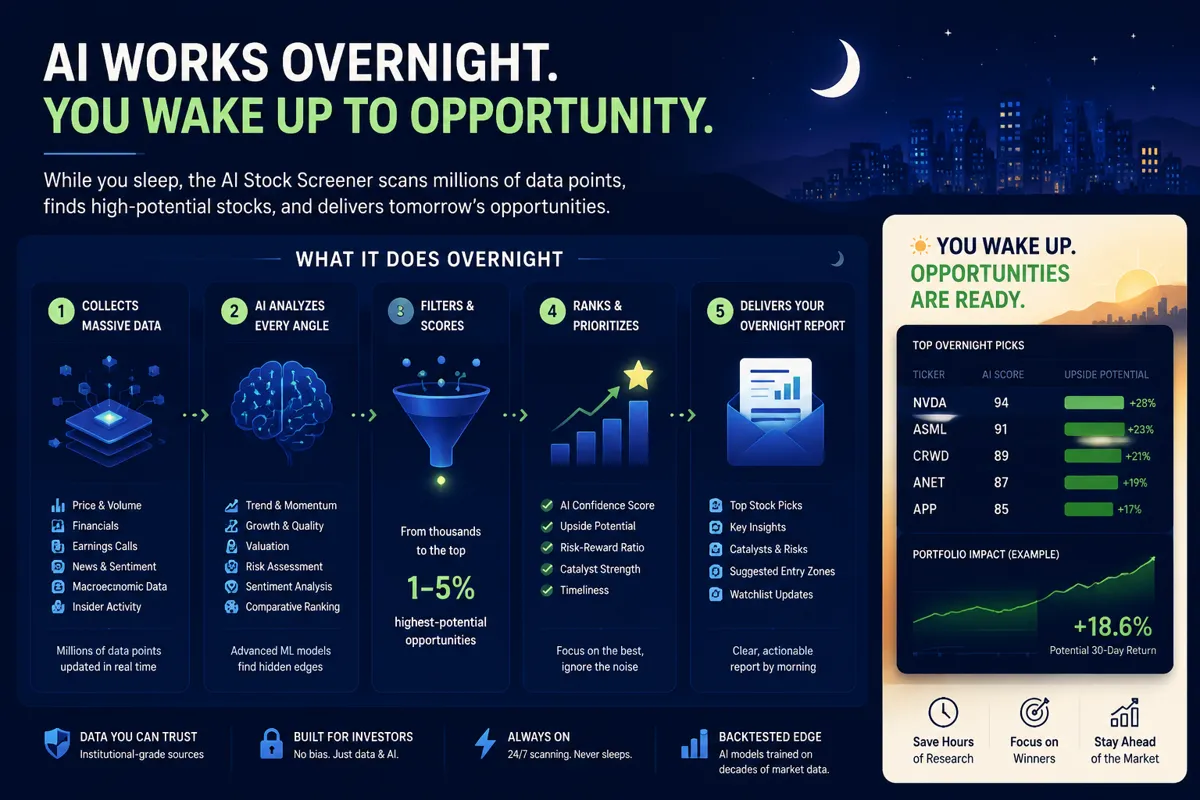
This is the core value proposition, and it's worth being precise about it. The AI stock screener tool that finds winners while you sleep isn't magic. It's systematic pre-market preparation running on autopilot.
While you're offline, these tools are doing the following:
- Scanning for stocks breaking out of multi-week bases (tight consolidation near resistance)
- Flagging unusual volume spikes that often precede big moves
- Identifying gap fill setups and earnings season momentum plays
- Updating watchlists based on new price action and news sentiment
- Running backtests against your saved filter criteria
Tools like Trade Ideas' Holly AI run thousands of simulated trades overnight to identify the highest-probability setups for the next session. TrendSpider's AI-assisted multi-timeframe screener automatically detects trendlines and support/resistance levels across daily, weekly, and intraday charts simultaneously — something that would take a human analyst several hours to replicate manually.
The result is a clean watchlist waiting for you at 6 a.m. That's the setup. What you do with it still requires judgment, position sizing, and a stop loss. The AI handles the search. You handle the trade.
How Much Does an AI Stock Screening Tool Cost Compared to Traditional Stock Screeners
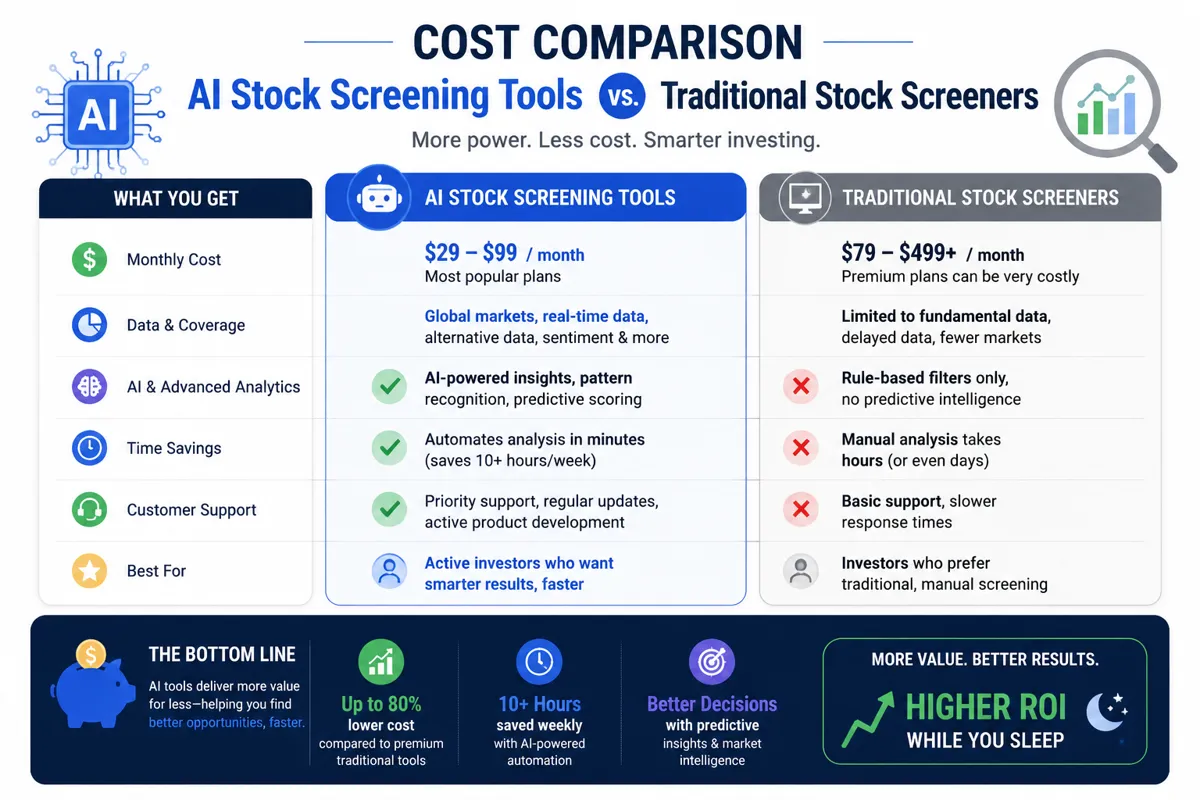
AI stock screeners range from free to several hundred dollars per month, and the price gap between AI-powered tools and traditional screeners has narrowed significantly in 2026.
Here's a practical breakdown:
| Tool Type | Price Range | Best For |
|---|---|---|
| Free AI screener (Finviz basic, StoxHub free tier) | $0/month | Beginners, fundamental + basic technical filters |
| Mid-tier AI screener (TrendSpider, Tickeron) | $20–$80/month | Swing traders, multi-timeframe analysis |
| Professional AI screener (Trade Ideas, Amsflow Pro) | $100–$250/month | Active day traders, real-time Holly AI scans |
| Institutional-grade (AlphaSense, Accern) | $500+/month | Fund managers, enterprise research teams |
Traditional screeners like Finviz's free version offer solid filtering but lack the pattern-recognition layer. Finviz Elite adds real-time data and backtesting for around $35/month — still cheaper than most AI-native tools, but it won't auto-detect a breakout setup the way Trade Ideas does.
StoxHub offers a free tier covering over 3,500 companies across US, ASX, and NZX markets with plain-English AI summaries grounded in SEC filings. That's a legitimate starting point for a beginner who doesn't want to spend anything.
The decision rule: if you're paper trading or just building your watchlist process, start free. If you're trading real money with a defined system, the $50–$150/month range buys you meaningful signal quality. Don't pay for institutional tools until you're consistently profitable at the mid-tier level. Play stupid games, win stupid prizes — and paying $250/month for a tool you don't have the process to use is a very expensive game.
Can AI Stock Screeners Really Find Winning Stocks Better Than Human Analysts
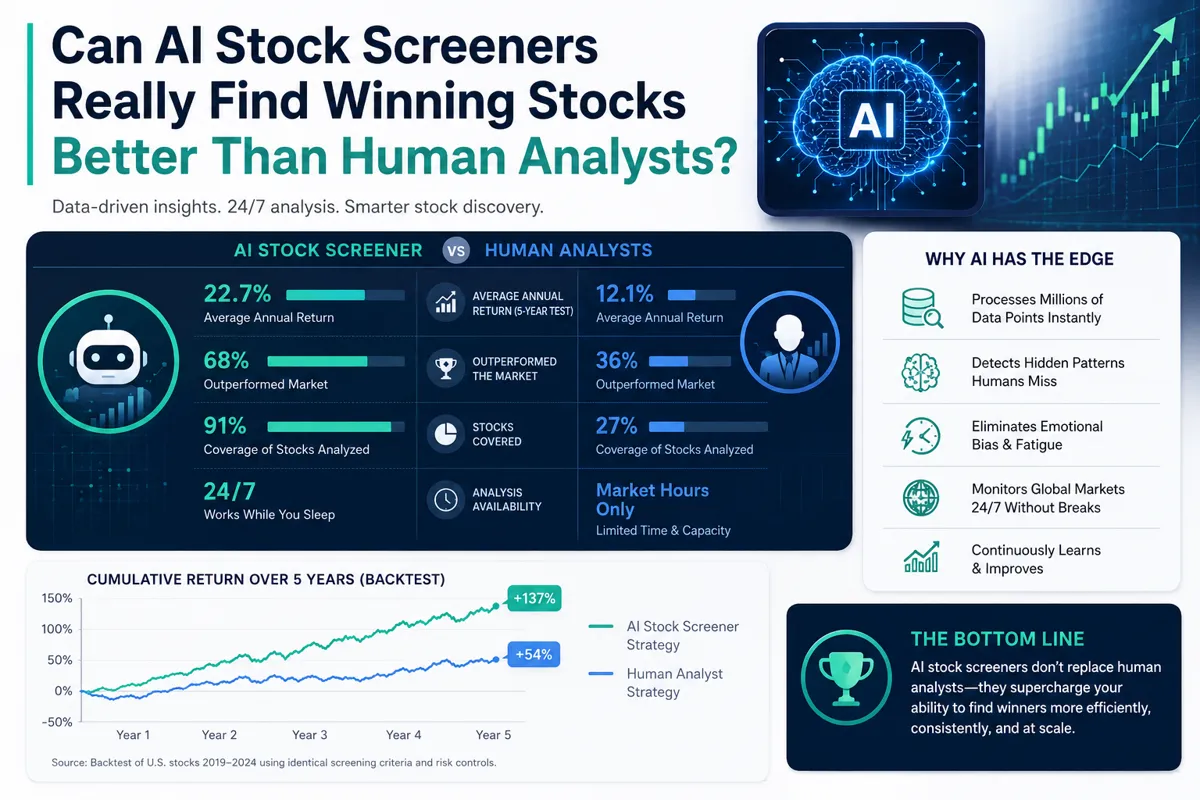
AI screeners outperform human analysts on speed and consistency. They do not outperform on judgment, context, or understanding why a setup matters in a specific macro environment.
The honest answer: AI screeners are better at scanning, worse at reasoning.
A human analyst might recognize that a stock's breakout is happening during a sector rotation driven by Fed policy — context that raw price data doesn't capture cleanly. An AI screener might flag the same stock purely on volume and price action, without knowing the macro tailwind behind it.
What the data suggests (without overstating it): platforms like Coinrule's AI screener adapt to changing market conditions using machine learning algorithms trained on technical indicators, fundamentals, and market patterns across multiple brokers. That adaptive layer is genuinely useful — it's not a static filter set that gets stale.
The practical takeaway: treat AI screener output as the first filter, not the final word. The screener finds the setup. You confirm the thesis. Discipline beats prediction every time, and no AI changes that.
Which AI Stock Screening Tools Are Best for Beginners vs. Professional Traders
Beginners need simplicity, plain-English outputs, and low financial risk. Professionals need speed, customization, and real-time data depth.
Best for beginners:
- Finviz (free): Visual heat maps, basic fundamental and technical filters, no learning curve. Start here.
- StoxHub: Plain-English company summaries from SEC filings, multi-factor screener, free tier available.
- Cotrader: Accepts natural language queries ("show me profitable tech stocks under $20 with rising volume") across 11,000+ stocks. Zero technical knowledge required.
- Tykr: Simplified scoring system designed for self-directed investors who want Warren Buffett-style fundamental screening without the spreadsheet.
Best for intermediate to professional traders:
- TrendSpider: AI-assisted multi-timeframe screening with automated trendline detection. Strong for swing traders who want to see the full screener breakdown before committing to a setup.
- Trade Ideas: Holly AI runs real-time market scans and simulates thousands of trades overnight. The gold standard for active day traders who need pre-market watchlists.
- Tickeron: Technical and fundamental filters with a 14-day free trial. Good for traders building a rules-based system. See the Tickeron tool review for a full breakdown.
- Amsflow: Over 550 metrics and 8,000 filters with a natural language Lisa Screener Agent. Built for traders who want institutional-depth filtering without institutional pricing.
The common mistake beginners make: jumping straight to a professional tool, drowning in options, and falling into analysis paralysis. Start with one tool, one filter set, and paper trade it first for 30 days.
What Common Mistakes Do Investors Make When Using AI Stock Screening Technology
The biggest mistake is treating a screener output as a trade signal. It isn't. It's a research starting point.
Here are the mistakes that actually cost money:
1. Over-filtering into a dead end. Setting 15 simultaneous criteria produces zero results or one stock that technically qualifies but has no real catalyst. Keep filters to 4–6 core criteria.
2. Ignoring risk-reward on flagged stocks. The AI found the setup. You still need to define your entry and exit, your stop loss, and your position sizing before touching it. A clean setup with bad risk-reward is still a bad trade.
3. Chasing alerts in a choppy tape. Not every alert is worth acting on. In a sideways, low-conviction market, AI screeners will still flag setups that fail. The market context matters.
4. Overtrading the watchlist. Getting 20 alerts and trying to trade all of them is overtrading with extra steps. Pick the two or three cleanest setups. Let the rest go.
5. Ignoring the stop loss. The screener found the entry. It cannot manage the trade for you. Getting stopped out is part of the process — it's not a failure of the tool.
6. FOFO (Fear of Finding Out). Some traders run the screener, see a setup they like, and then spend three hours researching themselves out of the trade. At some point, the setup is either there or it isn't.
The free Stock Health Scorecard is a useful gut-check before acting on any screener output — it forces you to evaluate the setup against a consistent framework rather than vibes.
Is an AI Stock Screener Good for Day Traders or More for Long-Term Investors
AI stock screeners serve both groups well, but they serve them differently. The tool is the same; the filter criteria and timing are what change.
For day traders: Real-time AI screeners like Trade Ideas and StockMover focus on live market movers, volume spikes, and intraday price action. The goal is finding momentum plays during power hour or identifying gap fill candidates at the open. Speed is everything — a screener with a 15-minute data delay is useless for a day trader.
For swing traders: End-of-day AI screeners work fine. The goal is building a watchlist of stocks in tight consolidation near support, approaching a breakout level, or showing accumulation patterns. TrendSpider and Ticker Screener (which analyzes RSI, MACD, and Bollinger Bands to rank swing trade potential with entry price, target, and stop-loss) are built for this use case.
For long-term investors: Tools like Equilima combine AI stock picks, macro dashboards, and backtesting so investors can research fundamentals and test strategy behavior before committing capital. Morningstar's AI-assisted research layer also fits here for investors who want deep fundamental analysis rather than technical setups.
The decision rule: if you're holding for days to weeks, an end-of-day screener is sufficient. If you're trading intraday, you need real-time data and alerts. Don't pay for real-time if you're a swing trader — that's a cost you don't need.
What Machine Learning Algorithms Do Top AI Stock Screeners Use
Most top AI stock screeners use a combination of supervised learning, natural language processing, and pattern recognition — not a single algorithm.
The common approaches:
- Random forests and gradient boosting: Used to rank stocks by probability of a defined outcome (e.g., 5% move within 10 days) based on historical feature sets including volume, price momentum, and earnings surprise data.
- Recurrent neural networks (RNNs) and LSTMs: Designed for sequential data like price series. Used to detect patterns in time-series price action that precede significant moves.
- Natural language processing (NLP): Processes earnings call transcripts, SEC filings, and news headlines to generate sentiment scores. StoxHub uses this approach to produce plain-English summaries grounded in SEC filings.
- Reinforcement learning: Trade Ideas' Holly AI uses a simulation-based approach — running thousands of hypothetical trades to identify which setups have the highest historical win rate under current market conditions.
For the non-technical trader, none of this requires understanding. What matters is knowing that the AI is pattern-matching against historical data, not seeing the future. The model is only as good as the data it was trained on, and past patterns don't guarantee future results. That's not a disclaimer — that's the actual mechanic.
Are AI Stock Screeners Legal and Compliant with Financial Regulations
Yes, AI stock screeners are legal. They are research and filtering tools, not investment advisers. Using one doesn't require any special license, and the tools themselves operate within existing financial regulations.
A few important distinctions:
- Research tools vs. investment advice: A screener that surfaces stocks matching your criteria is a research tool. A platform that says "buy this specific stock for these reasons and here's the expected return" is closer to investment advice territory, which triggers SEC and FINRA oversight.
- Registered investment advisers: Platforms that manage money on your behalf (robo-advisors, automated portfolio tools) are regulated entities. Pure screeners are not.
- Data sourcing: Reputable AI screeners pull from public market data, SEC filings, and licensed data feeds. They don't use material non-public information (that's insider trading, which is illegal regardless of whether an AI or a human acts on it).
The SEC and FINRA have both issued guidance on AI use in financial services, focusing primarily on firms managing client assets rather than individual retail tools. For current regulatory guidance, FINRA.org is the authoritative source for retail investor protections.
The practical takeaway: using an AI stock screener is no different legally than using a spreadsheet to filter stocks. The responsibility for the trade decision remains with you.
How Accurate Are AI Stock Screeners Compared to Manual Stock Research
Accuracy is the wrong frame. The better question is: does the screener surface higher-quality setups than a manual process, and does it do it faster?
On speed: there's no contest. Manual research across 8,000 stocks is impossible for one person in a trading day. AI screeners do it in seconds.
On quality: it depends on the tool and the market environment. In trending markets with clear momentum, AI screeners that use pattern recognition and volume analysis perform well — they catch the breakout before it's obvious. In choppy, low-conviction markets, the same tools generate more false signals because the patterns they're trained on don't resolve cleanly.
AIQ, for example, combines technical, fundamental, and risk signals into a composite score with the reasoning behind it — giving buy, hold, or sell verdicts with context rather than just a number. That's more useful than a raw filter output because it forces the tool to show its work.
Manual research still wins on nuance. A human analyst reading an earnings call transcript will catch tone, hedging language, and management credibility signals that NLP models sometimes miss. The best process combines both: use the AI screener to narrow the field, then apply human judgment to the final three to five candidates.
For traders who want to compare screener tools side by side before committing to one, the full directory covers the major options with honest breakdowns.
What Types of Stocks and Markets Do AI Screeners Work Best In
AI screeners perform best in liquid, data-rich markets with clear price action trends. They struggle in illiquid, thinly traded markets where historical patterns are sparse.
Where AI screeners shine:
- U.S. large and mid-cap equities: Deep historical data, high liquidity, consistent volume patterns. The models are well-trained here.
- Earnings season momentum plays: AI tools that incorporate fundamental data and sentiment scoring are particularly effective at flagging post-earnings setups.
- Trending sectors: When a sector has a clear catalyst (AI infrastructure, energy transition, biotech approvals), screeners that weight momentum and relative strength surface the leaders quickly.
- Small-cap and low-float stocks: Contrary to what many assume, AI screeners handle small-cap stocks well when they include real-time volume spike detection. A low-float stock with unusual volume is exactly the kind of signal a screener catches faster than a human. StockMover specifically focuses on real-time market movers with volume spike detection across U.S. stocks.
Where AI screeners struggle:
- Choppy, sideways markets: Pattern recognition breaks down when there's no trend to recognize.
- Highly illiquid stocks: Thin data means the model has little to work with.
- Black swan events: No screener trained on historical data handles a genuine market shock well. The tape reads differently when the rules change.
Do AI Stock Screeners Work for Small Cap Stocks or Just Large Companies
AI stock screeners work effectively for small-cap stocks, and in some cases they're more valuable there than in large-cap research. Small-cap stocks receive less analyst coverage, which means the information edge for a retail trader using an AI screener is larger.
The key requirement: the screener needs real-time volume data and low-float detection capability. A small-cap stock moving on 10x its average volume is a signal worth investigating. A screener that only runs end-of-day filters will miss the intraday setup entirely.
Tools like StockMover are built specifically for this — real-time movers, AI score gauges, and volume spike alerts across U.S. stocks including small and micro-caps. For traders interested in the low-float, high-momentum style of trading, this is the category to focus on.
The risk with small-cap AI screening: low-float stocks can move violently in both directions. The screener finds the setup; risk management keeps you from getting destroyed when it reverses. Position sizing and a hard stop loss are non-negotiable in this space. Catching a falling knife is a real outcome if you chase a small-cap alert without confirming the setup.
What Technical Skills Do You Need to Use an AI Stock Screening Tool Effectively
Zero technical skills are required to use most modern AI stock screeners. The barrier dropped significantly when natural language interfaces became standard.
Cotrader, for example, accepts plain-English queries: "show me S&P 500 stocks with rising earnings and positive momentum." No coding, no filter syntax, no prior trading knowledge required. Amsflow's Lisa Screener Agent works the same way across 8,000 filters.
What you do need to understand:
- Basic chart reading: Support and resistance, what a breakout looks like, how to read a candlestick. This isn't technical skill — it's vocabulary. Spend two hours on it and you'll understand 80% of what screeners flag.
- Risk-reward basics: If a screener flags a stock at $50 with a target of $55 and a stop at $48, the risk-reward is 1:2.5. Understanding whether that's worth taking is on you.
- Market context: Is the broader market in a bull tape or a choppy tape? A clean setup in a terrible market is still a bad trade.
The free Swing Trade Planner is a practical tool for translating screener outputs into structured trade plans — entry, exit, stop loss, and position size — without needing to build your own spreadsheet.
If you want to go deeper on building a rules-based system around screener outputs, the AI trading platforms comparison covers the full landscape of tools that pair screening with execution and portfolio management.
Frequently Asked Questions
What is the best free AI stock screener in 2026?
Finviz's free tier is the most widely used starting point — it offers solid fundamental and technical filters with a visual heat map. StoxHub's free tier adds AI-generated company summaries across 3,500+ stocks. For natural language queries, Cotrader has a free entry point covering 11,000+ stocks.
Can an AI stock screener replace a financial adviser?
No. A screener is a research tool, not a fiduciary. It surfaces candidates based on data patterns. A financial adviser provides personalized guidance based on your full financial picture, goals, and risk tolerance. They serve different functions.
How often should I run an AI stock screener?
Swing traders typically run scans once per day after market close to build the next day's watchlist. Day traders use real-time screeners continuously during market hours. Running a scan more frequently than your trading timeframe requires is usually overtrading in disguise.
Is TrendSpider better than Finviz for AI screening?
They serve different needs. Finviz is faster, cheaper, and better for basic filtering. TrendSpider's AI layer adds automated trendline detection, multi-timeframe analysis, and pattern recognition that Finviz doesn't offer. If you're a swing trader who wants the AI to identify the setup structure, TrendSpider is worth the upgrade.
Do AI stock screeners work in bear markets?
Yes, but the filter criteria change. In a bear market, screeners are more useful for finding short setups, oversold bounces, or defensive sectors showing relative strength. The tool works — you just need to adjust what you're scanning for.
What's the difference between an AI stock screener and a stock alert service?
A screener gives you the criteria and lets you find candidates. An alert service pushes specific stock picks to you. Screeners build your process; alert services create dependency. Systems over hacks — build the process.
Can I use an AI stock screener for options trading?
Yes. Several tools include options-specific filters — unusual options activity, implied volatility rank, and open interest changes. The AI options tools directory covers the best platforms for options-focused screening.
How do I know if an AI screener's signals are reliable?
Backtest the filter criteria against historical data before trading it live. Most professional tools include backtesting functionality. Paper trade it first for at least 30 days to see how the signals perform in real market conditions before risking capital.
Are AI stock screeners suitable for ETF investors?
Mostly, yes — though ETF-specific screeners that filter by expense ratio, sector exposure, and factor tilt are more useful than equity screeners for ETF investors. Tools like Morningstar are better suited for ETF research than momentum-focused equity screeners.
What's the biggest limitation of AI stock screeners?
They're backward-looking. Every model is trained on historical data, which means it's optimized for patterns that have already occurred. Novel market conditions — new macro regimes, geopolitical shocks, structural market changes — can make historical patterns temporarily unreliable.
Conclusion
The AI stock screener tool that finds winners while you sleep is real, it works, and it's accessible at every budget level in 2026. But it's a process tool, not a prediction machine.
Here's what to do with this:
- Start with one free tool. Finviz or StoxHub. Run it for 30 days. Build the habit of reviewing a screener output every evening before the next session.
- Define your filter criteria before you run the scan. What kind of setup are you looking for? Breakout from consolidation? Earnings momentum? Volume spike on a small-cap? Know the answer before you open the tool.
- Use the screener to build a watchlist, not a buy list. The screener narrows the field. You confirm the setup, define the risk-reward, set the stop loss, and size the position.
- Paper trade the output for 30 days. Before real money touches any screener signal, verify that your filter criteria actually produce setups worth trading in current market conditions.
- Upgrade the tool when your process outgrows it. If you're consistently profitable with a free screener and hitting its limitations, that's the right time to pay for real-time data and AI pattern recognition.
Signal over noise. Process over prediction. The screener does the scanning — you do the thinking.
Browse the full directory of AI stock screening tools and comparisons at AI Stock Picker Apps, where over 100 tools are reviewed with honest breakdowns — no hype, no affiliate bias, just the signal.
References
StoxHub - https://stoxhub.io/?utm_source=openai
Equilima - https://equilima.com/?utm_source=openai
StockMover.ai - https://stockmover.ai/?utm_source=openai
Cotrader - https://getcotrader.com/?utm_source=openai
AI Stock Screener: Trade Ideas App - https://apps.apple.com/us/app/ai-stock-screener-trade-ideas/id6738607499?utm_source=openai
Amsflow Stock Finder - https://amsflow.com/stock-finder?utm_source=openai
Ticker Screener - https://www.ticker-screener.com/?utm_source=openai
Pineify AI Stock Picker - https://pineify.app/ai-stock-picker?utm_source=openai
AlgoVestIQ (AIQ) - https://www.algovestiq.com/?utm_source=openai
Coinrule AI Stock Screener - https://coinrule.com/ai-stock-screener/?utm_source=openai