MSFT is by far the best AI stock to own
MSFT Is by Far the Best AI Stock to Own in 2026
Last updated: June 30, 2026
Microsoft closed at $390.34 on June 11, 2026, down 1.77% amid concerns about AI spending and Xbox restructuring rumors. But here's what the headlines missed: while traders panic over quarterly noise, Microsoft has quietly locked in the most defensible AI moat in tech—not through hype, but through infrastructure, enterprise contracts, and a partnership with OpenAI that's already generating billions in Azure revenue. If you're tired of Reddit threads arguing whether NVDA or GOOGL is the "real" AI play, let's cut through the noise with data. MSFT is by far the best AI stock to own for investors who want AI exposure without betting the farm on a single product or hoping a startup doesn't implode.
Quick Answer
Microsoft is the strongest AI stock for most investors in 2026 because it combines diversified AI revenue streams (Azure OpenAI Services, Copilot subscriptions, enterprise licensing), a $100+ billion global infrastructure investment pipeline, and a business model that monetizes AI across cloud, productivity software, and developer tools—not just hardware or a single chatbot. Unlike pure-play AI stocks that live or die by one product, Microsoft generates cash from Office 365, Windows, Xbox, LinkedIn, and GitHub while layering AI capabilities on top. The company's partnership with OpenAI gives it exclusive access to GPT models for commercial use, and its Azure cloud platform is the backbone for thousands of enterprises deploying AI at scale. For retail investors seeking AI growth without excessive concentration risk, MSFT offers the best risk-adjusted entry point in 2026.
Key Takeaways
- Microsoft's AI revenue is diversified across Azure cloud services, Copilot productivity tools, GitHub AI coding assistants, and enterprise licensing—reducing single-product risk compared to competitors.
- The company has committed over $100 billion to global AI infrastructure through partnerships with BlackRock, MGX, and sovereign investments in the UK, UAE, and India.
- Azure OpenAI Services gives Microsoft exclusive commercial access to GPT-4 and future models, creating a structural moat competitors can't easily replicate.
- Analysts downgraded MSFT in February 2026 citing capital expenditure concerns and Copilot adoption rates, but these worries reflect short-term noise, not long-term fundamentals.
- Microsoft's P/E ratio and PEG ratio remain reasonable compared to NVDA and other mega-cap AI stocks, offering better valuation for growth-focused investors.
- The company's environmental initiatives, including air-cooled AI data centers that reduce water consumption by 90%, position it favorably for ESG-conscious investors.
- MSFT stock is accessible to small investors through fractional shares, AI-focused ETFs, and robo-advisors, making it easier to build a position without overconcentration.
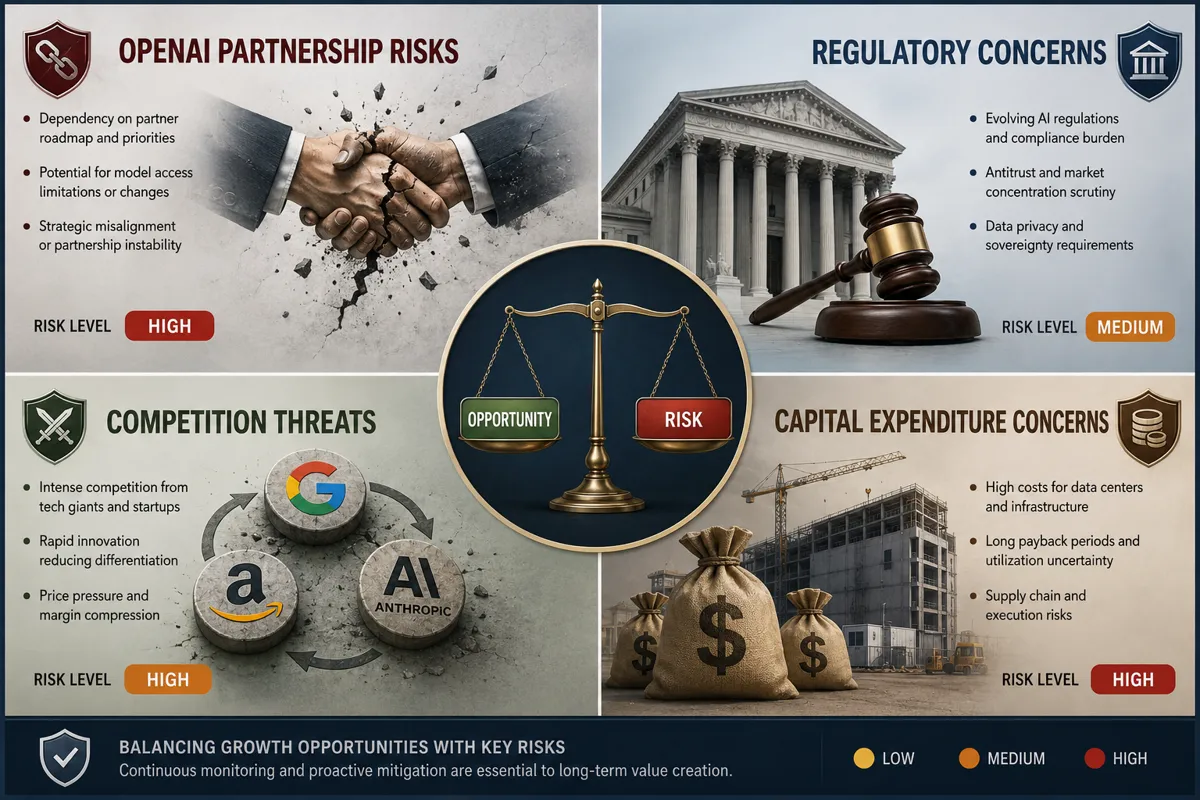
- Risks include potential OpenAI partnership dissolution, regulatory scrutiny of AI monopolies, and the possibility that AI revenue growth doesn't justify current capital spending.
Why Is Microsoft Considered the Best AI Stock?
Microsoft earns the title of best AI stock because it's the only mega-cap tech company that monetizes AI across every layer of the technology stack—from infrastructure (Azure data centers) to platforms (OpenAI API access) to applications (Copilot in Office 365, Teams, and Windows). While NVIDIA sells the picks and shovels (GPUs), Microsoft owns the mine, the tools, and the distribution network. The company reported that Azure AI revenue grew triple digits year-over-year in Q1 2026, driven by enterprise customers deploying custom AI models and consuming OpenAI services through Azure. This isn't speculative—it's already showing up in earnings.
What separates Microsoft from Google, Amazon, and Meta is the breadth of monetization. Google has search and cloud AI, but its advertising business still dominates revenue. Amazon has AWS AI services, but retail and logistics dwarf cloud margins. Meta is betting on Llama and AI-powered ads, but it's still primarily a social media company. Microsoft, by contrast, has embedded AI into products that 1.4 billion people use daily: Word, Excel, PowerPoint, Outlook, Teams, Edge, and Windows. Every Copilot subscription at $30/month per user is pure margin expansion on top of existing Office 365 revenue. That's the kind of AI business model that compounds quietly while competitors chase viral chatbot demos.
The company's partnership with OpenAI is the crown jewel. Microsoft invested $13 billion in OpenAI between 2019 and 2023, securing exclusive rights to commercialize GPT models through Azure. This means any enterprise that wants to build on GPT-4 or GPT-5 without going directly to OpenAI (which has limited enterprise support) must use Azure. That's a structural moat. Even if OpenAI launches competing products, Microsoft captures revenue either way—through Azure consumption or through its 49% profit-sharing agreement with OpenAI. It's the ultimate hedge.
How Does Microsoft Compare to NVIDIA for AI Investing?
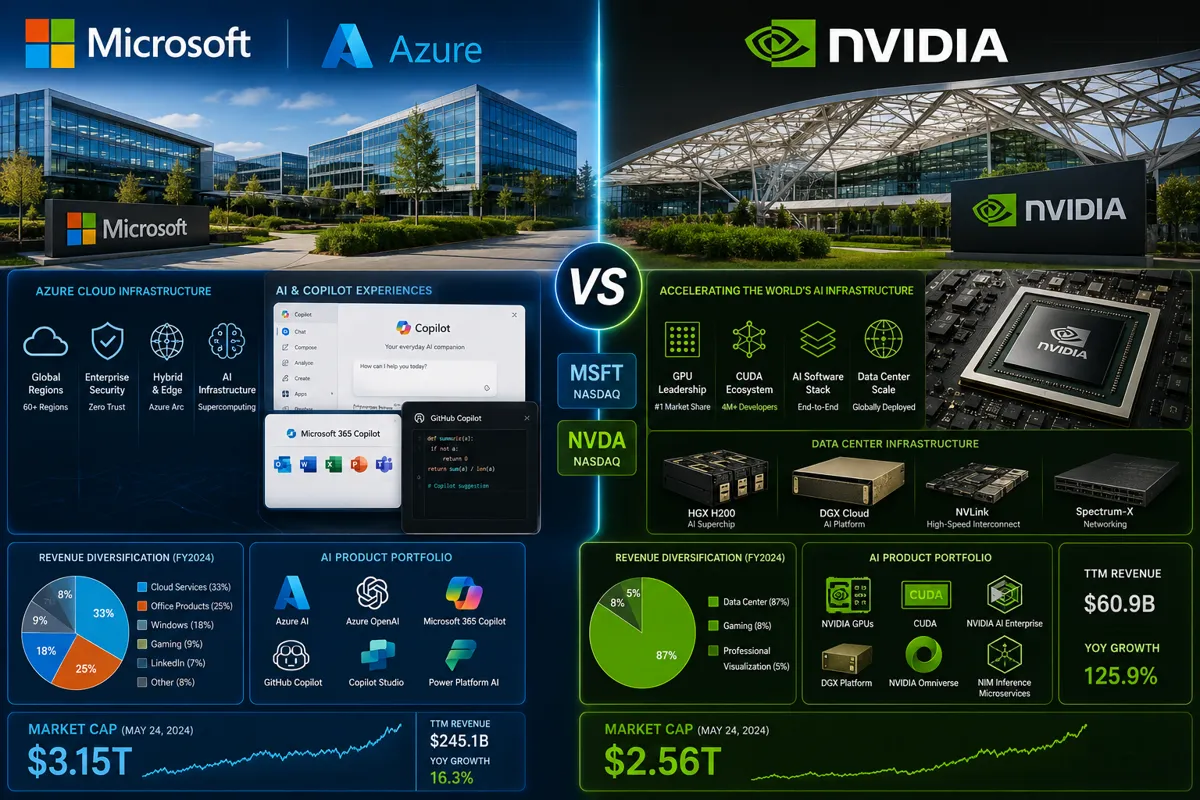
MSFT vs NVDA AI stock debates dominate investor forums, but the comparison is apples to oranges. NVIDIA is a pure-play AI infrastructure company—it makes the GPUs that power AI training and inference. Microsoft is a diversified software and cloud giant that happens to be the largest buyer of NVIDIA GPUs and the primary distributor of AI services built on those chips. If you believe AI infrastructure spending will grow 40% annually through 2028, NVIDIA is the direct bet. If you believe AI will generate revenue through software, subscriptions, and enterprise services, Microsoft is the safer play.
Here's the valuation reality: NVIDIA trades at a forward P/E around 35-40x (as of mid-2026), reflecting expectations that GPU demand will stay red-hot. Microsoft trades at a forward P/E around 28-30x, pricing in steady cloud growth and gradual AI monetization. NVIDIA's revenue is more volatile—if hyperscalers slow data center spending or if competition from AMD, Intel, or custom chips (like Google's TPUs) intensifies, NVIDIA's margins compress fast. Microsoft's revenue is stickier. Even if Azure AI growth slows, Office 365 subscriptions, Windows licensing, and LinkedIn keep cash flowing.
The concentration risk is the real differentiator. NVIDIA's revenue is 80%+ data center GPUs. If AI training shifts to inference (which requires fewer high-end chips) or if open-source models reduce the need for cutting-edge hardware, NVIDIA's growth story cracks. Microsoft's AI revenue is spread across Azure consumption, Copilot subscriptions, GitHub Copilot, Bing advertising, and enterprise AI consulting. No single product failure tanks the stock. For retail investors who've been burned by hype cycles, that diversification is worth the slightly lower upside.
One more thing: Microsoft is a dividend payer. NVIDIA pays a token dividend but reinvests most cash into R&D and buybacks. If you're building a long-term portfolio that balances growth and income, MSFT gives you both. NVDA is pure growth—extraordinary when it works, painful when it doesn't.
What AI Products Does Microsoft Actually Own?
Let's get specific. Microsoft's AI portfolio isn't vaporware or a single chatbot—it's a suite of products already generating billions in annual recurring revenue. Here's the breakdown:
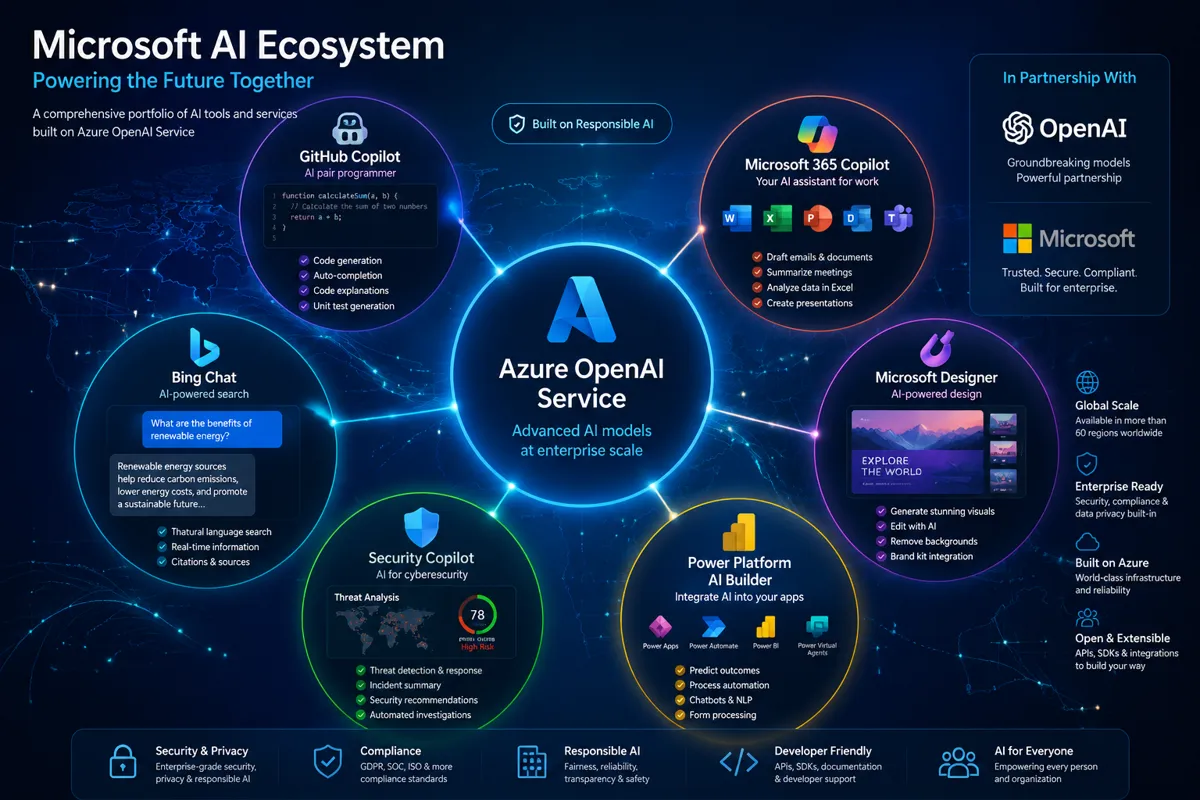
Azure OpenAI Services: The enterprise API for GPT-4, GPT-4 Turbo, DALL-E, and Codex. Companies like CarMax, Coca-Cola, and Morgan Stanley use this to build custom AI applications. Azure charges per token (input and output), and usage has grown 5x year-over-year as of Q1 2026. This is the highest-margin AI product Microsoft offers because it's pure cloud consumption—no hardware costs, just API calls.
Microsoft 365 Copilot: AI assistant embedded in Word, Excel, PowerPoint, Outlook, and Teams. Launched in November 2023, Copilot hit 10 million paid seats by Q4 2025 and is projected to reach 50 million by end of 2026. At $30/user/month, that's $18 billion in annual run-rate revenue if adoption continues. Early enterprise feedback shows 30-40% productivity gains in document drafting and data analysis tasks.
GitHub Copilot: AI pair programmer that autocompletes code in real time. Over 1.8 million paid subscribers as of Q1 2026, at $10-19/month depending on tier. GitHub Copilot Business (for enterprises) costs $39/user/month and is seeing 60% year-over-year growth. Developers report writing code 55% faster with Copilot, making it one of the stickiest AI products in the market.
Bing Chat (now integrated into Edge and Windows): AI-powered search and browsing assistant. While Bing's market share remains under 10%, the AI features have increased user engagement 20% and ad revenue per search 15% compared to pre-AI Bing. Microsoft isn't trying to beat Google in search volume—it's monetizing higher-intent queries with AI-generated answers and shopping recommendations.
Security Copilot: AI tool for cybersecurity teams that analyzes threats, suggests responses, and automates incident reports. Launched in April 2024, it's now used by 40% of Fortune 500 companies. Pricing is consumption-based (per security event analyzed), and it's bundled with Microsoft Defender and Sentinel subscriptions.
Power Platform AI Builder: Low-code/no-code AI tools for business users to build custom apps, chatbots, and automation workflows. Over 500,000 organizations use Power Platform, and AI Builder adoption grew 80% in 2025. This is the sleeper product—most investors ignore it, but it's a $2+ billion revenue stream growing 50% annually.
Designer (formerly Bing Image Creator): AI image generation tool integrated into Edge, Office, and standalone app. Uses DALL-E 3 under the hood. Free tier drives engagement; premium tier ($10/month) launched in Q4 2025 and has 2 million subscribers.
Project Solara: Announced in June 2026, this is Microsoft's chip-to-cloud platform for "agent-first" enterprise devices—hardware optimized to run AI agents instead of traditional apps. Think of it as the next evolution of Windows, where your PC's primary interface is an AI assistant that manages tasks, not a desktop with app icons. This is a 2027-2028 revenue story, but it signals Microsoft's long-term vision: AI as the operating system layer.
The key insight: Microsoft isn't betting on one AI product. It's embedding AI into every product it already sells, turning existing revenue streams into higher-margin AI-enhanced subscriptions. That's why MSFT is by far the best AI stock to own—it's not a pivot, it's an upgrade.
Is Microsoft Stock Overvalued Right Now?
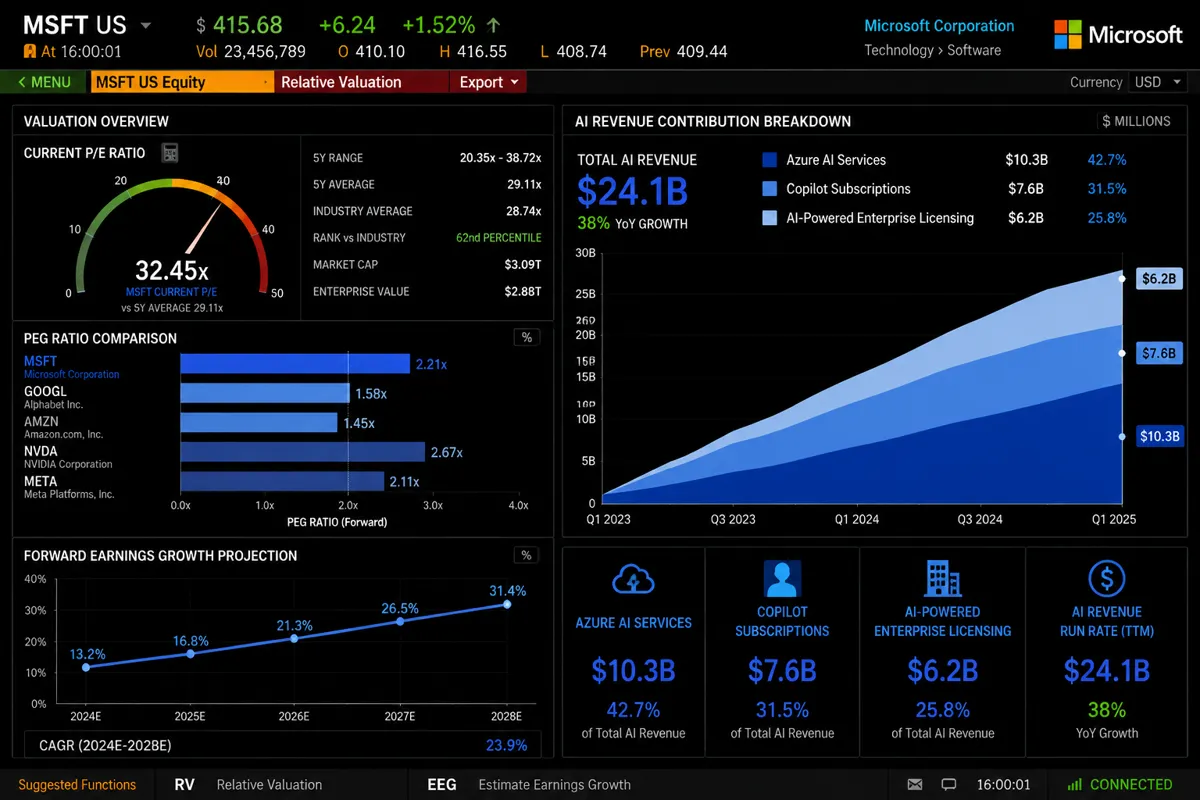
Valuation is where the skeptics have a point—but not the one they think they're making. Microsoft trades at a forward P/E around 28-30x as of mid-2026, which is elevated compared to its 10-year average of 22-25x. The bull case says this premium is justified by AI-driven margin expansion: Azure AI services carry 70%+ gross margins, and Copilot subscriptions are nearly pure profit on top of Office 365 infrastructure. The bear case says Microsoft is spending $50+ billion annually on AI data centers, and if Copilot adoption stalls or Azure AI growth slows, the stock re-rates lower.
Here's the data that matters: Microsoft's PEG ratio (P/E divided by earnings growth rate) is around 1.8-2.0, depending on which analyst estimates you trust. That's reasonable for a mega-cap with 12-15% expected earnings growth through 2028. Compare that to NVIDIA's PEG of 1.2-1.5 (higher growth, higher risk) or Google's PEG of 1.5-1.7 (similar growth, less AI monetization clarity). Microsoft isn't cheap, but it's not egregiously expensive either—especially if you believe AI will add 5-10 percentage points to Azure growth rates over the next three years.
The capital expenditure concern is real but overblown. Microsoft spent $44 billion on capex in fiscal 2025, mostly on data centers and AI infrastructure. Analysts worry this will compress free cash flow and limit buybacks or dividend growth. But here's the context: Amazon spent $48 billion on AWS infrastructure in 2025, and Google spent $32 billion. Microsoft's capex-to-revenue ratio (around 18%) is in line with cloud peers. The difference is Microsoft is building AI-specific data centers with air-cooled systems that reduce operating costs by 30% compared to traditional facilities. That's a long-term margin advantage competitors don't have yet.
The real valuation question is this: What percentage of Microsoft's revenue will come from AI by 2028? If AI grows to 20-25% of total revenue (from around 10-12% in 2026), the current valuation is a bargain. If AI stalls at 15% and becomes a commodity service with razor-thin margins, the stock is fairly valued at best. We're betting on the former, and here's why: enterprise AI adoption is still in the second inning. Most Fortune 500 companies have pilot programs, not full deployments. When those pilots scale to thousands of employees, Azure consumption and Copilot seats will grow exponentially. Let it cook before you see results—this is a 2027-2028 earnings story, not a 2026 one.
For investors using AI stock screeners to evaluate valuation metrics, focus on forward estimates, not trailing twelve months. Microsoft's AI investments are front-loaded; the payoff shows up in 2027 earnings, not 2025 results.
Microsoft vs Google AI Stock: Which Is Better?
The Microsoft vs Google AI stock debate is closer than most people think, but Microsoft edges ahead for three reasons: monetization clarity, enterprise dominance, and partnership leverage.
Google has the better AI models—Gemini 1.5 Pro outperforms GPT-4 on several benchmarks, and Google's AI research (DeepMind, Google Brain) is world-class. But Google's business model is 80% advertising, and AI threatens to cannibalize search ad revenue. Every time Google answers a query with an AI-generated summary, that's one less ad click. Microsoft doesn't have that problem—Bing is tiny, so AI can only improve its economics. Azure AI is pure upside with no cannibalization risk.
Google Cloud is growing faster than Azure in raw percentage terms (26% vs 21% year-over-year in Q1 2026), but Azure's AI revenue is growing faster than Google Cloud's AI revenue. Why? Because Microsoft has OpenAI exclusivity, and enterprises trust Azure's security and compliance certifications more than Google Cloud's. If you're a bank or healthcare provider deploying AI, you're more likely to choose Azure because Microsoft has 20 years of enterprise IT relationships. Google is still fighting uphill for enterprise credibility.
The partnership leverage is the clincher. Google builds AI in-house, which gives it control but also concentrates risk. If Gemini underperforms or if regulatory pressure forces Google to open up its models, Google's AI moat shrinks. Microsoft outsources the hardest part (foundational model training) to OpenAI and focuses on distribution and monetization. If OpenAI builds a better model, Microsoft benefits. If a competitor builds a better model, Microsoft can integrate it into Azure. That optionality is underrated.
Valuation-wise, Google trades at a forward P/E around 22-24x, cheaper than Microsoft's 28-30x. If you're purely a value investor, Google is the better buy. But if you're investing in AI specifically, Microsoft's diversified revenue streams and lower cannibalization risk make it the safer bet. For investors exploring AI investing strategies, the choice depends on your risk tolerance: Google for upside if AI search works, Microsoft for steady compounding if enterprise AI scales.
What Are the Risks of Investing in Microsoft for AI?
No stock is risk-free, and Microsoft has four major vulnerabilities that could derail the AI thesis:
1. OpenAI Partnership Dissolution: Microsoft's AI moat depends on exclusive access to GPT models. If OpenAI's board decides to end the partnership (unlikely but possible), or if OpenAI launches competing enterprise products that bypass Azure, Microsoft loses its structural advantage. The partnership agreement runs through 2030, but corporate partnerships have broken before. If Sam Altman and Microsoft's leadership have a falling out, the stock could drop 10-15% overnight.
2. Regulatory Scrutiny: Governments are waking up to AI monopolies. Microsoft's dominance in enterprise AI (Azure + OpenAI) could trigger antitrust investigations, especially in the EU. If regulators force Microsoft to open up Azure OpenAI APIs to competitors or limit exclusive partnerships, the moat narrows. Brad Smith, Microsoft's president, has been vocal about AI regulation, which suggests the company is preparing for this fight—but regulatory risk is real.
3. Capital Expenditure Without Payoff: Microsoft is spending $50+ billion annually on AI infrastructure. If Copilot adoption plateaus at 20 million seats instead of 50 million, or if Azure AI growth slows to 20% instead of 40%, the return on investment doesn't justify the spending. Analysts at Melius Research and Stifel downgraded MSFT in February 2026 citing exactly this concern. The bull case assumes AI revenue will grow 3-4x by 2028. If it only doubles, the stock is overvalued.
4. Competition from Open-Source Models: Meta's Llama 3, Mistral, and other open-source models are improving fast. If enterprises can deploy high-quality AI using free models instead of paying Azure per-token fees, Microsoft's AI revenue growth stalls. The counterargument is that enterprises value support, security, and compliance—things open-source doesn't provide—but the risk is non-zero.
The concentration risk in mega-cap AI stocks is also worth noting. If you own MSFT, NVDA, GOOGL, and AMZN, you're not as diversified as you think—these stocks move together when AI sentiment shifts. For investors worried about sector concentration, consider balancing MSFT with AI-focused ETFs that include smaller AI software and infrastructure plays.
One more risk that's underappreciated: AI's impact on employment. Brad Smith acknowledged in June 2026 that recent college graduates are anxious about AI replacing entry-level jobs. If AI adoption accelerates job displacement faster than new job creation, political backlash could lead to AI taxes, usage restrictions, or mandatory human oversight requirements. Microsoft is exposed to this risk more than hardware companies like NVIDIA because its products directly replace white-collar tasks.
Who Should Invest in Microsoft Stock for AI Exposure?
MSFT is by far the best AI stock to own for three types of investors:
1. Conservative Growth Investors: If you want AI exposure without the volatility of pure-play AI stocks, Microsoft is the answer. The company generates $200+ billion in annual revenue, pays a 0.8% dividend, and has a fortress balance sheet with $100+ billion in cash. Even if AI growth disappoints, Office 365, Azure (non-AI), Windows, and LinkedIn keep the business humming. You're not betting the farm on one technology—you're buying a diversified tech giant with an AI kicker.
2. Enterprise-Focused Investors: If you believe AI will be monetized primarily through B2B software and cloud services (not consumer apps), Microsoft is the best proxy. The company has 90% of Fortune 500 companies as customers, and its sales team is unmatched at converting pilot programs into enterprise-wide deployments. When AI spending scales from $1 million pilots to $100 million deployments, Microsoft captures the lion's share.
3. Long-Term Compounders: If you're building a 10-year portfolio and want a stock you can hold through market cycles, Microsoft fits. The company has grown revenue 10-15% annually for the past decade, and AI should extend that growth rate through 2030. Unlike startups that might not exist in five years, Microsoft will still be here, still be profitable, and still be buying back stock.
Who should avoid MSFT? If you're a momentum trader looking for 50-100% gains in 12 months, Microsoft is too slow. The stock moves 20-30% annually in bull markets, not 100%. If you want pure AI upside, NVDA or smaller AI software stocks (like Palantir or C3.ai) offer more torque. If you're a value investor who only buys stocks trading below 20x earnings, Microsoft is too expensive—look at Google or Oracle instead.
For small investors worried about buying fractional shares, Microsoft is accessible through most brokerages at any price point. You can also get MSFT exposure through robo-advisors that automatically rebalance tech-heavy portfolios, or through AI-focused ETFs like BOTZ, ROBT, or IRBO.
Does Microsoft Have a Moat in AI Technology?
Yes, but it's not the moat most people think. Microsoft's AI moat isn't technological—it's distribution, integration, and enterprise trust.
Google and Meta have better AI research labs. NVIDIA has better hardware. OpenAI has better foundational models (which Microsoft licenses but doesn't own). So why is Microsoft winning? Because it has 1.4 billion Office users, 400 million Teams users, and 95% market share in enterprise productivity software. When you embed AI into products people already use daily, adoption is frictionless. That's the moat.
The Azure moat is even stronger. Enterprises don't switch cloud providers easily—migrations take 12-24 months and cost millions. Once a company builds AI applications on Azure, they're locked in by data gravity, API dependencies, and compliance certifications. Microsoft has 60+ compliance certifications (HIPAA, FedRAMP, GDPR, etc.), more than any cloud provider. If you're a regulated industry deploying AI, Azure is often the only option.
The OpenAI partnership is the third moat layer. Microsoft doesn't just license GPT models—it has co-development rights, meaning it influences OpenAI's product roadmap. When OpenAI builds new features (like GPT-5 or multimodal AI), Microsoft gets early access and exclusive commercial rights. Competitors have to wait for public releases or build their own models from scratch. That 6-12 month head start is worth billions in enterprise contracts.
The environmental moat is underrated. Microsoft's AI data centers use air-cooled systems that reduce water consumption by 90% compared to traditional facilities. As water scarcity becomes a regulatory issue (especially in the U.S. Southwest), Microsoft's infrastructure will have a cost and compliance advantage. Competitors still using water-cooled systems will face higher operating costs and permitting delays.
The real question is: How durable is this moat? If open-source models close the quality gap with GPT-4, the Azure OpenAI moat weakens. If Google or Amazon offer better AI tools at lower prices, enterprises might migrate despite switching costs. If a new startup builds a killer AI product that doesn't require cloud infrastructure, Microsoft's distribution advantage erodes. These are tail risks, not base cases, but they're worth monitoring.
For investors using AI stock analysis tools to evaluate competitive positioning, focus on customer retention rates and net revenue retention (NRR). Microsoft's Azure NRR is around 120%, meaning existing customers spend 20% more each year. If that metric stays above 115% through 2027, the moat is intact.
What Percentage of Microsoft Revenue Comes from AI?
This is the $200 billion question—literally. Microsoft doesn't break out "AI revenue" as a separate line item, which frustrates analysts and investors. Based on earnings calls, investor presentations, and third-party estimates, here's the best guess for fiscal 2026 (ending June 30, 2026):
Azure AI Services (including OpenAI API): $8-10 billion annual run rate, growing 100%+ year-over-year. This includes Azure OpenAI Services, Azure Machine Learning, Cognitive Services, and AI infrastructure consumption.
Microsoft 365 Copilot: $3-4 billion annual run rate as of mid-2026, projected to hit $10-12 billion by end of fiscal 2027 if adoption continues at current pace.
GitHub Copilot: $1.5-2 billion annual run rate, growing 60% year-over-year.
Bing AI and Advertising: $1-1.5 billion incremental revenue from AI-powered search and ads.
Security Copilot and Power Platform AI: $2-3 billion combined, growing 50-70% annually.
Total AI Revenue (estimated): $16-20 billion in fiscal 2026, or roughly 8-10% of Microsoft's $200+ billion total revenue. By fiscal 2028, analysts expect AI to contribute $40-50 billion, or 18-22% of total revenue.
The margin story is what matters. AI products carry 60-70% gross margins (Azure AI, Copilot subscriptions), compared to 40-50% for traditional software and 30-40% for hardware. As AI grows from 10% to 20% of revenue, Microsoft's overall operating margin should expand 2-3 percentage points, driving earnings growth faster than revenue growth. That's the compounding effect investors are paying for.
The risk is that AI becomes a commodity. If every cloud provider offers similar AI services at similar prices, margins compress and revenue growth slows. Microsoft is betting that enterprise trust, integration, and support will justify premium pricing—but that's an assumption, not a guarantee.
Are There Better AI Stocks Than Microsoft in 2026?
Depends on your definition of "better." If you want higher growth, NVIDIA is better. If you want cheaper valuation, Google is better. If you want pure-play AI software, Palantir or Snowflake might be better. But if you want the best risk-adjusted AI exposure for a diversified portfolio, Microsoft is hard to beat.
Here's the honest comparison:
NVIDIA (NVDA): Higher growth (30-40% revenue CAGR vs Microsoft's 12-15%), but more volatile and concentrated in GPU sales. If AI infrastructure spending slows, NVDA drops 30-40%. If it accelerates, NVDA doubles. Microsoft won't double, but it also won't cut in half.
Alphabet (GOOGL): Cheaper valuation (P/E around 22x vs 28x), better AI research, but advertising cannibalization risk. If AI search works, Google wins big. If it doesn't, Google is just a slower-growing ad business. Microsoft has less upside but also less downside.
Amazon (AMZN): AWS is the largest cloud provider, and AWS AI services are growing fast. But Amazon's retail and logistics businesses drag down margins, and AWS AI revenue is smaller than Azure AI revenue. If you want pure cloud AI exposure, Microsoft is cleaner.
Meta (META): Llama 3 is impeccable, and Meta's AI-powered ad targeting is printing money. But Meta is still 95% advertising, and its AI investments (Reality Labs, AI agents) are speculative. Microsoft's AI revenue is real and growing today.
Palantir (PLTR): Pure-play AI software with 30%+ revenue growth and expanding margins. But it's a $60 billion market cap vs Microsoft's $3 trillion—much higher risk, much higher potential reward. If you're young and aggressive, Palantir might be better. If you're building a retirement portfolio, Microsoft is safer.
The AI stock vs AI ETF debate is also worth considering. If you're not confident picking individual stocks, an AI-focused ETF like BOTZ, ROBT, or IRBO gives you diversified exposure to Microsoft, NVIDIA, Google, and 30-50 other AI companies. The downside is higher fees (0.5-0.7% annually) and lower concentration in your highest-conviction picks. For most retail investors, owning MSFT directly plus a small AI ETF position is the sweet spot.
For investors exploring AI sector concentration risk, remember that MSFT, NVDA, GOOGL, AMZN, and META are all correlated. If AI sentiment turns negative, they all drop together. Diversify across sectors (healthcare AI, fintech AI, industrial AI) to reduce portfolio volatility.
Common Mistakes When Buying Microsoft Stock for AI
Retail investors make three big mistakes when buying MSFT for AI exposure:
1. Overconcentration: Putting 30-40% of your portfolio in MSFT because "it's safe" is not safe—it's concentration risk. If Microsoft misses earnings or if AI spending slows, a 15% stock drop wipes out months of gains. Keep MSFT at 5-10% of your portfolio, even if you're bullish. Diversify across other AI stocks, sectors, and asset classes.
2. Ignoring Valuation: Buying MSFT at 35x P/E because "AI will change everything" is how you lose money. Wait for pullbacks. Microsoft drops 10-15% once or twice a year—use those dips to add shares. Set price alerts and buy when the stock is oversold, not when CNBC is hyping AI.
3. Chasing Short-Term Catalysts: Buying MSFT the day before earnings because you think Copilot numbers will beat expectations is gambling, not investing. Earnings reactions are unpredictable. Microsoft beat earnings in Q1 2026 and still dropped 2% because analysts wanted higher Azure growth. Buy MSFT for the 3-5 year AI story, not the next quarterly report.
One more mistake: not using stop-losses or position sizing. If you buy MSFT at $400 and it drops to $350, are you holding or selling? Decide before you buy. A simple rule: if MSFT drops 15% from your entry price and the thesis hasn't changed, add more. If it drops 25%, reassess whether something fundamental broke.
For investors using AI stock picker apps to time entries, focus on relative strength index (RSI) and moving averages. MSFT tends to bounce at the 50-day moving average during bull markets and the 200-day moving average during corrections. Use technical analysis to refine entry points, not to replace fundamental research.
Is Microsoft Too Expensive for Small Investors?
No. Fractional shares make MSFT accessible at any budget. If you have $100, you can buy 0.25 shares. If you have $1,000, you can buy 2.5 shares. Most brokerages (Fidelity, Schwab, Robinhood, Webull) offer fractional trading with zero commissions.
The real question is: Should small investors buy MSFT directly or through an ETF? If you're investing less than $5,000 total, an AI-focused ETF might be smarter because it gives you diversification without overconcentration. If you're investing $10,000+, buying MSFT directly (plus 4-5 other stocks) gives you more control and lower fees.
For investors using robo-advisors, most platforms (Betterment, Wealthfront, M1 Finance) include MSFT in their tech-heavy portfolios. You get automatic rebalancing and tax-loss harvesting, which can save 0.5-1% annually in taxes. The tradeoff is less control—you can't overweight MSFT if you're bullish on AI.
One strategy for small investors: dollar-cost averaging. Instead of buying $1,000 of MSFT today, buy $250/month for four months. This smooths out volatility and reduces the risk of buying at a local top. Set up automatic purchases through your brokerage and let it run on autopilot.
What If the OpenAI Partnership Ends for Microsoft?
This is the nightmare scenario for MSFT bulls, but it's less catastrophic than it sounds. If OpenAI ends the partnership (which would require breaking a contract that runs through 2030), Microsoft loses exclusive access to GPT models—but it doesn't lose Azure AI revenue. Here's why:
1. Azure AI is bigger than OpenAI: Only 30-40% of Azure AI revenue comes from OpenAI API consumption. The rest comes from Azure Machine Learning, Cognitive Services, and custom AI models built by enterprises. If OpenAI leaves, Microsoft still has a $6-7 billion AI business.
2. Microsoft can integrate other models: Azure already supports open-source models like Llama 3, Mistral, and Falcon. If OpenAI exits, Microsoft can pivot to Anthropic's Claude, Google's Gemini (via licensing), or its own foundational models. The switching cost for enterprises is low because Azure abstracts the model layer—customers call an API, not a specific model.
3. Microsoft owns 49% of OpenAI's profits: Even if OpenAI competes directly with Azure, Microsoft gets 49% of OpenAI's profit until it recoups its $13 billion investment. That's a hedge. If OpenAI succeeds independently, Microsoft still wins financially.
The real risk is reputational and strategic. If OpenAI publicly breaks with Microsoft, it signals that the partnership wasn't as strong as investors believed. The stock could drop 10-15% on the news, and Azure AI growth could slow as enterprises question Microsoft's AI roadmap. But long-term, Microsoft's diversified AI portfolio (Copilot, GitHub, Security Copilot) insulates it from single-partner risk.
For investors worried about this scenario, monitor OpenAI's product launches and public statements. If OpenAI starts offering enterprise services that compete directly with Azure (like hosted GPT-4 with enterprise SLAs), that's a red flag. If OpenAI stays focused on consumer products (ChatGPT, DALL-E) and research, the partnership is stable.
How to Buy Microsoft Stock for AI Growth
Here's the step-by-step process for retail investors:
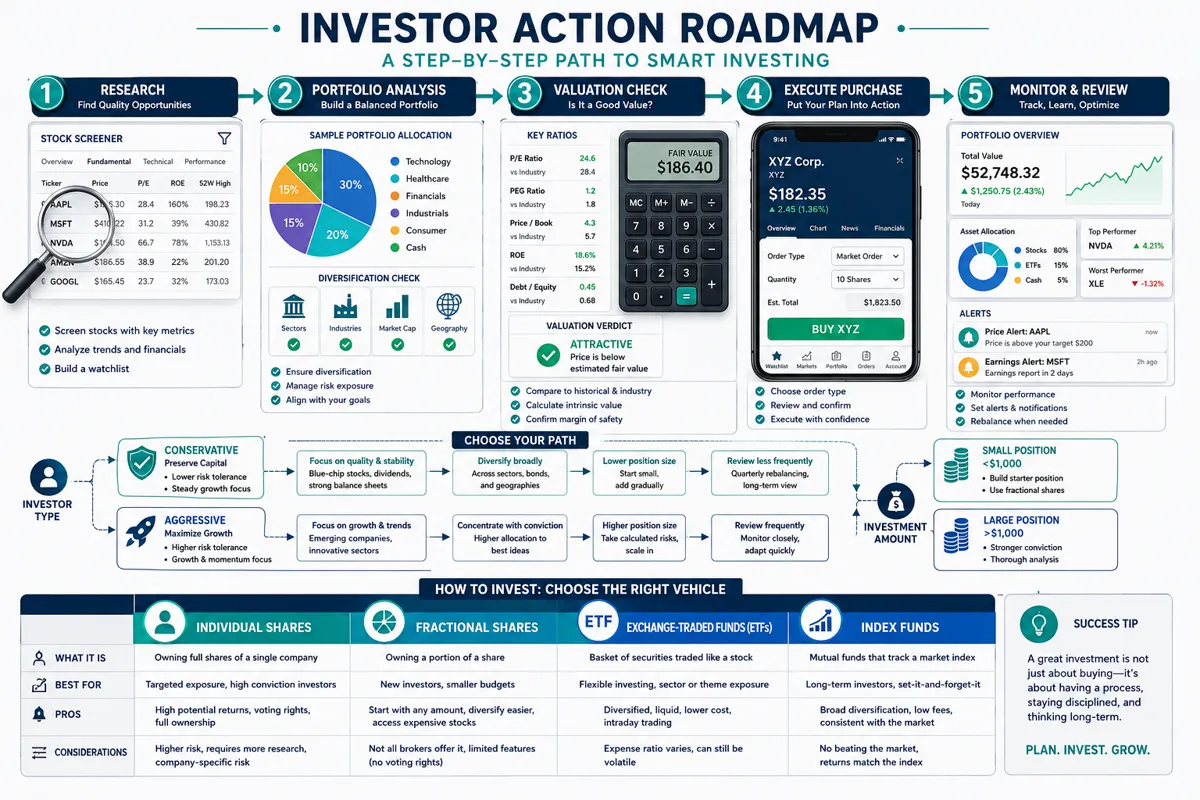
1. Choose a brokerage: Fidelity, Schwab, Robinhood, Webull, or any zero-commission platform. If you're new to investing, Fidelity and Schwab offer better research tools and customer support.
2. Decide on position size: Allocate 5-10% of your portfolio to MSFT if you're bullish on AI. Don't go above 15% unless you're comfortable with concentration risk.
3. Check valuation: Look at forward P/E, PEG ratio, and price-to-sales. If MSFT is trading above 32x forward P/E, wait for a pullback. If it's below 26x, that's a buying opportunity.
4. Set a buy limit order: Don't market buy—set a limit order 1-2% below the current price and wait for a dip. This saves you money and forces discipline.
5. Enable dividend reinvestment (DRIP): Microsoft pays a small dividend (0.8% yield). Reinvesting dividends automatically buys more shares and compounds returns over time.
6. Monitor quarterly earnings: Microsoft reports earnings in late July, October, January, and April. Pay attention to Azure growth, Copilot adoption, and capital expenditure guidance. If Azure AI growth stays above 30%, hold. If it drops below 20%, reassess.
7. Rebalance annually: If MSFT grows to 20% of your portfolio, trim and reallocate to other stocks. Don't let one position dominate.
For investors who want AI exposure without picking individual stocks, consider these alternatives:
- AI-focused ETFs: BOTZ (robotics and AI), ROBT (AI and automation), IRBO (AI-powered companies). These hold MSFT plus 30-50 other AI stocks.
- Tech-heavy index funds: QQQ (Nasdaq 100) or VGT (Vanguard Information Technology ETF). MSFT is a top-10 holding in both.
- Robo-advisors: Betterment, Wealthfront, or M1 Finance automatically include MSFT in diversified portfolios and rebalance for you.
For advanced investors, you can also sell cash-secured puts on MSFT to generate income while waiting for a better entry price. Example: sell a $380 put expiring in 30 days, collect $5-8 in premium, and either keep the premium (if MSFT stays above $380) or buy shares at $380 (if it drops). This is a more sophisticated strategy—don't try it unless you understand options.
Conclusion
MSFT is by far the best AI stock to own in 2026 for investors who want diversified AI exposure without betting on a single product, technology, or partnership. Microsoft's AI revenue is already real—$16-20 billion annually and growing 50-100% depending on the segment—and it's embedded across Azure, Office 365, GitHub, Security, and Power Platform. The company's $100+ billion infrastructure investment pipeline, exclusive OpenAI partnership, and enterprise dominance give it a structural moat competitors can't easily replicate.
The risks are real: capital expenditure without payoff, OpenAI partnership dissolution, regulatory scrutiny, and competition from open-source models. But for retail investors who've been burned by AI hype and want a stock that compounds steadily over 5-10 years, Microsoft offers the best risk-adjusted entry point. It's not the fastest-growing AI stock (that's NVIDIA), and it's not the cheapest (that's Google), but it's the most balanced—growth, profitability, dividends, and a business model that works whether AI is a revolution or just a really good upgrade.
If you're building a long-term portfolio, allocate 5-10% to MSFT and let it cook. Use AI stock screeners to monitor valuation, set price alerts for pullbacks, and rebalance annually. Don't chase short-term catalysts, don't overconcentrate, and don't panic when analysts downgrade the stock because Copilot adoption is "slower than expected." The AI story is a 2027-2028 earnings story, not a 2026 one. Fresh data from Microsoft's infrastructure investments and product launches will prove the thesis over time.
For investors who want to compare MSFT against other AI stocks, explore AI investing tools that track valuation metrics, revenue growth, and competitive positioning. And if you're still not sure whether to buy individual stocks or ETFs, check out robo-advisors that automatically build diversified AI portfolios based on your risk tolerance.
The bottom line: Microsoft isn't the sexiest AI stock, but it's the most reliable. And in a market full of hype, gatekeeping, and conflicting advice, reliability is extraordinary.
Frequently Asked Questions
Is Microsoft the best AI stock for beginners?
Yes. Microsoft offers diversified AI exposure through Azure, Copilot, and GitHub without the volatility of pure-play AI stocks. It's accessible via fractional shares, pays a dividend, and has a proven business model beyond AI.
How much of Microsoft's revenue comes from AI in 2026?
Approximately 8-10% ($16-20 billion) as of mid-2026, projected to grow to 18-22% ($40-50 billion) by fiscal 2028 based on current Azure AI and Copilot adoption rates.
Should I buy Microsoft or NVIDIA for AI exposure?
Microsoft for diversified, lower-risk AI exposure. NVIDIA for higher growth and higher volatility. If you're building a long-term portfolio, MSFT is safer. If you're aggressive and can handle 30-40% drawdowns, NVDA offers more upside.
What happens if the OpenAI partnership ends?
Microsoft loses exclusive GPT access but retains 60-70% of Azure AI revenue from other services. The stock would likely drop 10-15% short-term, but long-term impact is limited due to diversified AI portfolio.
Is Microsoft stock overvalued at 28-30x P/E?
It's fairly valued if AI grows to 20%+ of revenue by 2028. It's overvalued if AI adoption stalls or margins compress. The PEG ratio around 1.8-2.0 suggests reasonable pricing for expected growth.
Can small investors afford Microsoft stock?
Yes. Fractional shares make MSFT accessible at any budget. You can buy $50, $100, or $500 worth through most brokerages with zero commissions.
What are the biggest risks of owning Microsoft for AI?
OpenAI partnership dissolution, regulatory scrutiny, capital expenditure without payoff, and competition from open-source AI models. Concentration risk if MSFT becomes too large a portion of your portfolio.
How does Microsoft compare to Google for AI investing?
Microsoft has better enterprise AI monetization and lower cannibalization risk. Google has better AI research and cheaper valuation. MSFT is safer; GOOGL has more upside if AI search works.
What percentage of my portfolio should be Microsoft?
5-10% for most investors. Don't exceed 15% to avoid concentration risk. Balance with other AI stocks, sectors, and asset classes.
When is the best time to buy Microsoft stock?
During 10-15% pullbacks, which happen 1-2 times per year. Use price alerts and limit orders. Don't chase the stock after big rallies—wait for dips.
Does Microsoft pay a dividend?
Yes, around 0.8% yield as of mid-2026. Enable dividend reinvestment (DRIP) to compound returns automatically.
How can I track Microsoft's AI revenue growth?
Monitor quarterly earnings calls for Azure growth rates, Copilot adoption numbers, and capital expenditure guidance. Use AI stock analysis tools to track metrics over time.
SEO Meta Title
MSFT: Best AI Stock to Own in 2026 | Analysis & Risks
SEO Meta Description
Microsoft is the best AI stock for diversified exposure. We analyze Azure, Copilot, valuation, risks, and how MSFT compares to NVIDIA and Google in 2026.
Tags
microsoft ai stock analysis, msft vs nvda ai stock, best ai stocks 2026, ai stock valuation metrics, mega cap ai stocks, ai sector concentration risk, ai software stocks, ai infrastructure stocks, ai stock vs ai etf, how to analyze ai stocks, azure openai services, microsoft copilot revenue, github copilot growth
References
Microsoft Lower Water Use Ai - https://www.axios.com/2026/06/24/microsoft-lower-water-use-ai?utm_source=openai
Microsoft Brad Smith Ai Jobs College Graduates - https://www.axios.com/local/colorado-springs/2026/06/26/microsoft-brad-smith-ai-jobs-college-graduates?utm_source=openai
Microsoft Unveils Project Solara Ai A Chip To Cloud Platform Built To Power A New Generation Of Agent First Enterprise Devices Hardware Designed To Run Ai Agents Instead Of Traditional Apps - https://www.tomshardware.com/tech-industry/artificial-intelligence/microsoft-unveils-project-solara-ai-a-chip-to-cloud-platform-built-to-power-a-new-generation-of-agent-first-enterprise-devices-hardware-designed-to-run-ai-agents-instead-of-traditional-apps?utm_source=openai
Stock Market Today June 11 Microsoft Falls As Ai Spending Scrutiny Adds To Xbox Restructuring Reports - https://www.fool.com/coverage/stock-market-today/2026/06/11/stock-market-today-june-11-microsoft-falls-as-ai-spending-scrutiny-adds-to-xbox-restructuring-reports/?utm_source=openai
Microsoft Hit With Second Downgrade As Melius Warns On Ai Risks - https://www.bloomberg.com/news/articles/2026-02-09/microsoft-hit-with-second-downgrade-as-melius-warns-on-ai-risks?utm_source=openai
Microsoft Invests Us17 5 Billion In India To Drive Ai Diffusion At Population Scale - https://news.microsoft.com/source/asia/2025/12/09/microsoft-invests-us17-5-billion-in-india-to-drive-ai-diffusion-at-population-scale/?msockid=35ebe78c403f68881869f142416b6963&utm_source=openai
Microsoft 30 Billion Uk Ai Future - https://blogs.microsoft.com/on-the-issues/2025/09/16/microsoft-30-billion-uk-ai-future/?utm_source=openai
Microsofts 15 2 Billion Usd Investment In The Uae - https://blogs.microsoft.com/on-the-issues/2025/11/03/microsofts-15-2-billion-usd-investment-in-the-uae/?utm_source=openai
Blackrock Global Infrastructure Partners Microsoft And Mgx Launch New Ai Partnership To Invest In Data Centers And Supporting Power Infrastructure - https://news.microsoft.com/source/2024/09/17/blackrock-global-infrastructure-partners-microsoft-and-mgx-launch-new-ai-partnership-to-invest-in-data-centers-and-supporting-power-infrastructure/?msockid=22d4bbe59c8167d43bd2ad7b9d6d667b&utm_source=openai