AI Trading Platform: What TrendSpider Does That Screeners Can't
Last updated: August 31, 2026
Quick Answer
An ai trading platform does something a free screener structurally cannot: it turns analysis into a running process, drawing trendlines across every timeframe, updating alerts as price moves, and letting you backtest a strategy before you risk a dollar. A screener hands you a static list. TrendSpider is the clearest working example of the difference, and its lowest paid tier starts at $71 per month billed annually territory, not free. Whether that gap is worth paying for depends on what you actually do after the list loads.
Key Takeaways
- A screener filters a database. An ai trading platform runs automated technical analysis, backtesting, and alerts that update on their own, a structural difference, not a feature difference.
- TrendSpider's lowest paid plan and Finviz Elite both sit in a similar monthly range, while TradingView's Premium tier runs higher for deep backtesting access, per TradingView's own pricing page.
- Finviz Elite's backtesting status changed as of March 26, 2026, and free screeners still cannot draw or update trendlines automatically the way a full ai trading platform does.
- TrendSpider automates analysis and alerting. It does not place trades on its own; execution still runs through a connected broker.
- About 70% of day traders lose money over time according to broadly cited retail trading research, so no platform, automated or not, changes the math of risk management.
- Seven capabilities separate a real ai trading platform from a screener with a chatbot bolted on: backtesting, pattern detection, conditional alerts, multi-timeframe confirmation, strategy automation, broker connectivity, and data export.
- Users chasing the best ai trading platform for beginners should start with the free tier of a screener, then upgrade only once manual charting starts eating hours they don't have.
What Is an AI Trading Platform, and How Is It Different From a Screener?
An ai trading platform is software that automates the analysis loop itself: scanning charts, drawing structure, running historical tests, and firing alerts that adjust to new price data without you touching the chart again. A screener does one thing well. It filters a database of stocks by criteria you set, like price under $10 or relative volume over 2. Both are useful. They are not the same category of tool.
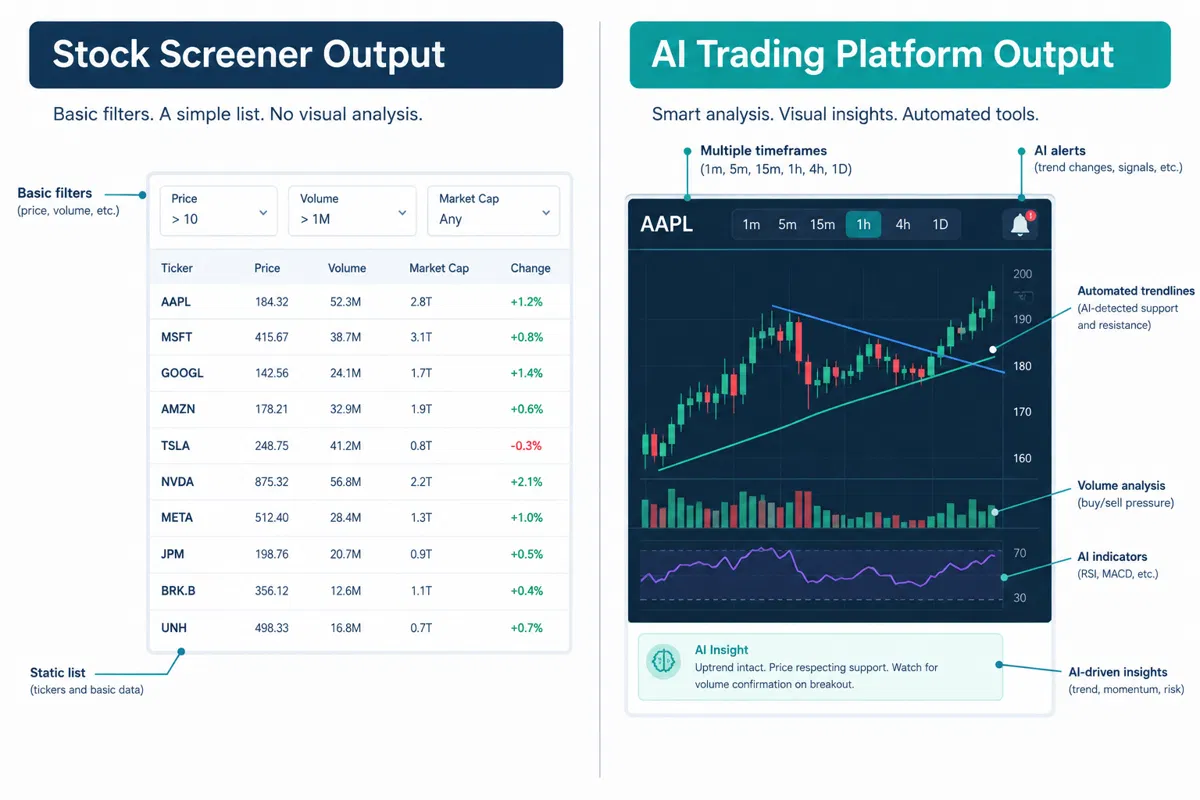
Here's the actual mechanical difference. A screener answers "what fits these numbers right now." An ai trading platform answers "what does this chart's structure look like across five timeframes, and what happens if I trade that structure going back three years." One is a filter. The other is a process that keeps running after you close the laptop.
Screener, Scanner, Platform: The Three Things Buyers Confuse
A screener filters, a scanner watches live 24h price and volume for a trigger, and a platform automates the analysis and alerting layer on top of both. Traders often use these words interchangeably, and vendors let them, because "platform" sounds like it costs more.
- Screener: static filter run on demand, like Finviz's free tool, per Liberated Stock Trader's review.
- Scanner: live-monitoring layer that flags a stock the moment it crosses a threshold, day or night, across a 24h session.
- Platform: the layer that automates trendlines, backtests, and alerts, then hands you a cleaner setup to trade, not just a list to read.
Why Most AI Trading Software Is a Screener With a Chatbot
Most products marketed as ai trading software are a screener with a chat box bolted on top, and that's the part nobody selling you a subscription wants to say out loud. Ask any "AI" tool to explain its methodology and watch how fast it retreats to "proprietary." That's a script talking, not structural automated technical analysis. A real ai trading platform publishes what it does: how it draws a trendline, how it defines a breakout, how the backtest engine handles slippage.
Want a gut check before you pay for anything labeled with the word AI? Ask what happens if you strip the chatbot out. If the tool still does something a screener can't, like auto-drawn trendlines synced across timeframes or a strategy you can test against ten years of data, it's an ai trading platform. If the answer is "it just talks to you about the list," it's a screener with makeup on.
TrendSpider: Automated Technical Analysis a Screener Cannot Run
TrendSpider automates the parts of technical analysis a screener was never built to do: drawing trendlines, syncing multiple timeframes, and re-checking alert conditions on a rolling basis, all without you redrawing a single line. It markets itself as an all-in-one professional trading tool built around automation rather than a manual screener workflow, and the July 2026 changelog added a new data provider along with an overhaul to the backtesting engine, plus a Sidekick AI trading agent that picked up Claude Opus 5 in late July 2026.
Automatic Trendlines and Multi Timeframe Analysis
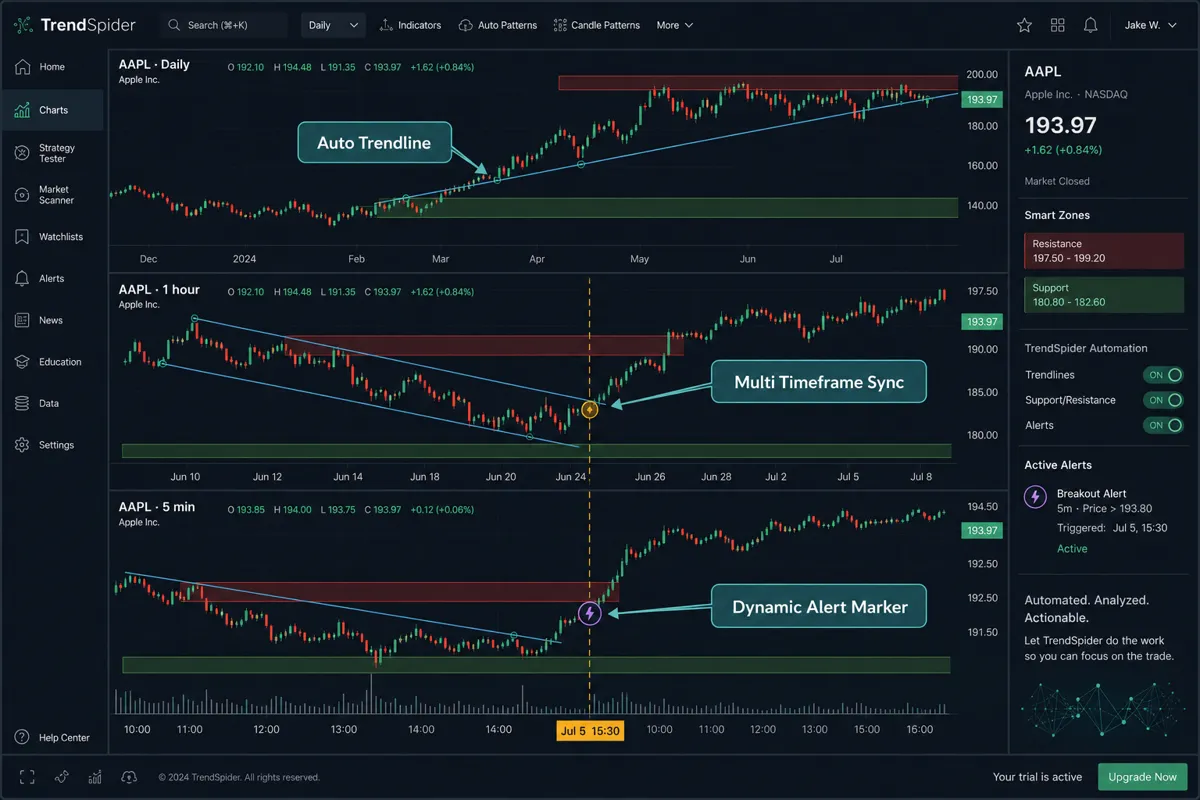
TrendSpider's core function is drawing trendlines, support and resistance zones, and Fibonacci levels automatically on live charts, then keeping those lines accurate as new candles print. That's multi timeframe analysis done by the software instead of by your eyes on six open tabs.
A manual charter redraws a trendline every time price breaks structure. TrendSpider's engine recalculates it. Check the daily trend, the hourly trend, and the five-minute trend at the same moment, and you get a read a screener physically cannot produce, because a screener has no chart engine underneath it at all.
Dynamic Price Alerts That Update Themselves
TrendSpider's alerts are dynamic, meaning they can be tied to a moving trendline or a pattern condition instead of a single fixed price, so the alert follows the setup instead of going stale the moment price moves. A basic screener alert fires once, on one static number. A dynamic alert on a real ai trading platform tracks a breakout level as it shifts day to day, and that's the whole point of paying for automation instead of doing it by hand at power hour.
Strategy Backtesting Without Writing Code
TrendSpider lets you backtest a trading strategy against historical data using a visual builder, no coding required, which is the single capability that separates it hardest from a free screener. You set entry and exit rules, run the test across years of price data, and see how the setup would have performed, before you risk trading money on it.
That is not the same as a promise of future returns. A backtest tells you how a rule set behaved in the past under specific conditions. It does not predict what the market does next, and no ai trading platform, TrendSpider included, should ever be sold to you as if it does.
The Seven Capabilities That Define a Real AI Powered Trading Platform
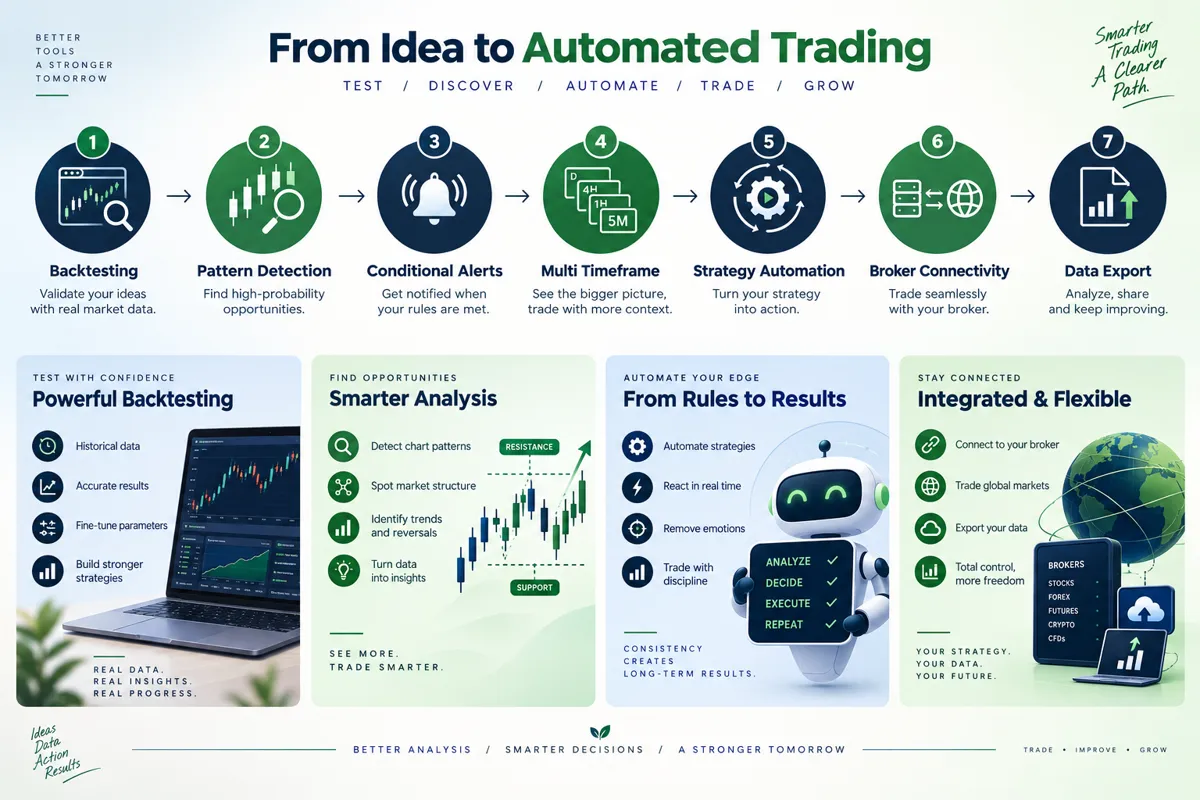
Seven capabilities separate a genuine ai trading platform from a screener wearing a chatbot costume, and if a tool is missing more than two or three, you're paying platform money for screener output. Run any candidate through this list before you hand over a card number.
- Backtesting against historical data. Can you test a rule set across years of price history, not just eyeball a chart and guess.
- Automated chart pattern detection. Does the software find triangles, flags, and channels on its own, or do you draw every line by hand.
- Conditional alerts that react to price. Does the alert adjust to a moving trendline, or does it fire once on a fixed number and go quiet.
- Multi timeframe confirmation. Can you check the daily, the hourly, and the five-minute structure in one pass instead of flipping six tabs.
- Strategy automation and trade triggers. Does the platform flag a triggered setup automatically, distinct from executing the trade for you.
- Broker connectivity. Can the tool connect to a live account for order routing, or does analysis stop at the chart.
- Raw data export. Can you pull the underlying data out for your own model, or is everything locked inside the dashboard.
That last point matters more than people think. A tool that hides its data behind a paywall and a chat window is optimizing for retention, not for your process. Trade Ideas, for comparison, leans harder into live scanning and its Holly AI bot for stock scanning specifically, which is a different job than TrendSpider's charting-first automation.
What Does the Best AI Trading Platform Actually Cost?
There is no single best ai trading platform on price alone, because the category spans free screeners, mid-tier charting tools, and full automation suites, and the honest answer is that cost tracks capability, not marketing copy. Expect free at the bottom, roughly $50 to $80 a month in the middle, and $150 plus at the top for the deepest backtesting and data access.
Monthly Pricing Across the Category
Finviz Elite, a screener with some added scanning, runs in the neighborhood documented across multiple 2026 reviews, and its backtesting status changed on March 26, 2026, when the feature set shifted for that tier, per Traderhq's 2026 review and QuantVPS's breakdown. TradingView's paid tiers scale from a basic plan up through Premium, with deep backtesting features confirmed as part of the higher tiers as of August 2026, according to TradingView's pricing page and independent testing from BacktestScore.
TrendSpider itself has updated its pricing and trial structure for 2026, positioning its lowest paid tier as the entry point into automated technical analysis, distinct from the free screeners it gets compared to on price alone. If you want the exact current breakdown, the full TrendSpider review on this site tracks it against the free tier line by line, and a dedicated cost analysis walks through whether the monthly number holds up.
Where the Free Tier Stops Being Enough
Free stops being enough the moment you need the chart to do work you're currently doing by hand, redrawing trendlines, manually checking three timeframes, or re-testing a strategy idea in a spreadsheet instead of a backtest engine. Finviz's free screener covers a wide filter set and remains a legitimate starting point, per Idealonlinebusiness's review, but it was never built to draw or update a trendline on its own.
That's the exact gap an ai trading platform is priced to close. If your process still involves eyeballing support and resistance every morning, you're doing manually what the paid tier automates.
Best AI Trading Platform for Beginners on a Small Budget
The best ai trading platform for beginners on a small budget is usually not a platform at all yet. It's a free screener paired with a disciplined watchlist and a paper-trading habit, until the manual charting workload justifies the upgrade. Start free, prove the process works on paper, then pay for automation once the hours saved are worth more than the subscription. That order matters more than which tool wins a beginner list.
Comparison Table: AI Trading Platform vs Screener vs Scanner
Capabilities differ by category more than most marketing pages admit, and the gap shows up clearest in backtesting and automated pattern detection, not in the chart colors.
| Capability | AI Trading Platform | Stock Screener | Stock Scanner |
|---|---|---|---|
| Backtesting | Yes, visual builder, no coding required | Rare, and usually limited | Not typically included |
| Automated pattern detection | Yes, trendlines and structure auto drawn | No, filter based only | Sometimes, alert based |
| Dynamic alerts | Yes, conditions update automatically | No, static filters only | Yes, but usually fixed triggers |
| Multi timeframe analysis | Yes, synced across timeframes | No | Limited |
| Broker connectivity | Often, for order routing | Rare | Sometimes |
| Typical monthly cost | Roughly $50 to $170 per month | Free to about $40 per month | Roughly $50 to $150 per month |
Capabilities, Automation, Data Depth, and Price
Read the table as a filter, not a scoreboard. If you only need capability one and two, a scanner covers you. If you need all seven from the earlier list, you're shopping for a real ai trading platform, and price follows capability, not the other way around.
How Do You Tell a Legit AI Trading Platform From a Wrapper?
You spot a legit ai trading platform by what it shows you, not what it claims. Published methodology, a visible backtest engine, and a specific list of what it can't do are the tell. A tool that answers every question with "proprietary AI" is usually a public model wearing a dashboard.
Questions That Expose a Thin Product
Ask these before you subscribe to anything calling itself an ai powered trading platform:
- Can I see the rule the alert is based on, or is it a black box.
- Does the backtest show drawdown and losing streaks, or only the best-case run.
- What data feed is this pulling from, and how fresh is it during a live 24h session.
- Does it connect to a real broker for execution, or is analysis where it stops.
- Is there a free trial with full functionality, or a locked demo dressed up as one.
Even the fine print in an app store listing tells you something. Search for any trading app on Google Play and you'll often land on a listing from a publisher you've never heard of, star ratings stacked next to a "found this review helpful" prompt and a flag inappropriate button, filed in the same storefront that also lists Games, Apps, Movies and TV, Books, and Kids. Scroll the reviews on a thin crypto bot listing and you'll sometimes hit garbled text where an emoji didn't render, strings like x1f680 x1f4a9 x1f680 sitting next to a five-star rating, or a foreign-language spam comment rendered as raw code, forex 1107 1130, that somehow still scored five stars. None of that tells you if the tool works. It tells you the review section is not being moderated, which is its own answer.
Before you download anything, check the "About this app," "Data safety," "Ratings and reviews," "What's new," and "App support" sections the same way you'd check a broker's disclosures. A checklist for what to verify before downloading an ai trading app covers this in more depth.
Why Published Methodology Beats Proprietary AI Claims
A tool that shows its work, how it defines a breakout, how it handles slippage in a backtest, earns more trust than one that hides behind the word proprietary. "Proprietary AI" is often marketing language for a wrapper built on a public language model with a subscription button attached, and this market is full of them. If a vendor can't explain in plain English how a signal gets generated, that's the answer, not a gap in your understanding.
Is Automated AI Trading Worth Paying For?
Automated AI trading is worth paying for when it replaces hours of manual chart work you were already doing badly, and it's not worth paying for if you're hoping the subscription replaces a strategy you never built. No ai trading platform, automated or not, changes the base rate: research cited widely in the retail trading world puts the share of day traders who lose money at around 70%, and automation doesn't repeal that math, it just executes your process faster.

Can an ai trading platform predict a market crash. No, and any product that implies it can is selling a story, not software. Backtesting shows how a rule performed on past data. It is not a forecast, and treating it like one is exactly how people end up overtrading a signal that was never built for prediction in the first place.
What Best Automated AI Trading Platform Listings Leave Out
Most "best automated ai trading platform" roundups leave out the two things that actually matter: whether the tool executes trades or only flags them, and whether the vendor discloses drawdown, not just win streaks. TrendSpider automates analysis and alerting. It does not place trades on your behalf; you still route the order through a connected broker, and that distinction gets blurred constantly in marketing copy for the whole category.
AI Based Stock Trading and the Human Steps That Remain
Ai based stock trading still leaves position sizing, stop loss placement, and the decision to pull the trigger in your hands, no platform automates judgment. The common mistake is treating a flagged setup as a guarantee instead of a candidate. Paper trade a new signal first. Size the position like you might be wrong, because sometimes you will be. Cut losers fast, let the winners that actually work run, and keep the watchlist short enough that you're not drowning in alerts across a dozen names during earnings season.
That discipline is the same whether you're trading stocks, stock trading bot output, forex pairs, or checking a crypto pair like SOL against USDC on a 24h chart. TrendSpider's July 2026 changelog expanded crypto coverage alongside the new data provider, so a trader watching SOL/USDC alongside a forex 24h session and a stock watchlist can now do it inside one ai trading platform instead of three separate apps. That's a convenience upgrade, not an edge. The bid ask spread still exists, the market maker still pockets the difference between bid and ask, and no automation changes that mechanic.
If you're weighing whether a bot should touch execution at all, a breakdown of what to know before you automate trades is worth reading before you connect a broker key to anything.

FullStack Alpha tool
Subscription Payback Calculator
“You would have to make $400 off his advice specifically for it to be worth it. He should charge a $10 monthly fee and he would make way more money.”
r/stocks · 553-comment thread on a $379-a-year newsletter
A platform fee is not a cost until you know what it has to earn back. Enter the fee and your account size to see the extra return the tool must produce just to break even.
Break-even only. It ignores taxes, slippage and commissions, so treat the result as the floor, not the target.
Frequently Asked Questions
What is the best AI trading platform for most traders?
There isn't one universal answer. TrendSpider fits traders who want automated technical analysis and backtesting; Trade Ideas fits traders who want live AI-powered stock scanning. The best ai trading platform is the one that automates the specific manual task costing you the most time, not whichever name ranks first on a listicle.
What is an AI trading platform and how does it work?
An ai trading platform automates technical analysis: drawing trendlines, syncing multiple timeframes, running historical backtests, and firing alerts that update on their own. It works by processing price and volume data continuously and applying rule-based pattern logic, then surfacing the result so you don't redraw charts by hand.
Is there a free AI trading tool worth using?
Yes. Finviz's free screener covers a wide filter set and remains a legitimate starting point for building a watchlist before you pay for anything, per Liberated Stock Trader's review. It won't automate trendlines or backtest a strategy, but it's a real free tool, not a bait page.
How much does AI trading software cost per month?
Pricing spans free at the low end to roughly $150 or more at the top for full automation and deep backtesting. TradingView's Premium tier and TrendSpider's paid plans sit in that higher range, per TradingView's pricing page, while screener-style tools like Finviz Elite land lower, according to multiple 2026 reviews.
What is the best AI trading platform for beginners?
For most beginners, the honest starting point is a free screener plus a paper-trading habit, not a paid platform. Once manual charting is eating real hours every week, an ai trading platform for beginners on a budget should prioritize automated alerts and a visual backtester over flashy dashboards you'll never fully use.
How do you spot a legit AI trading platform?
Look for published methodology, visible backtest drawdown data, and a specific list of what the tool cannot do. A legit ai trading platform explains its logic in plain English. One that answers every question with "proprietary AI" and nothing else is usually a wrapper around a public model.
Is an AI stock trading platform different from a stock screener?
Yes, structurally. A stock screener filters a static list by criteria you set. An ai stock trading platform automates the analysis layer on top, drawing chart structure, running backtests, and updating alerts, none of which a screener's filter engine is built to do at all.
Does TrendSpider automate trades or just analysis?
TrendSpider automates analysis and alerting, not execution. It draws trendlines, tracks multi timeframe structure, and runs strategy backtests, then flags a triggered setup. Placing the actual order still runs through a connected broker; TrendSpider does not execute trades on your behalf by default.
Which is the best AI trading platform?
There's no single best, because the category splits by job. TrendSpider wins on automated charting and backtesting; Trade Ideas wins on live AI stock scanning. Pick based on which manual task you want automated, then confirm the tool's pricing tier actually includes that feature before subscribing.
Can you make $1000 a day day trading?
It's possible on any given day, and just as possible to lose that much. Daily results swing with account size, volatility, and risk management, not with the tool you use. No honest source states a reliable daily figure, because day trading income is not consistent by design, automated or not.
Do AI trading platforms really work?
They work at the job they're built for: automating chart analysis, alerts, and backtesting faster than doing it by hand. They don't work as a guarantee of profit. Roughly 70% of day traders lose money over time, a base rate no software changes, so "work" means faster process, not better odds.
Can I make money using AI trading?
You can, the same way you can with any trading approach: through risk management, position sizing, and a tested process, not through the software alone. An ai trading platform can speed up analysis and cut manual errors. It cannot guarantee an outcome, and no legitimate platform should claim otherwise.
Final Verdict: When a Platform Earns the Subscription
A platform earns its monthly fee the day it starts saving you more hours than the subscription costs in cash. That's not a philosophy. It's math you can actually check.
Sit down and count what a screener costs you in manual work: redrawing trendlines every morning, checking three timeframes by eye, guessing at how a strategy would have performed instead of running the backtest. If that adds up to real hours every week, an ai trading platform like TrendSpider is buying back time, not selling you an edge. If your process is still just glancing at a filtered list twice a day, save the money and stay on the free tier.
Just don't confuse automation with an advantage. TrendSpider automates analysis. It doesn't predict, and it doesn't place trades for you. Systems over hacks, process over prediction, that's the whole argument for paying at all.
One tool, examined in depth, is not the whole market. The FullStack Alpha directory catalogues 200+ AI stock tools by category and price, filterable by what you actually need.
Browse the directory at aistockpickerapps.com
This article may contain affiliate links. FullStack Alpha may earn a commission if you sign up through one, at no extra cost to you.
References
Is Finviz Elite Worth It In 2026 Full Cost Breakdown - https://www.insigtrade.com/blog/is-finviz-elite-worth-it-in-2026-full-cost-breakdown
Finviz Review - https://www.liberatedstocktrader.com/finviz-review/
Pricing - https://www.tradingview.com/pricing/
Finviz Review - https://www.quantvps.com/blog/finviz-review
Screener - https://www.tradingview.com/screener/
Finviz Elite Review - https://www.tradingreviewers.com/finviz-elite-review/
Tradingview - https://www.backtestscore.com/tools/tradingview
Finviz Review - https://idealonlinebusiness.com/product/finviz-review/
Finviz Elite Review Best Stock Screener Tool - https://traderhq.com/finviz-elite-review-best-stock-screener-tool/
Tradingview - https://damnpropfirms.com/trading-tools/tradingview/