AI Stock Picker Deals: Lifetime Offers and Real Promo Codes

A $399 product selling for $59.99 should make you curious, not excited. On October 26, 2026, 

Here's what this guide to ai stock picker deals does: names the offers that appear on vendor pages or official marketplace listings, shows the dollar difference between annual and monthly where the vendor publishes both, and tells you plainly when a tool has no public promo code instead of inventing one. Prices in this category move weekly. The live tracker sits on the FullStack Alpha deals page; check it and the vendor page before you pay.
Where can I get the best deal on an AI stock picker app subscription?
The strongest of the verified ai stock picker deals right now is Sterling Stock Picker's lifetime license at $59.99 through StackSocial's official listing, against a stated $399 suggested price (checked October 2026). The shortlist:
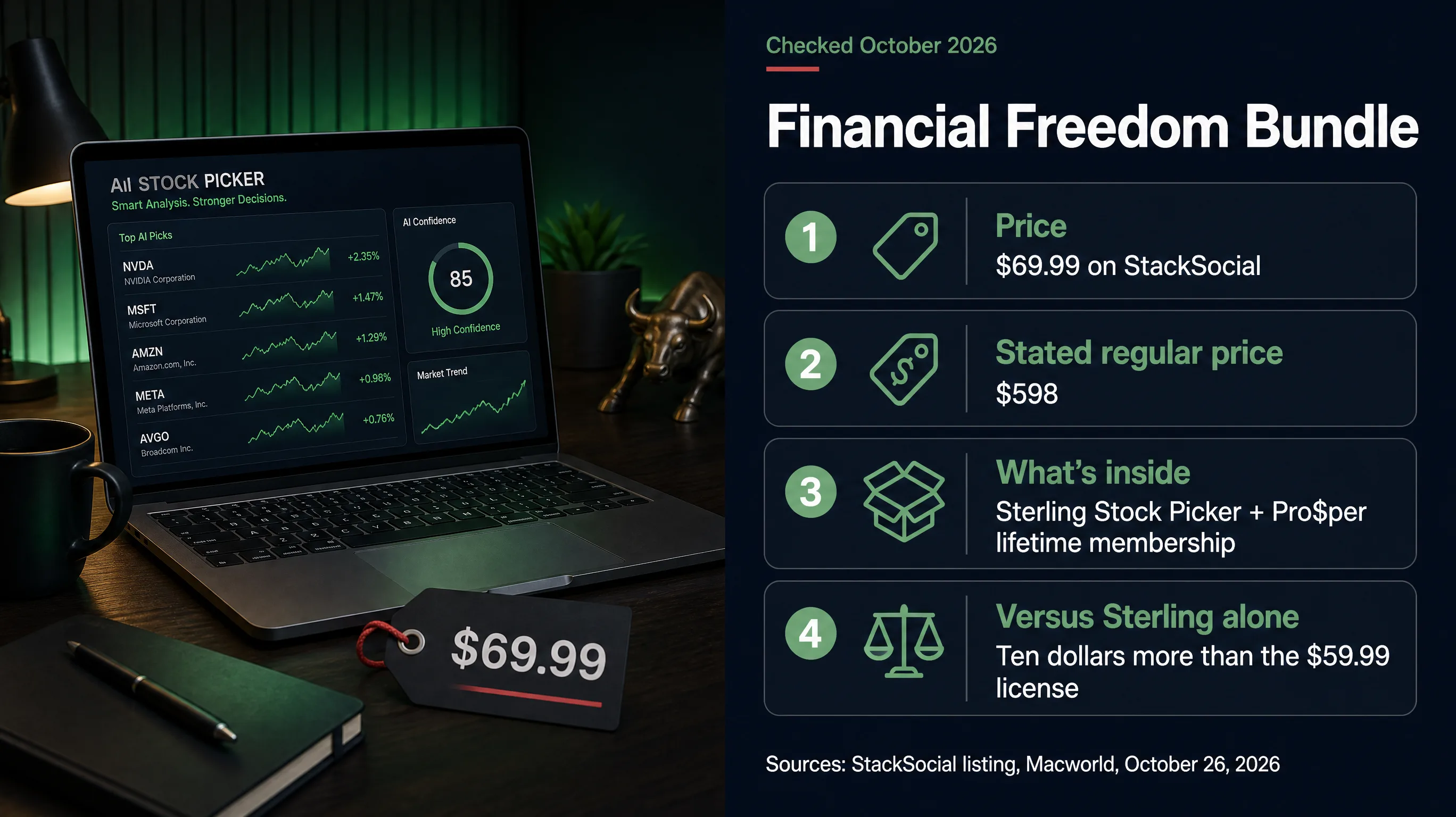
- Financial Freedom Bundle, $69.99 (Sterling plus a Pro$per lifetime membership, 150+ lessons), stated regular price $598 (checked October 2026)
- Annual billing on any major picker that publishes both monthly and annual rates;
Danelfin lists yearly at 25% off monthly (checked October 2026)
- Free tiers on screeners and chart tools, which cover more ground than most beginners expect
- The live list at the FullStack Alpha deals page, updated as offers change
One rule before any of this matters: a discount on a tool you won't use is a 100% loss, not a 85% saving.
1. Sterling Stock Picker Lifetime at $59.99: The Anchor Deal
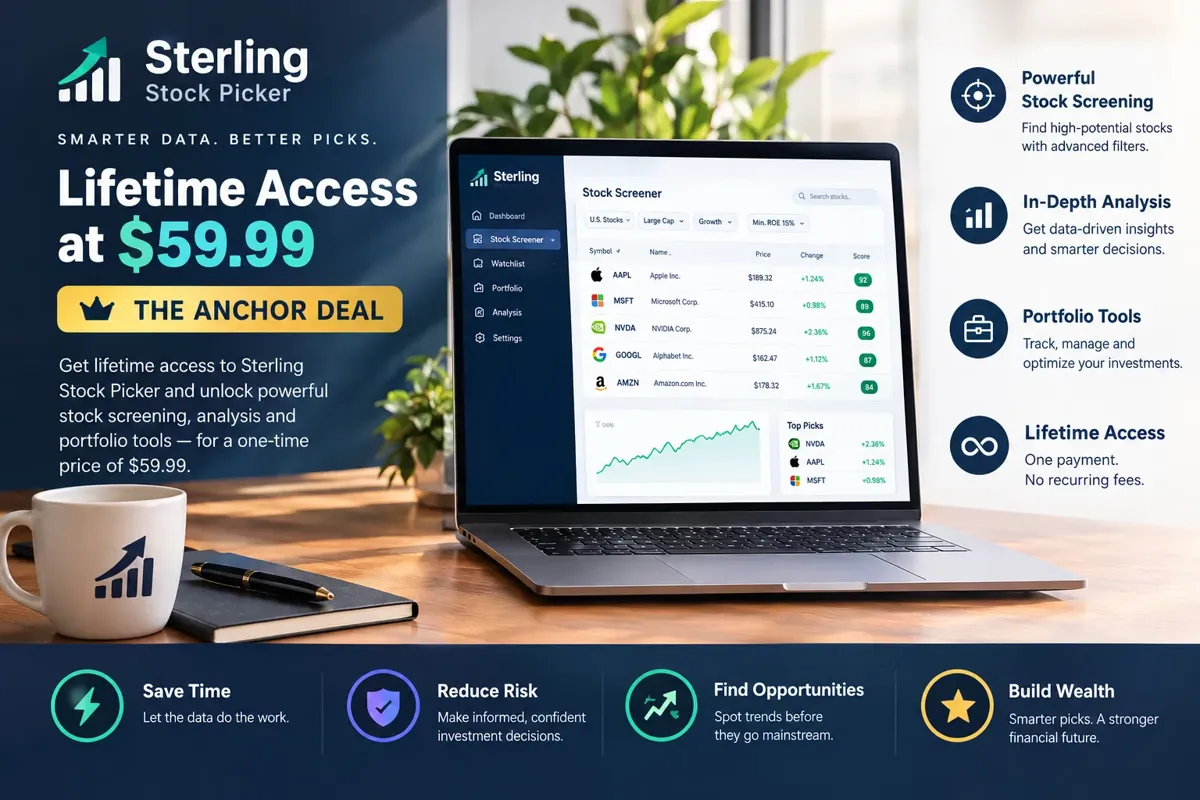
This is the offer every other entry in our ai stock picker deals list gets compared against. StackSocial lists Sterling Stock Picker at $59.99 for lifetime access, down from a stated suggested price of $399 (checked October 2026). The listing says access covers web, iOS, and Android, includes future updates, carries no monthly or annual fees, and is open to new users only.
Sterling markets itself as an AI stock-analysis and portfolio-building product running financial, technical, and risk analysis, with a personal AI finance coach and something called a "North Star Rating System". Those are vendor claims. They describe features, not outcomes. Nobody has audited them into evidence of outperformance, and you should read them the way you'd read a car ad: the horsepower number is probably real, the lifestyle footage is not.
What's genuinely useful about a one-time payment at this price is the math. If a comparable tool runs $20 a month, $59.99 pays for itself in three months. Everything after that is free, assuming the company stays alive. That assumption is the whole trade, and we'll get to it.
Our own breakdown of the product sits on the Sterling Stock Picker tool page if you want the scored version rather than the sales copy.
2. The Financial Freedom Bundle at $69.99: Ten Extra Dollars, Two Products

Ten dollars over the standalone price for an entire course library is the kind of upsell that's actually defensible, but only for one type of buyer. If you already know what a stop loss is, know how to size a position, and have a written set of rules, 150 beginner lessons are shelf decoration. If you're newer than that, the education is probably worth more than the picker.
Be honest with yourself about which one you are. Buying the bundle because it feels like more value is how people end up with four unopened courses and one unread watchlist.
3. The $49.97 Flash Price: An Expired Deal Worth Understanding
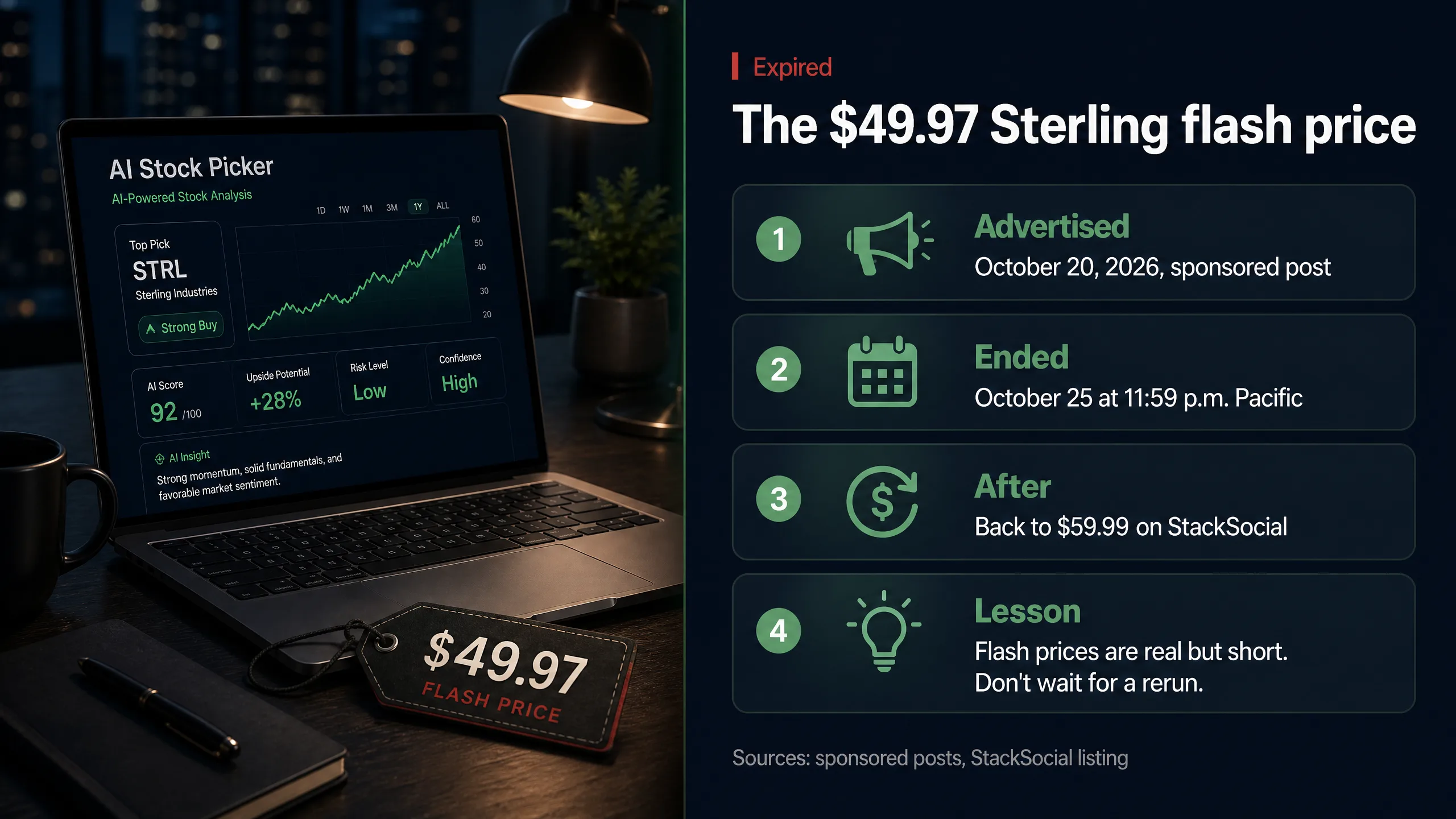
Flash pricing is the trickiest part of tracking ai stock picker deals. Sterling was advertised at $49.97 in a sponsored post dated October 20, 2026, which stated the offer ended October 25 at 11:59 p.m. Pacific. 
That sequence tells you something useful. The $49.97 number was a flash price, not a stable public rate. The $59.99 is closer to the real floor. Anyone quoting you $49.97 today is either reading a stale article or counting on you not to check.
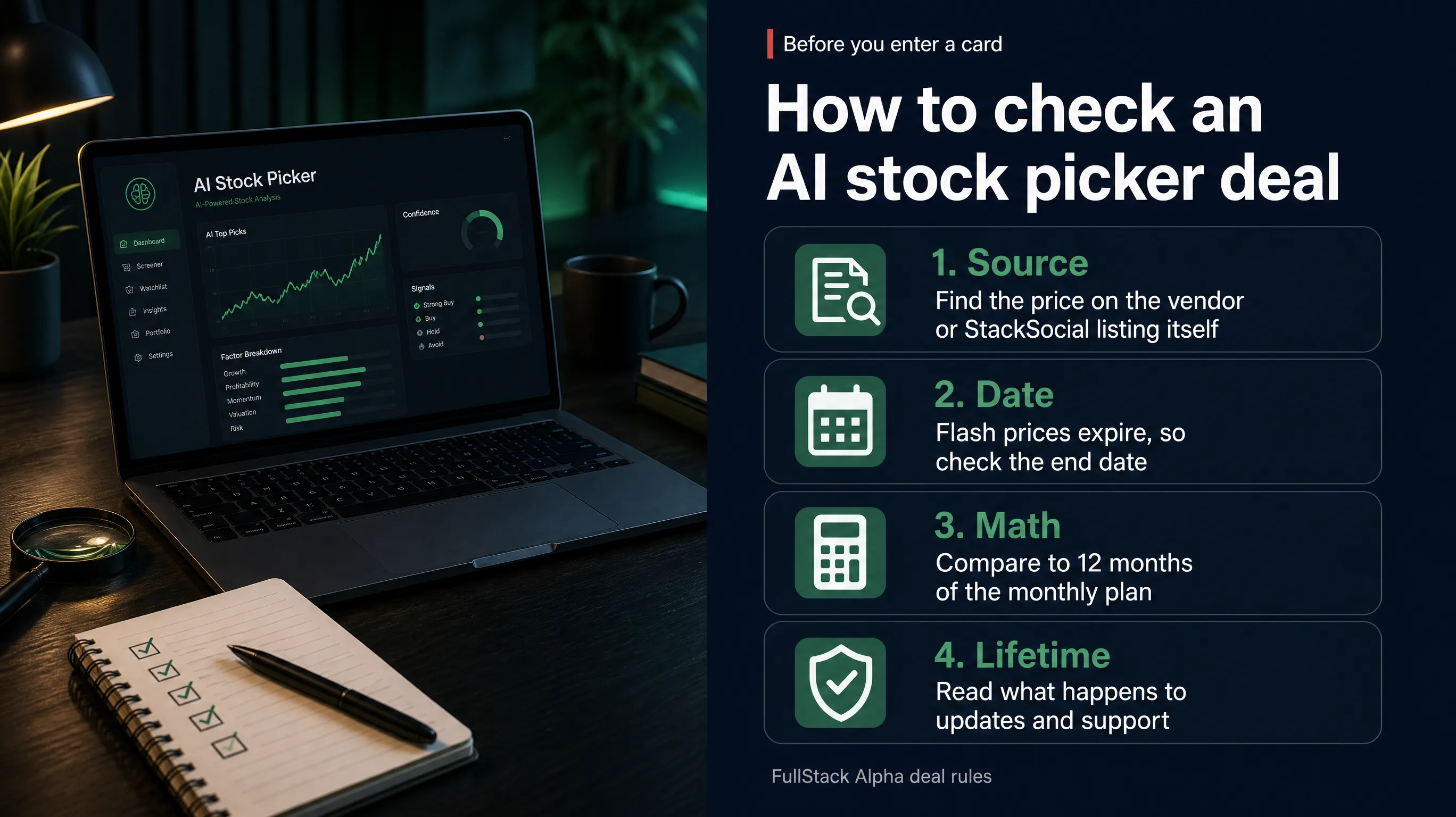
This is the single most practical habit in hunting an ai stock picker discount: screenshot the price and the date, then reload the checkout page before you enter a card. If checkout disagrees with the article, checkout wins.
4. Annual vs Monthly: The Discount Nobody Calls a Discount
The quietest ai stock picker lifetime deal alternative is the annual toggle. Most subscription tools publish both prices, and the gap is usually equivalent to one or two free months. It isn't marketed as a promo because it doesn't need to be, which makes it the most reliable saving on this entire list.
The table below shows how that arithmetic works at common price points. These are illustrative tiers, not quotes from any specific vendor. Pull the real numbers off the pricing page of whatever tool you've shortlisted and run the same math.
The catch is behavioral. Annual billing locks you in for twelve months with a tool you've used for zero days. Pay monthly for the first two months, prove you actually open it, then switch to annual at renewal. That's the sequence that saves money twice.
5. Free Tiers: The Cheapest AI Stock Picker Is Often $0
The cheapest ai stock picker for most people is the one they haven't paid for yet. Free screeners and chart platforms handle a surprising share of the work, especially if your process is a weekly watchlist rather than intraday scalping.
Start here before you spend: the roundup of free AI stock tools and the comparison of free stock charts across 

What you pay for with premium tools is speed, data depth, and automation. If your holding period is weeks, speed is worth almost nothing to you. A scan that surfaces a mover four minutes late is a history lesson to a day trader and a non-issue to a swing trader.
If you want automation rather than picks, the same logic applies to bots: compare the free tiers of AI trading bots before paying for one.
Run the free stack for 30 days. If you hit a specific wall you can name in one sentence, pay to remove that wall. If you can't name it, you don't have a tool problem.
6. Danelfin and the Transparency Premium
Danelfin takes a different approach: it publishes a 1-to-10 AI score built from technical, fundamental, and sentiment inputs, and shows the factors behind it. That transparency is the main reason it lands on so many shortlists: it explains itself rather than hiding behind "proprietary AI."
Danelfin's own materials say scores draw on rating history going back to 2017, ranking stocks by estimated probability of beating the market over a defined horizon. Read that carefully. Historical rating accuracy is a measurement of the past. It is not a forecast, and it is not a promise.
On ai stock picker deals specifically, Danelfin is the clean example of a vendor that discounts through billing terms, not codes. Its pricing page (checked October 2026) lists a free plan at $0, Plus at $22 a month billed yearly ($264 a year), Pro at $59 a month billed yearly ($708 a year) and Elite at $134 a month billed yearly ($1,608 a year). Yearly billing is marked 25% off monthly, a two-year plan is marked 40% off, paid plans carry a 14-day free trial, and there's a 30-day money-back guarantee on new subscriptions. No public promo code was found. Saying so is more useful than making one up.
If you want the head-to-head, we scored it against two rivals in Danelfin vs Zen Ratings vs 
7. Scanner Subscriptions: Where the Real Money Leaks
Scanners are the most expensive category in this space and the one where ai stock picker deals matter least. A tool like 
Vendors in this tier tend to run time-limited promotions rather than permanent coupon codes, and many publish annual pricing at a discount to monthly on their own site. We found no public Trade Ideas promo code (checked October 2026). There's no evergreen code hiding behind a browser extension. If a coupon site claims otherwise, the code almost certainly fails at checkout and the site still gets credit for your click.
A scanner is a tool for someone who already has a defined setup and needs it found faster. Buying one to discover a strategy is paying rent on an empty apartment.
8. Marketplace Bundles: Read the Fine Print on "Lifetime"
Most lifetime ai stock picker deals live on StackSocial, 
The Sterling listing specifies web, iOS, and Android access plus future updates with no recurring fees. Its terms (checked October 2026) say you must redeem within 30 days, unredeemed licenses can be returned for store credit within 30 days, and once a license is redeemed all sales are final. That's a clearly written promise. It's still conditional on the vendor continuing to exist, continuing to pay for market data feeds, and continuing to ship updates. Market data costs money every single month, which means a lifetime product carries a permanent cost with no recurring revenue attached to it. That math only works if the company keeps selling new licenses.
Before buying any marketplace lifetime offer, check three things: the refund window, whether the license transfers if the product gets acquired, and whether the data feed is first-party or borrowed from a free public API. The third one separates a real product from a dashboard bolted onto something anyone can access.
9. Promo Codes: What Works and What's Theater
Most "promo codes" for AI stock tools are not codes. They're affiliate links that apply a discount automatically, dressed up as a secret. Clicking through a partner link and seeing the price drop is fine and legitimate. Hunting a four-character coupon for a tool whose vendor has never issued one is wasted time.
What we checked (October 2026): no public ai stock picker promo code was found for Sterling Stock Picker or Danelfin. The "SALE" strings inside sponsored-article links are tracking tags, not checkout codes. The only marketplace-wide offer we could confirm is StackSocial's mailing-list signup, which advertises 15% off a first order; read the terms at checkout before assuming it stacks with a sale price.
Where a real code does exist, it usually appears in one of four places: the vendor's own pricing page banner, an official marketplace listing, a podcast or newsletter partnership read, or a first-purchase email after you abandon checkout. That last one is the most reliable trick in the book. Load the cart, enter your email, leave for 48 hours, and see what arrives.
Where it doesn't exist, say so and move on. A tool with no code isn't a worse tool. Some of the better-run products in this category simply price straight and never discount.
10. The Regulatory Backdrop Nobody's Reading
The SEC's Fiscal Year 2027 examination priorities, published October 23, placed "super intelligence and other advanced technologies" among the emerging technologies that may affect market operations, compliance, fraud prevention, and investor protection. That matters directly to any service giving recommendations or generating automated trading signals.
Translation for buyers: scrutiny is increasing on exactly the claims these products make in their marketing. A vendor making hard performance claims today may be making softer ones in twelve months, and the product you bought "for life" may quietly become a research tool rather than a recommendation engine.
That's not a reason to avoid the category. It's a reason to value tools that show their work over tools that show a results screenshot. Investor.gov is the plain-English place to check what an advisory claim is actually allowed to say.
11. Are Lifetime Deals on AI Stock Pickers Worth It?
Sometimes. The honest answer depends on two variables most buyers never calculate.
Variable one: break-even time. $59.99 against a $20 monthly alternative breaks even in three months. If the company survives three months, you won. That's a low bar and it's why these deals tend to be decent value.
Variable two: whether you'll use it. This is where nearly everyone loses. The average buyer of a discounted trading tool opens it hard for nine days, then forgets the login. The $59.99 wasn't a bargain. It was a donation with a dashboard.
There's a third thing worth naming. Lifetime pricing changes vendor incentives. A subscription company has to earn your renewal every month, so it keeps shipping. A lifetime company already has your money. Judge the product by what it does today, not by the roadmap, because the roadmap is the part with no payment attached to it.
12. How Accurate Are These Tools, Really?
Here's the question that should shape how much you're willing to pay: has anyone outside the company audited the results? For most AI stock pickers the honest answer is no. Vendor backtests and "hypothetical" performance claims are marketing until a third party checks them, and the SEC's own rules treat hypothetical performance as something advisers must disclose carefully for exactly that reason.
When a pick list does beat the market for a stretch, ask what it was riding. A model that loaded up on one sector or one style during a strong run will look brilliant until that run ends. That's the same trap that makes a trader feel like a genius in a bull market and a victim in a flat one.
The practical takeaway: treat any AI score as one input on a watchlist, never as a buy instruction. We dug into why the headline accuracy numbers mislead in AI stock prediction: 3 reasons the accuracy number lies.
13. Spotting a Fake Deal Before You Enter a Card
Fake ai stock picker deals follow a recognizable script. Learn it once and you'll never get caught.
Countdown timers that reset. Refresh the page in a private window. If the timer starts over at 23:59:59, the urgency is decoration.
A struck-through "regular price" nobody ever paid. A $598 anchor against a $69.99 sale is standard marketplace framing. It isn't fraud, but the anchor is a marketing number, not a historical receipt. Judge the product at the price in front of you.
Performance screenshots with no dates or no losers. A results image showing eleven green trades and zero red ones isn't a track record. It's a filter.
Codes from sites you've never heard of. If the only place a code appears is an aggregator page stuffed with twelve other brands, it doesn't work. Play stupid games.
No refund policy on the page. A real vendor states the window. A marketplace listing states it too. If you have to email to find out, that's your answer.
14. Day Trading vs Long-Term: Pay for the Right Thing
Your holding period determines which discount is actually worth chasing, and most people buy backwards.
Day traders need speed, real-time data, and a scanner that surfaces movers in seconds. Delayed data is useless here, and free tiers almost always run delayed. This is the one group for whom a premium annual subscription is genuinely defensible, and where a lifetime picker built on end-of-day fundamentals is the wrong tool entirely.
Swing and position traders need a clean screener, decent fundamentals, and an alert that fires when price reaches a level. Most of that is free or close to it. A lifetime picker at $59.99 fits this crowd well because the analysis refreshes daily and you only look daily.
Long-term investors need the least of all. Quarterly screening, a filings reader, and the discipline not to touch anything in between. Our walkthrough of AI stock analysis on 10-K filings covers more of what this group actually gets value from.
Buying a day-trading scanner to manage a buy-and-hold portfolio is paying for a race car to drive to the mailbox.
15. How to Never Pay Full Price: The Five-Step Sequence
Run this order every time and the best ai stock picker deals find you, not the other way around.
Step one: use the free tier for two weeks. Write down the specific thing it can't do. One sentence. If you can't finish the sentence, stop here and keep your money.
Step two: open the vendor's own pricing page. Note the monthly price, the annual price, and the dollar gap. Vendor pages carry promotions that aggregator sites miss by weeks.
Step three: check official marketplaces. StackSocial and AppSumo carry genuine lifetime listings, and the listing terms are spelled out. Compare the lifetime price against twelve months of the subscription.
Step four: abandon the cart. Enter your email, close the tab, wait 48 hours. First-purchase discounts arrive more often than coupon codes exist.
Step five: start monthly, upgrade later. Prove usage first. Switch to annual at renewal once you've got two months of actual logins behind you.
Before you buy anything, run your shortlist through the compare tool for AI stock apps so you're pricing the right two products against each other instead of the two that advertised hardest.
Frequently Asked Questions
What are the best AI stock picker apps available to buy or subscribe to right now? Sterling Stock Picker is the most aggressively discounted, at $59.99 lifetime on StackSocial (checked October 2026). Danelfin stands out for publishing its scoring factors instead of hiding behind "proprietary AI." Trade Ideas sits at the expensive end for active intraday scanning. Which is best depends entirely on your holding period, not on the size of the discount.
Which AI stock picker app is best for a beginner investor with a limited budget? Start free. A free screener plus a free charting platform covers more than most beginners need for the first six months. If you want a paid product, a one-time lifetime license at under $70 removes the recurring-cost anxiety that makes people trade badly to justify a subscription. The AI stock tools for beginners list is the shorter version of that answer.
Do AI stock pickers work during market crashes? Poorly, usually. Models trained mostly on rising markets tend to misread fast drawdowns, and sentiment inputs turn to noise when everything sells off at once. A lot of a model's raw performance usually comes from sector or style exposure rather than skill, and that exposure is exactly what blows up in a regime change. Your stop loss protects you in a crash. A score doesn't.
Can you actually make money with an AI stock picker? Some people do, and some people lose money using the same tool. The tool surfaces candidates. Position sizing, entries, exits, and whether you follow your own rules decide the outcome. Nobody credible promises returns, and any vendor who does is telling you something about their compliance posture, not their accuracy.
Are promo codes for these tools usually legitimate? The ones published on the vendor's own site or an official marketplace listing are. Codes found on generic coupon aggregators almost never work. When a tool has no public code, there's no code, and the annual plan is your discount. Our deals page only lists ai stock picker deals we can trace to a vendor or marketplace page.
How often do these lifetime prices change? Weekly, sometimes daily. Sterling moved between $49.97 and $59.99 inside a single week in late October 2026. Check the checkout page, not the article, and screenshot what you see before you pay.
Conclusion
The best ai stock picker deals aren't the ones with the biggest percentage off the sticker. They're the ones where you'd have paid the full price anyway because the tool solves a problem you can name in one sentence.
Do this today: open the free version of whatever tool you've been eyeing, use it for two weeks, and write down the one thing it won't do. If that sentence exists, go buy the fix at the best verified price you can find. If it doesn't, you just saved $59.99 and learned something more valuable than any score.
Deciding whether a lifetime license beats a subscription? Check the live list first. We track ai stock picker deals across 200+ catalogued tools and only post offers we can trace to a vendor or marketplace page. Browse current ai stock picker deals at aistockpickerapps.com/deals
References
- AI Stock Picks And 150 Money Lessons Are 69 99 For Life. macworld.com.
- Deals. aistockpickerapps.com.
- This $50 ChatGPT Powered App Helps Entrepreneurs Pick Winning Stocks. entrepreneur.com.
- Change How You Invest With This ChatGPT Powered Stock Picker Sponsored Deal. popsci.com.
- SEC Flags AI Super Intelligence. finance.yahoo.com.
- Sterling Stock Picker: Lifetime Subscription. stacksocial.com.
- The Financial Freedom Bundle ft. Sterling Stock Picker. stacksocial.com.
- Danelfin Plans and Pricing. danelfin.com.
This is education, not financial advice.
Your market edge starts with the right tool. Stay alpha.
Some links on this page may be affiliate links. Rankings are never influenced by them.