Wealthfront AI: What It Automates and the Fees You Pay

Last updated: October 28, 2026

Which is fine. Boring is often correct. But you should know exactly what you're renting before you hand over the keys.
Quick answer: does Wealthfront use AI, and what does it cost?
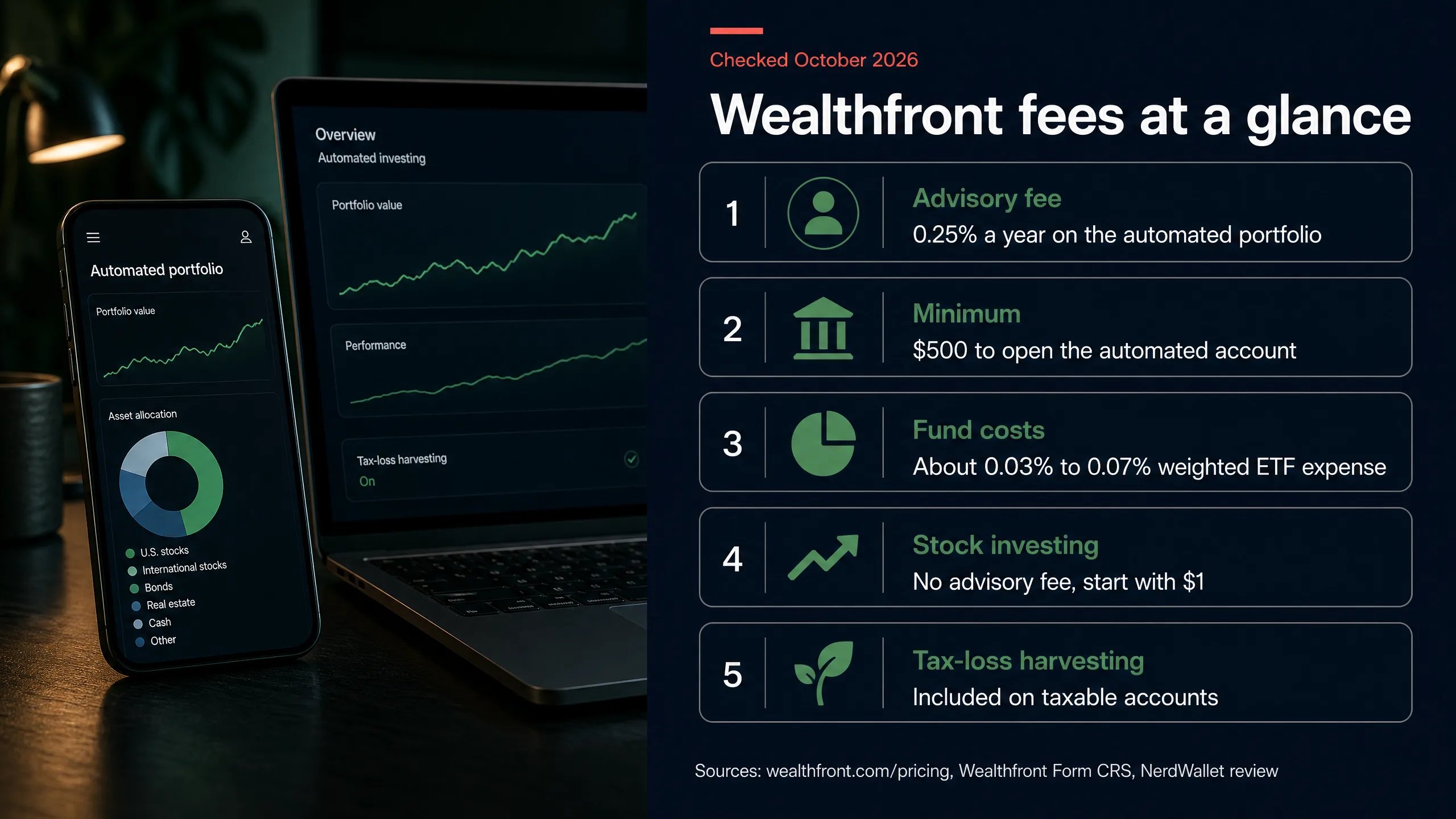
Wealthfront charges a 0.25% annual advisory fee on its Automated Investing Account (now marketed as the Wealthfront Portfolio), with a $500 minimum to open (checked October 2026). The underlying ETFs carry their own expense ratios on top; 
As for the wealthfront ai question: Wealthfront is a rules-based robo-advisor, not a predictive AI investment engine. The software follows pre-written logic (allocate by risk score, rebalance when drift crosses a threshold, sell losers for tax purposes) rather than forecasting prices. Wealthfront Advisers LLC is an SEC-registered investment adviser, and brokerage services come through Wealthfront Brokerage LLC, a FINRA/SIPC member.
So when someone says wealthfront ai, they usually mean automation. Those are different things, and the difference is worth 400 words of your attention.
Does Wealthfront use AI, or is it a standard robo-advisor?
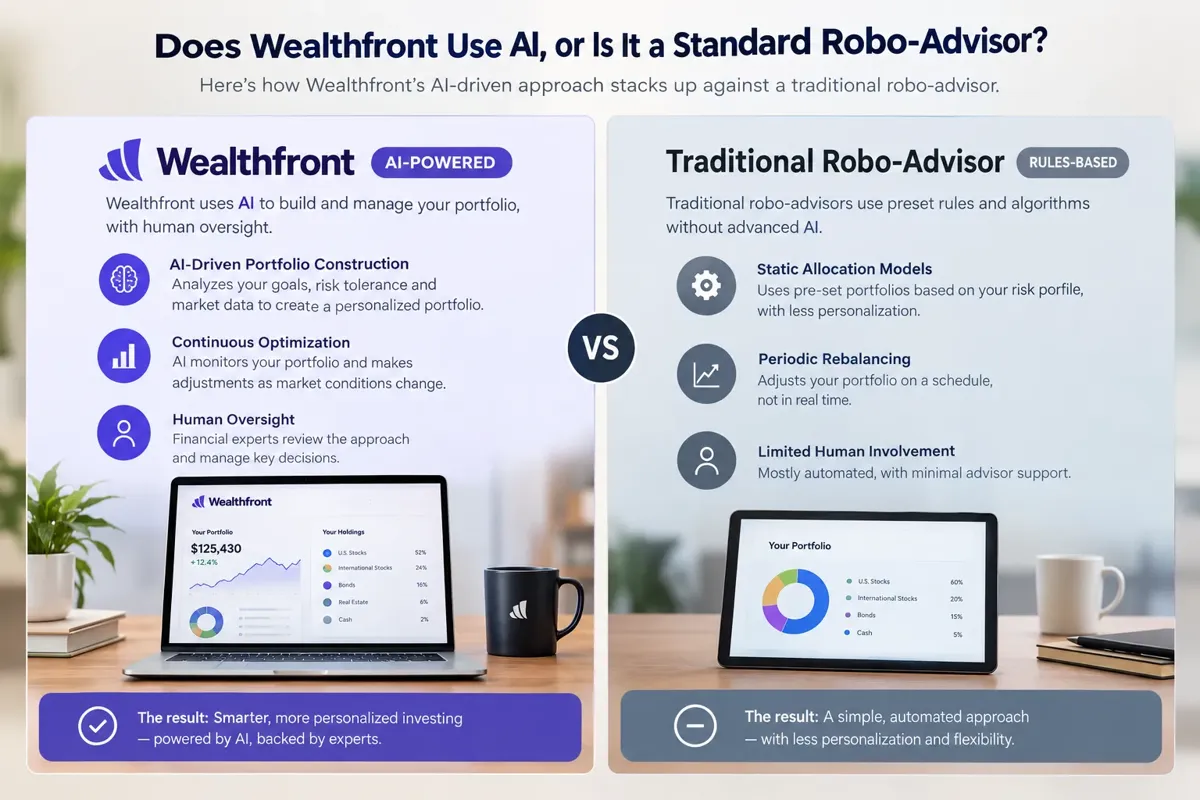
It's a standard robo-advisor with deep automation. Nothing in Wealthfront's public materials describes a predictive machine-learning model picking your investments. The portfolio logic is deterministic: you answer a questionnaire about goals, time horizon and risk tolerance, the software maps you to a risk score, and that score maps to a fixed allocation across ETFs.
What "rules-based" actually means
A rules-based system does the same thing every time the same conditions appear. If your international allocation drifts 5% above target, it trims. If a position sits below its cost basis, it's a harvesting candidate. No prediction. No opinion about whether semiconductors look toppy.
A predictive AI system, by contrast, tries to estimate something it doesn't know yet, like next quarter's earnings surprise or a probability-weighted price move. Tools in that category score stocks and change their minds. Wealthfront doesn't, and it isn't trying to.
The useful mental model: Wealthfront is a thermostat, not a weather forecaster. A thermostat reacts to the room. A forecaster guesses tomorrow. One is dull and reliable. The other needs you to check its track record.
Why the distinction matters for your money
If you're shopping for genuine signal generation, Wealthfront isn't the product. Systems that actually score securities are a separate category, and so are the fully automated AI trading apps that place trades for you. We've broken down where AI portfolio analysis catches things human review misses if that's the itch you're scratching.
If you want your money invested, rebalanced and tax-managed without you touching it, rules-based is exactly what you want, and that is what wealthfront ai really delivers. Predictive models introduce a variable you then have to supervise. Automation removes variables. That's the whole pitch.
Wealthfront's own 2026 product updates back this up. Its September 23, 2026 recap of what it shipped this year listed a new Custodial Account for investing on behalf of children, more than 300 securities added to the Stock Investing Account (Taiwan Semiconductor, ASML and Novo Nordisk among them), expanded cash automation, RTP and FedNow payment rails, and passkey login. Not one autonomous AI investment engine in the list. If you came looking for wealthfront ai that forecasts prices, this list is your answer.
Process over prediction. That's the design philosophy, whether or not they'd phrase it that way.
What does Wealthfront automate?
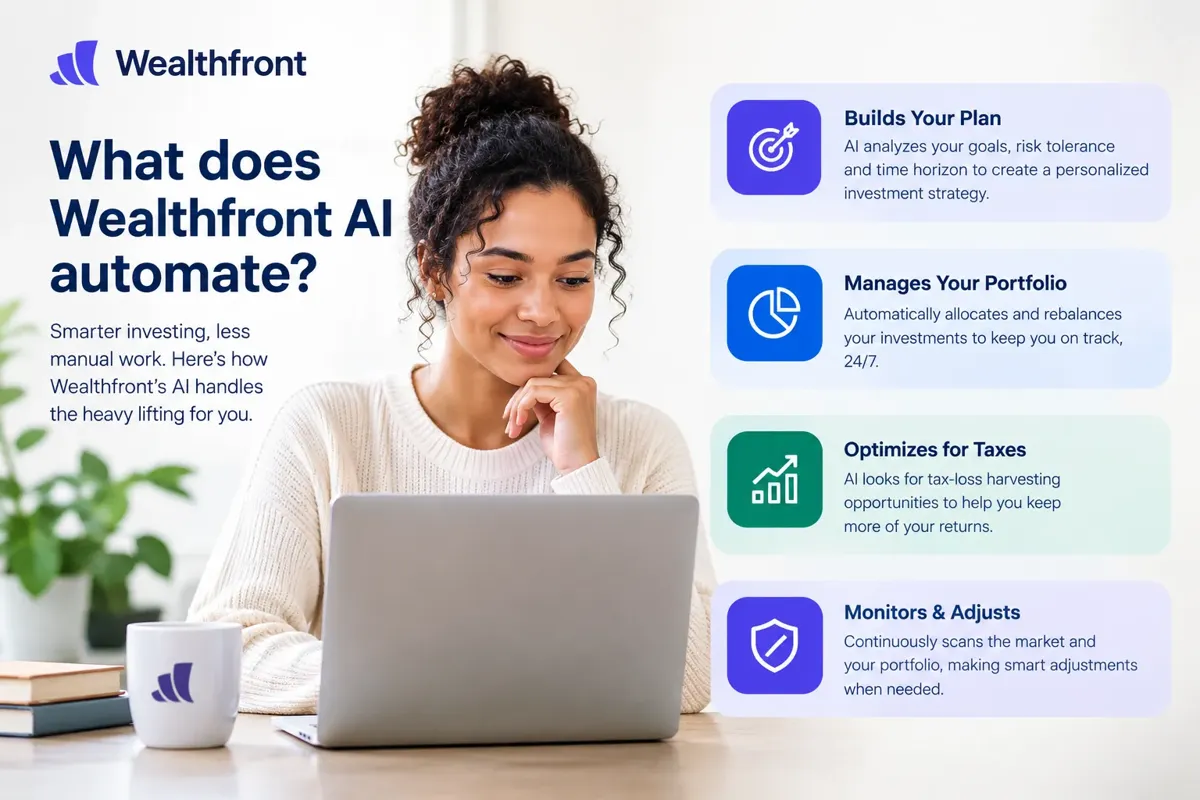
The wealthfront ai label covers four things that matter and several that are just convenient: portfolio construction, threshold rebalancing, daily tax-loss harvesting in taxable accounts, and cash sweep into a high-yield account. Everything else is plumbing.
Portfolio construction and automatic investing
After the questionnaire, the software builds a diversified ETF portfolio. According to NerdWallet's review, portfolios can draw from as many as 17 global asset classes, though a typical account holds roughly five to eight. Once funded, deposits get invested according to that allocation and dividends get reinvested, without you picking a single ticker.
For a beginner, this removes the most common failure point: money sitting in cash for eight months because you couldn't decide what to buy. Analysis paralysis has a cost, and it's usually larger than 0.25%.
Threshold-based rebalancing
Wealthfront monitors drift from your target allocation and rebalances when thresholds are hit, rather than only on a fixed quarterly or annual calendar. Deposits, withdrawals, dividends and market moves can all trigger it.
That's meaningfully better than most DIY investors manage. Be honest about whether you'd rebalance a six-fund portfolio in March 2020 or just stare at it.
Daily tax-loss harvesting
In taxable accounts, the software scans for holdings trading below purchase price, sells to realize the loss, and buys a similar (not identical) replacement so you stay invested. The realized loss offsets capital gains, and up to $3,000 a year of ordinary income.
Wealthfront's pricing page claims harvesting can typically cover the annual fee more than 4.2 times over for Classic portfolio clients. Read the disclosure carefully, because the benefit depends on your tax situation and can be limited by wash-sale rules, a lack of gains to offset, or that $3,000 cap. In a tax-advantaged IRA, harvesting does nothing at all. There's no tax to save.
Decision rule: tax-loss harvesting only earns its keep in a taxable brokerage account with meaningful gains elsewhere. If your money is all in a Roth IRA, discount that feature to zero.
Direct indexing at larger balances
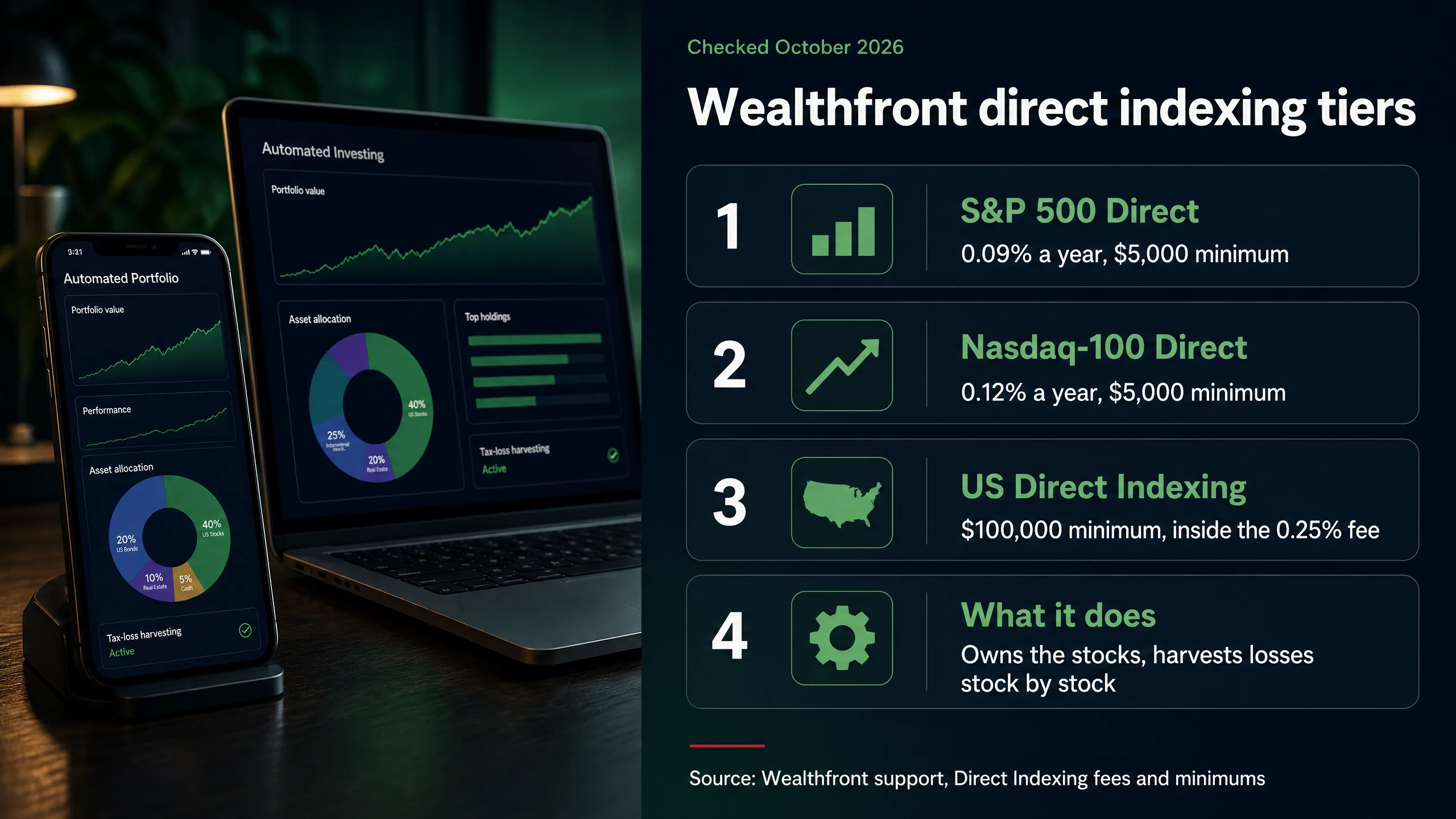
Direct indexing inside the flagship Automated Investing Account (Wealthfront calls it US Direct Indexing) starts at $100,000 and is included in the 0.25% fee. The standalone S&P 500 Direct and Nasdaq-100 Direct portfolios start at a $5,000 minimum, with advisory fees of 0.09% and 0.12% (checked October 2026). Direct indexing holds individual stocks instead of one ETF wrapper, which creates more chances to harvest losses, since individual names fall even when the index rises.
Cash and savings automation
The Cash Account listed a 3.55% base APY as of October 1, 2026 (checked October 2026), with an extra 0.25% for clients who keep a funded investing account and make qualifying monthly direct deposits ($1,000 or more) or recurring deposits. New clients can get a temporary promotional boost on top; Wealthfront's terms set the size and length. The yield is variable and paid through participating program banks, not from a Wealthfront bank deposit. During 2026 Wealthfront also added tools to route interest into savings categories, schedule recurring category transfers and track goal progress in-app.
What it does not automate
- It does not pick individual stocks for you in the automated portfolio
- It does not time the market, go to cash, or hedge a drawdown
- It does not replace a human planner for estate, equity-comp or complex tax questions
The planning tools connect outside accounts and model retirement, home purchases, college and travel, projecting whether your contributions are on pace. Useful. Not the same as a CFP who knows your family situation.
What are Wealthfront's fees and minimums? (table)
The headline wealthfront fees are simple: 0.25% annually on the Automated Investing Account, with a $500 minimum to open. Figures below were checked against wealthfront.com and its support center in October 2026 and can change, so verify before funding.
A few things worth noticing.
The 0.25% is not the all-in cost. ETF expense ratios stack on top. Call it roughly 0.28% to 0.32% total for a standard taxable portfolio, more for socially responsible ones. That's still cheap by advisory standards, and it's still more than a single index fund.
0.25% is the category standard, not a discount. 


What 0.25% costs in dollars. $10,000 balance: about $25 a year. $50,000: about $125. $250,000: about $625. Fee drag compounds against you the same way returns compound for you, which is why the gap matters more at $250,000 than at $5,000.
Use the calculator below to see your own number against a DIY index fund. It assumes about 0.08% in ETF costs, a little above NerdWallet's range, so treat the result as a conservative ceiling.
What is the downside of Wealthfront?
The main wealthfront ai downside is that you're paying an ongoing fee for a portfolio you could largely replicate with two or three index funds, plus you give up control over what you own. For a $5,000 account that's $12.50 a year, which is noise. For a $300,000 account held 25 years, it isn't.
The real drawbacks, ranked
1. You can't override the allocation holding by holding. You can adjust your risk score and, in some accounts, exclude certain categories. You can't say "cut emerging markets in half this quarter." If you have views, that's a cage.
2. No human advisor included. Vanguard Personal Advisor and Betterment's premium tier give you access to credentialed humans at higher fee tiers. Wealthfront's model is software-first, and the support team isn't a financial planning desk. If your situation involves RSUs vesting, a small business, a divorce or an inheritance, software alone won't cut it.
3. Tax-loss harvesting is often oversold. It's real, it helps, and the benefit is highly situational. Harvested losses defer tax rather than erase it, because your replacement holding has a lower cost basis. If you never sell, the deferral is valuable. If you liquidate in three years, less so.
4. The individual stock story is partial. Wealthfront's Stock Investing Account charges no fees and added more than 300 securities in 2026, plus dividend options (reinvest or sweep to the Cash Account). That's a self-directed sleeve sitting next to the automated one. Your automated portfolio still won't hold Nvidia because you feel strongly about it.
5. Rebalancing can look like it isn't happening. The most common support complaint. The system is threshold-based, so if your allocation hasn't drifted past its band, nothing trades. New deposits also get used to rebalance, which means cash flow quietly fixes drift without a visible sell order. No trade notification doesn't mean the system is asleep.
Common mistakes people make
- Opening an account, funding $500, then adding nothing for a year. Automation without contributions is a screensaver.
- Expecting harvesting benefits inside an IRA
- Changing the risk score after a bad month, which locks in losses and resets the whole point of the allocation
- Treating the Cash Account APY as fixed. It's variable, tied to program banks, and will move with rates
- Running Wealthfront alongside a separate brokerage holding the same ETFs, which can trigger wash-sale issues on harvested losses
Name the excuse, then fix it: "I'll pick my own funds later" is how money sits in cash for two years. Either automate it or schedule the decision.
Is Wealthfront safe?
Asking whether wealthfront ai is safe usually means two different questions: can the company lose my money through failure, and can I lose money in the market. The answers are different.
Custody protection. Wealthfront Brokerage LLC is a FINRA member and SIPC member. SIPC covers up to $500,000 in securities, including a $250,000 limit for cash, if the brokerage fails and client assets go missing. SIPC does not cover market losses. If your portfolio drops 22% in a bear market, that is not a covered event. It never was.
Cash Account protection. Cash deposits are swept to participating program banks for FDIC coverage. Important nuance: the insurance applies at the partner banks, not because Wealthfront is itself an FDIC-insured bank. Spreading deposits across up to 32 program banks is how Wealthfront advertises coverage of up to $8 million ($16 million for joint accounts), far above the standard $250,000 per-depositor limit (checked October 2026).
Regulatory standing. Advisory services come from Wealthfront Advisers LLC, an SEC-registered investment adviser. Registration means disclosure obligations and examination authority. It is not a government endorsement of performance, and the SEC says so. You can look up any adviser's Form ADV yourself at Investor.gov.
Account security. Wealthfront's 2026 updates added passkey login using Face ID, Touch ID or a device passcode, plus free instant withdrawals over RTP and FedNow, higher ACH limits and free outgoing wires (the receiving bank may still charge). Passkeys are a genuine step up from SMS codes, which are vulnerable to SIM-swap attacks.
The honest risk ranking. The thing most likely to hurt your account isn't a Wealthfront failure. It's you panic-selling in month nine of a drawdown, or setting a risk score far above your real tolerance. Behavior outranks custody risk by a wide margin. Same lesson applies when people hand money to automated trading bots and look at what the real results show.
Is Wealthfront worth it compared to buying an S&P 500 fund?
For most beginners under roughly $25,000 in a tax-advantaged account, buying a low-cost S&P 500 or total-market index fund yourself is cheaper and nearly as effective. The wealthfront ai fee starts earning its 0.25% in taxable accounts with real balances, or when the alternative is you not investing at all.
Run the comparison honestly.
Choose DIY if
- Your money is in a 401(k) or Roth IRA, where harvesting is worthless
- You'll actually rebalance once a year without flinching
- Your balance is small enough that the dollar fee is under a nice dinner
- You want US-only equity exposure and don't want the international drag
Choose Wealthfront if
- You have a taxable account with meaningful gains to offset
- You know yourself well enough to admit you won't rebalance
- You want bonds and international exposure without researching allocations
- You're over the $100,000 line where direct indexing kicks in
The honest version: 0.25% is the price of not having to care. For some people that's a bad trade. For others it's the only reason they have an invested portfolio at all. Both answers are defensible. Pretending the fee is free isn't.
One more comparison people forget. Wealthfront is not competing with a stock picker. If you're trying to find individual setups, or want an AI assistant like 
Can you take your money out of Wealthfront anytime?
Yes. There's no lock-up period, no withdrawal fee and no surrender charge on the Automated Investing Account. You request a withdrawal, the software sells the needed positions, and funds transfer to your linked bank. Timing is typically a few business days, driven by trade settlement and ACH rather than any Wealthfront restriction.
Three things to understand before you hit the button.
Selling in a taxable account creates a tax event. Positions sold at a gain generate capital gains. Held under a year, those are short-term and taxed at your ordinary income rate. The IRS doesn't care that a robot executed the trade.
Harvested losses can be clawed back by wash-sale rules. If you withdraw, then rebuy a substantially identical security within 30 days (at Wealthfront or anywhere else, including your spouse's account), the loss gets disallowed. The IRS wash-sale rule covers 30 days before and after the sale.
Retirement accounts have their own rules. Pulling from an IRA before 59½ generally means a 10% penalty plus income tax, with specific exceptions. Wealthfront's lack of a withdrawal fee doesn't override the tax code.
Partial withdrawals and transfers
You can withdraw part of a balance and leave the rest invested. The software sells across holdings in a way that tries to minimize tax impact and keep your allocation near target. You can also do an ACATS transfer to move holdings in kind to another brokerage, avoiding a taxable sale, though not every ETF has a home at every broker.
Practical rule: if you need the money inside two years, don't put it in an automated investing account at all. Use the Cash Account or a plain high-yield savings account. Market risk on a short timeline is how people end up selling at the worst moment.
Wealthfront alternatives
The right alternative depends on what you're actually replacing: the automation, the low fee, or the human. Those are three different shopping lists.
Betterment. The nearest competitor, also 0.25% on its Digital plan once you qualify, with no account minimum. Comparable automated rebalancing and tax-loss harvesting. Betterment's edge is goal-based account structuring and a Premium tier with human advisors at 0.65% (checked October 2026); Wealthfront's edge is direct indexing at $5,000 on the standalone portfolios and a generally stronger Cash Account story. Picking between them is a coin flip for most beginners. Pick the interface you'll open.
Vanguard Digital Advisor. An advisory fee capped at 0.20%, and Vanguard estimates about $15 to $16 a year per $10,000 for its all-index portfolio, built on Vanguard's own funds (checked October 2026). Cheaper, more conservative, less feature-rich. Reasonable if you already hold Vanguard accounts.
Fidelity Go. No advisory fee under $25,000, then 0.35% a year, and no minimum to open (checked October 2026). Good for small balances. It adds tax-loss harvesting in taxable accounts only at $25,000 and up.
Schwab Intelligent Portfolios. No advisory fee and a $5,000 minimum, but part of every portfolio sits in cash at Schwab Bank, sized by your risk profile, and that cash drags returns in a rising market. Our Charles Schwab scorecard covers the broker side. Free isn't free when the price is paid in opportunity cost.


Just an index fund. VOO, VTI, SPY or a target-date fund in your 401(k). Still the lowest-cost route, still unbeatable on expense ratio, still requires you to do the rebalancing.
Full profile and pricing detail sits in our Wealthfront review with pricing and verdict, and the wider robo field lives in the robo-advisor directory.
FAQ
Is Wealthfront AI or a rules-based robo-advisor? Rules-based. What people call wealthfront ai follows pre-written logic for allocation, threshold rebalancing and tax-loss harvesting rather than using a predictive model to forecast prices or select securities.
What is the Wealthfront minimum to start? The Automated Investing Account requires $500 to open. The standalone S&P 500 Direct and Nasdaq-100 Direct portfolios require $5,000. The Cash Account and Stock Investing Account start at $1 (checked October 2026).
How much does Wealthfront cost in fees? 0.25% per year on the Automated Investing Account, plus the expense ratios of the underlying ETFs, which NerdWallet puts at 0.03% to 0.07% on a taxable portfolio. S&P 500 Direct carries a 0.09% advisory fee and Nasdaq-100 Direct 0.12%. On $10,000 the advisory fee is about $25 a year.
Is Wealthfront good for beginners? Yes. The wealthfront ai setup suits someone who wants a diversified portfolio without making ongoing decisions. It's less suitable for a beginner whose entire balance is in a Roth IRA under $5,000, since the tax features do nothing there and a single index fund costs less.
Why is my Wealthfront portfolio not rebalancing? Because rebalancing is threshold-based, not calendar-based. If your allocation hasn't drifted past its band, no trades occur. New deposits and dividends are also used to correct drift, so rebalancing can happen without a visible sell order.
Can you buy individual stocks on Wealthfront? Yes, through the separate Stock Investing Account, which charges no fees and added more than 300 securities during 2026, including Taiwan Semiconductor, ASML and Novo Nordisk. The automated portfolio itself does not hold individual picks.
Wealthfront vs Betterment, which is better? Both charge 0.25% on their core automated plans, though Betterment charges $5 a month below $24,000 unless you set up $200 a month in recurring deposits. Wealthfront leans toward direct indexing and cash automation. Betterment leans toward goal-based structuring and optional human advice at a higher tier. For a beginner, the functional difference is small.
Does tax-loss harvesting actually pay for the fee? Sometimes, and only in taxable accounts. Wealthfront's own disclosures note the harvesting benefit depends on your tax situation and can be limited by wash-sale rules, a lack of offsetting gains, or the $3,000 annual ordinary-income deduction cap.
Conclusion
Wealthfront is good software doing unglamorous work on a schedule: allocate, rebalance at thresholds, harvest losses daily in taxable accounts, sweep cash into a yield-bearing account. The robo-advisor label fits better than the wealthfront ai label, and you should be skeptical of any platform in this category selling you machine intelligence when what you're buying is reliable if-then logic. That's not an insult. Reliable if-then logic beats most investors' actual behavior.
Three things to do this week:
- Open the fee math on your own number. Multiply your balance by 0.0033 for a conservative all-in estimate. If that figure feels fine for never having to rebalance again, Wealthfront is reasonable. If it makes you wince, buy the index fund.
- Check the account type first. Taxable account with gains, harvesting earns something. Roth IRA, it earns nothing. That single fact decides most of this.
- Set the contribution before the allocation. A $500 account on autopilot with no deposits is theater. Automation only compounds if something is flowing into it. If you'd rather automate trading than investing, that's a different toolset with different risks.
References
- Wealthfront pricing. wealthfront.com.
- Wealthfront investing and direct indexing. wealthfront.com.
- Wealthfront direct indexing accounts, fees and minimums. support.wealthfront.com.
- Wealthfront Cash Account. wealthfront.com.
- What we've shipped so far in 2026. wealthfront.com.
- Wealthfront review 2026. nerdwallet.com.
- Betterment pricing. betterment.com.
- Vanguard Digital Advisor. vanguard.com.
- Fidelity Go. fidelity.com.
- Schwab Intelligent Portfolios. schwab.com.
Still deciding between Wealthfront, Betterment and a plain index fund? Our robo-advisor directory puts fees, minimums and automation features side by side. Compare robo-advisors → aistockpickerapps.com/robo-advisors
This is education, not financial advice.
Your market edge starts with the right tool. Stay alpha.
Some links on this page may be affiliate links. Rankings are never influenced by them.