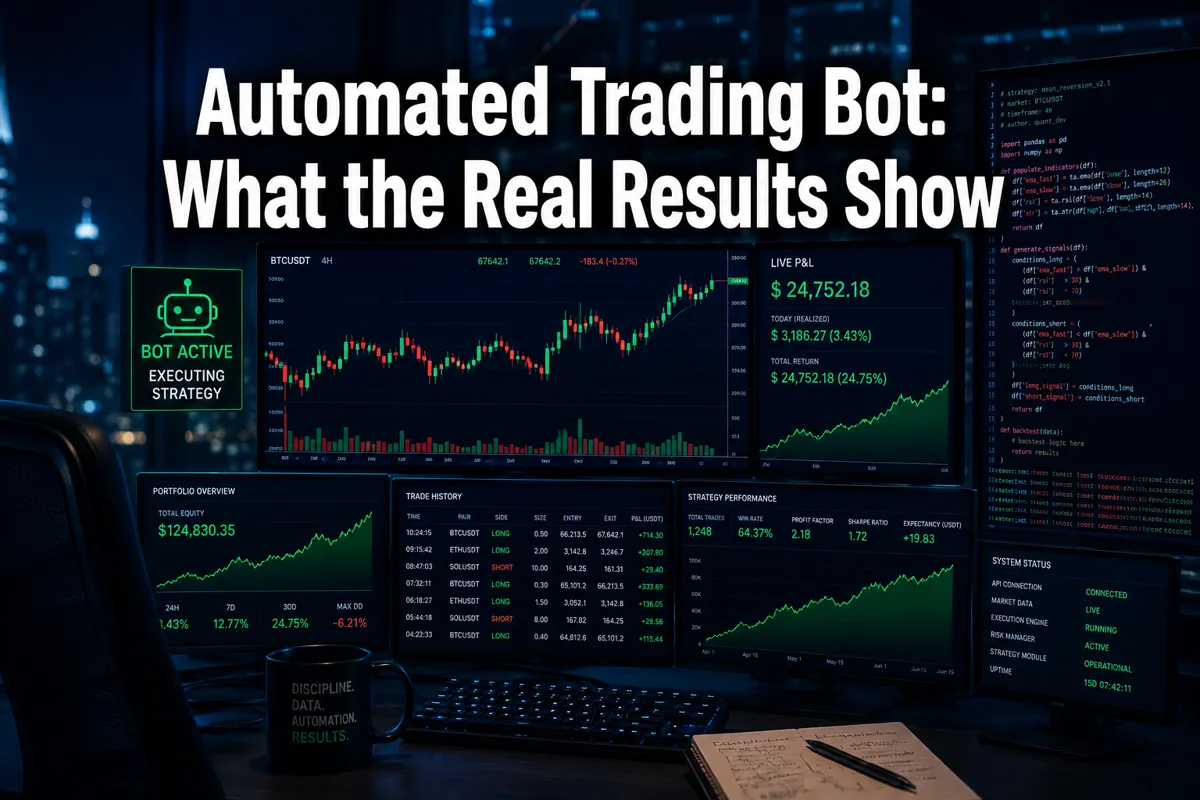
Automated Trading Bot: What the Real Results Show
Last updated: June 30, 2026
Quick Answer: Most automated trading bots underperform their backtests in live markets due to overfitting, slippage, and execution gaps. Some bots do generate consistent returns, but only when built on sound strategy logic, tested out-of-sample, and managed with strict risk controls. The real results are far more nuanced than any sales page will tell you.
Key Takeaways
- Backtested results and live trading results are almost never the same — the gap is where most traders get burned.
- Automated bots remove emotional decision-making but introduce new risks: overfitting, slippage, and technical failure.
- Platforms like Tickeron, Trade Ideas, TrendSpider, and QuantConnect publish audited or out-of-sample performance data — that's the standard to hold every bot to.
- Trading bot accuracy statistics vary wildly; win rate alone is meaningless without knowing the average win/loss ratio and max drawdown.
- Scams are rampant in this space. If a bot promises consistent profits with no drawdown, that's not a product — it's a pitch.
- Beginners should paper trade any bot for at least 60 days before risking real capital.
- Automated bot drawdown analysis is the single most important number most traders ignore.
- The best automated trading bot in 2026 is the one that fits your strategy, your risk tolerance, and your market — not the one with the flashiest dashboard.
What Is an Automated Trading Bot and How Does It Work
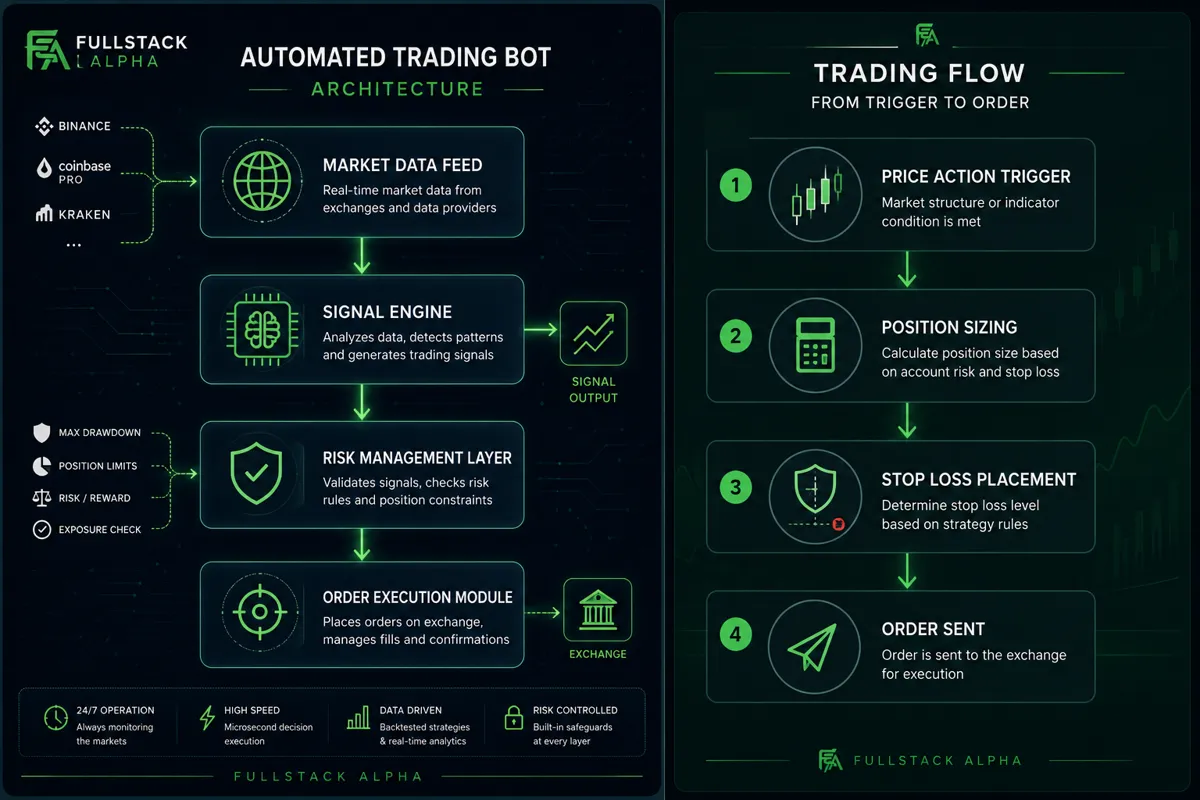
An automated trading bot is software that executes buy and sell orders in financial markets based on a predefined set of rules — no human clicking required. It monitors price action, applies your strategy logic, calculates position sizing, and fires orders when conditions are met.
Here's the basic anatomy of how automated trading bots really work:
- Data feed — the bot ingests real-time or delayed market data (price, volume, indicators).
- Signal engine — it checks whether current conditions match your strategy rules (a breakout above resistance, an RSI crossing a threshold, a moving average crossover).
- Risk management layer — it calculates position size based on your account size and risk parameters, then sets a stop loss.
- Order execution — it sends the order to your broker's API.
The bot doesn't think. It doesn't adapt. It runs the rules you gave it, exactly as written. That's the feature and the flaw. When your rules are good, it's a machine that never revenge trades, never overtrades, and never freezes up during power hour. When your rules are bad — or when the market shifts — it just keeps executing bad trades, automatically.
Automated Trading Bot: What the Real Results Show
This is the section most bot vendors hope you skip. The honest answer: results depend entirely on what you're measuring and how you're measuring it.
The Backtest vs. Live Trading Gap
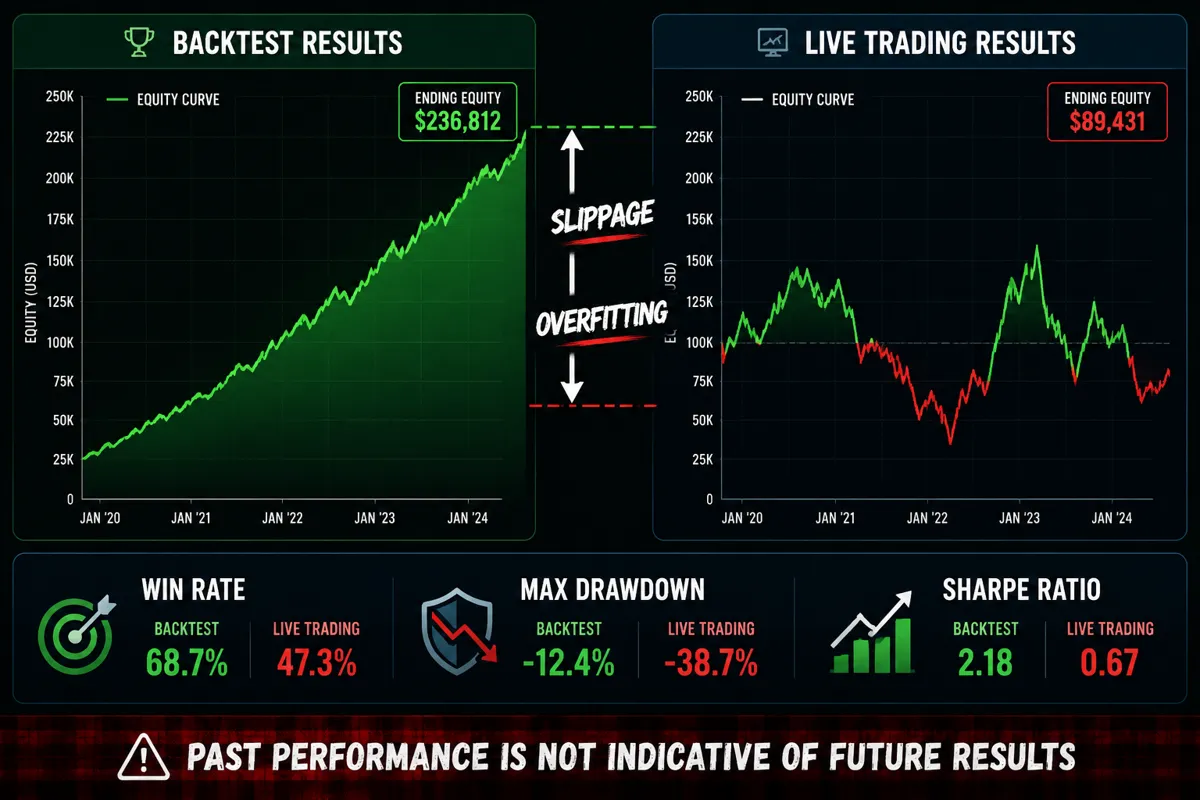
Every automated trading bot looks good in a backtest. That's not a compliment — it's a warning. Backtesting runs your strategy against historical data it has already seen. The bot "knows" where prices went. That's not trading; that's a history quiz.
The real test is out-of-sample performance — running your strategy on data it was never trained on. TrendSpider's Strategy Tester specifically separates in-sample and out-of-sample periods for this reason. QuantConnect, which institutional quants use as a validation standard, requires forward-testing before any strategy is considered credible. The gap between a polished backtest and messy live results is where most traders discover their bot was never actually an edge — it was a pattern-fitted story.
Trading Bot Accuracy Statistics: What the Numbers Actually Mean
Win rate is the most-cited and least-useful stat in bot marketing. A bot with a 70% win rate can still blow up your account if the average loss is three times the average win. What matters:
- Win rate + average win/loss ratio together
- Maximum drawdown (how deep does the equity curve fall before recovering?)
- Sharpe ratio (return per unit of risk taken)
- Trade frequency (is this 10 trades a month or 300?)
Tickeron publishes audited AI robot track records with trade-by-trade transparency. Trade Ideas' Holly AI posts overnight simulation results publicly. Those are the benchmarks. If a bot vendor won't show you verified, out-of-sample performance data with drawdown included, that's your answer.
Automated Bot Drawdown Analysis: The Number That Actually Matters
Drawdown is the peak-to-trough decline in your account before a new high is reached. A bot that returns 40% annually but hits a 60% drawdown at some point is not a good bot — it's a psychological torture device. Most traders quit during the drawdown and miss the recovery. Before trusting any automated trading bot results, demand the maximum drawdown figure and ask yourself: can you actually sit through that?
Do Automated Trading Bots Actually Make Money?
Some do. Most don't — at least not consistently, and not without significant human oversight. A 2019 study by the European Securities and Markets Authority found that the majority of retail algorithmic trading accounts lose money over a 12-month period. The bots that do work tend to share three traits: they're built on a genuine market inefficiency, they're tested on data they haven't seen before, and they're run with disciplined risk management.
The honest framing: an automated trading bot is not a passive income machine. It's a system that automates a strategy. If the strategy has no edge, the bot just executes the losing trades faster.
Automated Trading Bot vs. Manual Trading: Which Is Better
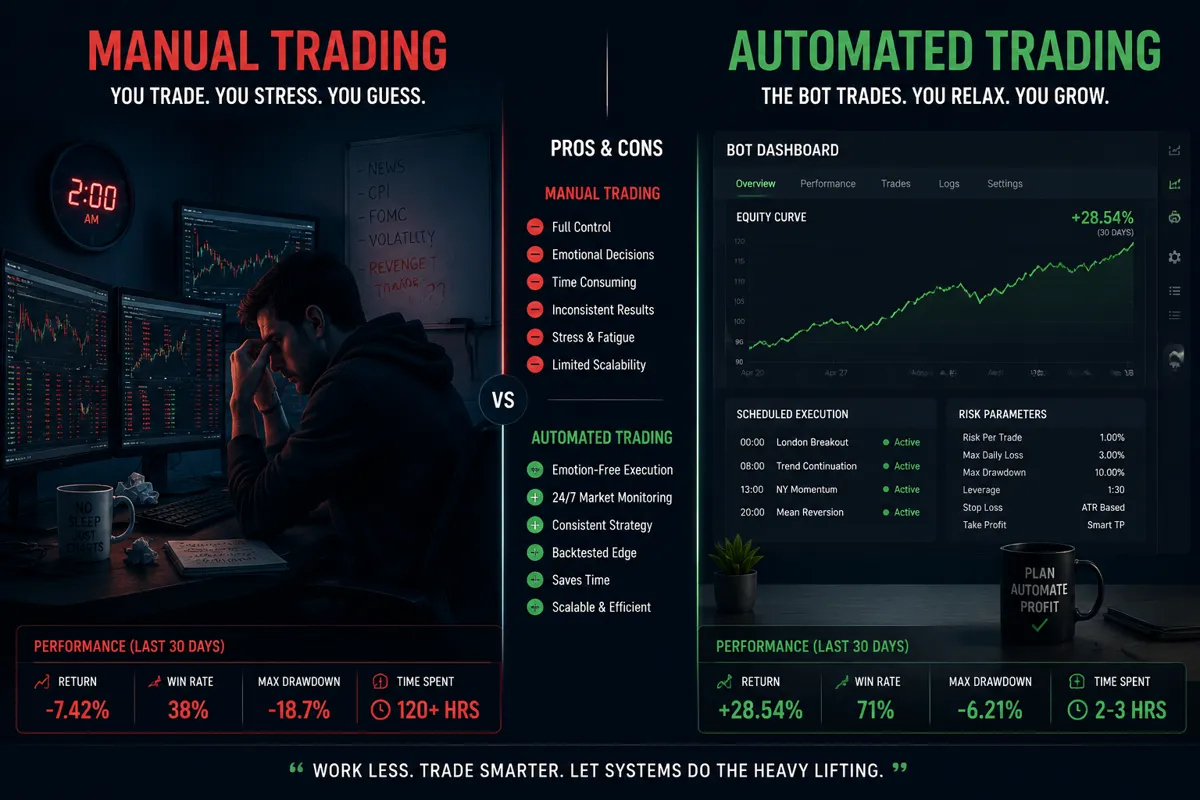
Neither is universally better. Each has a specific job.
| Factor | Automated Bot | Manual Trading |
|---|---|---|
| Emotional discipline | Excellent — no revenge trading | Weak — FOFO and fear dominate |
| Adaptability | Poor — rigid rules | Strong — can read context |
| Speed of execution | Milliseconds | Seconds to minutes |
| Scalability | High — runs 24/7 | Limited by attention |
| Strategy validation | Requires rigorous backtesting | Can rely on pattern recognition |
| Best for | Rule-based, quantifiable setups | Discretionary, news-driven trades |
The traders who win long-term often use a hybrid: automated bots handle the mechanical execution and risk management, while the human monitors the setup quality and market conditions. Automated bot vs manual trading isn't a competition — it's a division of labor.
For swing traders building repeatable systems, tools like those in the AI trading platforms directory can help you find the right combination of automation and discretion.
How Much Does an Automated Trading Bot Cost
Costs range from free to thousands per month, depending on what you're getting.
- Free/open-source: QuantConnect, Superalgos — you build and code everything yourself. No cost, but steep learning curve.
- Subscription-based platforms: Typically $30–$300/month. Tools like WunderTrading and Capitalise AI fall in this range and offer pre-built bot templates with no coding required.
- Done-for-you bots: $500–$5,000+ upfront or monthly. These are where scams concentrate. High price does not equal high performance.
- Broker-integrated tools: Some brokers offer basic automation built-in at no extra cost.
The cost of the bot is rarely the biggest expense. The real cost is the capital at risk if the bot underperforms. Size your position accordingly.
Can Automated Trading Bots Lose Money and What Are the Risks
Yes, and they can lose it faster than you can manually. Automated trading bot risks include:
- Overfitting — the strategy was curve-fitted to past data and has no real edge
- Slippage and execution gaps — the price you expected vs. the price you got, especially in low-float or choppy tape conditions
- Technical failure — API disconnects, server downtime, broker outages
- Market regime change — a strategy built for trending markets gets destroyed in a choppy tape
- Over-optimization — too many parameters, too little robustness
Trading bot slippage and execution quality matter more than most traders realize. A bot that shows a 1.5% edge in backtesting can see that edge entirely consumed by slippage in live markets, especially on smaller cap stocks or during earnings season.
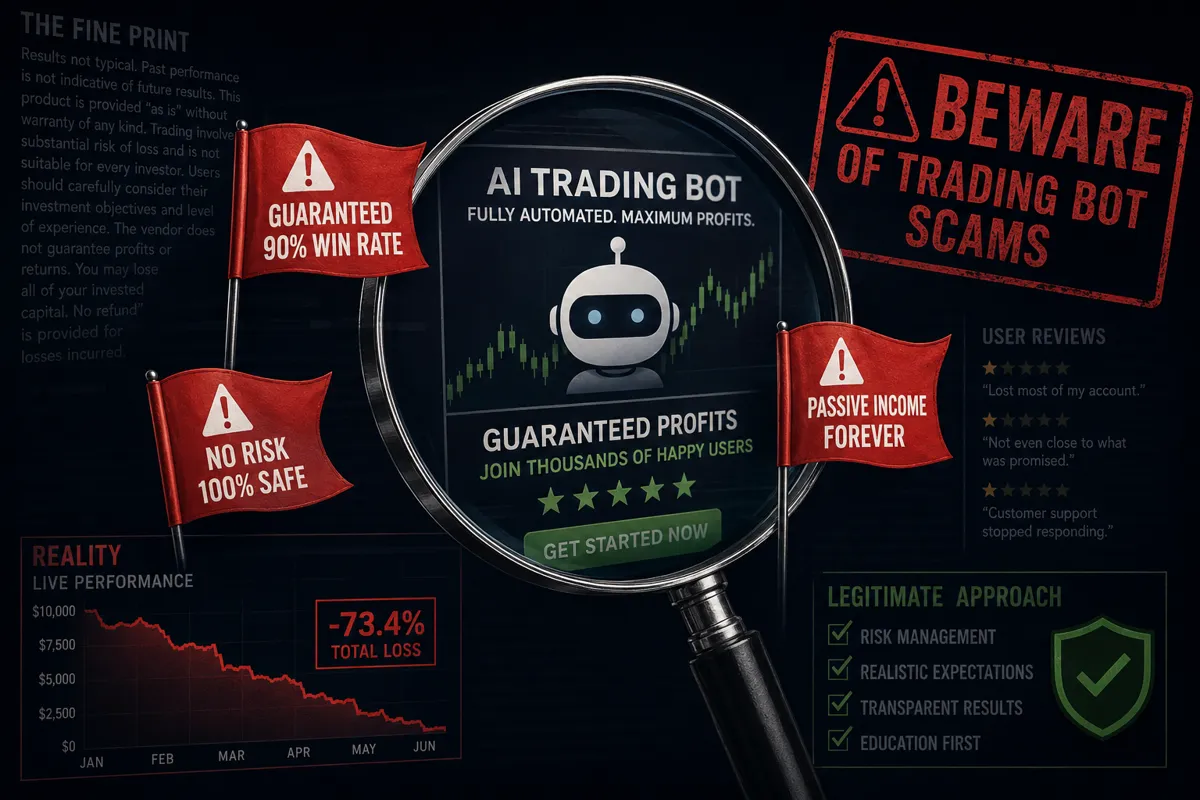
Automated Trading Bot Scams: What to Watch Out For
The automated bot space is a scam ecosystem. Play stupid games, win stupid prizes — and this game has a lot of players.
Red flags that should end the conversation immediately:
- Guaranteed returns or "consistent profits" claims
- No verified, audited track record — just screenshots
- Testimonials with no verifiable identity
- Pressure to invest more capital to "unlock" better performance
- Promises of passive income with zero monitoring required
- No information about drawdown or losing periods
The SEC and FINRA have both issued investor alerts specifically about fraudulent automated trading systems. If a bot's marketing looks more like a crypto influencer's Instagram than a quantitative research paper, trust that instinct.
Legitimate platforms publish their methodology. They show losing trades. They explain their risk management. That's the standard.
Automated Trading Bots for Beginners: Is It Worth It
For beginners, the honest answer is: not yet, unless you're paper trading. An automated trading bot is not a substitute for understanding the market — it's an amplifier. If you don't understand why a strategy should work, you won't know when to turn the bot off when conditions change.
The right sequence for beginners:
- Learn the underlying strategy manually first
- Paper trade the bot for 60+ days to validate ai automated trading performance
- Run live with minimal size (1% risk per trade maximum)
- Review every trade weekly — not just the P&L, but the setup quality
For beginners exploring the space, the trading bots comparison page and the day trading tools directory are good starting points to see what's actually available without the sales pressure.
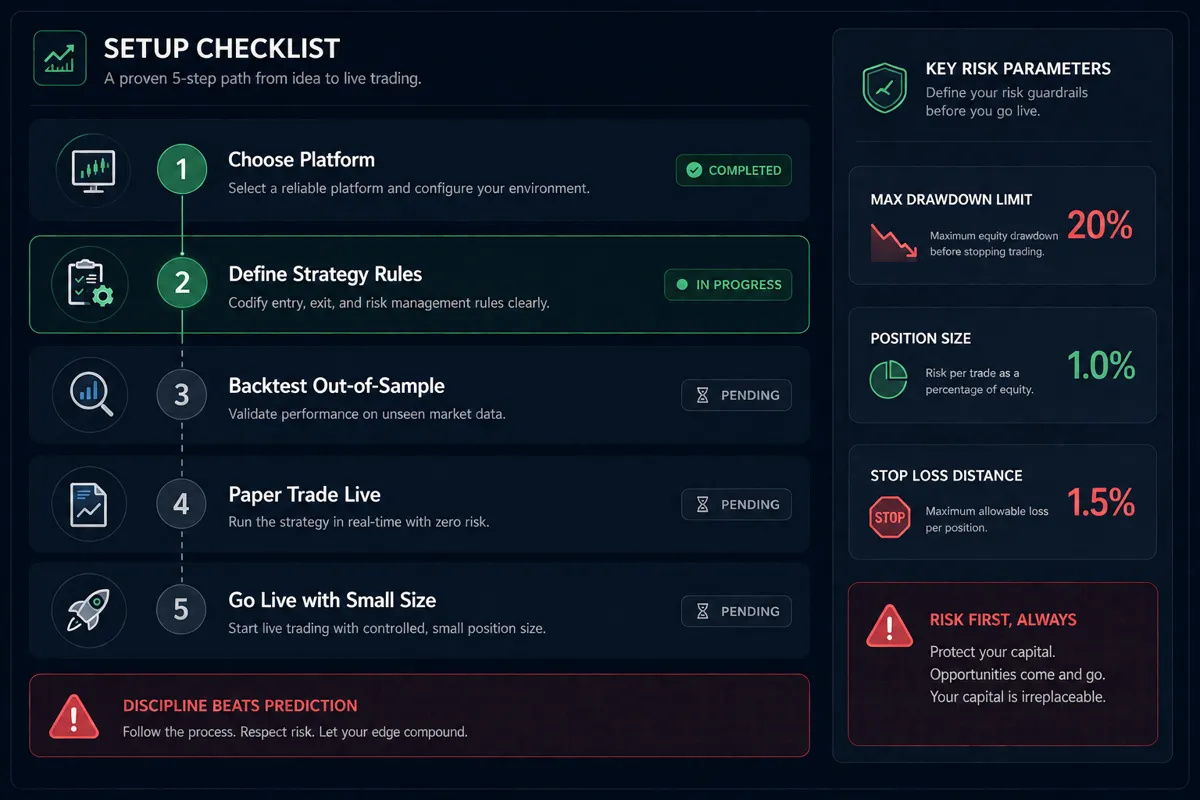
How to Set Up an Automated Trading Bot
Setting up an automated trading bot follows a repeatable process. Here's the clean setup:
- Choose a platform — QuantConnect for coders, TrendSpider or Trade Ideas for strategy-first traders, WunderTrading or Capitalise AI for no-code execution.
- Define your strategy rules precisely — entry trigger, exit trigger, stop loss distance, position size formula. Vague rules produce vague results.
- Backtest with out-of-sample data — use TrendSpider's Strategy Tester or QuantConnect's framework. Reserve at least 30% of your data for out-of-sample validation.
- Paper trade it first — run the bot in simulation mode for at least 60 days. Watch for slippage, missed entries, and unexpected behavior.
- Go live with small size — start with 25% of your intended capital. Confirm that live results match paper trading results before scaling.
- Monitor and adjust — review performance monthly. If the bot's drawdown exceeds your predetermined limit, pause it. Don't let it run unattended through a regime change.
For strategy research and signal validation, tools like TradingView and AlgoTest are worth having in the stack.
Are Trading Bots Legal and Regulated
Yes, automated trading bots are legal in the U.S. for retail investors. The SEC and FINRA regulate the brokers and platforms, not the individual use of automation. That said, certain strategies — like spoofing or layering — are illegal regardless of whether a human or a bot executes them.
For U.S. retail traders, the practical legal considerations are:
- Use a regulated broker with a compliant API
- Avoid strategies that could be construed as market manipulation
- Keep records of your trading activity (required for tax reporting)
FINRA's investor education resources at FINRA.org cover the regulatory landscape in plain English if you want to go deeper.
Common Mistakes People Make With Trading Bots
Most automated trading bot failures aren't technical — they're behavioral. The same mistakes, repeated endlessly:
- Skipping out-of-sample testing — the backtest looked great, so they went live immediately
- Ignoring drawdown limits — they let the bot run through a 40% drawdown hoping it would recover
- Over-optimizing parameters — 47 variables that fit the past perfectly and predict nothing
- Not monitoring execution quality — slippage and execution gaps ate the edge silently
- Treating it as truly passive — markets change. Bots don't adapt. Humans have to.
Discipline beats prediction. The traders who succeed with automation are the ones who treat the bot as a tool that requires maintenance, not a set-and-forget machine.
Can You Make Passive Income With a Trading Bot
Partially, and with significant caveats. An automated trading bot can reduce the time you spend actively trading. It cannot eliminate the need for oversight, strategy maintenance, and periodic adjustment.
The realistic picture for 2026: the best automated trading bot setups require roughly 2–5 hours per week of monitoring, review, and adjustment. That's not passive in the traditional sense — it's more like owning a rental property. The income can be consistent, but the property still needs maintenance.
Anyone promising fully passive, hands-off income from a trading bot is either selling something or hasn't lived through a market regime change. That wasn't in our bingo card when we started, but it's the reality every serious algorithmic trader eventually learns.
Conclusion: What to Do With This Information
The automated trading bot space in 2026 is a mix of genuinely useful tools and outright fraud, with a lot of mediocre products in between. The signal-to-noise ratio is terrible. Here's how to cut the noise and keep the alpha:
Actionable next steps:
- Before buying any bot, demand out-of-sample backtesting results with drawdown data. No exceptions.
- Use Tickeron's audited robot track records or Trade Ideas' published Holly AI results as your performance benchmark.
- Paper trade any new bot for 60 days minimum before risking real capital.
- Set a maximum drawdown limit before you start — and commit to pausing the bot if it hits that level.
- Treat automation as a tool that executes your strategy, not a strategy in itself. Systems over hacks, always.
- Browse the trading bots directory and the AI trading platforms comparison to see vetted options without the sales pressure.
The traders who win with automation aren't the ones who found the magic bot. They're the ones who built a sound process, validated it honestly, and had the discipline to follow it. That's the whole game.
Want the tools and setups behind this, without the hype? Start at aistockpickerapp.com.