The AI Stock Apps Traders Are Downloading Before the Next Rally
Last updated: June 16, 2026
Quick Answer: The AI stock apps traders are downloading before the next rally include platforms like Tickeron, Magnifi, Trade Ideas, Intellectia, and TrendSpider — tools that combine real-time AI screening, pattern recognition, and signal alerts to help traders find clean setups before price moves. The best choice depends on your experience level, trading style, and budget. None of them predict the future. The good ones just help you stop reacting and start preparing.
Key Takeaways
- AI stock apps range from free screeners to $200+/month professional platforms — know what you need before you pay.
- The best AI stock apps filter noise, surface high-probability setups, and support your process — they don't replace it.
- Tickeron, Magnifi, and Trade Ideas are among the most-downloaded AI stock trading apps in 2026 for retail traders.
- Beginners can absolutely use AI stock apps — but paper trade it first before putting real money behind any signal.
- AI stock prediction accuracy varies widely; no app consistently beats the market over time, and any claim otherwise is a red flag.
- Robinhood launched agentic AI trading in May 2026, signaling that AI integration is moving from optional to standard.
- The biggest risk with AI stock apps isn't the technology — it's the trader who turns off their brain and follows signals blindly.
- Discipline beats prediction. Use AI to sharpen your watchlist, not to outsource your judgment.
The AI Stock Apps Traders Are Downloading Before the Next Rally
Right now, serious retail traders are quietly rebuilding their toolkits. Not because they found a magic signal — but because the market has gotten faster, and the old way of scanning manually just doesn't cut it anymore.
The AI stock apps traders are downloading before the next rally share a common thread: they replace gut-feel guessing with data-driven filtering. Instead of staring at 500 charts hoping something jumps out, these apps surface the setups worth watching — tight consolidations, basing patterns near support, stocks showing unusual volume before a breakout — and do it in seconds.
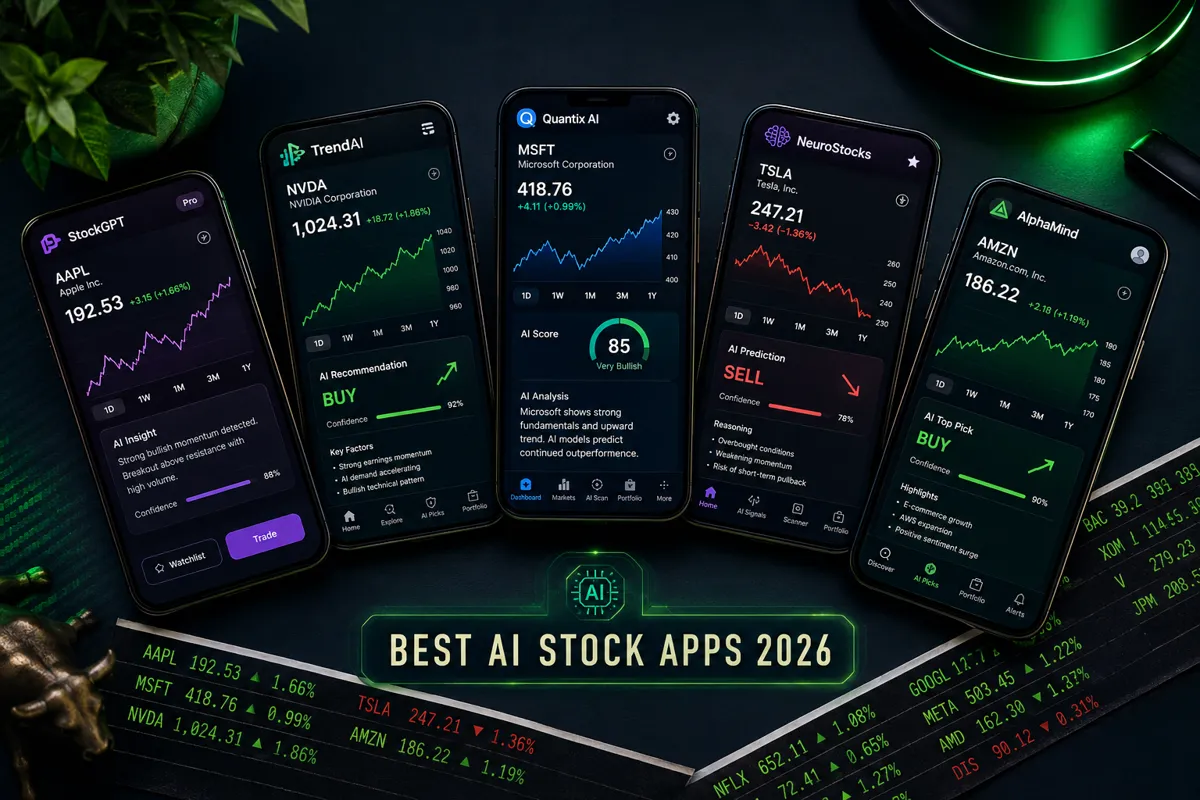
Here are the platforms getting the most attention from active traders in 2026:
Tickeron — A full-stack AI stock app with pattern recognition, AI-generated buy/sell signals, and a built-in rating system for stocks and ETFs. It covers day trading, swing trading, and long-term investing in one interface. Available on desktop, iOS, and Android. Check out the full Tickeron breakdown before committing.
Magnifi — A mobile-first AI investing assistant that lets you search for investments using plain-English questions. Ask "show me tech ETFs with low expense ratios" and it delivers. It's less of a scanner and more of a research companion. See the Magnifi tool review for the full picture.
Trade Ideas — The professional-grade AI scanner that serious day traders use. Holly AI, its built-in trading bot, runs pre-market scans and flags high-probability setups based on historical pattern data. Real-time alerts, backtesting, and a live trading room make it a complete system.
Intellectia — An AI trading signal app with swing trading alerts, technical analysis tools, and AI stock picks for stocks, ETFs, and crypto. Available on the App Store and built for traders who want signals without the noise.
TrendSpider — Automated technical analysis with AI-driven trendline detection, multi-timeframe analysis, and backtesting. Strong for traders who live in price action and want the chart to do the heavy lifting. Review the TrendSpider tool page for details.
TradeZing (TradeZ) — Launched in April 2026, TradeZ is an AI trading copilot that learns from your behavior and connects directly to 15+ brokerages for one-tap execution. It's one of the newer entries but already drawing attention for its execution speed.
BlackBox Stocks — Options flow, dark pool data, and AI alerts combined. Popular with traders who want to track where the smart money is moving. See the BlackBox Stocks review for a full breakdown.
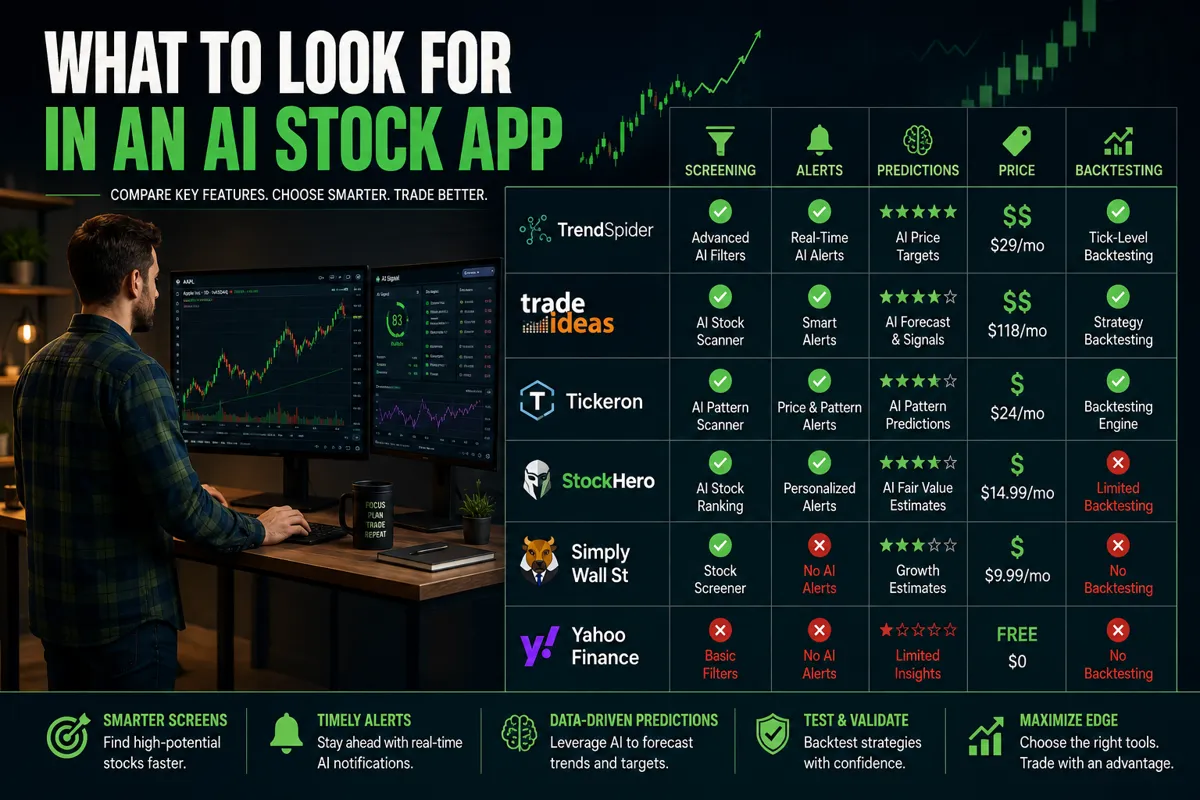
What Features Should You Look for in an AI Stock App?
The right features depend on your trading style, but there are non-negotiables that separate useful tools from expensive noise machines.
Must-have features for active traders:
- Real-time screening — The app should scan the full market and surface stocks meeting your criteria as conditions change, not just at open.
- AI pattern recognition — Automated detection of setups like flags, cups, breakouts, and tight consolidation saves hours of manual chart work.
- Customizable alerts — Price action alerts, volume spikes, and momentum shifts sent to your phone during power hour matter more than any dashboard feature.
- Backtesting — Before trusting any signal, you need to see how it performed historically. If the app can't show you that, it's selling hope.
- Risk-reward tools — Position sizing calculators, stop loss suggestions, and entry/exit guidance keep you from sizing into a trade emotionally.
- News integration — Earnings season moves fast. An AI app that connects price action to real-time news context helps you avoid catching a falling knife.
Nice-to-have features:
- Multi-asset coverage (stocks, ETFs, options, futures)
- Social sentiment analysis
- Portfolio tracking and performance analytics
- Paper trading mode for testing signals without real money
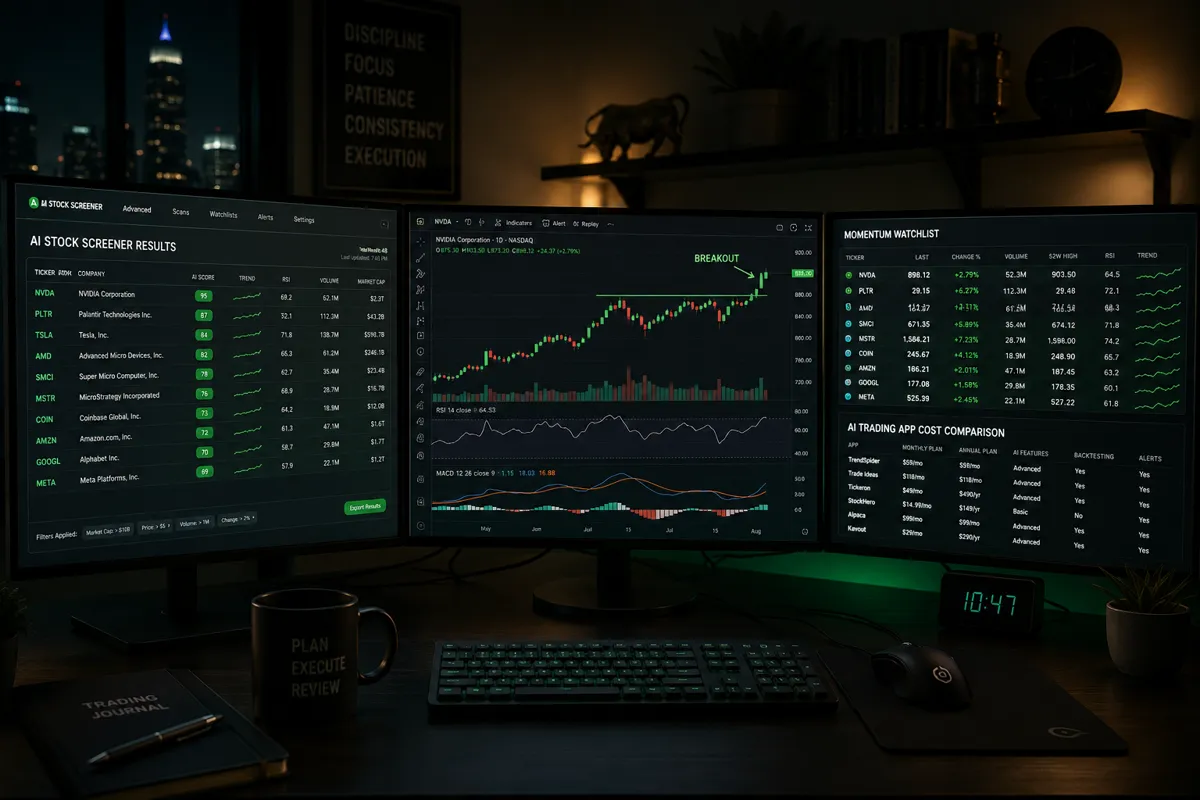
Use the free stock screener recipe builder to test different screening criteria before paying for a premium tool.
How Much Does an AI Stock Prediction App Cost?
AI stock app pricing in 2026 runs from completely free to over $250 per month for professional-grade platforms. Here's a realistic breakdown:
| Tier | Price Range | Best For | Examples |
|---|---|---|---|
| Free | $0 | Beginners, basic screening | Stock Analysis, Finviz, Robinhood Cortex |
| Entry-level | $10–$30/month | Casual investors, swing traders | Magnifi, Intellectia, Stash |
| Mid-tier | $30–$100/month | Active traders, swing and day traders | TrendSpider, Tickeron, BlackBox Stocks |
| Professional | $100–$250+/month | Full-time traders, serious retail | Trade Ideas, AlgoTraders, TC2000 |
A few things worth knowing before you pay:
- Most platforms offer a free trial. Use it. Paper trade it first before spending a dollar.
- Annual billing typically saves 20–40% over monthly.
- Some tools charge separately for add-ons like options flow data or AI signal packages.
- The most expensive tool is not automatically the best one for your style.
The free tools section at AI Stock Picker Apps is a good starting point if you want to stress-test your process before committing to a paid subscription.
Which AI Stock App Gives the Most Accurate Predictions?
No AI stock app predicts the market with consistent accuracy — and any platform claiming otherwise should be treated as a red flag, not a selling point.
That said, some tools have stronger track records than others when it comes to surfacing high-probability setups. The StockGPT model, trained on 70 million daily U.S. stock returns over nearly 100 years, showed strong backtesting performance — but backtesting and live trading are two very different environments. KLab's AI trading system reported more than double benchmark performance in backtesting in early 2026, but again, those results haven't been validated in live market conditions.
What "accuracy" actually means in practice:
- A good AI stock app doesn't need to be right 70% of the time. It needs to help you find setups where the risk-reward is skewed in your favor.
- A 55% win rate with disciplined position sizing and a solid stop loss system beats a 70% win rate where you let losers run and cut winners fast.
- The most useful metric isn't prediction accuracy — it's expectancy. Use the expectancy calculator to understand what your actual edge looks like.
Bottom line: Choose AI stock apps that help you build a repeatable process, not ones that promise to tell you what to buy tomorrow.
Are AI Stock Apps Legal and Safe to Use?
Yes, AI stock apps are legal for retail investors in the United States and most international markets. They are software tools — not licensed financial advisors — and using them to inform your own trading decisions is completely within the rules.
A few important distinctions:
- Regulated vs. unregulated platforms: Apps connected to licensed brokers (Robinhood, Tastytrade, Alpaca) operate under SEC and FINRA oversight. Standalone AI signal apps are not broker-dealers and are not regulated the same way. Always check FINRA's BrokerCheck before connecting an app to your brokerage account.
- Data security: Look for apps that use bank-level encryption and don't require direct access to your brokerage login credentials. Read-only API connections are safer than full account access.
- Agentic trading risk: Robinhood's May 2026 launch of agentic trading — where AI agents can execute trades autonomously on your behalf — introduces a new layer of risk. Automated execution without human review is not appropriate for most retail traders, especially beginners.
- Signal services: AI stock alert apps that charge for signals and imply guaranteed returns may be operating in a legal gray area. The SEC has taken action against fraudulent signal services. Verify any platform at SEC.gov if something feels off.
Can Beginners Use AI Stock Trading Apps?
Beginners can absolutely use AI stock trading apps — but the learning curve matters more than the tool. Starting with an AI app before understanding basic price action, support and resistance, and position sizing is like using GPS before you know how to drive.
The smart beginner's path:
- Start with a free or low-cost app (Magnifi, Stock Analysis, or Robinhood Cortex) to get comfortable with the interface.
- Learn the basics: what a breakout looks like, how to read a chart, what a stop loss does.
- Paper trade it first — use the app's signals in a simulated account for at least 30 days before risking real money.
- Track every trade in a journal. The pattern of your mistakes is more valuable than any AI signal.
- Only upgrade to a paid tool when you have a clear reason — a specific feature you need, not just a vague hope that more expensive means better results.
The swing trading resource hub covers the foundational concepts beginners need before any AI tool makes sense. Start there.
Do AI Stock Apps Actually Make Money for Traders?
Some traders make money using AI stock apps. Most traders lose money regardless of which tools they use. The tool is rarely the variable.
Here's the honest math: the majority of retail day traders underperform the market over a 12-month period, according to academic research on retail trading behavior. Adding an AI app doesn't automatically change that — because the problem is usually behavior, not information.
What AI stock apps genuinely help with:
- Cutting the time to find a setup — instead of scanning 500 charts, you get a filtered watchlist of 10–20 candidates.
- Removing emotional bias from screening — the algorithm doesn't care that you have a gut feeling about a stock.
- Flagging risk — good apps surface overextended stocks, low float warnings, and choppy tape conditions that beginners miss.
What they don't fix:
- Revenge trading after a loss
- Overtrading during a slow market
- Ignoring your stop loss because you "know" it'll bounce
- Analysis paralysis from having too many signals
The honest answer: AI stock apps can improve your process if you already have one. If you don't have a process, they'll just give you more reasons to make bad trades faster.
How Do AI Stock Apps Compare to Traditional Trading Platforms?
Traditional platforms like TD Ameritrade's thinkorswim or E*TRADE give you powerful charting and execution tools — but they don't do the thinking for you. AI stock apps add a layer of automated analysis on top of that raw data.
| Feature | Traditional Platform | AI Stock App |
|---|---|---|
| Chart tools | Advanced, manual | Automated pattern detection |
| Stock screening | Rule-based filters | AI-ranked signals |
| Alerts | Price-based only | Multi-factor AI alerts |
| Research | News feeds, analyst reports | AI-summarized insights |
| Execution | Full brokerage integration | Varies (some app-only) |
| Learning curve | Moderate to high | Low to moderate |
| Cost | Often free with brokerage | $0–$250+/month |
The best setup for most active traders is a combination: a solid brokerage for execution (Tastytrade, Alpaca, or Fidelity), a dedicated AI scanner for signal generation (Trade Ideas, TrendSpider, or Tickeron), and a simple journal to track what's actually working.
Explore the day trading tools comparison to see how different platforms stack up for specific trading styles.
What Are the Risks of Using AI for Stock Trading?
AI stock trading tools carry real risks that don't get enough airtime in the marketing copy.
The five risks traders underestimate:
Overfitting to backtests — An AI model trained on historical data may look brilliant in backtesting and fall apart in live market conditions. The market changes; the model doesn't always keep up.
Signal overload — More alerts doesn't mean better trading. A choppy tape with 40 AI signals firing is a recipe for overtrading. Cut the noise, keep the alpha.
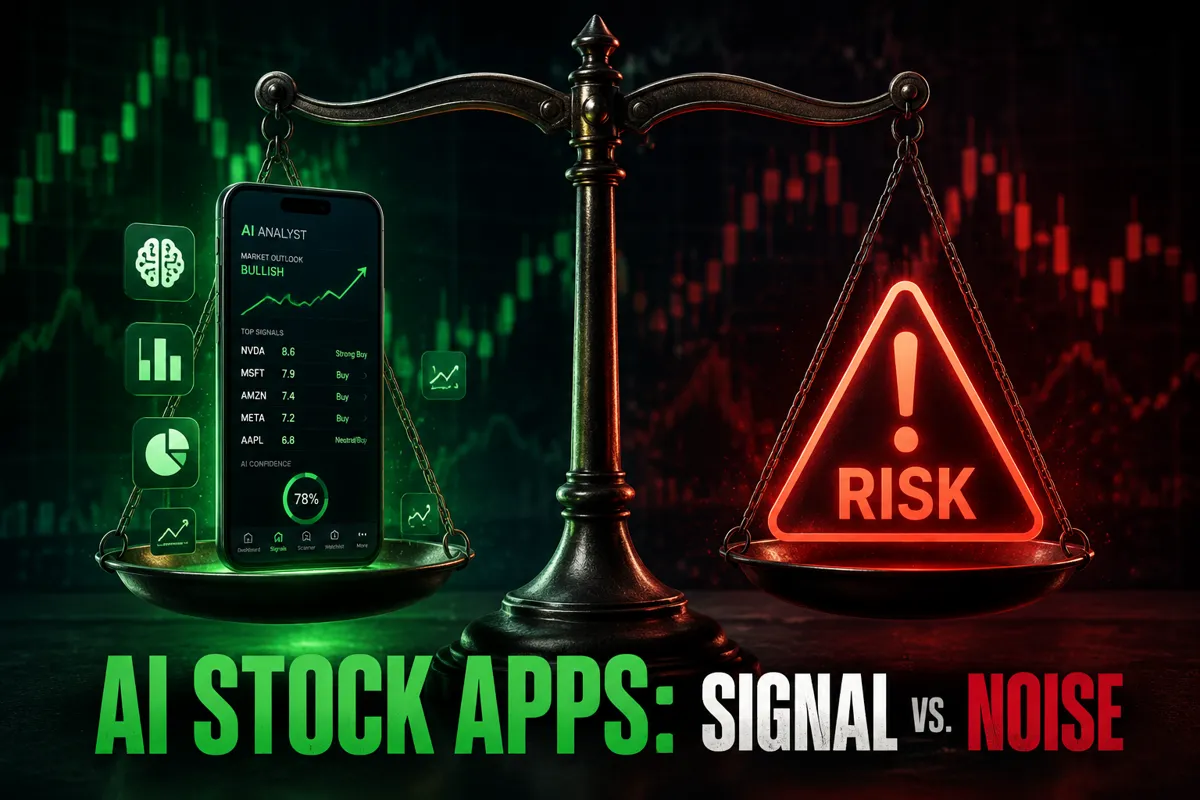
False precision — AI apps present signals with confidence scores and probability percentages that can feel more certain than they are. A "78% bullish signal" is not a guarantee.
Automation risk — Agentic trading features (like those launched by Robinhood in 2026 and TradeZ in April 2026) can execute trades without your direct approval. One misconfigured setting during a volatile open can create real damage.
Dependency without understanding — If you can't explain why a trade makes sense without the app telling you, you're not trading — you're following. That's fine until the app is wrong and you have no framework for knowing it.
The fix: Use AI stock apps as a filter, not a decision-maker. The setup still needs to make sense to you before you enter. Systems over hacks, always.
Common Mistakes Traders Make with AI Stock Apps
The FOFO is real — Fear Of Finding Out that the problem isn't the tool, it's the trader. Here's what actually goes wrong:
Mistake 1: Treating signals as instructions.
An AI alert that a stock is breaking out is information, not a buy order. Check the price action, the volume, the broader market context. Then decide.
Mistake 2: Skipping the stop loss.
No AI app removes the need for a stop loss. Getting stopped out on a bad trade is a feature, not a failure. It's how you stay in the game long enough to catch the good ones.
Mistake 3: Chasing the signal.
If the alert fires and the stock has already moved 8%, that's not your entry. That's someone else's exit. Play stupid games, win stupid prizes.
Mistake 4: Subscribing to five apps at once.
Tool overload is real. More dashboards create more analysis paralysis, not more clarity. Pick one primary tool, learn it deeply, and add a second only when you've maxed out the first.
Mistake 5: Ignoring the trend.
The trend is your friend. An AI signal in a downtrending stock is a lower-probability trade regardless of how clean the setup looks on a single timeframe.
Use the stock health scorecard to quickly assess whether a stock flagged by your AI app is actually worth trading before you size in.
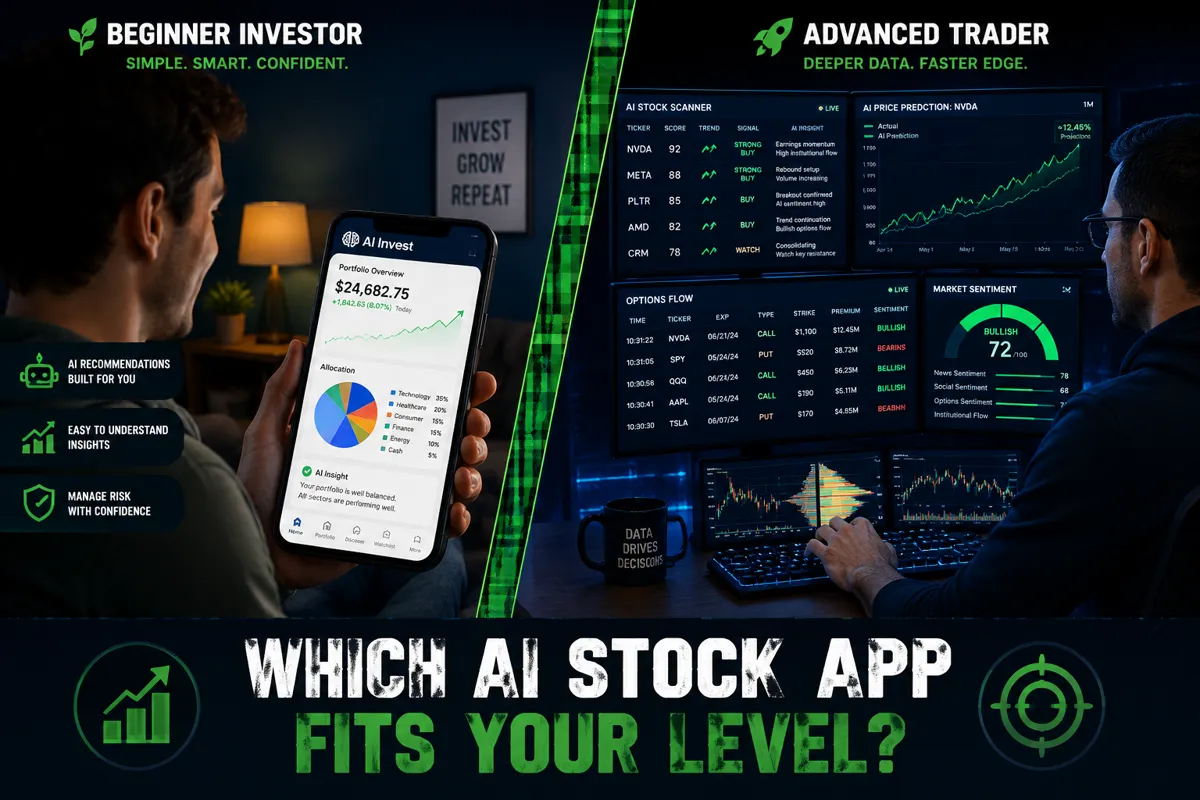
Which AI Stock Apps Work Best for Different Investment Levels?
The right AI stock app depends on how you trade, not just how much you have to invest.
For beginners and casual investors:
- Magnifi — Plain-English search, simple interface, good for ETF and fund research.
- Robinhood Cortex — Built into an app you may already use, zero additional cost.
- Stash — Guided investing with AI-assisted portfolio suggestions for long-term investors.
For intermediate swing traders:
- Tickeron — AI pattern recognition, swing trade signals, and a solid rating system across stocks and ETFs.
- Intellectia — Swing trading signals, AI stock picks, and technical analysis tools in one mobile-friendly package.
- TrendSpider — Automated trendline detection and multi-timeframe analysis for traders who want to go deeper on price action.
For active day traders:
- Trade Ideas — The gold standard for real-time AI scanning and pre-market setup identification. Holly AI runs continuously and surfaces the highest-probability setups before the open.
- BlackBox Stocks — Options flow and dark pool data for traders tracking institutional activity.
- AlgoTraders — For traders who want to build and run their own automated strategies. See the AlgoTraders review for details.
For research-heavy investors:
- AlphaSense — Enterprise-grade AI research tool for deep fundamental analysis.
- Quiver Quantitative — Alternative data, congressional trading disclosures, and institutional flow tracking.
How Accurate Are AI Stock Predictions Compared to Human Analysts?
AI stock prediction models can process more data faster than any human analyst — but processing speed isn't the same as accuracy. The honest answer is that both AI models and human analysts are wrong a meaningful percentage of the time.
Research on the StockGPT model — trained on nearly 100 years of U.S. stock return data — showed strong backtesting performance, but live market validation remains limited. FinRL-X, an AI-native quantitative trading framework introduced in early 2026, offers a more rigorous infrastructure for testing AI strategies across real market conditions.
What the data actually shows:
- Human analysts on Wall Street beat the market in a given year roughly 40–50% of the time, depending on the study and timeframe.
- AI models trained on historical data can show impressive backtested results, but live performance often degrades due to market regime changes, data snooping bias, and execution slippage.
- The most reliable AI tools don't claim to predict price — they identify statistical patterns with historically favorable risk-reward profiles.
The practical takeaway: Don't use AI stock apps to find certainty. Use them to find asymmetry — situations where the potential reward is meaningfully larger than the risk you're taking. That's what discipline beats prediction actually means in practice.
Frequently Asked Questions
What is the best AI stock app for beginners in 2026?
Magnifi and Intellectia are the most beginner-friendly AI stock apps in 2026. Magnifi uses plain-English search to help new investors find ETFs and stocks without needing to know screening syntax. Intellectia provides AI-generated swing trading signals with clear entry and exit guidance. Both have mobile apps for iOS and Android.
Are there free AI stock apps that actually work?
Yes. Stock Analysis, Finviz, and Robinhood Cortex offer meaningful AI-assisted features at no cost. They won't replace a professional scanner, but they're solid starting points for building a watchlist and understanding basic screening logic.
Can AI stock apps trade automatically on my behalf?
Some can. Robinhood launched agentic trading in May 2026, allowing AI agents to execute trades autonomously. TradeZ also supports one-tap execution across 15+ brokerages. Automated execution carries real risk — a misconfigured bot during a volatile session can cause significant losses. Most retail traders should keep a human in the loop.
Do AI stock apps work for options trading?
Yes. Tools like BlackBox Stocks, Cheddar Flow, and Trade Ideas include options flow data and AI-generated options alerts. For a dedicated overview, see the AI options tools guide.
How do I know if an AI stock app is a scam?
Watch for guaranteed returns, pressure to subscribe immediately, no verifiable track record, and no clear explanation of how the signals are generated. Verify any platform through SEC.gov and FINRA.org before connecting it to your brokerage.
What's the difference between an AI stock screener and an AI stock prediction app?
A screener filters stocks based on criteria you define (or that AI ranks for you). A prediction app attempts to forecast future price direction. Screeners are generally more reliable and transparent. Prediction apps vary widely in quality and should be evaluated with healthy skepticism.
Is Tickeron worth the money?
Tickeron is one of the more comprehensive AI stock apps available, covering pattern recognition, AI ratings, and signal generation across multiple asset classes. Whether it's worth the cost depends on how actively you trade. Casual investors may find free tools sufficient. Active swing and day traders typically get more value from the paid tier. Read the full Tickeron tool review before deciding.
What is the Magnifi app?
Magnifi is a mobile AI investing assistant that lets users search for investment ideas using conversational language. It's designed for investors who want research help without learning complex screening tools. It's particularly useful for ETF discovery and portfolio comparison.
Can AI stock apps work on both Android and iPhone?
Most major AI stock apps — including Tickeron, Magnifi, Intellectia, and Trade Ideas — offer apps for both iOS and Android. Some professional platforms like TC2000 are primarily desktop-based with limited mobile functionality.
What's the biggest mistake traders make with AI stock apps?
Treating AI signals as instructions rather than information. The signal tells you where to look. Your process — entry criteria, position sizing, stop loss, exit plan — determines whether you make money. No app replaces that.
How often should I check my AI stock app during the trading day?
For swing traders, checking pre-market and at the close is usually sufficient. For day traders, real-time monitoring during power hour (the first and last 30 minutes of the session) is where most of the actionable price action happens. Checking constantly in between creates noise and triggers overtrading.
Which AI stock app is best for swing trading specifically?
TrendSpider and Tickeron are the strongest AI stock apps for swing trading in 2026, combining automated chart analysis with multi-timeframe pattern recognition. For a full comparison of swing trading tools, visit the swing trading resource hub.
Conclusion
The AI stock apps traders are downloading before the next rally aren't magic. They're filters. The market is full of noise — thousands of stocks, hundreds of headlines, dozens of conflicting signals every single day. A good AI stock app cuts through that and hands you a shorter list of setups worth your attention.
But here's what no app can do: it can't make you patient. It can't stop you from revenge trading after a bad week. It can't force you to honor your stop loss when a position moves against you. Those are process problems, and process is a human job.
Three things to do right now:
- Identify your trading style (day trader, swing trader, long-term investor) and match your tool to that style — not the other way around.
- Start with a free tool or a free trial. Paper trade it first for at least two weeks before putting real money behind any signal.
- Track your trades. Not just wins and losses — track your entries, your exits, your reasoning, and your emotional state. The pattern in your mistakes is worth more than any AI signal.
Signal over noise. Process over prediction. Systems over hacks.
We test the AI stock tools so you don't waste months on the wrong ones. Browse the full breakdowns at aistockpickerapps.com.
References
Robinhood AI Trading Credit Card - https://www.axios.com/2026/05/27/robinhood-ai-trading-credit-card?utm_source=openai
Tradezing Launches Tradez The First AI Trading Copilot For Retail Investors With One Tap Brokerage Execution - https://www.prnewswire.com/news-releases/tradezing-launches-tradez-the-first-ai-trading-copilot-for-retail-investors-with-one-tap-brokerage-execution-302747579.html?utm_source=openai
Arisealpha Launches AI Stock Trading Bot As Automated Investing Trends Grow Among U.S. Investors In 2026 - https://www.globenewswire.com/news-release/2026/04/18/3276565/0/en/arisealpha-launches-ai-stock-trading-bot-as-automated-investing-trends-grow-among-u-s-investors-in-2026.html?utm_source=openai
Avant Garde Trading Securities Officially Launches New AI Powered Trading Platform - https://www.businesswire.com/news/home/20260406529066/en/Avant-Garde-Trading-Securities-Officially-Launches-New-AI-Powered-Trading-Platform?utm_source=openai
BingX Unveils BingX AI Claw The World's First AI Powered Multi Asset Trading Analyst - https://www.globenewswire.com/news-release/2026/03/20/3259622/0/en/bingx-unveils-bingx-ai-claw-the-world-s-first-ai-powered-multi-asset-trading-analyst.html?utm_source=openai
AI Trading System - https://www.klab.com/en/press/release/2026/0209/AITradingSystem.html?utm_source=openai
Intellectia AI Trading Signal App - https://apps.apple.com/us/app/intellectia-ai-trading-signal/id6743067049?utm_source=openai
Hyperscale Data Subsidiary askROI Launches OnlyBulls Mobile Only Investing App - https://www.nasdaq.com/press-release/hyperscale-data-subsidiary-askroi-launches-onlybulls-mobile-only-investing-app-your?utm_source=openai
FinRL-X AI Trading Infrastructure - https://arxiv.org/abs/2603.21330?utm_source=openai
StockGPT Generative AI Model for Stock Prediction - https://arxiv.org/abs/2404.05101?utm_source=openai