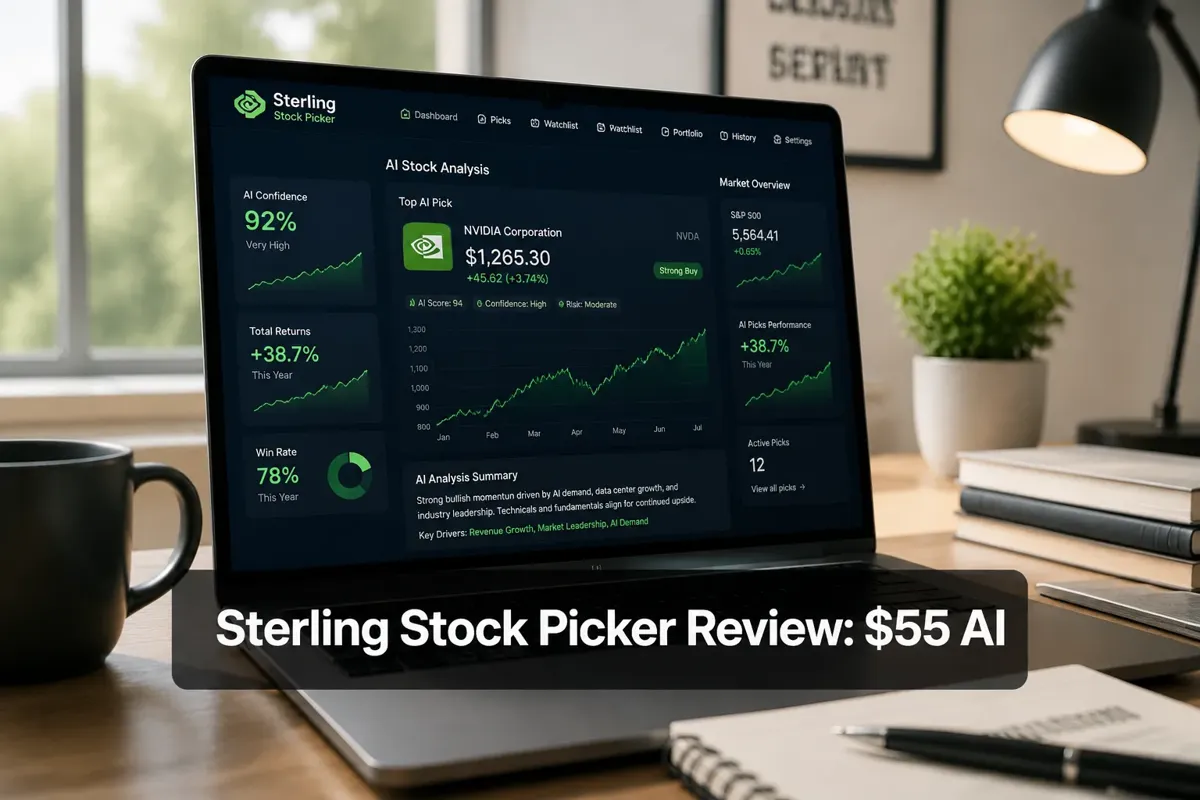
Sterling Stock Picker Review: What the $55 Lifetime AI Delivers
Last updated: July 19, 2026
Quick Answer
Sterling Stock Picker is a $55 lifetime-deal AI stock picking app built around Finley, a ChatGPT-powered assistant that answers market questions and suggests personalized stock picks based on your goals and risk tolerance. It's aimed squarely at beginners and casual investors who want AI-guided recommendations without recurring subscription fees. The tool covers U.S. stocks, offers portfolio tracking, and delivers daily watchlists, but it lacks the depth, backtesting, and advanced screening features that active swing or day traders expect from platforms like TrendSpider or Trade Ideas.
Key Takeaways
- Sterling Stock Picker costs $55 as a one-time lifetime payment with no hidden recurring fees or upsells after purchase.
- The core feature is Finley, an AI assistant powered by ChatGPT that provides conversational stock recommendations and answers market questions in plain English.
- The tool focuses exclusively on U.S. stocks and ETFs; international markets are not supported as of 2026.
- Sterling Stock Picker is designed for beginners and self-directed investors building long-term portfolios, not active day or swing traders who need real-time scanners and technical setups.
- Past performance data and accuracy rates are not publicly disclosed by the company, making it difficult to verify the AI's historical track record.
- The refund policy allows a 30-day money-back guarantee if you're not satisfied with the tool's recommendations or interface.
- Common mistakes include expecting real-time trade signals, confusing it with Sterling Trader Pro (a professional day trading platform), and relying solely on AI picks without independent research.
What Is Sterling Stock Picker and How Does It Work
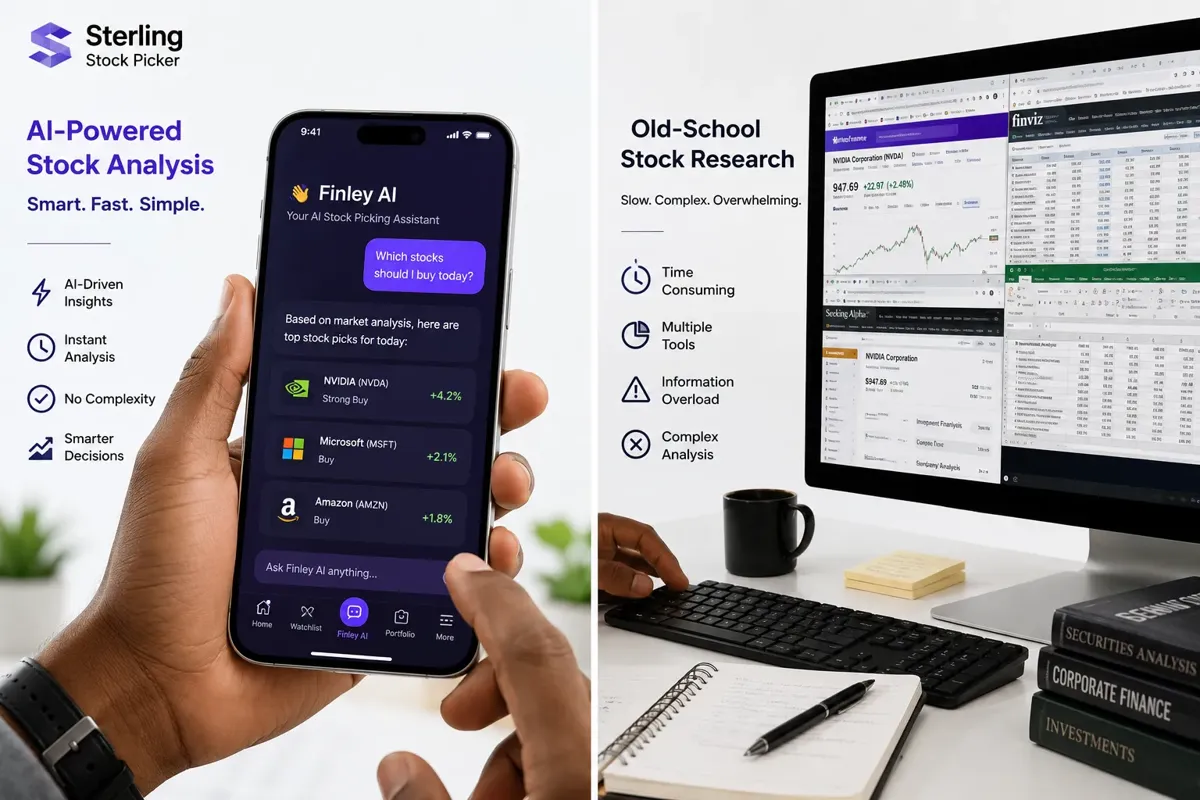
Sterling Stock Picker is an AI-driven stock recommendation app that uses natural language processing to help retail investors identify potential buy opportunities. At its core sits Finley, a conversational AI assistant built on ChatGPT technology that you can ask questions like "What are the best dividend stocks for retirement?" or "Show me growth stocks under $50." Finley responds with personalized picks, brief rationales, and links to deeper research.
The workflow is straightforward. You create a profile, answer a few questions about your investment goals (growth, income, value, or a mix), set your risk tolerance, and specify any sector preferences or exclusions. Finley then generates a daily watchlist of stocks that match your criteria, pulling from fundamental data, analyst ratings, and market sentiment signals. You can chat with Finley anytime to refine the list, ask follow-up questions, or request alternatives.
Behind the scenes, Sterling Stock Picker aggregates data from public financial APIs, earnings reports, and third-party sentiment analysis. It doesn't execute trades or connect directly to your brokerage, it's purely a research and recommendation layer. You review the picks, do your own due diligence, and place trades manually through your broker of choice.
The app also includes a portfolio tracker so you can log your holdings and monitor performance over time. It's a lightweight feature compared to dedicated portfolio apps, but it keeps everything in one place if you're managing a small, focused watchlist.
One critical distinction: Sterling Stock Picker is not Sterling Trader Pro. Sterling Trader Pro is a professional-grade direct-access trading platform used by active day traders and prop firms, with Level II quotes, hotkeys, and sub-second execution. Sterling Stock Picker is a consumer-facing AI recommendation tool with zero overlap in features, pricing, or target audience. Mixing the two up is a common mistake, they share a brand name and nothing else.
For a broader look at how AI stock tools compare across features and pricing, check out our AI stock picker apps comparison page.
Sterling Stock Picker Review: What the $55 Lifetime AI Delivers
Let's cut through the noise and talk about what you actually get for $55.
The good: You pay once and own it forever. No monthly subscription treadmill, no surprise upsells, no "premium tier" unlock six months later. In a market where every stock screener wants $30 to $100 per month, a lifetime deal is rare enough to warrant attention. Finley's conversational interface is genuinely useful for beginners who don't yet speak fluent finance, you can ask "What's a good stock for someone who wants steady income?" and get a coherent answer instead of a wall of jargon.
The daily watchlists are curated and focused. You're not drowning in 200 tickers; you get a handful of picks with brief explanations of why they made the cut. For someone building their first portfolio or adding one or two positions per month, that's enough signal without the overload.
The limitations: This is not a tool for active traders. There's no real-time scanner, no technical setup alerts, no breakout notifications, no integration with your broker's API. If you're looking for tight consolidation patterns, low-float movers, or intraday gap-fill setups, Sterling Stock Picker won't deliver. It's fundamentally a long-term stock picker, not a trading system.
The AI's recommendations lack transparency. You don't see the underlying model, the backtested performance, or the specific data inputs that drove a particular pick. Finley tells you what to consider but not why the algorithm weighted one factor over another. That's fine for casual use, but it's a red flag if you're trying to build a repeatable, rules-based process.
There's also no options coverage, no futures, no crypto, and no international stocks. If you trade anything beyond U.S. equities and ETFs, you'll need a second tool.
The verdict: Sterling Stock Picker delivers exactly what it promises, a beginner-friendly AI assistant that suggests U.S. stocks based on your goals, packaged as a one-time purchase. It won't replace a serious scanner or a professional platform, but for $55, it's a reasonable entry point if you're tired of subscription fatigue and just want a clean starting watchlist each week.
If you're comparing lifetime-deal AI tools, also consider Tykr, which offers value-focused stock scoring with a similar one-time pricing model.
What AI Technology Does Sterling Stock Picker Use
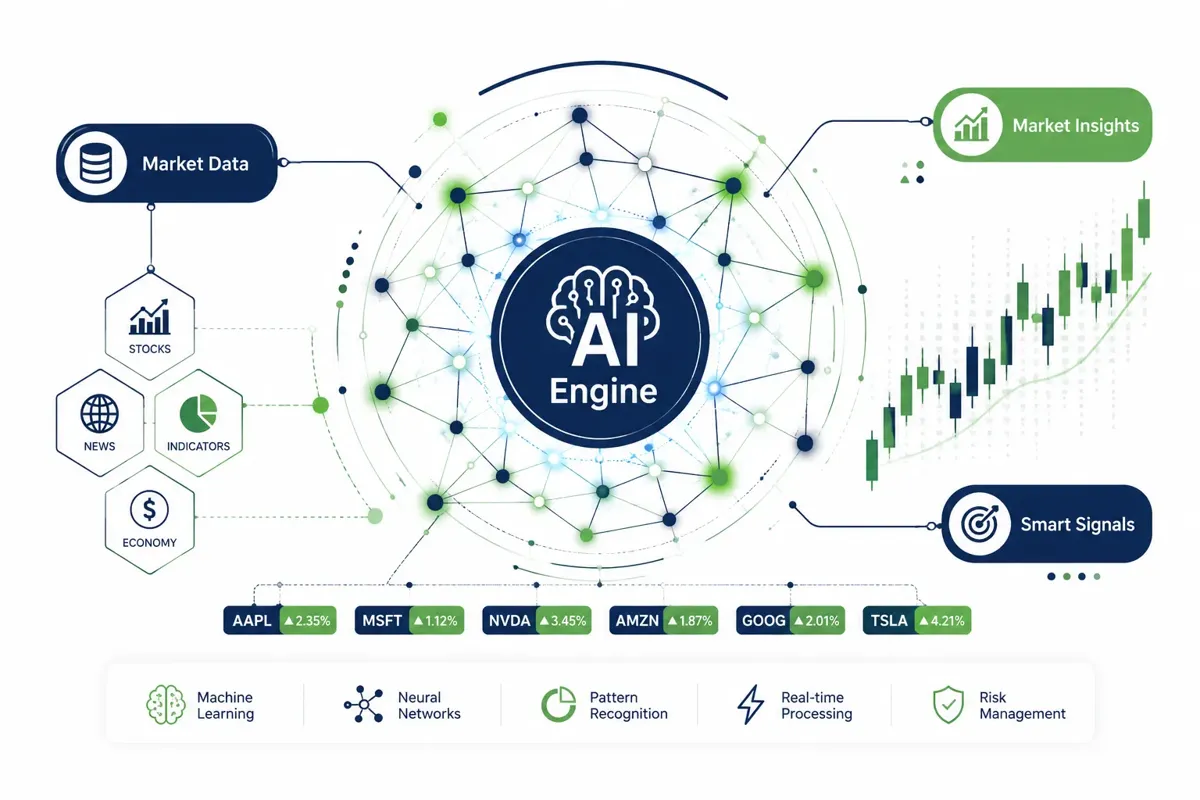
Sterling Stock Picker is built on top of OpenAI's ChatGPT, specifically fine-tuned with financial data and market context to handle stock-related queries. Finley isn't a proprietary AI model trained from scratch, it's a customized implementation of GPT that's been fed historical stock data, earnings transcripts, analyst reports, and sentiment signals so it can respond intelligently to investment questions.
The system uses natural language processing to interpret your questions and match them against a database of stocks that fit your criteria. When you ask Finley for "dividend stocks with low volatility," it parses the request, filters the universe of U.S. equities by dividend yield and beta, and ranks the results based on a blend of fundamental metrics and recent sentiment.
Sentiment analysis comes from aggregating news headlines, social media mentions, and analyst upgrades or downgrades. The AI doesn't predict price movements, it identifies stocks that are currently attracting positive attention or showing improving fundamentals. Think of it as a research assistant that reads the same public data you could access manually, but faster and with pattern recognition across thousands of tickers.
One thing Sterling Stock Picker does not do: it doesn't backtest its recommendations or publish a verifiable track record. You can't see how Finley's picks would have performed over the past year, quarter, or month. That's a significant gap compared to tools like Danelfin or Kavout, which publish historical accuracy rates and performance metrics.
The AI also doesn't learn from your individual trades or adapt its recommendations based on your actual portfolio outcomes. It's a stateless assistant, every conversation starts fresh. If you tell Finley you bought a stock it recommended and it tanked, that feedback doesn't influence future picks. You're getting a general-purpose AI tuned for stock research, not a personalized trading coach that evolves with your results.
For traders who want AI tools with deeper technical analysis and backtested signals, TrendSpider and TC2000 offer more robust platforms, though at significantly higher monthly costs.
Is Sterling Stock Picker Worth the $55 Lifetime Price
Here's the math that matters: $55 one-time versus $30 to $100 per month for comparable AI stock tools.
If you use Sterling Stock Picker for just two months, you've already broken even compared to a $30/month subscription service. After six months, you're $125 ahead. After a year, you've saved $300 to $1,200 depending on which competitor you're measuring against. The lifetime deal is the entire value proposition, not the AI's sophistication, not the feature set, but the fact that you pay once and never think about it again.
Who should buy it:
- Beginners who want an AI assistant to explain stocks in plain English without committing to a monthly subscription.
- Self-directed investors building a long-term portfolio who need a clean weekly watchlist and don't require real-time alerts or advanced screening.
- Anyone suffering from subscription fatigue who's tired of $30/month tools they forget to cancel.
- Casual investors who want a second opinion on potential picks but plan to do their own research before buying.
Who should skip it:
- Active day or swing traders who need real-time scanners, technical setups, and breakout alerts. Sterling Stock Picker doesn't deliver the speed or specificity you need.
- Traders who demand transparency and backtested performance data. The AI's track record isn't published, so you're flying blind on historical accuracy.
- International investors or anyone trading options, futures, or crypto. The tool only covers U.S. stocks and ETFs.
- Anyone expecting a professional-grade platform with broker integration, automated execution, or advanced risk management. This is a research assistant, not a trading system.
The $55 price point is low enough that even if you use it sparingly, you're not out much. But it's also low enough that you should temper your expectations, this isn't going to replace a $100/month institutional-grade scanner. It's a solid entry-level AI tool that does one thing reasonably well: suggesting U.S. stocks based on your goals, without the recurring billing headache.
If you're weighing other AI trading platforms with different pricing models, compare the feature depth and support before committing.

Who Should Use Sterling Stock Picker AI Tool
Sterling Stock Picker is built for a specific slice of the retail investor spectrum: people who are new to stock picking, overwhelmed by information, and looking for a low-cost AI assistant to narrow the field.
Ideal users:
- Beginners building their first portfolio. If you're still learning the difference between growth and value stocks, Finley's conversational interface is a gentle on-ramp. You can ask basic questions, get plain-English answers, and build a watchlist without needing to master a complex screener.
- Self-directed investors who want a second opinion. You do your own research but appreciate an AI-generated list to spark ideas or validate your thinking. Sterling Stock Picker gives you a starting point, not a final answer.
- Casual investors adding one or two positions per month. You're not trading daily or chasing momentum plays. You want a curated list of fundamentally sound stocks that fit your long-term strategy, delivered weekly without noise.
- Anyone tired of subscription fatigue. You've canceled three stock tools in the past year because you forgot you were paying for them. A one-time $55 purchase eliminates that friction.
Not a fit for:
- Active day traders. You need real-time scanners, Level II data, and sub-second execution. Sterling Stock Picker updates daily, not intraday, and doesn't integrate with your broker. It's the wrong tool for the job.
- Swing traders hunting technical setups. If your edge is reading the tape, spotting tight consolidation, or catching breakouts on volume, this AI won't help. It's fundamentally focused, not technically driven.
- International investors. The tool only covers U.S. stocks and ETFs. If you trade European, Asian, or emerging markets, you'll need a different platform.
- Options or futures traders. Sterling Stock Picker doesn't analyze options chains, implied volatility, or derivatives strategies. It's equity-only.
- Anyone who demands verifiable performance data. If you need to see backtested accuracy rates or historical win percentages before trusting a tool, Sterling Stock Picker doesn't publish those metrics.
The tool works best as a supplement, not a replacement. Use it to generate ideas, then validate those ideas with your own research, technical analysis, and risk management. It's a research assistant, not a trading system, and that distinction matters.
For traders who need more advanced AI stock screeners with technical filters and real-time alerts, explore our full comparison of tools built for active trading.
Sterling Stock Picker vs Motley Fool Stock Advisor: Which Is Better
This comparison comes up often because both services target retail investors looking for stock recommendations. But they're fundamentally different products with different philosophies.
Sterling Stock Picker:
- One-time $55 payment, lifetime access.
- AI-driven recommendations via Finley, a ChatGPT-based assistant.
- Daily watchlists tailored to your goals and risk tolerance.
- No human analysts, no editorial content, no community.
- Covers U.S. stocks and ETFs only.
- No published track record or historical accuracy data.
Motley Fool Stock Advisor:
- $199/year (or $99 for first-year promotional pricing), recurring subscription.
- Human analysts (Tom and David Gardner) pick two stocks per month.
- Editorial content, podcasts, community forums, and educational resources.
- Published track record: Stock Advisor claims a 600%+ return since inception in 2002, significantly outperforming the S&P 500 over the same period.
- Covers U.S. stocks with occasional international mentions.
- Strong brand reputation and decades of performance history.
The trade-offs:
If you want human expertise, a proven track record, and a community, Motley Fool Stock Advisor is the better choice. You're paying for the Gardners' research, their editorial voice, and the accountability that comes with publishing every pick publicly. The annual fee is higher, but you're buying credibility and transparency.
If you want low cost, AI-driven flexibility, and no recurring billing, Sterling Stock Picker wins. You pay once, get daily AI-generated picks, and avoid the subscription treadmill. But you sacrifice the human judgment, the editorial context, and the verifiable performance history that Motley Fool provides.
The honest take: Motley Fool Stock Advisor is a better product for most investors who can afford the annual fee. The track record speaks for itself, and the human curation adds value that AI can't yet replicate. Sterling Stock Picker is a better fit if you're on a tight budget, prefer AI-driven recommendations, or simply refuse to pay recurring subscriptions.
You could also use both: let Motley Fool guide your core portfolio with high-conviction picks, and use Sterling Stock Picker to generate supplemental ideas for smaller positions. The $55 lifetime cost makes it easy to layer on top of another service without doubling your expenses.
For more AI-driven alternatives to traditional stock advisory services, explore our breakdown of AI investing tools.

Sterling Stock Picker Accuracy Rate and Past Performance
Here's the uncomfortable truth: Sterling Stock Picker does not publish historical accuracy rates, backtested performance data, or a verifiable track record of its AI recommendations.
You can't see how Finley's picks performed over the past year, quarter, or month. There's no win rate, no average return per pick, no comparison against a benchmark like the S&P 500. The company doesn't disclose whether the AI's recommendations would have beaten the market, matched it, or lagged behind.
This is a significant transparency gap. Tools like Danelfin publish their AI's historical accuracy (claiming 70%+ on certain timeframes), and Kavout provides backtested performance for its K Score rankings. Even human-driven services like Motley Fool Stock Advisor publish every pick and its outcome publicly. Sterling Stock Picker offers none of that.
Why this matters:
Without a track record, you're trusting the AI on faith. You don't know if Finley's recommendations are statistically better than random picks, sector ETFs, or a simple index fund. You can't evaluate whether the AI's edge (if it has one) justifies the time you spend reviewing its picks.
This isn't necessarily a dealbreaker for a $55 tool aimed at beginners, many users will treat it as a research assistant rather than a performance-driven system. But if you're comparing Sterling Stock Picker to platforms that publish their results, the lack of transparency is a red flag.
What you can do:
Track your own results. If you follow Finley's recommendations, log every pick, your entry price, and your exit outcome. After six months, calculate your win rate and average return. Compare that to a simple buy-and-hold strategy in an S&P 500 ETF. If the AI isn't adding value, you'll know, and you can adjust your process accordingly.
The $55 lifetime price means you're not bleeding money while you test it. But don't assume the AI is accurate just because it sounds confident. Verify, measure, and hold it accountable to your own performance standards.
For traders who want AI tools with published track records and backtested signals, TrendSpider and Trade Ideas offer more transparency, at significantly higher monthly costs.
Sterling Stock Picker Alternatives for Stock Picking Software
If Sterling Stock Picker doesn't fit your needs, here are the alternatives worth considering in 2026, organized by use case.
For beginners who want AI-driven picks with more transparency:
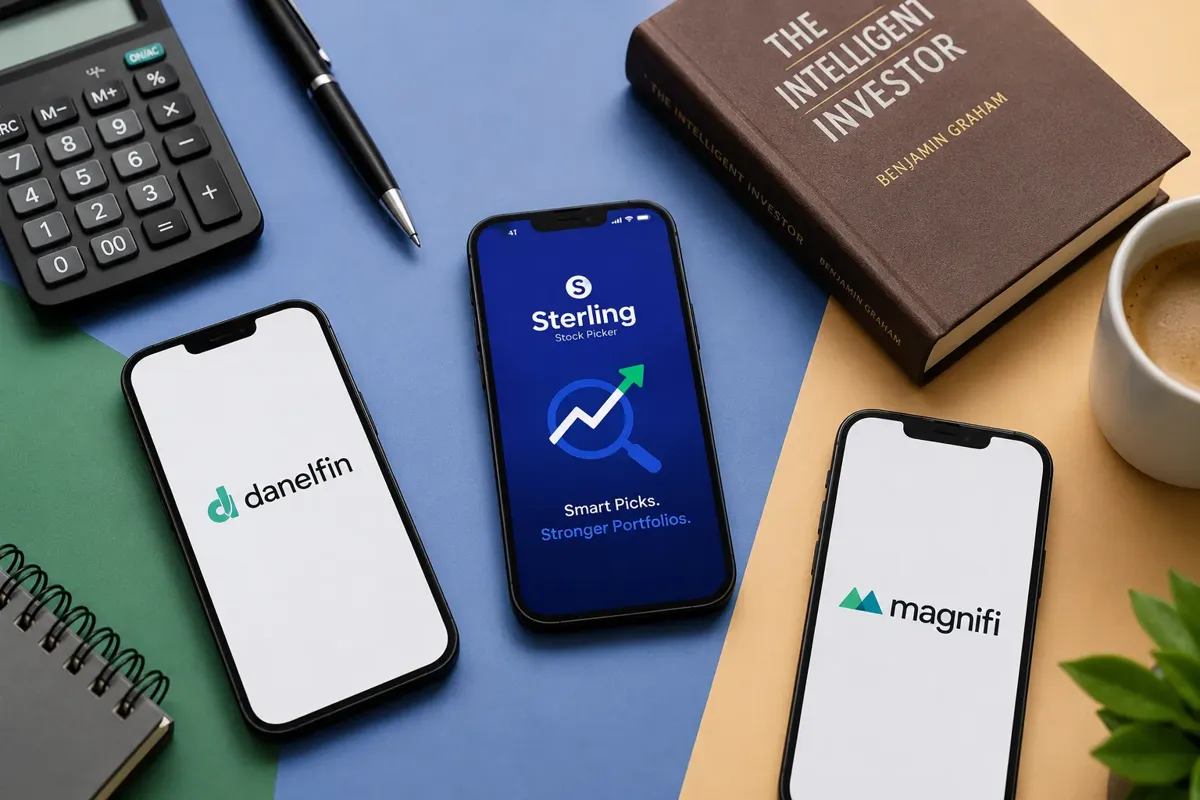
- Danelfin: AI-powered stock scoring with published accuracy rates and daily rankings. Starts at $34.99/month, but offers a free tier with limited picks. Better transparency than Sterling Stock Picker, but recurring cost.
- Tykr: Value-focused stock scoring with a one-time lifetime deal option. Similar pricing philosophy to Sterling Stock Picker, but emphasizes margin of safety and fundamental analysis over conversational AI.
For active traders who need real-time scanners and technical setups:
- Trade Ideas: Real-time AI scanner with backtested strategies and live alerts. Starts at $118/month. Built for day and swing traders who need speed and precision.
- TrendSpider: Automated technical analysis with multi-timeframe pattern recognition and dynamic alerts. Starts at $49/month. Best for traders who rely on price action and support/resistance levels.
For investors who want human-curated picks with a track record:
- Motley Fool Stock Advisor: $199/year for two human-picked stocks per month, plus editorial content and a published performance history. More expensive than Sterling Stock Picker, but with decades of credibility.
- Seeking Alpha Premium: $299/year for analyst ratings, earnings call transcripts, and curated stock ideas. Broader research platform, not AI-focused, but deep fundamental coverage.
For portfolio builders who want AI-assisted diversification:
- Magnifi: Conversational AI for building diversified portfolios with natural language queries. Free tier available, premium at $14.99/month. Similar to Finley but with more ETF and thematic investing focus.
- Pluto: AI-driven portfolio construction with automated rebalancing. Free to use, monetizes through broker partnerships. Good for hands-off investors who want AI to manage allocation.
The honest comparison:
Sterling Stock Picker sits in a narrow niche: lifetime-deal AI stock picker for U.S. equities, aimed at beginners. If you need more features, better transparency, or active trading tools, you'll pay more, either monthly or annually. If you want a cheaper entry point with no recurring fees, Sterling Stock Picker and Tykr are your best bets.
The right choice depends on your trading style, budget, and how much transparency you demand. For a full side-by-side breakdown of features and pricing, visit our AI stock picker comparison tool.
Common Mistakes When Using Sterling Stock Picker AI
Even a simple tool can be misused. Here are the mistakes that cost beginners the most when they start using AI stock pickers like Sterling Stock Picker.
Mistake 1: Treating AI picks as guaranteed winners.
Finley suggests stocks based on data and patterns, but it doesn't predict the future. No AI does. If you buy every recommendation without your own research, you're outsourcing your judgment to an algorithm that has no skin in the game. The AI doesn't lose money when a pick tanks, you do.
Fix: Use Sterling Stock Picker to generate ideas, then validate each pick with your own fundamental and technical analysis. Check the company's earnings, read recent news, look at the chart, and decide if the setup fits your risk tolerance and strategy.
Mistake 2: Expecting real-time trade signals.
Sterling Stock Picker updates daily, not intraday. If you're trying to catch breakouts, gap fills, or momentum plays, this tool won't deliver the speed you need. It's built for long-term stock picking, not active trading.
Fix: If you're a day or swing trader, use a real-time scanner like Trade Ideas or TrendSpider. Sterling Stock Picker is a supplement for long-term watchlists, not a replacement for live alerts.
Mistake 3: Ignoring position sizing and risk management.
The AI tells you what to buy, but it doesn't tell you how much to buy or where to set your stop loss. If you go all-in on a single AI pick and it drops 20%, you've just learned an expensive lesson about position sizing.
Fix: Never risk more than 1-2% of your portfolio on a single position. Set a stop loss before you enter the trade. Use our position sizing calculator to determine the right allocation based on your account size and risk tolerance.
Mistake 4: Confusing Sterling Stock Picker with Sterling Trader Pro.
This happens more often than it should. Sterling Trader Pro is a professional day trading platform with Level II quotes, direct market access, and sub-second execution. Sterling Stock Picker is a consumer AI recommendation app with zero overlap. Mixing them up leads to wildly incorrect expectations.
Fix: Know what you bought. Sterling Stock Picker is a research assistant, not a trading platform. If you need professional execution tools, you're looking for a different product entirely.
Mistake 5: Relying solely on the AI without building your own process.
If you never learn to evaluate stocks independently, you'll always be dependent on the AI. When the tool stops working, gets discontinued, or simply has a bad month, you'll have no fallback.
Fix: Use Sterling Stock Picker as training wheels, not a crutch. Study the picks Finley suggests. Ask yourself why the AI chose them. Over time, you'll start to recognize patterns and develop your own criteria. The goal is to build a repeatable process that works with or without the AI.
For more on building a disciplined trading system, read our guide on how to find stocks for swing trading before everyone else does.
Does Sterling Stock Picker Work for International Stocks or Just US Markets
Sterling Stock Picker covers U.S. stocks and ETFs only. As of 2026, there is no support for international equities, foreign exchanges, or ADRs (American Depositary Receipts) that trade on U.S. exchanges but represent foreign companies.
If you're an investor who trades European stocks, Asian markets, or emerging economies, Sterling Stock Picker won't help. The AI's data sources, sentiment analysis, and recommendation engine are all tuned to U.S.-listed securities. You'll need a different tool if your portfolio extends beyond domestic markets.
Alternatives for international stock picking:
- TradingView: Global coverage with charting and screening tools for stocks, forex, crypto, and futures across dozens of exchanges. Free tier available, premium starts at $14.99/month.
- Seeking Alpha Premium: Covers international stocks with analyst ratings and earnings data. $299/year.
- FinChat: AI-powered financial research with global stock coverage. Free tier available, premium at $29/month.
If you're a U.S.-focused investor, the lack of international coverage isn't a dealbreaker. But if you're building a globally diversified portfolio, Sterling Stock Picker is too narrow to be your primary research tool.
Sterling Stock Picker Refund Policy If Not Satisfied
Sterling Stock Picker offers a 30-day money-back guarantee. If you're not satisfied with the tool's recommendations, interface, or overall value, you can request a full refund within 30 days of purchase, no questions asked.
This is standard for lifetime-deal software and removes most of the risk from trying the tool. You have a full month to test Finley's picks, evaluate the daily watchlists, and decide if the AI fits your workflow. If it doesn't, you get your $55 back.
How to request a refund:
Contact Sterling Stock Picker's support team via email (typically listed on the purchase confirmation or the app's settings page). Provide your purchase details and state that you'd like a refund under the 30-day guarantee. Most refunds are processed within 5-7 business days.
What to test during your 30-day window:
- Ask Finley a variety of questions to see if the AI's responses are useful and accurate.
- Review the daily watchlists and compare them to your own research or other tools you trust.
- Track a few of the AI's picks (on paper or in a demo account) to see if they align with your strategy.
- Evaluate the app's interface, speed, and overall user experience.
If you're on the fence about the $55 investment, the 30-day guarantee makes it a low-risk trial. Just don't forget to test it actively, if you buy it and ignore it for a month, you'll miss your refund window.
How Often Does Sterling Stock Picker Update Its Recommendations
Sterling Stock Picker generates daily watchlists that refresh every morning before the U.S. market opens. Finley's AI scans the universe of U.S. stocks overnight, applies your saved preferences (goals, risk tolerance, sector filters), and delivers a curated list of picks each day.
You won't get intraday updates or real-time alerts when a stock breaks out, hits a support level, or spikes on news. The tool is designed for investors who check in once per day, review the new picks, and make decisions on a longer timeframe, weekly or monthly, not hourly.
What triggers a new recommendation:
- Changes in fundamental data (earnings reports, analyst upgrades, revenue growth).
- Shifts in sentiment (news headlines, social media mentions, insider buying).
- Market conditions (sector rotation, volatility spikes, macro events).
Finley doesn't explain why a stock appeared on today's list but wasn't there yesterday, you just see the new picks and their brief rationales. If you want more transparency into the AI's decision-making process, you'll need to ask Finley follow-up questions or cross-check the picks with your own research.
For active traders: Daily updates are too slow. If you're trading breakouts, gap fills, or momentum plays, you need real-time scanners that alert you the moment a setup appears. Tools like Trade Ideas or Benzinga Pro deliver sub-second alerts and live market data.
For long-term investors: Daily updates are more than enough. You're not chasing intraday moves; you're building a watchlist of fundamentally sound stocks to research and potentially buy over the next week or month. Sterling Stock Picker's cadence fits that workflow.
Is Sterling Stock Picker Good for Beginners or Experienced Traders
For beginners: Sterling Stock Picker is a solid entry point. The conversational AI lowers the barrier to stock research, you don't need to master a complex screener or learn technical jargon before you can generate a watchlist. Finley explains picks in plain English, and the $55 lifetime cost means you're not locked into a recurring subscription while you're still learning.
The tool won't teach you how to evaluate stocks independently, but it gives you a starting point. You can ask Finley questions, review the daily picks, and gradually build your own understanding of what makes a stock worth buying. It's training wheels, not a crutch, use it to learn, not to avoid learning.
For experienced traders: Sterling Stock Picker is too basic. If you've been trading for years, you already have a process, a set of criteria, and a preferred set of tools. You don't need an AI to suggest stocks, you need real-time data, advanced screening, and technical setups that match your edge.
The lack of backtested performance data, the absence of technical filters, and the daily (not real-time) update cadence make Sterling Stock Picker a poor fit for active swing or day traders. You'll outgrow it quickly, if you haven't already.
The middle ground: Intermediate investors who are building a long-term portfolio but want a second opinion might find value in Sterling Stock Picker as a supplement. Use it to generate ideas, then validate those ideas with your own research and technical analysis. The $55 cost is low enough that it's not a waste even if you only use it occasionally.
For experienced traders who need professional-grade tools, explore our breakdown of AI trading platforms built for active trading.
Sterling Stock Picker Hidden Fees After Lifetime Purchase
There are no hidden fees, upsells, or recurring charges after you pay the $55 lifetime price. You own the tool permanently, and there's no "premium tier" unlock, no monthly data subscription, and no surprise billing six months later.
This is one of Sterling Stock Picker's strongest selling points. In a market where every stock tool wants $30 to $100 per month, a true one-time payment is rare. The company makes its money upfront and doesn't rely on recurring revenue from existing users.
What you get for $55:
- Lifetime access to Finley, the AI assistant.
- Daily watchlists tailored to your goals and risk tolerance.
- Portfolio tracking and performance monitoring.
- All future updates and feature additions (as long as the company continues to operate).
What you don't get:
- Real-time data or live alerts (those typically require paid data feeds from exchanges).
- Broker integration or automated trade execution.
- Advanced screening, backtesting, or technical analysis tools.
- Customer support beyond basic email (no phone support or live chat).
The lack of hidden fees is a major trust signal. You know exactly what you're paying, and you'll never see an unexpected charge on your credit card. If the company decides to launch a "pro" version in the future, you'll still have access to the original tool you paid for, they can't take that away or downgrade you to a free tier.
For traders who are tired of subscription fatigue and want a clean one-time purchase, Sterling Stock Picker delivers on that promise. Just make sure the feature set matches your needs before you buy, because there's no monthly upgrade path if you outgrow it.
Frequently Asked Questions
Is Sterling Stock Picker legit or a scam?
Sterling Stock Picker is a legitimate AI stock recommendation tool with a real product, a functional app, and a 30-day money-back guarantee. It's not a scam, but it's also not a magic money-printing machine. The AI suggests stocks based on data and patterns, it doesn't guarantee returns, and it doesn't publish a verified track record. Treat it as a research assistant, not a get-rich-quick scheme.
How much does Sterling Stock Picker cost?
Sterling Stock Picker costs $55 as a one-time lifetime payment. There are no recurring fees, no hidden upsells, and no premium tiers. You pay once and own the tool permanently.
Can I use Sterling Stock Picker for day trading?
No. Sterling Stock Picker updates daily, not in real-time, and it's focused on fundamental stock picking rather than technical setups. Day traders need live scanners, Level II data, and sub-second alerts, none of which Sterling Stock Picker provides. Use a tool like Trade Ideas or TrendSpider instead.
Does Sterling Stock Picker work with my broker?
No. Sterling Stock Picker doesn't integrate with brokers or execute trades. It's purely a research and recommendation tool. You review the AI's picks, do your own due diligence, and place trades manually through your broker of choice.
What's the difference between Sterling Stock Picker and Sterling Trader Pro?
Sterling Stock Picker is a $55 lifetime AI stock recommendation app for retail investors. Sterling Trader Pro is a professional day trading platform with Level II quotes, direct market access, and institutional-grade execution tools. They share a brand name but have zero overlap in features, pricing, or target audience.
Can I get a refund if I don't like Sterling Stock Picker?
Yes. Sterling Stock Picker offers a 30-day money-back guarantee. If you're not satisfied, contact support within 30 days of purchase and request a full refund.
Does Sterling Stock Picker cover international stocks?
No. Sterling Stock Picker only covers U.S. stocks and ETFs. If you trade international markets, you'll need a different tool like TradingView or FinChat.
How accurate is Sterling Stock Picker's AI?
Sterling Stock Picker does not publish historical accuracy rates or backtested performance data. You can't verify how the AI's picks would have performed over the past year or compare its results to a benchmark. Track your own outcomes if you want to measure the AI's effectiveness.
Is Sterling Stock Picker better than ChatGPT for stock picking?
Sterling Stock Picker is built on ChatGPT but fine-tuned with financial data and market context. It's more specialized than asking ChatGPT directly, but it's not fundamentally different. If you already have a ChatGPT Plus subscription, you can get similar (though less polished) stock recommendations by asking the right questions. Sterling Stock Picker's advantage is the curated daily watchlists and the $55 lifetime cost.
Can beginners use Sterling Stock Picker without any stock market knowledge?
Yes, but with a caveat. Sterling Stock Picker is beginner-friendly and explains picks in plain English, but it won't teach you how to evaluate stocks independently. Use it as a starting point, then invest time in learning fundamental and technical analysis so you're not blindly following AI recommendations.
Does Sterling Stock Picker recommend penny stocks or only blue chips?
Sterling Stock Picker can recommend a range of stocks depending on your preferences. If you set your risk tolerance to "aggressive" and ask Finley for high-growth picks, you might see smaller-cap names. If you prefer stability, the AI will lean toward blue chips and dividend payers. You control the filters.
How do I cancel my Sterling Stock Picker subscription?
There's no subscription to cancel. Sterling Stock Picker is a one-time $55 purchase with lifetime access. You own it permanently, and there are no recurring charges.
Conclusion
Sterling Stock Picker delivers exactly what it promises: a beginner-friendly AI assistant that suggests U.S. stocks based on your goals, packaged as a one-time $55 lifetime purchase. It's not a professional trading platform, it's not a real-time scanner, and it's not a magic algorithm with a verified track record. It's a research assistant that cuts through the noise and gives you a clean starting watchlist each day.
For beginners who are overwhelmed by information and tired of subscription fatigue, the $55 lifetime deal is a low-risk entry point. You get conversational AI, daily picks, and a portfolio tracker without the recurring billing headache. For active traders who need speed, technical setups, and real-time alerts, Sterling Stock Picker is too basic, you'll outgrow it immediately.
The lack of transparency around performance data is a red flag. You can't verify the AI's accuracy, and you're trusting the recommendations on faith. Track your own results, validate every pick with independent research, and never risk more than you can afford to lose on a single AI suggestion.
If you're building a long-term portfolio and want a second opinion without paying $30 to $100 per month, Sterling Stock Picker is worth testing. The 30-day money-back guarantee removes most of the risk. Just know what you're buying, a research assistant, not a trading system.
Want the tools and setups behind this, without the hype? Start at aistockpickerapps.com.