SEC EDGAR: Read Berkshire's 13F the Day It Files
Last updated: August 30, 2026
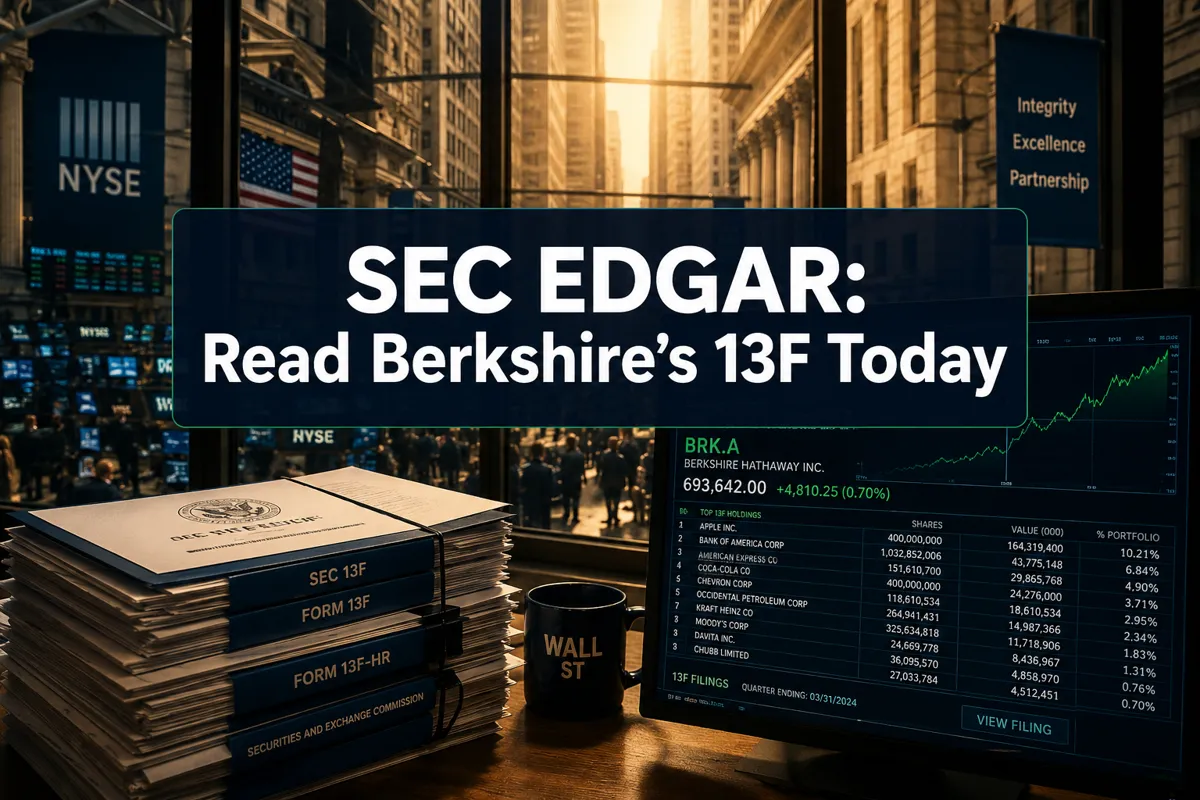
Quick Answer: SEC EDGAR is the Securities and Exchange Commission's free public database where every institutional investor, public company, and insider must file legally required disclosures. Berkshire Hathaway's 13F, its quarterly holdings report, posts on EDGAR the same day it is accepted, up to 45 days after each quarter ends. No subscription required. No middleman. Just the primary source.
Key Takeaways
- SEC EDGAR at edgar.sec.gov is free, requires no login, and indexes every electronic filing since 1993.
- A 13F filing covers long U.S. equity positions only. It does not show short positions, bonds, cash, or foreign holdings, and it reflects holdings from up to 45 days ago.
- The 2026 Form 13F deadlines are: Q4 2025 due February 17, Q1 2026 due May 15, Q2 2026 due August 14, and Q3 2026 due November 16.
- Most large managers, including Berkshire, file on or very close to the deadline, so monitoring EDGAR on deadline day is the fastest free alert system available.
- EDGAR full text search covers the complete body and exhibits of all electronic filings since 2001, searchable by keyword, form type, CIK, and date range.
- SEC Form 4 insider trading disclosures must be filed within two business days of a transaction, making them one of the most time-sensitive signals on EDGAR.
- Paid screeners that repackage 13F data pull from the same EDGAR source. The only thing they add is a prettier interface.
What Is SEC EDGAR, and Why Does It Look So Dated?
SEC EDGAR (Electronic Data Gathering, Analysis, and Retrieval) is the official public dissemination service run by the SEC at sec.gov. Every public company, institutional filer, and corporate insider in the United States is legally required to submit filings through this system. The database holds tens of millions of documents, and every single one is free to search, view, and download.
The interface looks like it was designed during a Clinton administration budget meeting. That is not an accident or an oversight. EDGAR is a gov portal built for compliance and public access, not for aesthetics. The data is the product.
What SEC EDGAR Holds That No Subscription Adds
The edgar system contains 13F filings, 10-K annual reports, 10-Q quarterly reports, 8-K event disclosures, SEC Form 4 insider trading reports, S-1 IPO prospectuses, proxy statements, and hundreds of other form types. Every institutional investment manager with over $100 million in 13(f) securities must submit their holdings quarterly. Every director or officer who buys or sells company stock must file a Form 4 within two business days. None of that data is proprietary. It all lives on a gov server that anyone can hit.
A paid screener that shows you Berkshire's latest 13F pulled that data from EDGAR. The screener added a table and charged you $30 a month for the privilege. That is the whole business model.
Why the Interface Scares People Off
The edgar search page offers several entry points: company search, full text search, latest filings, and a filer management portal for those who submit filings. New users land on the main search, type a company name, and get a list of every filing that company has ever submitted. Without knowing what form types to filter for, that list looks like noise. Once you know the three or four forms that matter for your research, the system is fast and precise.
The CIK (Central Index Key) is the unique number EDGAR assigns every filer. Berkshire Hathaway's CIK is 0001067983. Once you have a company's CIK, you can build a direct URL to its filing page and bookmark it. That is faster than any screener's search bar.
How Do You Read Berkshire's 13F the Day It Files?
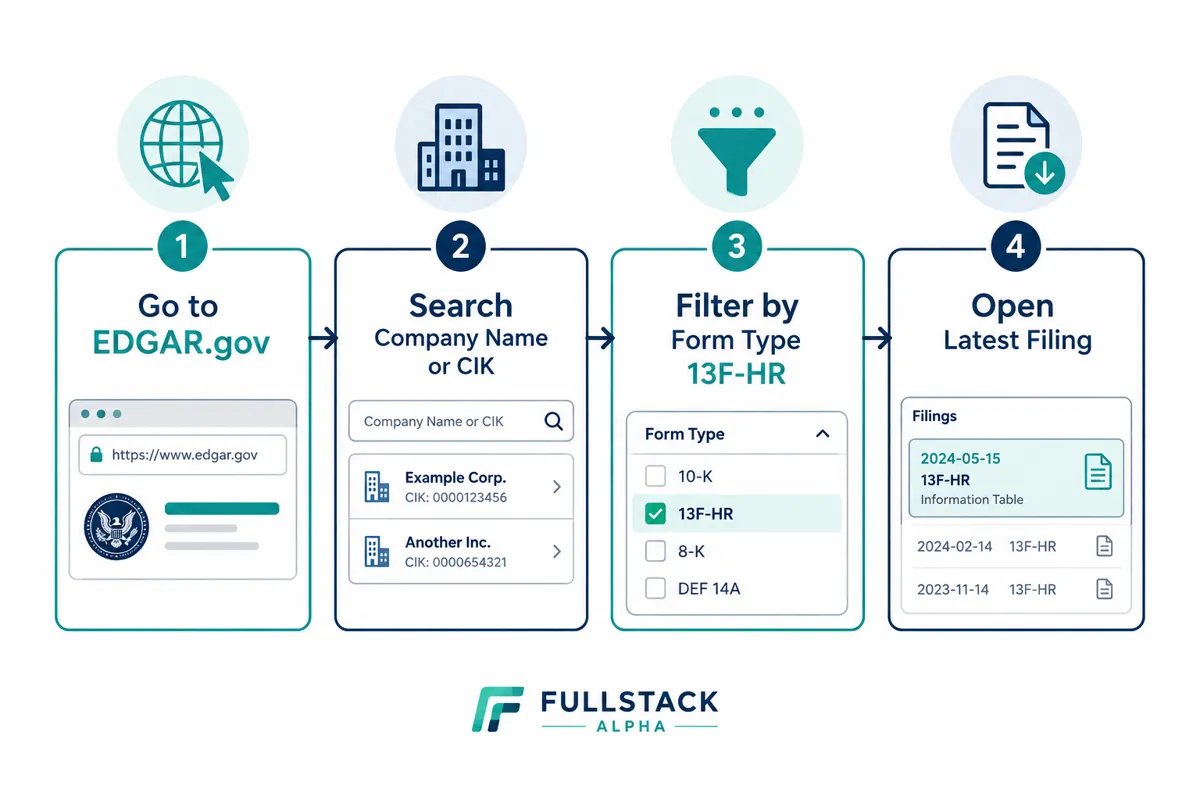
Go to efts.sec.gov, type "Berkshire Hathaway" in the company field, set the form type to 13F-HR, and hit search. On deadline day, the filing appears within minutes of SEC acceptance. No account, no subscription, no waiting for a screener to sync.
What a 13F Filing Shows, and What It Hides
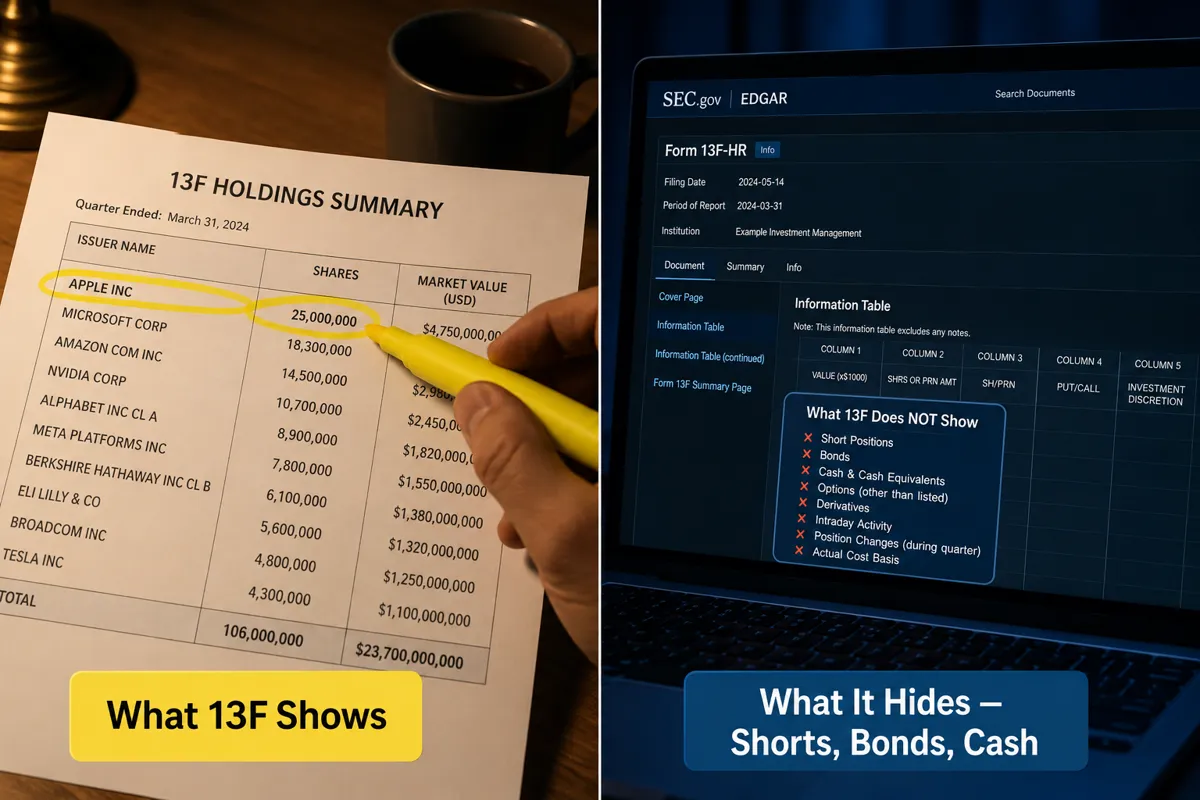
A 13F filing reports long positions in U.S. exchange-traded equities, options, and convertible notes held as of the last day of the quarter. That is it. The filing does not show short positions, bonds, cash holdings, foreign equities, or private investments. It also does not show when positions were bought or at what price.
This matters enormously. A 13F is a snapshot of what an institution held on one specific date, reported up to 45 days later. Treating it as a live portfolio is one of the most common mistakes retail investors make when reading these filings. The position you see may have been partially or fully sold by the time you read it.
The 45-Day Lag Every Headline Ignores
Under SEC Rule 13f-1, institutional managers must file Form 13F within 45 calendar days after each quarter ends. If the 45th day falls on a weekend or federal holiday, the deadline moves to the next business day. For 2026, the specific deadlines are: Q4 2025 holdings due February 17, 2026; Q1 2026 holdings due May 15, 2026; Q2 2026 holdings due August 14, 2026; and Q3 2026 holdings due November 16, 2026.
Most large managers file on or very close to the final deadline. That is intentional. Filing early reveals your hand before you have to. So the practical move is to monitor EDGAR on deadline afternoon. For Q2 2026, that means checking edgar on August 14.
Tracking Any Institution, Not Just Berkshire
The same process works for any institutional filer. Search by company name, filter for 13F-HR, sort by date. The edgar filer management system assigns every institution a unique CIK number, which you can use to build a direct bookmark. Institutions from Canada, the Cayman Islands, the British Virgin Islands, and other foreign jurisdictions that manage U.S. securities above the $100 million threshold must also file, so the database is not limited to domestic managers.
How Do You Pull Any 10-K in Under Two Minutes?
Search the company name on EDGAR, filter for form type 10-K, and click the most recent filing. The full text of the annual report, including all exhibits, loads in the browser. No account required. For context on what AI tools can do with that document once you have it, see the AI stock research tool that reads every 10-K so you don't have to.
Using EDGAR Full Text Search
EDGAR full text search, accessible at efts.sec.gov/LATEST/search-index, indexes the complete body text and exhibits of every electronic filing since 2001. You can search for a phrase like "insurance float" or "share repurchase" across all filings, or narrow by form type, date range, company name, ticker, or CIK. This is how you find every time a specific company mentioned a risk factor across multiple years, or every 8-K that referenced a particular acquisition target.
The edgar search tool supports Boolean logic and phrase matching. Searching filings full text for "Berkshire Hathaway" with form type 13F-HR and a date range of the current quarter pulls the exact document you want within seconds of it being accepted.
How to Read a 10-K Without Reading All of It
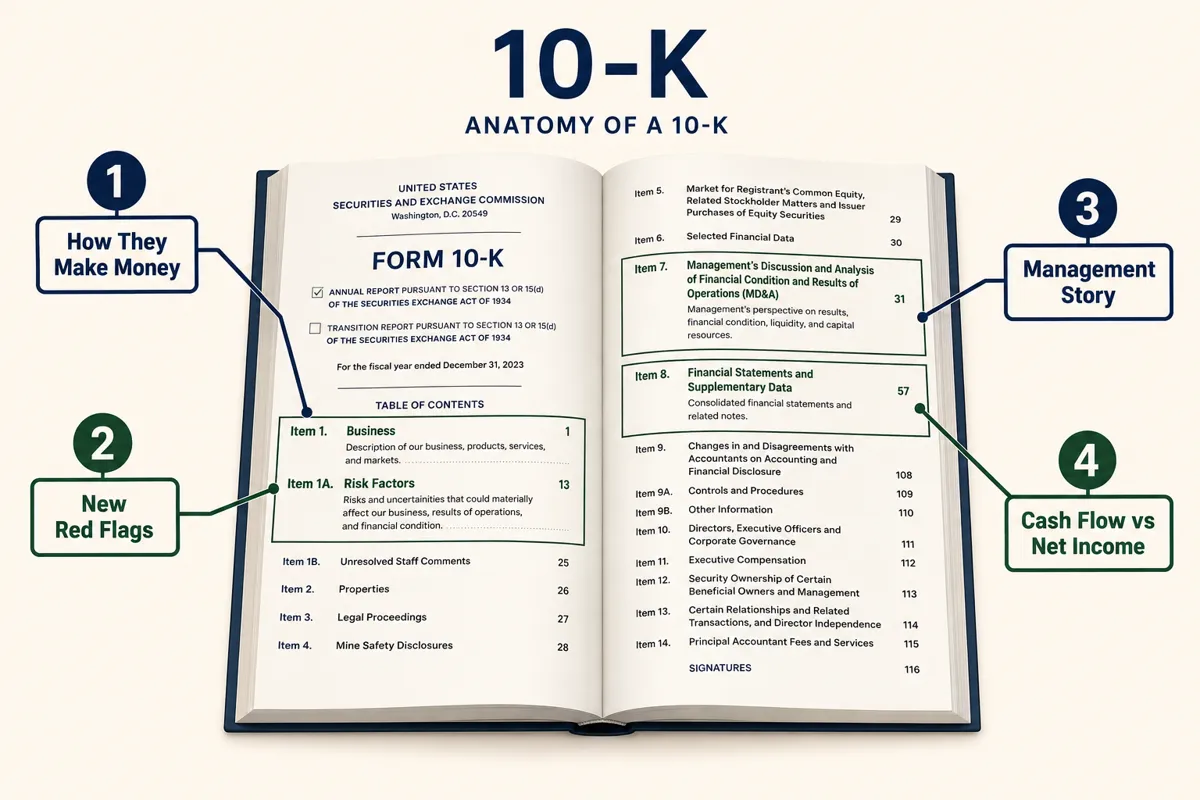
A 10-K is not a novel. It is a legal document with a predictable structure, and most of the useful information is concentrated in three sections. Start with Item 1 (Business) to understand how the company actually makes money. Move to Item 1A (Risk Factors) and read only the risks that are new or changed from the prior year filing. Spend the most time on Item 7 (MD&A, Management's Discussion and Analysis), where management explains what drove revenue, margins, and cash flow. Then check Item 8 (Financial Statements) for the cash flow statement, specifically operating cash flow versus net income. A company printing strong net income but weak operating cash flow is worth a second look.
The annual report vs 10-K distinction trips up a lot of readers. The annual report is the glossy document a company sends to shareholders, full of photos and CEO letters. The 10-K is the legally required SEC filing with audited financials and full risk disclosures. The 10-K tells the truth because it has to. The annual report tells the story the company wants you to hear.
Which SEC Filings Do Retail Investors Skip and Should Not?
Beyond the 13F and 10-K, three form types give retail investors an edge that most people leave on the table. They are all free on EDGAR, they all post in near real time, and almost nobody reads them the day they file.
SEC Form 4 Insider Trading: Who Bought With Their Own Money
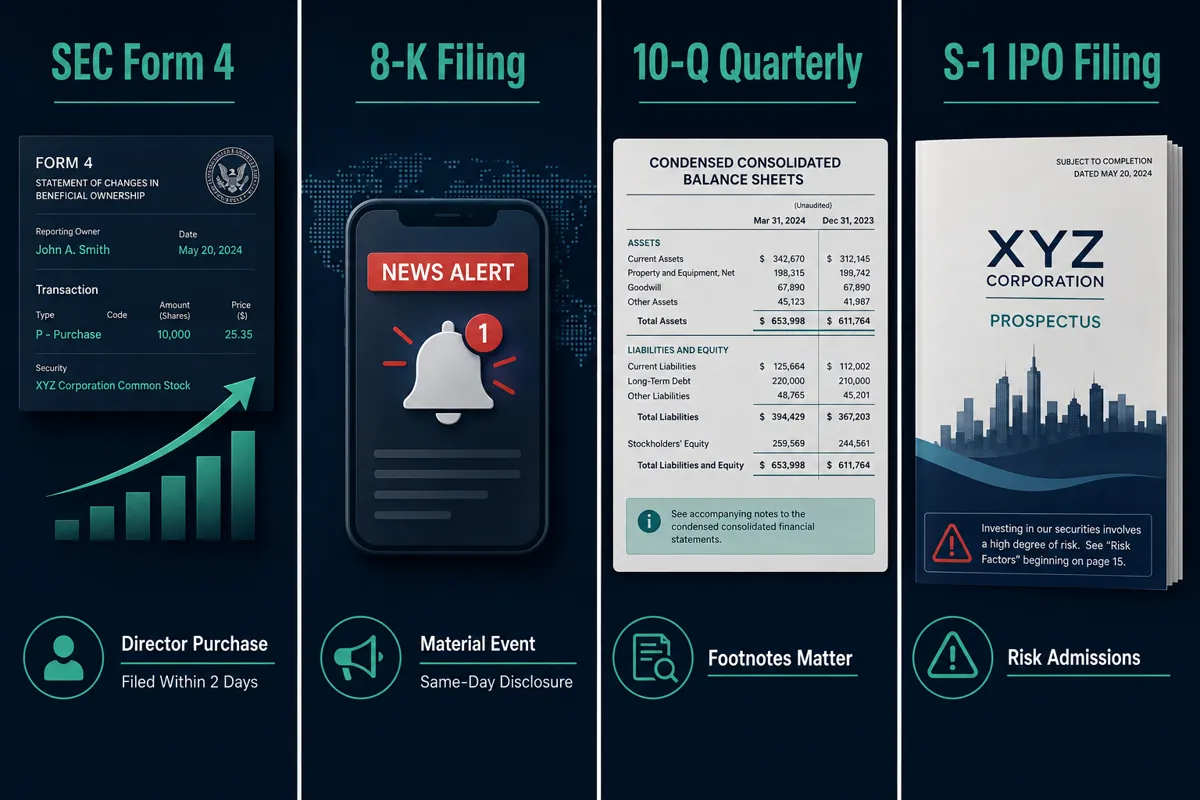
SEC Form 4 must be filed within two business days whenever a director, officer, or 10% shareholder buys or sells company stock [see SEC Form 4 guidance at sec.gov]. This is the most time-sensitive signal on EDGAR. An insider selling a small position to diversify is noise. A CEO buying $2 million of stock in the open market with their own money, right after a rough earnings quarter, is a different kind of signal. It does not guarantee anything, but it is a data point that costs nothing to check.
8-K Filing Meaning: The Events Companies Must Disclose
An 8-K is a current report that public companies must file within four business days of a material event. Material events include earnings announcements, leadership changes, acquisitions, bankruptcies, and credit agreement amendments. The 8-K filing meaning in practice is simple: it is the first official document that tells you something significant just happened at a company. Reading the 8-K before the press release summary gets filtered through a financial news site gives you the primary source, not someone else's interpretation of it.
The 10-Q and Why the Footnotes Matter
The 10-Q is the quarterly version of the 10-K, unaudited but still legally required. Most investors skim the headline numbers and move on. The footnotes are where the interesting disclosures live: changes in accounting methods, new litigation, updated guidance language, and segment-level detail that never makes it into the earnings press release. Comparing footnotes across three consecutive 10-Q filings for the same company takes about 20 minutes and surfaces changes that quarterly earnings calls rarely mention.
S-1 Filings and What a Company Admits Before an IPO
An S-1 is the registration statement a company files before going public. The risk factors section of an S-1 is where companies are legally required to disclose every material risk they can identify, because they are liable if they omit one. Reading the S-1 risk factors for a company before its IPO is the closest thing to a candid conversation with management about what could go wrong. Most retail investors skip it entirely and rely on the roadshow narrative instead.
Where Do You Find Free Earnings Call Transcripts?
EDGAR does not host earnings call audio, but it does host the 8-K filings that companies submit with their prepared remarks and sometimes the full Q&A transcript as an exhibit. For companies that file the transcript as an exhibit to their 8-K, the full text is searchable through EDGAR full text search within hours of the call ending.
Pulling Transcripts and Exhibits From EDGAR
When a company files an 8-K after an earnings call, click into the filing index page on EDGAR. The index lists every document attached to that filing. Exhibit 99.1 is typically the press release. Exhibit 99.2 is often the prepared remarks or full transcript. Not every company files the transcript, but many do, and for those that do, it is free and searchable through the edgar search interface the same day.
For companies that do not file transcripts, Fintool and similar AI-powered research tools can pull and summarize earnings call content. That is a legitimate use case for a paid tool. But check EDGAR first.
What the Transcript Adds That the Press Release Removes
The press release is what management wants you to read. The Q&A section of an earnings call is where analysts push back, ask follow-up questions, and occasionally get answers that contradict the prepared remarks. The tone shifts, the hedging language changes, and sometimes a CFO says something in response to a direct question that would never appear in a polished press release. That is the data worth reading.
How Do You Set Up SEC EDGAR Alerts and RSS Feeds?
EDGAR offers free RSS feeds for any company's filings, updated in near real time as filings are accepted. No account required. The feed URL format is straightforward: https://www.sec.gov/cgi-bin/browse-edgar?action=getcompany&CIK=[CIK_NUMBER]&type=&dateb=&owner=include&count=40&search_text=&output=atom. Plug in Berkshire's CIK (0001067983) and you have a live feed of every filing they submit. Add it to any RSS reader and you will see Berkshire's 13F the moment it posts.
Following a Single Company for Free
The EDGAR company page for any filer shows all filings sorted by date. Bookmark the page, filter by form type, and check it on deadline days. For 13F filings, the four annual deadlines are fixed and published months in advance. Set a calendar reminder for each deadline date. That is a free alert system that requires no portal, no subscription, and no app.
Using the EDGAR API for Automated Pulls
The SEC provides a public JSON API at data.sec.gov/submissions/CIK[number].json that returns a complete filing history for any filer, including the most recent submissions. This is the same data source that powers the EDGAR web interface. Developers and data-forward investors can query this endpoint programmatically to detect new 13F or 10-K filings the moment they are accepted, without ever loading the web interface. For a deeper look at what AI tools can do with this kind of automated data pull, the AI portfolio analysis breakdown covers several practical approaches.
SEC EDGAR vs Paid Screeners: Comparison Table
Most paid screeners that surface 13F data, insider filings, or SEC forms are pulling from the same EDGAR source you can access directly. Here is what the comparison actually looks like.
| Feature | SEC EDGAR | Typical Paid Screener |
|---|---|---|
| Cost | Free, always | Monthly subscription fee |
| Data Freshness | Real time on acceptance | Hours to days delay common |
| Filing Coverage | All form types since 1993 | Selected forms only |
| Ease of Use | Steep learning curve | Polished UI, faster navigation |
| Alerts | Free RSS feeds per company | Push notifications, email alerts |
| Export Options | Raw HTML, XBRL, JSON API | CSV export, formatted tables |
What You Give Up and What You Save
EDGAR wins on cost, freshness, and coverage. A paid screener wins on convenience and formatted output. If you are doing occasional research on a handful of companies, EDGAR is all you need. If you are running systematic screens across hundreds of filers every week, a tool like Alpha Spread or Wisesheets that pulls structured EDGAR data into a spreadsheet may be worth the cost. The question is whether you are paying for genuine analysis or paying for a slightly nicer wrapper around public data.
For a direct comparison of screener value, the Stock Rover vs Finviz breakdown covers exactly that question.

FullStack Alpha tool
EDGAR Filing Finder
EDGAR holds the best free research in America behind one of its worst interfaces. Type a ticker or company name and get direct links to the filings that matter, no navigation required.
Institutional 13F holdings are filed by the manager, so search the firm name for those.
Links open EDGAR full-text and company search directly. Filings are the primary source, so what you read there is what the company actually told the SEC.
Frequently Asked Questions
What is SEC and EDGAR?
The SEC (Securities and Exchange Commission) is the U.S. federal agency that regulates securities markets and enforces disclosure laws. EDGAR (Electronic Data Gathering, Analysis, and Retrieval) is the SEC's public filing database where companies, institutional investors, and insiders are legally required to submit financial disclosures. Both are operated by the United States government and accessible free at sec.gov.
Is SEC EDGAR free to use?
Yes. SEC EDGAR is completely free to search, view, and download. No account, no registration, and no subscription is required to access any filing. The public dissemination service (PDS) makes every accepted filing available to anyone with an internet connection, typically within minutes of acceptance.
How to access SEC EDGAR?
Go to sec.gov and click "Search Filings" in the main navigation, or go directly to efts.sec.gov for full text search. Type a company name, ticker, or CIK number to pull up its filing history. No login required. The edgar filer management portal is only needed by those who submit filings, not those who read them.
What is an EDGAR submission?
An EDGAR submission is any document or set of documents that a filer submits to the SEC through the EDGAR filing system. Submissions include annual reports (10-K), quarterly reports (10-Q), current event reports (8-K), insider transaction reports (Form 4), institutional holdings reports (13F), and hundreds of other form types. Each submission receives a unique accession number and is publicly available immediately after acceptance.
How often is SEC EDGAR updated with new filings?
EDGAR updates in near real time. Once the SEC accepts a filing, it typically appears in the edgar search results within minutes. The RSS feeds update on the same schedule. There is no batch processing delay for public access.
How do you search SEC EDGAR by company name or ticker?
Go to the EDGAR company search at sec.gov/cgi-bin/browse-edgar. Enter the company name or ticker in the search field. Filter by form type (for example, 13F-HR or 10-K) to narrow results. You can also search by CIK number for a direct match. The edgar search results show every filing that company has submitted, sorted by date.
What is a 13F filing and when is it due?
A 13F is a quarterly holdings report that institutional investment managers with over $100 million in 13(f) securities must file with the SEC. It discloses long positions in U.S. equities and certain other instruments as of the last day of the quarter. The filing deadline is 45 calendar days after each quarter ends, adjusted for weekends and holidays. For 2026, the deadlines are February 17, May 15, August 14, and November 16.
Where can I get free earnings call transcripts?
Check the 8-K filing index on EDGAR for the company immediately after an earnings call. Many companies attach the prepared remarks or full transcript as Exhibit 99.2. For companies that do not file transcripts, the SEC's EDGAR full text search can surface any filed exhibits containing earnings language. Some companies also post transcripts on their investor relations pages.
What does an 8-K filing mean for a stock?
An 8-K is a current report that public companies must file within four business days of a material event. Material events include earnings releases, CEO changes, acquisitions, credit agreement amendments, and bankruptcy filings. An 8-K is the first official primary source document for any significant company development, and reading it directly on EDGAR gives you the unfiltered disclosure before financial media summarizes or interprets it.
How do I read a 10-K if I am not an accountant?
Focus on four sections in this order: Item 1 (Business) for how the company makes money, Item 1A (Risk Factors) for new or changed risks compared to the prior year, Item 7 (MD&A) for management's explanation of financial results, and Item 8 (Financial Statements) for operating cash flow versus net income. Skip the boilerplate legal language. The MD&A and risk factors sections carry the most decision-relevant information and are written in plain English, not accounting jargon.
Can I set up alerts for SEC Form 4 insider trading?
Yes, through EDGAR's free RSS feeds. The feed URL for Form 4 filings by a specific company uses the company's CIK number and the form type parameter set to 4. Add it to any RSS reader for real-time alerts. You can also use the EDGAR full text search to run periodic searches for Form 4 filings by a specific company name or CIK within a recent date range.
Final Verdict: The Free Database Worth Learning
SEC EDGAR is not glamorous. The interface has not won any design awards, and it will not send you a push notification with a green arrow. What it does is give every retail investor access to the same primary source documents that institutional analysts read, on the same day they are filed, at no cost.
The 13F workflow is the clearest example. On August 14, 2026, Berkshire Hathaway's Q2 holdings report will post on EDGAR. You can read it that afternoon, for free, before any screener has finished syncing its database. The 45-day lag is real and must be respected. But reading the primary source the day it files is still better than reading a summary two days later.
Systems over hacks. The edgar system has been public since 1996. The investors who use it consistently are not the ones paying $50 a month for a prettier version of the same data.
One tool that builds on this kind of primary source research: MarketReader surfaces the context behind price moves, which pairs well with what you find in 8-K and 10-Q filings.
One tool that builds on EDGAR research, or 200 more to compare it against. The FullStack Alpha directory catalogs 200+ AI stock tools by category and price, so you can see what the same money buys elsewhere.
Browse the directory at aistockpickerapps.com
Disclosure: FullStack Alpha may earn a commission from affiliate links in this article. This does not affect editorial independence or the accuracy of the information provided.
References
Frequently Asked Questions About Form 13F - https://www.sec.gov/rules-regulations/staff-guidance/division-investment-management-frequently-asked-questions/frequently-asked-questions-about-form-13f
Form 13F - https://www.sec.gov/files/form13f.pdf
13F Filing Calendar - https://13finsight.com/calendar
2026 Annual And Periodic Reporting Compliance For Investment Managers - https://www.daypitney.com/2026-annual-and-periodic-reporting-compliance-for-investment-managers
13F Filing Deadlines - https://filingsflow.com/guides/13f-filing-deadlines
13F Filing Deadlines 2026 - https://superinvestordb.com/learn/13f-filing-deadlines-2026
Form 13F Filing Deadlines 2026 - https://file13f.com/form-13f-filing-deadlines-2026
13F Filing Deadlines 2026: Every Date, Rule, and Trap - https://www.finrep.ai/blog/13f-filing-deadlines-2026-every-date-rule-and-trap
EDGAR Solutions - 13F Filing Services - https://edgarsolutions.com/services/edgar-filings/13f/